Low-loader trailers and abnormal loads: indivisible loads, permits and categories
A vehicle carrying an indivisible load may exceed EU dimension limits only on a special permit or case-by-case arrangement. What EU, German and British law require, and Britain's weight categories.
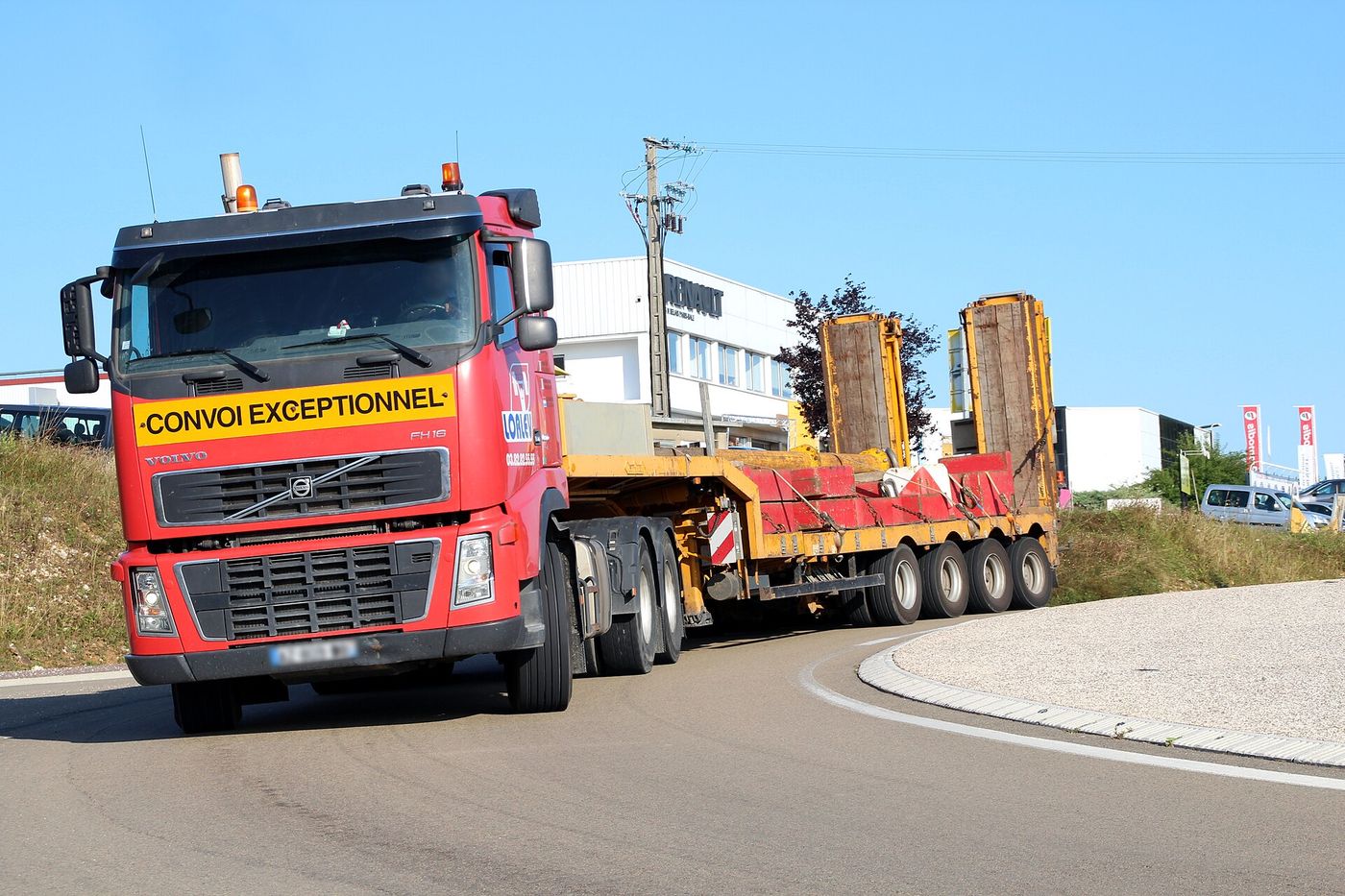
A low-loader is a trailer that carries machinery and other heavy or tall cargo on a low loading deck, built for what Nooteboom, one of its makers, calls “heavy and exceptional transport”. When a load cannot be divided without undue expense or risk of damage and is too large or too heavy for a vehicle within the standard limits, EU law calls it an indivisible load and British law an abnormal indivisible load. Under Article 4(3) of Council Directive 96/53/EC, vehicles that exceed the maximum dimensions may circulate only on special permits issued without discrimination by the competent authorities, or on similar case-by-case arrangements, where they carry or are intended to carry indivisible loads. In Germany, § 29(3) of the Straßenverkehrs-Ordnung requires a permit when dimensions, axle loads or total masses actually exceed the limits the law generally allows. In Great Britain, the Road Vehicles (Authorisation of Special Types) (General) Order 2003, the Special Types Order, in force since 25 August 2003, sorts abnormal indivisible load vehicles into three weight categories up to 150,000 kg, with notice, speed and size rules attached.
Status as at 27 October 2026. Read on that day: Council Directive 96/53/EC in its Official Journal text of 1996 and its consolidated text of 14 August 2019; § 29 of the Straßenverkehrs-Ordnung (StVO) and § 70 of the Straßenverkehrs-Zulassungs-Ordnung (StVZO) on the Federal Ministry of Justice’s Gesetze im Internet; the Special Types Order of 2003 as made and, for its Parts 1, 2 and 4 and Schedules 1, 5, 6, 7 and 9, the latest revised text on legislation.gov.uk, which listed no known outstanding effects for those parts; and the English websites of Broshuis, Faymonville and Nooteboom. No official text was read for France or Türkiye.
What counts as an indivisible load
Article 2 of Directive 96/53/EC defines the term. An indivisible load is “a load that cannot, for the purpose of carriage by road, be divided into two or more loads without undue expense or risk of damage and which owing to its dimensions or mass cannot be carried by a motor vehicle, trailer, road train or articulated vehicle complying with this Directive in all respects”. The definition joins two conditions with “and”: the load cannot be split without undue expense or risk of damage, and in one piece it is too large or too heavy for a vehicle within the Directive’s limits. Recital 9 gives the reason for clarifying the concept: to “ensure uniform application of this Directive in respect of permits for vehicles or vehicle combinations carrying such loads”.
The British definition has the same two elements. In the Special Types Order an abnormal indivisible load is “a load that cannot without undue expense or risk of damage be divided into two or more loads for the purpose of being carried on a road” and that, on account of its length, width or height, cannot be carried on a motor vehicle of category N3 or a trailer of category O4, or a combination of them, complying in all respects with Part 2 of the Road Vehicles (Construction and Use) Regulations 1986, or on account of its weight cannot be carried on one that also complies with the Road Vehicles (Authorised Weight) Regulations 1998 (Schedule 1, paragraph 2). The Order describes N3 as “motor vehicles over 12,000 kilograms maximum weight” and O4 as “trailers over 10,000 kilograms maximum weight” (article 3(1)); the categories are set out in vehicle categories M, N and O.
The EU rule: special permits above the maximum dimensions
Article 4(3) of the Directive reads in part: vehicles or vehicle combinations “which exceed the maximum dimensions may only be allowed to circulate on the basis of special permits issued without discrimination by the competent authorities”. The alternative is “similar non-discriminatory arrangements agreed on a case-by-case basis with those authorities”, and both apply “where these vehicles or vehicle combinations carry or are intended to carry indivisible loads”. The maximum dimensions are those laid down in Annex I (Article 2); Annex I and the rest of Article 4 are set out in semi-trailer dimensions, and the Annex I weights in gross vehicle and combination weights.
The definition of an indivisible load covers both “dimensions or mass”; Article 4(3) is worded for vehicles that exceed the maximum dimensions. It refers to “the competent authorities” without naming them. Article 7 adds that the Directive “shall not preclude the application of road traffic provisions in force in each Member State which permit the weight and/or dimensions of vehicles on certain roads or civil engineering structures to be limited”, whatever the state in which the vehicle is registered or was put into circulation.
Permit rules by country
| Country | Legal basis | What it requires | Source |
|---|---|---|---|
| Germany | StVO § 29(3); StVZO § 70 | A permit (Erlaubnis) for traffic with vehicles and combinations whose dimensions, axle loads or total masses actually exceed the limits generally allowed by law; exceptions under § 70 StVZO, for example from §§ 32, 32d, 33, 34 and 36 by the higher administrative authorities, after hearing the highest road construction authorities of the Länder, with a set local area of validity and, for an exception granted for a vehicle, a document carried on journeys | Gesetze im Internet, § 29 StVO and § 70 StVZO |
| Great Britain | Road Vehicles (Authorisation of Special Types) (General) Order 2003 | Abnormal indivisible load vehicles in three weight categories up to 150,000 kg; notice to the police and to road and bridge authorities, attendants, and the Secretary of State’s consent above 5 m width; at most 6.1 m wide and 30 m long | legislation.gov.uk, latest revised text |
| France | Not verified | ||
| Türkiye | Not verified | ||
Germany: § 29 StVO and § 70 StVZO
Section 29 of the Straßenverkehrs-Ordnung is headed “Übermäßige Straßenbenutzung”, excessive use of the road. Its paragraph 3 reads: “Einer Erlaubnis bedarf der Verkehr mit Fahrzeugen und Zügen, deren Abmessungen, Achslasten oder Gesamtmassen die gesetzlich allgemein zugelassenen Grenzen tatsächlich überschreiten.” In English: traffic with vehicles and vehicle combinations whose dimensions, axle loads or total masses actually exceed the limits generally allowed by law requires a permit, an Erlaubnis. The same applies to traffic with vehicles whose design does not leave the driver an adequate field of view.
Exceptions from the Straßenverkehrs-Zulassungs-Ordnung are dealt with in its § 70, headed “Ausnahmen”. The higher administrative authorities (höhere Verwaltungsbehörden) may grant exceptions from §§ 32, 32d, 33, 34 and 36, among other provisions, in specific individual cases or generally for specific individual applicants (paragraph 1, no. 1). The competent highest Land authorities, or the bodies they designate or that Land law makes competent, may grant exceptions from all of its provisions in the same way; where an exception has significant effects on the territory of other Länder, the decision is taken in agreement with their competent authorities (no. 2). Before an exception from §§ 32, 32d, 33, 34, 34b or 36 is granted, the highest road construction authorities of the Länder and, where still necessary, the bodies responsible for the roads (Träger der Straßenbaulast) must be heard (paragraph 2). The local area of validity of every exception has to be set (paragraph 3). An exception from the construction or operating rules granted for a vehicle by administrative act is proven by a document that the driver carries on journeys and hands to the competent persons for inspection on request (paragraph 3a). Under paragraph 5 the Land governments may, by regulation, make other authorities competent in place of the higher administrative authorities and of the highest road construction authorities.
Great Britain: the Special Types Order
Which vehicles it covers
The Order extends to England, Wales and Scotland and has been in force since 25 August 2003. It applies only to motor vehicles or trailers that do not comply in all respects with the standard construction and use requirements and that fall within a “recognised category of special vehicles” (article 8(1)). Such a vehicle is authorised to be used on roads “if (but only if)” it complies with the authorisation requirements of its category (article 9(1)). Abnormal indivisible load vehicles, AILVs in the Order’s abbreviation, are one of the four categories of Part 2, with mobile cranes, engineering plant and road recovery vehicles (article 10(1)).
An AILV is a vehicle of one of four descriptions (Schedule 1, paragraph 3): a motor vehicle of category N3, or a trailer of category O4, “specially designed and constructed for the carriage of abnormal indivisible loads”; a locomotive specially designed and constructed to tow such trailers; or an N3 motor vehicle that is not constructed to carry a load itself but is specially designed and constructed to tow them. An AILV “must not be used on roads for, or in connection with, the carriage of any load that may safely be carried on a vehicle (or vehicle-combination) that complies in all respects with the Construction and Use Regulations and the Authorised Weight Regulations” (paragraph 16), and the N3 and O4 kinds may be used only for the carriage of an abnormal indivisible load or a load of exceptional width (paragraph 17(1)). “An AILV or AILV-combination may carry only one abnormal indivisible load at any one time” (paragraph 20(1)), subject to exceptions for loads of the same character in Categories 1 and 2 and for engineering plant carried with its detached parts (paragraphs 21 to 23).
Three weight categories
Schedule 1 sorts AILVs and AILV-combinations into three categories by weight (paragraph 4). A vehicle within the Category 1 restrictions is in Category 1; one that is not, but is within those of Category 2, is in Category 2; Category 3 takes the rest, and no AILV may exceed the Category 3 restrictions (paragraph 26).
| Category | Maximum total weight | Axles | Maximum axle weight | Speed limit: motorway / dual carriageway / other roads |
|---|---|---|---|---|
| 1 | 46,000 kg for a combination, or 50,000 kg with at least 6 axles; a single AILV within its limit under the Authorised Weight Regulations | 5 or more | As in Schedule 3 to the Authorised Weight Regulations | 60 / 50 / 40 mph |
| 2 | 80,000 kg, and not more than D × 7,500 kg | 6 or more, at least 1 m apart | 12,000 kg where adjacent axles are less than 1.35 m apart, 12,500 kg at 1.35 m or more | 40 / 35 / 30 mph |
| 3 | 150,000 kg, and not more than D × 12,500 kg | 6 or more, at least 1 m apart | 15,000 kg where adjacent axles are less than 1.35 m apart, 16,500 kg at 1.35 m or more | 40 / 35 / 30 mph |
The 50,000 kg allowance in Category 1 also requires the combination to comply in all other respects with the Authorised Weight Regulations as they apply to a vehicle or combination of 44,000 kg (paragraph 28(3)). The wheel weight limits are 6,000 kg and 6,250 kg in Category 2 and 7,500 kg and 8,250 kg in Category 3, for the same two axle spacings. Groups of closely spaced axles have their own ceilings: 50,000 kg for a group in Category 2, and 90,000 kg or 100,000 kg in Category 3, depending on the spacing within the group (paragraphs 31(5) and 33(5) and (6)).
Categories 2 and 3 add a plate. Such an AILV, unless manufactured before 29 July 1983, carries a plate marked “SPECIAL TYPES USE” that gives, for 20, 25, 30, 35 and 40 mph, the maximum weights at which in the manufacturer’s opinion it may be used at or below that speed (paragraph 13). It must not exceed the weights on the plate for the speed at which it is travelling, nor any speed specified on the plate (paragraphs 27(2) and 34(1)). Every AILV or AILV-combination is fitted with a sign showing its category, mounted on the front in white letters on a black background, or with a sign approved for vehicles carrying loads of exceptional dimensions by the authority of another EEA state or of a member country of the United Nations Economic Commission for Europe (paragraph 15). The speeds in the table are ceilings: nothing in the Schedule authorises travel above a speed restriction imposed under any other enactment (paragraph 34(3)).
Notice, attendants and consent
| Trigger | Requirement | Article |
|---|---|---|
| Overall length of a single rigid unit with any load projection over 18.75 m, or of the vehicle combination over 25.9 m | Notice to the police; one or more attendants | 12 |
| Forward or rearward projection of the load over 3.05 m | Notice to the police | 13 |
| Forward projection over 2 m, or rearward projection over 3.05 m | One or more attendants | 14 |
| Width with the load over 3 m, or a lateral projection over 305 mm | Notice to the police | 15(3) |
| Width with the load over 3.5 m | One or more attendants | 15(4) |
| Width with the load over 5 m | Written consent of the Secretary of State | 15(5) |
| Total weight over 44,000 kg, or axle weights outside Schedule 3 to the Authorised Weight Regulations | Notice to the authority for each road and bridge to be used, and an indemnity to each | 17(1) and (2) |
| Total weight over 80,000 kg | Notice to the police | 17(3) and (4) |
Articles 15 and 17 each state that their requirements apply cumulatively. Notices are given before the start of any journey. A notice to the police must be received “before the beginning of the period of two days which ends immediately before the date of use” (Schedule 5, paragraph 2(3)). A notice to road and bridge authorities follows the same two-day rule, or a five-day one where the gross weight exceeds 80,000 kilograms (Schedule 9, paragraph 2(2) and (3)). Where the Order requires something to be done within a specified number of days, Saturdays, Sundays and public holidays in any part of Great Britain are not counted (article 3(3)), and the police and the authorities may accept shorter notice. A police notice states, among other details, the time, date and route of the journey, a description and profile of the load, the overall length, width and maximum height, the gross weight, and all axle weights and axle spacings (Schedule 5, paragraph 4). The vehicle is then used in accordance with it, subject to police directions on time, date or route (paragraphs 5 and 6).
An attendant must have appropriate training or experience and must be additional to the person driving; where three or more vehicles travel together in convoy, only the foremost and rearmost have to be accompanied by one (Schedule 6, paragraphs 2 and 4). An application for the Secretary of State’s consent is made in writing and, for an abnormal indivisible load, includes among other details the “implications of dividing the load” and the “approximate cost of any alternative to road movement that has been considered” (Schedule 7, paragraph 1); the written consent is carried in the vehicle throughout the journey (paragraph 2). On bridges, the driver of a Part 2 vehicle must not take it onto a bridge if the driver knows, or could reasonably be expected to ascertain, that another such vehicle is already on it, and must not let it stand on a bridge except in circumstances beyond the driver’s control (article 18).
Width, length and loads of exceptional width
No AILV may be wider than 6.1 metres with any lateral projection of its load (Schedule 1, paragraph 24), and an AILV or AILV-combination used to carry an abnormal indivisible load may not exceed 30 metres in length (paragraph 25(1)). How that length is measured depends on where the load rests: on the motor vehicle alone, on the trailer alone, on a motor vehicle and trailer together, or on several vehicles, in which case the distances between them count as well (paragraph 25(3) to (6)).
A separate category in Part 4 of the Order covers vehicles carrying a load of exceptional width, which it defines as an overall width with the load of more than 4.3 metres (article 28(2)). Such a vehicle may be at most 6.1 metres wide with its load; its speed limits are 40 mph on a motorway, 35 mph on a dual carriageway and 30 mph on other roads; notice to the police and attendants are required in every case, and above 5 metres the Secretary of State’s written consent (articles 30 and 31).
The vehicles: low-loaders, extendables, dollies and modules
Nooteboom’s range includes EURO and EURO-PX low-loaders and OSD(S), MCO(S) and MANOOVR MPL semi low-loaders. It launched the EURO-PX in 2005 with what it calls “Pendel-X technology combined with excavator trough”, introduced a third generation, the EURO-PX3, in 2025, redesigning the programme “with hydraulically steered swing axles”, and offers the Interdolly and the Jeepdolly to increase the payload capacity of a low-loader combination. Broshuis lists semi low loaders with a fixed or movable neck, up to three times extendable and with 3 to 8 axles, offered with wheel wells, a crane arm recess, hydraulic ramps and a two- or three-axle dolly as options, at up to 115 t load capacity; its low loaders come as dolly low-loader combinations of 1 to 8 axles, extendable once or twice, with an outer or central beam, at up to 85 t. Faymonville lists low loaders, lowbed trailers, flatbed trailers, self-steering trailers, inloaders and modular vehicles, and its group page lists brands for “Special trailers using a modular structure for payloads from 15 t to 123 t” and “SPMT and industrial vehicles for payloads up to 25,000 t and beyond”.
A low-loader can also be built to the standard dimensions. Nooteboom’s two-axle EURO-PX3, model EURO-47-02(P3), which its November 2025 release announced for a first showing at Solutrans in Lyon from 18 to 22 November 2025, is described there in these words: “Retracted, the vehicle is within legal dimensions, meaning no special permit is required to operate this trailer.” Nooteboom gives it as no longer than 12 metres from kingpin to bumper and no wider than 2.55 metres, with a total load capacity of 33 tons at 80 km/h and a technical axle load of 12 tons per axle line at 80 km per hour; fully extended, it can carry a 40-foot container on the low bed. The low-loader’s place among the other semi-trailer bodies, with Nooteboom’s semi low-loader figures, is covered in trailer types.
British law provides for modular combinations. Where an AILV-combination consists of two or more modules, each module may carry its own plate if the information for the AILV as a whole can be readily determined from the individual plates (Schedule 1, paragraph 14). When such a combination is being used in connection with an abnormal indivisible load but is not carrying it, the modules may be disassembled so that one part carries any other (paragraph 19). The towing vehicle can itself be an AILV, as an N3 motor vehicle built to tow AILV trailers rather than to carry a load (paragraph 3(d)); how a truck’s axle layout is written, from 4×2 to 8×4, is explained in axle configurations.
Quick answers
- What is an indivisible load?
- In Article 2 of Council Directive 96/53/EC, a load that cannot, for carriage by road, be divided into two or more loads without undue expense or risk of damage and which, owing to its dimensions or mass, cannot be carried by a motor vehicle, trailer, road train or articulated vehicle complying with the Directive in all respects. Great Britain's Road Vehicles (Authorisation of Special Types) (General) Order 2003 defines an 'abnormal indivisible load' with the same two elements, measured against an N3 motor vehicle or O4 trailer that complies with the Construction and Use and Authorised Weight Regulations.
- When does an abnormal load need a special permit in the EU?
- Under Article 4(3) of Directive 96/53/EC, vehicles or vehicle combinations that exceed the maximum dimensions may circulate only on special permits issued without discrimination by the competent authorities, or on similar non-discriminatory arrangements agreed case by case with them, where they carry or are intended to carry indivisible loads. The maximum dimensions are those of Annex I to the Directive. Article 7 does not preclude national road traffic provisions that permit the weight or dimensions of vehicles on certain roads or civil engineering structures to be limited.
- What permit does an abnormal load need in Germany?
- Under § 29(3) of the Straßenverkehrs-Ordnung, traffic with vehicles and combinations whose dimensions, axle loads or total masses actually exceed the limits generally allowed by law requires a permit (Erlaubnis). Exceptions from the Straßenverkehrs-Zulassungs-Ordnung are granted under its § 70, for example by the higher administrative authorities from §§ 32, 32d, 33, 34 and 36; the highest road construction authorities of the Länder are heard first, each exception has a set local area of validity, and an exception granted for a vehicle by administrative act is proven by a document carried on journeys.
- What are Categories 1, 2 and 3 for abnormal loads in Great Britain?
- They are the weight categories of abnormal indivisible load vehicles in Schedule 1 to the Road Vehicles (Authorisation of Special Types) (General) Order 2003. In Category 1 the load-carrying vehicles of a combination may weigh up to 46,000 kg, or up to 50,000 kg with at least six axles, and the weight goes to the road through five or more axles. Category 2 allows up to 80,000 kg and Category 3 up to 150,000 kg, each on six or more axles and each also limited to D × 7,500 kg or D × 12,500 kg, D being the distance in metres from the foremost axle or kingpin to the rearmost load-carrying axle. Speed limits are 60, 50 and 40 mph for Category 1 and 40, 35 and 30 mph for Categories 2 and 3 on motorways, dual carriageways and other roads.
- How much notice does an abnormal load need in Great Britain?
- Under the Road Vehicles (Authorisation of Special Types) (General) Order 2003, a notice to the police must be received before the beginning of the two days that end immediately before the date of use. Road and bridge authorities need two days as well, or five days where the gross weight exceeds 80,000 kg. Where the Order requires something to be done within a specified number of days, Saturdays, Sundays and public holidays are not counted, and the police and the authorities may accept shorter notice. Road and bridge authorities are notified, and given an indemnity, above 44,000 kg total weight; the police above 80,000 kg and above set lengths, projections and widths; above 5 metres width the Secretary of State's written consent is required.
Sources
- Council Directive 96/53/EC of 25 July 1996 laying down for certain road vehicles circulating within the Community the maximum authorized dimensions in national and international traffic and the maximum authorized weights in international traffic — Official Journal text (OJ L 235, 17.9.1996): recital 9, Articles 2 and 4(3) — EUR-Lex, European Union, 25 Jul 1996
- Council Directive 96/53/EC — consolidated text of 14 August 2019: Articles 2, 4(3) and 7 — EUR-Lex, European Union
- Straßenverkehrs-Ordnung (StVO), § 29 Übermäßige Straßenbenutzung — Bundesministerium der Justiz (gesetze-im-internet.de)
- Straßenverkehrs-Zulassungs-Ordnung (StVZO), § 70 Ausnahmen — Bundesministerium der Justiz (gesetze-im-internet.de)
- The Road Vehicles (Authorisation of Special Types) (General) Order 2003 (SI 2003/1998), as made on 4 August 2003 — legislation.gov.uk (The National Archives), 4 Aug 2003
- The Road Vehicles (Authorisation of Special Types) (General) Order 2003 — Part 1, articles 1, 3, 8 and 9, latest available revised text, read on 27 October 2026 — legislation.gov.uk (The National Archives)
- The Road Vehicles (Authorisation of Special Types) (General) Order 2003 — Part 2, articles 10 to 18, latest available revised text, read on 27 October 2026 — legislation.gov.uk (The National Archives)
- The Road Vehicles (Authorisation of Special Types) (General) Order 2003 — Part 4, articles 28 to 31 (loads of exceptional width), latest available revised text, read on 27 October 2026 — legislation.gov.uk (The National Archives)
- The Road Vehicles (Authorisation of Special Types) (General) Order 2003 — Schedule 1, abnormal indivisible load vehicles, latest available revised text, read on 27 October 2026 — legislation.gov.uk (The National Archives)
- The Road Vehicles (Authorisation of Special Types) (General) Order 2003 — Schedule 5, notices to police, latest available revised text, read on 27 October 2026 — legislation.gov.uk (The National Archives)
- The Road Vehicles (Authorisation of Special Types) (General) Order 2003 — Schedule 6, attendants, latest available revised text, read on 27 October 2026 — legislation.gov.uk (The National Archives)
- The Road Vehicles (Authorisation of Special Types) (General) Order 2003 — Schedule 7, notices to Secretary of State, latest available revised text, read on 27 October 2026 — legislation.gov.uk (The National Archives)
- The Road Vehicles (Authorisation of Special Types) (General) Order 2003 — Schedule 9, road and bridge authorities, latest available revised text, read on 27 October 2026 — legislation.gov.uk (The National Archives)
- Nooteboom Trailers, English website as served on 27 October 2026: trailer range and the news item 'Nooteboom introduces the 2-axle EURO-PX3 at Solutrans in Lyon' (November 2025) — Nooteboom Trailers B.V.
- Broshuis, English home page as read on 27 October 2026: semi low loaders, low loaders and flat trailers — Broshuis B.V.
- Faymonville, English home page as read on 27 October 2026: group brands and product range — Faymonville