Spray-suppression systems on trucks and trailers: mudguards, rain flaps, outer valances and devices in EU 2021/535
Mudguards, rain flaps and outer valances on EU trucks and trailers: who needs them under Annex VIII of Regulation 2021/535, the dimensions, the A and S device marks and the roadworthiness test.
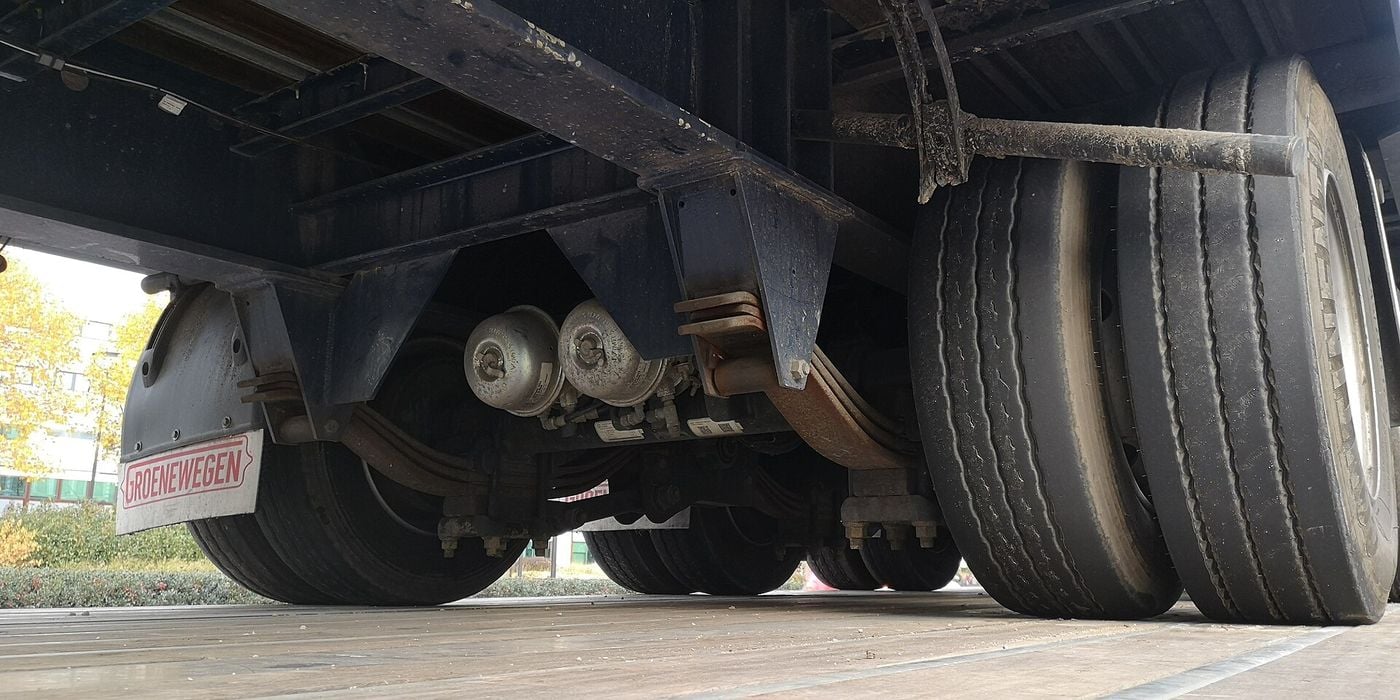
A spray-suppression system is, in the words of Article 2(18) of Commission Implementing Regulation (EU) 2021/535, “a system that reduces the pulverization of water thrown upwards by the tyres of a vehicle in motion”, made up of a mudguard, rain flaps and valances equipped with a spray-suppression device. Annex VIII of that Regulation requires vehicles of categories N and O, goods vehicles and trailers, to be constructed or fitted with one, with the exception of off-road vehicles. Regulation (EU) 2019/2144 lists the requirement in its Annex II as row F10, for categories N1, N2, N3, O1, O2, O3 and O4 and for separate technical units, with note A: registration of non-compliant vehicles prohibited from 6 July 2022. Buses, coaches and cars, categories M1, M2 and M3, have no entry in that row. Both Regulations have applied since 6 July 2022. For vehicles in use, Directive 2014/45/EU lists mudguards and spray-suppression devices among the items of the periodic roadworthiness test.
Status as at 14 November 2026. Read on that day from the Publications Office of the European Union: Implementing Regulation (EU) 2021/535 in its Official Journal text and in its consolidated text of 1 January 2025, with the Official Journal text of Annex VIII also in German, French, Italian, Spanish and Polish; Regulation (EU) 2019/2144 in its consolidated text of 2 August 2026; Commission Regulation (EU) No 109/2011; and Directive 2014/45/EU in its Official Journal text and its consolidated text of 20 May 2023. Those consolidated texts were the latest the Publications Office listed for the three acts on that day. National rules were not read.
What the parts are
Article 2(19) defines the spray-suppression device as the “part of the spray suppression system, which may comprise an air/water separator and an energy absorber”. Annex VIII, Part 2, point 1 defines the components:
- Mudguard (point 1.1): “a rigid or semi-rigid component intended to trap the water thrown up by tyres in motion and to direct it towards the ground”. It may be wholly or partly part of the bodywork or of other parts of the vehicle, such as the lower part of the load platform.
- Rain flap (point 1.2): “a flexible component mounted vertically behind the wheel”, on the lower part of the chassis or the loading surface or on the mudguard, which reduces the risk of small objects, “in particular pebbles”, being picked up by the tyres and thrown upwards or sideward towards other road users.
- Outer valance (point 1.5): a component located approximately in a vertical plane parallel to the longitudinal plane of the vehicle, which may be part of a mudguard or of the bodywork.
- Energy absorber (point 1.4): a component of the mudguard, valance or rain flap “which absorbs the energy of water spray”.
- Air/water separator (point 1.3): a component of the valance or rain flap “through which air can pass whilst reducing pulverized water emissions”.
Neither Implementing Regulation (EU) 2021/535 nor Regulation (EU) No 109/2011 nor Directive 2014/45/EU uses the term mud flap. The language versions of the same Regulation name the parts as follows.
| English | German | French | Italian | Spanish | Polish |
|---|---|---|---|---|---|
| spray suppression system | Spritzschutzsystem | système antiprojections | sistema antispruzzi | sistema antiproyección | osłona przeciwrozbryzgowa kół |
| spray suppression device | Spritzschutzvorrichtung | dispositif antiprojections | dispositivo antispruzzi | dispositivo antiproyección | urządzenie przeciwrozbryzgowe kół |
| mudguard | Schutzblech | garde-boue | parafango | guardabarros | błotnik |
| rain flap | Schmutzfänger | bavette | paraspruzzi | faldilla posterior | fartuch przeciwdeszczowy |
| outer valance | Schürze | jupe extérieure | bordo esterno | faldilla exterior | falbana zewnętrzna |
| energy absorber | Wasserabsorber | absorbeur d’énergie | assorbitore di energia | absorbedor de energía | pochłaniacz energii |
| air/water separator | Luft-Wasser-Separator | séparateur air/eau | separatore aria/acqua | separador aire/agua | separator powietrza/wody |
Which vehicles need one
Row F10 of Annex II to Regulation (EU) 2019/2144, “Spray suppression systems”, names Annex VIII of Implementing Regulation (EU) 2021/535 as its regulatory act and carries the letter A in the columns N1, N2, N3, O1, O2, O3, O4 and in the column for separate technical units; the M1, M2 and M3 columns are empty. Note A reads: “Date for the prohibition of the registration of vehicles, as well as the placing on the market and entry into service of components and separate technical units: 6 July 2022”. Row F9, wheel guards under Annex V of the same Implementing Regulation, carries A for M1 only. How the letters of Annex II become dates under Article 16, and the other systems the Regulation requires, is set out in mandatory driver assistance systems.
Annex VIII itself draws the lines in points 4.1 and 4.2. Point 4.1 covers “Category N and O vehicles, with the exception of off-road vehicles as defined in Annex I to Regulation (EU) 2018/858”; on chassis/cab vehicles the requirements “may only be applied to the wheels covered by the cab”. At the manufacturer’s discretion, N1, N2 with a permissible maximum laden mass not exceeding 7.5 tonnes, O1 and O2 may meet the requirements of Part 2 of Annex V as set out for M1 instead. Point 4.2 concerns only the spray-suppression devices as defined in Article 2(19): the requirements relating to them “are not mandatory” for the vehicles it lists, but devices fitted to those vehicles must fulfil the Regulation. The categories are explained in vehicle categories M, N and O, and the approval of vehicles completed in stages in certificate of conformity and multi-stage type-approval.
| Vehicle | Annex VIII | Requirements on spray-suppression devices |
|---|---|---|
| N2 above 7.5 t, N3, O3, O4 | Applies | Apply |
| N1; N2 up to 7.5 t; O1, O2 | Applies, or at the manufacturer’s discretion Part 2 of Annex V as set out for M1 | Not mandatory; devices fitted must fulfil the Regulation |
| Chassis/cab vehicles | May be applied only to the wheels covered by the cab | Not mandatory; devices fitted must fulfil the Regulation |
| Unbodied vehicles | Applies | Not mandatory; devices fitted must fulfil the Regulation |
| Vehicles on which the devices would be incompatible with their use | Applies | Not mandatory; devices fitted must fulfil the Regulation |
| Off-road vehicles as defined in Annex I to Regulation (EU) 2018/858 | Excepted | Excepted |
| M1, M2, M3 | No entry in row F10; M1 has wheel guards, row F9 | Not covered |
On a vehicle with one or more retractable axles, the system covers all the wheels when the axle is lowered and the wheels in contact with the ground when it is raised (point 4.4.1). Reflective contour marking on the same trucks and trailers is a separate requirement, set out in contour marking and conspicuity tape, and lateral protection devices in underrun protection and Mansfield bars.
The dimensions in Annex VIII
Annex VIII gives three ways to build the system: with energy-absorption devices (point 4.8), with air/water separator devices (point 4.10), and, for non-steered or self-steered wheels covered by the bodywork floor or the lower part of the load platform, a further variant with energy-absorption devices (point 4.9, allowed by point 4.7.2). Compliance is verified on the unladen vehicle with the wheels in the straight-ahead position and the tyres at their normal pressure; on semi-trailers the loading surfaces are horizontal (point 4.6). The figures below are type-approval requirements for the vehicle type.
| Part | Requirement | Point |
|---|---|---|
| Outer valance, position | Distance c between the longitudinal plane tangential to the outer tyre wall and the inner edge of the valance: not more than 100 mm | 4.5 |
| Mudguard, forward edge | Extends forwards to a line O-Z where θ (theta) is no more than 45° above the horizontal; on multiple axles this applies to the foremost axle | 4.8.1.1(a), (b) |
| Mudguard, rearmost edge | Extends downwards to not more than 100 mm above a horizontal line through the centre of the wheel; on multiple axles this applies to the rearmost axle | 4.8.1.1(a), (b) |
| Mudguard, width q | At least the width b of the tyre, or the entire width t of two tyres on twin wheels, measured at hub height | 4.8.1.1(c) |
| Mudguard, inside | A spray-reduction device meeting point 3.1 on the front side of the rear part, up to a line from the wheel centre forming an angle of at least 30° with the horizontal | 4.8.1.2 |
| Outer valance, lower edge, air suspension | Single axles: Rv ≤ 1.5 R on axles with steered or self-steering wheels; Rv ≤ 1.25 R on axles with non-steered wheels | 4.8.2.1 |
| Outer valance, lower edge, mechanical suspension | Single axles: Rv ≤ 1.8 R in the general case; Rv ≤ 1.5 R for non-steered wheels on vehicles with a technically permissible laden mass of more than 7.5 t | 4.8.2.1 |
| Mudguard and outer valance, depth | Not less than 45 mm at all points behind a vertical line through the centre of the wheel, or of the first wheel on multiple axles | 4.8.2.3 |
| Rain flap, width | The mudguard width q, except any part inside the mudguard, which is at least the width of the tyre tread | 4.8.3.1 |
| Rain flap, bottom edge | Not higher than 200 mm; 300 mm on the last axle where Rv does not exceed the tyre radius, or where the manufacturer deems it technically appropriate with regard to the suspension | 4.8.3.3 |
| Rain flap, distance behind the tyre | Not more than 300 mm from the rearmost edge of the tyre, measured horizontally | 4.8.3.4 |
| Rain flaps on multiple axles | Only behind the rear set of wheels where the distance d between the tyres on adjacent axles is less than 250 mm; behind each wheel where it is at least 250 mm | 4.8.3.5 |
| Rain flap, stiffness | Deflected by no more than 100 mm towards the rear under a force of 3 N per 100 mm of flap width, applied 50 mm above the lower edge | 4.8.3.6 |
| Rain flap, front face | The whole front face of the part with the minimum dimensions carries a spray-suppression device meeting point 3.1 | 4.8.3.7 |
R is the radius of the tyre fitted to the vehicle and Rv the distance, expressed as a radius, at which the lower edge of the outer valance is situated (point 4.8.2.1). Openings that let spray emerge are not allowed in mudguards made up of several components, in the outer valances or between the lower rear edge of the mudguard and the rain flaps (points 4.8.1.3, 4.8.2.4 and 4.8.3.8). On multiple axles the valance may run straight between the centres of the first and the last axle (point 4.8.2.2).
Air/water separator devices. Under point 4.10 the lower edges of the outer valances carry the separators. On single axles, and on multiple axles where the tyres on adjacent axles are more than 300 mm apart, the lower edge of the device on the valance has Rv ≤ 1.05 R on axles with steered or self-steering wheels, from tip C at 30° to tip A at 100 mm, and Rv ≤ 1.00 R on axles with non-steered wheels, from tip C at 20° to tip A at 100 mm (point 4.10.2.2). The valance is at least 45 mm deep behind the vertical line through the wheel centre (point 4.10.2.4). A rain flap either meets point 4.8.3, or meets points 4.8.3.1, 4.8.3.2, 4.8.3.5 and 4.8.3.8 and carries spray-suppression equipment along at least its full edge: the lower edge of the device is no more than 200 mm from the ground, the bottom edge of the rain flap may be raised to 300 mm where the manufacturer deems it technically appropriate with regard to the suspension, and the device is at least 100 mm deep (points 4.10.3.1 and 4.10.3.2). Point 4.10.3.3 puts the rain flap no more than 200 mm from the rearmost edge of the tyre, measured horizontally.
Wheels under the bodywork floor or load platform. Under point 4.9 the front and rear extremities of the mudguards extend at least to the horizontal plane tangent to the upper edge of the tyres, and all of the inner rear part of the mudguard carries an energy-absorption device. Where the adjacent tyres are at least 250 mm apart, an outer valance covers the area up to the tangent to the upper edge of the tyres, with one valance by each wheel on multiple axles; the outer valance is at least 100 mm high and its entire inner surface carries an energy-absorption device (points 4.9.1 and 4.9.2).
Low-chassis tractors. Tractors for semi-trailers with a low chassis, whose height of coupling face, as defined in point 6.20 of standard ISO 612:1978, may be 1,100 mm or less, may be exempted from points 4.8.1.1(a), 4.8.1.3 and 4.8.2.4. Their mudguards and valances do not cover the area immediately above the tyres of the rear axles when the tractor is coupled to a semi-trailer, “in order to avoid the spray suppression system being destroyed”, but they meet those points in sectors more than 60° from the vertical line through the wheel centre, in front of and behind these tyres. Operated without a semi-trailer, these tractors meet the requirements of that first paragraph, and to that end the mudguards and valances may comprise a removable part (point 4.8.2.6). On multiple axles the system of an axle other than the rearmost need not cover the entire width of the tread where it could interfere with the axles, the suspension or the undercarriage (point 4.11).
Devices: approval, tests and the A or S mark
Article 2(17) defines a type of spray-suppression device by the physical principle adopted to reduce emissions, water-energy absorption or air/water separator, and by its materials, its shape and its dimensions in so far as they may influence the behaviour of the material. The vehicle type is approved for its spray-suppression system on an application under Article 5(1)(g). The system can also be approved on its own as a separate technical unit: the application follows the model in Annex VIII, Part 1, Section B (Article 7(b)), and the type-approval authority grants the approval where Part 2 of Annex VIII is met (Article 8(1)). Of the samples submitted, three are used for the tests and the fourth is kept by the test laboratory for any later verification (point 2.3).
- Energy absorbers (point 3.1): a sample 500 (+0/−5) mm wide and 750 mm high is secured to a vertical plate and sprayed by a series of jets. The percentage of the water collected is calculated in five tests, and the average “shall be 70 % or higher” (point 3.1.5.1).
- Air/water separators (point 3.2): a sample of 305 × 100 mm is sprayed by a pressurised air/water pulveriser. The average percentage of five tests “shall be 85 % or higher” (point 3.2.5.1).
Both tests are carried out in a closed room with still air, at 21 (± 3) °C, with de-ionised water. Where the highest and lowest results of a series depart from the average by more than 5 %, the series is repeated; if the second series departs again by more than 5 % and the lower value does not meet the threshold, type-approval is refused (points 3.1.5.2 and 3.2.5.2).
Each sample is marked clearly and indelibly with the trade name or mark and an indication of the type, with space for the approval mark (point 2.4). Under point 2.5 a symbol A for devices of the energy-absorption type, or S for devices of the air/water separator type, “shall be added to the approval mark”. That mark, set out in Part 3, Section C, is a rectangle around a lower-case e followed by the distinguishing number of the Member State that granted the approval, for example 1 for Germany, 2 for France, 3 for Italy, 9 for Spain and 20 for Poland. Next to it stand two digits for the series of amendments, 00 “at present”, then a space and a five-digit number. The mark is affixed to the device so that it is indelible and clearly legible even when the device is fitted to a vehicle. The example in the Annex was issued by the Netherlands under number 00406 and carries the symbol A.
From Directive 91/226/EEC to Annex VIII
Annex VIII follows two earlier texts. Council Directive 91/226/EEC of 27 March 1991 relating to the spray-suppression systems of certain categories of motor vehicles and their trailers was repealed by Regulation (EC) No 661/2009, and Commission Regulation (EU) No 109/2011 of 27 January 2011 carried its requirements over, “adapted where necessary to the development of scientific and technical knowledge” (recital 4), for vehicles of categories N and O (Article 1). Its Article 6 had national authorities permit the sale and entry into service of vehicles and separate technical units type-approved under Directive 91/226/EEC before 1 November 2012, and continue to grant extensions to those approvals.
Annex IV of Regulation No 109/2011 already had the off-road exception, the chassis/cab rule and the list of vehicles for which the devices are not mandatory (points 0.1 and 0.2). Its alternative for lighter vehicles was Council Directive 78/549/EEC, for N1 and N2 with a permissible maximum laden mass not exceeding 7.5 tonnes, at the request of the manufacturer. Annex VIII of Implementing Regulation (EU) 2021/535 refers instead to the requirements of Part 2 of its Annex V, wheel guards, as set out for M1, and extends the option to O1 and O2.
Regulation (EU) 2019/2144 repealed Regulation No 109/2011 with effect from its date of application (Article 18(1)), 6 July 2022 (Article 19), and Implementing Regulation (EU) 2021/535 applies from the same day (Article 14). Article 12(5) of the Implementing Regulation has national authorities permit the sale and entry into service of vehicles, systems, components and separate technical units type-approved before 6 July 2022, and continue to grant extensions of those approvals under Regulation (EC) No 661/2009 and its implementing measures, as regards the subject matter of its Annexes II to XIV.
In the roadworthiness test
Directive 2014/45/EU sets minimum requirements for periodic roadworthiness tests. It applies, among other categories, to N1, N2, N3, O3 and O4 (Article 2(1)); trailers of categories O1 and O2 are not in its list, and Member States may introduce national requirements for vehicles outside its scope (Article 2(3)). N2, N3, O3 and O4 are tested within one year of first registration and at least annually thereafter, N1 within four years of first registration and at least every two years thereafter (Article 5(1)). In Annex I, under cab and bodywork, item 6.2.10 is “Mudguards (wings), spray suppression devices”, with the method “Visual inspection.”
| Reason for failure | Minor | Major | Dangerous |
|---|---|---|---|
| (a) Missing, loose or badly corroded. | X | ||
| Likely to cause injuries; likely to fall off. | X | ||
| (b) Insufficient clearance to tyre/wheel (spray suppression). | X | ||
| Insufficient clearance to tyre/wheel (mudguards). | X | ||
| (c) Not in accordance with the requirements. | X | ||
| Insufficient coverage of tread. | X |
The requirements in (c) are those “laid down by type-approval at the date of approval, first registration or first entry into service”, by retrofitting obligations or by national legislation in the country of registration, and the reasons for failure that refer to them apply “only when compliance with requirements has been checked” (note 1 to Annex I). Under item 5.2.3, tyres, reason (f) lists “Tyre rubbing against other components (flexible anti spray devices)” as a minor deficiency, and tyre rubbing against other components with safe driving not impaired as a major one.
Article 7(2) describes minor deficiencies as “having no significant effect on the safety of the vehicle or impact on the environment” and major deficiencies as those that “may prejudice the safety of the vehicle or have an impact on the environment or put other road users at risk”. With minor deficiencies only, the test is deemed passed and the deficiencies are to be rectified; with a major deficiency it is deemed failed (Article 9). The testing bodies, the certificate and the roadside checks are covered in roadworthiness tests and roadside checks.
Quick answers
- Are mud flaps required on trucks and trailers in the EU?
- Annex VIII of Implementing Regulation (EU) 2021/535 requires category N and O vehicles, except off-road vehicles, to be built or fitted with a spray-suppression system made up of a mudguard, rain flaps and valances; rain flap is the Regulation's term for the flexible flap behind the wheel. N1, N2 up to 7.5 tonnes, O1 and O2 may instead meet the M1 wheel-guard rules of Annex V, at the manufacturer's discretion. Regulation (EU) 2019/2144 lists the requirement as row F10 for N1 to N3, O1 to O4 and separate technical units, with the registration of non-compliant vehicles prohibited from 6 July 2022 under note A; categories M1 to M3 have no entry in that row.
- How high off the ground can a truck mud flap be?
- Under point 4.8.3.3 of Annex VIII the bottom edge of the rain flap may be no higher than 200 mm. The limit is 300 mm on the last axle where the radial distance Rv of the lower edge of the outer valance does not exceed the tyre radius, and may be raised to 300 mm where the manufacturer deems it technically appropriate with regard to the suspension. The flap is no more than 300 mm behind the rearmost edge of the tyre, measured horizontally (point 4.8.3.4; 200 mm in systems with air/water separator devices, point 4.10.3.3), and may not be deflected by more than 100 mm towards the rear under a force of 3 N per 100 mm of flap width.
- Do light trucks and small trailers need spray-suppression devices?
- Point 4.2 of Annex VIII makes the requirements on spray-suppression devices, the energy absorbers and air/water separators, not mandatory for categories N, O1 and O2 vehicles with a permissible maximum laden mass not exceeding 7.5 tonnes, chassis/cab vehicles, unbodied vehicles and vehicles on which the devices would be incompatible with their use; devices fitted to them must still fulfil the Regulation. The point covers only the devices, not the mudguards, rain flaps and valances. Off-road vehicles are the only vehicles excepted from the Annex as a whole (point 4.1).
- What do the letters A and S on a spray-suppression device mean?
- A marks a device of the energy-absorption type and S one of the air/water separator type (Annex VIII, point 2.5). The letter is added to the EU separate technical unit approval mark: a rectangle around a lower-case e with the number of the approving Member State, the series digits 00 and a five-digit number. In the approval tests the average share of water collected must be 70 % or higher for an energy absorber and 85 % or higher for an air/water separator.
- Are mudguards and spray suppression checked at the roadworthiness test?
- Yes. Annex I of Directive 2014/45/EU has item 6.2.10, 'Mudguards (wings), spray suppression devices', checked by visual inspection. Its three reasons for failure are parts missing, loose or badly corroded; insufficient clearance to the tyre or wheel; and parts not in accordance with the requirements or insufficient coverage of the tread. Each carries one minor and one major entry, and none is graded dangerous. N2, N3, O3 and O4 are tested within one year of first registration and at least annually thereafter.
Sources
- Commission Implementing Regulation (EU) 2021/535 of 31 March 2021 on uniform procedures and technical specifications for the type-approval of vehicles as regards their general construction characteristics and safety, Official Journal text (OJ L 117, 6 April 2021): Article 2(17) to (19), Articles 5(1)(g), 7(b), 8(1), 12(5) and 14, and Annex VIII in English, German, French, Italian, Spanish and Polish — EUR-Lex, European Union, 31 Mar 2021
- Commission Implementing Regulation (EU) 2021/535, consolidated text of 1 January 2025: Annex VIII, Parts 2 and 3 — EUR-Lex, European Union
- Regulation (EU) 2019/2144 on type-approval requirements for motor vehicles and their trailers as regards their general safety, consolidated text of 2 August 2026: Articles 16, 18(1) and 19, Annex II rows F9 and F10 and note A — EUR-Lex, European Union
- Commission Regulation (EU) No 109/2011 of 27 January 2011 implementing Regulation (EC) No 661/2009 as regards type-approval requirements for certain categories of motor vehicles and their trailers as regards spray suppression systems, Official Journal text (OJ L 34, 9 February 2011): recitals 2 and 4, Articles 1 and 6, Annex IV points 0.1 and 0.2 — EUR-Lex, European Union, 27 Jan 2011
- Directive 2014/45/EU of 3 April 2014 on periodic roadworthiness tests for motor vehicles and their trailers, Official Journal text (OJ L 127, 29 April 2014): Articles 2, 5(1), 7(2) and 9, Annex I items 5.2.3 and 6.2.10 — EUR-Lex, European Union, 3 Apr 2014
- Directive 2014/45/EU on periodic roadworthiness tests, consolidated text of 20 May 2023: Annex I items 5.2.3 and 6.2.10 with note 1 — EUR-Lex, European Union