Contour marking and conspicuity tape: what UN R48, R104 and FMVSS 108 require
Which trucks and trailers must carry reflective contour marking, where it goes and in which colours: UN Regulations 48 and 104, FMVSS No. 108 and 49 CFR 393.11 in the US.
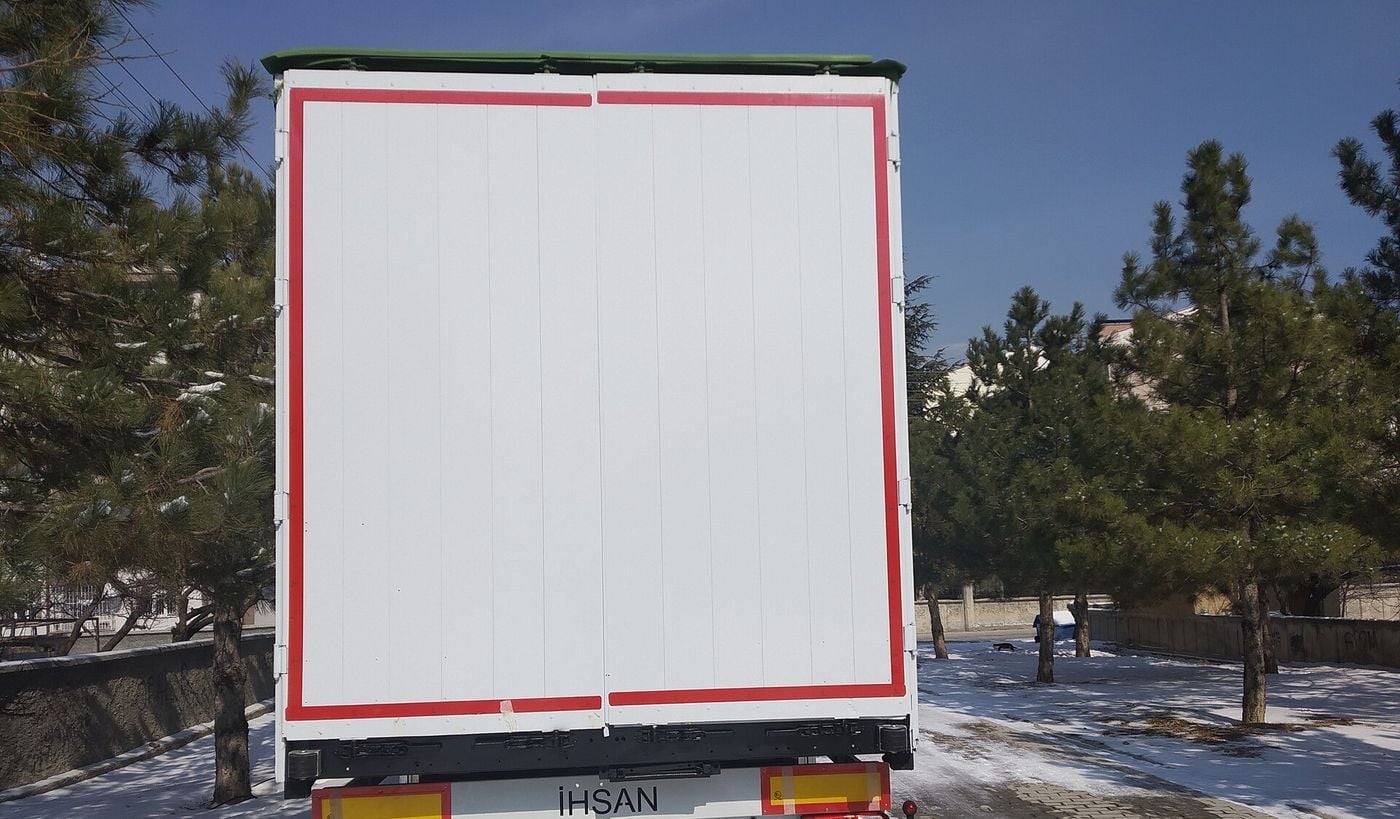
Contour marking is retro-reflective material fixed along the edges of a vehicle so that it shows the vehicle’s length, width and height by reflecting light from a source not connected to the vehicle back towards an observer near that source. Conspicuity tape and reflective tape are names used for the same strips; UN Regulation No 48 calls them conspicuity markings, and the US standard FMVSS No. 108 retroreflective sheeting within a conspicuity system. Under UN Regulation No 48, whose paragraphs 2, 5 and 6 Commission Directive 2007/35/EC made the technical requirements of EU Directive 76/756/EEC on the installation of lighting and light-signalling devices, full contour marking to the rear is mandatory on vehicles wider than 2,100 mm and partial contour marking to the side on vehicles longer than 6,000 mm, in categories N2 over 7.5 t and N3 and in the trailer categories O3 and O4, with exceptions that include tractors for semi-trailers; the material is approved under UN Regulation No 104 or No 150. In the United States, FMVSS No. 108 requires a conspicuity system on trailers 2,032 mm (80 in) or more wide with a gross vehicle weight rating (GVWR) over 10,000 lb and on truck tractors, and 49 CFR 393.11(b) requires one on such trailers manufactured on or after 1 December 1993.
Status as at 9 November 2026. Read on that day: UN Regulation No 48 as published in the Official Journal of 30 September 2021, incorporating Supplement 1 to the 07 series of amendments; UN Regulation No 104 as published in the Official Journal of 14 March 2014, incorporating Supplement 7 to its original version; Commission Directive 2007/35/EC; and 49 CFR 571.108 and 393.11 in the 2025 edition of the Code of Federal Regulations, dated 1 October 2025. UN Regulation No 150, later UN series and supplements, EU type-approval acts later than Directive 2007/35/EC and later CFR editions were not read.
What the terms mean
UN Regulation No 48 defines the family in paragraph 2.5.9:
- Conspicuity marking: “a device intended to increase the conspicuity of a vehicle, when viewed from the side or rear (or in the case of trailers, additionally from the front), by the reflection of light emanating from a light source not connected to the vehicle, the observer being situated near the source”.
- Contour marking: a conspicuity marking “intended to indicate the horizontal and vertical dimensions (length, width and height) of a vehicle”.
- Full contour marking indicates “the outline of the vehicle by a continuous line”.
- Partial contour marking indicates the horizontal dimension by a continuous line “and the vertical dimension by marking the upper corners”.
- Line marking indicates only the horizontal dimensions, length and width, by a continuous line.
UN Regulation No 104, which approves the material, calls it retro-reflective marking material: “a surface or a device from which, when directionally illuminated, a relatively large portion of the incident radiation is retro-reflected” (paragraph 2.2.1). In FMVSS No. 108 the requirement “may be met with retroreflective sheeting, conspicuity reflex reflectors, or a combination of retroreflective sheeting and conspicuity reflex reflectors” (S8.2), and 49 CFR 393.11(b) speaks once of “retroreflective tape”. Equipment carried on board rather than fixed to the body, such as warning triangles and reflective vests, is covered in mandatory equipment in trucks and buses by country.
Which vehicles: UN Regulation No 48
Paragraph 6.21.1 sorts every vehicle category into prohibited, mandatory and optional.
| Direction | Mandatory | Optional | Prohibited |
|---|---|---|---|
| Rear | Full contour marking on vehicles wider than 2,100 mm: N2 with a maximum mass over 7.5 t and N3, except chassis-cabs, incomplete vehicles and tractors for semi-trailers; O3 and O4, except incomplete vehicles | All other categories, including the cab of tractor units for semi-trailers and the cab of chassis-cabs | M1 and O1 |
| Side | Partial contour marking on vehicles longer than 6,000 mm, drawbar included for trailers, in the same categories with the same exceptions; full contour marking may be fitted instead | All other categories, including the same cabs | M1 and O1 |
| Front | None | Line marking on O2, O3 and O4 | Partial or full contour marking on any vehicle; any marking on M1 and O1 |
The category letters are set out in vehicle categories M, N and O, and the bodies that O3 and O4 semi-trailers carry in trailer types explained.
Three provisions allow departures from it. A line marking may be installed instead of the mandatory contour marking “if the shape, structure, design or operational requirements of the vehicle make it impossible to install the mandatory contour marking” (paragraph 6.21.1.2.3). Where the bodywork is partly of flexible material, the line marking goes on rigid parts and the rest may be on the flexible material; on bodywork made wholly of flexible material the line marking may be fitted on it (paragraph 6.21.1.2.4). Where the manufacturer proves to the Type Approval Authority, after verification by the Technical Service, that operational requirements make compliance with paragraphs 6.21.2 to 6.21.7.5 impossible, partial fulfilment is acceptable: retro-reflectors of class IVA of UN Regulation No 3 or 150, or brackets with class C material of UN Regulation No 104 or 150, may then replace part of the marking, at least one per 1,500 mm (paragraph 6.21.1.2.5). The communication form of a vehicle approval records, for rear and side, whether full contour, partial contour or line marking is fitted and whether this exemption was used (Annex 1, item 9.24).
Where it goes: position, coverage and visibility
The markings are to be as close as practicable to horizontal and vertical, compatible with the shape, structure, design and operational requirements of the vehicle, and otherwise follow the outer shape as closely as practicable. They are to be “spaced as evenly as possible over the horizontal dimensions of the vehicle such that the total length and/or width of the vehicle can be identified” (paragraph 6.21.3).
| Requirement | Figure in the text | Paragraph |
|---|---|---|
| Coverage of the width | At least 70 percent of the overall width, as close as practicable to the edge of the vehicle | 6.21.4.1 |
| Coverage of the length | At least 70 percent of the length, reaching to within 600 mm of each end; on trailers the drawbar is excluded, on tractors for semi-trailers the length of the cab counts | 6.21.4.2 |
| Alternative at the front end of a motor vehicle | Within 2,400 mm of the front, a series of retro-reflectors of class IVA or class C, each of at least 25 square centimetres: the first not more than 600 mm from the front end, the others not more than 600 mm apart, and not more than 600 mm from the last one to the start of the marking | 6.21.4.2.1.1 |
| Height of line markings and lower elements | As low as practicable between 250 mm and 1,500 mm above the ground; up to 2,500 mm accepted where the vehicle’s shape, structure, design or operation prevents 1,500 mm | 6.21.4.3.1 |
| Height of upper elements of contour markings | As high as practicable, within 400 mm of the upper extremity of the vehicle | 6.21.4.3.2 |
| Upper corners of a partial contour marking | Two lines at 90 degrees, each at least 250 mm long | 6.21.7.2 |
| Gaps between elements | Not more than 50 percent of the shortest adjacent element; where the manufacturer proves this impossible, as small as possible and not more than 1,000 mm | 6.21.7.1 |
| Distance from stop lamps | Distance to each mandatory stop lamp: “should be greater than 200 mm” | 6.21.7.3 |
| Space on the vehicle | Locations allow markings at least 60 mm wide | 6.21.7.5 |
| Visibility | At least 70 percent of the illuminating surface visible from an observation plane 25 m from the vehicle, between 1 m and 3.0 m above the ground for rear and front markings and between 1.0 m and 1.5 m for side markings, bounded by planes at 4 degrees outwards | 6.21.5 |
Rear marking plates that conform to the 01 series of UN Regulation No 70 or to UN Regulation No 150 may, at the manufacturer’s discretion, count as part of the rear marking when the length of the marking and its proximity to the side of the vehicle are calculated (paragraph 6.21.7.4). If coverage stays below 70 percent, or lower elements sit above 1,500 mm, the communication form carries the comments and the justification (Annex 1, items 10.5 and 10.7; paragraph 6.21.4.3.1).
Colours
Paragraph 5.15 of UN Regulation No 48 lists the colour of each lamp and device. For conspicuity marking it reads: “White to the front; White or yellow to the side; Red or yellow to the rear.” A footnote adds: “Nothing in this Regulation shall preclude the Contracting Parties applying this Regulation from allowing the use of white conspicuity markings to the rear in their territories.”
UN Regulation No 104 sets the matching limits for the material: “Retro-reflective marking materials (class C) shall be white, yellow or red. Retro-reflective distinctive markings and/or graphics (classes D and E) may be of any colour” (Annex 6, point 1).
The material: UN Regulation No 104
UN Regulation No 104 applies to retro-reflective markings for vehicles of categories M2, M3, N, O2, O3 and O4 (paragraph 1). It approves types of marking material, whose installation on the vehicle is the subject of UN Regulation No 48, and divides them into classes, each with its symbol in the approval mark (paragraph 5.4.3):
- C: material for contour or strip marking;
- D: material for distinctive markings or graphics intended for a limited area;
- E: material for distinctive markings or graphics for an extended area;
- D/E: white material used as base or background for printed, fully coloured logos and markings of class E that meets the requirements for class D.
Each approved material bears the trade name or trade mark of the applicant and, where its retro-reflective system is not omnirotational, the orientation mark “TOP” (paragraph 4.1). The approval mark is a circle around the letter E with the number of the country that granted approval, followed by the number of the Regulation with the letter R, a dash, the approval number and the class symbol (paragraph 5.4). On strips it appears at least once at 0.5 m intervals (paragraph 5.5). The first two digits of the approval number give the series of amendments, 00 for the Regulation in its original form (paragraph 5.2). Strips for side and rear marking are 50 mm wide, with a tolerance of plus 10 mm and minus 0 mm (Annex 5, point 1.2.1).
| Colour | 5° | 20° | 30° | 40° | 60° |
|---|---|---|---|---|---|
| White | 450 | none given | 200 | 95 | 16 |
| Yellow | 300 | none given | 130 | 75 | 10 |
| Red | 120 | 60 | 30 | 10 | none given |
Classes D and E have maximum values instead: for class D, 150 cd per square metre per lux at an entrance angle of 5 degrees, down to 5 at 60 degrees, in any colour (Annex 7, Table 2); for class E, not more than 33 percent of those values (paragraph 7.2.2). Paragraph 7.2 reads: “Advertising, consisting of retro-reflective logos, distinctive markings or letters/characters has to be decent.” Class D material may be used if the total retro-reflective area is less than 2 square metres; from 2 square metres class E is to be used. A footnote leaves national authorities free to prohibit retro-reflective advertising, logos, distinctive markings and letters.
Annex 8 tests the material’s resistance to weathering, corrosion, fuels, heat, cleaning (by hand and by power washing) and penetration of water, its bonding strength where class C material is adhesive, and its flexing where it is to be adhered to a flexible substrate such as a tarpaulin. The approval granting authority may also test the stability of the optical properties of material in use.
How the obligation reached EU law
Commission Directive 2007/35/EC of 18 June 2007 gives this reason in recital 2: “In order to increase road safety by improving the conspicuity of large trucks and their trailers the obligation for fitting retro reflective marking on these vehicles should be introduced into Directive 76/756/EEC.” Its Annex replaced Annex II of Directive 76/756/EEC with a reference to UN Regulation No 48: “The technical requirements are those set out in paragraphs 2, 5 and 6 of UN/ECE Regulation No 48 and Annexes 3 to 9 thereto.” A footnote to that point identifies the Regulation by its publication in Official Journal L 137 of 30 May 2007.
Member States had to adopt and publish their provisions by 9 July 2008 and apply them from 10 July 2008 (Article 3(1)). Article 2 set the date for new vehicles: “With effect from 10 July 2011, if the requirements laid down in Directive 76/756/EEC, as amended by this Directive, are not complied with, Member States, on grounds related to the installation of lighting and light-signalling devices, shall consider Certificates of Conformity which accompany new vehicles in accordance with the provisions of Directive 70/156/EEC to be no longer valid for the purposes of Article 7(1) of that Directive.”
UN Regulation No 48 keeps its own dates for these vehicles in the transitional provisions of the 03 series of amendments (paragraph 12.2). From 10 October 2009 Contracting Parties applying the Regulation “may refuse first national or regional entry into service” of vehicles of categories N2 over 7.5 tonnes, N3, O3 and O4 wider than 2,100 mm (rear markings) and longer than 6,000 mm (side markings), except tractors for semi-trailers and incomplete vehicles, that do not meet the 03 series. From 10 October 2011 they no longer recognise approvals of such vehicle types granted under any earlier series. The Official Journal publication notes that “only the original UN/ECE texts have legal effect under international public law” and refers to the UN status document TRANS/WP.29/343 for the status and date of entry into force; that document was not read.
United States: FMVSS No. 108 and 49 CFR 393.11
FMVSS No. 108 applies to passenger cars, multipurpose passenger vehicles, trucks, buses, trailers other than pole trailers and trailer converter dollies, and motorcycles, and to retroreflective sheeting and reflex reflectors manufactured to conform to S8.2 (S3). Paragraph S6.1.1.1 reads: “Each trailer of 2032 mm or more in overall width, and with a GVWR over 10,000 lbs., except a trailer designed exclusively for living or office use, and each truck tractor must be equipped with retroreflective sheeting, reflex reflectors, or a combination of retroreflective sheeting and reflex reflectors as specified in S8.2.”
The sheeting has “a smooth, flat, transparent exterior film with retroreflective elements embedded or suspended beneath the film” (S8.2.1.1) and meets, except for photometry, the requirements of ASTM D 4956-90 for Type V sheeting. It comes in three grades: DOT-C2 at least 50 mm wide, DOT-C3 at least 75 mm and DOT-C4 at least 100 mm (S8.2.1.2). The grade letters, at least 3 mm high, certify conformity and must appear at least once on each white or red segment and at least once every 300 mm on white-only sheeting (S8.2.1.3). In alternating material each white and red segment is 300 mm long, plus or minus 150 mm, and neither colour may exceed two thirds of a continuous strip across the width of a trailer or of a strip along its length (S8.2.1.4). White sheeting stays at least 75 mm from any required red or amber lamp, red sheeting at least 75 mm from any required amber lamp (S8.2.1.6). At an observation angle of 0.2 degrees and an entrance angle of minus 4 degrees, the minimum photometry is 250 cd per lux per square metre for white and 60 for red in grade DOT-C2, 165 and 40 in DOT-C3, and 125 and 30 in DOT-C4 (Table XVI-c).
Conspicuity reflex reflectors are marked DOT-C (S8.2.2.1) and are fitted in a repetitive pattern of two or three white reflectors alternating with two or three red ones, with centres not more than 100 mm apart (S8.2.2.2.1).
| Vehicle and side | Element | Placement | Material |
|---|---|---|---|
| Trailer, rear | Element 1 | Across the full width, as close to the extreme edges as practicable, between 375 mm and 1,525 mm at curb weight | Alternating red and white |
| Trailer, rear | Element 2, not required on container chassis or platform trailers without bulkheads | Two pairs of 300 mm strips, horizontal and vertical, at the right and left upper contours of the body, as close to the top and as far apart as practicable | White, grade DOT-C2, C3 or C4 |
| Trailer, rear | Element 3, not required on trailers without an underride protection device | Across the full width of the horizontal member of the rear underride protection device | Grade DOT-C2 at least 38 mm wide, or reflectors; alternating red and white |
| Trailer, each side | Side strip | As horizontal as practicable from as close to the front to as close to the rear as practicable, between 375 mm and 1,525 mm, not obscured by equipment or cargo; may be broken if at least half the length is covered and the spaces are distributed as evenly as practicable | Alternating red and white |
| Truck tractor, rear | Element 1 | Two strips of at least 600 mm close to the edges of the rear fenders, mudflaps or mudflap support brackets; without mudflaps, other positions, up to 1,525 mm on the back of the cab | Alternating red and white |
| Truck tractor, rear | Element 2 | Two pairs of 300 mm strips at the right and left upper contours of the cab, no more than 25 percent of their area obscured | White |
Rear underride protection devices, which carry element 3, are the subject of underrun protection and Mansfield bars. The system need not be installed on discontinuous surfaces such as outside ribs, stake post pickets on platform trailers and external protruding beams, nor on door hinges and lamp bodies on trailers, or body joints, stiffening beads, drip rails and rolled surfaces on truck tractors (S8.2.1.5).
49 CFR 393.11 is part of the Federal Motor Carrier Safety Regulations, in the part on parts and accessories necessary for safe operation. Under paragraph (b), “Each trailer of 2,032 mm (80 inches) or more overall width, and with a GVWR over 4,536 kg (10,000 pounds), manufactured on or after December 1, 1993, except pole trailers and trailers designed exclusively for living or office use, shall be equipped with” retroreflective sheeting, reflex reflectors or a combination meeting FMVSS No. 108. A trailer with such conspicuity material need not also carry the reflex reflectors listed in Table 1 of the section if the material is at the locations of those reflectors and meets their visibility requirements (393.11(a)(2)). Commercial motor vehicles manufactured on or after 25 December 1968 must meet at least FMVSS No. 108 as in effect at the time of their manufacture (393.11(a)(1)). Paragraph (b) refers to FMVSS paragraphs numbered S5.7.1 to S5.7.3; the 2025 edition of FMVSS No. 108 has no paragraph S5.7, and its conspicuity requirements are in S6.1.1.1 and S8.2.
The two systems side by side
| UN Regulations Nos 48 and 104 | FMVSS No. 108 | |
|---|---|---|
| Mandatory on | N2 over 7.5 t, N3, O3 and O4: rear if wider than 2,100 mm, side if longer than 6,000 mm | Trailers 2,032 mm or more wide with a GVWR over 10,000 lb; truck tractors |
| Tractor units | Not mandatory; optional on the cab | Mandatory: strips at the rear fenders or mudflaps and at the upper corners of the cab |
| Rear | Full contour marking | Full-width strip, white upper corners, strip on the underride guard |
| Side | Partial contour marking: continuous line and upper corners | Horizontal strip, at least half the length |
| Colours | Rear red or yellow, side white or yellow, front white; white to the rear where a Contracting Party allows it | Alternating red and white; white at the upper corners |
| Material width | 50 mm, plus 10 mm, minus 0 mm (strips for side and rear marking) | At least 50, 75 or 100 mm (DOT-C2, C3, C4) |
| Height of the lower strip | 250 mm to 1,500 mm, up to 2,500 mm by exception | 375 mm to 1,525 mm |
| Mark on the material | E approval mark with 104R, approval number and C, every 0.5 m on strips | DOT-C2, C3 or C4 on each segment and every 300 mm on white-only sheeting |
Where each text applies
| Country | Rule read | Status | Source |
|---|---|---|---|
| European Union, all Member States | UN Regulation No 48, paragraphs 2, 5 and 6 and Annexes 3 to 9, introduced into Directive 76/756/EEC by Directive 2007/35/EC | Certificates of Conformity of non-complying new vehicles no longer valid from 10 July 2011; EU acts later than Directive 2007/35/EC not read | Directive 2007/35/EC, Articles 2 and 3 and Annex |
| United States | FMVSS No. 108, S6.1.1.1 and S8.2; 49 CFR 393.11(b) | In force in the CFR edition of 1 October 2025; 393.11(b) covers trailers manufactured on or after 1 December 1993 | CFR 2025 edition, 49 CFR 571.108 and 393.11 |
| Canada | Not verified | Not verified | No national text read |
| Great Britain | Not verified | Not verified | No national text read |
| Türkiye | Not verified | Not verified | No national text read |
| Russia | Not verified | Not verified | No national text read |
Outside the EU, UN Regulation No 48 applies in the countries that apply it under the 1958 Agreement; which countries those are, and which series each applies, is in the UN status document TRANS/WP.29/343, which was not read. One declaration is in the text itself: until the UN Secretary-General is notified otherwise, Japan will only be bound with respect to vehicles of categories M1 and N1 in relation to the installation of lighting and light-signalling devices (paragraph 12.1.7).
Quick answers
- Which trucks and trailers must have contour marking?
- Under paragraph 6.21.1.2 of UN Regulation No 48, full contour marking to the rear is mandatory on vehicles wider than 2,100 mm of categories N2 with a maximum mass over 7.5 tonnes, N3, O3 and O4, and partial contour marking to the side on the same categories when longer than 6,000 mm, including the drawbar for trailers. Chassis-cabs, incomplete vehicles and tractors for semi-trailers are excepted among N2 and N3, incomplete vehicles among O3 and O4. Paragraph 6.21.1.3.1 makes the marking optional on all categories not otherwise specified, including the cab of tractor units for semi-trailers and the cab of chassis-cabs, and paragraph 6.21.1.1 prohibits it on M1 and O1.
- What colour does conspicuity marking have to be?
- UN Regulation No 48 (paragraph 5.15) gives white to the front, white or yellow to the side and red or yellow to the rear, and lets Contracting Parties allow white to the rear in their territories. Class C material under UN Regulation No 104 is white, yellow or red. In the United States, FMVSS No. 108 uses alternating red and white material across the rear and along the sides, and white strips at the upper rear corners.
- What do the markings 104R and C on reflective tape mean?
- They are part of the approval mark of UN Regulation No 104: a circle around the letter E with the number of the approving country, then 104R, a dash and the approval number, and a class symbol. C stands for contour or strip marking, D and E for distinctive markings or graphics on a limited or an extended area. On strips the mark appears at least once every 0.5 m.
- What is DOT-C2 tape?
- DOT-C2, DOT-C3 and DOT-C4 are the grades of retroreflective sheeting in FMVSS No. 108, at least 50, 75 and 100 mm wide. The letters certify that the sheeting conforms to the standard and must appear at least once on each white or red segment and at least every 300 mm on white-only sheeting, in characters at least 3 mm high. Conspicuity reflex reflectors are marked DOT-C.
- Do buses need contour marking?
- UN Regulation No 48 does not list buses among the vehicles on which conspicuity marking is mandatory. Paragraph 6.21.1.3.1 makes it optional on all categories not otherwise specified, and paragraph 6.21.1.1 prohibits it on M1 and O1. In the United States, paragraph S6.1.1.1 of FMVSS No. 108 names trailers 2,032 mm or more wide with a GVWR over 10,000 lb and truck tractors.
Sources
- UN Regulation No 48, installation of lighting and light-signalling devices, incorporating Supplement 1 to the 07 series of amendments (in force 30 September 2021), OJ L 347, 30 September 2021: paragraphs 2.5.9, 5.15, 6.21, 12.1.7 and 12.2 and Annex 1, items 9.24, 10.5 and 10.7 — EUR-Lex, European Union, 30 Sept 2021
- UN Regulation No 104, approval of retro-reflective markings for vehicles of category M, N and O, incorporating Supplement 7 to the original version (in force 26 July 2012), OJ L 75, 14 March 2014: paragraphs 1, 2, 4, 5 and 7 and Annexes 5 to 8 — EUR-Lex, European Union, 14 Mar 2014
- Commission Directive 2007/35/EC of 18 June 2007 amending, for the purposes of its adaptation to technical progress, Council Directive 76/756/EEC concerning the installation of lighting and light-signalling devices, OJ L 157, 19 June 2007: recital 2, Articles 1 to 3 and Annex — EUR-Lex, European Union, 18 Jun 2007
- 49 CFR 571.108, Standard No. 108: Lamps, reflective devices, and associated equipment, Code of Federal Regulations, 2025 edition (1 October 2025): S3, S6.1.1.1, S8.2 and Table XVI-c — National Highway Traffic Safety Administration, via govinfo.gov, 1 Oct 2025
- 49 CFR 393.11, Lamps and reflective devices, Code of Federal Regulations, 2025 edition (1 October 2025): paragraphs (a) and (b) — Federal Motor Carrier Safety Administration, via govinfo.gov, 1 Oct 2025