Truck, bus and trailer lights: end-outline, clearance and side-marker lamps under UN R48 and FMVSS 108
End-outline marker lamps above 2.10 m width, side-marker lamps above 6 m length, daytime running lamps on motor vehicles only (UN R48, 07 series), and US clearance lamps.
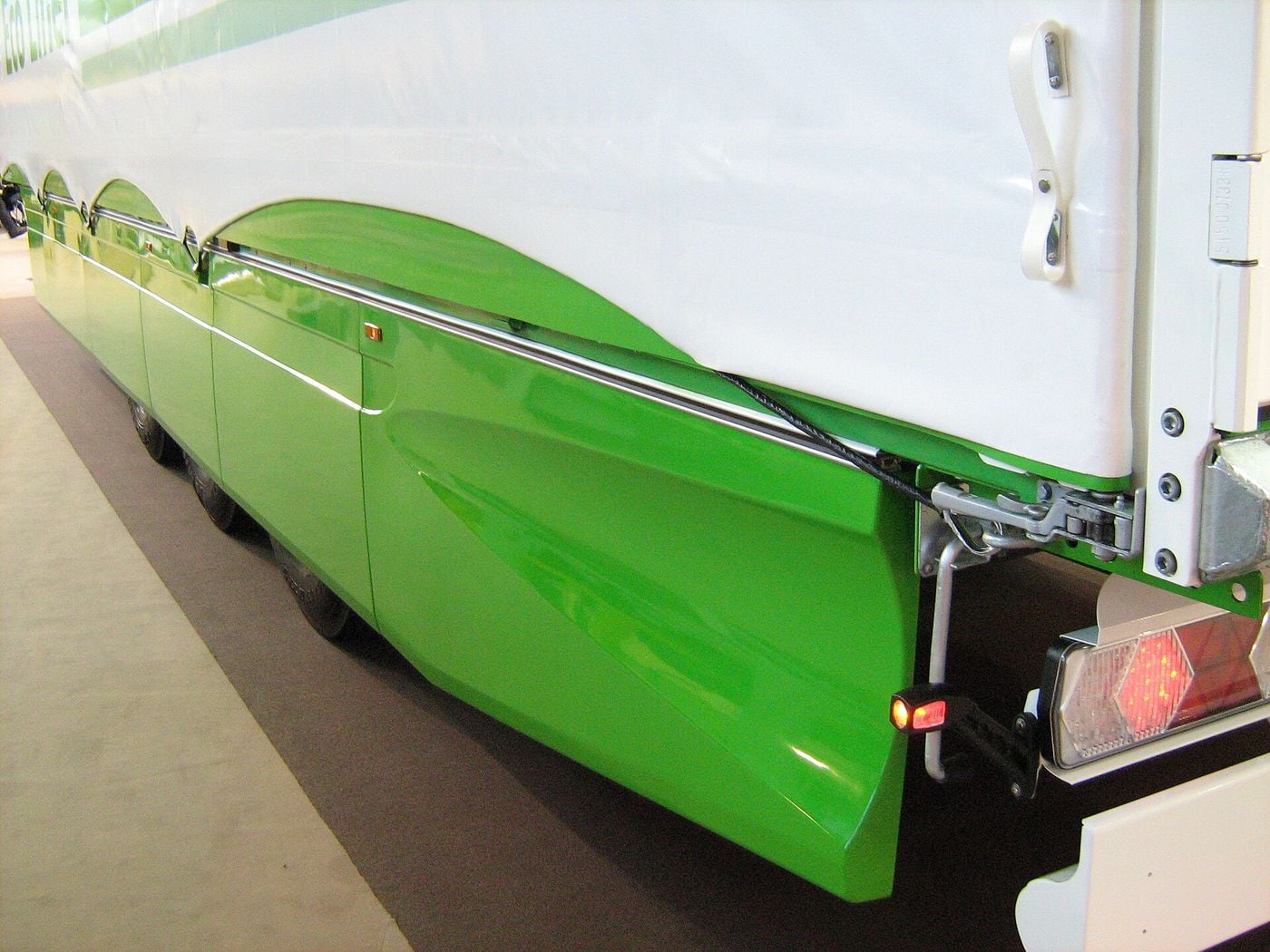
Which lamps a new truck, bus or trailer carries, how many and where, is set for EU type-approval by UN Regulation No 48, a regulation under the UN 1958 Agreement that “applies to vehicles of categories M, N, and to their trailers (category O)” with regard to the installation of lighting and light-signalling devices (paragraph 1). Annex I of Regulation (EU) 2019/2144 lists its 07 series of amendments, published in the Official Journal of 30 September 2021. In that text, end-outline marker lamps are mandatory on vehicles wider than 2.10 m (paragraph 6.13.1), side-marker lamps on all vehicles longer than 6 m except chassis-cabs (paragraph 6.18.1), and daytime running lamps on motor vehicles, while they are prohibited on trailers (paragraph 6.19.1). In the United States, Federal Motor Vehicle Safety Standard (FMVSS) No. 108 requires trucks and buses 2,032 mm or more in overall width to carry two amber clearance lamps and three amber identification lamps at the front and, except on truck tractors, two red clearance lamps and three red identification lamps at the rear (Table I-a); 49 CFR 393.11 lists the same lamps for commercial motor vehicles in its Table 1.
Status as of 14 November 2026. Read on that day: UN Regulation No 48 as published in the Official Journal of 30 September 2021, incorporating Supplement 1 to the 07 series of amendments (in force 30 September 2021), in English and, for the paragraph headings, in German, French, Spanish, Polish and Italian; and 49 CFR 571.108 and 393.11 in the 2025 edition of the Code of Federal Regulations, dated 1 October 2025. Annexes I and II of Regulation (EU) 2019/2144 are cited from its consolidated text of 2 August 2026, read on 26 October 2026. Later series of amendments and supplements to UN Regulation No 48, the regulations that approve the lamps themselves, and later CFR editions were not read.
Which text sets the rules
UN Regulation No 48 deals with installation: which devices a vehicle carries, how many, where and when they light up. The lamps themselves are approved under the regulations named in most headings of its paragraph 6, for example “End-outline marker lamp (UN Regulation No. 7 or 148)” (paragraph 6.13) and “Side-marker lamps (UN Regulation No. 91 or 148)” (paragraph 6.18). For each device, paragraph 6 sets out presence, number, arrangement, position, geometric visibility, orientation, electrical connections, tell-tale and other requirements. Presence is stated as mandatory, optional or prohibited; an optional lamp is “a lamp, the installation of which is left to the discretion of the manufacturer” (paragraph 2.4.9).
Annex I of Regulation (EU) 2019/2144 gives the version EU type-approval refers to: “48 Installation of lighting and light-signalling devices on motor vehicles 07 series of amendments OJ L 347, 30.9.2021, p. 1”, for vehicle categories M, N and O. In Annex II, item D15 (installation of light signalling, road illumination and retro-reflective devices) and item D16 (emergency stop signal) both refer to UN Regulation No 48. Annex I also lists device regulations, among them No 7 for position lamps, stop lamps and end-outline marker lamps (02 series), No 91 for side-marker lamps (original version) and Nos 148, 149 and 150 on light signalling, road illumination and retro-reflective devices (original versions, in the same Official Journal of 30 September 2021). The Official Journal publication of UN Regulation No 48 carries the note: “Only the original UN/ECE texts have legal effect under international public law.”
The letters M, N and O and the categories M2, M3, N2, N3, O3 and O4 used below are explained in vehicle categories M, N and O, and the type-approval of the whole vehicle in certificate of conformity and multi-stage type-approval.
Mandatory, optional and prohibited lamps under UN Regulation No 48
| Lamp | Presence | Number | Paragraph |
|---|---|---|---|
| End-outline marker lamp | Mandatory on vehicles wider than 2.10 m; optional between 1.80 m and 2.10 m; the rear ones optional on chassis-cabs | Two visible from the front and two from the rear; two more of each optional | 6.13.1, 6.13.2 |
| Side-marker lamp | Mandatory on all vehicles longer than 6 m, except chassis-cabs, and on M1 and N1 vehicles under 6 m where they supplement the reduced geometric visibility of the position lamps; optional on all other vehicles | Per side, as many as the rules for longitudinal positioning require | 6.18.1, 6.18.2 |
| Daytime running lamp | Mandatory on motor vehicles; prohibited on trailers | Two | 6.19.1, 6.19.2 |
| Rear fog lamp | Mandatory | One or two | 6.11.1, 6.11.2 |
| Reversing lamp | Mandatory on motor vehicles and on trailers of categories O2, O3 and O4; optional on O1 | One, and a second optional, on M1 and on other vehicles up to 6,000 mm long; two, and two more optional, on vehicles longer than 6,000 mm except M1 | 6.4.1, 6.4.2 |
| Parking lamp | Optional on motor vehicles not longer than 6 m and not wider than 2 m; prohibited on all other vehicles | Two at the front and two at the rear, or one on each side | 6.12.1, 6.12.3 |
| Manoeuvring lamp | Optional on motor vehicles | One or two, one per side | 6.26.1, 6.26.2 |
Paragraph 5.15 gives the colours: end-outline marker lamps “White in front, red at the rear”; side-marker lamps amber, except that the rearmost may be red if it is grouped, combined or reciprocally incorporated with the rear position lamp, the rear end-outline marker lamp, the rear fog lamp or the stop lamp, or grouped with or sharing part of its light-emitting surface with the rear retro-reflector; daytime running lamps and reversing lamps white; rear fog lamps red.
Two signals are given by the vehicle’s stop or direction-indicator lamps. The emergency stop signal, “a signal to indicate to other road users to the rear of the vehicle that a high retardation force has been applied to the vehicle relative to the prevailing road conditions” (paragraph 2.6.2), is mandatory on motor vehicles and optional on trailers (paragraph 6.23.1); where it stands among the EU’s required safety systems is set out in mandatory driver assistance systems. The rear-end collision alert signal, given by all the direction-indicator lamps, is optional (paragraph 6.25.1). Retro-reflective conspicuity marking, paragraph 6.21, is the subject of contour marking and conspicuity tape. The Regulation also defines a “Rear marking plate” as “a plate faced with retro-reflective and fluorescent material or devices intended to increase the visibility and permit easy identification of heavy and long vehicles” (paragraph 2.4.17.2); how such plates count towards the rear conspicuity marking under paragraph 6.21.7.4 is set out on that page.
End-outline marker lamps
Paragraph 2.5.14 defines the end-outline marker lamp as “the lamp fitted near to the extreme outer edge and as close as possible to the top of the vehicle and intended to indicate clearly the vehicle’s overall width”. It is intended, “for certain vehicles and trailers, to complement the vehicle’s front and rear position lamps by drawing particular attention to its bulk”.
Paragraph 6.13.1 reads: “Mandatory on vehicles exceeding 2.10 m in width. Optional on vehicles between 1.80 and 2.10 m in width. On chassis-cabs the rear end-outline marker lamps are optional.” The number is “Two visible from the front and two visible from the rear”, and two more visible from the front and two more visible from the rear may be added (paragraph 6.13.2).
| Requirement | Figure in the text | Paragraph |
|---|---|---|
| In width | As close as possible to the extreme outer edge, deemed met when the outermost point of the apparent surface is not more than 400 mm from the extreme outer edge | 6.13.4.1 |
| Height at the front, motor vehicles | The upper edge of the lamp’s apparent surface not lower than the upper edge of the transparent zone of the windscreen | 6.13.4.2 |
| Height at the front of trailers and semi-trailers, and at the rear | At the maximum height compatible with the width, design and operational requirements of the vehicle and the symmetry of the lamps | 6.13.4.2 |
| Additional lamps visible from the front | As close as practicable to the rear, deemed met within 400 mm of the rear; used to mark the rear end outline, visible within the fields of vision of the approved main rear-view devices | 6.13.4.3, 6.13.9 |
| Geometric visibility | 80° outwards; 5° above and 20° below the horizontal | 6.13.5 |
| Distance from the position lamp | Not less than 200 mm | 6.13.9 |
Provided that all other requirements are met, a front and a rear lamp on the same side may be combined into one device (paragraph 6.13.9).
Side-marker lamps
A side-marker lamp is “a lamp used to indicate the presence of the vehicle when viewed from the side” (paragraph 2.5.15). Paragraph 6.18.1 makes it “Mandatory: On all vehicles the length of which exceeds 6 m, except for chassis-cabs”, and adds: “The SM1 type of side-marker lamp shall be used on all categories of vehicles; however the SM2 type of side-marker lamps may be used on the M1 category of vehicles.” Mounting height is between 250 mm and 1,500 mm above the ground, or 2,100 mm if the shape of the bodywork makes 1,500 mm impossible (paragraph 6.18.4.2).
Spacing along the vehicle is set by paragraph 6.18.4.3: “at least one side-marker lamp shall be fitted to the middle third of the vehicle, the foremost side-marker lamp being not further than 3 m from the front. The distance between two adjacent side-marker lamps shall not exceed 3 m. If the structure, design or the operational use of the vehicle make it impossible to comply with such a requirement, this distance may be increased to 4 m.” It continues: “The distance between the rearmost side-marker lamp and the rear of the vehicle shall not exceed 1 m.” For vehicles not longer than 6 m and for chassis-cabs, one side-marker lamp within the first third and/or the last third of the length is sufficient. For trailers, the overall length and any measurement in length include the drawbar, “except when specifically excluded” (paragraph 2.3.4.2).
On six vehicle categories, mandatory amber side-marker lamps may flash with the indicators: “On M2, M3, N2, N3, O3 and O4 vehicles mandatory amber side marker lamps may flash simultaneously with the direction-indicator lamps on the same side of the vehicle. However, where there are direction indicator lamps of category 5 installed according to paragraph 6.5.3.1. on the side of the vehicle these amber side marker lamps shall not flash” (paragraph 6.18.7). Rear side-marker lamps “shall be amber if they flash with the rear direction-indicator lamp” (paragraph 6.18.9). Otherwise the front and rear position lamps, the end-outline marker lamps and the side-marker lamps, where fitted, and the rear registration plate lamp “can only be switched ON and OFF simultaneously” (paragraph 5.11); among the exceptions in paragraph 5.11.1 are side-marker lamps flashing with the direction indicators and daytime running lamps that are switched on.
Daytime running lamps
Paragraph 2.5.16 defines a daytime running lamp as “a lamp facing in a forward direction used to make the vehicle more easily visible when driving during daytime”. Paragraph 6.19.1 reads: “Mandatory on motor vehicles. Prohibited on trailers.” The number is two (paragraph 6.19.2). The inner edges of their apparent surfaces are at least 600 mm apart, and the lamps are between 250 mm and 1,500 mm above the ground, at the front of the vehicle (paragraph 6.19.4).
They switch on automatically when the device which starts or stops the propulsion system is set so that the propulsion system can operate, and may remain off while an automatic transmission is in park, while the parking brake is applied, or before the vehicle first moves after each manual activation of that device (paragraph 6.19.7.1). They switch off automatically when the front fog lamps or headlamps are switched on, except when those are used to give intermittent luminous warnings (paragraph 6.19.7.3).
Rear fog, reversing, parking and manoeuvring lamps
- Rear fog lamp (paragraph 6.11): one or two, between 250 mm and 1,000 mm above the ground, up to 1,200 mm when grouped with any rear lamp and 1,400 mm on off-road vehicles of categories N2G, N3G, M2G and M3G. A single rear fog lamp is “on the opposite side of the median longitudinal plane of the vehicle to the direction of traffic prescribed in the country of registration”, or on that plane. The distance between the rear fog lamp and each stop lamp is greater than 100 mm.
- Reversing lamp (paragraph 6.4): “Mandatory on motor vehicles and on trailers of categories O2, O3 and O4. Optional on trailers of category O1.” Between 250 mm and 1,200 mm above the ground, 1,400 mm on N2G, N3G, M2G and M3G off-road vehicles, at the rear; the two optional devices of vehicles longer than 6,000 mm may be fitted on the side, subject to paragraphs 6.4.5.2 and 6.4.6.2.
- Parking lamp (paragraph 6.12.1): “On motor vehicles not exceeding 6 m in length and not exceeding 2 m in width, optional. On all other vehicles, prohibited.”
- Manoeuvring lamp (paragraph 6.26): “a lamp used to provide supplementary illumination to the side of the vehicle to assist during slow manoeuvres” (paragraph 2.5.19), optional on motor vehicles, one per side, directed downwards. It switches on automatically for slow manoeuvres up to 15 km/h under the conditions of paragraph 6.26.7 and switches off automatically above 15 km/h forward speed.
The same lamps in other language versions
In six language versions of the Official Journal publication, the headings of paragraph 6 name the lamps as follows.
| Paragraph | English | German | French | Spanish | Polish | Italian |
|---|---|---|---|---|---|---|
| 6.13 | End-outline marker lamp | Umrissleuchte | Feu d’encombrement (feu de gabarit) | Luz de gálibo | Światła obrysowe górne | Luce di ingombro |
| 6.18 | Side-marker lamps | Seitenmarkierungsleuchten | Feux de position latéraux | Luz de posición lateral | Światła pozycyjne boczne | Luci di posizione laterali |
| 6.19 | Day-time running lamp | Tagfahrleuchte | Feu de circulation diurne | Luz de circulación diurna | Światło do jazdy dziennej | Luce di marcia diurna |
| 6.11 | Rear fog lamp | Nebelschlussleuchte | Feu de brouillard arrière | Luz antiniebla trasera | Tylne światło przeciwmgłowe | Luce posteriore per nebbia |
| 6.4 | Reversing lamp | Rückfahrscheinwerfer | Feu de marche arrière | Luz de marcha atrás | Światło cofania | Proiettore di retromarcia |
| 6.26 | Manoeuvring lamps | Manövrierscheinwerfer | Feu de manœuvre | Luces auxiliares de maniobra | Światła manewrowe | Proiettori di manovra |
United States: FMVSS No. 108 and 49 CFR 393.11
FMVSS No. 108 applies to “Passenger cars, multipurpose passenger vehicles, trucks, buses, trailers (except pole trailers and trailer converter dollies), and motorcycles” (S3.1). Each vehicle must be equipped with “at least the number of lamps, reflective devices, and items of associated equipment specified for that vehicle type and size in Table I and Section 6.6” (S6.1.1). Its definitions (S4):
- Clearance lamps “are lamps which show to the front or rear of the vehicle, mounted on the permanent structure of the vehicle as near as practicable to the upper left and right extreme edges to indicate the overall width and height of the vehicle”.
- Side marker lamps “are lamps which show to the side of the vehicle, mounted on the permanent structure of the vehicle as near as practicable to the front and rear edges to indicate the overall length of the vehicle. Additional lamps may also be mounted at intermediate locations on the sides of the vehicle.”
- Identification lamps are the row of three lamps that Tables I-a and I-b place near the vertical centerline.
| Lamp | Front | Rear | Vehicles |
|---|---|---|---|
| Clearance lamps | 2 amber, at the same height, symmetrically about the vertical centerline, indicating the overall width of the vehicle or, on a truck tractor, the width of the cab; as near the top as practicable | 2 red, as near the top as practicable except where the rear identification lamps are at the extreme height; not required on truck tractors | Trucks, buses and multipurpose passenger vehicles 2,032 mm or more in overall width (Table I-a); trailers 2,032 mm or more in overall width (Table I-b) |
| Identification lamps | 3 amber, at the same height, as close as practicable to the vertical centerline, lamp centers not less than 6 inches (152 mm) or more than 12 inches (305 mm) apart; as near the top of the vehicle or top of the cab as practicable | 3 red, same spacing, as near the top as practicable; not required on truck tractors | Trucks, buses and multipurpose passenger vehicles 2,032 mm or more in overall width; on trailers 2,032 mm or more wide, the 3 red rear lamps only |
| Side marker lamps | 2 amber, one on each side as far to the front as practicable, not less than 15 inches (381 mm) high | 2 red, one on each side as far to the rear as practicable; not required on truck tractors; on trailers 2,032 mm or more wide not more than 60 inches (1,524 mm) high | All trucks and buses; trailers, except that the front amber ones are not required on trailers less than 1,829 mm (6 ft) in overall length including the tongue |
| Intermediate side marker lamps | 2 amber, one on each side at or near the midpoint between the front and rear side marker lamps, not less than 15 inches high | Vehicles and trailers 30 feet or longer (FMVSS No. 108); more than 9,144 mm (30 feet) long (49 CFR 393.11) | |
Clearance and identification lamps are “Steady burning”; side marker lamps are “Steady burning except may be flashed for signaling purposes” (Table I-a). Clearance lamps “May be located at a location other than the front if necessary to indicate the overall width of the vehicle, or for protection from damage during normal operation of the vehicle”, and the same applies at the rear; for lamps at the rear, “Practicability of locating lamps on the vehicle header is presumed when the header extends at least 25 mm (1 inch) above the rear doors.” Daytime running lamps appear under the heading “Daytime Running Lamps Permitted But Not Required on Passenger Cars, Multipurpose Passenger Vehicles (MPV), Trucks, and Buses”.
49 CFR 393.11 belongs to the Federal Motor Carrier Safety Regulations, in the part on parts and accessories necessary for safe operation. “All commercial motor vehicles manufactured on or after December 25, 1968, must, at a minimum, meet the applicable requirements of 49 CFR 571.108 (FMVSS No. 108) in effect at the time of manufacture of the vehicle” (393.11(a)(1)). Its Table 1 lists the lamps for each type of commercial motor vehicle, among them buses and trucks 2,032 mm (80 inches) or more in overall width, truck tractors, and semitrailers and full trailers 2,032 mm or more wide, with the millimetre figures used in the table above. The table and its footnotes add:
- Front identification lamps may alternatively be located “as close as practicable to the top of the cab” (Table 1). Where the cab “is not more than 42 inches wide at the front roofline”, a single lamp at the center of the cab is deemed to comply, and “No part of the identification lamps or their mountings may extend below the top of the vehicle windshield” (footnote 1).
- Rear identification lamps “need not be visible or lighted if obscured by a vehicle in the same combination” (footnote 3).
- On a truck tractor, “clearance lamps mounted on the cab may be located to indicate the width of the cab, rather than the width of the vehicle” (footnote 15(4)).
- A load extending more than 102 mm (4 inches) beyond the overall width is marked with an amber lamp at the foremost edge and a red lamp at the rearmost edge of the projecting part, and a load extending more than 1,219 mm (4 feet) beyond the rear with a red side marker lamp on each side and two red lamps and two red reflectors on the rear, when the vehicle is operated during the hours when headlamps are required (footnotes 9 and 10).
Paragraph (c) reads: “No commercial motor vehicle may be equipped with an amber stop lamp, a tail lamp, or other lamp which is optically combined with an amber stop lamp or tail lamp.” The tractor units these rules refer to as truck tractors are described in what is a semi truck.
The two systems side by side
| UN Regulation No 48 | FMVSS No. 108 and 49 CFR 393.11 | |
|---|---|---|
| Width threshold | End-outline marker lamps: mandatory above 2.10 m, optional from 1.80 m to 2.10 m | Clearance and identification lamps: required at 2,032 mm (80 inches) or more in overall width; 49 CFR 393.11 Table 1 also lists the front ones for truck tractors as a separate vehicle type |
| Front | Two end-outline marker lamps, white | Two amber clearance lamps and three amber identification lamps; on trailers clearance lamps only |
| Rear | Two end-outline marker lamps, red; optional on chassis-cabs | Two red clearance lamps and three red identification lamps; not required on truck tractors |
| Side | Side-marker lamps on vehicles longer than 6 m except chassis-cabs: amber, the rearmost may be red when grouped or combined with certain rear lamps; not more than 3 m from the front, 3 m apart (4 m by exception) and 1 m from the rear | Amber side marker lamps at the front and red at the rear of each side (the red ones not on truck tractors); amber intermediate lamps on vehicles 30 feet or longer |
| Flashing | Amber side-marker lamps of M2, M3, N2, N3, O3 and O4 may flash with the direction indicators, unless category 5 side direction indicators are fitted | Side marker lamps steady burning except may be flashed for signaling purposes |
| Daytime running lamps | Mandatory on motor vehicles, two, white; prohibited on trailers | Permitted but not required |
| Overall width, as defined, disregards | Devices for indirect vision; side direction-indicator, end-outline marker, position, parking and side-marker lamps; retro-reflectors; and other listed projections (paragraphs 2.3.3 and 2.3.4.1) | Signal lamps, marker lamps, outside rearview mirrors, flexible fender extensions, mud flaps and outside door handles (FMVSS No. 108, S4, overall width) |
Quick answers
- Which trucks and trailers must have side marker lights?
- Under paragraph 6.18.1 of UN Regulation No 48 (07 series), side-marker lamps are mandatory on all vehicles longer than 6 m, except chassis-cabs; on other vehicles they are optional, except that M1 and N1 vehicles under 6 m use them where they supplement the reduced geometric visibility of the position lamps. At least one goes in the middle third, the foremost not more than 3 m from the front, adjacent lamps not more than 3 m apart (4 m where the vehicle makes 3 m impossible) and the rearmost not more than 1 m from the rear. In the United States, FMVSS No. 108 requires two amber side marker lamps as far to the front as practicable and two red ones as far to the rear as practicable on trucks and buses (the red ones not on truck tractors), plus two amber intermediate lamps on vehicles 30 feet or longer.
- What are clearance lights on a semi truck?
- FMVSS No. 108 defines clearance lamps as lamps showing to the front or rear, mounted as near as practicable to the upper left and right extreme edges to indicate the overall width and height of the vehicle. Trucks and buses 2,032 mm or more in overall width carry two amber clearance lamps at the front, which on a truck tractor may indicate the width of the cab, and two red ones at the rear, not required on a truck tractor. In UN Regulation No 48 the lamp defined to indicate the overall width near the top of the vehicle is the end-outline marker lamp, mandatory on vehicles wider than 2.10 m.
- What are the three lights on top of a truck cab?
- In US rules, three lamps in a row near the top of the vehicle or of the cab are identification lamps. FMVSS No. 108 Table I-a requires three amber identification lamps on the front of trucks and buses 2,032 mm or more in overall width, at the same height, as close as practicable to the vertical centerline, with lamp centers 6 to 12 inches apart (152 to 305 mm in 49 CFR 393.11), as near the top of the vehicle or of the cab as practicable. Three red ones are required at the rear, except on truck tractors; trailers 2,032 mm or more wide carry the three red ones at the rear only.
- Are daytime running lights mandatory on trucks and buses?
- Under UN Regulation No 48 (07 series), paragraph 6.19.1, daytime running lamps are mandatory on motor vehicles and prohibited on trailers. Two are required, white, between 250 mm and 1,500 mm above the ground, with at least 600 mm between their inner edges. In the United States, FMVSS No. 108 lists daytime running lamps as permitted but not required on passenger cars, multipurpose passenger vehicles, trucks and buses.
- What are end-outline marker lamps?
- UN Regulation No 48 defines an end-outline marker lamp as the lamp fitted near the extreme outer edge and as close as possible to the top of the vehicle to indicate clearly its overall width. Under paragraph 6.13 they are mandatory on vehicles wider than 2.10 m and optional between 1.80 m and 2.10 m: two visible from the front, white, and two from the rear, red, each within 400 mm of the extreme outer edge; on chassis-cabs the rear ones are optional.
Sources
- UN Regulation No 48, installation of lighting and light-signalling devices, incorporating Supplement 1 to the 07 series of amendments (in force 30 September 2021), OJ L 347, 30 September 2021: paragraphs 1, 2.3.3, 2.3.4.1, 2.3.4.2, 2.4.9, 2.4.17.2, 2.5.14 to 2.5.16, 2.5.19, 2.6.2, 5.11, 5.15, 6.4, 6.11, 6.12, 6.13, 6.18, 6.19, 6.23.1, 6.25.1 and 6.26; paragraph headings also read in the German, French, Spanish, Polish and Italian versions — EUR-Lex, European Union, 30 Sept 2021
- Regulation (EU) 2019/2144 on type-approval requirements for motor vehicles and their trailers as regards their general safety — consolidated text of 2 August 2026: Annex I, entries for UN Regulations Nos 7, 48, 91, 148, 149 and 150, and Annex II, items D15 and D16 — EUR-Lex, European Union
- 49 CFR 571.108, Standard No. 108: Lamps, reflective devices, and associated equipment, Code of Federal Regulations, 2025 edition (1 October 2025): S3, S4, S6.1.1, Table I-a and Table I-b — National Highway Traffic Safety Administration, via govinfo.gov, 1 Oct 2025
- 49 CFR 393.11, Lamps and reflective devices, Code of Federal Regulations, 2025 edition (1 October 2025): paragraphs (a)(1) and (c), Table 1 with its legend and footnotes 1, 3, 9, 10, 15 and 16 — Federal Motor Carrier Safety Administration, via govinfo.gov, 1 Oct 2025