What is a semi truck? Tractor unit, semi-trailer and trailer defined
A semi truck is a tractor unit coupled to a semi-trailer. How EU, UN, US, British, Turkish and Spanish texts define the tractor, the semi-trailer, the trailer and the combination.
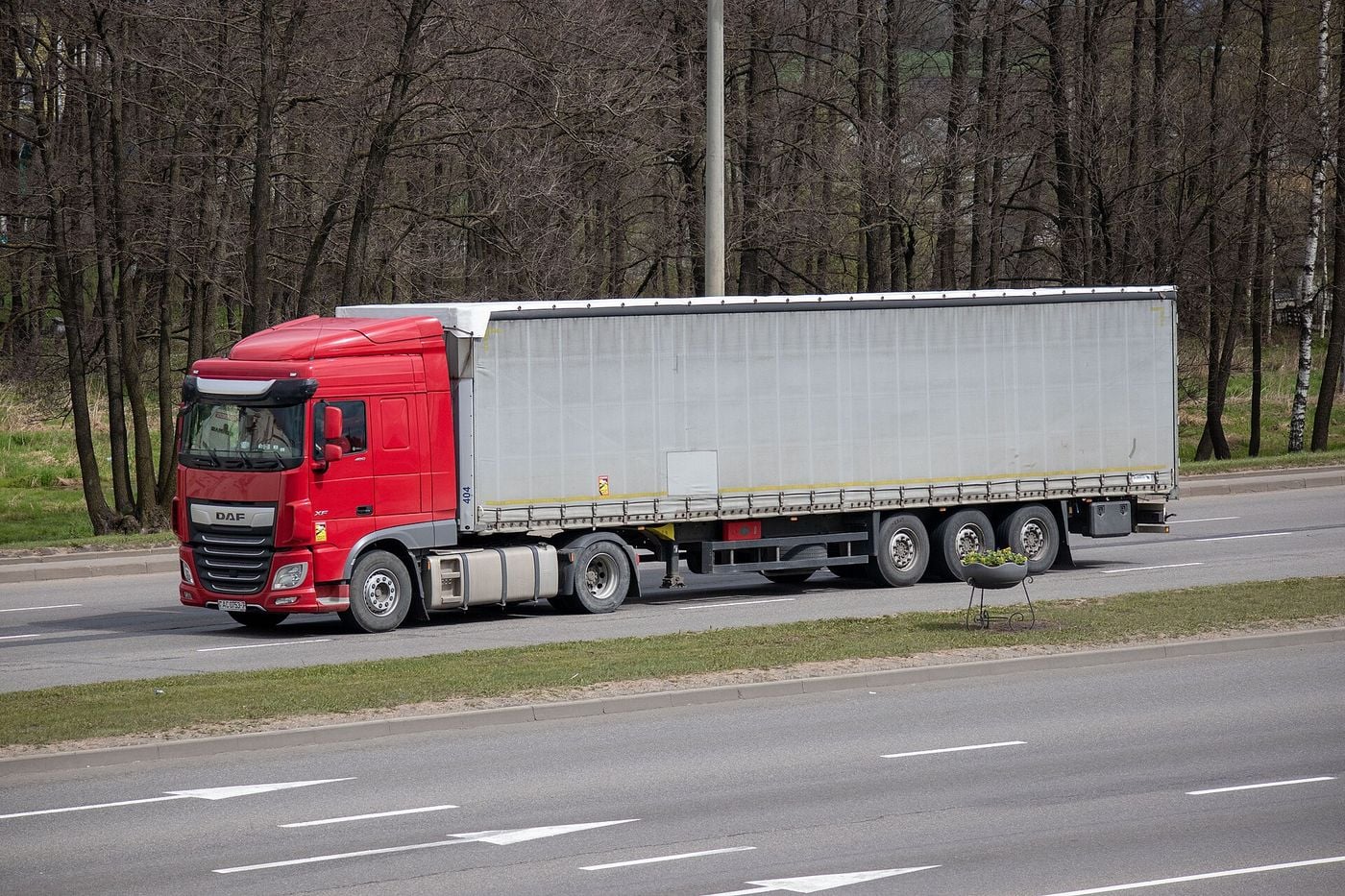
A semi truck is a tractor unit coupled to a semi-trailer, a trailer that rests partly on the tractor. United States federal rules define the two halves in 49 CFR 390.5T, as published in the eCFR on 5 October 2026: a truck tractor is “a self-propelled commercial motor vehicle designed and/or used primarily for drawing other vehicles”, and a semitrailer is “constructed so that some part of its weight rests upon the self-propelled towing motor vehicle”. In European Union law, Council Directive 96/53/EC (Article 2) calls the combination “an articulated vehicle consisting of a motor vehicle coupled to a semi-trailer”, and the towing vehicle has its own bodywork code, BC, “Tractor unit for semi-trailer”, in Annex I to Regulation (EU) 2018/858. Semi truck, 18-wheeler, tractor-trailer and big rig are everyday names; none of the definitions compared on this page uses them.
Status as of 8 October 2026. Every text was read on that day, in the version named in the second table and the source list; the EU texts in English, German and Spanish, the UN R.E.3 in English and Russian. The eCFR marks 49 CFR 390.5 as suspended indefinitely; the parallel section 390.5T, quoted here, has the same wording for every term used on this page. Turkish and Spanish legal texts are given in our translation; quotations keep the original words, followed by the translation in brackets.
Everyday words and the terms in the texts
Each market has its own everyday words for the vehicle. The table sets them beside the terms used in the texts read for each market or language: the national texts, the EU texts in their English, German and Spanish versions, and for Russian the Russian version of R.E.3.
| Market and language | Everyday words | Towing vehicle | Semi-trailer | Combination |
|---|---|---|---|---|
| United States, English | semi truck, 18-wheeler, tractor-trailer, big rig | truck tractor (49 CFR 390.5T; 23 CFR 658.5) | semitrailer (49 CFR 390.5T) | truck tractor-semitrailer (23 CFR 658.13) |
| Great Britain, English | articulated lorry, artic, tractor unit | no tractor-unit entry; the drawing vehicle is “a heavy motor car or motor car” (Construction and Use Regulations 1986, reg. 3) | semi-trailer (reg. 3) | articulated vehicle (reg. 3) |
| European Union, English version of the texts | — | tractor unit for semi-trailer (2018/858, code BC); tractor (2019/1242) | semi-trailer (2018/858; 96/53) | articulated vehicle (96/53) |
| Germany, German version of the EU texts | Sattelzug, Sattelauflieger | Sattelzugmaschine (2018/858, code BC; 2019/1242) | Sattelanhänger (2018/858; 96/53) | Sattelkraftfahrzeug (96/53) |
| Türkiye, Turkish | tır, dorse | çekici (Law No. 2918, Art. 3; Road Transport Regulation, Art. 4(1)(ı)) | yarı römork (Law No. 2918, Art. 3; Regulation, Art. 4(1)(uuu)) | taşıt katarı, coupled vehicles travelling as a unit (Law No. 2918, Art. 3; Regulation, Art. 4(1)(nnn)) |
| Russian, Russian version of R.E.3 | фура, седельный тягач | дорожный тягач (1.8); тягач для полуприцепа (2.3.4.1) | полуприцеп (1.5; 2.4.5.1) | сочлененное транспортное средство (1.7) |
| Spain, Spanish | cabeza tractora, tráiler | tractocamión (Reglamento General de Vehículos, Annex II; 2018/858, code BC) | semirremolque (Reglamento General de Vehículos; 2018/858; 96/53) | vehículo articulado (Reglamento General de Vehículos; 96/53) |
Neither tır nor dorse occurs in the current text of Türkiye’s Law No. 2918 or of the Road Transport Regulation (our search of both texts on 8 October 2026); both use çekici and yarı römork. The Regulation’s definition of a birim taşıt (unit vehicle) begins with “Yarı römorkuyla birlikte çekiciyi” (a çekici together with its yarı römork) (Article 4(1)(ğ)).
No text compared here defines an 18-wheeler or fixes a number of wheels for a semi truck. On a five-axle tractor and semi-trailer with single wheels on the steering axle and dual wheels on the other four axles, the wheels add up to 2 + 4 × 4 = 18 (our count); other axle or wheel layouts give other totals. Axle layouts are explained in axle configurations explained, and day cabs and sleeper cabs in truck cabs.
How the texts define the tractor unit, the semi-trailer and the combination
The same vehicle is defined in each of these texts for a different purpose: type approval in Regulation (EU) 2018/858, weights and dimensions in Directive 96/53/EC, CO2 standards in Regulation (EU) 2019/1242, the construction of vehicles in R.E.3, and road traffic, vehicle and transport rules in the national texts.
| Text | Towing vehicle | Semi-trailer | Combination |
|---|---|---|---|
| EU, Regulation (EU) 2018/858, Art. 3(33) and Annex I, Part C (consolidated 2 August 2026) | BC, tractor unit for semi-trailer: designed and constructed exclusively or principally to tow semi-trailers (BD, road tractor: to tow trailers other than semi-trailers) | Axle or axles behind the centre of gravity when uniformly loaded; a connecting device that transmits horizontal and vertical forces (Art. 3(33)). DA: a substantial vertical load on the towing vehicle; king pin and fifth wheel | No defined term in the provisions read |
| EU, Directive 96/53/EC, Art. 2 (consolidated 14 August 2019) | Motor vehicle: any power-driven vehicle that travels on the road by its own means | Part of it rests on the motor vehicle, which bears a substantial part of its weight and of its load’s weight; built for the carriage of goods | Articulated vehicle: a motor vehicle coupled to a semi-trailer (with a trailer: a road train) |
| EU, Regulation (EU) 2019/1242, Art. 3(6) and (7) (consolidated 10 September 2026) | Tractor: a tractor unit designed and constructed exclusively or principally to tow semi-trailers | Not defined in the points read; a rigid lorry is a lorry not designed or constructed to tow a semi-trailer | — |
| UN, R.E.3 Revision 7, 1.5 to 1.8, 2.3.4.1 and 2.4.5.1 (15 May 2023) | Road tractor (дорожный тягач): designed exclusively or primarily to haul road vehicles that are not power-driven, mainly semi-trailers; tractor for semi-trailer (тягач для полуприцепа) in 2.3.4.1 | Semi-trailer (полуприцеп): axle or axles behind the centre of gravity when uniformly loaded; a connecting device that transmits horizontal and vertical forces; one or more axles may be driven by the towing vehicle | Articulated vehicle (сочлененное транспортное средство): a motor vehicle with a semi-trailer coupled to it |
| US, 49 CFR 390.5T (eCFR of 5 October 2026); 23 CFR 658.5 and 658.13 (eCFR of 23 September 2026) | Truck tractor: a self-propelled commercial motor vehicle designed and/or used primarily for drawing other vehicles; in 658.5, the noncargo carrying power unit, with two exceptions | Semitrailer: designed to be drawn by another motor vehicle, with some part of its weight resting on the towing vehicle; pole trailers excluded | Truck tractor-semitrailer, a combination named in 658.13 |
| Great Britain, Road Vehicles (Construction and Use) Regulations 1986, reg. 3 (revised text) | No tractor-unit entry; the drawing vehicle is a heavy motor car or motor car | A trailer constructed or adapted to form part of an articulated vehicle | Articulated vehicle: part of the trailer is superimposed on the drawing vehicle, which bears not less than 20% of the weight of the load when the trailer is uniformly loaded |
| Türkiye, Law No. 2918, Art. 3 (current text) | Çekici: built to pull trailers and semi-trailers; carries no load | Yarı römork: a trailer resting partly on a motor vehicle or other vehicle, with part of its load and of its own weight carried by the motor vehicle | Taşıt katarı: vehicles coupled to travel on the road as a unit |
| Türkiye, Road Transport Regulation, Art. 4(1) (amendments up to 16 May 2026) | Çekici (ı): built to pull semi-trailers and trailers; cannot carry goods without them | Yarı römork (uuu): a trailer resting partly on a motor vehicle, which carries part of its goods and of its own weight | Taşıt katarı (nnn): at least one towing vehicle with at most two towed trailers, or with a semi-trailer and a trailer, coupled to travel as a unit |
| Spain, Reglamento General de Vehículos, Annex II (consolidated, 26 June 2026) | Tractocamión: designed and built mainly to haul a semi-trailer | Semirremolque: not self-propelled; coupled to a motor vehicle on which part of it rests, transferring to it a substantial part of its mass | Vehículo articulado: a motor vehicle coupled to a semi-trailer |
What the towing vehicle may carry. The EU and US texts describe a vehicle designed “exclusively or principally” (Regulation (EU) 2018/858, code BC) or designed and/or used “primarily” (49 CFR 390.5T) for towing. The Turkish texts define the çekici by the load it does not carry: “yük taşımayan” (carrying no load) in Law No. 2918, “bunlar olmadan eşya taşıyamayan” (unable to carry goods without them) in the Regulation. 23 CFR 658.5 calls the truck tractor “The noncargo carrying power unit that operates in combination with a semitrailer or trailer” and makes two exceptions: a truck tractor and semitrailer transporting automobiles may carry motor vehicles on part of the power unit, and a truck tractor with a dromedary unit, pulling a semitrailer that carries Class 1 explosives and/or munitions-related security material, may use the dromedary unit to carry a portion of the cargo.
How much of the semi-trailer rests on the tractor. The texts use general words: “a substantial part of its weight and of the weight of its load” (Directive 96/53/EC), “a substantial vertical load” (Regulation (EU) 2018/858, code DA), “una parte sustancial de su masa” (a substantial part of its mass, Reglamento General de Vehículos), “taşıdığı yükün ve kendi ağırlığının bir kısmı” (part of the load it carries and of its own weight, Law No. 2918), “some part of its weight” (49 CFR 390.5T). Of the texts compared, only the British one puts a figure on it: “not less than 20% of the weight of its load is borne by the drawing vehicle” when the trailer is uniformly loaded.
Where the axles are. Regulation (EU) 2018/858 (Article 3(33)) and R.E.3 (2.4.5.1) place them “behind the centre of gravity of the vehicle (when uniformly loaded)”. R.E.3 adds that “One or more of the axles may be driven by the towing vehicle”, and the British semi-trailer includes a vehicle “which has some or all of its wheels driven by the drawing vehicle”. The Glossary for transport statistics describes the semi-trailer as a “Goods road vehicle with no front axle designed in such way that part of the vehicle and a substantial part of its loaded weight rests on a road tractor”.
R.E.3, a consolidated resolution of the UNECE World Forum WP.29, notes that its definitions of paragraph 1 are according to the Vienna Convention on Road Traffic of 8 November 1968 and the European Agreements supplementing it, except the road tractor, taken from the OECD “Glossary of statistical terms”.
Semi-trailer, trailer and drawbar trailer
Most of the texts treat the semi-trailer as a kind of trailer: “a trailer in which the axle, or axles are positioned behind the centre of gravity” (Regulation (EU) 2018/858, Article 3(33)); a trailer “includes semi–trailers” (R.E.3, 1.5); the semitrailer is listed under “Trailer includes” (49 CFR 390.5T); “a trailer which is constructed or adapted to form part of an articulated vehicle” (British regulation 3); and in Law No. 2918 the yarı römork is a römork, the unpowered vehicle drawn by a motor vehicle to carry people or goods. Directive 96/53/EC defines a trailer “excluding semi-trailers”, and Spain’s Reglamento General de Vehículos defines the remolque and the semirremolque in separate entries. In everyday Turkish a yarı römork is a dorse.
Annex I, Part C of Regulation (EU) 2018/858 gives each type of trailer a two-letter code. The definitions separate them by their axles, by the vertical load on the towing vehicle and by the coupling; DF and DG also have a fifth wheel at the rear.
| Code | English, German and Spanish names | What the definition says |
|---|---|---|
| DA | Semi-trailer; Sattelanhänger; semirremolque | Imposes a substantial vertical load on a tractor unit or converter dolly; coupled by a king pin and a fifth wheel |
| DB | Drawbar trailer; Deichselanhänger; remolque con barra de tracción | At least two axles, at least one of them steered; a towing device that can move vertically; less than 100 daN static vertical load on the towing vehicle |
| DC | Centre-axle trailer; Zentralachsanhänger; remolque de eje central | Axle or axles close to the centre of gravity; static vertical load on the towing vehicle not over 10 % of the trailer’s maximum mass or 1,000 daN, whichever is the lesser |
| DE | Rigid drawbar trailer; Starrdeichselanhänger; remolque con barra de tracción rígida | One axle or axle group; a drawbar transmitting a static load of not more than 4,000 daN; not a centre-axle trailer; no king pin and fifth wheel |
| DF | Link semi-trailer; Sattelanhänger mit Kupplung; semirremolque de enlace | A semi-trailer with a fifth wheel at the rear to tow another semi-trailer |
| DG | Link drawbar trailer; Deichselanhänger mit Kupplung; remolque de enlace con barra de tracción | A drawbar trailer with a fifth wheel at the rear to tow another semi-trailer |
R.E.3 sorts trailers of categories O2, O3 and O4 into three types: the semi-trailer, the full trailer, which “transmits no significant static load to the towing vehicle”, and the centre-axle trailer, with the same limit of 10 per cent of the trailer’s maximum mass or 1,000 daN as code DC (2.4.5). Spain’s remolque completo transmits no significant load to the towing vehicle, “(menos de 100 kg.)” (less than 100 kg). In the United States no part of a full trailer’s weight, “except for the towing device”, rests on the towing vehicle, and “A semitrailer equipped with an auxiliary front axle (converter dolly) shall be considered a full trailer” (49 CFR 390.5T). Directive 96/53/EC calls a motor vehicle with a trailer a road train, as Spain does with the tren de carretera, and code BD of Regulation (EU) 2018/858, the road tractor, is built “to tow trailers other than semi-trailers”. The bodies built on semi-trailers, from curtainsiders to low loaders, are described in trailer types explained.
The coupling: king pin and fifth wheel
Code DA makes the coupling part of the definition: “The coupling to be used for a vehicle combination shall consist of a king pin and a fifth wheel”. Code DE rules that coupling out for a rigid drawbar trailer, and codes DF and DG put a fifth wheel at the rear of a trailer. The figures that decide whether a tractor can couple to a given semi-trailer, such as the D value, the imposed load and the coupling height, are covered in kingpin and fifth wheel.
How the tractor unit and the semi-trailer are classified by mass
Regulation (EU) 2018/858 (Article 4(1)) sorts motor vehicles designed and constructed primarily for the carriage of goods by maximum mass into categories N1 (not exceeding 3.5 tonnes), N2 (exceeding 3.5 tonnes but not exceeding 12 tonnes) and N3 (exceeding 12 tonnes), and trailers into O1 (not exceeding 0.75 tonnes), O2 (exceeding 0.75 tonnes but not exceeding 3.5 tonnes), O3 (exceeding 3.5 tonnes but not exceeding 10 tonnes) and O4 (exceeding 10 tonnes); R.E.3 sets the same limits in kilograms. For a tractor unit, “the maximum mass to be considered for classifying the vehicle shall include the maximum mass of the semi-trailer borne by the fifth wheel coupling” (Annex I, point 2.2.1). For a semi-trailer, the mass that counts is “the maximum mass transmitted to the ground by the wheels of an axle or group of axles when coupled to the towing vehicle” (point 2.2.3). In R.E.3 (2.3.4.1), the mass to be considered for classifying a tractor for semi-trailer is the mass of the tractor in running trim, increased by the mass corresponding to the maximum static vertical load transferred to it by the semi-trailer and, where applicable, by the maximum mass of the tractor’s own load.
US federal rules group vehicles by gross vehicle weight rating in Table II of 49 CFR 565.15, whose top group, Class 8, is “Greater than 14968 kg. (33,001 lbs. and over)”; the ratings are explained in GVWR, GCWR and GAWR. How much a semi truck may weigh on the road and how long it may be are set by other rules: for the European Union in truck weights and semi-trailer dimensions, for the United States in how much a semi-truck weighs and semi-truck dimensions. The definitions of logistics and of the carrier and forwarder roles in road freight are compared in what is logistics.
Quick answers
- What is a semi truck?
- A semi truck is a tractor unit coupled to a semi-trailer. In US federal rules (49 CFR 390.5T) a truck tractor is 'a self-propelled commercial motor vehicle designed and/or used primarily for drawing other vehicles', and a semitrailer is built so that 'some part of its weight rests upon the self-propelled towing motor vehicle'. Directive 96/53/EC calls the combination an articulated vehicle, 'a motor vehicle coupled to a semi-trailer'. Semi truck, 18-wheeler, tractor-trailer and big rig are everyday names; none of the definitions compared on this page uses them.
- What is a tractor unit?
- In Annex I to Regulation (EU) 2018/858 the tractor unit for semi-trailer, code BC, is 'A towing vehicle that is designed and constructed exclusively or principally to tow semi-trailers'; Regulation (EU) 2019/1242 defines the 'tractor' as 'a tractor unit that is designed and constructed exclusively or principally to tow semi-trailers'. US federal rules call it a truck tractor, and 23 CFR 658.5 defines it as 'The noncargo carrying power unit that operates in combination with a semitrailer or trailer', with two exceptions. Türkiye's Road Traffic Law defines the çekici as a motor vehicle built to pull trailers and semi-trailers that carries no load. For classification in the EU, the maximum mass considered for a tractor unit includes the maximum mass of the semi-trailer borne by the fifth wheel coupling, and category N3 covers motor vehicles with a maximum mass exceeding 12 tonnes.
- What is the difference between a semi-trailer and a trailer?
- In Annex I, Part C of Regulation (EU) 2018/858 a semi-trailer (code DA) imposes a substantial vertical load on the towing vehicle and is coupled by a king pin and a fifth wheel. A drawbar trailer (DB) has at least two axles, at least one of them steered, and transmits less than 100 daN as a static vertical load; a centre-axle trailer (DC) transmits no more than 10 % of its maximum mass or 1,000 daN, whichever is less. Regulation (EU) 2018/858, R.E.3 and the US, British and Turkish texts treat the semi-trailer as a kind of trailer; Directive 96/53/EC defines 'trailer' as excluding semi-trailers.
- What is an articulated lorry?
- Articulated lorry and artic are everyday British words. Regulation 3 of the Road Vehicles (Construction and Use) Regulations 1986 defines an articulated vehicle as a heavy motor car or motor car with a trailer attached so that part of the trailer is superimposed on the drawing vehicle and, when the trailer is uniformly loaded, not less than 20% of the weight of its load is borne by the drawing vehicle. Directive 96/53/EC defines the articulated vehicle as a motor vehicle coupled to a semi-trailer.
- How many wheels does an 18-wheeler have?
- None of the definitions compared here defines an 18-wheeler or fixes a number of wheels for a semi truck. On a five-axle tractor and semi-trailer with single wheels on the steering axle and dual wheels on the other four axles, the wheels add up to 2 + 4 × 4 = 18 (our count); other axle or wheel layouts give other totals.
Sources
- Regulation (EU) 2018/858 on the approval and market surveillance of motor vehicles and their trailers — consolidated text of 2 August 2026, Articles 3 and 4 and Annex I (introductory part, point 2.2, and Part C), English, German and Spanish versions — EUR-Lex, European Union
- Council Directive 96/53/EC laying down the maximum authorised dimensions and weights for certain road vehicles — consolidated text of 14 August 2019, Article 2, English, German and Spanish versions — EUR-Lex, European Union
- Regulation (EU) 2019/1242 setting CO2 emission performance standards for new heavy-duty vehicles — consolidated text of 10 September 2026, Article 3, English, German and Spanish versions — EUR-Lex, European Union
- Consolidated Resolution on the Construction of Vehicles (R.E.3), Revision 7, ECE/TRANS/WP.29/78/Rev.7, 15 May 2023 — paragraphs 1 and 2, English and Russian versions — United Nations Economic Commission for Europe, World Forum for Harmonization of Vehicle Regulations (WP.29), 15 May 2023
- 49 CFR 390.5T Definitions (and the Effective Date Note on 49 CFR 390.5) — eCFR, issue date 5 October 2026 — Electronic Code of Federal Regulations, United States
- 23 CFR 658.5 Definitions and 23 CFR 658.13 Length — eCFR, issue date 23 September 2026 — Electronic Code of Federal Regulations, United States
- 49 CFR 565.15, Table II — Gross Vehicle Weight Rating Classes — eCFR, issue date 5 October 2026 — Electronic Code of Federal Regulations, United States
- The Road Vehicles (Construction and Use) Regulations 1986 (SI 1986/1078), regulation 3 — latest available revised text — legislation.gov.uk, The National Archives, United Kingdom
- Law No. 2918, Karayolları Trafik Kanunu (Road Traffic Law) — current text, Article 3 — Mevzuat Bilgi Sistemi, Presidency of the Republic of Türkiye
- Karayolu Taşıma Yönetmeliği (Road Transport Regulation, Resmî Gazete of 8 January 2018, No. 30295) — consolidated text with amendments up to the Resmî Gazete of 16 May 2026, No. 33255, Article 4 — Mevzuat Bilgi Sistemi, Presidency of the Republic of Türkiye
- Real Decreto 2822/1998, Reglamento General de Vehículos — consolidated text, last update published on 26 June 2026, Annex II — Agencia Estatal Boletín Oficial del Estado, Spain
- Glossary for transport statistics, 5th edition (2019) — road transport chapter — Eurostat, United Nations Economic Commission for Europe and International Transport Forum