What is a Jake Brake? Engine brakes, noise rules and signs
Jake Brake is a Jacobs Vehicle Systems trademark for engine retarders. New US trucks over 10,000 lb GVWR face an 80 dBA limit at 50 feet; the MUTCD has no engine-brake sign.
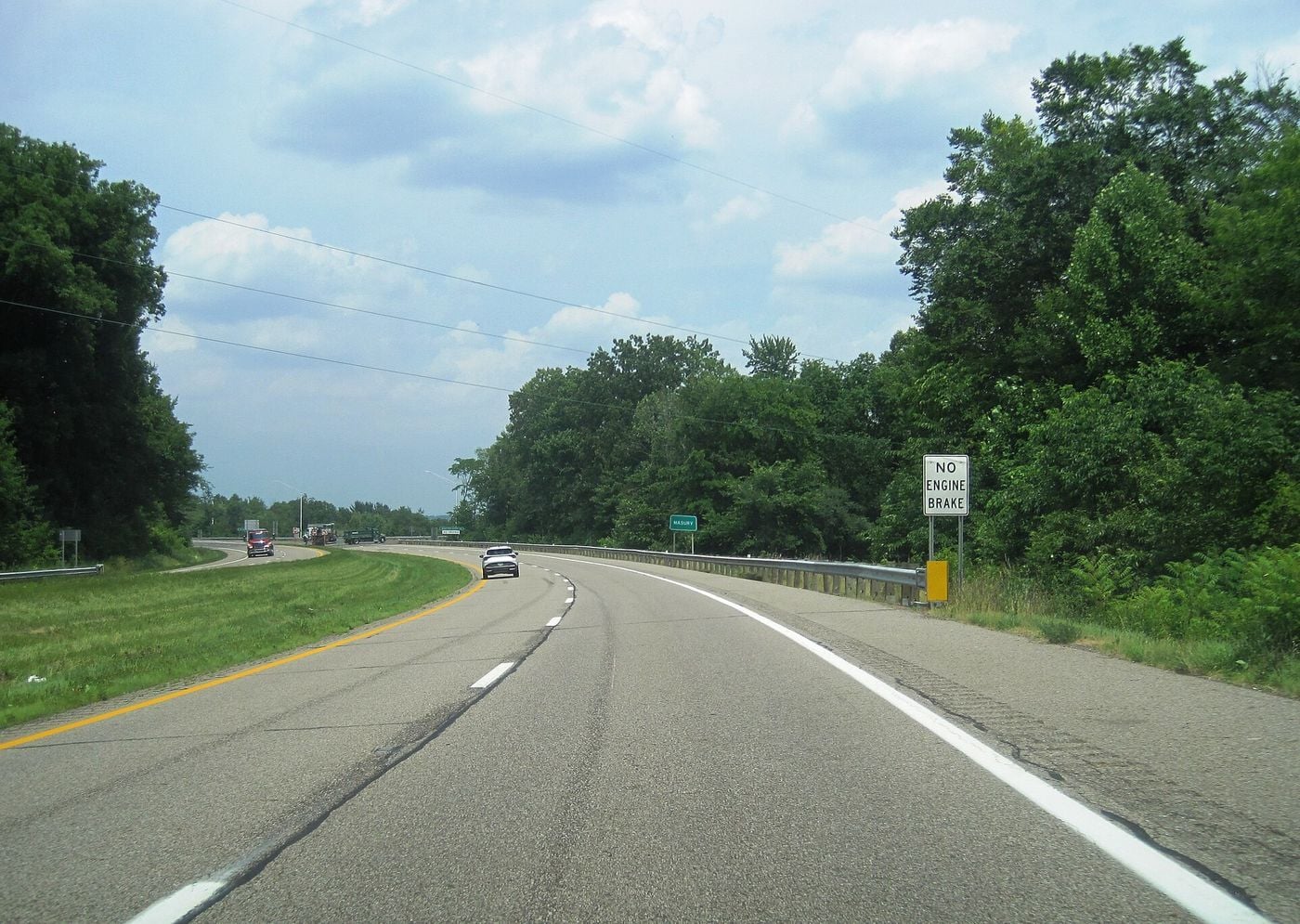
“Jake Brake” is a registered trademark: the US Patent and Trademark Office record names Jacobs Vehicle Systems, Inc. as the owner of JAKE BRAKE for engine retarders for land vehicle engines, with first use given as April 1966. The federal noise standard for new trucks over 10,000 pounds GVWR, 80 dBA measured 50 feet away for vehicles made after January 1, 1988, adds a closed throttle deceleration test for trucks equipped with an engine brake. The national sign manual has no “no engine brake” sign; it lets State and local highway agencies develop special word legend signs.
Status: 8 November 2026. This page follows the USPTO trademark records as generated on November 8, 2026; 40 CFR Part 205 in the annual Code of Federal Regulations edition revised as of July 1, 2025, the most recent edition govinfo served that day; the MUTCD 11th Edition with Revision 1 (Final Rules published on December 19, 2023 and March 5, 2026); the 2026 Kansas Statutes; the Delaware Code Online; and the Delaware MUTCD, Revision 3 of May 2018. The engine makers’ pages and brochures cited below were read the same day.
| Item | What the text says | Source |
|---|---|---|
| Trademark | JAKE BRAKE, Reg. No. 2864614, owner Jacobs Vehicle Systems, Inc., for engine retarders for land vehicle engines; live, renewed August 27, 2024 | USPTO TSDR |
| Second trademark | JAKE BRAKE with a road design, Reg. No. 3635162, for exhaust brakes; live, renewed March 23, 2019 | USPTO TSDR |
| Federal noise standard | 83 dBA for vehicles made after January 1, 1979; 80 dBA after January 1, 1988; vehicles over 10,000 pounds GVWR | 40 CFR 205.50, 205.52 |
| Where it is measured | Microphone 50 feet from the centerline of truck travel, 4 feet above the ground; A-weighting, fast response | 40 CFR 205.54-1 |
| Engine-brake test | Closed throttle deceleration test, required only for vehicles equipped with an engine brake | 40 CFR 205.54-1(c) |
| In-use standard | [Reserved] | 40 CFR 205.52(d) |
| National sign | None in the MUTCD 11th Edition with Revision 1 | MUTCD |
| A State sign | Delaware SR1-19-DE: ENGINE COMPRESSION BRAKE USE PROHIBITED EXCEPT FOR EMERGENCIES, with a TRUCKS plaque | Delaware MUTCD 2B.70, Figure 2B-33 |
What is a Jake Brake?
The USPTO’s Trademark Status and Document Retrieval record for Registration No. 2864614 shows the standard-character mark JAKE BRAKE on the Principal Register, filed on July 24, 2003 and registered on July 20, 2004, with the status “LIVE/REGISTRATION/Issued and Active” and the note that the registration has been renewed; the second ten-year renewal is dated August 27, 2024. The goods are “ENGINE PARTS, NAMELY, ENGINE RETARDERS FOR LAND VEHICLE ENGINES” in international class 7, with first use given as April 1966 and first use in commerce as December 1970. The record lists Jacobs Vehicle Systems, Inc., a Delaware corporation in Bloomfield, Connecticut, as the current owner, disclaims the word “BRAKE”, and claims ownership of Registrations Nos. 1448368 and 1672541.
A second registration, No. 3635162, is for the words with “the design of a swerving road inside a square”, again with “BRAKE” disclaimed. Its goods are “Automotive and truck parts, namely, exhaust brakes” in class 12, with first use in 1997; it was registered on June 9, 2009 and renewed on March 23, 2019, and the same company is listed as owner.
State laws use their own terms for engine braking devices. Kansas defines a “compression release engine braking system” as “a hydraulically operated device that converts a power producing diesel engine into a power absorbing retarding mechanism” (K.S.A. 8-1761(b)). Delaware’s definition of an “engine compression brake device” is “any device that uses the engine and transmission to impede the forward motion of the motor vehicle by compression of the engine” (21 Del. C. § 4311A(b)). How the compression release brake works inside the cylinder, in Cummins’ description of the Jacobs mechanism, and how UN Regulation No. 13 groups it with exhaust brakes and retarders, are set out in what is a retarder? The other American truck words, from bobtail to cabover, are defined in 18-wheeler, bobtail, cabover and other truck terms.
Engine brakes in the makers’ documents
Truck and engine makers’ own documents describe the engine brakes as follows.
| Maker and engine | Wording in the document | Document |
|---|---|---|
| International S13 Integrated | “double overhead cam design with integrated compression release brake assembly” | S13 Integrated Powertrain EPA 2027 brochure, TAD22004 07/2026 |
| PACCAR MX-13 (Euro 6) | Under “MX Engine Brake”: “integrated compression release brake” and “VTG and BPV for brake power control” | DAF Components, PACCAR MX-13 truck engine page |
| Volvo D11, D13 and D17 (Euro 6) | “Volvo Engine Brake, compression brake with exhaust pressure governor”; VEB+ a “high efficiency compression brake with exhaust pressure governor” | Volvo Trucks fact sheet, 17 June 2024 |
| Volvo D13 (North America) | Engine brake retarding power 500 HP [372 kW] at 2200 RPM; type not named | Volvo Trucks North America, D13 page |
| Mack MP8 | Engine brake retarding power 500 HP [372 kW] at 2100 RPM; type not named | Mack Trucks, MP8 page |
| Cummins X15 in the International LT | “Jacobs Engine Brake®” among the X15 features | International LT Series brochure, TAD16013 06/2025 |
International’s 2027 brochure gives the S13’s braking power in two ways. It gives the new compression release brake “braking power of up to 470 HP (at sea level)”, and says that “Variable valve braking (VVB)” “Works alongside VVT to deliver improved engine braking performance, with VVB braking at 470 hp”; its parts list reads “Improved engine braking performance from 470hp to 540hp”. The engine families behind these rows are described in the PACCAR MX-13 engine and the Volvo D13 engine, and the truck that the LT brochure describes is the International LT.
The federal noise standard: 40 CFR Part 205, subpart B
Subpart B covers medium and heavy trucks. Section 205.50(a) applies it to “any vehicle which has a gross vehicle weight rating (GVWR) in excess of 10,000 pounds, which is capable of transportation of property on a highway or street and which meets the definition of the term ‘new product’ in the Act.” Paragraph (b) leaves out “highway, city, and school buses” and special purpose equipment such as construction equipment, snow plows, garbage compactors and refrigeration equipment. In section 205.51, a vehicle also has to have “a partially or fully enclosed operator’s compartment”, and GVWR is defined there as “the value specified by the manufacturer as the loaded weight of a single vehicle”; how that rating is used elsewhere in federal rules is set out in GVWR, GCWR and GAWR.
Section 205.52(a) is the standard itself: vehicles manufactured after the effective dates “shall be designed, built and equipped so that they will not produce sound emissions in excess of the levels indicated.”
| Effective date | Level |
|---|---|
| January 1, 1979 | 83 dBA |
| January 1, 1988 | 80 dBA |
Paragraph (b) ties the levels to the measurement procedures in sections 205.54-1 and 205.54-2. Paragraph (d), “In-Use Standard”, and paragraph (e), “Low Noise Emission Product”, both read “[Reserved]”. The source notes of the section give the amendments of December 5, 1977 and January 8, 1986 (51 FR 852).
How the test is set up
Section 205.54-1 is the low speed sound emission test. Its procedure states: “Full throttle acceleration and closed throttle deceleration tests are to be used,” and “Closed throttle deceleration tests are required only for those vehicles equipped with an engine brake.” The recommended format for the vehicle noise data sheet, Table IV in Appendix I to subpart B, carries a separate line for a “Deceleration Test with Exhaust Brake Applied”.
| Condition | Requirement |
|---|---|
| Microphone | 50 feet ±4 in. (15.2 ±0.1 meter) from the centerline of truck travel, 4 feet ±4 in. (1.2 ±0.1 meters) above the ground plane |
| Test site | Open space free of large reflecting surfaces within 100 feet (30.4 meters) of the vehicle path or the microphone; smooth concrete or smooth sealed asphalt |
| Run | Acceleration point 50 feet (15 m) before the microphone point; end point 100 feet (30 m) from the acceleration point; end zone the last 40 feet (12 m) |
| Acceleration test | Wide-open throttle starting at no more than two-thirds (66 percent) of maximum rated or of governed engine speed with standard transmissions, at two-thirds with automatic transmissions; reaching maximum rated or governed engine speed within the end zone, without exceeding 35 mph (56 k/h) before the end point |
| Meter | Set for “fast response” and the A-weighted network; readings on both sides of the vehicle |
| Result | Average of the first two pass-by measurements on each side if within 2 dB(A) of each other; the reported level is the higher of the two side averages |
| Weather and background | Wind below 12 mph (19 km/hr); no wet road, snow cover or precipitation; background at least 10 dB below the regulated level |
Section 205.54 describes these procedures as “the test program to determine the conformity of vehicles with the standards set forth in § 205.52 for the purposes of Selective Enforcement Auditing and Testing by the Administrator.”
Engine brake signs: what the MUTCD says
The Manual on Uniform Traffic Control Devices, in FHWA’s words, “defines the standards used by road managers nationwide to install and maintain traffic control devices on all streets, highways, pedestrian and bicycle facilities, and site roadways open to public travel.” FHWA’s MUTCD page states that a Final Rule adopting Revision 1 of the 11th Edition was published on March 5, 2026, effective that day, and that States must adopt the 11th Edition as their legal State standard within two years from its effective date of January 18, 2024. The 11th Edition with Revision 1 has no sign for engine braking or compression braking.
What the manual says about wording it does not supply is in Section 2A.04. Paragraph 11: “In situations where word messages are necessary other than those provided in this Manual (see Paragraph 15 of this Section), the signs shall be of the same shape and color as standard signs of the same functional type.” Paragraph 15: “State and local highway agencies and owners of site roadways open to public travel may develop special word legend signs in situations where engineering judgment determines roadway conditions make it necessary to provide road users with additional regulatory, warning, or guidance information, such as when road users need to be notified of special regulations or warned about a situation that might not be readily apparent. Unlike colors that have not been assigned or symbols that have not been approved for signs, new word legend signs may be used without the need for experimentation.” Paragraph 16 adds that such word legends “might still warrant an evaluation to determine comprehension or possible misinterpretation of the intended message by the road user.”
Two State examples: Delaware and Kansas
Delaware. Section 4303(c) of Title 21 of the Delaware Code reads: “Except as provided in this subsection, no motor vehicle, when operated upon a highway in this State, shall utilize or employ any brake or braking system that is attached to, or an integral part of, the vehicle’s internal combustion engine or exhaust systems.” The same subsection adds that nothing in the section shall be interpreted as prohibiting the equipping of a motor vehicle with such a system, or its use “in an emergency situation or an emergency vehicle including police, fire, ambulance, emergency medical service vehicles or other emergency vehicles.” Section 4311A(a) adds: “No person shall drive a commercial vehicle equipped with an engine compression brake device on a highway, including residential streets, unless such commercial vehicle is also equipped with a muffler in good working order and in accordance with manufacturer’s specifications and in constant operation to prevent excessive noise.” Under section 4315, a violation of section 4311A is fined $500; violations of sections 4301 to 4305 are fined $25 to $115 for a first offense and $57.50 to $230, or 10 to 30 days’ imprisonment, or both, for each subsequent like offense; and a violation of section 4303(c) is also a moving violation on the driving record.
Delaware’s MUTCD carries the matching sign. Section 2B.70 provides that Engine Compression Brake Prohibition (SR1-19-DE) signs “may be installed at major points of entry into the state and along designated truck routes entering the state to inform motorists of their responsibilities under § 4303 of Title 21 of the Delaware Code, which restricts the use of engine exhaust braking systems except in emergency braking situations.”
| Item | Delaware MUTCD |
|---|---|
| Legend | ENGINE COMPRESSION BRAKE USE PROHIBITED EXCEPT FOR EMERGENCIES |
| Colors | Black legend and border on a white background, with a plaque at the top reading TRUCKS in black on yellow |
| Size, conventional roads | 42 x 60 inches (width x height), single-lane and multi-lane |
| Size, expressways and freeways | 60 x 84 inches (width x height) |
| Where | Major points of entry, including Interstate, U.S. Route and State Route crossings of the state line, and designated truck routes entering the state |
| Local roads | May be installed on roads entering cities, towns and municipalities at the request of the local government, which bears the cost of installing and maintaining them |
DelDOT’s manual page lists a 2026 Delaware MUTCD as pending approval; the section quoted here is from the 2011 edition at Revision 3.
Kansas. K.S.A. 8-1761, headed “Improper compression release engine braking system”, provides in subsection (a): “It shall be unlawful for the driver of any motor vehicle to use or cause to be used or operated any compression release engine braking system without such motor vehicle being equipped with a muffler in accordance with K.S.A. 8-1739, and amendments thereto.” The section dates from 2004 (L. 2004, ch. 114, § 1) and is part of the uniform act regulating traffic on highways.
What this page does not cover
- When and how an engine brake is used on the road, and how it is fitted, adjusted or serviced.
- Municipal ordinances and the signs posted under them.
- Where a given sign or local rule applies, and whether it is valid.
Quick answers
- What is a Jake Brake?
- Jake Brake is a registered trademark: USPTO Registration No. 2864614 names Jacobs Vehicle Systems, Inc. as owner and covers engine parts, namely engine retarders for land vehicle engines. State laws use their own terms for engine braking devices: Kansas law, for example, defines a “compression release engine braking system” as “a hydraulically operated device that converts a power producing diesel engine into a power absorbing retarding mechanism” (K.S.A. 8-1761(b)).
- Is Jake Brake a brand name?
- Yes. The USPTO record for Registration No. 2864614 shows JAKE BRAKE as a live registration owned by Jacobs Vehicle Systems, Inc., registered on July 20, 2004 and renewed on August 27, 2024, with first use given as April 1966 and the word “BRAKE” disclaimed. A second live registration, No. 3635162, covers the words with a road design for exhaust brakes.
- What federal noise standard applies to new trucks with an engine brake?
- 80 dBA for new vehicles over 10,000 pounds GVWR manufactured after January 1, 1988, and 83 dBA after January 1, 1979, under 40 CFR 205.52. The level is measured 50 feet from the vehicle path, and the closed throttle deceleration test is required only for vehicles equipped with an engine brake. The in-use standard in the same section is reserved.
- Is there an official engine brake prohibited sign?
- Not in the national MUTCD: the 11th Edition with Revision 1 has no engine-brake sign. Section 2A.04 lets State and local highway agencies develop special word legend signs where engineering judgment determines that road users need additional information, such as notice of special regulations. Delaware's MUTCD, for example, has the SR1-19-DE sign reading ENGINE COMPRESSION BRAKE USE PROHIBITED EXCEPT FOR EMERGENCIES under a yellow TRUCKS plaque.
- What do State laws say about engine brakes?
- Two examples: Delaware's 21 Del. C. § 4303(c) bars motor vehicles on its highways from using a braking system attached to or part of the engine or exhaust, except in an emergency or on emergency vehicles, and § 4311A requires a muffler on commercial vehicles with an engine compression brake, fined $500. Kansas makes it unlawful to use a compression release engine braking system without a muffler (K.S.A. 8-1761).
Models in this article
Sources
- Trademark status: JAKE BRAKE, US Serial No. 76532279, Registration No. 2864614 (TSDR record generated November 8, 2026) — United States Patent and Trademark Office
- Trademark status: JAKE BRAKE and design, US Serial No. 77611096, Registration No. 3635162 (TSDR record generated November 8, 2026) — United States Patent and Trademark Office
- 40 CFR Part 205, Transportation Equipment Noise Emission Controls, Subpart B — Medium and Heavy Trucks (annual edition revised as of July 1, 2025) — U.S. Government Publishing Office, govinfo
- Manual on Uniform Traffic Control Devices, 11th Edition (December 2023) with Revision 1 (December 2025), Sections 2A.04 and 2B.65 to 2B.76 — Federal Highway Administration
- MUTCD home page: Current Edition of the MUTCD, Final Rules of December 19, 2023 and March 5, 2026 — Federal Highway Administration
- K.S.A. 8-1761, Improper compression release engine braking system (2026 Kansas Statutes) — Revisor of Statutes, State of Kansas
- Delaware Code, Title 21, Chapter 43, Subchapter I: sections 4303, 4311A and 4315 — State of Delaware, Delaware Code Online
- Delaware MUTCD, Part 2 — Signs, Revision 3, May 2018: Section 2B.70, Table 2B-1 and Figure 2B-33 — Delaware Department of Transportation
- Delaware Manual on Uniform Traffic Control Devices (MUTCD): manual page listing the 2011 edition and the 2026 edition pending approval — Delaware Department of Transportation
- S13 Integrated Powertrain, EPA 2027, product brochure (TAD22004, 07/2026) — International Motors, LLC
- LT Series Truck, product brochure (TAD16013, 06/2025) — International Motors, LLC
- PACCAR MX-13 truck engine (product page) — DAF Components
- Fact sheet: Engine brake — EBR-VEB+, EBR-VEB, EBR-EPGC, EBR-EPG (ENG Version 02, 17 June 2024) — Volvo Trucks
- Volvo D13 engine (specifications) — Volvo Trucks North America
- MP8 engine (specifications) — Mack Trucks