Automated and driverless trucks and buses: the rules in the EU, Germany and Great Britain
EU type-approval of driverless trucks and buses covers predefined areas and hub-to-hub routes, at most 1,500 registrations of a type a year. The German and British rules as at 27 October 2026.
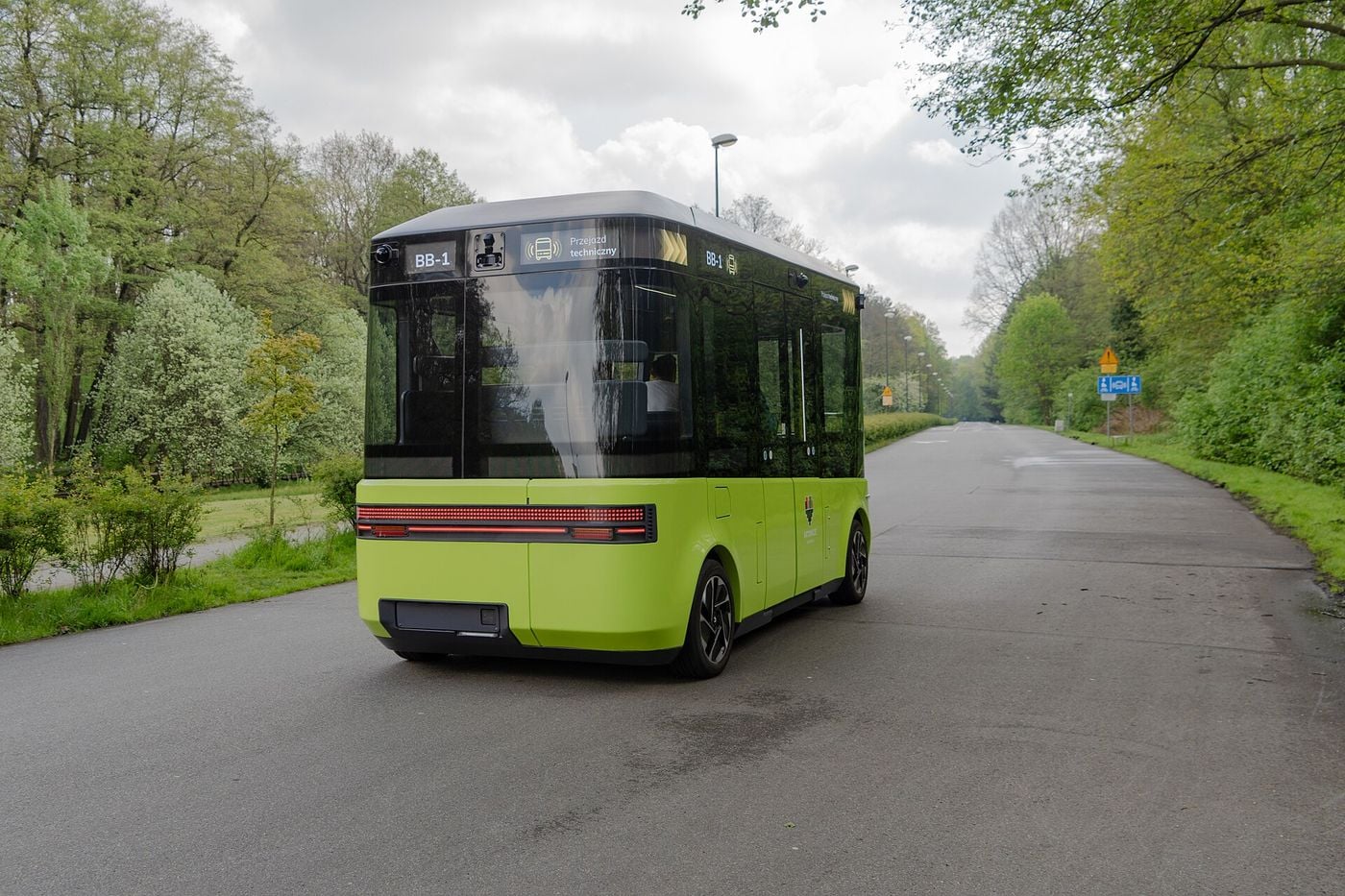
A truck or bus built to drive itself with no driver supervision at all is a “fully automated vehicle” in EU law (Regulation (EU) 2019/2144, Article 3(22)). Its automated driving system can be type-approved under Commission Implementing Regulation (EU) 2022/1426, in force since 15 September 2022, for three use cases: carrying passengers or goods in a predefined area, the same on a “hub-to-hub” route with fixed start and end points, and automated valet parking. For fully automated vehicles of categories M2, M3, N2 and N3, Regulation (EU) 2018/858 allows at most 1,500 units of a type a year in the Union under its small series scheme. Under its recital 7, Regulation 2022/1426 is without prejudice to the Member States’ right to regulate the circulation and the safety of operation of fully automated vehicles in traffic. Germany allows a vehicle with an autonomous driving function on public roads only in an approved operating area and under a technical supervision. In Great Britain the Automated Vehicles Act 2024 provides for authorising self-driving vehicles and licensing the operators of vehicles with no one in charge; on 27 October 2026 those parts were not in force, while permits for automated passenger services have applied since 15 May 2026.
Status as at 27 October 2026. Read on that day: Regulations (EU) 2019/2144 and 2022/1426 in their Official Journal texts and their latest consolidated texts, of 2 August 2026 and 24 March 2026; the amending Implementing Regulation (EU) 2026/481; Regulation (EU) 2018/858 as consolidated on 2 August 2026 and Delegated Regulation (EU) 2026/1188; the EU Publications Office’s records of acts amending Regulation 2022/1426; sections 1d to 1l of the German Road Traffic Act (StVG) and the AFGBV ordinance on gesetze-im-internet.de; the Automated Vehicles Act 2024 with its commencement information on legislation.gov.uk and S.I. 2026/731; and two GOV.UK publications of 2025.
Automated, fully automated and dual mode: the EU terms
Regulation (EU) 2019/2144, the EU’s General Safety Regulation, defines two levels. An “automated vehicle” is a motor vehicle “designed and constructed to move autonomously for certain periods of time without continuous driver supervision but in respect of which driver intervention is still expected or required” (Article 3(21)). A “fully automated vehicle” is a motor vehicle “that has been designed and constructed to move autonomously without any driver supervision” (Article 3(22)).
Implementing Regulation (EU) 2022/1426 adds the dual mode vehicle: a fully automated vehicle with a driver seat, driven by a driver in a manual driving mode and by the automated driving system (ADS) in a fully automated driving mode, switching between the two only at standstill (Article 2(34)). It also defines two roles for people who are not drivers. An on-board operator inside the vehicle may, among other tasks, activate or deactivate the ADS, request a minimal risk manoeuvre, confirm a manoeuvre the ADS proposes while the vehicle is at standstill, and assist passengers; a remote intervention operator outside the vehicle may carry out the same tasks remotely where it is safe to do so. In both cases the operator “shall not drive the fully automated vehicle and the ADS shall continue to perform the DDT”, the dynamic driving task (Article 2(24) and (25)).
The driver assistance systems that EU law requires on new trucks and buses, with their dates, are set out in mandatory driver assistance systems, and Euro NCAP’s rating of such systems on trucks in how Euro NCAP tests trucks. The categories M (passengers) and N (goods) used below are explained in vehicle categories M, N and O.
Article 11 and the Annex II rows for automated vehicles
Article 11(1) of Regulation 2019/2144 requires automated and fully automated vehicles to comply with implementing acts on six items: (a) systems to replace the driver’s control of the vehicle, including signalling, steering, accelerating and braking; (b) systems giving the vehicle real-time information on its state and the surrounding area; (c) driver availability monitoring systems, which do not apply to fully automated vehicles; (d) event data recorders for automated vehicles; (e) a harmonised format for the exchange of data, for instance for multi-brand vehicle platooning; and (f) systems providing safety information to other road users. Article 11(2), which empowers the Commission to adopt those acts, has applied since 5 January 2020, and Article 11(1) since 6 July 2022, the general date of application of the Regulation (Article 19).
| Code | Requirement | Regulatory act named in Annex II | Categories | Note |
|---|---|---|---|---|
| E4 | Driver availability monitoring system | UN Regulation No 157 | M1 to N3 | B, footnote (5) |
| E6 | Systems to replace driver’s control | UN Regulation No 157; Implementing Regulation (EU) 2022/1426 for fully automated vehicles | M1 to N3 | B, footnote (5) |
| E7 | Systems to provide the vehicle with information on state of vehicle and surrounding area | UN Regulation No 157; Implementing Regulation (EU) 2022/1426 for fully automated vehicles | M1 to N3 | B, footnote (5) |
| E8 | Platooning | None named | M2, M3, N2, N3 | B, footnote (1) |
| E9 | Systems to provide safety information to other road users | None named | M1 to N3 | B, footnote (5) |
| E11 | Automated valet parking | Implementing Regulation (EU) 2022/1426, Annex V | M1 to N3 | IF |
Regulation 2019/2144 defines vehicle platooning as the linking of two or more vehicles in a convoy using connectivity technology and automated driving support systems, which keep a set, close distance between the vehicles and adapt to the lead vehicle “with little to no action from the drivers” (Article 3(24)). Annex II names no regulatory act for it, and recital 1 of Regulation 2022/1426 says the harmonised data format for multi-brand platooning “is still subject to standardisation activities and shall not be included in this regulation at this stage”.
The same recital leaves the driving systems of automated vehicles that are not fully automated outside Regulation 2022/1426, as the intention is to cover them “with a reference to UN Regulation 157 on automated lane keeping systems” in Annex I to Regulation 2019/2144, the list of UN Regulations that apply on a compulsory basis in the EU. In the consolidated text of 2 August 2026, Annex I lists UN Regulation No 157, Automated Lane Keeping Systems (ALKS), in its original version (OJ L 82 of 9 March 2021), with M1 as the scope covered.
Type-approval of the driving system under Regulation 2022/1426
Article 4 puts the entry into force of Regulation 2022/1426 on the twentieth day after its publication in the Official Journal of 26 August 2022, that is 15 September 2022. Article 1 limits it to the type-approval of fully automated vehicles of categories M and N with regard to their ADS, for three use cases:
- vehicles, including dual mode vehicles, “designed and constructed for the carriage of passengers or carriage of goods on a predefined area”;
- “hub-to-hub”: the same “on a predefined route with fixed start and end points of a journey/trip”;
- automated valet parking.
Implementing Regulation (EU) 2026/481, in force since 24 March 2026, redefined the third use case as “vehicles with an automated driving system (‘ADS’) feature for parking applications within an operational design domain (‘ODD’)”, which its recital 4 describes as extending the scope beyond dual mode vehicles, and added Annex V with its requirements, including a maximum speed that “shall not be higher than 30 km/h” (point 2.3). Article 1 also allows an individual approval or a type-approval of the ADS of the vehicles listed in Article 2(3) of Regulation 2018/858, among them vehicles designed and constructed for use principally on construction sites or in quarries, port or airport facilities.
The technical specifications are in Annex II. Among them:
- the ADS “shall comply with traffic rules of the country of operation” (point 1.3);
- in the absence of specific traffic rules, a vehicle intended to carry standing or unrestrained occupants may not exceed a combined horizontal acceleration of 2.4 m/s² or a rate of change of acceleration of 5 m/s³, although exceeding these limits may be appropriate in situations such as emergency operation (point 1.3.2);
- in the event of an unavoidable alternative risk to human life, the ADS “shall not provide for any weighting on the basis of personal characteristics of humans”, and the protection of human life outside the vehicle “shall not be subordinated to the protection of human life inside the fully automated vehicle” (points 2.1.1.1 and 2.1.1.2);
- a minimal risk manoeuvre brings the vehicle to a full standstill in the safest possible place, aiming at a deceleration demand of no more than 4.0 m/s², with higher values permitted in the event of a severe failure (point 5.1);
- where a remote intervention operator is part of the safety concept, the occupants must be able to call that operator through an audiovisual interface, and the operator must be able to open the power-operated service door remotely (points 6.2 and 6.5);
- where the ADS allows manual driving, for instance to take over after a minimal risk manoeuvre, the vehicle is limited to 6 km/h and may be controlled by a remote control in the driver’s direct line of sight and no more than 10 metres away; a vehicle intended to be driven manually above 6 km/h counts as a dual mode vehicle (points 10.1 to 10.3).
A footnote to point 7.1.1 says that, for instance, based on current accident data on buses, coaches, trucks and cars in the EU, an indicative aggregated acceptance criterion of 10⁻⁷ fatalities per hour of operation “could be considered for market introduction of ADSs for comparable transport services and situations”; the manufacturer may use other metrics and methods if it can demonstrate an absence of unreasonable safety risk.
After approval, Part 5 of Annex III requires the manufacturer to notify safety-critical occurrences “without delay” to the type-approval authorities, the market surveillance authorities and the Commission, to report within one month the short-term occurrences it has to remedy, and to report every year to the authority that granted the approval (points 2.1 to 2.3). The ADS records occurrences such as its activation and deactivation, emergency operation, detected collisions and minimal risk manoeuvres, each with the date, GPS position and a timestamp (Annex II, points 9.1 and 9.3). At the periodic roadworthiness tests described in roadworthiness tests and roadside checks, it must be possible to verify the ADS’s operational status and, through an electronic vehicle interface where the vehicle’s technical characteristics allow, its functionality and software integrity (point 12.1).
Small series: 1,500 vehicles of a type a year
For whole-vehicle type-approval, recital 2 of Regulation 2022/1426 says the ADS approval “should be complemented with the requirements set out in Annex II, Part I, Appendix 1 of Regulation (EU) 2018/858”, and that the Commission “will continue the work to further develop and adopt by July 2024 the necessary requirements for the EU whole vehicle type approval of fully automated vehicles produced in unlimited series”. In the consolidated text of Regulation 2018/858 of 2 August 2026, Table 2 of that Appendix covers fully automated vehicles produced in small series under Article 41, in three columns: categories N1, N2 and N3 without driver seat and without occupants; categories N1, N2, N3, M1, M2 and M3 without driver seat, with occupants; and dual mode vehicles. Its row for vehicles carrying dangerous goods reads: “Fully automated vehicles intended for the transportation of dangerous goods cannot be approved.”
| Category | Units a year |
|---|---|
| M1 | 1,500 |
| M2, M3 | 0 until the date of application of the delegated acts referred to in Article 41(5); for fully automated vehicles produced in small series, 1,500 from 6 December 2022 |
| N1 | 1,500 |
| N2, N3 | 0 until the date of application of the delegated acts referred to in Article 41(5); for fully automated vehicles produced in small series, 1,500 from 6 December 2022 |
Regulation 2026/481 sums up the arrangement in its first recital: “The Union type-approval legislation allows since 2022 the market introduction of driverless vehicles for specific use cases, by means of a small series scheme, allowing exemptions from certain type-approval regulations for fully automated vehicles. The derogations under this small series scheme apply under the condition that the number of registrations of a vehicle type in the Union per year does not exceed 1 500 registrations.” Its recital 2 finds it “possible and appropriate to lift the small series limitation starting with the (‘AVP’) use case”, automated valet parking, and Delegated Regulation (EU) 2026/1188 of 23 March 2026 adds automated valet parking to the whole-vehicle type-approval of vehicles produced in unlimited series (recital 3). The records of the EU Publications Office, queried on 27 October 2026, list Regulation 2026/481 as the only act amending Regulation 2022/1426.
Operation on public roads: the Member States’ rules
Under recital 7 of Regulation 2022/1426, subject to Regulation 2018/858 and other EU law, the Regulation “is without prejudice to the right of Member States to regulate the circulation and the safety of operation of fully automated vehicles in traffic and the safety of operation of those vehicles in local transport services. Member States are not obliged to predefine areas, routes or parking facilities under this regulation. Motor vehicles covered by this Regulation can only operate within the scope of Article 1.”
| Country | National framework for driverless operation | Status on 27 October 2026 | Source |
|---|---|---|---|
| Germany | Road Traffic Act (StVG) sections 1d to 1l and the AFGBV: operating permit from the Kraftfahrt-Bundesamt, EU type-approval under Regulation 2022/1426 or a comparable approval; approved operating area; technical supervision | In force (current text) | gesetze-im-internet.de |
| Great Britain (England, Wales, Scotland) | Automated Vehicles Act 2024: authorisation of self-driving vehicles, licensing of no-user-in-charge operators, permits for automated passenger services | Passenger service permits in force since 15 May 2026; authorisation (section 3), operator licensing (section 12) and the offence in section 53 not in force | legislation.gov.uk |
| France | Not verified | Not verified | None opened |
| Spain | Not verified | Not verified | None opened |
| Italy | Not verified | Not verified | None opened |
| Poland | Not verified | Not verified | None opened |
| Türkiye | Not verified | Not verified | None opened |
| Russia | Not verified | Not verified | None opened |
Germany: an approved operating area and a technical supervision
Germany’s rules are in sections 1d to 1l of the Road Traffic Act (Straßenverkehrsgesetz, StVG) and in the AFGBV, the ordinance on the approval and operation of motor vehicles with an autonomous driving function in defined operating areas (Autonome-Fahrzeuge-Genehmigungs-und-Betriebs-Verordnung). Such a vehicle can perform the driving task “ohne eine fahrzeugführende Person”, without a person driving it, on its own in a defined operating area: the locally and spatially determined public road space in which it may be operated (§ 1d(1) and (2)). The technical supervision (Technische Aufsicht) is the natural person who can deactivate the vehicle during operation and release driving manoeuvres for it (§ 1d(3)).
Under § 1e(1), operation by means of the autonomous driving function is lawful when:
- the vehicle meets the technical requirements of § 1e(2);
- it holds an operating permit (Betriebserlaubnis) under § 1e(4), “eine Typgenehmigung nach der Durchführungsverordnung (EU) 2022/1426” or a comparable approval;
- it is used in a defined operating area approved by the authority competent under federal or Land law or, on federal trunk roads administered by the Federation, by the private-law company set up under the Infrastructure Company Establishment Act;
- it is registered for public road traffic.
Among the technical requirements of § 1e(2), the accident-avoidance system must, in an unavoidable alternative harm to different legal interests, weigh their importance with the protection of human life as the highest priority and, in an unavoidable alternative danger to human lives, make no further weighting on the basis of personal characteristics (no. 2). The vehicle must put itself into the minimal risk condition, a standstill at the safest possible place with the hazard warning lights on (§ 1d(4)), where the journey could only continue by breaking road traffic law (no. 3), and must be capable of being deactivated at any time by the technical supervision or by the occupants (no. 8).
| Who | Duty or power | Provision |
|---|---|---|
| Manufacturer | Applies to the Kraftfahrt-Bundesamt (KBA) for the operating permit; proves that the electronic architecture is secured against attacks and the radio link sufficiently secure; draws up a system description and an operating manual declaring that the vehicle meets § 1e(2); offers training to the people involved in operation; may not place on the market or sell a vehicle without a valid operating permit | StVG § 1f(3); AFGBV §§ 3 and 12(3) |
| KBA | Grants the operating permit, also for vehicles built in series; carries out market surveillance and revokes permits on the grounds the AFGBV lists; approves the later activation of an automated or autonomous function; grants testing permits | StVG §§ 1e(4), 1h and 1i; AFGBV §§ 2, 4 to 6 and 16 |
| Keeper (Halter) | Defines the operating area and applies for its approval; ensures that the tasks of the technical supervision are carried out; stores the data listed in § 1g(1) during operation; has a daily extended pre-departure check, an overall inspection every 90 days from registration and the periodic technical inspection (Hauptuntersuchung), with a period of six months from registration, carried out | StVG §§ 1f(1) and 1g; AFGBV §§ 7, 8 and 13 |
| Technical supervision | Assesses an alternative driving manoeuvre the vehicle proposes and releases it where carrying it out does not endanger road safety; deactivates the autonomous function without delay when the vehicle signals this; contacts the occupants without delay when the vehicle enters the minimal risk condition | StVG § 1f(2); AFGBV § 14 |
| Competent authority | Approves the defined operating area: the authority competent under Land law or, on federal trunk roads administered by the Federation, the private-law company under the Infrastructure Company Establishment Act; may attach conditions, including an initial, time-limited ban on carrying passengers and goods | StVG § 1e(1) no. 3; AFGBV §§ 1(3), 7 and 9 |
The technical supervision must hold an engineering degree (Diplom-Ingenieur, Bachelor or Master) or be a state-certified technician in mechanical, vehicle, electrical, aerospace or aircraft engineering, have completed the manufacturer’s training on the vehicle, hold a valid driving licence of the vehicle’s class (the truck and bus classes) and be reliable; under the AFGBV reliability is not given where more than three points are entered in the register (§ 14(1)). Registration requires the operating permit, the approved operating area and motor liability insurance, and the restriction to the approved area is entered in Part I of the registration certificate (AFGBV § 11). An operating permit from an authority of another EU or EEA Member State counts as equal where it applies an equivalent standard of assessment and testing and states the abstract operating area; the KBA determines the equivalence on the keeper’s application (§ 4(3)). Operating such a vehicle without an operating permit, intentionally or negligently, is an administrative offence (§ 17).
A vehicle used to test or develop automated or autonomous driving functions needs a testing permit from the KBA, and an autonomous function under test must be permanently supervised by a technical supervision present on site (StVG § 1i(1)). The permit is time-limited, normally to no more than four years, and is extended by two years at a time where its conditions continue to be met and the course of the testing so far does not stand in the way (AFGBV § 16(2)). Under § 1l StVG the Federal Ministry for Transport is to evaluate the application of the Act of 12 July 2021 (BGBl. I p. 3108) after the end of 2023 and, if necessary, again by 2030.
Great Britain: the Automated Vehicles Act 2024
The Automated Vehicles Act 2024, dated 20 May 2024, extends to England and Wales and Scotland, with exceptions (section 98(1)). A vehicle satisfies its “self-driving test” if it is designed or adapted with the intention that a feature will allow it to travel autonomously, and is capable of doing so “safely and legally” (section 1(2)). It travels autonomously when equipment of the vehicle, not an individual, controls it and no individual monitors the vehicle or its surroundings “with a view to immediate intervention in the driving of the vehicle” (section 1(5)). The statement of safety principles must be framed so that authorised vehicles achieve “a level of safety equivalent to, or higher than, that of careful and competent human drivers” (section 2(2)(a)), and no vehicle may be authorised before such a statement has effect (section 2(10)).
- Authorisation. The Secretary of State may authorise a vehicle, or all vehicles of a described type, for use as an automated vehicle (section 3). Each authorised feature is either “user-in-charge” or “no-user-in-charge” (section 4(3)), a person must be designated as the authorised self-driving entity for each authorisation (section 6), and an authorisation takes effect when it is entered in a public register (section 10).
- No-user-in-charge operators. The Secretary of State may make regulations licensing no-user-in-charge operators; such regulations are to be designed to secure, so far as reasonably practicable, that a licensed operator has general responsibility for detecting and responding to problems on the no-user-in-charge journeys it oversees (section 12).
- The user-in-charge of a vehicle whose authorised user-in-charge feature is engaged does not commit an offence arising from the way the vehicle is driven (sections 46 and 47), with exceptions, for example once the period of a transition demand has ended (section 48).
- Driverless use. Section 53 inserts section 34B into the Road Traffic Act 1988, making it an offence to use a road vehicle with no individual exercising, or in position to exercise, control, unless an authorised no-user-in-charge feature is engaged and a licensed no-user-in-charge operator oversees the journey.
- Marketing restrictions reserve the words, expressions, symbols or marks specified in regulations for authorised automated vehicles (sections 78 to 81).
- Permits for automated passenger services cover carrying passengers in a vehicle designed or adapted to travel autonomously, or used in a trial to develop such vehicles (section 82). During a permitted service the vehicle is not treated as a taxi, a private hire vehicle or a public service vehicle (section 83), and a permit under which the service could run in what would otherwise be a public service vehicle is granted by the Secretary of State (section 90(5) and (6)). A service that would otherwise be subject to bus franchising, for example in Greater London, needs the franchising body’s consent, taken as given if, within six weeks of a written request, the body neither gives nor refuses it or refuses without written reasons (section 86). Every permit carries a condition to publish reports on meeting the needs of older or disabled passengers and on safeguarding passengers (section 87(4)).
| Provisions | Subject | In force from | Instrument |
|---|---|---|---|
| Sections 55 and 56 | Amended offences of tampering and of fitting unsuitable parts | 1 January 2026 | S.I. 2025/1339 |
| Section 78, partially | Restriction of certain terms to authorised automated vehicles, for the purpose of making regulations | 1 January 2026 | S.I. 2025/1339 |
| Sections 82, 83 and 85 to 88; section 89 in part | Permits for automated passenger services | 15 May 2026; parts of sections 88 and 89 from 1 January 2026 | S.I. 2026/437; S.I. 2025/1339 |
| Section 93 | Information about traffic regulation measures | 15 May 2026 | S.I. 2026/437 |
| Part 4, sections 78 to 81, so far as not already in force, and Schedule 5 | Marketing restrictions and their enforcement | 7 January 2027 | S.I. 2026/731 |
| Sections 3, 12 and 53 | Authorisation; operator licensing; using a vehicle without driver or licensed oversight | Not in force; no commencement listed | legislation.gov.uk |
The programme page of the Centre for Connected and Autonomous Vehicles, published on 26 February 2025, describes the programme as responsible for the policy, legislative and operational work “to implement the Automated Vehicles Act 2024 in 2027”. In a written statement of 10 June 2025 the government said it would accelerate the regulations for automated passenger services, subject to a consultation, to “help facilitate commercial pilots of services with paying passengers and no safety driver to be deployed from spring 2026”. Sections 82 and 83 came into force on 15 May 2026.
Quick answers
- Are driverless trucks and buses allowed in the EU?
- The automated driving system of a fully automated vehicle of category M or N can be type-approved under Implementing Regulation (EU) 2022/1426, in force since 15 September 2022, for three use cases: carrying passengers or goods in a predefined area, the same on a hub-to-hub route with fixed start and end points, and automated valet parking. For whole vehicles, Annex V of Regulation (EU) 2018/858 allows fully automated vehicles of categories M2, M3, N2 and N3 produced in small series, at most 1,500 of a type a year in the Union; under Annex II of the same Regulation, fully automated vehicles intended for the transportation of dangerous goods cannot be approved. Regulation 2022/1426 is without prejudice to the Member States' right to regulate the circulation and safety of operation of such vehicles (recital 7).
- What is the difference between an automated and a fully automated vehicle?
- Under Article 3 of Regulation (EU) 2019/2144, an automated vehicle moves autonomously for certain periods of time without continuous driver supervision, but driver intervention is still expected or required; a fully automated vehicle moves autonomously without any driver supervision. Driver availability monitoring is required for automated vehicles and does not apply to fully automated ones (Article 11(1)). The driving systems of fully automated vehicles are approved under Implementing Regulation (EU) 2022/1426; for automated vehicles the EU refers to UN Regulation No 157 on automated lane keeping systems, which Annex I of Regulation 2019/2144 lists in its original version with M1 as the scope covered.
- Can a driverless bus carry passengers in Germany?
- Section 1e of the German Road Traffic Act allows a vehicle with an autonomous driving function on public roads if it meets the technical requirements of section 1e(2), holds an operating permit from the Kraftfahrt-Bundesamt, an EU type-approval under Implementing Regulation (EU) 2022/1426 or a comparable approval, runs in a defined operating area approved by the competent authority, and is registered. A technical supervision must be able to deactivate it and release driving manoeuvres. The authority may attach conditions to the approval of the operating area, among them an initial, time-limited ban on carrying passengers and goods (AFGBV section 9(5)).
- Is the UK Automated Vehicles Act 2024 in force?
- In part. On 27 October 2026 legislation.gov.uk showed the permits for automated passenger services (sections 82, 83 and 85 to 87) in force since 15 May 2026, and the marketing restrictions of Part 4 coming fully into force on 7 January 2027 under S.I. 2026/731. The authorisation of self-driving vehicles (section 3), the licensing of no-user-in-charge operators (section 12) and the offence of using a vehicle without a driver or licensed oversight (section 53) were not in force. The government's programme page of 26 February 2025 speaks of implementing the Act in 2027.
- Who is responsible when no one is driving?
- In EU type-approval, an on-board operator or a remote intervention operator may activate or deactivate the system, request a minimal risk manoeuvre or confirm a manoeuvre at standstill, but shall not drive the vehicle; the manufacturer must notify safety-critical occurrences without delay and report every year. In Germany the keeper, the technical supervision and the manufacturer each carry duties under section 1f of the Road Traffic Act. The UK Act provides for an authorised self-driving entity for each authorisation and for licensed no-user-in-charge operators, but authorisation (section 3) and operator licensing (section 12) were not in force on 27 October 2026.
Sources
- Regulation (EU) 2019/2144 on type-approval requirements for motor vehicles as regards their general safety — Official Journal text: Article 3, points 21 to 24, and Articles 11 and 19 — EUR-Lex, European Union, 27 Nov 2019
- Regulation (EU) 2019/2144 — consolidated text of 2 August 2026: Annex I, entry for UN Regulation No 157, and Annex II, rows E4 to E11 with note B and footnotes (1), (5) and (21) — EUR-Lex, European Union
- Commission Implementing Regulation (EU) 2022/1426 of 5 August 2022 on the type-approval of the automated driving system (ADS) of fully automated vehicles — Official Journal text: recitals 1, 2 and 7, Articles 1 to 4, Annex II and Annex III, Part 5 — EUR-Lex, European Union, 5 Aug 2022
- Implementing Regulation (EU) 2022/1426 — consolidated text of 24 March 2026 — EUR-Lex, European Union
- Commission Implementing Regulation (EU) 2026/481 of 3 March 2026 amending Implementing Regulation (EU) 2022/1426 — recitals 1, 2 and 4, Articles 1 and 2, and Annex II (Annex V added to Implementing Regulation 2022/1426), point 2.3 — EUR-Lex, European Union, 3 Mar 2026
- Regulation (EU) 2018/858 on the approval and market surveillance of motor vehicles — consolidated text of 2 August 2026: Article 2(3), Annex II, Part I, Appendix 1, Table 2, and Annex V, Part A, point 1 — EUR-Lex, European Union
- Commission Delegated Regulation (EU) 2026/1188 of 23 March 2026 amending Annex II to Regulation (EU) 2018/858 — recital 3, automated valet parking for vehicles produced in unlimited series — EUR-Lex, European Union, 23 Mar 2026
- Straßenverkehrsgesetz (StVG), § 1d, Kraftfahrzeuge mit autonomer Fahrfunktion in festgelegten Betriebsbereichen (current text) — Federal Ministry of Justice, Germany (gesetze-im-internet.de)
- Straßenverkehrsgesetz (StVG), § 1e, Betrieb von Kraftfahrzeugen mit autonomer Fahrfunktion; Widerspruch und Anfechtungsklage (current text) — Federal Ministry of Justice, Germany (gesetze-im-internet.de)
- Straßenverkehrsgesetz (StVG), § 1f, Pflichten der Beteiligten beim Betrieb von Kraftfahrzeugen mit autonomer Fahrfunktion (current text) — Federal Ministry of Justice, Germany (gesetze-im-internet.de)
- Straßenverkehrsgesetz (StVG), § 1g, Datenverarbeitung (current text) — Federal Ministry of Justice, Germany (gesetze-im-internet.de)
- Straßenverkehrsgesetz (StVG), § 1h, Nachträgliche Aktivierung von automatisierten und autonomen Fahrfunktionen (current text) — Federal Ministry of Justice, Germany (gesetze-im-internet.de)
- Straßenverkehrsgesetz (StVG), § 1i, Erprobung von automatisierten und autonomen Fahrfunktionen (current text) — Federal Ministry of Justice, Germany (gesetze-im-internet.de)
- Straßenverkehrsgesetz (StVG), § 1l, Evaluierung (current text) — Federal Ministry of Justice, Germany (gesetze-im-internet.de)
- Autonome-Fahrzeuge-Genehmigungs-und-Betriebs-Verordnung (AFGBV), table of contents, §§ 1 to 18 and Annexes 1 to 3 — Federal Ministry of Justice, Germany (gesetze-im-internet.de)
- AFGBV, § 1, Anwendungsbereich; Regelungsgegenstand und Begriffsbestimmungen (current text) — Federal Ministry of Justice, Germany (gesetze-im-internet.de)
- AFGBV, § 2, Betriebserlaubnis; Genehmigung der nachträglichen Aktivierung automatisierter oder autonomer Fahrfunktionen (current text) — Federal Ministry of Justice, Germany (gesetze-im-internet.de)
- AFGBV, § 3, Antrag auf Erteilung der Betriebserlaubnis durch den Hersteller (current text) — Federal Ministry of Justice, Germany (gesetze-im-internet.de)
- AFGBV, § 4, Erteilung der Betriebserlaubnis; Erteilung der Genehmigung der nachträglichen Aktivierung automatisierter oder autonomer Fahrfunktionen (current text) — Federal Ministry of Justice, Germany (gesetze-im-internet.de)
- AFGBV, § 5, Marktüberwachung (current text) — Federal Ministry of Justice, Germany (gesetze-im-internet.de)
- AFGBV, § 6, Widerruf und Ruhen der Betriebserlaubnis; Widerruf und Ruhen der Genehmigung der nachträglichen Aktivierung automatisierter oder autonomer Fahrfunktionen (current text) — Federal Ministry of Justice, Germany (gesetze-im-internet.de)
- AFGBV, § 7, Festlegung eines Betriebsbereichs durch Genehmigung (current text) — Federal Ministry of Justice, Germany (gesetze-im-internet.de)
- AFGBV, § 8, Antrag auf Genehmigung durch den Halter (current text) — Federal Ministry of Justice, Germany (gesetze-im-internet.de)
- AFGBV, § 9, Genehmigungserteilung; Kontrollen (current text) — Federal Ministry of Justice, Germany (gesetze-im-internet.de)
- AFGBV, § 11, Maßgaben zur Anwendung der Fahrzeug-Zulassungsverordnung (current text) — Federal Ministry of Justice, Germany (gesetze-im-internet.de)
- AFGBV, § 12, Anforderungen an den Hersteller (current text) — Federal Ministry of Justice, Germany (gesetze-im-internet.de)
- AFGBV, § 13, Anforderungen an den Halter (current text) — Federal Ministry of Justice, Germany (gesetze-im-internet.de)
- AFGBV, § 14, Anforderungen an die Technische Aufsicht (current text) — Federal Ministry of Justice, Germany (gesetze-im-internet.de)
- AFGBV, § 16, Erprobungsgenehmigung (current text) — Federal Ministry of Justice, Germany (gesetze-im-internet.de)
- AFGBV, § 17, Ordnungswidrigkeiten (current text) — Federal Ministry of Justice, Germany (gesetze-im-internet.de)
- Automated Vehicles Act 2024 (c. 10), as enacted on 20 May 2024: sections 1 to 4, 6, 10, 12, 46 to 48, 53, 55, 56, 78 to 83, 86, 87, 90, 93, 98 and 99 — legislation.gov.uk (The National Archives), 20 May 2024
- Automated Vehicles Act 2024 — table of contents and changes to legislation, read on 27 October 2026 — legislation.gov.uk (The National Archives)
- Automated Vehicles Act 2024, section 3, latest available version with commencement information, read on 27 October 2026 — legislation.gov.uk (The National Archives)
- Automated Vehicles Act 2024, section 12, latest available version with commencement information, read on 27 October 2026 — legislation.gov.uk (The National Archives)
- Automated Vehicles Act 2024, section 53, latest available version with commencement information, read on 27 October 2026 — legislation.gov.uk (The National Archives)
- Automated Vehicles Act 2024, section 82, latest available version with commencement information, read on 27 October 2026 — legislation.gov.uk (The National Archives)
- The Automated Vehicles Act 2024 (Commencement No. 3) Regulations 2026, S.I. 2026/731, made 1 July 2026 — regulation 2, explanatory note and note as to earlier commencement regulations — legislation.gov.uk (The National Archives), 1 Jul 2026
- Automated Vehicles Act implementation programme (guidance, published 26 February 2025) — Centre for Connected and Autonomous Vehicles, GOV.UK, 26 Feb 2025
- Automated Vehicles Act 2024 implementation — written statement to Parliament, 10 June 2025 — Department for Transport, GOV.UK, 10 Jun 2025