Safe and secure truck parking areas: the EU standard, its four levels and the 2040 target
What an EU-certified safe and secure parking area must provide: the services required at every site, the bronze to platinum security levels, three-year certificates and the 2040 TEN-T target.
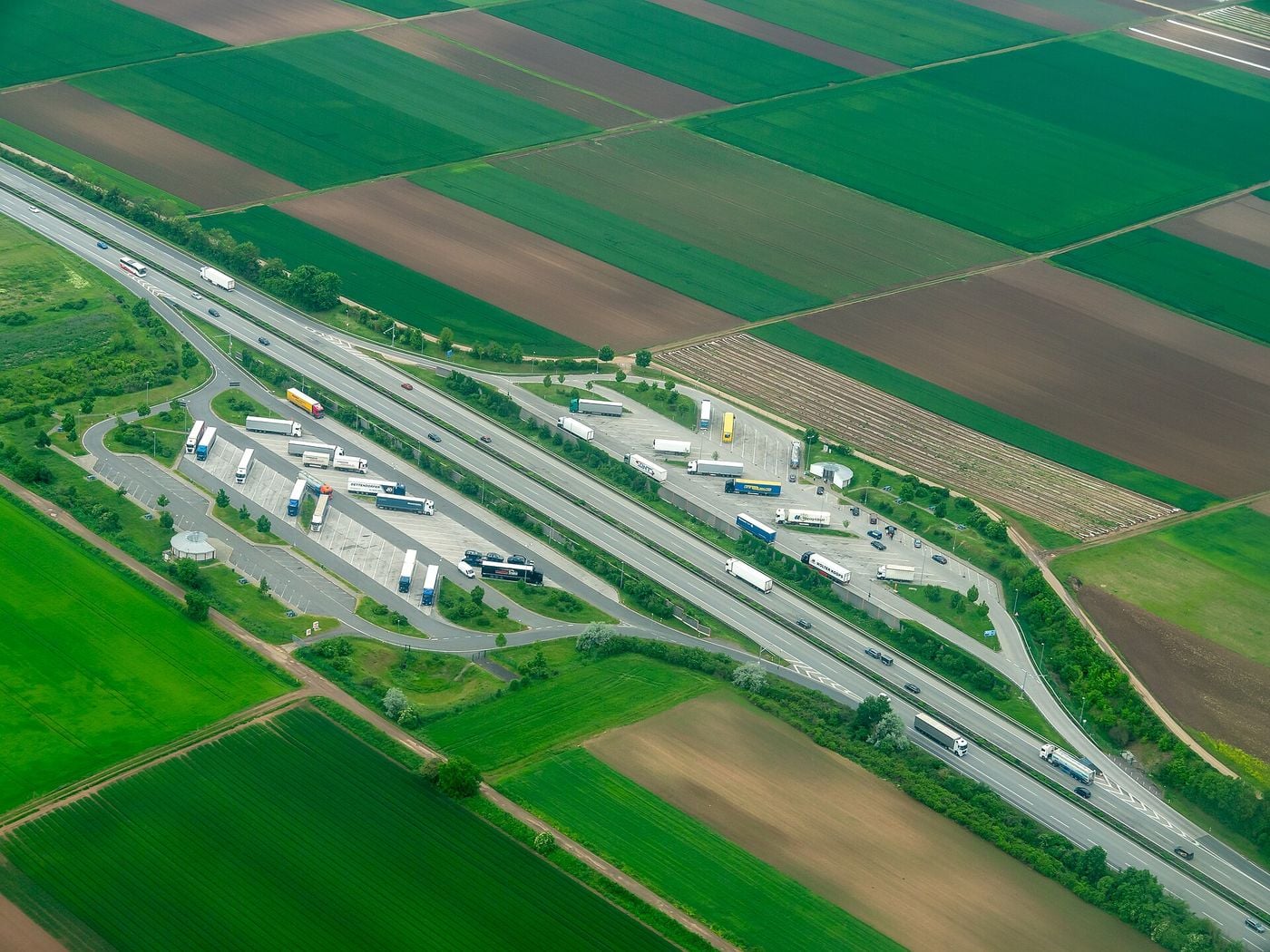
A safe and secure parking area (SSPA) is, in EU law, a parking area accessible to drivers engaged in the carriage of goods or passengers that has been certified against the Union standards of Commission Delegated Regulation (EU) 2022/1012: a minimum level of service that is the same everywhere, and one of four security levels, bronze, silver, gold or platinum. The Delegated Regulation, adopted under Article 8a(2) of Regulation (EC) No 561/2006, has been in force since 18 July 2022. Independent certification bodies audit each area on site, the audit certificate is valid for three years, and the Commission must publish a list of all certified areas. Regulation (EU) 2024/1679 on the trans-European transport network (TEN-T) requires Member States to develop such areas along the core and extended core road network by 31 December 2040, with an average maximum distance of 150 km between two of them. In its report of 21 November 2025 the Commission counted 4,943 truck parking spaces certified in line with the EU standards, out of a total supply of around 380,000.
Status as at 27 October 2026. Read on that day: Delegated Regulation (EU) 2022/1012; Regulation (EU) 2020/1054, which inserted Article 8a into Regulation (EC) No 561/2006; Regulation (EU) 2024/1679; Delegated Regulation (EU) No 885/2013 and Directive (EU) 2023/2661 on intelligent transport systems; the Commission’s report COM(2025) 703; the Commission’s page on safe and secure truck parking, its list of national access points updated in October 2025, and the record of its truck parking dataset on data.europa.eu; and the Commission’s Have your say portal. The EU Publications Office records list no act amending Delegated Regulation (EU) 2022/1012 or Delegated Regulation (EU) No 885/2013.
The legal basis
Article 8a was inserted into Regulation (EC) No 561/2006, the EU rules on driving times, breaks and rest periods, by Regulation (EU) 2020/1054, which entered into force on 20 August 2020. Paragraph 1 opens: “The Commission shall ensure that information about safe and secure parking areas is easily accessible to drivers engaged in the carriage of goods and passengers by road.” The Commission is to publish a list of all parking areas that have been certified, “in order to provide drivers with adequate” intrusion detection and prevention, lighting and visibility, emergency contact points and procedures, gender-friendly sanitary facilities, food and beverage purchasing options, communications connections and power supply. The list is to be made available “on a single official website that is regularly updated”. Neither Article 8a nor the Delegated Regulation gives the address of that website.
Paragraph 2 empowered the Commission to adopt delegated acts with standards on the level of service and security of those areas and on the procedures for certifying them. It did so in Delegated Regulation (EU) 2022/1012 of 7 April 2022, published in the Official Journal on 28 June 2022. Under paragraph 3, all certified parking areas “may indicate that they are certified in accordance with Union standards and procedures”. Paragraph 4 required a Commission report on rest facilities and secured parking by 31 December 2024; the report, COM(2025) 703, is dated 21 November 2025.
Regulation (EU) 2024/1679 builds its definition on the same two paragraphs. Its Article 3, point (39), defines a safe and secure parking area as “a parking area accessible to drivers engaged in the carriage of goods or passengers” that meets the requirements of Article 8a(1) of Regulation (EC) No 561/2006 “and which has been certified in accordance with Union standards and procedures, referred to in Article 8a(2) of that Regulation”. Recharging for electric trucks at these areas is covered in AFIR truck-charging targets, article by article.
Other certification schemes exist alongside the EU one. The Commission’s report divides safe and secure parking areas into certified and non-certified ones and notes that the EU standards “are the only ones set out in legislation”. It names other industry standards, the TAPA EMEA Parking Security Requirements of the Transported Asset Protection Association and the certification of the European Secure Parking Organisation (ESPORG), and regional ones such as the Premium Parking and Quality Parking certifications of the Vereinigung Deutscher Autohöfe (VEDA), which “remain marginal”. Coach drivers, the report says, “do not in general stay overnight in the parking areas used by truck drivers”, and “SSPAs are largely irrelevant for the coach industry, given its distinct operational needs”.
The service every certified area must provide
Article 1 of the Delegated Regulation sets two conditions for certification: the parking area fulfils all of the standards on the minimum level of service in Section A of Annex I, and all of the standards of one of the security levels in Section B. Recital 6 explains why the service level does not vary: to improve the working conditions of drivers, a minimum common level of services “should be available on all safe and secure parking areas, regardless of their level of security”.
| Heading in Table 1 | Requirement |
|---|---|
| Gender-friendly sanitary facilities | Separate toilets and showers for male and for female users, available and working, with warm water in the showers. Water taps with warm water; hand soap free of charge. Waste bins on site, regularly emptied. Toilets, showers and water basins cleaned and checked daily at regular intervals, with the cleaning schedule displayed. |
| Food and beverage purchasing and consumption options | Snacks and drinks for purchase 24 hours a day, 7 days a week; a dining area for drivers. |
| Communication connections | Internet connection free of charge. |
| Power supply | Electrical sockets for personal use. By 31 December 2026, electric power facilities for refrigerated road transport vehicles on site. |
| Emergency contact points and procedures | Clear signs to ensure safe traffic movement at the parking facility. Emergency contacts displayed at least in the national official language and in English, supported by easily understandable pictograms. |
Section B adds duties that apply at every security level. Without prejudice to national law on training, operators ensure that their on-site and remote staff and the parking manager attend a training on the Union standards, new staff within six months of entering service; it covers staff training and supervision, incident management, surveillance and monitoring, and technology. Each area displays on site how users can submit a complaint to the relevant certification body. The lux values in the security tables are average values, and the periods for keeping CCTV data are without prejudice to national or Union law.
Bronze, silver, gold and platinum
The security levels are set out in Tables 2 to 5 of Annex I. Each covers the perimeter, the parking area, the entry and exit points and staff procedures, and the equipment and procedures listed under a level must be “fully operational”. Recital 8 explains the gradation: transport operators and drivers “may need parking areas with different levels of security, depending on the goods they carry”.
| Requirement | Bronze | Silver | Gold | Platinum |
|---|---|---|---|---|
| Perimeter | Visual deterrent on the ground marking the perimeter | At least a physical deterrent that hinders passage, plus a visual deterrent and continuous video monitoring and recording | Physical barrier at least 1.8 m high, with a clear zone of 1 m to the parking area | Continuous barrier at least 1.8 m high with deterrents to climb over, clear zone of 1 m |
| Perimeter lighting | 15 lux | 20 lux | 25 lux | 25 lux |
| CCTV coverage | All entry and exit points | Perimeter and all entry and exit points | Entire perimeter with no blank spots, and all entry and exit points | As gold, plus the parking area; images remotely controlled 24/7 by an external monitoring and alarm receiving centre unless security staff are on site; intrusion and over-climbing alarms |
| CCTV routine check / functional check | Once a week / at least every 48 hours | Every 72 hours / at least every 48 hours | Every 48 hours / at least every 24 hours | Every 48 hours / at least every 24 hours |
| Surveillance of the parking area | Physical or remote check at least once every 24 hours | At least twice every 24 hours, at least once by day and once by night | At least twice every 24 hours, at least once by day and once by night | Site manned or video-controlled 24/7 |
| Entry and exit points, all lit at 25 lux | CCTV | Barriers with a voice intercom and ticketing system | Barriers with under- and over-climbing protection and traffic lights; licence plate recognition; intrusion prevention and detection, such as pedestrian turnstiles at least 1.8 m high | Gates with under- and over-climbing protection, or barriers with the same protection supplemented by bollards; licence plate checked against the ticket, RFID or QR identifier on exit; two-step verification of drivers and other people entering; any gatehouse able to withstand an external attack |
| Staff and procedures | Security plan based on an annual risk assessment; a person responsible for staff procedures in case of incidents; displayed procedures for unauthorised vehicles and for reporting incidents | As bronze, plus assistance to users 24/7 | As silver, plus a business continuity plan; management system prepared for DATEX II data transfer | As gold, plus a technical user manual, alarm response procedures and secure pre-booking |
Some CCTV rules are common to every level: continuous recording of at least 5 frames per second, or recording triggered by motion detection with pre- and post-recording, from true day and night HD cameras with 720 pixels; data kept for 30 days unless national or Union law requires a shorter period, in which case the longest period the law permits applies; and a CCTV warranty, a service level agreement or the operator’s own maintenance capability, with at least one service visit a year at gold and two at platinum. Lanes inside the parking area are lit at 15 lux at every level and are also marked at gold and platinum, where CCTV and access events are synchronised through common software and stored locally during a network outage.
The Commission’s report gives prices by level: approximately EUR 15 to approximately EUR 35 per night at platinum and gold parking areas, and between EUR 5 and EUR 15 at silver and bronze ones. Drivers and transport operators, it says, “agree that drivers should not bear the cost of parking”.
Certification, audits and the three-year certificate
Annex II sets the procedure. Only certification bodies and auditors meeting its requirements may certify. A certification body needs a group accreditation in accordance with ISO 17021; its auditors have a contractual relationship with it, have passed a training on the latest version of the standards with a theoretical and a practical part, and have “a good working knowledge of English as well as knowledge of the relevant local language of the Member State where they carry the audit”. A certification body sends the Commission the documents proving that it meets these requirements; if it does, its name and contact details are added to the official website of Article 8a(1).
Certification audits take place physically, at the request of the parking operator. After a successful audit the certification body issues the audit certificate, sends a copy to the Commission, and informs the Commission when certificates are revoked or a security level changes. The certificate “shall have a validity of three years”. To renew it, the operator asks the certification body of its choice for a re-certification audit three months before the certificate expires. Where exceptional circumstances that neither side could have anticipated prevent that audit, the certification body may extend the certificate by up to six months, and renew the extension only once; the reasons go to the Commission, and the relevant information is made available on the official website.
While a certificate runs, the certification body carries out at least one unannounced audit. If an audit finds that a requirement covered by the certificate is no longer met, the operator gets a period set by the auditor, according to the seriousness of the failure, to remedy it, and the certification body assesses the remedies within four weeks. The outcome is a certificate at the same level, a certificate at a different security level (after an unannounced audit, with the expiry date of the certificate it replaces), or revocation, after which the operator must remove any reference to the Union standards from its site. The operator can appeal to the certification body in accordance with ISO 17021, and certification bodies run an online complaint mechanism for users.
How many there are, and where
The Commission’s report of 21 November 2025 draws on a study carried out for the Commission, and all its survey results come from that study. It puts the total supply of truck parking spaces in the EU at around 380,000, secure and unsecure. Of these, 60,816 are of more than a basic level, “not certified but with some security elements”; 23,651 are certified secure under different certification methods; and 4,943 are certified in line with the EU standards, “most of which are gold-level”. The certified sites are “clustered in only a few countries/regions (Belgium, the Pyrenees region, northern Italy and Hungary)”, which, the report says, leaves significant gaps across the TEN-T core network, for example in Austria, Czechia, Germany, Poland and Slovakia. The areas that drivers consider the least served by SSPAs are, according to the same report, Belgium, France, Germany, Italy, the Netherlands, Portugal and Spain.
The report estimates the current need at about 395,000 parking spaces. Assuming the whole demand is to be met by certified SSPAs, the gap is 390,057 spaces, the 395,000 minus the 4,943 spaces certified in line with the EU standards, which is equivalent to 3,250 parking areas at an estimated average of 120 spaces each. For 2040 it projects a demand of 507,000 secure parking spaces and 24,000 spaces certified in line with the EU standards on the current investment trend, a gap of 483,000 spaces or 4,025 parking areas.
According to the report, new SSPAs are under construction or due to start construction shortly, among them 49 ongoing Connecting Europe Facility (CEF) projects expected to add 4,614 SSPA parking spaces for trucks, “nearly doubling the current supply”. In the last CEF transport call, published in 2024 and closed in 2025, 14 SSPA proposals were approved for funding of more than EUR 91 million, 12 under the general envelope and 2 under the cohesion envelope. Before that call the EU had co-funded 138 parking areas and around 16,113 parking spaces, certified and not, with more than EUR 231 million under the CEF. The report states that Member States “are responsible to ensure the proper development of the SSPAs network”, and that CEF funding, though important, “is limited in nature”.
On security, 85% of transport operators report having experienced theft or vandalism when their vehicles were parked in unsecured areas, and 41% in secured parking areas; 79% of drivers report having faced a security threat or dangerous issue while their vehicle was parked, and 9% report feeling safe at parking areas in Europe. The report says the challenges around SSPAs affect the security, safety and well-being of drivers, “exacerbating the shortage of professional drivers”; the shortage itself is covered in European truck driver supply. It also notes that 6% of drivers are women.
The TEN-T deadlines
Regulation (EU) 2024/1679 entered into force on 18 July 2024 and repealed the earlier TEN-T guidelines, Regulation (EU) No 1315/2013. It counts “parking and rest areas, including safe and secure parking areas for commercial vehicles” among the components of road transport infrastructure (Article 29(1)(h)). Article 31(4) sets the deadline for safe and secure parking areas: “Member States shall, by 31 December 2040, ensure the development of safe and secure parking areas along the roads of the core network and extended core network, or within 3 km driving distance from the nearest exit of the road of the trans-European network, with an average maximum distance of 150 km between two such areas”. The areas must provide sufficient parking space for commercial vehicles and comply with Article 8a(1) of Regulation (EC) No 561/2006, and “Member States may focus on road sections with high intensity of freight traffic”.
| Provision | Roads | Requirement | Deadline |
|---|---|---|---|
| Article 31(4) | Core and extended core network | Safe and secure parking areas along the roads or within 3 km driving distance from the nearest exit, an average maximum distance of 150 km between two such areas | 31 December 2040 |
| Article 31(3)(a) | Core and extended core network | Rest areas at a maximum distance of 60 km from each other, with sufficient safe parking space and appropriate facilities, including sanitary facilities | 31 December 2040 |
| Article 30(2)(b) | Comprehensive network | Rest areas at a maximum distance of 100 km from each other, with safe and sufficient parking space and appropriate facilities, including sanitary facilities | 31 December 2050 |
| Article 32(e) | Comprehensive network | Development of safe and secure parking areas complying with Article 8a(1) of Regulation (EC) No 561/2006, as a priority in promoting projects of common interest | No date |
Exemptions are possible. At the request of a Member State, in duly justified cases, the Commission adopts implementing acts granting exemptions from Article 31(2) to (4) for roads where the traffic density does not exceed 10,000 vehicles per day in both directions, or on grounds of specific geographical or significant physical constraints, a negative result of socio-economic cost-benefit analysis, or significant negative impacts on the environment or on biodiversity (Article 31(6)). The Commission decides within six months of the request, or within four months of the latest additional information, whichever is later; in the absence of an explicit decision within those limits, “the exemption shall be deemed to be granted”. Article 30(4) provides exemptions on the same grounds from the requirements of Article 30(2) on the comprehensive network.
Weekly rest: the cab, the parking area and the accommodation
Recital 1 of the Delegated Regulation starts from the rest periods: some of the daily and weekly rest periods drivers take “are frequently spent on the road, particularly in cases where the drivers are engaged in long-distance international transport operations”. Article 8(8) of Regulation (EC) No 561/2006, as replaced in 2020, rules the cab out for some of them: “The regular weekly rest periods and any weekly rest period of more than 45 hours taken in compensation for previous reduced weekly rest periods shall not be taken in a vehicle. They shall be taken in suitable gender-friendly accommodation with adequate sleeping and sanitary facilities.” Any costs for accommodation outside the vehicle are covered by the employer. Article 8(8) contains no exception for certified parking areas. Recital 15 of Regulation (EU) 2020/1054 puts the two rules side by side: “While regular weekly rest periods and longer rest periods cannot be taken in the vehicle or in a parking area, but only in suitable accommodation, which may be adjacent to a parking area, it is of utmost importance to enable drivers to locate safe and secure parking areas that provide appropriate levels of security and appropriate facilities.” The other weekly rest rules are set out in driving time and rest rules.
The Commission’s report counts around 123,000 hotels across the EU-27 and finds that 46% of parking areas certified to the EU standards have at least one overnight stay facility within 3 km, measured as the crow flies. It adds that many hotels identified near SSPAs “cater primarily to tourists and business travellers and are unaffordable for truck drivers”. Among the amendments the Commission could propose if and when a broader revision of Regulation (EC) No 561/2006 takes place, the report lists one to “allow drivers to take their regular rests in the cabins of vehicles if they are equipped with all necessary functions for comfort and parked in high-quality SSPAs”. The report presents its possible initiatives as “contributions to a broader discussion”, meant to inform further reflection “without anticipating or influencing any decisions related to future actions”.
Finding a parking area: the information rules
An older set of rules covers information about truck parking. Commission Delegated Regulation (EU) No 885/2013, adopted under the intelligent transport systems (ITS) Directive 2010/40/EU, applies to information services on the trans-European road network: since 1 October 2013 for services deployed after its entry into force, and since 1 October 2015 for services already deployed by then. It has its own term, a “safe and secure parking place”: “a parking place for commercial users allowing them to avoid unsuitable parking and contributing to safety of drivers and freight” (Article 2(1)). That definition does not refer to certification.
Member States designate the areas where traffic and security conditions require such information services, and define priority zones where dynamic information is provided (Article 3). Parking operators and service providers collect static data, such as the location of the parking area and the price of its places; information on its safety and equipment, such as a description of its security, safety and service equipment and the number of places for refrigerated goods vehicles; and dynamic data on whether a parking area is full or closed or how many places are free (Article 4). The data are exchanged in DATEX II (CEN/TS 16157) or a compatible machine-readable format, on a non-discriminatory basis; static data go to a national or international access point at least once a year, and dynamic data are updated “no less than once every 15 minutes” (Article 5). Service providers collecting information at a specific location display “at least the next two safe and secure parking places along a corridor within approximately 100 kilometres” (Article 6). At gold and platinum level, Delegated Regulation (EU) 2022/1012 requires the parking area management system to be “prepared for DATEX II data transfer”; where a platinum area offers pre-booking via apps or similar booking systems, “data transmission must happen in real time”.
Directive (EU) 2023/2661, which amended the ITS Directive and had to be transposed by 21 December 2025, set dates for these data. Under the new Article 6a(1), where the underlying information already exists, Member States ensure that the data are available for the geographical coverage set for each data type in Annex III, and accessible via the national access points: data created or updated on or after a first date are made available without delay, and, unless Annex III provides otherwise, the other existing data without delay after a second date. The deadlines apply to existing infrastructure; for infrastructure completed later, they are understood to be the dates of completion. Point 2 of Annex III covers “Data relating to information and reservation services for safe and secure parking places for trucks and commercial vehicles”. The same Annex sets dates for traffic regulation data, among them the zonal access restrictions covered in EU cross-border traffic fines.
| Data | Roads | Data created or updated from | Older existing data available after |
|---|---|---|---|
| Static data related to the parking areas; information on safety and equipment of the parking area | TEN-T core network | 31 December 2025 | 31 December 2026 |
| Static data related to the parking areas; information on safety and equipment of the parking area | TEN-T comprehensive network | 31 December 2026 | 31 December 2027 |
| Dynamic data on availability of parking places: full, closed or number of free places | TEN-T core and comprehensive network | 31 December 2027 | Not applicable: no obligation for data created or updated before that date |
Recital 19 of the Directive encourages Member States to make data accessible via the national access points “as soon as possible (e.g. speed limits or dynamic data for safe and secure parking areas)”, also for roads outside the geographical scope of Annex III. In the Commission’s report, 27% of transport operators find current parking information reliable, 75% believe that accurate data on available SSPAs improves route planning and helps comply with driving and rest time rules, and over 50% say they do not make parking area reservations at all.
The Commission runs a European Access Point for Truck Parking Data. Its page says that the access point “only supports static data” at this moment and that responsibility for data quality and updating remains “with the Member States that are submitting the data”. The datasets are published on data.europa.eu, where the dataset’s record was last modified on 7 August 2018 and the dates given for its country files run from February 2016 to April 2018.
The Commission’s list of national access points, updated in October 2025, names an access point for truck parking data under Regulation (EU) No 885/2013 for 21 of the 27 Member States and gives “Not applicable” for Croatia, Cyprus, Ireland, Lithuania, Malta and Portugal. For ten Member States it gives the EU access point for the static data.
| Country | National access point | Static data, EU access point |
|---|---|---|
| Austria | mobilitaetsdaten.gv.at, mobilitydata.gv.at | data.europa.eu |
| Belgium | transportdata.be | data.europa.eu |
| Bulgaria | lima.api.bg, datasheet.api.bg | See national access point |
| Croatia | Not applicable | Not applicable |
| Cyprus | Not applicable | Not applicable |
| Czechia | registr.dopravniinfo.cz | data.europa.eu |
| Denmark | nap.vd.dk (dynamic data) | data.europa.eu |
| Estonia | tarktee.mnt.ee | See national access point |
| Finland | avoindata.fi and aineistot.vayla.fi, datasets for the E18 | data.europa.eu |
| France | bison-fute.gouv.fr | See national access point |
| Germany | mobilithek.info | data.europa.eu |
| Greece | nap.gov.gr | See national access point |
| Hungary | napportal.kozut.hu | See national access point |
| Ireland | Not applicable | Not applicable |
| Italy | cciss.it | See national access point |
| Latvia | transportdata.gov.lv | See national access point |
| Lithuania | Not applicable | Not applicable |
| Luxembourg | data.public.lu, datasets of the Administration des ponts et chaussées | data.europa.eu |
| Malta | Not applicable | Not applicable |
| Netherlands | truck-parking.ndw.nu | data.europa.eu |
| Poland | kpd.gddkia.gov.pl | See national access point |
| Portugal | Not applicable | Not applicable |
| Romania | pna.cestrin.ro | See national access point |
| Slovakia | ndsas.sk, and the Pomoc na diaľnici mobile application | See national access point |
| Slovenia | nap.si, National Traffic Management Centre | See national access point |
| Spain | visorcarreteras.transportes.gob.es, Aparcamientos seguros | data.europa.eu |
| Sweden | trafficdata.se | data.europa.eu |
| Norway | Not applicable | Not applicable |
| Switzerland | See EU access point | data.europa.eu |
| United Kingdom | data.gov.uk | See national access point |
What is under review
Article 3 of Delegated Regulation (EU) 2022/1012 required the Commission to assess, no later than 7 April 2026, whether the standards and certification procedures in Annexes I and II “need to be amended in light of the existing technological developments, and in order to continuously improve working conditions of drivers”. As at 27 October 2026 the EU Publications Office records list no act amending the Delegated Regulation. The Commission’s report of November 2025 lists points the Commission could consider in that assessment, based on consultation with Member States and stakeholders: intermediate certifications, such as a “silver+” certification for a silver parking area that invests in high-level services; an obligation of on-site security personnel at platinum level; a signalling system informing about parking spaces reserved for female drivers; and dietary considerations and the collection of gender-disaggregated data about the drivers in restrooms.
Outside legislation, the report says the Commission “considers that the more efficient way to bridge the gap between the number of SSPAs needed and the current number of SSPAs is to upgrade non-secure parking facilities along motorways”, to bronze level or higher, and that in regions with higher incidents of cargo theft Member States “should also prioritise the construction of and the upgrade to platinum-certified SSPAs”. On funding it refers to the Commission’s proposal of 16 July 2025 for a third Connecting Europe Facility, with a transport budget of EUR 51.5 billion in the 2028 to 2034 Multiannual Financial Framework.
A revision of the information rules is planned. On 13 November 2025 the Commission entered on its Have your say portal a planned delegated regulation under the ITS Directive with updated specifications for information services for safe and secure parking for trucks and commercial vehicles, the subject of Regulation (EU) No 885/2013. Its summary says the updated specifications “aim notably to improve the availability and sharing of the data necessary to provide these services”. As at 27 October 2026 no draft had been published for feedback, and adoption was planned for the second quarter of 2027.
Quick answers
- What is a safe and secure parking area for trucks?
- A parking area accessible to drivers engaged in the carriage of goods or passengers that has been certified against the Union standards of Delegated Regulation (EU) 2022/1012, in force since 18 July 2022: it must provide a minimum level of service that is the same everywhere and meet one of four security levels, bronze, silver, gold or platinum. The certification rests on Article 8a of Regulation (EC) No 561/2006, inserted by Regulation (EU) 2020/1054, under which the Commission must publish a list of all certified parking areas on a single official website. Certification bodies audit each area on site, and the audit certificate is valid for three years.
- What is the difference between bronze, silver, gold and platinum parking areas?
- The security of the perimeter, the parking area, the entry and exit points and the staff procedures; the minimum service is the same at all four levels. Bronze marks the perimeter with a visual deterrent, lights it at 15 lux and has CCTV at the entry and exit points. Silver adds a physical deterrent and video monitoring of the perimeter, barriers with an intercom and ticketing system, and assistance to users 24/7. Gold requires a barrier at least 1.8 m high, video surveillance of the entire perimeter with no blank spots, licence plate recognition and a business continuity plan. Platinum requires a continuous barrier with deterrents to climb over, CCTV images remotely controlled 24/7 by an external monitoring and alarm receiving centre unless security staff are on site, two-step verification at the entry and exit points, and secure pre-booking.
- How many certified safe and secure truck parking spaces are there in the EU?
- 4,943 parking spaces certified in line with the EU standards, most of them gold-level, according to the Commission's report COM(2025) 703 of 21 November 2025, out of a total supply of around 380,000 truck parking spaces; 23,651 spaces were certified secure under different certification methods. The report says the certified sites are clustered in Belgium, the Pyrenees region, northern Italy and Hungary, and that 49 ongoing Connecting Europe Facility projects are expected to add 4,614 spaces.
- Can a truck driver spend the regular weekly rest in the cab at a certified secure parking area?
- No. Article 8(8) of Regulation (EC) No 561/2006 says regular weekly rest periods, and any weekly rest period of more than 45 hours taken in compensation for reduced ones, shall not be taken in a vehicle but in suitable gender-friendly accommodation with adequate sleeping and sanitary facilities, at the employer's cost, and it contains no exception for certified parking areas. Recital 15 of Regulation (EU) 2020/1054 says those rest periods cannot be taken in the vehicle or in a parking area, but only in suitable accommodation, which may be adjacent to a parking area. The Commission's report of November 2025 lists allowing regular rests in well-equipped cabins parked in high-quality SSPAs among amendments it could propose in a broader revision of Regulation (EC) No 561/2006, as a contribution to discussion, not a proposal.
- What must EU countries build along the main roads by 2040?
- Under Article 31(4) of Regulation (EU) 2024/1679, by 31 December 2040 Member States must ensure the development of safe and secure parking areas along the roads of the TEN-T core and extended core network, or within 3 km driving distance from the nearest exit, with an average maximum distance of 150 km between two such areas, providing sufficient parking space for commercial vehicles and complying with Article 8a(1) of Regulation (EC) No 561/2006. By the same date rest areas must be available on those roads at a maximum distance of 60 km from each other (Article 31(3)(a)). The Commission can grant exemptions, among others for roads where traffic does not exceed 10,000 vehicles a day in both directions (Article 31(6)).
Sources
- Commission Delegated Regulation (EU) 2022/1012 of 7 April 2022 supplementing Regulation (EC) No 561/2006 with regard to the establishment of standards detailing the level of service and security of safe and secure parking areas and to the procedures for their certification, OJ L 170, 28.6.2022 — recitals, Articles 1 to 4, Annexes I and II — EUR-Lex, European Union, 7 Apr 2022
- Regulation (EU) 2020/1054 of 15 July 2020 amending Regulation (EC) No 561/2006 — recital 15, Article 1, points (6) and (7) (Article 8(8) and Article 8a of Regulation (EC) No 561/2006), and Article 3 — EUR-Lex, European Union, 15 Jul 2020
- Regulation (EU) 2024/1679 of 13 June 2024 on Union guidelines for the development of the trans-European transport network — Article 3, point (39), Articles 29 to 32, 68 and 69 — EUR-Lex, European Union, 13 Jun 2024
- Commission Delegated Regulation (EU) No 885/2013 of 15 May 2013 supplementing ITS Directive 2010/40/EU with regard to the provision of information services for safe and secure parking places for trucks and commercial vehicles — Articles 1 to 10 — EUR-Lex, European Union, 15 May 2013
- Directive (EU) 2023/2661 of 22 November 2023 amending Directive 2010/40/EU on the framework for the deployment of Intelligent Transport Systems in the field of road transport and for interfaces with other modes of transport — recital 19, Article 1, point (7) (Article 6a), Article 2 and Annex III — EUR-Lex, European Union, 22 Nov 2023
- Report from the Commission on the availability of suitable rest facilities for drivers and of secured parking facilities, and on the development of safe and secure parking areas certified in accordance with Delegated Regulation (EU) 2022/1012, COM(2025) 703 final, 21 November 2025 — EUR-Lex, European Commission, 21 Nov 2025
- Safe and secure truck parking: the European Access Point for Truck Parking Data (page last modified 22 October 2025, read on 27 October 2026) — European Commission, Directorate-General for Mobility and Transport
- National Access Points: a mechanism for accessing, exchanging and reusing transport related data under Delegated Acts of the ITS Directive (2010/40/EU), updated October 2025 — European Commission, Directorate-General for Mobility and Transport, 24 Oct 2025
- Safe and secure truck parking data according to Commission delegated Regulation (EU) No 885/2013 — dataset record, last modified 7 August 2018 (read on 27 October 2026) — European Commission, Directorate-General for Mobility and Transport (data.europa.eu)
- Road safety – updated specifications for information services for safe, secure parking for trucks & commercial vehicles (initiative 15672, planned Commission delegated regulation, read on 27 October 2026) — European Commission, Have your say
- EUR-Lex records for Delegated Regulation (EU) 2022/1012, Delegated Regulation (EU) No 885/2013 and the other acts cited: in-force flag, entry-into-force dates and amending acts (Publications Office CELLAR query, 27 October 2026) — Publications Office of the European Union