How long is a school bus: types A to D and their sizes
Collins and Trans Tech list Type A school buses up to 290 inches long; GreenPower's Type D is 40 feet, seating up to 90. Types A to D and federal rules.
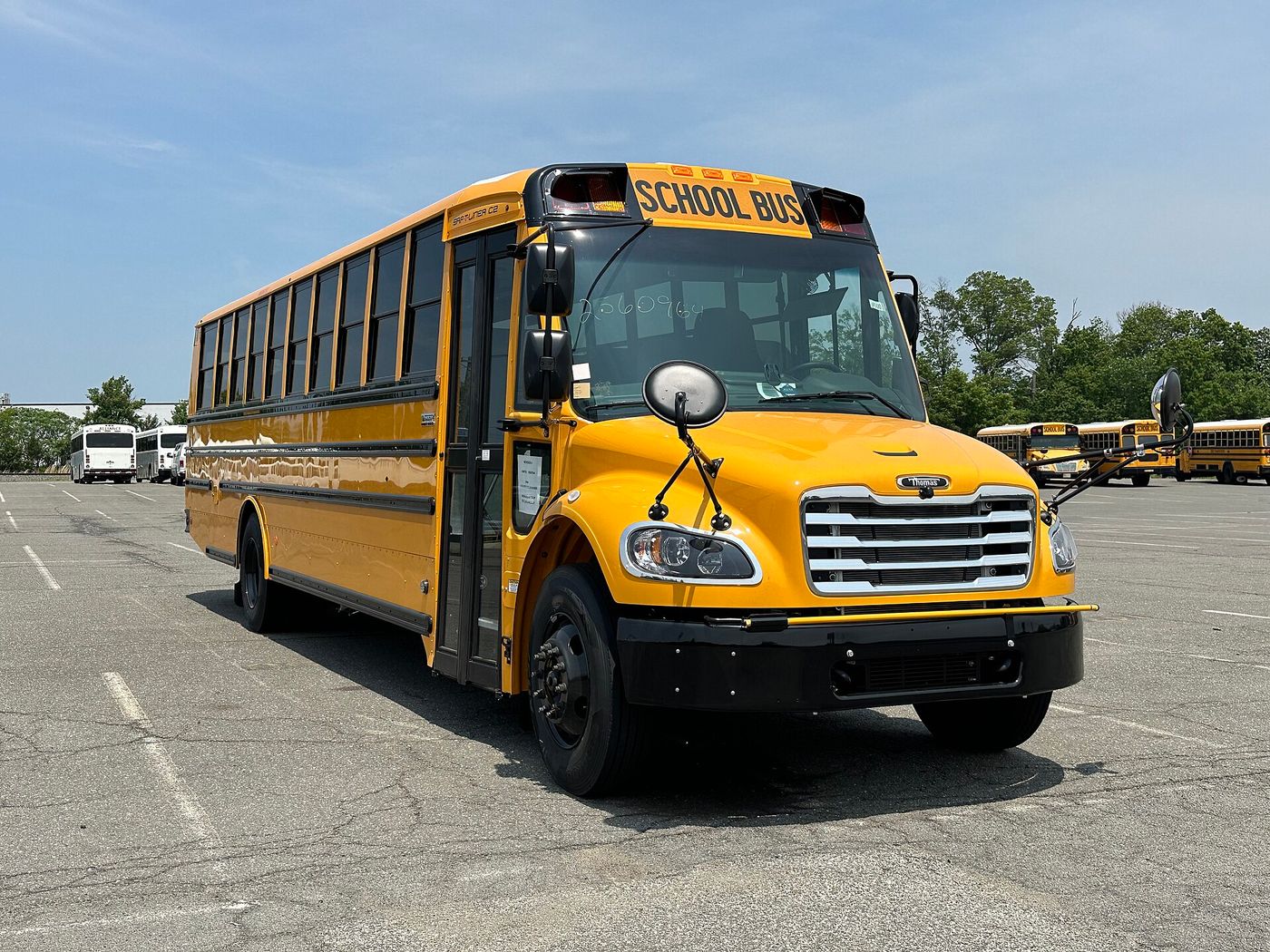
The federal school bus definitions and safety standards fix no overall length for the bus, so the length depends on the type and the model. In Collins’ and Trans Tech’s current data a Type A school bus is up to 290 inches (24 feet 2 inches) long bumper to bumper, and GreenPower describes its Type D BEAST as a 40-foot bus; Thomas Built Buses and IC Bus publish wheelbases of up to 279 and 289 inches for their Type C models but no overall length. These makers list Type C models for up to 78 to 83 passengers, Type D models for up to 90 and Type A models for up to 35.
Status: 28 October 2026. The federal parts follow 49 U.S.C. 30125 (United States Code, 2024 edition) and the annual Code of Federal Regulations on govinfo: Title 49 revised as of October 1, 2025, with the amendments to Standards No. 217 and No. 222 published on June 3, 2026, and Title 23 revised as of April 1, 2025. The type definitions follow the 2025 Minnesota Statutes and chapter 281—44 of the Iowa Administrative Code in the text dated IAC 2/5/25 (February 5, 2025); other States’ rules are not covered. Model figures are those the makers publish on their product pages, brochures and specification sheets, read on 28 October 2026.
| Type | Built on | Entrance door | GVWR classes | Makers’ figures |
|---|---|---|---|---|
| A | A van conversion or a cutaway front-section vehicle with a left-side driver’s door | Not stated in the definition | A-I: 14,500 pounds or less; A-II: over 14,500 and up to 21,500 pounds | Up to 290 inches long; up to 35 passengers (Collins, Trans Tech) |
| B | A stripped chassis | Behind the front wheels | B-I: 10,000 pounds or less; B-II: over 10,000 pounds | None among the models listed below |
| C | A chassis with a hood and front fender assembly; also a cutaway truck chassis or truck chassis with cab of over 21,500 pounds GVWR | Behind the front wheels | No subclasses | Wheelbases of 158 to 289 inches, no overall length published; up to 78 to 83 passengers (Thomas Built, IC Bus) |
| D | A stripped chassis | Ahead of the front wheels | No subclasses | 40 feet (GreenPower); up to 90 passengers (Thomas Built, IC Bus, GreenPower) |
What federal law calls a school bus
The statute behind the federal school bus standards, 49 U.S.C. 30125(a)(1), defines the vehicle by capacity and use: “‘schoolbus’ means a passenger motor vehicle designed to carry a driver and more than 10 passengers, that the Secretary of Transportation decides is likely to be used significantly to transport preprimary, primary, and secondary school students to or from school or an event related to school.” The definition was added to the National Traffic and Motor Vehicle Safety Act on October 27, 1974 (Pub. L. 93–492). Subsection (b) requires standards with minimum performance requirements for emergency exits, interior protection for occupants, floor strength, seating systems, crashworthiness of body and frame (including protection against rollover hazards), vehicle operating systems, windows and windshields, and fuel systems.
The Federal Motor Vehicle Safety Standards work from the definitions in 49 CFR 571.3:
- Bus: “a motor vehicle with motive power, except a trailer, designed for carrying more than 10 persons.”
- School bus: “a bus that is sold, or introduced in interstate commerce, for purposes that include carrying students to and from school or related events, but does not include a bus designed and sold for operation as a common carrier in urban transportation.”
- Multifunction school activity bus (MFSAB): “a school bus whose purposes do not include transporting students to and from home or school bus stops.”
The statute counts a driver and more than 10 passengers, the regulation more than 10 persons. Neither text sorts school buses into lettered types. Some of the standards below divide school buses by gross vehicle weight rating (GVWR), which section 571.3 defines as “the value specified by the manufacturer as the loaded weight of a single vehicle”; the rating itself is explained in GVWR, GCWR and GAWR.
The federal standards written for school buses
| Standard | Subject | School buses in the text |
|---|---|---|
| No. 111 | Rear visibility | Applies to school buses among other vehicles; S9 sets requirements for school buses, including “two outside rearview mirror systems: System A and System B” |
| No. 131 | School bus pedestrian safety devices | Applies to “school buses other than multifunction school activity buses”, each of which must have a stop signal arm |
| No. 217 | Bus emergency exits and window retention and release | Applies to buses except those for transporting persons under physical restraint; “School buses shall meet the requirements of S5.2.3”, the school bus exit provisions |
| No. 220 | School bus rollover protection | “This standard applies to school buses.” |
| No. 221 | School bus body joint strength | “This standard applies to school buses.” |
| No. 222 | School bus passenger seating and crash protection | Applies to school buses, with separate requirements for large school buses over 4,536 kg (10,000 pounds) GVWR and small school buses at or below it |
| No. 301 | Fuel system integrity | Applies to passenger cars, to multipurpose passenger vehicles, trucks and buses of 4,536 kg GVWR or less that use fuel with a boiling point above 0 °C, and to school buses with a GVWR greater than 4,536 kg that use fuel with a boiling point above 0 °C |
Standard No. 222 draws its line at a GVWR of 4,536 kg (10,000 pounds). S5(a), headed “Large school buses”, covers each school bus above it. Under S5(b), “Small school buses”, each vehicle at or below it must be capable of meeting, at all seating positions, S4.4.3.2 of Standard No. 208 and Standards No. 207, 209 and 210 as they apply to school buses of that weight, together with listed requirements of Standard No. 222 itself. Section S5.1 reads: “School bus passenger seats shall be forward facing.” A final rule published on June 3, 2026 and effective July 6, 2026 removed obsolete requirements from the standard, among them those for buses manufactured before October 21, 2011 and before September 1, 1991; S5(a) and S5(b) as amended keep the 4,536 kg (10,000 pounds) line. The same 10,000-pound figure divides Type B into B-I and B-II in the State definitions below.
A multifunction school activity bus is a school bus in the federal sense, but Standard No. 131, which requires the stop signal arm, applies only to school buses “other than multifunction school activity buses”. Iowa’s rule says: “MFSABs meet all FMVSS for school buses except the traffic control requirements (alternately flashing signal and stop arm).”
Types A, B, C and D in State law
The type letters appear in State law. Minnesota lists them in Minnesota Statutes section 169.011, subdivision 71(b): “A school bus may be type A, type B, type C, or type D, multifunction school activity bus, or type III as provided in paragraphs (c) to (h).” Paragraphs (c) to (f) define the four types:
- Type A is “a van conversion or bus constructed utilizing a cutaway front section vehicle with a left-side driver’s door. This definition includes two classifications: type A-I, with a gross vehicle weight rating (GVWR) less than or equal to 14,500 pounds; and type A-II, with a GVWR greater than 14,500 pounds and less than or equal to 21,500 pounds.”
- Type B is “constructed utilizing a stripped chassis. The entrance door is behind the front wheels. This definition includes two classifications: type B-I, with a GVWR less than or equal to 10,000 pounds; and type B-II, with a GVWR greater than 10,000 pounds.”
- Type C is “constructed utilizing a chassis with a hood and front fender assembly. The entrance door is behind the front wheels. A ‘type C school bus’ also includes a cutaway truck chassis or truck chassis with cab, with or without a left side door, and with a GVWR greater than 21,500 pounds.”
- Type D is “constructed utilizing a stripped chassis. The entrance door is ahead of the front wheels.”
Iowa’s school bus rule, Iowa Administrative Code 281—44.2, uses the same four types with the same GVWR limits, numbers the subclasses A-1, A-2, B-1 and B-2, and names two of them: a Type C school bus is “also known as a conventional school bus”, a Type D “also known as a rear or front engine transit-style school bus”. Under the same rule a school bus “meets all applicable FMVSS” and is identified by alternately flashing lights, National School Bus Glossy Yellow paint and the legend “School Bus.”
Both texts refer to a national specification. Except as sections 169.4502 and 169.4503 provide, Minnesota section 169.4501 requires the construction, design, equipment and color of “types A, B, C, D school buses and multifunction school activity buses used for the transportation of school children” to meet the requirements of the “‘bus body and chassis specifications’ in the most recent edition of the ‘National School Transportation Specifications and Procedures’ adopted by the National Congress on School Transportation”, and incorporates the “bus body and chassis specifications” and “specially equipped school bus specifications” sections of that edition by reference. Under subdivision 2 of the same section, the standards apply “to school buses manufactured after August 1 of the year following a year in which a revised edition of the National School Transportation Specifications and Procedures is adopted.” Iowa’s rule cites the “National School Transportation Specifications and Procedures Manual 2015”, for example for the color standard of the school bus body (44.3(9)).
The two States differ on type III vehicles. Minnesota’s type III vehicle is restricted to passenger vehicles and buses “having a maximum manufacturer’s rated seating capacity of ten or fewer people, including the driver, and a gross vehicle weight rating of 10,000 pounds or less”; Iowa’s Type III vehicle “may carry a maximum of 12 or fewer people, including the driver, and weigh 10,000 pounds or less.” How European rules treat school transport is described in school transport vehicles, and the European bus classes in bus classes under UN R107.
How long is a school bus?
None of the federal school bus definitions and standards above fixes an overall length for the bus. For buses in general, 23 CFR 658.13(d) says: “No State shall impose a limit of less than 45 feet on the length of any bus on the NN”, the National Network; the other federal size rules are covered in semi-truck dimensions. Iowa’s rule leaves the outer limits to the department of transportation: “Overall height, length and width of the bus will not exceed the maximums allowed by the department of transportation” (44.3(39)). The same subrule sets an interior body height of 72 inches or more, 62 inches or more in Type A-2 buses, and subrule 44.3(70) a turning radius of not more than 42½ feet, curb to curb, for a chassis with a wheelbase of 264 inches or less, and not more than 44½ feet at 265 inches or more.
| Model | Type as the maker states it | Overall length | Wheelbase | Width and height |
|---|---|---|---|---|
| Collins Type A, SH, TH, DH and DE Series | Type A | Up to 242 to up to 290 inches, by series | 138 to 159 inches | 83 or 96 inches wide; 110 to 115 inches high |
| Trans Tech Type A School Bus | Type A | Up to 290 inches bumper to bumper | – | Up to 96 inches wide; up to 115 inches high |
| Thomas Built Saf-T-Liner C2 | Type C | – | 158, 179, 199, 219, 238, 259 or 279 inches | – |
| IC Bus CE Series, diesel or gasoline | Type C | – | 158, 169, 193, 217, 236, 254 or 276 inches | – |
| IC Bus CE Series, electric | Type C | – | 217, 254, 276 or 289 inches | – |
| Thomas Built Saf-T-Liner EFX2 | Type D | – | 212 or 231 inches | – |
| Thomas Built Saf-T-Liner HDX2 | Type D | – | 267 or 277 inches | – |
| Thomas Built Saf-T-Liner HDX2 Wattson, battery-electric | Type D | – | 277 inches | – |
| GreenPower BEAST and Mega BEAST, battery-electric | Type D | 40 feet | – | – |
Collins gives overall lengths of up to 242 inches for its SH Series, up to 288 inches for the TH and up to 290 inches for the DH and DE; the summary line of the same brochure gives a bus length of 22´ to 24´ 2˝. GreenPower calls its BEAST “a purpose-built 40-foot Type D all-electric, zero-emission school bus” and its Mega BEAST a 40-foot Type D as well. Thomas Built publishes wheelbases but no overall length for its Type C and Type D models, and IC Bus for its Type C CE Series; Thomas Built’s battery-electric Saf-T-Liner C2 Jouley Gen 2 comes on wheelbases of 219, 259 and 279 inches. Thomas Built describes the EFX2 as “a next-generation Type D school bus” in “a front-engine, transit-style design”.
How many passengers a school bus carries
| Model | Type as the maker states it | Passengers | GVWR |
|---|---|---|---|
| Collins Type A, SH / TH / DH / DE Series | Type A | Maximum seated capacity 20 / 21 / 35 / 32; up to 4 (TH) or 8 (DE) wheelchairs | 9,900–10,100 / 9,070–11,000 / 11,500–14,500 / 11,500–14,500 (no unit given) |
| Trans Tech Type A School Bus | Type A | Up to 35 | – |
| Thomas Built Saf-T-Liner C2 | Type C | Up to 81 | Up to 33,000 lbs |
| IC Bus CE Series, diesel or gasoline | Type C | Up to 83 | Up to 33,000 lbs |
| IC Bus CE Series, electric | Type C | Up to 78 | Up to 35,000 lbs |
| Thomas Built Saf-T-Liner EFX2 and HDX2 | Type D | Up to 90 | Up to 36,200 lbs |
| Thomas Built Saf-T-Liner HDX2 Wattson | Type D | Up to 90 | Up to 37,600 lbs |
| IC Bus RE Series | Type D | Up to 90 (72 to 90 in the page title) | – |
| GreenPower BEAST | Type D | Up to 90 passengers + driver | – |
Collins adds that “All passenger capacities are references and subject to final weight analysis”, and the headline of the same brochure gives up to 34 passengers for its Type A bus. Thomas Built lists the C2 Jouley Gen 2 for up to 81 passengers and its 219-inch wheelbase for “up to a 60-seat capacity”. Reporting to Congress on its Clean School Bus rebates, the Environmental Protection Agency described Type C school buses as having “a maximum passenger load of approximately 75-80 passengers.” In its brake provisions, Iowa’s rule describes designed seating capacity, “also known as manufacturer’s seating capacity”, as “the actual or theoretical passenger capacity of the vehicle if it were constructed with the maximum number of seating positions” (44.3(5)“c”(2)).
What this page does not cover
- School bus rules of States other than Minnesota and Iowa, and State size limits.
- The National School Transportation Specifications and Procedures themselves.
- Driver licensing: the commercial driver’s license and its S (school bus) endorsement are described in CDL classes and endorsements.
- Prices, funding programs and used school buses.
Quick answers
- How long is a school bus?
- The federal school bus definitions and safety standards fix no overall length for the bus, so it depends on the model. In Collins' and Trans Tech's current data a Type A school bus is up to 290 inches (24 feet 2 inches) long, and GreenPower describes its Type D BEAST as a 40-foot bus. Thomas Built and IC Bus publish wheelbases of 158 to 289 inches for their Type C models but no overall length. For buses in general, no State may set a length limit of less than 45 feet on the National Network.
- What are the types of school buses?
- Four lettered types, A to D, as State law such as Minnesota Statutes 169.011 and Iowa rule 281—44.2 defines them; both texts also define the multifunction school activity bus and the type III vehicle. Type A is a van conversion or a bus built on a cutaway front-section vehicle; Type B is built on a stripped chassis with the entrance door behind the front wheels; Type C on a chassis with a hood and front fender assembly, door behind the front wheels; Type D on a stripped chassis with the entrance door ahead of the front wheels. The federal definitions use no type letters.
- What is the difference between a Type C and a Type D school bus?
- A Type C is built on a chassis with a hood and front fender assembly and has its entrance door behind the front wheels; a Type D is built on a stripped chassis with the entrance door ahead of the front wheels. Iowa's rule calls Type C the conventional school bus and Type D the rear or front engine transit-style school bus. Thomas Built and IC Bus list their Type C models for up to 78 to 83 passengers; Thomas Built, IC Bus and GreenPower list their Type D models for up to 90.
- How many kids fit on a school bus?
- Makers list up to 90 passengers for their Type D buses (Thomas Built, IC Bus, GreenPower), up to 78 to 83 for Type C (Thomas Built Saf-T-Liner C2, IC Bus CE Series) and up to 35 for Type A (Collins, Trans Tech). Collins notes that its capacities are references subject to final weight analysis, and the EPA describes Type C buses as having a maximum passenger load of approximately 75 to 80.
- What is a multifunction school activity bus?
- A school bus “whose purposes do not include transporting students to and from home or school bus stops”, as 49 CFR 571.3 defines it. The federal stop signal arm standard, No. 131, does not apply to it, and Iowa's rule says such buses meet all federal school bus standards except the traffic control requirements, the alternately flashing signal and the stop arm.
- What is a Type A school bus?
- A van conversion or a bus built on a cutaway front-section vehicle with a left-side driver's door. Minnesota and Iowa split it by GVWR: A-I (A-1 in Iowa) at 14,500 pounds or less, A-II (A-2) above 14,500 and up to 21,500 pounds. Collins lists overall lengths from up to 242 to up to 290 inches and up to 35 seated passengers for its Type A series, Trans Tech up to 290 inches and 35 passengers.
Sources
- 49 U.S.C. 30125 — Schoolbuses and schoolbus equipment (United States Code, 2024 edition) — U.S. Government Publishing Office (govinfo)
- 49 CFR 571.3 — Definitions (Code of Federal Regulations, annual edition revised as of October 1, 2025) — National Highway Traffic Safety Administration (govinfo, U.S. Government Publishing Office)
- 49 CFR 571.111 — Standard No. 111; Rear visibility (CFR revised as of October 1, 2025) — National Highway Traffic Safety Administration (govinfo, U.S. Government Publishing Office)
- 49 CFR 571.131 — Standard No. 131; School bus pedestrian safety devices (CFR revised as of October 1, 2025) — National Highway Traffic Safety Administration (govinfo, U.S. Government Publishing Office)
- 49 CFR 571.217 — Standard No. 217; Bus emergency exits and window retention and release (CFR revised as of October 1, 2025) — National Highway Traffic Safety Administration (govinfo, U.S. Government Publishing Office)
- 49 CFR 571.220 — Standard No. 220; School bus rollover protection (CFR revised as of October 1, 2025) — National Highway Traffic Safety Administration (govinfo, U.S. Government Publishing Office)
- 49 CFR 571.221 — Standard No. 221; School bus body joint strength (CFR revised as of October 1, 2025) — National Highway Traffic Safety Administration (govinfo, U.S. Government Publishing Office)
- 49 CFR 571.222 — Standard No. 222; School bus passenger seating and crash protection (CFR revised as of October 1, 2025) — National Highway Traffic Safety Administration (govinfo, U.S. Government Publishing Office)
- 49 CFR 571.301 — Standard No. 301; Fuel system integrity (CFR revised as of October 1, 2025) — National Highway Traffic Safety Administration (govinfo, U.S. Government Publishing Office)
- Final rule: Federal Motor Vehicle Safety Standards No. 222; School Bus Passenger Seating and Crash Protection, 91 FR 33101, June 3, 2026, effective July 6, 2026 — Federal Register (govinfo, U.S. Government Publishing Office), 3 Jun 2026
- Final rule: Federal Motor Vehicle Safety Standards No. 217; Bus Emergency Exits and Window Retention and Release, 91 FR 33084, June 3, 2026, effective July 6, 2026 — Federal Register (govinfo, U.S. Government Publishing Office), 3 Jun 2026
- 23 CFR 658.13 — Length (Code of Federal Regulations, annual edition revised as of April 1, 2025) — Federal Highway Administration (govinfo, U.S. Government Publishing Office)
- 23 CFR 658.5 — Definitions (Code of Federal Regulations, annual edition revised as of April 1, 2025) — Federal Highway Administration (govinfo, U.S. Government Publishing Office)
- 2025 Minnesota Statutes, section 169.011, subdivision 71 — School bus — Minnesota Office of the Revisor of Statutes
- 2025 Minnesota Statutes, section 169.4501 — School bus equipment standards (subdivisions 1 and 2) — Minnesota Office of the Revisor of Statutes
- Iowa Administrative Code, Education [281], chapter 44 — School buses (IAC 2/5/25) — Iowa Legislature
- Collins Type A School Bus brochure (03/26) — Collins, a division of Forest River, Inc.
- Trans Tech buses: Type A School Bus — Trans Tech Bus
- Evolved Saf-T-Liner C2: product page — Thomas Built Buses
- Saf-T-Liner C2 Jouley Gen 2: product page — Thomas Built Buses
- C2 Jouley Gen 2 mini brochure (winter 2025) — Thomas Built Buses
- Saf-T-Liner EFX2: product page — Thomas Built Buses
- Saf-T-Liner HDX2: product page — Thomas Built Buses
- Saf-T-Liner HDX2 Wattson: product page — Thomas Built Buses
- CE Series Type C School Bus: product page — IC Bus
- IC Bus CE Series school bus specification sheet, diesel and gasoline (06/2025) — IC Bus
- IC Bus CE Series electric school bus specification sheet (01/2024) — IC Bus
- RE Series Type D School Bus: product page — IC Bus
- BEAST and Mega BEAST school buses: product pages — GreenPower Motor Company
- EPA Clean School Bus Program, Fourth Report to Congress, Fiscal Year 2024 (EPA-420-R-25-004, January 2025) — U.S. Environmental Protection Agency, Office of Transportation and Air Quality