Semi-trailer types in the US: lowboy, conestoga, step deck
Dry van, reefer, flatbed, step deck, lowboy, conestoga, hopper, walking floor and tank trailers, with makers' figures and the federal 102-inch width rule.
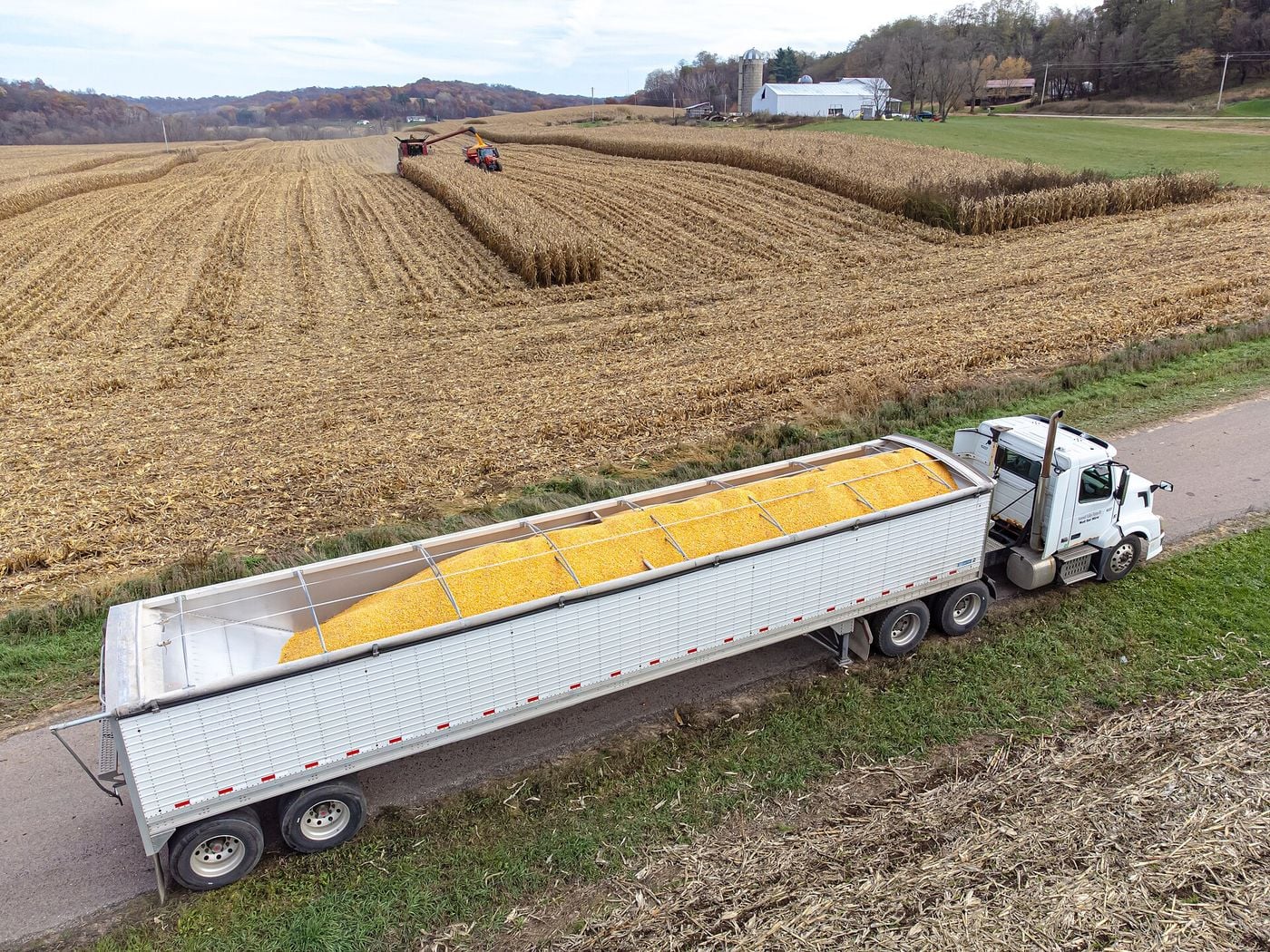
US semi-trailer types differ in what sits on the chassis: closed vans, open decks at several heights, a rolling cover over a deck, and bulk bodies. Hyundai Translead lists a 53-foot dry van 102.36 inches wide and 13 feet 6 inches high, Trail King a step deck with a loaded deck height of 34 to 40 inches, and Talbert a lowboy with a 20-inch loaded deck. Federal rules on the National Network fix trailer width at 102 inches and bar States from limiting a single semitrailer to less than 48 feet; they set no height.
Status: 5 November 2026. The trailer figures are the makers’ own, from the product pages and data sheets listed under Sources and read on that date; Utility, Timpte and Fontaine say their specifications can change without notice. The federal rules follow 23 CFR Part 658 in the annual edition of the Code of Federal Regulations revised as of April 1, 2025, and the Federal Highway Administration’s pamphlet Federal Size Regulations for Commercial Motor Vehicles, which paraphrases the regulations; in case of a dispute the regulations govern. European bodies are covered in trailer types explained.
| Type | Whose figure | As printed |
|---|---|---|
| Dry van | Hyundai Translead Composite | 53 ft long, 102.36 in wide, 13 ft 6 in high; 4,070 cu. ft. inside |
| Refrigerated | Hyundai Translead ThermoTech | 53 ft long, 102.36 in wide, 13 ft 6 in high; 3,722 cu. ft. inside |
| Flatbed | Utility 4000AE | 48 ft long, 102 in wide; 58 3⁄16 in high on a 47 in fifth wheel |
| Step deck or drop deck | Trail King TK80ACS | 47 ft 10 in long, 102 in wide; loaded deck height 34, 38 or 40 in |
| Double drop | Talbert 30-55 FG | 29 ft deck, 8 ft 6 in wide; loaded deck height 18 in |
| Lowboy | Talbert 55SA | 25 ft deck, 8 ft 6 in wide; loaded deck height 20 in |
| Conestoga | Aero Industries | Rolling tarp system with models for flatbeds, drop decks and straight trucks |
| Hopper and grain | Timpte Tandem Axle | 28 ft 6 in to 42 ft 2 in long, 96 or 102 in wide; sidewalls 66 to 90 in |
| Walking floor | MAC Lite Moving Floor | Lengths from 42 to 53 feet |
| Tank | MAC Fertilizer | 5,600 U.S. gallons + 1% |
Dry van and refrigerated trailers
A dry van is a closed box on a chassis with doors at the rear. A refrigerated van, or reefer, adds foamed insulation and a refrigeration unit mounted on the nose. Great Dane sells its Champion dry vans in 28-foot pup, 48-foot and 53-foot lengths and in two constructions, sheet-and-post and composite. Vanguard offers the same two constructions and prints an inside width of 100 inches post to post on its sheet-and-post VIP 4000 and 101-1/4 inches panel to panel on its composite VXP.
| Model | Outside (L x W x H) | Inside | GVWR | Weight |
|---|---|---|---|---|
| Hyundai Translead Composite, dry | 53 ft 0 in x 102.36 in x 13 ft 6 in | 52 ft 6 in x 101.5 in x 110 in; 4,070 cu. ft. | 68,000 lb | 13,350 lb |
| Utility 4000D-X Composite, dry | 53 ft 0 in x 102⅜ in x 13 ft 6 in on a 46½ in fifth wheel | 101 in wide at wearband; 110½ in high at front, 111 in at rear | 65,000 lb | Not given |
| Wabash DuraPlate, dry | 53 ft x 102-3/8 in x 13 ft 6 in | 101 in wide; 110-1/4 in high at front, 111-1/4 in at rear | 68,000 lb / 30,845 kg | Not given |
| Hyundai Translead ThermoTech, refrigerated | 53 ft 0 in x 102.36 in x 13 ft 6 in | 52 ft 2 in x 97.4 in lining to lining x 105.5 in; 3,722 cu. ft. | 68,000 lb | 11,950 lb excluding reefer unit |
| Utility 3000R, refrigerated | 53 ft 0 in x 102⅜ in x 13 ft 6 in on a 46½ in fifth wheel | 97½ in wide at wearband; 104⅛ in high | 65,000 lb | Not given |
Against Hyundai’s dry van, its refrigerated van is 4.1 inches narrower and 4.5 inches lower inside and holds 348 cubic feet less (our subtraction). Hyundai foams 2 inches of urethane into the sides, floor and roof, 3 inches into the rear door and 4 inches into the front wall. Great Dane gives its Everest reefer a base weight of 12,000 pounds and offers up to three temperature-controlled zones plus an ambient section, which it says lets frozen, fresh and dry goods share a load. Utility prints a payload capacity of 55,000 lb for both of its vans above.
Strick builds a sheet-and-post van with a lowered floor, its Drop Frame, with a 14-inch or 18-inch drop or another dimension, for tall or bulky freight such as furniture. It prints an inside width of 100.5 inches post to post and a GVWR of 65,000 lbs.
Flatbed trailers
A flatbed is an open platform with, in Trail King’s words, a single deck height. MAC Trailer names coils, lumber, steel plate, pipe and home building materials as loads for its standard flatbed, and building materials, pipe and palletized general freight for its low-profile MLP-8. Utility builds its 4000AE with a 47,000 lb coil haul package as standard and offers coil packages from 50,000 lb to 57,000 lb.
| Model | Length | Width | Height | Rating |
|---|---|---|---|---|
| Utility 4000AE | 48 ft 0 in | 102 in | 58 3⁄16 in on a 47 in fifth wheel | 80,000 lb evenly distributed mainbeam; GVWR 73,000 lb |
| Hyundai Translead Latitude | 32 ft 0 in to 53 ft 0 in | 102 in | Rear deck 54-5/16 in maximum; fifth wheel 47 in nominal | 60,000 lb in 10 ft; 55,000 lb in 4 ft |
| Wabash Aluminum Flatbed 524 | 28 to 53 ft | 96 and 102 in | Not given | 52,000 in 4 ft; 57,000 lb in 10 ft; 110,000 lb evenly distributed |
| Vanguard VAF | 48 ft | Not given | Not given | 80,000 lb distributed; 55,000 lb concentrated in 4 ft sections |
Great Dane, Wabash and Fontaine all sell steel, combination and aluminum lines. Fontaine prints weight ranges of 8,767-9,388 lbs for Revolution Aluminum, 10,180-10,836 lbs for Infinity Combo and 11,500-12,600 lbs for Velocity Steel. Vanguard prints 8,800 lbs for its aluminum VAF and 10,700 lbs for its lightweight steel VSF, Wabash 8,712 lb for a 48-foot Aluminum Flatbed 524.
The ratings above are makers’ figures for the trailer; the road limit is a separate figure. On the Interstate System, section 658.17(b) says: “The maximum gross vehicle weight shall be 80,000 pounds except where lower gross vehicle weight is dictated by the bridge formula.” Fontaine’s Infinity sheet notes that legal load ratings depend on federal, state and local regulations as well as axle and tire ratings. The weight rules are set out in how much a semi-truck weighs.
What is a step deck or drop deck trailer?
A step deck has two deck levels, a short upper deck at the front and a longer, lower main deck behind it. Trail King says the lower level lets taller freight stay within legal height limits. The names overlap: Trail King says step deck; Utility, Wabash, Great Dane and Fontaine say drop deck; MAC Trailer’s page puts drop deck, step deck and low platform in one title. MAC names heavy equipment, machinery and specialty loads in construction and agriculture, and Utility heavy or awkward loads.
| Model | Length, width | Upper deck | Lower deck height | Rating | Base weight |
|---|---|---|---|---|---|
| Trail King TK80ACS-34 | 47 ft 10 in, 102 in | 10 ft | 34 in loaded, 9 in ground clearance | 80k distributed; 60k in 10 ft | 9,575 lb |
| Trail King TK80ACS-40 | 47 ft 10 in, 102 in | 10 ft | 40 in loaded, 15 in ground clearance | 80k distributed; 60k in 10 ft | 9,995 lb |
| Utility Drop Deck and 4000AE Drop Deck | 48 ft 0 in, 102 in | 11 ft 0 in, 59⅝ in high on a 47 in fifth wheel | 40¼ in, with a 21 in drop | 80,000 lb evenly distributed mainbeam; GVWR 73,000 lb | Not given |
| Wabash Steel Drop Deck 554 | 28 to 53 ft, 96 and 102 in | 10 or 11 ft | Not given | 55,000 lb in 4 ft; 60,000 lb in 10 ft; 80,000 lb over lower deck | 11,390 lb at 48 x 102 |
| Wabash Steel Drop Deck 804 | 28 to 53 ft, 96 and 102 in | 10 or 11 ft | Not given | 80,000 lb in 4 ft; 85,000 lb in 10 ft; 94,000 lb over lower deck | 11,924 lb at 48 x 102 |
What is a double drop trailer?
A double drop carries its load in a low deck between what Talbert calls a gooseneck platform at the front and a rear bridge platform. Talbert offers its 30-55 series with a fixed gooseneck (FG), a mechanical removable gooseneck (SRG) or a hydraulic removable gooseneck (HRG), and with a drop deck and raised center, a beam deck or a flat deck. Fontaine Specialized sells its Renegade range as double drop trailers for commercial work and also calls them lowbed trailers, so the two names overlap; it measures clear deck length from the back of the gooseneck to the front of the bogie. Its extendable models stretch a 29-foot deck to 50 feet and a 32-foot deck to 56 feet.
| Model | Capacity | Loaded deck height | Deck length | Deck width | Weight |
|---|---|---|---|---|---|
| Talbert 30-55 FG | 60,000 - 110,000 lb | 18 in | 29 ft 0 in | 8 ft 6 in | Estimated, starting at 14,920 lb |
| Fontaine Renegade 18, mechanical gooseneck | Not given by model | 18 in | 29 ft | 8 ft 6 in | 16,140 lb |
| Fontaine Renegade N12, hydraulic gooseneck | Not given by model | 12 in | 33 ft | 8 ft 6 in | 20,525 lb |
| Trail King 80HED 2-axle, extendable | 60,000 lb in 10 ft closed | Not given | 34 ft closed, 59 ft 6 in extended | Not given | Not given |
| Trail King 110HED 3-axle, extendable | 90,000 lb in 10 ft closed | Not given | 28 ft 9 in closed, 48 ft 10 in extended | Not given | Not given |
What is a lowboy trailer?
A lowboy, or lowbed, is a heavy-haul semi-trailer whose main deck sits close to the ground. Kaufman Trailers writes that a detachable gooseneck trailer is often abbreviated RGN, for removable gooseneck, or called a lowboy: the front section, the gooseneck, connects by a hydraulic or mechanical mechanism and detaches from the deck, which creates a ramp for loading. It lists construction equipment, bulldozers, excavators, cranes, wind turbine components, paving equipment, combines and tractors among the cargo. By Kaufman’s account most 2-axle construction lowboys come with 24-foot wells, most 3- and 4-axle RGNs start at 26 feet, and trailers for agriculture and over-the-road commercial hauling mostly have wells of 29 to 34 feet.
The gooseneck is not one design. Trail King’s TKHDG is hydraulic, and its TKMG-HG takes four interchangeable styles, full or narrow width, mechanical or hydraulic. Deck style changes the height as well: Fontaine’s Magnitude 55H has a 22-inch deck in flat level form (FLD) and a 14.5-inch deck in drop side rail form (DSR).
| Model | Capacity | Loaded deck height | Deck length | Deck width | Weight |
|---|---|---|---|---|---|
| Talbert 35CC | 70,000 lb in 1/2 deck length | 22 in | 24 ft 0 in | 8 ft 6 in | 14,540 lb |
| Talbert 55SA | 110,000 lb in 1/2 deck length | 20 in | 25 ft 0 in | 8 ft 6 in | 20,850 lb |
| Talbert 60SA | 120,000 lb in 1/2 deck length | 22 in | 25 ft 0 in | 8 ft 6 in | 22,590 lb |
| Talbert 65SA Modular | 130,000 lb in 14 ft, 5 axle | 24 in | 28 ft 0 in | 8 ft 6 in | 31,750 lb, 3-axle base |
| Trail King TK70HDG | 70,000 lb in 12 ft | Not given | 24 ft 0 in | Not given | Not given |
| Trail King TK120HDG | 120,000 lb in 12 ft | Not given | 25 ft 9 in | Not given | Not given |
| Fontaine Magnitude 55H FLD | 55 ton | 22 in | 26 ft | 8 ft 6 in | 22,335 lb |
| Fontaine Magnitude 55H DSR | 55 ton | 14.5 in | 26 ft | 8 ft 6 in | 22,835 lb |
| Fontaine Magnitude 80 MFLD | 80 ton | 24 in | 28 ft | 8 ft 6 in | 37,620 lb |
A deck 8 feet 6 inches wide is the 102 inches of the federal rule (our arithmetic). Fontaine also lists a Magnitude 75 with a 9-foot deck, and for anything over 102 inches section 658.15(c) says “a State may grant special use permits to motor vehicles, including manufactured housing, that exceed 102 inches in width”. Section 658.17(h) says: “States may issue special permits without regard to the axle, gross, or Federal Bridge Formula requirements for nondivisible vehicles or loads.” Section 658.5 defines nondivisible as any load or vehicle exceeding applicable length or weight limits which, if separated into smaller loads or vehicles, would compromise its intended use, destroy its value, or take “more than 8 workhours to dismantle using appropriate equipment”. How Europe and Great Britain treat such loads is covered in low-loader trailers and abnormal loads.
What is a conestoga trailer?
A conestoga is a flatbed or drop deck with a rolling tarp system: tarp-covered bows run on wheels in tracks along the deck sides, and the cover rolls along the deck to open it for loading from the side. Conestoga is a product name. Aero Industries says it introduced the first rolling tarp system, the Conestoga, in 1984, and lists models for flatbeds, drop decks and straight trucks. Utility offers a factory-installed Conestoga XP on its 4000AE and prints the name with trademark signs. Other makers use general words: MAC Trailer writes sliding tarp system and Hyundai Translead rolling tarp system. Utility also offers a Tautliner curtainside on its combo flatbed, with three-way simultaneous access.
Aero’s documents give no deck dimensions of their own. What they print is the cover: front and rear bows 30 inches wide, and uplift bows that leave 8-10 inches of internal tarp drop with a double uplift, 4-5 inches with a quad and 2-3 inches with a quint. MAC says a sliding tarp system on its MLP-8 adds 5-6 inches of interior height.
Federal rules name these systems. Appendix D to 23 CFR Part 658 excludes from the width determination “Movable devices to enclose the cargo area of flatbed semitrailers or trailers, usually called tarping systems, where no component part of the system extends more than 3 inches from the sides or back of the vehicle when the vehicle is in operation.” The transverse structure at the front “may be up to 108 inches wide if properly centered”, while a headerboard designed to comply with 49 CFR 393.106 “is load bearing and thus limited to 102 inches in width”.
What is a hopper trailer?
A hopper trailer carries dry bulk in a tarp-covered body and empties through traps under sloped tubs. Timpte, which says it has built bulk grain and commodity trailers for over 140 years, says its Super Hopper is for agricultural and industrial bulk commodities and lists the tandem and tri-axle models under agriculture, fertilizer and aggregate, and the tandem under energy as well. In grain work this body is the grain trailer: Timpte’s brochure converts cubic feet to bushels by dividing by 1.244 and prints shelled corn at 45 lb per cubic foot and 56 lb per bushel.
Timpte lists Tandem Axle lengths of 28 ft 6 in, 33 ft 5 in, 36 ft 0 in, 38 ft 0 in, 40 ft 0 in and 42 ft 2 in and Tri-Axle lengths of 48 ft 0 in and 50 ft 0 in, in widths of 96 and 102 inches and sidewall heights from 66 to 90 inches; its capacity tables do not list every combination. Its brochure gives ground clearance by tub style: 25 inches for the Ag Hopper, 20.5 inches for the Hi-Flow and 17 inches for the Split Tub. For frac sand it lists the Roughneck at 39 feet long, 96 inches wide, with 66-inch sidewalls.
| Model and size | Ag, heaped 9 in | Ag, water level | Split, heaped 9 in | Split, water level |
|---|---|---|---|---|
| Tandem, 28 ft 6 in long, 66 in high, 96 in wide | 1037 ft3 | 913 ft3 | — | — |
| Tandem, 42 ft 2 in long, 72 in high, 102 in wide | 1,738 ft3 | 1,576 ft3 | 1,882 ft3 | 1,720 ft3 |
| Tri-Axle, 50 ft 0 in long, 78 in high, 102 in wide | 2,065 ft3 | 1,886 ft3 | 2,223 ft3 | 2,044 ft3 |
| Tri-Axle, 50 ft 0 in long, 90 in high, 102 in wide | 2,434 ft3 | 2,249 ft3 | 2,592 ft3 | 2,407 ft3 |
By Timpte’s divisor, the 1,738 ft3 of the 42 ft 2 in trailer is about 1,397 bushels (our arithmetic).
What is a walking floor trailer?
A walking floor trailer empties horizontally: the floor moves the load along the trailer bed, and the body does not tip. MAC Trailer says this lets its moving floor trailer unload in covered spaces, under power lines and at sites without a tipper platform, and names municipal solid waste, recycling, agricultural products, scrap and wood chips among its loads. Walking Floor is a registered trademark of Keith Mfg. Co., which says it makes the unloading system and not the trailer. MAC fits Keith Walking Floors as standard and offers Hallco Industries and Cargo Floor as options, and gives lengths from 42 to 53 feet for its MAC Lite.
| Cylinder bore | Load capacity | Unloading speed per minute |
|---|---|---|
| 3.0 in (76 mm) | 35 tons | 12.5 ft (3.8 m) |
| 3.5 in (89 mm) | 50 tons | 8.6 ft (2.6 m) |
| 4.0 in (102 mm) | 75 tons | 6.4 ft (2 m) |
Tank trailers
Tank trailers are sorted by what they carry. Wabash builds them for chemical, food grade and sanitary product. MAC Trailer’s list runs from liquid fuel to dry bulk, and for most of its liquid tanks it prints construction and not one capacity: its DOT 406 comes in customizable capacities and axle configurations. Builders’ volumes and the EU food tanker rules are on tanker trucks and tank trailers.
| Trailer | Carries, as the maker says | Figure printed |
|---|---|---|
| MAC DOT 406 | Refined fuels | Customizable capacities |
| MAC DOT 407 | Petrochemicals, crude oil, other chemical products | Not given |
| MAC Fertilizer | Fertilizer | 5,600 U.S. gallons + 1% |
| MAC 3A Sanitary | Milk | Tandem axles to eight axles |
| MAC Hot Product | Asphalt, sulfur, other high-temperature materials | 400°F maximum operating temperature |
| MAC low cube pneumatic | Abrasive materials like cement and sand | 1,000 ft3 |
| MAC high cube pneumatic | Sugar, flour, lime, fly ash, plastic pellets | 1600 Cube Model |
| Wabash Food Grade | Vinegar, eggs, kosher foods, organic juices or creams, wine | Not given |
What is a car hauler?
A car hauler is a trailer built to carry finished vehicles. Kaufman Trailers lists multi-car trailers “Engineered for vehicle transport, available in sizes ranging from a two-car hauler up to a six-car carrier.” The federal rules call these combinations automobile transporters and class them as specialized equipment. Section 658.13(e)(1)(i): “No State shall impose an overall length limitation of less than 65 feet on traditional automobile transporters (5th wheel located on tractor frame over rear axle(s)), including ‘low boys,’ or less than 75 feet on stinger-steered automobile transporters.” Section 658.13(e)(1)(ii) says these lengths are “exclusive of front and rear cargo overhang”, that no State may set a front overhang limit below 3 feet or a rear one below 4 feet, and that ramps or “flippers” used for the overhang “must be retracted when not supporting vehicles”. European car transporters are described in car transporter trucks and trailers.
How long and wide can a semi-trailer be under federal rules?
The federal length rules apply to two combinations, truck tractor-semitrailer and truck tractor-semitrailer-trailer, and only on the National Network or in transit between it and terminals or service locations (section 658.13(a)). FHWA’s pamphlet calls them minimum length standards:
- Section 658.13(b)(1): “No State shall impose a length limitation of less than 48 feet on a semitrailer operating in a truck tractor-semitrailer combination.”
- Section 658.13(b)(2): “No State shall impose a length limitation of less than 28 feet on any semitrailer or trailer operating in a truck tractor-semitrailer-trailer combination.”
- Section 658.13(b)(3): “No State shall impose an overall length limitation on commercial vehicles operating in truck tractor-semitrailer or truck tractor-semitrailer-trailer combinations.”
Width is one figure. Section 658.15(a): “No State shall impose a width limitation of more or less than 102 inches, or its approximate metric equivalent, 2.6 meters (102.36 inches) on a vehicle operating on the National Network, except for the State of Hawaii, which is allowed to keep the State’s 108-inch width maximum by virtue of section 416(a) of the STAA.”
Height is not a federal figure. FHWA’s pamphlet says: “There is no Federal vehicle height requirement for CMVs. Thus, States may set their own height restrictions. Most height limits range from 13 feet, 6 inches (4.11 meters) to 14 feet (4.27 meters), with exceptions granted for lower clearance on particular roads.” On other highways, section 658.7 says nothing in the regulation prevents a State “from applying any weight and size limits to other highways, except when such limits would deny reasonable access to the National Network”.
The grandfathered State lengths of Appendix B and the 53-foot question are set out in semi-truck dimensions. The European rule is a different one, explained in semi-trailer dimensions.
Appendix D lists devices excluded from measurement as long as they do not carry property and stay within the limits of section 658.16, and says the list is not exhaustive. Several concern the trailers above:
- At the front of a semitrailer or trailer: a “Refrigeration unit”, a “Pump offline on tank trailer”, a “Removable bulkhead” and “Stake pockets”.
- From width, up to 3 inches from the side: “Tarping systems for open-top trailers”, a “Tie-down assembly on platform trailers” and “Weevil pins and sockets on low-bed trailers”.
What this page does not cover
- State length, width and height rules, and the roads outside the National Network.
- Oversize and overweight permits in detail.
- Trailer prices and sale listings.
Quick answers
- What is a lowboy trailer?
- A lowboy, or lowbed, is a heavy-haul semi-trailer with a main deck close to the ground, for machinery: Talbert's 55SA has a 20-inch loaded deck height, a 25-foot deck 8 ft 6 in wide and a capacity of 110,000 lb in half the deck length. Kaufman Trailers writes that a detachable gooseneck trailer is often abbreviated RGN, for removable gooseneck, or called a lowboy; its front section detaches and creates a ramp for loading.
- What is a conestoga trailer?
- A flatbed or drop deck with a rolling tarp system, whose tarp-covered bows run on wheels in tracks along the deck sides. Aero Industries says it introduced the first such system, the Conestoga, in 1984, and lists models for flatbeds, drop decks and straight trucks. Appendix D to 23 CFR Part 658 leaves tarping systems out of the width measurement where no part extends more than 3 inches from the sides or back.
- Is a drop deck the same as a step deck trailer?
- In these makers' documents, yes: both name a trailer with two deck levels. Trail King says step deck, Utility and Wabash say drop deck, and MAC uses both on one page. Trail King's TK80ACS has a 10-foot upper deck and a loaded deck height of 34, 38 or 40 inches. A flatbed, Trail King says, has a single deck height; Hyundai Translead prints a rear deck height of up to 54-5/16 inches for its Latitude flatbed.
- What is a hopper trailer?
- A dry bulk trailer that empties through traps under sloped tubs. Timpte lists tandem models from 28 ft 6 in to 42 ft 2 in and tri-axle models of 48 and 50 ft, 96 or 102 in wide, and prints 1,738 cubic feet heaped 9 inches for a 42 ft 2 in Ag tub trailer 72 inches high and 102 inches wide. It says they are for agricultural and industrial bulk commodities, and its brochure gives grain in bushels.
- What is a walking floor trailer?
- A trailer whose floor moves the load out horizontally, so it unloads without tipping. MAC Trailer lists its MAC Lite Moving Floor in lengths from 42 to 53 feet with Keith Walking Floors available, and Keith gives its RUNNING FLOOR II drive a load capacity of 35, 50 or 75 tons by cylinder bore, adding that maximum tonnage depends on material type and other variables.
- How long and wide can a semi-trailer be in the US?
- 102 inches wide, or its approximate metric equivalent of 2.6 meters (102.36 inches), on the National Network, except in Hawaii, which keeps 108 inches. On the National Network, or in transit between it and terminals or service locations, no State may limit a semitrailer in a truck tractor-semitrailer combination to less than 48 feet, or each trailer in a truck tractor-semitrailer-trailer combination to less than 28 feet, or set an overall length limit on either. FHWA says there is no federal vehicle height requirement; States may set their own, and most limits range from 13 feet 6 inches to 14 feet.
Sources
- 23 CFR Part 658 — Truck Size and Weight, Route Designations—Length, Width and Weight Limitations: sections 658.5, 658.7, 658.13, 658.15, 658.16 and 658.17 and Appendix D (annual edition, revised as of April 1, 2025) — Federal Highway Administration (Code of Federal Regulations, govinfo)
- Federal Size Regulations for Commercial Motor Vehicles (FHWA-HOP-04-022) — Federal Highway Administration, Office of Freight Management and Operations
- Composite dry van: product specifications — Hyundai Translead
- ThermoTech refrigerated van: product specifications — Hyundai Translead
- Latitude flatbed: product specifications — Hyundai Translead
- Dry vans: specifications (4000D-X Composite series) — Utility Trailer Manufacturing Company
- Reefers: specifications (3000R series) — Utility Trailer Manufacturing Company
- Flatbeds: specifications (4000AE, 4000S, Drop Deck, 4000AE Drop Deck) — Utility Trailer Manufacturing Company
- 4000AE flatbed: standard features and options — Utility Trailer Manufacturing Company
- Drop Deck: standard features and options — Utility Trailer Manufacturing Company
- Dry Vans with DuraPlate Cell Core Technology: product sheet — Wabash National
- Aluminum Flatbeds: product sheet — Wabash National
- Steel Drop Decks: product sheet — Wabash National
- Tank trailer overview (TT-01-01.23) — Wabash National
- Food grade tank trailers — Wabash National
- Champion dry vans — Great Dane
- Everest refrigerated trailer — Great Dane
- Freedom flatbeds — Great Dane
- Dry freight van trailers: VIP 4000, MaxCube and VXP — Vanguard National Trailer Corp.
- Flatbed trailers: VAF and VSF — Vanguard National Trailer Corp.
- Drop Frame sheet and post trailer — Strick Trailers
- Trailer models: weight ranges — Fontaine Trailer
- Infinity Superior Slide spec sheet (2013) — Fontaine Trailer
- Velocity steel trailers — Fontaine Trailer
- Standard flatbed — MAC Trailer
- MLP-8 low profile flatbed — MAC Trailer
- Aluminum drop deck flatbed trailer — MAC Trailer
- Steel-aluminum step deck: performance specs (published June 17, 2026) — Trail King Industries
- TKHDG hydraulic detachable gooseneck: specifications — Trail King Industries
- HED detachable double drop extendable: performance specs (published September 30, 2026) — Trail King Industries
- TKMG-HG detachable gooseneck (published July 20, 2026) — Trail King Industries
- 30-55 FG double drop trailers — Talbert Manufacturing
- 30-55 SRG double drop trailers — Talbert Manufacturing
- 30-55 HRG double drop trailers — Talbert Manufacturing
- 35CC close couple lowbed trailer — Talbert Manufacturing
- 55SA spread axle lowboy trailer — Talbert Manufacturing
- 60SA spread axle lowboy trailer — Talbert Manufacturing
- 65SA modular spread axle lowboy trailer — Talbert Manufacturing
- Renegade lowbed trailers: models — Fontaine Specialized
- Magnitude lowbed trailers: models — Fontaine Specialized
- Fontaine Specialized home page: trailer ranges and model list — Fontaine Specialized
- An introduction to detachable gooseneck trailers — Kaufman Trailers
- Aero Conestoga rolling tarp system — Aero Industries
- Conestoga rolling tarp solution: brochure — Aero Industries
- Super Hopper brochure (2026) — Timpte
- Tandem Axle: sizes and capacities — Timpte
- Tri-Axle: sizes and capacities — Timpte
- New trailers: agriculture, fertilizer, energy and aggregate ranges — Timpte
- Roughneck trailer (energy) — Timpte
- Trailer unloaders: RUNNING FLOOR II drive — Keith Mfg. Co.
- Moving floor transfer trailer: specifications — MAC Trailer
- MAC Lite Moving Floor and MAC Lite Tipper: brochure (MTL 400 Rev. A, 12/22) — MAC Trailer
- Liquid tank trailers, aluminum: brochure (MTL 502 Rev. A, 1.26) — MAC Trailer
- DOT 406 aluminum tank trailer — MAC Trailer
- DOT 407 tank trailer — MAC Trailer
- Fertilizer tank trailer: specifications — MAC Trailer
- 3A sanitary tank trailer — MAC Trailer
- Hot product tank trailer: specifications — MAC Trailer
- Low cube pneumatic tank: specifications — MAC Trailer
- High cube pneumatic tank: specifications — MAC Trailer