Tanker trucks and tank trailers: liquid, dry bulk and food-grade tankers
Tank bodies, full trailers and semi-trailers for mineral oil and dry bulk, with the volumes and weights builders publish, and the EU rule reserving bulk food tankers for food.
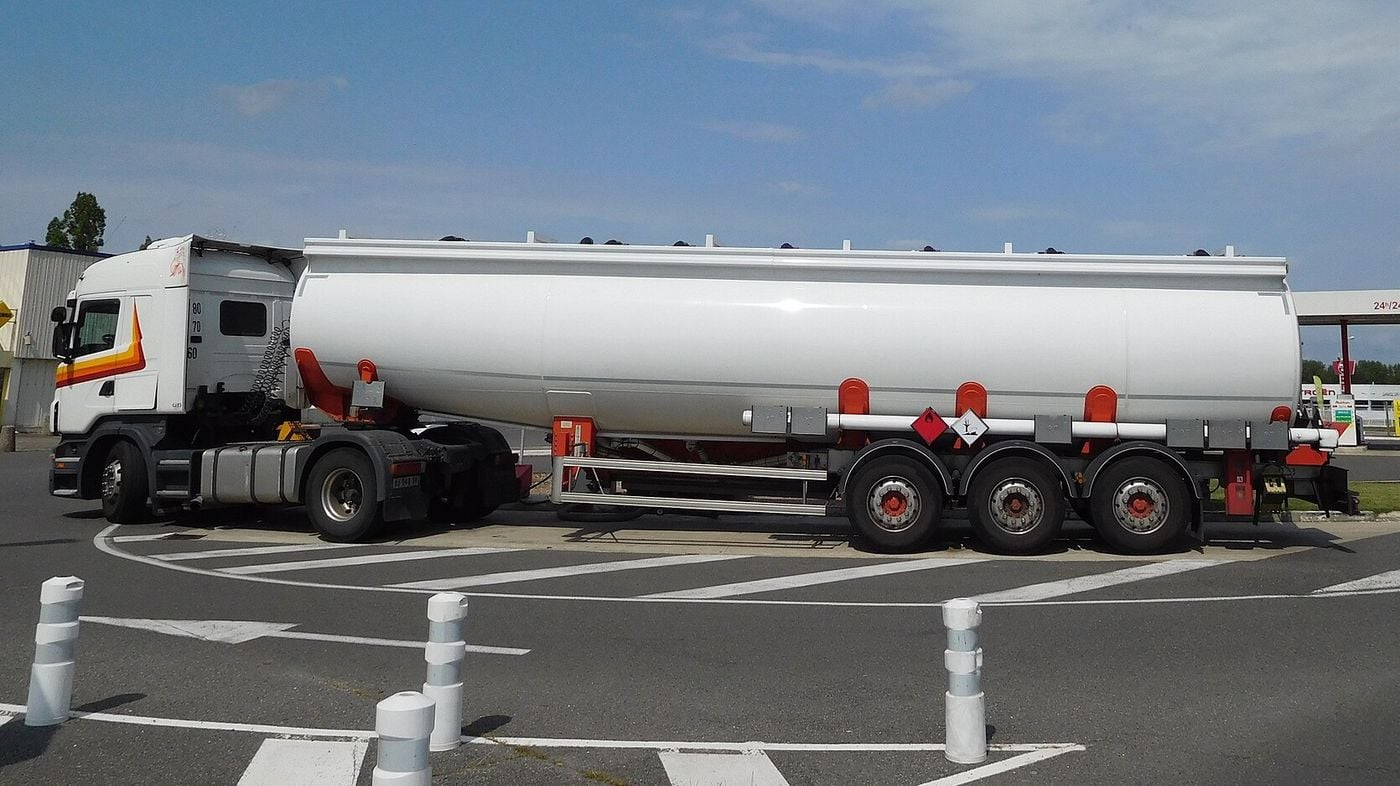
A tanker truck carries its load in a tank built onto the truck itself; a tank trailer carries it in a tank mounted on a full trailer or on a semi-trailer. Schwarzmüller lists mineral oil tank bodies, mineral oil tank trailers and mineral oil tank semitrailers, and Spitzer builds its tanks for powdery and granulated goods as truck-mounted units, full trailers and semi-trailers, with published volumes from approx. 18 m³ on a truck to approx. 89 m³ on a tipping semi-trailer. In the European Union, bulk foodstuffs in liquid, granulate or powder form are to be transported in receptacles, containers or tankers reserved for the transport of foodstuffs and marked as such, under Annex II to Regulation (EC) No 852/2004 on the hygiene of foodstuffs. For dangerous goods, the vehicle and tank rules of the ADR are set out in ADR explained: dangerous goods vehicles, orange plates and tunnel codes.
Status as at 27 October 2026. Read on that day: the tank vehicle pages of Schwarzmüller, the dry bulk vehicle pages of Spitzer and the home page of Feldbinder named below, and the French, Italian and Polish versions of the consolidated text of Regulation (EC) No 852/2004 of 24 March 2021. The English, German and Spanish versions of that text were read on 10 October 2026.
Tank bodies, full trailers and semi-trailers
Spitzer distinguishes non-tipping and tipping containers for dry bulk and says where they go: “These can be built onto HGVs, attached as full trailers (tandem or turntable trailers) or designed as semi-trailers.” Its range follows that split: truck-mounted units (A, AK and API ranges), full trailers and centre-axle trailers (SA, ZA and SAPI ranges), non-tipping semi-trailers, including versions with hydraulically forced steering (SF range), and tipping semi-trailers (SK range). It also builds containers (CK-BI range) in sizes of 20, 30 and 40 feet, and suction/pressure vehicles in non-tipping and tipping form.
Schwarzmüller files its tank vehicles under four headings: mineral oil tank bodies, mineral oil tank trailers, mineral oil tank semitrailers, and individual solutions. Feldbinder offers silo trucks and tankers for the road, silo wagons and tank wagons for rail, and silo and tank containers for transport that combines the road with rail or sea, and says its vehicles are made of aluminium. The volumes Feldbinder publishes for its silo semi-trailers are given in Trailer types explained.
Mineral oil tankers
Schwarzmüller’s category of mineral oil tank semitrailers shows three versions of a three-axle aluminium tank semitrailer: a “3-axle aluminium tank semitrailer - 38,000 l”, one “with electronic dipsticks”, and one “with pumping and measuring system and/or gravitational measuring system (cylinder)”.
The ADR requirements for a tank vehicle carrying dangerous goods, from vehicle designations such as FL to the tank plate, the certificate of approval and tunnel codes, are set out in ADR explained, and the driver’s training certificate with its tank specialisation in the ADR driver training certificate explained. Vacuum tankers for liquid waste and sludge are covered in sewer-cleaning and vacuum trucks.
Dry bulk tankers
Spitzer gives its own definition: “Dry bulk tankers are vehicles or semi-trailers used to transport pulverized and granulated bulk goods.” In its description, the goods are carried in vessels made of a five-millimetre-thick aluminium alloy, and the tanker “is generally emptied or discharged via a discharge hopper, with the help of compressed air up to max. 2 bar”, supplied by an on-board compressor or by a stationary compressor unit.
The volumes Spitzer publishes by range:
- non-tipping semi-trailers (SF range): approx. 23 m³ to approx. 63 m³;
- tipping semi-trailers (SK range): approx. 38 m³ to approx. 89 m³;
- truck-mounted units (A, AK and API ranges): approx. 18 m³ to approx. 35 m³;
- full trailers and centre-axle trailers (SA, ZA and SAPI ranges): the five full trailers in the table below hold approx. 18 m³ to approx. 33 m³.
Spitzer names foodstuffs, construction materials, chemical substances such as plastic pellets, animal feed and hazardous goods (ADR) as the loads of its dry bulk tankers. Its list for the SF range includes cement, plaster, mortar, liquid manure, slurry, lime water mixtures, flour, starch, rice and feed pellets; its list for the SK range includes gravel, sand, cement, sugar, salt, cocoa beans, coffee beans, milk powder, plastic granulate and wood pellets. The duties of road carriers of plastic pellets are set out in plastic pellet losses and road carriers.
On vehicles for foodstuffs, Spitzer says it pays close attention to the applicable regulations and norms and writes: “These regulations include DIN 10502 and the EC norm 1935/2004.” For vehicles carrying animal feed it names GMP (Good Manufacturing Practice), and of its hazardous goods vehicles it says that they “are always manufactured in compliance with the latest applicable ADR rules at the time of production”.
Published figures for nine dry bulk models
Spitzer publishes technical facts model by model. For the nine models below, each with one chamber, it gives an operating/test pressure of 2 bar, an operating temperature of -40 °C to +80 °C and 385/65 R22.5 tyres.
| Model | Type | Volume | Total length | Total weight | Axles | Tare weight |
|---|---|---|---|---|---|---|
| SF 2723 FL | Non-tipping semi-trailer | approx. 23 m³ | approx. 8,600 mm | 40 t | 3 × 9 t, air suspended | approx. 4.1 t (semi-trailer) |
| SF 2731/2 P | Non-tipping semi-trailer | approx. 31 m³ | approx. 8,930 mm | 40 t | 3 × 9 t, air suspended | approx. 4.15 t (semi-trailer) |
| SF 2734/2 P | Non-tipping semi-trailer | approx. 34 m³ | approx. 9,300 mm | 40 t | 3 × 9 t, air suspended | approx. 4.25 t (semi-trailer) |
| SF 2737/2 P | Non-tipping semi-trailer | approx. 37 m³ | approx. 9,800 mm | 40 t | 3 × 9 t, air suspended | approx. 4.35 t (semi-trailer) |
| ZA 1818/1 | Full trailer | approx. 18 m³ | approx. 5,700 mm | approx. 18 t | 2 × 9 t, air suspended | approx. 2.6 t (full trailer) |
| ZA 1825/2 | Full trailer | approx. 25 m³ | approx. 7,350 mm | approx. 18 t | 2 × 9 t, air suspended | approx. 3.45 t (vessel, without additional equipment) |
| ZA 1830/2 | Full trailer | approx. 30 m³ | approx. 8,250 mm | approx. 18 t | 2 × 9 t, air suspended | approx. 3.45 t (vessel) |
| SAPI 1830/3 | Full trailer | approx. 30 m³ | approx. 8,720 mm | 18 t | 2 × 9 t, air suspended | approx. 3.7 t (vessel) |
| SAPI 1833/3 | Full trailer | approx. 33 m³ | approx. 9,120 mm | 18 t | 2 × 9 t, air suspended | approx. 3.8 t (vessel) |
For the four semi-trailers Spitzer gives 27 t as the semi-trailer axle load and 13 t as the fifth-wheel load. The SAPI 1830/3 page lists possible chamber contents with straight partition walls of approx. 9.0, 10.5 and 10.5 m³. Every model in the table has DN 450 manholes; the outlets are DN 800, except on the SF 2723 FL, which has a single DN 200 outlet.
Food tankers: the EU hygiene rules
Regulation (EC) No 852/2004 applies “to all stages of production, processing and distribution of food and to exports” (Article 1(1)). Food business operators carrying out any stage after primary production and the associated operations listed in Annex I comply with the general hygiene requirements of its Annex II (Article 4(2)), and the introduction to that Annex states that its Chapter IV, on transport, “applies to all transportation”. Under Article 3 the duty sits with the food business operators for all stages “under their control”.
Point 4 of Chapter IV deals with bulk loads: “Bulk foodstuffs in liquid, granulate or powder form are to be transported in receptacles and/or containers/tankers reserved for the transport of foodstuffs.” The same point sets the marking: “Such containers are to be marked in a clearly visible and indelible fashion, in one or more Community languages, to show that they are used for the transport of foodstuffs, or are to be marked ‘for foodstuffs only’.”
The other points of the Chapter cover conveyances and containers in general:
- they are to be kept clean and maintained in good repair and condition to protect foodstuffs from contamination and, where necessary, designed and constructed to permit adequate cleaning and/or disinfection (point 1);
- receptacles in vehicles and/or containers “are not to be used for transporting anything other than foodstuffs where this may result in contamination” (point 2);
- where they carry anything in addition to foodstuffs, or different foodstuffs at the same time, there is, where necessary, to be effective separation of products (point 3);
- where they have been used for anything other than foodstuffs or for different foodstuffs, “there is to be effective cleaning between loads to avoid the risk of contamination” (point 5);
- foodstuffs in them are to be so placed and protected as to minimise the risk of contamination (point 6).
Point 7, on maintaining foodstuffs at appropriate temperatures and allowing those temperatures to be monitored, is covered in refrigerated transport and the ATP. Article 2(3) defines “where necessary” in the Annexes as where necessary “to achieve the objectives of this Regulation”.
Point 9 of Chapter IX, which comes from Commission Regulation (EU) 2021/382 of 3 March 2021, covers allergens. Equipment, conveyances and/or containers used for the processing, handling, transport or storage of one of the substances or products causing allergies or intolerances referred to in Annex II to Regulation (EU) No 1169/2011 “shall not be used for the processing, handling, transport or storage of any food, not containing that substance or product, unless the equipment, conveyances and/or containers have been cleaned and checked at least for the absence of any visible debris of that substance or product”.
Article 13 allows the Commission to grant derogations from Annexes I and II, “in particular to facilitate the implementation of Article 5 for small businesses”, provided that they do not affect the achievement of the Regulation’s objectives (paragraph 2). Member States may, without compromising achievement of the Regulation’s objectives, adopt national measures adapting the requirements of Annex II in accordance with paragraphs 4 to 7 of that Article (paragraph 3).
“For foodstuffs only” in six language versions
Under point 4, the marking showing that the containers are used for the transport of foodstuffs is to be made “in one or more Community languages”; the alternative is the marking ‘for foodstuffs only’. The table gives the wording of point 4 in six language versions of the consolidated text.
| Language version | Transported in | Alternative marking |
|---|---|---|
| English | receptacles and/or containers/tankers | ‘for foodstuffs only’ |
| German | Transportbehältern und/oder Containern/Tanks | „Nur für Lebensmittel“ |
| French | réceptacles et/ou conteneurs/citernes | «Uniquement pour denrées alimentaires» |
| Spanish | receptáculos, contenedores o cisternas | «exclusivamente para productos alimenticios» |
| Italian | vani di carico e/o contenitori/cisterne | «esclusivamente per prodotti alimentari» |
| Polish | pojemnikach i/lub kontenerach/zbiornikach | „tylko dla środków spożywczych” |
Quick answers
- What is the difference between a tanker truck and a tank trailer?
- On a tanker truck the tank is built onto the truck itself; on a tank trailer it is mounted on a full trailer or a semi-trailer. Spitzer says its dry bulk tanks ‘can be built onto HGVs, attached as full trailers (tandem or turntable trailers) or designed as semi-trailers’, and Schwarzmüller lists mineral oil tank bodies, mineral oil tank trailers and mineral oil tank semitrailers.
- How much does a tank semi-trailer hold?
- Schwarzmüller lists a 3-axle aluminium tank semitrailer for mineral oil with 38,000 l. For dry bulk, Spitzer gives approx. 23 to 63 m³ for its non-tipping semi-trailers (SF range) and approx. 38 to 89 m³ for its tipping semi-trailers (SK range); its SF 2737/2 P holds approx. 37 m³, with an admissible total weight of 40 t and a tare weight of approx. 4.35 t.
- What is a dry bulk tanker?
- Spitzer defines dry bulk tankers as ‘vehicles or semi-trailers used to transport pulverized and granulated bulk goods’. In its description the goods are carried in vessels made of a five-millimetre-thick aluminium alloy, and the tanker is generally discharged via a discharge hopper with compressed air at up to 2 bar, from an on-board compressor or a stationary compressor unit. The loads it names range from cement and flour to plastic pellets, animal feed and hazardous goods (ADR).
- Can a food tanker carry anything other than food in the EU?
- Bulk foodstuffs in liquid, granulate or powder form are to be transported in receptacles and/or containers/tankers ‘reserved for the transport of foodstuffs’ (Regulation (EC) No 852/2004, Annex II, Chapter IV, point 4). For vehicles and containers in general, point 2 bars the use of receptacles in vehicles and/or containers for transporting anything other than foodstuffs where this may result in contamination, and point 5 requires effective cleaning between loads where conveyances and/or containers have carried anything other than foodstuffs or different foodstuffs. Chapter IX, point 9 requires a conveyance used to transport one of the substances or products causing allergies or intolerances referred to in Annex II to Regulation (EU) No 1169/2011 to be cleaned and checked at least for the absence of any visible debris of it before it carries food not containing it.
- What does ‘for foodstuffs only’ on a tanker mean?
- It is one of the two ways point 4 of Annex II, Chapter IV to Regulation (EC) No 852/2004 allows containers for bulk foodstuffs to be marked: in a clearly visible and indelible fashion, in one or more Community languages, to show that they are used for the transport of foodstuffs, or with the words ‘for foodstuffs only’. The German version of the Regulation gives „Nur für Lebensmittel“, the French «Uniquement pour denrées alimentaires».
Sources
- Regulation (EC) No 852/2004 of the European Parliament and of the Council of 29 April 2004 on the hygiene of foodstuffs — consolidated text of 24 March 2021, English version: Articles 1 to 4 and 13, Annex II (introduction, Chapters IV and IX) — EUR-Lex, Publications Office of the European Union
- Regulation (EC) No 852/2004 on the hygiene of foodstuffs — consolidated text of 24 March 2021, German version: Annex II, Chapter IV — EUR-Lex, Publications Office of the European Union
- Regulation (EC) No 852/2004 on the hygiene of foodstuffs — consolidated text of 24 March 2021, French version: Annex II, Chapter IV — EUR-Lex, Publications Office of the European Union
- Regulation (EC) No 852/2004 on the hygiene of foodstuffs — consolidated text of 24 March 2021, Spanish version: Annex II, Chapter IV — EUR-Lex, Publications Office of the European Union
- Regulation (EC) No 852/2004 on the hygiene of foodstuffs — consolidated text of 24 March 2021, Italian version: Annex II, Chapter IV — EUR-Lex, Publications Office of the European Union
- Regulation (EC) No 852/2004 on the hygiene of foodstuffs — consolidated text of 24 March 2021, Polish version: Annex II, Chapter IV — EUR-Lex, Publications Office of the European Union
- General information: what is a dry bulk tanker? Vehicle ranges, capacities and loads (read on 27 October 2026) — Spitzer Silo-Fahrzeugwerke GmbH
- SF 2723 FL, non-tipping type semi-trailer / P: technical facts (read on 27 October 2026) — Spitzer Silo-Fahrzeugwerke GmbH
- SF 2731/2 P, non-tipping type semi-trailer / P: technical facts (read on 27 October 2026) — Spitzer Silo-Fahrzeugwerke GmbH
- SF 2734/2 P, non-tipping type semi-trailer / P: technical facts (read on 27 October 2026) — Spitzer Silo-Fahrzeugwerke GmbH
- SF 2737/2 P, non-tipping type semi-trailer / P: technical facts (read on 27 October 2026) — Spitzer Silo-Fahrzeugwerke GmbH
- ZA 1818/1, full trailer: technical facts (read on 27 October 2026) — Spitzer Silo-Fahrzeugwerke GmbH
- ZA 1825/2, full trailer: technical facts (read on 27 October 2026) — Spitzer Silo-Fahrzeugwerke GmbH
- ZA 1830/2, full trailer: technical facts (read on 27 October 2026) — Spitzer Silo-Fahrzeugwerke GmbH
- SAPI 1830/3, full trailer: technical facts (read on 27 October 2026) — Spitzer Silo-Fahrzeugwerke GmbH
- SAPI 1833/3, full trailer: technical data (read on 27 October 2026) — Spitzer Silo-Fahrzeugwerke GmbH
- Tank vehicles: product categories (read on 27 October 2026) — Wilhelm Schwarzmüller GmbH
- Mineral oil tank semitrailers: product category (read on 27 October 2026) — Wilhelm Schwarzmüller GmbH
- Feldbinder home page: road, rail and container products (read on 27 October 2026) — Feldbinder Spezialfahrzeugwerke GmbH