CVSA inspection levels, decal and out-of-service criteria
CVSA lists nine inspection levels; a vehicle passing Level I or V gets a decal valid up to three months. Next Roadcheck: May 11–13, 2027.
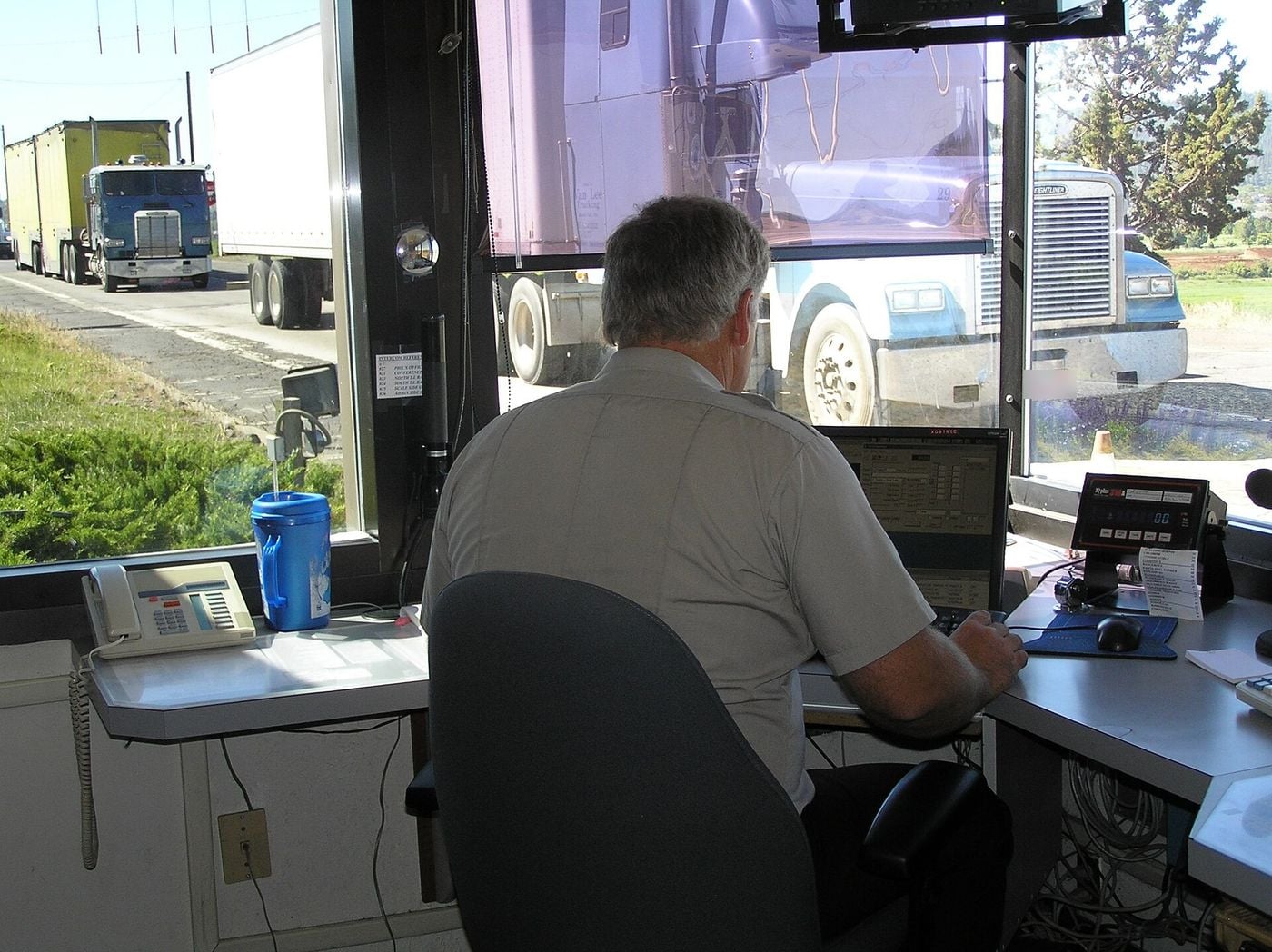
Roadside inspections of trucks and buses in the United States follow the North American Standard Inspection Program of the Commercial Vehicle Safety Alliance (CVSA). CVSA’s list of inspection levels runs from Level I, the inspection of both driver and vehicle, to Level IX, the post-crash inspection. A vehicle that passes a Level I or Level V inspection with no critical violation under CVSA’s out-of-service criteria receives a CVSA decal for the month of issue plus two months, while a vehicle declared out of service may not be operated until it has been repaired (49 CFR 396.9). The next International Roadcheck, CVSA’s annual 72-hour inspection event, is scheduled for May 11–13, 2027.
Status: 22 November 2026. This page follows CVSA’s pages on inspections, inspection levels, inspection decals, the out-of-service criteria, International Roadcheck and its results; section 396.9 and Part 350 of Title 49 of the Code of Federal Regulations in the annual edition revised as of October 1, 2025; and FMCSA’s final rule of June 22, 2026 (91 FR 37053), in force since July 22, 2026, which revised paragraph 396.9(d)(3)(ii) and which that edition does not yet print. All were read on 21 November 2026. On that day the Federal Register listed two documents affecting Part 396 published since October 1, 2025, that rule and the rule on electronic driver vehicle inspection reports of February 19, 2026 (91 FR 7893), and none affecting Part 350.
| Item | Rule or figure | Source |
|---|---|---|
| Inspection program | CVSA’s North American Standard Inspection Program; approximately 4 million inspections a year throughout North America | CVSA, Inspections |
| Inspection levels | Level I to Level IX; Level I covers driver and vehicle, Level IX is the post-crash inspection | CVSA, All Inspection Levels |
| CVSA decal | After a Level I or Level V inspection with no critical violation; special decal after a passed Level VI; vehicle only, not the driver | CVSA, About Inspection Decals |
| CVSA decal validity | Month of issuance plus two months, not to exceed three consecutive months; the color shows the quarter | CVSA, About Inspection Decals |
| Out-of-service criteria | CVSA’s pass-fail criteria; new edition each year, effective April 1; 2026 edition effective April 1, 2026 | CVSA, Out-of-Service Criteria |
| Vehicle declared out of service | Not operated, or towed except by crane or hoist, until all required repairs are completed | 49 CFR 396.9(c)(2) |
| Carrier’s certification | Within 15 days of the inspection; form returned to the issuing State agency only if it requests it (since July 22, 2026); copy kept 12 months | 49 CFR 396.9(d)(3); 91 FR 37053 |
| International Roadcheck | Annual, 72 hours; next on May 11–13, 2027 | CVSA, International Roadcheck |
Who carries out roadside inspections?
According to CVSA, approximately 4 million commercial motor vehicle inspections are conducted every year throughout North America. Specially trained inspectors in each state, jurisdiction, territory and province carry them out “based on inspection procedures and criteria created by CVSA, known as the North American Standard Inspection Program.” Inspections must be performed by inspectors certified for Level I, Level V or Level VI; “certified” means that the government employee performing inspections and/or affixing CVSA decals “must have successfully completed a training program approved by CVSA.”
The federal regulation on the Motor Carrier Safety Assistance Program (MCSAP), 49 CFR Part 350, defines the North American Standard Inspection as “the methodology used by State CMV safety inspectors to conduct safety inspections of CMVs”, consisting of various levels of inspection of the vehicle or driver or both. Its criteria “are developed by FMCSA in conjunction with the Commercial Vehicle Safety Alliance (CVSA), which is an association of States, Canadian Provinces, and Mexico whose members agree to adopt these standards for inspecting CMVs in their jurisdiction” (section 350.105). MCSAP is a federal formula grant program that provides financial assistance to the States (350.201(a)); driver inspections and vehicle inspections are the first two of its national elements (350.203). Among the conditions a State must meet to qualify for MCSAP funds, section 350.207(a) lists:
- adopting and enforcing compatible laws, regulations, standards and orders on commercial motor vehicle safety (paragraph (a)(2));
- granting “maximum reciprocity for inspections conducted under the North American Standard Inspection Program through the use of a nationally accepted system that allows ready identification of previously inspected CMVs” ((a)(16));
- conducting driver or vehicle inspections at locations that are adequate to protect the safety of drivers and enforcement personnel ((a)(18));
- except in the case of an imminent or obvious safety hazard, ensuring that an inspection of a vehicle transporting passengers for a motor carrier of passengers is conducted at “a bus station, terminal, border crossing, maintenance facility, destination, or other location where a motor carrier may make a planned stop (excluding a weigh station)” ((a)(19)).
How fixed scales, weigh-in-motion and bypass systems work is described in weigh stations in the US.
The nine CVSA inspection levels
CVSA’s page on inspection levels lists nine levels, Level I to Level IX; Level IX is the post-crash inspection. CVSA’s inspections overview page gives a different number of levels.
| Level | CVSA name | What it covers, in CVSA’s definition | CVSA decal |
|---|---|---|---|
| I | North American Standard Inspection | Driver and vehicle; the items are listed in the next section | Yes, with no critical violation |
| II | Walk-Around Driver/Vehicle Inspection | A walk-around examination of driver and vehicle items, contemplated to include only those that can be inspected without physically getting under the vehicle | Not eligible |
| III | Driver/Credential/Administrative Inspection | At a minimum, where required or applicable: driver’s license, Medical Examiner’s Certificate and Skill Performance Evaluation (SPE) Certificate, record of duty status, hours of service, seat belt, vehicle inspection reports, carrier identification and status | Not eligible |
| IV | Special Inspections | Typically a one-time examination of a particular item, normally in support of a study or to verify or refute a suspected trend | Not eligible |
| V | Vehicle-Only Inspection | Each vehicle item of the Level I inspection, without a driver present, at any location | Yes, with no critical violation |
| VI | North American Standard Inspection for Transuranic Waste and Highway Route Controlled Quantities (HRCQ) of Radioactive Material | Select radiological shipments: enhancements to the Level I inspection, radiological requirements and the out-of-service criteria for transuranic waste and HRCQ radioactive material | Special Level VI decal |
| VII | Jurisdictional Mandated Commercial Vehicle Inspection | A jurisdiction’s own inspection program that does not meet the requirements of any other level, for example school buses, limousines, taxis, shared-ride transportation, hotel courtesy shuttles and other intrastate operations | No CVSA decal; a jurisdiction-specific decal may be applied |
| VIII | North American Standard Electronic Inspection | Conducted electronically or wirelessly while the vehicle is in motion, without direct interaction with an enforcement officer | Not eligible |
| IX | Post-Crash Inspection | To be conducted after a crash resulting in a fatality or a serious physical injury, after a high-profile crash involving a commercial motor vehicle, or where jurisdictionally required; includes all accessible Level I items | Not eligible |
The levels page adds detail for three of them:
- Level VI. “All vehicles and carriers transporting HRCQ of radioactive material are regulated by the U.S. Department of Transportation and required to pass the North American Standard Level VI Inspection.” HRCQ is as defined in 49 CFR 173.403; because only a small fraction of transuranics are HRCQ, the U.S. Department of Energy includes its transuranic waste shipments in the Level VI program.
- Level VII. These inspections may be conducted by CVSA-certified inspectors, other designated government employees or jurisdiction-approved contractors, and inspector training requirements “shall be determined by each jurisdiction.”
- Level VIII. The data exchange must include, where required or applicable, a descriptive location with GPS coordinates, electronic validation of who is operating the vehicle, the license class, endorsements and status, the Medical Examiner’s Certificate and Skill Performance Evaluation (SPE) Certificate, the record of duty status and hours-of-service compliance, the USDOT or Canadian NSC number, power unit registration, operating authority, Unified Carrier Registration compliance and federal out-of-service orders. To be a complete Level VIII inspection, the data exchange must include each of the required or applicable data points.
What is a Level 1 DOT inspection?
Level I, the North American Standard Inspection, is the inspection that examines both the driver and the vehicle. CVSA’s definition lists, on the driver side, the driver’s license, the Medical Examiner’s Certificate and Skill Performance Evaluation (SPE) Certificate (if applicable), alcohol and drugs, the record of duty status as required, hours of service, the seat belt and vehicle inspection reports (if applicable). On the vehicle side it lists brake systems, cargo securement, coupling devices, driveline/driveshaft, exhaust systems, frames, fuel systems, lighting devices, steering mechanisms, suspensions, tires, van and open-top trailer bodies, wheels, rims and hubs, and windshield wipers. For “buses, motorcoaches, passenger vans or other passenger-carrying vehicles” it adds emergency exits, electrical cables and systems in engine and battery compartments, and seating. Hazardous materials/dangerous goods (HM/DG) and specification cargo tank requirements are included as applicable; HM/DG items are inspected only by certified HM/DG and cargo tank inspectors.
Two notes on the levels page mark the boundaries between levels. If more than 20 percent of pushrod travel on exposed pushrods cannot be measured, the inspection “would not be considered a Level I Inspection and shall be identified as a Level II Inspection.” Mechanical equipment violations specific to a Level I or Level II inspection “should not be included in a Level III Inspection”, while traffic violations or infractions, if applicable, are to be included in it. Level V covers the Level I vehicle items without the driver, and Level IX all accessible Level I items.
A roadside Level I inspection is not the periodic inspection that 49 CFR 396.17 requires; that inspection, and the question of whether a roadside inspection counts as one, are covered in the DOT annual inspection. The driver’s own pre-trip check and the driver vehicle inspection report (DVIR) are described in pre-trip inspection and the DVIR.
The CVSA decal
CVSA says that each commercial motor vehicle “(motorcoach, school bus, other bus, truck, truck tractor, semi-trailer, trailer, etc.) used singularly or in combination may qualify for a CVSA decal, if it passes inspection.” Level I and Level V are the only inspections eligible for the decal; Level VI inspections may result in a special Level VI decal. A “Pass Inspection” means that during a Level I, Level V or Level VI inspection “there are no critical violations, according to the North American Standard Out-of-Service Criteria.” The decal is affixed by an inspector certified for Level I, Level V or Level VI.
The decal criteria “apply only to the condition of the vehicle, not the driver. It is possible for a driver to be out of service and still have his or her vehicle(s) qualify for a CVSA decal.”
Validity. Decals “remain valid for a period not to exceed three consecutive months”: they are valid for the month of issuance plus two months. In CVSA’s example, a decal issued on July 28, 2018, expired on September 30, 2018. “Generally, vehicles displaying a valid CVSA decal will not be subject to re-inspection. However, nothing prevents re-inspection of a vehicle or combination of vehicles bearing valid CVSA decals.”
Color, year and corners. A CVSA decal is a colored sticker with the year of the inspection, shown by the last digit of the calendar year, and the CVSA trademarked logo below it. The color shows the quarter of issue:
| Color | Issued in | Valid until the end of |
|---|---|---|
| Green | January, February or March | March, April or May |
| Yellow | April, May or June | June, July or August |
| Orange | July, August or September | September, October or November |
| White | October, November or December | December, January or February |
Within the quarter, the corners show the month: a decal affixed in the first month of a calendar quarter has both upper corners removed, one issued in the second month has the upper right corner removed, and one issued in the last month has no corner removed.
Placement. On a power unit the decal goes on the lower right corner of the exterior surface of the passenger’s windshield. On trailing units (trailers, full trailers, semi-trailers, converter dollies) it goes on the lower right corner as near the front as possible; on a cargo tank semi-trailer at eye level near the right front of the cargo tank. On passenger vehicles it goes on the glass portion (window) of the passenger door, as close to the inspector’s eye level as possible. An expired decal is removed before a new one is affixed.
The decal or report that section 396.17(c) allows as proof of the periodic annual inspection is a separate document, described in the DOT annual inspection.
The out-of-service criteria
CVSA describes the North American Standard Out-of-Service Criteria (OOSC) as “the pass-fail criteria for inspections. The purpose of the criteria is to identify critical violations. Those violations render the driver, vehicle and/or cargo out of service until the condition(s) or defect(s) can be corrected or fixed.” The OOSC identify critical vehicle inspection items and detail the criteria “that can prohibit a motor carrier or driver from operating a commercial motor vehicle for a specified period of time or until the condition is corrected.”
The criteria are “updated annually, effective April 1 of each year, with the release of that year’s edition of the handbook.” On November 21, 2026, CVSA’s page offered the 2026 edition of the handbook for purchase and a document outlining the changes that took effect on April 1, 2026.
Where the criteria appear in federal regulations. FMCSA’s rulemakings of 2024 and 2025 on CVSA’s handbook concern only FMCSA’s hazardous materials safety permit regulations, which incorporate the handbook by reference for the inspection procedures and out-of-service criteria “for inspections of shipments of transuranic waste and highway route-controlled quantities (HRCQs) of radioactive material (RAM)”, the shipments that are the subject of the Level VI inspection. The 2024 final rule and the 2025 proposed rule both say that the criteria “provide enforcement personnel nationwide, including FMCSA’s State partners, with uniform enforcement tolerances for inspections.”
- In force: the final rule of August 21, 2024 (89 FR 67560), effective September 20, 2024, replaced the April 1, 2023 edition of the handbook with the April 1, 2024 edition.
- Proposed: the proposed rule of November 19, 2025 (90 FR 52030) would incorporate the April 1, 2025 edition; comments were due by December 19, 2025. The Federal Register listed no final rule on it up to November 21, 2026.
The provision of the hazardous materials safety permit rules that incorporates the handbook, and the wider point that the cargo securement rules of Part 393, subpart I, contain no out-of-service criteria, are set out in cargo securement rules for trucks in the US.
Separately, on August 10, 2026, FMCSA proposed to codify the English language proficiency driver qualification requirement as an out-of-service violation, which would align the regulations with the current enforcement tolerances in CVSA’s criteria (91 FR 51422, docket FMCSA-2026-0826; comments closed October 9, 2026); the Federal Register listed no final rule up to November 21, 2026.
The out-of-service order: 49 CFR 396.9
Section 396.9 of the Federal Motor Carrier Safety Regulations covers the inspection of motor vehicles and intermodal equipment in operation. Under paragraph (a), every special agent of FMCSA is authorized to enter upon and perform inspections of a motor carrier’s vehicles and intermodal equipment in operation.
| Paragraph | Rule |
|---|---|
| (b) | The Driver Vehicle Examination Report records the results of inspections conducted by authorized FMCSA personnel |
| (c)(1) | Authorized personnel declare and mark out of service any motor vehicle or intermodal equipment which by reason of its mechanical condition or loading would likely cause an accident or a breakdown, using an “Out-of-Service Vehicle” sticker |
| (c)(2) | No person may operate, and no motor carrier or intermodal equipment provider may require or permit anyone to operate, the vehicle or equipment until all repairs required by the out-of-service notice have been satisfactorily completed; operating includes towing, except towing away by a vehicle using a crane or hoist |
| (c)(3) | No one may remove the sticker before all repairs required by the out-of-service notice are completed |
| (d)(1) | The driver delivers a copy of the inspection report to the motor carrier and the intermodal equipment provider on arrival at the next terminal or facility; if not due there within 24 hours, the driver immediately mails, faxes or otherwise transmits it |
| (d)(2) | The motor carrier and intermodal equipment provider examine the report; violations or defects are corrected in accordance with section 396.11(a)(3) |
| (d)(3)(i) | Within 15 days following the date of the inspection, the motor carrier or intermodal equipment provider certifies that all violations noted have been corrected, by completing the signature, title and date portions of the form |
| (d)(3)(ii) | If requested by the issuing State agency, the completed form is returned to it at the address on the form; in all instances a copy is kept at the principal place of business or where the vehicle is housed for 12 months from the date of the inspection |
Under paragraph (c)(2), a combination of an emergency towing vehicle and an out-of-service vehicle may be operated only if it meets the performance requirements of the Federal Motor Carrier Safety Regulations, except for the conditions noted on the Driver Vehicle Examination Report.
The 2026 change. Until July 22, 2026, paragraph (d)(3)(ii) required the completed roadside inspection form to be returned to the issuing agency; the edition revised as of October 1, 2025, still prints that wording. FMCSA’s final rule “Completed Inspection Report Disposition” (91 FR 37053, June 22, 2026, docket FMCSA-2025-0116) responded to a petition for rulemaking from CVSA: “completed forms will only be returned to those States that request them.” The rule notes that not all issuing State agencies require the return. A commenter asked FMCSA to publish a list of the States that do; FMCSA replied that it “will not be compiling this list.” The requirement to keep a copy is unchanged apart from a cross-reference to the certification in paragraph (d)(3)(i).
The repair and defect-reporting duties of section 396.11 are described in pre-trip inspection and the DVIR. The civil penalties for operating while out of service and for failing to return the certification of correction are listed in FMCSA civil penalties, and how inspection results are used in FMCSA’s Safety Measurement System in CSA and the Safety Measurement System.
International Roadcheck
International Roadcheck is, in CVSA’s words, “an annual three-day event when CVSA-certified inspectors conduct compliance, enforcement and educational initiatives targeted at various elements of motor carrier, vehicle and driver safety.” During the 72 hours, nearly 15 trucks and motorcoaches are inspected, on average, every minute across North America. Since the first Roadcheck in 1988, inspections conducted during the event have numbered more than 1.8 million. CVSA sponsors it with the participation of FMCSA, the Pipeline and Hazardous Materials Safety Administration, the Canadian Council of Motor Transport Administrators, Transport Canada and Mexico’s Ministry of Infrastructure, Communications and Transportation.
“The next International Roadcheck is scheduled for May 11-13, 2027.” On November 21, 2026, CVSA’s Roadcheck page named no focus areas for 2027.
| Year | Dates | Inspections | Out-of-service figures |
|---|---|---|---|
| 2026 | May 12–14 | 54,575 | 81% of vehicles and 94.2% of drivers inspected had no out-of-service violation |
| 2025 | May 13–15 | 56,178 (vehicle, driver and cargo inspections) | |
| 2024 | May 14–16 | 48,761 | 77% of vehicles and 95.2% of drivers had no out-of-service violation |
| 2023 | May 16–18 | 59,429 vehicles inspected | 81% of vehicles and 94.5% of drivers inspected had no out-of-service violation |
| 2022 | 59,026 | 12,456 vehicles and 3,714 drivers placed out of service | |
| 2021 | More than 40,000 | 6,710 vehicles and 2,080 drivers removed: a 16.5% vehicle and 5.3% driver out-of-service rate | |
| 2020 | More than 50,000 Level I, II, III and V inspections | Vehicle out-of-service rate 20.9% for Level I, II and V inspections combined | |
| 2019 | 67,072 | 12,019 vehicles and 2,784 drivers out of service: a 17.9% overall vehicle and 4.2% driver out-of-service rate | |
| 2018 | 67,603 | 21.6% of vehicles that received Level I inspections and 3.9% of drivers who received Level I, II or III inspections placed out of service | |
| 2017 | 23% of vehicles and 4.2% of drivers that received Level I inspections placed out of service |
Several entries cover more than the United States: the entries for 2020, 2023, 2024 and 2025 name Canada, Mexico and the U.S., the 2026 entry North America and the 2019 entry Canada and the U.S.; the entries for 2017, 2018, 2021 and 2022 name no area.
CVSA runs other campaigns besides Roadcheck: its Operation Airbrake program on commercial motor vehicle brake systems, developed in Canada in 1998, includes brake safety campaigns, and its Operation Safe Driver program holds an annual one-week campaign, Operation Safe Driver Week, against unsafe driving by commercial motor vehicle drivers and car drivers; neither program page gave a 2027 date on November 21, 2026.
What this page does not cover
- The content of CVSA’s out-of-service criteria handbook, which CVSA sells, and its item-by-item tolerances; the inspection procedures themselves.
- State laws on roadside inspections, intrastate rules and State penalties.
- Rules in Canada and Mexico, beyond the fact that CVSA’s program and Roadcheck cover North America.
- Carrier-wide out-of-service orders and safety ratings.
- Concerted roadside checks in the European Union and ROADPOL’s operations, described in concerted roadside checks in Europe.
Quick answers
- What are the CVSA inspection levels?
- CVSA's inspection levels page lists nine: Level I, the North American Standard Inspection of driver and vehicle; Level II, the walk-around driver/vehicle inspection; Level III, the driver/credential/administrative inspection; Level IV, special inspections; Level V, the vehicle-only inspection; Level VI, the inspection for transuranic waste and highway route controlled quantities of radioactive material; Level VII, the jurisdictional mandated inspection; Level VIII, the electronic inspection; and Level IX, the post-crash inspection.
- What is a Level 1 DOT inspection?
- Level I, CVSA's North American Standard Inspection, examines both the driver and the vehicle. CVSA's definition covers the driver's license, Medical Examiner's Certificate and Skill Performance Evaluation (SPE) Certificate (if applicable), alcohol and drugs, record of duty status, hours of service, seat belt and vehicle inspection reports (if applicable), and vehicle items from brake systems, cargo securement and coupling devices to tires, wheels and windshield wipers, with further items for buses and for hazardous materials. If more than 20 percent of pushrod travel on exposed pushrods cannot be measured, CVSA identifies the inspection as Level II.
- How long is a CVSA decal valid?
- For the month of issuance plus two months; CVSA says decals remain valid “for a period not to exceed three consecutive months”. In CVSA's example a decal issued on July 28, 2018, expired on September 30, 2018. The color shows the quarter: green for January to March, yellow for April to June, orange for July to September and white for October to December. A vehicle gets the decal after a Level I or Level V inspection with no critical violation; a passed Level VI inspection gets a special Level VI decal.
- What are the CVSA out-of-service criteria?
- The North American Standard Out-of-Service Criteria are CVSA's pass-fail criteria for inspections. They identify critical violations, which render the driver, vehicle and/or cargo out of service until the condition or defect is corrected. CVSA updates them annually, effective April 1, with that year's edition of its handbook; the 2026 changes took effect on April 1, 2026.
- What happens when a truck is placed out of service?
- Under 49 CFR 396.9, a vehicle declared out of service is marked with an “Out-of-Service Vehicle” sticker and may not be operated until all repairs required by the out-of-service notice are completed; towing counts as operating, except towing away by a vehicle using a crane or hoist. Within 15 days of the inspection the motor carrier certifies that the violations were corrected. Since July 22, 2026, it returns the completed form to the issuing State agency only if that agency requests it, and in all instances keeps a copy for 12 months.
- When is International Roadcheck 2027?
- CVSA has scheduled the next International Roadcheck for May 11–13, 2027. It is an annual three-day event, held since 1988, in which CVSA-certified inspectors across North America inspect trucks and motorcoaches over 72 hours; Roadcheck inspections since 1988 number more than 1.8 million. In 2026, from May 12 to 14, inspectors conducted 54,575 inspections.
Sources
- All Inspection Levels: Level I to Level IX of the North American Standard Inspection Program (web page, read November 21, 2026) — Commercial Vehicle Safety Alliance (CVSA)
- Inspections: overview of the North American Standard Inspection Program (web page, read November 21, 2026) — Commercial Vehicle Safety Alliance (CVSA)
- About Inspection Decals: eligibility, validity, colors and placement of the CVSA decal (web page, read November 21, 2026) — Commercial Vehicle Safety Alliance (CVSA)
- Out-of-Service Criteria: the North American Standard Out-of-Service Criteria and their annual update, 2026 edition (web page, read November 21, 2026) — Commercial Vehicle Safety Alliance (CVSA)
- International Roadcheck: program page with the 2027 date (web page, read November 21, 2026) — Commercial Vehicle Safety Alliance (CVSA)
- International Roadcheck Results, 2017 to 2026 (web page, read November 21, 2026) — Commercial Vehicle Safety Alliance (CVSA)
- Operation Airbrake: program page (web page, read November 21, 2026) — Commercial Vehicle Safety Alliance (CVSA)
- Operation Safe Driver: program page (web page, read November 21, 2026) — Commercial Vehicle Safety Alliance (CVSA)
- 49 CFR 396.9 — Inspection of motor vehicles and intermodal equipment in operation (Code of Federal Regulations, annual edition revised as of October 1, 2025) — U.S. Government Publishing Office (govinfo)
- Completed Inspection Report Disposition — final rule, FR Doc. 2026-12450, 91 FR 37053 (June 22, 2026), effective July 22, 2026 — Federal Motor Carrier Safety Administration (Federal Register, govinfo), 22 Jun 2026
- 49 CFR Part 350 — Motor Carrier Safety Assistance Program (MCSAP) and High Priority Program (Code of Federal Regulations, annual edition revised as of October 1, 2025) — U.S. Government Publishing Office (govinfo)
- Incorporation by Reference; North American Standard Out-of-Service Criteria; Hazardous Materials Safety Permits — final rule, FR Doc. 2024-18749, 89 FR 67560 (August 21, 2024), effective September 20, 2024 (Federal Register record: abstract and dates) — Federal Motor Carrier Safety Administration (Federal Register, federalregister.gov), 21 Aug 2024
- Incorporation by Reference; North American Standard Out-of-Service Criteria; Hazardous Materials Safety Permits (2025) — proposed rule, FR Doc. 2025-20282, 90 FR 52030 (November 19, 2025) (Federal Register record: abstract and dates) — Federal Motor Carrier Safety Administration (Federal Register, federalregister.gov), 19 Nov 2025
- English Language Proficiency; Out of Service Criteria — proposed rule, FR Doc. 2026-16288, 91 FR 51422 (August 10, 2026) (Federal Register record: abstract and dates) — Federal Motor Carrier Safety Administration (Federal Register, federalregister.gov), 10 Aug 2026
- Federal Register documents of FMCSA matching “North American Standard Out-of-Service Criteria”, published from January 1, 2024 (API listing, read November 21, 2026) — Office of the Federal Register (federalregister.gov)
- Federal Register documents of FMCSA matching “English Language Proficiency”, published from January 1, 2025 (API listing, read November 21, 2026) — Office of the Federal Register (federalregister.gov)
- Federal Register documents affecting 49 CFR Part 396, published from October 1, 2025 (API listing, read November 21, 2026) — Office of the Federal Register (federalregister.gov)
- Federal Register documents affecting 49 CFR Part 350, published from October 1, 2025 (API listing, read November 21, 2026) — Office of the Federal Register (federalregister.gov)