Reversing detection and reverse warning on trucks and buses: UN R158, UN R165 and the rules in Germany and the US
New trucks and buses registered in the EU have needed reversing detection to UN R158 since 7 July 2024: a mirror, camera or detection system. UN R165 audible reverse warning, German and US rules.
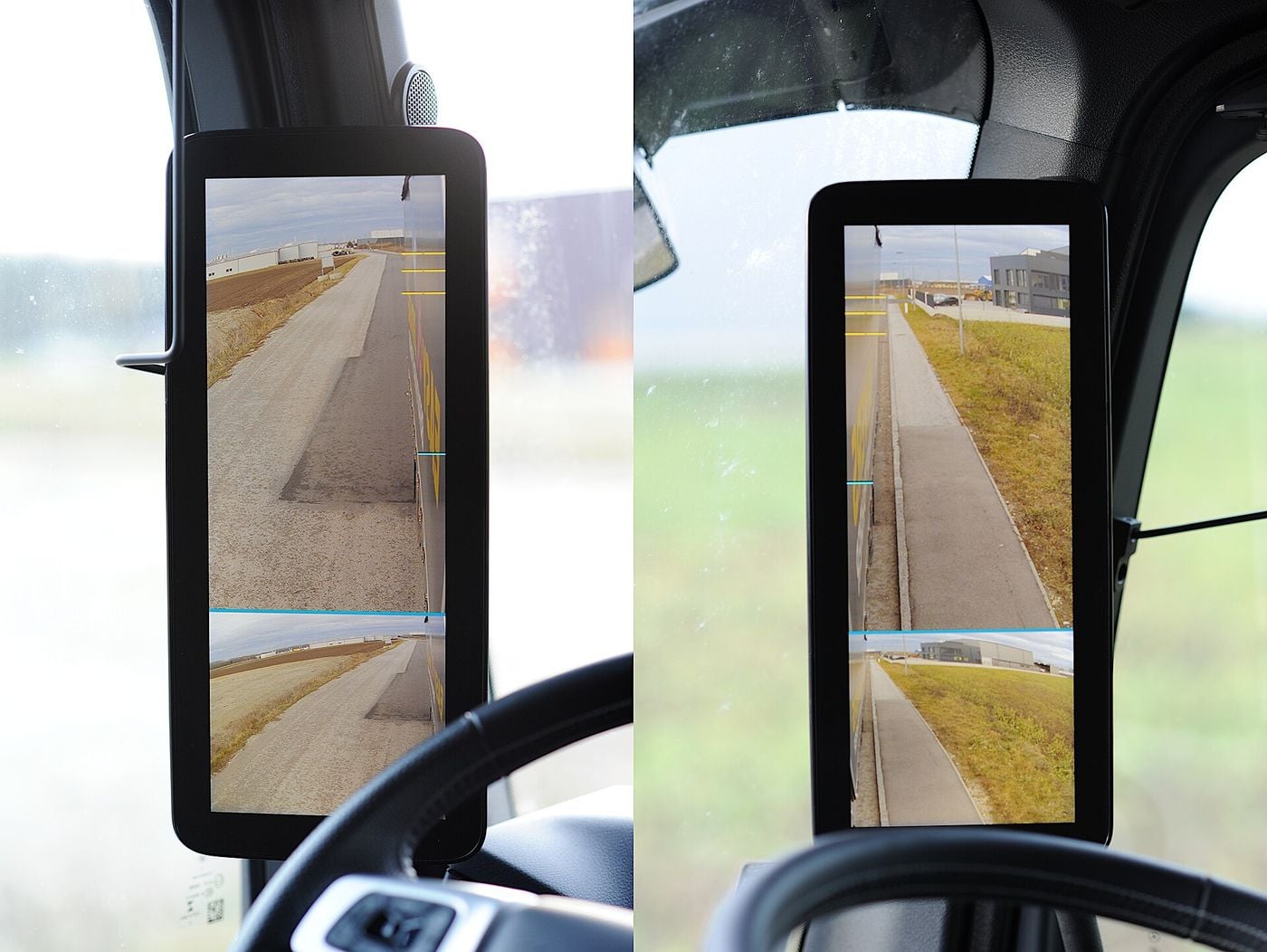
In the European Union new motor vehicles, trucks and buses included, must have reversing detection. Article 6(1) of Regulation (EU) 2019/2144 lists it among the systems with which motor vehicles shall be equipped, and row B7 of its Annex II names UN Regulation No 158 as the requirement. For categories M1 to N3, EU type-approval has been refused to vehicle types without it since 6 July 2022, and since 7 July 2024 vehicles that do not comply may not be registered. UN Regulation No 158 does not prescribe a camera. It requires at least one means of vision or awareness for the driver during a backing event: a mirror or camera-monitor system approved to UN Regulation No 46, a close-proximity rear-view mirror, a rear-view camera system or a detection system. Direct vision counts only for small M1 and N1 vehicles. Audible reverse warning devices and signals are the subject of a separate regulation, UN Regulation No 165, in force since 19 January 2023 but not listed in Regulation (EU) 2019/2144. National rules on reversing itself apply as well. In Germany a driver who reverses must be guided by another person, an Einweiser, where necessary under the road traffic regulations (StVO), and under the accident prevention regulation DGUV Vorschrift 70 whenever it cannot be ensured that insured persons are not endangered. In the United States the federal safety regulations for construction require a reverse signal alarm or an observer for vehicles with an obstructed rear view on off-highway jobsites.
Status as at 14 November 2026. Read on that day: UN Regulation No 158 as published in the Official Journal of the European Union of 25 May 2021; Regulation (EU) 2019/2144 in its consolidated text of 2 August 2026; Annex XI of Implementing Regulation (EU) 2021/535; the status record of UN Regulation No 165 in the United Nations Treaty Collection; § 9 of the German Straßenverkehrs-Ordnung (StVO) and the annex to the Bußgeldkatalog-Verordnung (BKatV) on gesetze-im-internet.de; DGUV Vorschrift 70 as published by BG Verkehr; and sections 1926.601 and 1926.602 of Title 29 of the US Code of Federal Regulations in the annual edition revised as of 1 July 2025. The text of UN Regulation No 165 was not read, so this page gives its status, not its technical requirements.
Reversing detection in EU type-approval
Article 3(8) of Regulation (EU) 2019/2144 defines reversing detection as “a system to make the driver aware of people and objects at the rear of the vehicle with the primary aim of avoiding collisions when reversing”. Article 6(1) begins “Motor vehicles shall be equipped with the following advanced vehicle systems” and lists reversing detection as point (f), next to intelligent speed assistance, alcohol interlock installation facilitation, driver drowsiness and attention warning, advanced driver distraction warning, emergency stop signal and event data recorder.
Annex II gives the requirement as row B7, “Reversing detection”, and names UN Regulation No 158 as the regulatory act. The row carries note B in each of the columns M1, M2, M3, N1, N2 and N3; the trailer columns O1 to O4 are empty. Note B sets two dates: refusal to grant EU type-approval from 6 July 2022, and prohibition of the registration of vehicles from 7 July 2024. How the two dates of a note work, and which other systems share that timetable, is set out in Mandatory driver assistance systems. Annex I lists UN Regulation No 158 under the subject “Devices for means of rear visibility or detection”, in its original version as published in OJ L 184 of 25 May 2021 at page 20, for categories M and N.
A device for reversing as such is a separate row. Row F2, “Reversing motion”, refers to Annex XI of Implementing Regulation (EU) 2021/535, whose point 1.1 reads: “All motor vehicles shall be equipped with a device for reversing which can be easily operated from the driver’s position.” It carries note A for M1 to N3: from 6 July 2022, vehicles that do not comply may not be registered.
What UN Regulation No 158 accepts
UN Regulation No 158, “Uniform provisions concerning the approval of devices for reversing motion and motor vehicles with regard to the driver’s awareness of vulnerable road users behind vehicles”, entered into force on 10 June 2021. Part I covers the approval of devices for reversing motion, Part II the approval of their installation in vehicles of categories M and N (paragraph 1). Vehicles “where installation of any device for reversing safety is incompatible with their on-road use” may be partly or fully exempted, subject to the decision of the Type Approval Authority (paragraph 1.4).
The central requirement is paragraph 15.1: “During a backing event at least one means of vision or awareness shall be provided to the driver.” A backing event starts when the vehicle is in active vehicle mode and its direction selector is placed into reverse (paragraph 15.1.1). A means of vision shows the driver a close-proximity field behind the vehicle; the means of awareness is a detection system.
| Means | Paragraph | Vehicles |
|---|---|---|
| Direct view from the driver’s looking-back ocular points | 15.1(a), 15.2.1.1 | M1 and N1 only, with one seating row and no more than 2,000 mm from the looking-back ocular point to the rear end (15.2.1.7) |
| Direct view combined with a close-proximity rear-view mirror at the rear end of the vehicle | 15.2.1.2 | M1 and N1 only, on the same conditions (15.2.1.7) |
| Device of indirect vision approved to UN Regulation No 46: mirror, camera-monitor system or other | 15.1(b), 15.2.1.3 | Categories M and N |
| Close-proximity rear-view mirror or rear-view camera system complying with UN Regulation No 158 | 15.1(c) and (d), 15.2.1.4 | Categories M and N |
| Detection system complying with UN Regulation No 158 (means of awareness) | 15.1, 15.3, 17 | Categories M and N |
| Combination of devices, except a rear-view camera system combined with mirrors or a close-proximity rear-view mirror | 15.2.1.6 | Categories M and N |
Paragraph 15.2.1.7 limits the two direct-view options to “the vehicle categories M1 and N1, when the distance between looking back ocular point to vehicle rear-end does not exceed 2 000 mm and when the vehicle has one seating row”. A bus or coach of category M2 or M3, or a truck of category N2 or N3, therefore meets the regulation only with a device. The categories themselves are explained in Vehicle categories M, N and O. Camera-monitor systems approved to UN Regulation No 46 that replace mirrors are described in Camera-monitor systems instead of mirrors.
Field of vision and rear-view camera
The close-proximity rear-view field of vision begins 0.3 m and ends 3.5 m behind the outermost point of the rear of the vehicle, and spans the vehicle’s width between its outermost points on each side (paragraph 15.2). It is checked with nine test objects, cylinders 0.8 m high and 0.3 m in diameter, set in three rows. In the first row a 0.15 m by 0.15 m area or the top of each object must be visible; in the second and third rows the whole object must be seen (paragraph 15.2.1). A rear-view camera system must default to the rear-view image at the beginning of each backing event, whatever view the driver selected before (paragraph 16.1), and must provide that image within 2.0 seconds after the start of the backing event (paragraph 16.1.2.1). Its non-operation must be recognisable to the driver, for example by a warning indication or a black screen (paragraph 16.1.2).
Detection systems
A detection system covers a shorter field, from 200 mm to 1,000 mm behind the outermost point of the rear of the vehicle, across the same width (paragraph 15.3). It is activated when the backing event starts and remains active as long as the direction selector is in reverse; where the vehicle can detect coupling with a coupling device, the system may be switched off (paragraph 17.1). The system “shall have at least two kinds of information signal selected from audible, optical, and haptics” (paragraph 17.2.1), and as long as one signal remains active the driver may deactivate the others (paragraph 17.2.1.1). Audible information is given in accordance with ISO 15006:2011 and may identify the distance at two or more levels; “a faster intermittent sound or continuous sound shall be used as the distance becomes closer” (paragraph 17.2.2). At least one audible or haptic signal must reach the driver within 0.6 seconds after the start of the backing event (paragraph 17.3.1).
These signals are addressed to the driver. Paragraph 2.1.5.1 defines audible information as information using auditory signals provided by a detection system “to enable the driver to detect objects in the area adjacent to the vehicle”.
| Requirement | Value in the regulation | Paragraph |
|---|---|---|
| Close-proximity rear-view field of vision | From 0.3 m to 3.5 m behind the rearmost point, full vehicle width | 15.2 |
| Test objects | 9 cylinders, 0.8 m high, 0.3 m in diameter, in three rows | 2.1.3, 15.2 |
| Rear-view camera image available | Within 2.0 seconds after the start of the backing event | 16.1.2.1 |
| Field of detection | From 200 mm to 1,000 mm behind the rearmost point, full vehicle width | 15.3 |
| Kinds of signal of a detection system | At least two of audible, optical and haptic | 17.2.1 |
| Audible information | In accordance with ISO 15006:2011 | 17.2.2 |
| First audible or haptic signal | Within 0.6 seconds after the start of the backing event | 17.3.1 |
| Direct vision (M1 and N1 only) | No more than 2,000 mm from the looking-back ocular point to the rear end, one seating row | 15.2.1.7 |
Audible reverse warning: UN Regulation No 165
Audible reverse warning devices are the subject of United Nations Regulation No. 165, “Uniform provisions concerning the approval of audible reverse warning devices and of motor vehicles with regard to their audible reverse warning signals”. Its status record in the United Nations Treaty Collection gives its date as Geneva, 22 June 2022, and cites as its text depositary notification C.N.173.2022 of 19 July 2022 (the draft regulation) and C.N.28.2023 of 27 January 2023 (entry into force). The regulation entered into force on 19 January 2023, “in accordance with article 1(4)” of the Agreement to which it is annexed. As at 14 November 2026 the record lists 58 parties.
The European Union, Germany, France, Italy, Spain, Poland, Türkiye and the Russian Federation apply it from 19 January 2023. Five states are listed with later dates: Uganda 23 February 2023, the Philippines 3 May 2023, Kyrgyzstan 1 September 2023, Uzbekistan 20 October 2025 and Mongolia 29 April 2026. The record’s notes explain such dates. A state that becomes a party to the Agreement after the regulation entered into force, and does not notify its disagreement, applies it from the date the Agreement enters into force for that state, and the listed date is that of the deposit of its instrument of accession. A state party that does not apply a regulation may notify the Secretary-General at any time that it intends to apply it; the regulation then enters into force for that state on the sixtieth day after the notification, and the listed date is that of the deposit of the notification. The United Kingdom notified its disagreement or its intention not to apply the regulation; the notification was received on 6 December 2022. The United States does not appear in the list.
Neither Annex I nor Annex II of Regulation (EU) 2019/2144, in its consolidated text of 2 August 2026, lists UN Regulation No 165. On our reading, EU type-approval therefore does not make an audible reverse warning to that regulation compulsory. The sound that electric and hybrid vehicles emit at low speed, the acoustic vehicle alerting system (AVAS), is a separate requirement, explained in Truck and bus noise limits.
National rules on reversing
The type-approval texts set what a vehicle must have. The German and US texts below deal with the act of reversing: when another person must guide the driver, and when a reverse alarm is required at work.
| Country | Rule | Applies to | What the text requires |
|---|---|---|---|
| Germany | § 9 Abs. 5 StVO | Drivers in road traffic | When reversing, behave so that endangering other road users is excluded; where necessary, be guided by another person. Endangering another road user when reversing: EUR 80 (BKatV no. 44) |
| Germany | § 46 DGUV Vorschrift 70 (version of 1 January 1997, implementing instructions updated August 2007) | Drivers and Einweiser covered by the accident prevention regulation | Reverse only when it is ensured that insured persons are not endangered; otherwise be guided by an Einweiser, who stays in the driver’s field of view. A breach is an Ordnungswidrigkeit (§ 58) |
| United States | 29 CFR 1926.601(b)(4) | Employers; motor vehicles on off-highway jobsites not open to public traffic | With an obstructed view to the rear: a reverse signal alarm audible above the surrounding noise level, or backing only when an observer signals that it is safe |
| United States | 29 CFR 1926.602(a)(9)(ii) | Employers; earthmoving and compacting equipment, including off-highway trucks | With an obstructed view to the rear, in reverse gear: a reverse signal alarm distinguishable from the surrounding noise level, or an employee signalling that it is safe |
Germany: the Einweiser
On public roads, § 9 Abs. 5 StVO requires anyone driving a vehicle, when turning into a property, turning round or reversing, to behave in such a way “dass eine Gefährdung anderer Verkehrsteilnehmer ausgeschlossen ist” (that endangering other road users is excluded) and adds: “erforderlichenfalls muss man sich einweisen lassen” (where necessary, one must be guided in). The federal catalogue of fines, the annex to the BKatV, in its section on negligent offences, sets a standard fine (Regelsatz) of EUR 80 under no. 44 for endangering another road user when turning into a property, turning round or reversing. Under its heading for Autobahnen and Kraftfahrstraßen, no. 83 covers turning round, reversing or driving against the direction of travel contrary to § 18 Abs. 7 StVO: EUR 75 in an entry or exit, EUR 130 on the Nebenfahrbahn or the Seitenstreifen (hard shoulder), and EUR 200 with a one-month driving ban on the through carriageway.
At work, the accident prevention regulation DGUV Vorschrift 70 of 1 October 1990, in its version of 1 January 1997, with implementing instructions (Durchführungsanweisungen, DA) of January 1993 in the version updated in August 2007, has a section of its own on reversing, § 46 “Rückwärtsfahren und Einweisen”. Paragraph 1 reads: “Der Fahrzeugführer darf nur rückwärtsfahren oder zurücksetzen, wenn sichergestellt ist, dass Versicherte nicht gefährdet werden; kann dies nicht sichergestellt werden, hat er sich durch einen Einweiser einweisen zu lassen.” (The driver may reverse only if it is ensured that insured persons are not endangered; if this cannot be ensured, he must be guided by an Einweiser.) Under paragraph 2, Einweiser may stand only within the driver’s field of view and not between the moving vehicle and obstacles in its direction of travel, and may do no other work while guiding.
The DA define an Einweiser as a person who gives signs to a driver whose view is restricted, so that insured persons are not endangered by the vehicle’s movements, and refer to Annex 4 of the regulation for suitable hand signals. For reversing in public traffic they refer to § 9 Abs. 5 StVO. As a case where endangering insured persons cannot be ruled out, the DA name vehicles at whose rear insured persons are normally present, such as refuse workers at a refuse collection vehicle, and state: “Auf das Einweisen des Fahrzeugführers kann dabei nicht verzichtet werden.” (Guiding the driver cannot be dispensed with in that case.) The bodies of these vehicles are described in Refuse collection vehicles. Otherwise, in the words of the DA, endangering insured persons can as a rule be avoided by fencing off the danger area, traffic mirrors that let the driver see the danger area, reversing video systems (Rückfahr-Videosysteme), manoeuvring warning devices (Rangier-Warneinrichtungen) to DIN 75 031, or radio communication, for example in heavy transport.
§ 58 lists § 46 among the provisions whose breach, intentional or negligent, is an Ordnungswidrigkeit within the meaning of § 209(1) no. 1 of Book VII of the German Social Code (SGB VII).
United States: reverse signal alarms on jobsites
In the United States, reverse signal alarms appear in the federal safety and health regulations for construction, issued by the Occupational Safety and Health Administration (OSHA) of the Department of Labor in Part 1926 of Title 29 of the Code of Federal Regulations. Section 1926.601 covers motor vehicles “that operate within an off-highway jobsite, not open to public traffic”. Its paragraph (b)(4) reads: “No employer shall use any motor vehicle equipment having an obstructed view to the rear unless: (i) The vehicle has a reverse signal alarm audible above the surrounding noise level or: (ii) The vehicle is backed up only when an observer signals that it is safe to do so.”
Section 1926.602 deals with earthmoving equipment, which its paragraph (a)(1) lists as scrapers, loaders, crawler or wheel tractors, bulldozers, off-highway trucks, graders, agricultural and industrial tractors, and similar equipment. Paragraph (a)(9)(ii) reads: “No employer shall permit earthmoving or compacting equipment which has an obstructed view to the rear to be used in reverse gear unless the equipment has in operation a reverse signal alarm distinguishable from the surrounding noise level or an employee signals that it is safe to do so.” Paragraph (a)(9)(i) requires bidirectional machines, such as rollers, compactors, front-end loaders and bulldozers, to have a horn distinguishable from the surrounding noise level. Vehicle inspections before a trip are a different subject, set out in Pre-trip inspection and the DVIR.
Quick answers
- Is a reversing camera mandatory on new trucks and buses in the EU?
- Not a camera as such. Reversing detection to UN Regulation No 158 is compulsory under Article 6(1) and row B7 of Annex II of Regulation (EU) 2019/2144: for categories M1 to N3, type-approval has been refused without it since 6 July 2022 and registration prohibited since 7 July 2024. UN Regulation No 158 requires at least one means of vision or awareness during a backing event: a mirror or camera-monitor system approved to UN Regulation No 46, a close-proximity rear-view mirror, a rear-view camera system or a detection system. Direct vision counts only for M1 and N1 vehicles with one seating row and no more than 2,000 mm from the driver's looking-back ocular point to the rear.
- Does a truck have to beep when reversing in the EU?
- Regulation (EU) 2019/2144, in its consolidated text of 2 August 2026, does not list UN Regulation No 165, the UN regulation on audible reverse warning devices; on our reading, EU type-approval does not make an audible reverse warning to that regulation compulsory. UN Regulation No 165 has been in force since 19 January 2023, and the European Union is among its 58 parties. The audible signal of a detection system under UN Regulation No 158 is information for the driver.
- May a truck reverse in Germany without an Einweiser?
- In road traffic, § 9(5) StVO requires a driver who reverses to behave so that endangering other road users is excluded and, where necessary, to be guided by another person; endangering another road user when reversing carries a standard fine of EUR 80 (BKatV no. 44). At work, § 46(1) of the accident prevention regulation DGUV Vorschrift 70 allows the driver to reverse only when it is ensured that insured persons are not endangered; if that cannot be ensured, the driver must be guided by an Einweiser. Its implementing instructions name refuse collection vehicles with crews at the rear as a case where guiding cannot be dispensed with.
- Are backup alarms required on trucks in the US?
- On off-highway construction jobsites, a vehicle with an obstructed rear view needs a reverse signal alarm or an observer. Under 29 CFR 1926.601(b)(4), an employer may not use motor vehicle equipment with an obstructed view to the rear unless it has a reverse signal alarm audible above the surrounding noise level, or is backed up only when an observer signals that it is safe. The section covers vehicles on off-highway jobsites not open to public traffic. 29 CFR 1926.602(a)(9)(ii) sets the same alternative for earthmoving and compacting equipment, including off-highway trucks.
- What must a reversing detection system do under UN R158?
- It covers a field from 200 mm to 1,000 mm behind the rear of the vehicle, is activated when the backing event starts and stays active while reverse is selected. It must use at least two kinds of signal out of audible, optical and haptic, give at least one audible or haptic signal within 0.6 seconds after the start of the backing event, and present audible information in accordance with ISO 15006:2011.
Sources
- UN Regulation No 158 – Uniform provisions concerning the approval of devices for reversing motion and motor vehicles with regard to the driver's awareness of vulnerable road users behind vehicles [2021/828] — Official Journal text (OJ L 184, 25.5.2021, p. 20): paragraphs 1, 2.1, 12, 15, 16 and 17 — Publications Office of the European Union, 25 May 2021
- Regulation (EU) 2019/2144 of the European Parliament and of the Council of 27 November 2019 on type-approval requirements for motor vehicles and their trailers, and systems, components and separate technical units intended for such vehicles, as regards their general safety and the protection of vehicle occupants and vulnerable road users — consolidated text of 2 August 2026: Article 3(8), Article 6(1), Annex I (UN Regulation No 158) and Annex II (rows B7 and F2, notes A and B) — Publications Office of the European Union
- Commission Implementing Regulation (EU) 2021/535 (OJ L 117, 6.4.2021) — Annex XI Reversing motion, Part 2, point 1.1 — Publications Office of the European Union
- United Nations Regulation No. 165. Uniform provisions concerning the approval of audible reverse warning devices and of motor vehicles with regard to their audible reverse warning signals — status record XI.B.16.165, read on 14 November 2026 — United Nations Treaty Collection
- Straßenverkehrs-Ordnung (StVO), § 9 Abbiegen, Wenden und Rückwärtsfahren, paragraph 5 — Bundesministerium der Justiz (gesetze-im-internet.de)
- Bußgeldkatalog-Verordnung (BKatV), Anlage (Bußgeldkatalog), lfd. Nr. 44 and 83 — Bundesministerium der Justiz (gesetze-im-internet.de)
- DGUV Vorschrift 70, Unfallverhütungsvorschrift vom 1. Oktober 1990 in der Fassung vom 1. Januar 1997, Durchführungsanweisungen vom Januar 1993, aktualisierte Fassung August 2007 — § 46 Rückwärtsfahren und Einweisen and § 58 Ordnungswidrigkeiten — BG Verkehr (Berufsgenossenschaft Verkehrswirtschaft Post-Logistik Telekommunikation)
- 29 CFR 1926.601 Motor vehicles — Code of Federal Regulations, Title 29, annual edition revised as of 1 July 2025: paragraphs (a) and (b)(4) — Occupational Safety and Health Administration (Code of Federal Regulations, govinfo)
- 29 CFR 1926.602 Material handling equipment — Code of Federal Regulations, Title 29, annual edition revised as of 1 July 2025: paragraphs (a)(1) and (a)(9) — Occupational Safety and Health Administration (Code of Federal Regulations, govinfo)