Truck and bus noise limits: EU phases, UN R51, AVAS and the US standard
In Phase 3 a new EU N3 truck over 250 kW may emit 79 dB(A), an M3 bus over 250 kW 77 dB(A). Limits and dates of Regulation 540/2014 and UN R51, AVAS rules and the US 80 dBA truck standard.
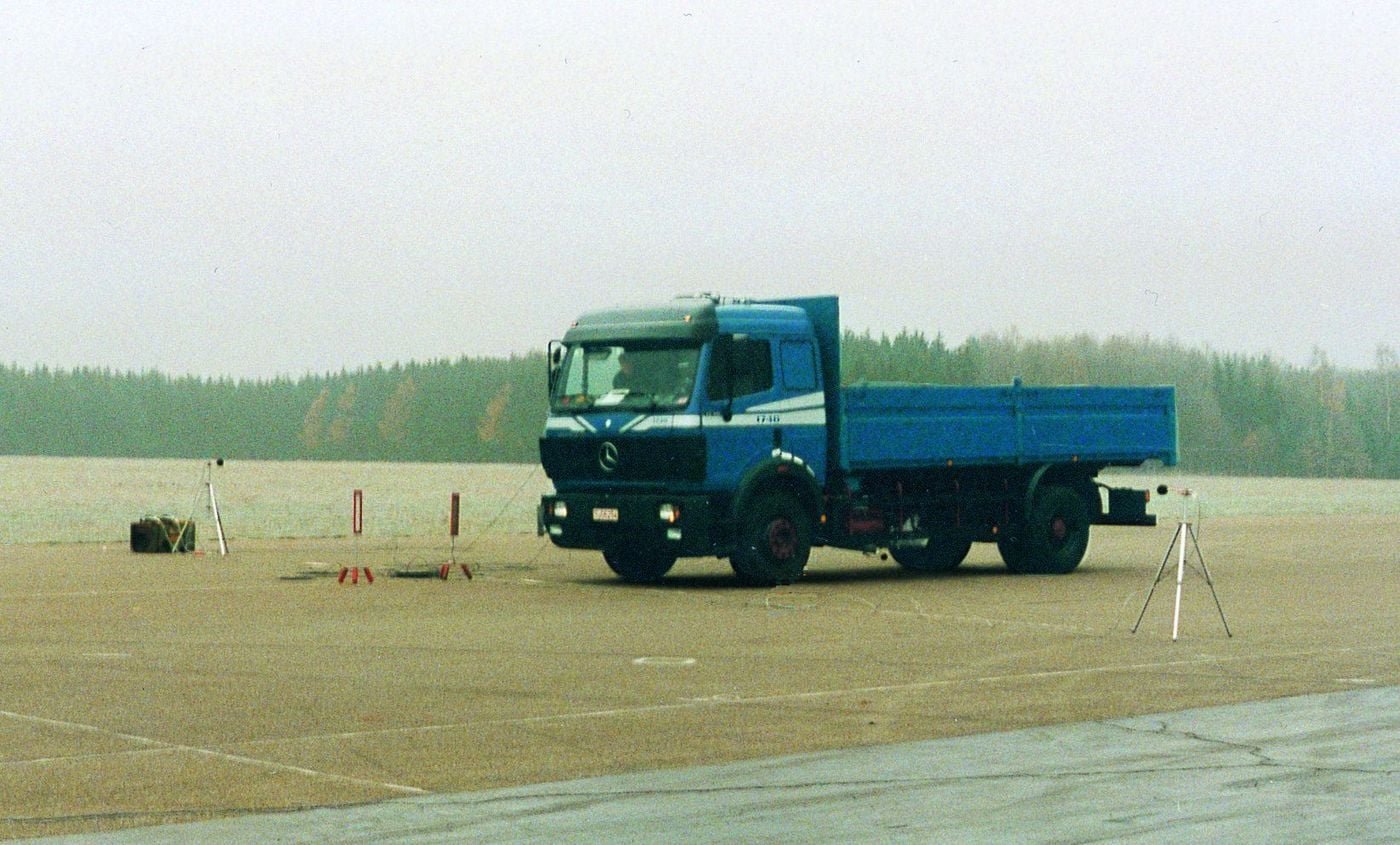
New trucks and buses registered in the European Union must meet the sound level limits of Regulation (EU) No 540/2014, measured at type approval as the vehicle accelerates past microphones 7.5 m from its path. The limits fall in three phases. For trucks of category N3 with a rated engine power over 250 kW, they go from 82 to 81 and then 79 dB(A); for buses and coaches over 250 kW, from 80 to 78 and then 77 dB(A). Phase 3 applies to new truck and bus types of categories M3, N2 and N3 from 1 July 2026 and to their first registration from 1 July 2027. UN Regulation No 51 carries the same values in its 03 series of amendments. Hybrid and electric vehicles must also emit a minimum sound at low speed, through an Acoustic Vehicle Alerting System (AVAS). In the United States, new trucks over 10,000 pounds gross vehicle weight rating have had a federal limit of 80 dBA since 1988; buses are outside that standard.
Status as at 9 November 2026. Read on that day: Regulation (EU) No 540/2014 in its Official Journal text and in the consolidated text of 27 May 2019, which includes Commission Delegated Regulations (EU) 2017/1576 and 2019/839; UN Regulation No 51 as published in the Official Journal on 4 June 2018, incorporating texts up to Supplement 2 to its 03 series of amendments; UN Regulation No 138 as published on 13 January 2017; and 40 CFR Part 205 in the edition revised as of July 1, 2025.
Which vehicles and which texts
Article 2 of Regulation (EU) No 540/2014 states that it “shall apply to vehicles of categories M1, M2, M3, N1, N2 and N3, as defined in Annex II to Directive 2007/46/EC”. Annex III labels category M “Vehicles used for the carriage of passengers” and category N “Vehicles used for the carriage of goods”; the boundaries between M1, M2 and M3 and between N1, N2 and N3 are set out in vehicle categories M, N and O.
The Regulation was adopted on 16 April 2014 and has applied from 1 July 2016 (Article 15(2)). It is “binding in its entirety and directly applicable in all Member States”. Council Directive 70/157/EEC, which according to recital 4 harmonised the Member States’ requirements on the permissible sound level of motor vehicles, “is repealed with effect from 1 July 2027” (Article 14(1)). Recital 7 gives the reason for a new method: “Studies showed that the test method used under that Directive no longer reflected real life driving behaviour in urban traffic”, and the contribution of tyre-rolling noise “was underestimated in the test method”. Recital 3 opens with “Traffic noise harms health in numerous ways.”
Recital 23 bases the Regulation on UNECE Regulation No 51 “with regard to the test method”, and recital 6 records that, as a Contracting Party to the 1958 Agreement, “the Union has decided to apply those Regulations”. UN Regulation No 51 applies to vehicles of categories M and N, and its paragraph 1 says its specifications “are intended to reproduce the sound levels which are generated by vehicles during normal driving in urban traffic”.
What the figure measures
The limit is a pass-by level. Under point 4.1 of Annex II, the microphone stands 7.5 m from the reference line of the track and 1.2 m above the ground, with lines marked 10 m before and 10 m after the microphone line. A bus or truck of category M2 over 3,500 kg, M3, N2 or N3 accelerates at full throttle from the first line until its rear passes the second, without a trailer. The target at the second line is a vehicle speed of 35 km/h plus or minus 5 km/h, with the engine at 70 to 74 % of the speed at which it develops its rated maximum power for M2 over 3,500 kg and N2, and at 85 to 89 % for M3 and N3. N2 and N3 trucks are tested at a mass of 50 kg per kW of rated engine power. Equipment such as a concrete mixer or a compressor “shall not be in operation during the test”. Each run gives the maximum A-weighted sound pressure level between the two lines; at least four runs are made on each side, the results of each side are averaged, and the higher average counts (point 4.1.3). Annex III compares that result with the limit “mathematically rounded to the nearest integer value”.
A second measurement is made with the vehicle stationary, close to the exhaust outlet, and Annex II has its results entered in the test report. Paragraph 6.2.2 of UN Regulation No 51 applies its limits to the sound measured in motion, under paragraph 3.1 of its Annex 3, and a footnote gives the purpose of the stationary test: “A test is made on a stationary vehicle in order to provide a reference value for administrations which use this method to check vehicles in use.”
Tyres are dealt with elsewhere. Annex II states that “Tyre rolling sound emissions are laid down in Regulation (EC) No 661/2009”; the external rolling noise class on a truck tyre is described in truck tyre labelling.
The limit values
| Category | Description | Phase 1 | Phase 2 | Phase 3 |
|---|---|---|---|---|
| M2 | Mass up to 2,500 kg | 72 | 70 | 69 |
| M2 | Mass over 2,500 kg, up to 3,500 kg | 74 | 72 | 71 |
| M2 | Mass over 3,500 kg, up to 5,000 kg; rated engine power up to 135 kW | 75 | 73 | 72 |
| M2 | Mass over 3,500 kg, up to 5,000 kg; rated engine power over 135 kW | 75 | 74 | 72 |
| M3 | Rated engine power up to 150 kW | 76 | 74 | 73 |
| M3 | Rated engine power over 150 kW, up to 250 kW | 78 | 77 | 76 |
| M3 | Rated engine power over 250 kW | 80 | 78 | 77 |
| N1 | Mass up to 2,500 kg | 72 | 71 | 69 |
| N1 | Mass over 2,500 kg, up to 3,500 kg | 74 | 73 | 71 |
| N2 | Rated engine power up to 135 kW | 77 | 75 | 74 |
| N2 | Rated engine power over 135 kW | 78 | 76 | 75 |
| N3 | Rated engine power up to 150 kW | 79 | 77 | 76 |
| N3 | Rated engine power over 150 kW, up to 250 kW | 81 | 79 | 77 |
| N3 | Rated engine power over 250 kW | 82 | 81 | 79 |
Annex III raises the limits in three cases. For vehicles that meet the off-road definition of Directive 2007/46/EC, “Limit values shall be increased by 1dB (2 dB(A) for N3 and M3 categories)”. Wheelchair accessible vehicles and armoured vehicles, as defined in Annex II to Directive 2007/46/EC, may emit 2 dB(A) more; paragraph 6.2.2.3 of UN Regulation No 51 gives the wheelchair allowance to vehicles of category M1. UN Regulation No 51 has a further allowance that Annex III does not contain: “For vehicle types of category M3 having a gasoline only engine, the applicable limit value is increased by 2 dB(A)” (paragraph 6.2.2.4).
When each phase applies
The column heads of Annex III give the dates: Phase 1 “applicable for new vehicle types from 1 July 2016”; Phase 2 for new vehicle types from 1 July 2020 and for first registration from 1 July 2022; Phase 3 for new vehicle types from 1 July 2024 and for first registration from 1 July 2026. A footnote marks some values with “+ two years for new vehicle type and + one year for new vehicles registration”. It is attached to every Phase 3 value for M3, N2 and N3, and to the Phase 2 values for N2.
| Categories | Phase 1, new types | Phase 2, new types | Phase 2, first registration | Phase 3, new types | Phase 3, first registration |
|---|---|---|---|---|---|
| M2, N1 | 1 Jul 2016 | 1 Jul 2020 | 1 Jul 2022 | 1 Jul 2024 | 1 Jul 2026 |
| M3, N3 | 1 Jul 2016 | 1 Jul 2020 | 1 Jul 2022 | 1 Jul 2026 | 1 Jul 2027 |
| N2 | 1 Jul 2016 | 1 Jul 2022 | 1 Jul 2023 | 1 Jul 2026 | 1 Jul 2027 |
The dates work in two steps under Article 4. For a new type, “Member States shall refuse, on grounds relating to the permissible sound level, to grant EU type-approval in respect of a type of motor vehicle which does not comply with the requirements of this Regulation” (Article 4(1)). For new vehicles, Member States “shall prohibit the registration, sale and entry into service of such vehicles where such vehicles do not comply with this Regulation” (Article 4(3)). Both are subject to the phase dates of Annex III. As at 9 November 2026, Phase 3 applies to new types in every category in the table and to the first registration of M2 and N1 vehicles; for M3, N2 and N3 vehicles, the first-registration date of Phase 3 is 1 July 2027.
UN Regulation No 51 sets the same steps for type approvals in its transitional provisions. From 1 July 2026 for N2, N3 and M3 types, and from 1 July 2024 for the others, Contracting Parties “shall grant type-approvals only if the vehicle type to be approved meets the requirements of phase 3” (paragraph 11.4.1). Until 30 June 2027 for N2, N3 and M3, they may not refuse national or regional type approval of a vehicle type approved to Phase 2 (paragraph 11.4.3).
The type-approval number shows the phase: under point 3.3.1 of Annex I, section 3 of the number is followed by the letter A for Phase 1, B for Phase 2 and C for Phase 3.
Compressed air noise
Vehicles with a technically permissible maximum laden mass over 2,800 kg have an additional stationary measurement of compressed air noise “if the corresponding brake equipment is part of the vehicle” (Annex II, point 1.1). Under Annex V the highest level is recorded while the pressure regulator vents and while the system vents after the service and parking brakes are used, with microphones 7 m from the contour of the vehicle and 1.2 m above the ground. Annex V states: “The sound level shall not exceed the limit of 72 dB(A).” UN Regulation No 51 has the same limit in its Annex 5. How the air system works is described in the truck compressed air system.
Quiet vehicles: the AVAS rules
Recital 19 of Regulation (EU) No 540/2014 states that the reduction in the noise of hybrid electric and pure electric vehicles “has removed an important source of an audible signal that is relied upon by blind and visually impaired pedestrians and cyclists”. Article 3(22) defines an Acoustic Vehicle Alerting System as “a system for hybrid electric and pure electric vehicles which provides sound to signal the vehicle’s presence to pedestrians and other road users”. Article 8 set two dates: AVAS in new types of hybrid electric and pure electric vehicles by 1 July 2019, and “Manufacturers shall install AVAS in all new hybrid electric and pure electric vehicles by 1 July 2021.”
Annex VIII was rewritten in 2017, after UN Regulation No 138 had been adopted, and amended in 2019; it ties the requirements to that UN regulation. The AVAS has to generate a sound automatically from start-up up to approximately 20 km/h and when reversing, and the sound “shall be similar to the sound of a vehicle of the same category equipped with an internal combustion engine”. Its level “shall not exceed the approximate sound level of a vehicle of the M1 category equipped with an internal combustion engine and operating under the same conditions” (point III.3(c)). A vehicle whose overall sound already meets the minimum levels of UN Regulation No 138 with a margin of 3 dB(A) does not need an AVAS, and an AVAS need not sound when reversing if the vehicle has a reversing sound warning device whose sound meets the requirements of that UN regulation (point III.2(a)).
| Test | Minimum overall level |
|---|---|
| Constant speed, 10 km/h | 50 |
| Constant speed, 20 km/h | 56 |
| Reversing | 47 |
UN Regulation No 138 also caps the sound. A vehicle with an AVAS “shall not emit an overall sound level of more than 75 dB(A), if driving in forward direction” (paragraph 6.2.7); its footnote gives this as corresponding to 66 dB(A) at 7.5 m and adds that “The limit value of 66 dB(A) at a distance of 7,5 m is the lowest permitted maximum value in Regulations established under the 1958 Agreement.” At least one tone has to vary in proportion to speed, by an average of at least 0.8 % per 1 km/h between 5 and 20 km/h in forward driving; the stated intention is “to acoustically inform road users about the change in vehicle speed” (paragraph 6.2.3).
Recital 3 of the 2019 amendment, Delegated Regulation (EU) 2019/839, gives the purpose of reviewing Annex VIII: “in order to introduce the AVAS pause function prohibition”. Under Annex VIII as amended, the provisions with the new pause-function rule (section IV) apply to vehicle types approved on or after 1 September 2021 and to all new vehicles registered on or after 1 September 2023. How battery-electric city buses are built and charged is covered in electric buses explained.
The United States: 40 CFR Part 205
The US federal noise emission standard for new medium and heavy trucks is in Subpart B of 40 CFR Part 205. It applies to vehicles with a gross vehicle weight rating over 10,000 pounds capable of transporting property, and section 205.50(b) states that it does not apply to “highway, city, and school buses”. Under section 205.52 such trucks manufactured after January 1, 1979 may not exceed 83 dBA, and those manufactured after January 1, 1988 80 dBA. The test procedure of section 205.54-1 places the microphone 50 feet (15.2 m) from the centerline of truck travel and adds a closed throttle deceleration test: “Closed throttle deceleration tests are required only for those vehicles equipped with an engine brake.” The federal standard, its test and the state rules on engine brakes are set out in what is a Jake Brake; engine brakes and retarders as braking systems are covered in retarders and engine braking.
Where these texts apply
| Country | Rule for new trucks and buses | Source |
|---|---|---|
| European Union, all Member States | Annex III limits for new types and first registration; compressed air noise 72 dB(A); AVAS for hybrid and electric vehicles | Regulation (EU) No 540/2014, Articles 2, 4, 8 and 15 |
| United States | 80 dBA for trucks over 10,000 pounds GVWR manufactured after January 1, 1988; buses excluded | 40 CFR 205.50 and 205.52 |
| Other Contracting Parties applying UN Regulation No 51 | Limit values of paragraph 6.2.2 for type approvals under the 03 series; which countries apply the Regulation: not verified | UN Regulation No 51, paragraphs 6.2.2 and 11 |
| Great Britain | Not verified | No national text read |
| Turkey | Not verified | No national text read |
| Russia | Not verified | No national text read |
Other provisions of the Regulation
The additional sound emission provisions of Article 6, which recital 9 describes as covering “driving conditions of the vehicle in real traffic outside the type-approval driving cycle”, apply to vehicles of categories M1 and N1 equipped with an internal combustion engine (Article 6(1)). M2, M3, N2 and N3 are not named.
Article 7 asks vehicle manufacturers and distributors to “endeavour to ensure that the sound level of each vehicle in decibels (dB(a)), measured in accordance with this Regulation, is displayed in a prominent position at the point of sale and in technical promotional material”.
Article 11 is a revision clause: “The Commission shall carry out and publish a detailed study on sound level limits by 1 July 2021.” On the basis of its conclusions the Commission was to submit a legislative proposal “where appropriate”.
Quick answers
- What is the noise limit for a new heavy truck in the EU?
- For an N3 truck with a rated engine power over 250 kW, Annex III of Regulation (EU) No 540/2014 sets 82 dB(A) in Phase 1, 81 dB(A) in Phase 2 and 79 dB(A) in Phase 3. Phase 3 applies to new N3 types from 1 July 2026 and to first registration from 1 July 2027. N3 trucks up to 150 kW have 79, 77 and 76 dB(A), and those over 150 up to 250 kW 81, 79 and 77 dB(A). UN Regulation No 51 gives the same values.
- What is the noise limit for a city bus or coach?
- An M3 bus or coach with a rated engine power up to 150 kW has 76, 74 and 73 dB(A) in Phases 1 to 3; over 150 up to 250 kW, 78, 77 and 76 dB(A); over 250 kW, 80, 78 and 77 dB(A). For M3, Phase 3 applies to new types from 1 July 2026 and to first registration from 1 July 2027. Off-road M3 vehicles may emit 2 dB(A) more.
- How is the truck noise limit measured?
- Under Annex II of Regulation (EU) No 540/2014 an M3, N2 or N3 vehicle accelerates at full throttle past microphones 7.5 m from its path and 1.2 m above the ground, reaching 35 km/h plus or minus 5 km/h at the end line. The maximum A-weighted level of each run is noted, at least four runs on each side are averaged, the higher side counts, and the result, rounded to the nearest whole number, may not exceed the limit. The US federal standard uses a microphone 50 feet (15.2 m) from the vehicle path.
- Do electric trucks and buses have to make a sound?
- Yes, at low speed. Article 8 of Regulation (EU) No 540/2014 required manufacturers to fit an Acoustic Vehicle Alerting System (AVAS) to new types of hybrid electric and pure electric vehicles by 1 July 2019 and to all new ones by 1 July 2021. Under UN Regulation No 138 the vehicle must reach at least 50 dB(A) at 10 km/h, 56 dB(A) at 20 km/h and 47 dB(A) when reversing, measured 2 m away, and a vehicle with an AVAS may not exceed 75 dB(A) in forward driving.
- Does the US federal truck noise standard cover buses?
- No. Subpart B of 40 CFR Part 205 applies to vehicles over 10,000 pounds GVWR capable of transporting property and sets 83 dBA for vehicles manufactured after January 1, 1979 and 80 dBA after January 1, 1988. Section 205.50(b) states that it does not apply to highway, city and school buses.
Sources
- Regulation (EU) No 540/2014 of the European Parliament and of the Council of 16 April 2014 on the sound level of motor vehicles and of replacement silencing systems — Official Journal text: recitals, Articles 1 to 15 and Annexes I, II, III, V and VIII — EUR-Lex, European Union, 16 Apr 2014
- Regulation (EU) No 540/2014 on the sound level of motor vehicles — consolidated text of 27 May 2019, including Delegated Regulations (EU) 2017/1576 and 2019/839 — EUR-Lex, European Union
- Commission Delegated Regulation (EU) 2017/1576 of 26 June 2017 amending Regulation (EU) No 540/2014 as regards the Acoustic Vehicle Alerting System requirements for vehicle EU-type approval — recitals and Annex — EUR-Lex, European Union, 26 Jun 2017
- Commission Delegated Regulation (EU) 2019/839 of 7 March 2019 amending Regulation (EU) No 540/2014 — recital 3 and Annex (AVAS sections I and IV) — EUR-Lex, European Union, 7 Mar 2019
- UN Regulation No 51 — Uniform provisions concerning the approval of motor vehicles having at least four wheels with regard to their sound emissions, incorporating texts up to Supplement 2 to the 03 series of amendments (OJ L 138, 4 June 2018) — paragraphs 1, 6 and 11 and Annex 5 — EUR-Lex, European Union, 4 Jun 2018
- UN Regulation No 138 — Uniform provisions concerning the approval of Quiet Road Transport Vehicles with regard to their reduced audibility (OJ L 9, 13 January 2017) — paragraphs 1, 2, 6 and Annex 3 — EUR-Lex, European Union, 13 Jan 2017
- 40 CFR Part 205, Transportation Equipment Noise Emission Controls, Subpart B — Medium and Heavy Trucks, sections 205.50, 205.52 and 205.54-1 (annual edition revised as of July 1, 2025) — U.S. Government Publishing Office, govinfo, 1 Jul 2025