Camera-monitor systems instead of mirrors on trucks and buses
UN Regulation No 46 approves cameras and monitors as devices for indirect vision; in the US they replace the two required mirrors only under FMCSA exemptions. What each text says.
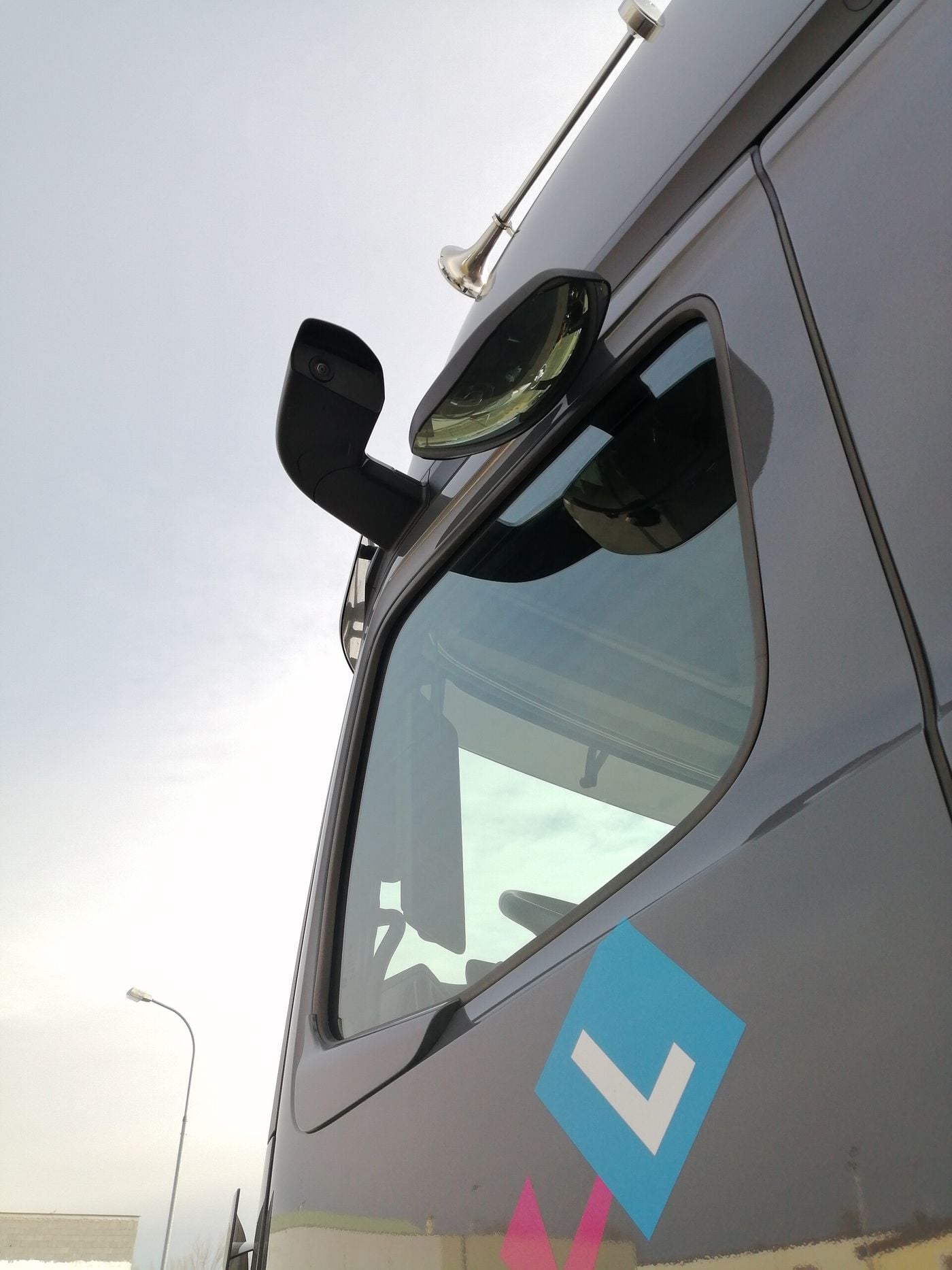
A camera-monitor system replaces a mirror with a camera outside the vehicle and a monitor inside the cab. UN Regulation No 46, the UNECE regulation on devices for indirect vision, treats it as one such device alongside mirrors, and Regulation (EU) 2019/2144 lists that UN Regulation for the EU type-approval of motor vehicles of categories M and N, which include buses and trucks. In the version of UN Regulation No 46 published in the EU Official Journal on 8 August 2014, a camera-monitor device may take the place of the close-proximity mirror (Class V) and the front mirror (Class VI). Mercedes-Benz Trucks, DAF, MAN and Volvo describe factory systems that also replace the main and wide-angle mirrors, which DAF names as Classes II and IV. In the United States, 49 CFR 393.80(a) requires every bus, truck and truck-tractor to carry two rear-vision mirrors, one at each side; the Federal Motor Carrier Safety Administration (FMCSA) has allowed camera-monitor systems in their place only through exemptions of up to five years, each limited to one named system.
Status as at 9 November 2026. Read on that day: UN Regulation No 46 as published in the Official Journal of the European Union, L 237 of 8 August 2014, page 24, a text that incorporates all valid text up to Supplement 1 to the 04 series of amendments, whose date of entry into force it gives as 9 October 2014; Regulation (EU) 2019/2144 in its Official Journal text of 16 December 2019; eight FMCSA notices in the Federal Register, from 21 February 2019 to 9 January 2026; and pages and press releases of Daimler Truck, DAF, MAN Truck & Bus, Volvo Trucks, Scania and the supplier Stoneridge. Not among the texts read: the amendments to UN Regulation No 46 after 2014 and the consolidated UNECE text, any later amendment to Annex I of Regulation (EU) 2019/2144, and the text of 49 CFR 393.80 itself, which is quoted here as the FMCSA notices give it.
What a camera-monitor device is
UN Regulation No 46 defines devices for indirect vision as devices “to observe the traffic area adjacent to the vehicle which cannot be observed by direct vision”, and continues: “These can be conventional mirrors, camera-monitors or other devices able to present information about the indirect field of vision to the driver” (paragraph 2.1). In a camera-monitor device for indirect vision the field of vision “is obtained by means of a camera-monitor combination” (paragraph 2.1.2): a camera that renders an image of the outside world and converts it into a signal, and a monitor that converts the signal into images in the visual spectrum (paragraphs 2.1.2.1 and 2.1.2.2).
For camera-monitor devices the Regulation uses a reference object, the critical object, a cylinder 0.50 m high and 0.30 m in diameter (paragraph 2.1.2.6), and the detection distance runs from the centre of the camera lens to the point at which that object “can just be perceived” (paragraph 2.1.2.9). Apart from the design of the device and its attachment to the bodywork, a type of mirror is defined by its class, shape, dimensions and the radius of curvature of its reflecting surface, and a type of camera-monitor device by its detection distance and range of vision (paragraph 2.1.4).
Not every camera on a vehicle is such a device. A surveillance camera-monitor-recording device shows fields of vision other than the ones the Regulation prescribes, or serves as a security system in or around the vehicle (paragraph 2.1.2.13). The Regulation’s provisions do not apply to it, but paragraph 15.3.6 sets where an exterior surveillance camera may sit: at least 2 m above the ground with the vehicle loaded to its maximum technically permissible mass or, if its lower edge is below 2 m, projecting no more than 50 mm beyond the vehicle’s overall width, with radii of curvature of at least 2.5 mm.
The mirror classes a camera stands in for
The Regulation sorts mirrors into classes by the field of vision each must give the driver, set out as a flat portion of road measured from the driver’s ocular points (paragraph 15.2.4). Paragraph 15.2.1.1.1 says these fields “shall be obtained from the minimum number on mandatory mirrors set out in the following table”, and adds: “Where the presence of a mirror is not requested on a mandatory base, this means that no other system for indirect vision can be requested on a mandatory base.”
| Class | Name in the Regulation | Minimum field of vision | N2 over 7.5 t and N3 | M2 and M3 |
|---|---|---|---|---|
| I | Interior rear-view mirror | A 20 m wide strip of road centred on the vehicle, from 60 m behind to the horizon | Optional, no requirements for the field of view | Optional, no requirements for the field of view |
| II | Main exterior rear-view mirror (large) | On each side, a 5 m wide strip from 30 m behind to the horizon, and a 1 m wide strip alongside the vehicle from 4 m behind | Compulsory, one on each side | Compulsory, one on each side |
| III | Main exterior rear-view mirror (small) | On each side, a 4 m wide strip from 20 m behind to the horizon, and a 1 m wide strip from 4 m behind | Not permitted | Not permitted |
| IV | Wide-angle exterior mirror | On each side, a 15 m wide strip from at least 10 m to 25 m behind, and a 4.5 m wide strip from 1.5 m behind | Compulsory, one on each side | Optional, one on the driver’s and/or one on the passenger’s side |
| V | Close-proximity exterior mirror | Along the passenger’s side, 2 m out from the cab, from 1.75 m behind to 1 m in front | Compulsory on the passenger’s side, optional on the driver’s side; at least 2 m above the ground | Optional, one on each side; at least 2 m above the ground |
| VI | Front mirror | In front of the vehicle, 2,000 mm deep, from the driver’s side to 2,000 mm beyond the opposite side | Compulsory, one; at least 2 m above the ground | Optional; at least 2 m above the ground |
Two qualifications sit in the paragraphs on the fields of vision. A Class V mirror is not compulsory where its field can be seen through the combination of a Class IV and a Class VI mirror (paragraph 15.2.4.5.5). The front-mirror provisions are compulsory for forward-controlled vehicles of categories N2 over 7.5 t and N3 (paragraph 15.2.4.6.1), but a Class VI mirror is not mandatory if the driver can see, allowing for the A-pillars, a straight line 300 mm in front of the vehicle at a height of 1,200 mm across the width that paragraph 15.2.4.6.2 sets.
The areas beside and in front of a heavy vehicle that these classes cover are the subject of other rules as well: France’s blind-spot signs for heavy vehicles mark them on the bodywork, and London’s permit scheme, which names camera monitoring systems among its measures, is set out in London’s Direct Vision Standard.
What the 2014 text lets a camera replace
Paragraph 15.2.1.1.2 opens two classes to other devices. Where the field of vision of a front mirror and/or a close-proximity mirror “can be obtained by another device for indirect vision that is approved according to paragraph 6.2 of this Regulation and that is installed according to paragraph 15 above, this device can be used instead of the relevant mirror or mirrors.” When that device is a camera and monitor, the monitor “shall exclusively show”:
- the Class V field of vision, where the close-proximity mirror has been replaced;
- the Class VI field of vision, where the front mirror has been replaced, “while the vehicle is moving forward with a speed of up to 10 km/h”;
- both fields at the same time, where both mirrors have been replaced. Moving forward above 10 km/h or reversing, the monitor “may be used for other information, provided that the field of vision prescribed in paragraph 15.2.4.5 below is permanently displayed”, that is, the Class V field.
For the forward-controlled trucks that need a front mirror, the Regulation adds: “If vehicles of these categories cannot fulfil the requirements by using a front mirror or a camera/monitor device, a vision support system shall be used.” That system has to detect an object 50 cm high and 30 cm in diameter within the Class VI field (paragraph 15.2.4.6.1).
The 2014 text has no provision of this kind for the Class II main mirrors or the Class IV wide-angle mirrors; its table lists them as mirrors. In the United States, FMCSA’s notices of 2022 and 2024 describe the European position in their own words: camera-monitor systems “are authorized for use in a number of European countries as a legal alternative to the traditional rear-vision mirrors” under UN Regulation No 46, “which specifies minimum safety, ergonomic, and performance requirements for CMS in place of mandatory inside and outside rearview mirrors for road vehicles. This regulation references ISO (International Organization for Standardization) standard 16505 Rev 2019”. ISO 16505 does not appear in the 2014 text. The amendments of UN Regulation No 46 after 2014 were not among the texts read for this page, so the provisions that FMCSA’s description refers to are not quoted here.
What the device itself must meet
Paragraph 6.2 sets the approval requirements for devices for indirect vision other than mirrors. If the user has to adjust the device, it must be adjustable without tools; a device that covers the prescribed field by scanning must complete scanning, rendering and reset within 2 seconds (paragraphs 6.2.1.1 and 6.2.1.2). For camera-monitor devices:
- Sunlight. “The camera shall function well in conditions in which sunlight falls on the camera.” In a test with simulated sunlight of 40 kLx, the saturated area, where the luminance contrast of a high-contrast pattern falls below 2.0, may cover no more than 15 per cent of the displayed image (paragraph 6.2.2.2.1).
- Monitor. It must render a minimum contrast under various light conditions as specified by ISO 15008:2003, with the luminance contrast measured according to ISO 15008:2009, and its average luminance must be adjustable, manually or automatically, to the ambient conditions (paragraphs 6.2.2.2.2 to 6.2.2.2.4).
- Edges. With the device mounted on a plane surface, parts that a sphere 165 mm in diameter (monitor) or 100 mm in diameter (camera) could touch have a radius of curvature of at least 2.5 mm (paragraph 6.2.2.1.1).
Installed on the vehicle, the device “shall give such performances that a critical object can be observed by the driver over the entire required field of vision” (paragraph 15.3.1), assessed under Annex 10 or, alternatively, by the displayed object size of Annex 11. The obstruction of the driver’s direct view by the device “shall be restricted to a minimum” (paragraph 15.3.2), and “The viewing direction of the monitor shall roughly be the same direction as the one for the main mirror” (paragraph 15.3.4). For Class V and VI camera-monitor devices, the instructions for use must include a table of the minimum and maximum mounting height of the camera above the ground for different viewing distances, and the camera must be mounted within the applicable height range (Annex 11, paragraph 1.4).
How UN Regulation No 46 reaches EU type-approval
Regulation (EU) 2019/2144, the General Safety Regulation, applies from 6 July 2022 (Article 19). Its Annex I lists UN Regulation No 46, “Devices for indirect vision and their installation”, in its 04 series of amendments with the Official Journal reference L 237 of 8 August 2014, page 24, for categories M and N. Article 4(2) states: “Type-approval in accordance with the UN Regulations listed in Annex I shall be considered as EU type-approval in accordance with the requirements of this Regulation and of the delegated acts and implementing acts adopted pursuant to it.” Annex II lists “Indirect vision devices” under UN Regulation No 46 as requirement B13 with date code A: 6 July 2022 as the date for the prohibition of the registration of vehicles, as well as the placing on the market and entry into service of components and separate technical units.
Article 4(3) empowers the Commission to amend Annex I by delegated acts “by introducing and updating references to the UN Regulations, and relevant series of amendments, that apply on a compulsory basis”. Amendments to Annex I were not among the texts read for this page. The Official Journal publication of UN Regulation No 46 carries its own caveat: “Only the original UNECE texts have legal effect under international public law”, and the status and date of entry into force are to be checked in the UNECE status document TRANS/WP.29/343.
The other vision-related requirements of the same Annex II, such as the blind spot information system of requirement B6, and their dates for trucks and buses are set out in mandatory driver assistance systems.
The makers’ systems
| Maker | System | Mirrors replaced, in the maker’s words | Cameras and monitors | Date the maker gives |
|---|---|---|---|---|
| Mercedes-Benz Trucks | MirrorCam | “Like the conventional mirror system, the monitor image is divided into a main and wide-angle field of vision” | Two cameras on the left and right of the roof frame; two upright 15.2-inch monitors, 720 x 1920 pixels, on the A-pillars | Standard on the new Actros since June 2019 |
| DAF | DAF Digital Vision System (option 01362) | “Replaces main and wide angle mirrors (Class II and IV)” | Cameras above the cab doors; two displays on the A-pillars, 12.3-inch on the driver’s side and 15-inch on the co-driver’s side, 1920 x 720 pixels | Not given; New Generation DAF trucks |
| DAF | DAF Corner View (option 01913) | “Replaces front view and kerb view mirror (class V and VI)” | One wide-angle camera at the cab corner on the co-driver’s side, 285-degree angle; 10-inch display on the A-pillar | Not given |
| MAN Truck & Bus | MAN OptiView, trucks | “replaces exterior and wide-angle rearview mirrors as well as front and ramp mirrors” | Cameras on the sides and front; two displays on the A-pillars and the media system screen; a rear-view camera as an option | Orderable for TGL, TGM, TGS and TGX since the beginning of October 2021 |
| MAN Truck & Bus | MAN OptiView, buses | Mirror replacement system showing the side and rear areas; a front view mirror is standard on coaches, inside next to the right-hand monitor on the NEOPLAN Cityliner and Skyliner, outside on the A-pillar on the NEOPLAN Tourliner and MAN Lion’s Coach | Two cameras on each side; two monitors inside | Premiere for coaches at the IAA in 2018; available for all models of the new generation of city buses, including the Lion’s City E, according to the release of 24 January 2022 |
| Volvo Trucks | Camera Monitoring System | “The cameras provide main rearview and wide-angle rearview.” | Up to three cameras: driver’s side, passenger’s side and an optional corner front passenger camera | Not given |
| Scania | CornerEye (accessory) | “certified in accordance with R46 for the PGR series which facilitates replacement of front view mirror and close-up mirror (class V and VI)” | One wide-angle camera; 10.1-inch monitor | Not given |
| Stoneridge (supplier) | MirrorEye Multi-Purpose II | “replaces traditional side-view mirrors” | 12.3-inch or 15-inch displays; a built-in surveillance camera; blind spot and moving-off warnings shown on the monitors | Launched for buses, coaches and rigid vehicles in Europe on 31 July 2025 |
The makers’ descriptions include further functions. Daimler Truck’s release of 13 December 2019 says that on the MirrorCam a manoeuvring view switches on with reverse gear and stays on when driving forwards up to ten km/h, that the image on the inside of a bend swivels with a semi-trailer, and that Sideguard Assist shows its warning triangles in the passenger-side display. DAF lists automatic panning for vehicles with a connected (semi-)trailer and display overlays: a red line for the length of the vehicle, a yellow line at 50 metres and a green line at 150 metres. Mercedes-Benz, MAN and Volvo each describe a mode for viewing the surroundings from the cab when the truck is parked. Mercedes-Benz places the cameras on the roof frame and DAF above the cab doors; the cab types themselves are explained in European truck cabs.
DAF and MAN each publish a figure, and the two measure different things. DAF gives its Digital Vision System an improvement in fuel efficiency of 1.2 per cent, “VECTO certified”, and the Corner View 0.3 per cent; MAN says buses with OptiView have “around ten percent less aerodynamic drag than vehicles with conventional mirror systems”. Other aerodynamic claims made for cabs are set out in aerodynamic cabs and length rules, and the way Euro NCAP’s truck rating treats camera monitoring systems in how Euro NCAP tests trucks.
Stoneridge supplies systems for vehicle makers as well. In its renewal application to FMCSA, summarised in the notice of 2 February 2024, it reported that MirrorEye had been installed on over 1,000 vehicles in North America and that in Europe it had been installed on over 1,110 buses and over 2,000 systems had been installed by commercial vehicle original equipment manufacturers.
United States: two mirrors, or an exemption
FMCSA’s notices state the rule: “Section 393.80(a) of the FMCSRs requires that each bus, truck, and truck-tractor be equipped with two rear-vision mirrors, one at each side. The mirrors must be positioned to reflect to the driver a view of the highway to the rear, and the area along both sides of the CMV.” Section 393.80(a) cross-references the National Highway Traffic Safety Administration’s standard FMVSS No. 111, whose paragraph S7.1 covers multipurpose passenger vehicles and trucks with a gross vehicle weight rating above 4,536 kg and below 11,340 kg and buses other than school buses above 4,536 kg, and paragraph S8.1 multipurpose passenger vehicles and trucks of 11,340 kg or more. For commercial motor vehicles with a gross vehicle weight rating of 11,340 kg (25,000 pounds) or more, the 2022 Rosco notice says, FMVSS No. 111 requires a rearview mirror of unit magnification of no less than 323 cm² (50 in²) on each side of the vehicle.
FMCSA may exempt from that rule under 49 U.S.C. 31136(e) and 31315. It decides “whether granting the exemption would likely achieve a level of safety equivalent to, or greater than, the level that would be achieved by the current regulation (49 CFR 381.305)”; an exemption runs for up to five years and may be renewed (49 CFR 381.300(b)). Six camera-monitor systems had been exempted in the notices read.
| System | Holder | Exemption period | Federal Register |
|---|---|---|---|
| MirrorEye Camera Monitor System | Stoneridge, Inc. | 21 February 2019 to 13 February 2024; provisionally renewed from 13 February 2024 to 12 February 2029, unless revoked | 84 FR 5557; 89 FR 7437 |
| Smart-Vision high-definition camera monitoring system | Vision Systems North America, Inc. | First exemption published on 15 January 2020 (85 FR 2486, cited in the 2024 Convoy notice, not read); renewed from 15 January 2025 to 15 January 2030 | 90 FR 4835 |
| CV Digital Mirror System | Robert Bosch, LLC and Mekra Lang North America, LLC | 17 September 2020 to 17 September 2025; no renewal notice among the documents read | 85 FR 58106 |
| CV Digital Camera Monitor System | Rosco Vision, Inc. | 4 December 2022 to 4 December 2027 | 87 FR 73386 |
| Electronic Rear View System (ERVS) | Convoy Technologies, Inc. | 24 July 2024 to 24 July 2029 | 89 FR 59964 |
| MirrorLESS camera monitor system | Safe Fleet Bus and Rail | 30 July 2024 to 25 July 2029 | 89 FR 60486 |
| ProViu Mirror camera monitor system | Aumovio SE | Application only; comments invited until 9 February 2026; no decision among the documents read | 91 FR 1028 |
Each grant is limited to the named system and “does not apply to any other camera-based mirror replacement system/technology”. The conditions changed over time. The grants of 2019 to Stoneridge and of 2020 to Bosch and Mekra Lang forbade continued operation of the vehicle if the camera or monitor failed during normal operation on the highway, until the system could be repaired or mirrors complying with section 393.80 were installed. The grant and renewal notices from 2022 on set conditions instead: drivers inspect the system each time before operating the vehicle and again at the end of each day, noting any defects, and the motor carrier repairs defects noted by the driver before the vehicle is operated again; each of these five notices also has the motor carrier inspect the system periodically. The 2025 renewal for Vision Systems North America also requires motor carriers using the system to report to FMCSA each year the number of vehicles operating under the exemption and any crashes, other than front-end crashes, involving them. The Rosco, Convoy and Safe Fleet notices say that a camera or monitor failure would not lead to an out-of-service order, because it is not a critical inspection item under the Commercial Vehicle Safety Alliance’s out-of-service criteria; the Rosco and Convoy notices add “in the same way conventional mirrors are not out of service if cracked or damaged while in operation”. While an exemption is in effect, no State may enforce a conflicting law with respect to interstate operations under it; States “may, but are not required to, adopt the same exemption with respect to operations in intrastate commerce”.
The 2022 Rosco notice refers to an advance notice of proposed rulemaking on rear visibility that NHTSA published on 10 October 2019 (84 FR 54533); no later NHTSA document was among the texts read. The application by Aumovio SE, which the notice describes as formerly the Continental Automotive division, estimates that, if the exemption is granted, 50 to 100 vehicles with the ProViu Mirror system would be used initially as proof-of-concept or demonstration vehicles with key customers.
Where the rules were read
| Jurisdiction | Rule on mirrors | Camera-monitor systems | Source |
|---|---|---|---|
| European Union | UN Regulation No 46, 04 series, for the EU type-approval of categories M and N | Approved as devices for indirect vision; in the 2014 text a camera-monitor device may replace the Class V and VI mirrors | UN Regulation No 46, OJ L 237 of 8 August 2014; Regulation (EU) 2019/2144, Article 4 and Annexes I and II |
| United States | 49 CFR 393.80(a): two rear-vision mirrors, one at each side, on each bus, truck and truck-tractor | Only under an FMCSA exemption for a named system; six systems exempted from 2019 to 2024, one application published for comment in January 2026 | FMCSA notices in the Federal Register, 2019 to 2026 |
| United Kingdom | Not verified | Not verified | None read for this page |
| Turkey | Not verified | Not verified | None read for this page |
| Russia | Not verified | Not verified | None read for this page |
| Canada | Not verified | Not verified | None read for this page |
Quick answers
- Are camera mirrors legal on trucks in the EU?
- UN Regulation No 46 approves camera-monitor devices as devices for indirect vision, alongside mirrors, and Regulation (EU) 2019/2144 lists that UN Regulation, 04 series of amendments as published in the Official Journal on 8 August 2014, for the EU type-approval of vehicles of categories M and N; under Article 4(2) a type-approval to it counts as EU type-approval. In that 2014 text a camera-monitor device may take the place of the Class V close-proximity mirror and the Class VI front mirror. Mercedes-Benz Trucks, DAF, MAN and Volvo describe factory systems that also replace the main and wide-angle mirrors; the amendments of UN Regulation No 46 after 2014 were not among the texts read for this page.
- Which mirrors can a camera replace under UN Regulation No 46?
- In the text published on 8 August 2014, paragraph 15.2.1.1.2 lets another device for indirect vision, approved under paragraph 6.2 and installed under paragraph 15, be used instead of the front mirror (Class VI) and the close-proximity mirror (Class V). The text has no provision of that kind for the Class II main mirrors or the Class IV wide-angle mirrors. FMCSA notices of 2022 and 2024 describe UN Regulation No 46 as setting requirements for camera-monitor systems in place of mandatory inside and outside rearview mirrors, with a reference to ISO 16505 in its 2019 revision; ISO 16505 does not appear in the 2014 text.
- Are camera mirrors allowed on trucks in the US?
- Only under an exemption. 49 CFR 393.80(a) requires each bus, truck and truck-tractor to carry two rear-vision mirrors, one at each side, and FMCSA has granted exemptions of up to five years, each limited to one named system: Stoneridge MirrorEye (renewed to 12 February 2029), Vision Systems North America Smart-Vision (renewed to 15 January 2030), Bosch and Mekra Lang CV Digital Mirror System (to 17 September 2025), Rosco CV Digital CMS (to 4 December 2027), Convoy ERVS (to 24 July 2029) and Safe Fleet MirrorLESS (to 25 July 2029). An application for Aumovio's ProViu Mirror was published for comment on 9 January 2026.
- What must the monitor show when a camera replaces the front mirror?
- Under paragraph 15.2.1.1.2 of the 2014 text, the monitor must show exclusively the Class VI field of vision while the vehicle moves forward at up to 10 km/h. Where both the front mirror and the close-proximity mirror are replaced, it shows both fields at once; moving forward above 10 km/h or reversing, it may show other information as long as the Class V field stays permanently displayed.
- Which mirrors do the makers' camera systems replace?
- In the makers' own words: Mercedes-Benz Trucks' MirrorCam, standard on the new Actros since June 2019, shows a main and a wide-angle field of vision; DAF's Digital Vision System replaces the Class II and IV mirrors and its Corner View the Class V and VI mirrors; MAN's OptiView, orderable for its truck series since October 2021, replaces the exterior and wide-angle mirrors as well as the front and ramp mirrors; Volvo's cameras provide the main and wide-angle rear view; Scania describes its CornerEye accessory as certified in accordance with R46 for the PGR series, which facilitates replacement of the Class V and VI mirrors.
Models in this article
Sources
- Regulation No 46 of the Economic Commission for Europe of the United Nations (UNECE) — Uniform provisions concerning the approval of devices for indirect vision and of motor vehicles with regard to the installation of these devices, incorporating all valid text up to Supplement 1 to the 04 series of amendments (OJ L 237, 8 August 2014, p. 24) — paragraphs 2, 6.2 and 15 and Annexes 10 and 11 — EUR-Lex, European Union, 8 Aug 2014
- Regulation (EU) 2019/2144 of the European Parliament and of the Council of 27 November 2019 on type-approval requirements for motor vehicles as regards their general safety — Articles 4, 16 and 19, Annex I and Annex II (requirement B13) — EUR-Lex, European Union, 27 Nov 2019
- Parts and Accessories Necessary for Safe Operation; Application for an Exemption From Stoneridge, Inc. — notice of final disposition, 84 FR 5557, 21 February 2019 — Federal Motor Carrier Safety Administration, Federal Register, 21 Feb 2019
- Parts and Accessories Necessary for Safe Operation; Exemption Renewal for Stoneridge, Inc. — notice of provisional renewal of exemption, 89 FR 7437, 2 February 2024 — Federal Motor Carrier Safety Administration, Federal Register, 2 Feb 2024
- Parts and Accessories Necessary for Safe Operation; Robert Bosch, LLC and Mekra Lang North America, LLC Application for an Exemption — notice of final disposition, 85 FR 58106, 17 September 2020 — Federal Motor Carrier Safety Administration, Federal Register, 17 Sept 2020
- Parts and Accessories Necessary for Safe Operation; Rosco Vision, Inc.; Application for an Exemption — notice of final disposition, grant of exemption, 87 FR 73386, 29 November 2022 — Federal Motor Carrier Safety Administration, Federal Register, 29 Nov 2022
- Parts and Accessories Necessary for Safe Operation; Convoy Technologies, Inc. — notice of final disposition, grant of exemption, 89 FR 59964, 24 July 2024 — Federal Motor Carrier Safety Administration, Federal Register, 24 Jul 2024
- Parts and Accessories Necessary for Safe Operation; Safe Fleet Bus and Rail — notice of final disposition, grant of exemption, 89 FR 60486, 25 July 2024 — Federal Motor Carrier Safety Administration, Federal Register, 25 Jul 2024
- Parts and Accessories Necessary for Safe Operation; Exemption Renewal From Vision Systems North America, Inc. — notice of final disposition, granting of renewal of exemption, 90 FR 4835, 16 January 2025 — Federal Motor Carrier Safety Administration, Federal Register, 16 Jan 2025
- Parts and Accessories Necessary for Safe Operation; Application for Exemption From Aumovio SE — notice of application for exemption, request for comments, 91 FR 1028, 9 January 2026 — Federal Motor Carrier Safety Administration, Federal Register, 9 Jan 2026
- Unique in long-haul transport – MirrorCam replaces the mirror (press release, 13 December 2019) — Daimler Truck, 13 Dec 2019
- DAF Camera systems — DAF Digital Vision System and DAF Corner View (infosheet, read on 9 November 2026) — DAF Trucks
- Digital mirror replacement system MAN OptiView wins European Transport Award for Sustainability 2022 (press release, 24 November 2021) — MAN Truck & Bus, 24 Nov 2021
- MAN presents MAN OptiView in a European road-show – the new mirror cam system providing even greater road safety (press release, 6 August 2021) — MAN Truck & Bus, 6 Aug 2021
- MAN OptiView mirror replacement system now also available for city buses (press release, 24 January 2022) — MAN Truck & Bus, 24 Jan 2022
- Camera Monitoring System – streamlined for truck efficiency (page read on 9 November 2026) — Volvo Trucks UK & Ireland
- CornerEye camera systems — Scania accessories catalogue (read on 9 November 2026) — Scania
- Stoneridge Launches Next-Generation MirrorEye System for Buses and Rigid Vehicles in Europe (press release, 31 July 2025) — Stoneridge, Inc., 31 Jul 2025