France's blind-spot signs for heavy vehicles (angles morts)
Since 1 January 2021 vehicles over 3.5 t in France must carry angles morts signs on the sides and rear: the legal texts, which vehicles, where the signs go, exemptions and the fine.
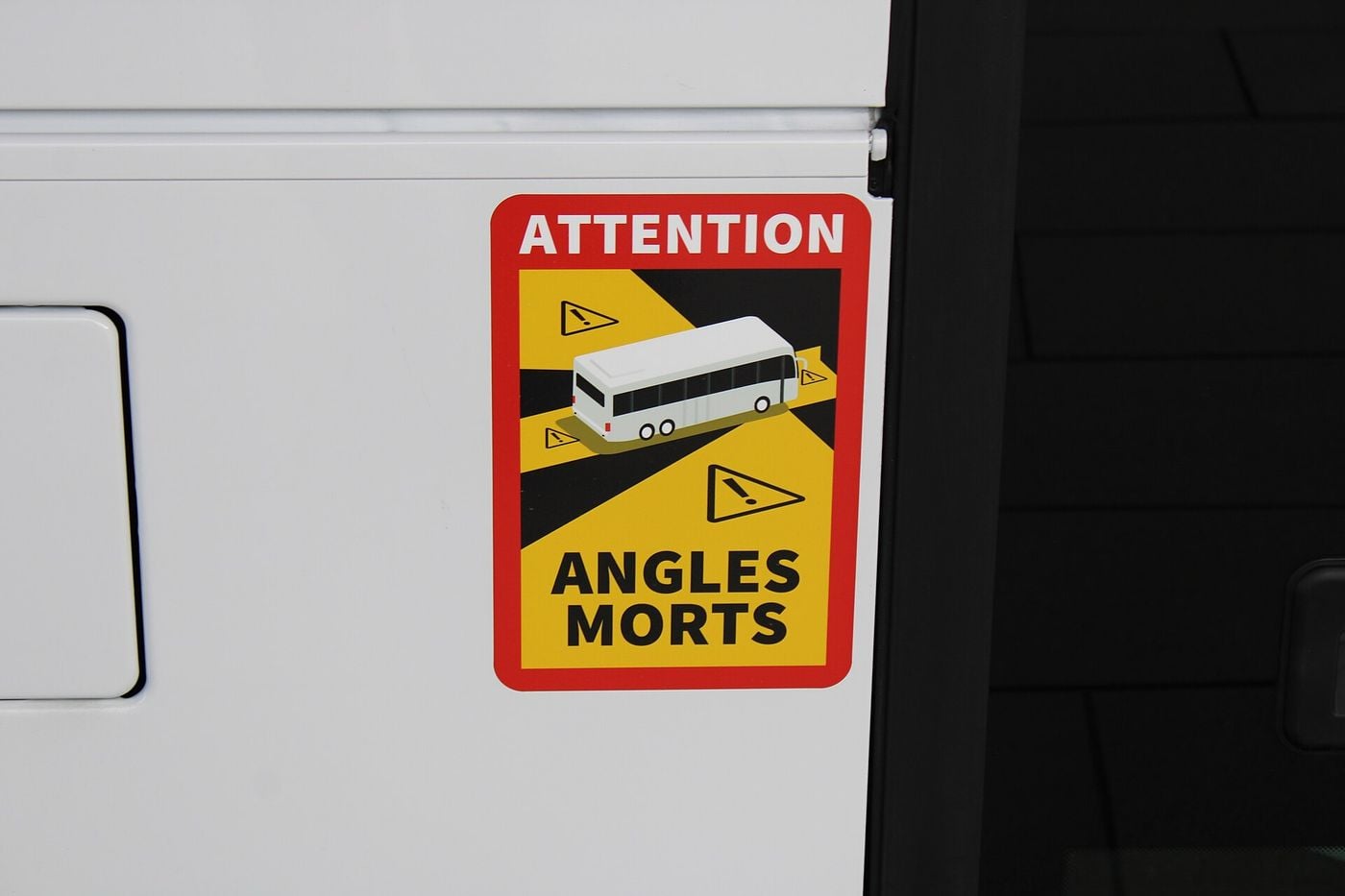
Since 1 January 2021 vehicles in France whose maximum authorised laden mass (poids total autorisé en charge, PTAC) exceeds 3.5 tonnes must carry signs marking the position of their blind spots, visible on the sides and at the rear; only a few categories, such as agricultural vehicles, are exempt. The duty is Article R. 313-32-1 of the Code de la route, created by Decree No 2020-1396 of 17 November 2020. An arrêté of 5 January 2021 fixes the model, a sign 25 cm high and 17 cm wide, and its position on trucks, buses and coaches, trailers and semi-trailers. The ministry states that the obligation applies to heavy vehicles travelling on French territory. A driver who breaks it commits a fourth-class contravention, for which the fixed fine is €135.
Status as of 6 October 2026. The decree, the arrêté and Articles R. 313-32-1, L. 313-1, R. 130-6 and R. 311-1 of the Code de la route were read on 6 October 2026 in the official XML of the Journal officiel and of the consolidated code that the Direction de l’information légale et administrative (DILA) releases as open data. On that date Légifrance showed the arrêté in its version in force since 7 January 2021, with no article amended, Articles R. 313-32-1, L. 313-1 and R. 130-6 in their versions in force since 1 January 2021, and Article R. 311-1 in its version of 25 July 2026, which changed none of the definitions used here. The ministry’s press release, Service-Public.fr, the Interior Ministry instruction and the TfL page were also read that day; the Sécurité routière website did not respond, so its application guide and its news page were read in Internet Archive copies of June 2021 and November 2024. The DREAL Normandie page was under maintenance on 6 October and is cited from the copy read on 30 September 2026.
The legal texts
The obligation comes from the 2019 mobility law. The notice of the decree explains that Article L. 313-1 of the Code de la route, introduced by Article 55 of Law No 2019-1428 of 24 December 2019 on mobility (loi d’orientation des mobilités), requires vehicles of more than 3.5 tonnes to be equipped with a signal marking the position of the blind spots, applied so as to be as visible as possible, in particular to cyclists, pedestrians and users of personal mobility devices.
| Text | Signed | Published | In force | What it does |
|---|---|---|---|---|
| Decree No 2020-1396 | 17 November 2020 | JORF No 0280, 19 November 2020 | 1 January 2021 (Article 3) | Inserts Article R. 313-32-1 into the Code de la route and adds it to the list in Article R. 130-6, 1° |
| Article R. 313-32-1, Code de la route | — | — | 1 January 2021 | Sets the duty, the exemptions and the fourth-class fine |
| Arrêté of 5 January 2021 | 5 January 2021 | JORF No 0005, 6 January 2021 | Consolidated version from 7 January 2021 | Fixes the model (annex), how it is fixed, where it goes and the derogations |
Article R. 313-32-1 states that vehicles whose PTAC exceeds 3.5 tonnes must carry, “visible sur les côtés ainsi qu’à l’arrière du véhicule”, a signal marking the position of the blind spots. Its second paragraph leaves the model and the way it is applied to a joint arrêté of the ministers responsible for transport and for road safety. The arrêté of 5 January 2021 is that text; its preamble records that it was notified to the European Commission under Directive (EU) 2015/1535 as notification 2020/425/F on 2 July 2020.
Which vehicles must carry the signs
The test in Article R. 313-32-1 is the PTAC alone: above 3.5 tonnes, the vehicle needs the signs unless it falls in an exempt category. The article does not distinguish goods vehicles from passenger vehicles. Sécurité routière lists the vehicles concerned as “poids-lourds, bus, cars” — heavy goods vehicles, buses and coaches — and the DREAL Normandie page speaks of goods transport vehicles and passenger transport vehicles. The application guide shows two versions of the sign, one for goods transport and one for public passenger transport.
Articulated buses and coaches. Article 3 of the arrêté requires articulated buses and coaches, as defined in point 1.8 of Article R. 311-1, to carry signs on each of the sections that make up the vehicle.
Trailers and semi-trailers. Article 2 of the arrêté sets positions for motor vehicles and for towed vehicles, with separate rules for semi-trailers (point 3.6 of Article R. 311-1) and trailers (point 3.5). The decree’s threshold is the PTAC of the vehicle; the texts read do not deal separately with a towed vehicle of 3.5 tonnes or less in a heavy combination. The body types themselves are explained in trailer types explained, and the mass terms in truck weights: GVW and GCW.
Vehicles registered abroad. The ministry’s press release of 23 November 2020 states that the obligation applies to heavy vehicles “circulant sur le territoire national” — travelling on French territory — and Article R. 313-32-1 makes no exception for foreign registration. The third paragraph of Article 1 of the arrêté adds that vehicles which carry, on the sides and at the rear, a device marking the blind spots under the legislation of another member state of the European Union are deemed to satisfy the arrêté. The texts read contain no equivalent clause for devices fitted under the law of a country outside the EU.
Fire and rescue vehicles. A Ministry of the Interior instruction of 22 February 2022 on the vehicles of the fire and rescue services states that their heavy vehicles must comply, and that they may benefit, case by case, from the derogations in Article 4 of the arrêté.
Exemptions
Article R. 313-32-1 names three exempt categories, each by reference to a definition in Article R. 311-1 of the Code de la route. The DREAL Normandie page introduces the same list with the words “Seuls sont exemptés” — only these are exempt.
| Exempt category | Article R. 311-1 | Definition in the code |
|---|---|---|
| Agricultural and forestry vehicles | Point 5 | Agricultural motor vehicles of category T (wheeled) or C (tracked), towed agricultural vehicles (category R), towed agricultural machines or implements (category S) and self-propelled agricultural machines; a vehicle intended for forestry work is treated as the corresponding category of agricultural vehicle |
| Winter service machines (engins de service hivernal) | Point 6.1 | A motor vehicle or towed goods vehicle with a PTAC over 3.5 tonnes, or an agricultural tractor, belonging to the authorities that manage public roads or to persons acting for them, when fitted with specific tools for fighting ice or snow on roads open to public traffic |
| Intervention vehicles of the services that manage motorways or dual carriageways | Point 6.6 | Point 6.6 defines vehicles of general interest with passage facilities; its list ends with winter service machines and, on motorways or roads with two separate carriageways, the intervention vehicles of the services that manage those roads |
The arrêté adds one further exemption. Under the last paragraph of its Article 4, motor vehicles and towed vehicles for which a structural impossibility is established are exempt from the side sign, the rear sign, or both. The ministry’s press release described the vehicles excluded by the decree as ones not intended to operate in dense urban areas.
The sign: model, size and colours
The model is in the annex to the arrêté: “Hauteur : 25 +/- 1 cm ; Largeur : 17 +/- 1 cm”, that is 25 cm high and 17 cm wide, each within 1 cm. The official XML text does not reproduce the picture of the model; it refers the reader to the authenticated electronic Journal officiel for the full text with its images. The annex lists the colours by reference:
| Colour | RAL | Pantone |
|---|---|---|
| Red (rouge) | 3024 | 185 |
| Yellow (jaune) | 1021 | 012 |
| Yellow shadow (ombre jaune) | 1027 | 3975 |
| Orange | 2008 | 716 |
| Black (noir) | 9005 | Neutral Black |
The Sécurité routière application guide (version 04, January 2021) describes the sign: it carries the words ATTENTION and ANGLES MORTS on a red and a yellow ground respectively — ATTENTION in white on red, ANGLES MORTS in black on yellow — shows the vehicle category (goods or passenger transport) and marks out the blind-spot zones. Its colour page gives the same Pantone references but RAL 3026 and RAL 1018 where the arrêté has RAL 3024 for red and RAL 1021 for yellow. Article R. 313-32-1 leaves the model to the arrêté, so the arrêté’s references are the ones the code points to.
Article 1 of the arrêté allows each sign to be attached to the vehicle by gluing, riveting or any other means of fixing, or to be painted or stencilled on the bodywork.
Where the signs go
Article 2 of the arrêté sets the standard positions. Every sign, side or rear, sits at a height between 0.90 m and 1.50 m from the ground.
| Vehicle | Side signs (left and right) | Rear sign |
|---|---|---|
| Motor vehicle (truck, tractor unit, bus, coach) | Within the first metre from the front of the vehicle, not on glazed surfaces, 0.90–1.50 m | On the rear face, to the right of the longitudinal median plane, 0.90–1.50 m |
| Semi-trailer (R. 311-1, point 3.6) | Within the first metre behind the kingpin, 0.90–1.50 m | On the rear face, to the right of the longitudinal median plane, 0.90–1.50 m |
| Trailer (R. 311-1, point 3.5) | Within the first metre of the front bodied part, 0.90–1.50 m | On the rear face, to the right of the longitudinal median plane, 0.90–1.50 m |
| Articulated bus or coach (R. 311-1, point 1.8) | On each section, within the first metre from the front of that section, not on glazed surfaces, 0.90–1.50 m | On the rear face, to the right of the longitudinal median plane, 0.90–1.50 m |
The kingpin, the “pivot d’attelage” of the arrêté, is the coupling pin of the semi-trailer described in kingpin and fifth wheel. Article 2 also requires each sign to be placed so that it is visible in all circumstances and does not obstruct the visibility of the vehicle’s plates and regulatory markings, of its lamps and signalling devices, or the driver’s field of vision.
When the standard position is impossible
Article 4 of the arrêté sets derogations from Articles 2 and 3:
- Height. Where it is established that the height cannot technically be met, the signs are placed as close as possible to the prescribed height, up to a limit of 2.10 m.
- Direct-vision doors. Vehicles with direct-vision systems in the lower part of the doors, or with glazed doors, carry the signs as close as possible to the prescribed distance from the front, up to 3 m. The 3 m limit may be exceeded where the structure of the vehicle does not allow the signs to be placed without covering part of the glazing.
- Rear sign. The rear position criteria do not apply to vehicles for which there is a technical impossibility. The arrêté names, among others, container carriers, car transporters, tractor units for semi-trailers, tank vehicles, flatbed vehicles, arms for demountable skips (bras pour bennes amovibles) and dollies. These vehicles carry the sign on the rear face at a place compatible with their technical characteristics.
- Side signs on towed vehicles. The side position criteria do not apply to towed vehicles for which there is a technical impossibility; they carry the side signs at a place compatible with their characteristics.
- Structural impossibility. Vehicles for which a structural impossibility is established are exempt from the side and/or rear sign.
The tractor unit is therefore not exempt from the rear sign: it carries it on its rear face, at a place its design allows.
Fine and enforcement
Under the third paragraph of Article R. 313-32-1, any driver (“tout conducteur”) who breaches the signalling obligation of the article, or the provisions made for its application, “est puni de l’amende prévue pour les contraventions de la quatrième classe” — is liable to the fine for fourth-class contraventions. The offence is the driver’s, and it covers both the article and the arrêté made under it. The article provides for a fine only; it says nothing about licence points.
Service-Public.fr gives the fixed fine (amende forfaitaire) for a fourth-class contravention under the Code de la route as €135. It is reduced to €90 if paid immediately to the officer or within 15 days, and increased to €375 if the fixed fine is not paid within 45 days, or 60 days when the notice is paid online by card. The DREAL Normandie page states the penalty for the blind-spot signs as a fixed fine of 135 euros.
Article 2 of the decree added R. 313-32-1 to point 1° of Article R. 130-6, the list of contraventions that the State officials responsible for the control of land transport, under the authority of the minister for transport, may record in an official report (procès-verbal).
The transition of 2021
The arrêté was published five days after the obligation took effect. Its Article 1, fourth paragraph, gave vehicles that had been fitted on the sides and at the rear before 31 March 2021 with a blind-spot device not matching the annex model a period of 12 months from the arrêté’s publication on 6 January 2021 during which they were deemed to comply. That period has ended; the presumption that remains in force is the one for devices fitted under the legislation of another EU member state.
Outside France: London
Transport for London’s HGV Safety Permit Scheme is a separate set of rules, described in London’s Direct Vision Standard and HGV Safety Permit. TfL ties the two at one point: in its section on left-hand drive vehicles, it states that for the blind-spot warning sign required on the rear of a trailer, “the stickers now legally required for HGVs operating in France (Angles morts) are acceptable.” France’s weekend, holiday and summer driving bans for trucks are another separate matter, set out in truck driving bans in Europe.
Quick answers
- Do foreign trucks and coaches need angles morts stickers in France?
- The French ministry states that the obligation applies to heavy vehicles travelling on French territory, and Article R. 313-32-1 of the Code de la route makes no exception for vehicles registered abroad. The arrêté of 5 January 2021 treats a vehicle as compliant if it carries, on the sides and at the rear, a blind-spot device fitted under the legislation of another EU member state. These texts contain no equivalent clause for devices fitted under the law of a non-EU country.
- Where do the angles morts signs go on a truck and a semi-trailer?
- Under Article 2 of the arrêté of 5 January 2021, a motor vehicle carries one sign on each side within the first metre from the front, not on glazed surfaces, and one on the rear face to the right of the longitudinal median plane, all between 0.90 and 1.50 m from the ground. A semi-trailer carries its side signs within the first metre behind the kingpin and a sign on its rear face; a trailer carries them within the first metre of its front bodied part and on its rear face.
- What is the fine for not having angles morts signs in France?
- Article R. 313-32-1 punishes any driver who breaks the obligation with the fine for fourth-class contraventions. Service-Public.fr gives the fixed fine for that class as €135, reduced to €90 if paid immediately or within 15 days and increased to €375 if not paid within 45 days. The article provides a fine only; it does not mention licence points.
- Which vehicles over 3.5 tonnes are exempt from angles morts signs?
- Article R. 313-32-1 exempts agricultural and forestry vehicles, winter service machines, and the intervention vehicles of the services that manage motorways or dual carriageways. Under Article 4 of the arrêté of 5 January 2021, a vehicle for which a structural impossibility is established is exempt from the side and/or rear sign. Heavy fire and rescue vehicles are not an exempt category: a Ministry of the Interior instruction of 22 February 2022 states that they must comply, and that they may benefit, case by case, from the derogations in Article 4.
- What size and colours is the angles morts sign?
- The annex to the arrêté of 5 January 2021 sets the sign at 25 cm high and 17 cm wide, each with a tolerance of 1 cm, and lists the colours by RAL and Pantone reference, such as RAL 3024 red and RAL 1021 yellow. The Sécurité routière guide describes ATTENTION on a red ground and ANGLES MORTS on a yellow ground, in one version for goods vehicles and one for public passenger transport.
Sources
- Décret n° 2020-1396 du 17 novembre 2020 relatif à la signalisation matérialisant les angles morts sur les véhicules dont le poids total autorisé en charge excède 3,5 tonnes — JORF n° 0280 of 19 November 2020 — Journal officiel de la République française, via Légifrance
- Arrêté du 5 janvier 2021 portant application de l'article R. 313-32-1 du code de la route relatif à la signalisation matérialisant les angles morts sur les véhicules lourds — JORF n° 0005 of 6 January 2021, consolidated version in force on 6 October 2026 — Journal officiel de la République française, via Légifrance
- Code de la route, Article R. 313-32-1 — version in force since 1 January 2021 — Légifrance, France
- Code de la route, Articles L. 313-1 and R. 130-6 (versions in force since 1 January 2021) and R. 311-1 (version in force since 25 July 2026) — Légifrance, France
- Guide d'application de la signalisation angles morts — version 04, January 2021 — Délégation à la sécurité routière, France
- Mise en place du dispositif de signalisation des angles morts des véhicules lourds — press release of 23 November 2020 — Ministère de la Transition écologique, France
- Les véhicules lourds doivent désormais être équipés d'une signalisation matérialisant leurs angles morts — news page — Sécurité routière, France
- Nouvelle obligation de signalisation des angles morts des véhicules lourds — page updated 10 March 2025 — DREAL Normandie, France
- Amende forfaitaire en cas de contravention au code de la route — page checked 11 January 2025 — Service-Public.fr, Direction de l'information légale et administrative
- Instruction du 22 février 2022 relative à la réglementation générale des véhicules utilisés par les services d'incendie et de secours (NOR INTE2204906J) — Ministère de l'Intérieur, France
- Direct Vision Standard and HGV safety permit — scheme page, section on left-hand drive vehicles — Transport for London