GVMS and ICS2 for hauliers: the GMR and entry declarations
GVMS joins a lorry's customs references into one goods movement reference at GB ports; the EU's ICS2 has required a road carrier's ENS since 1 April 2025.
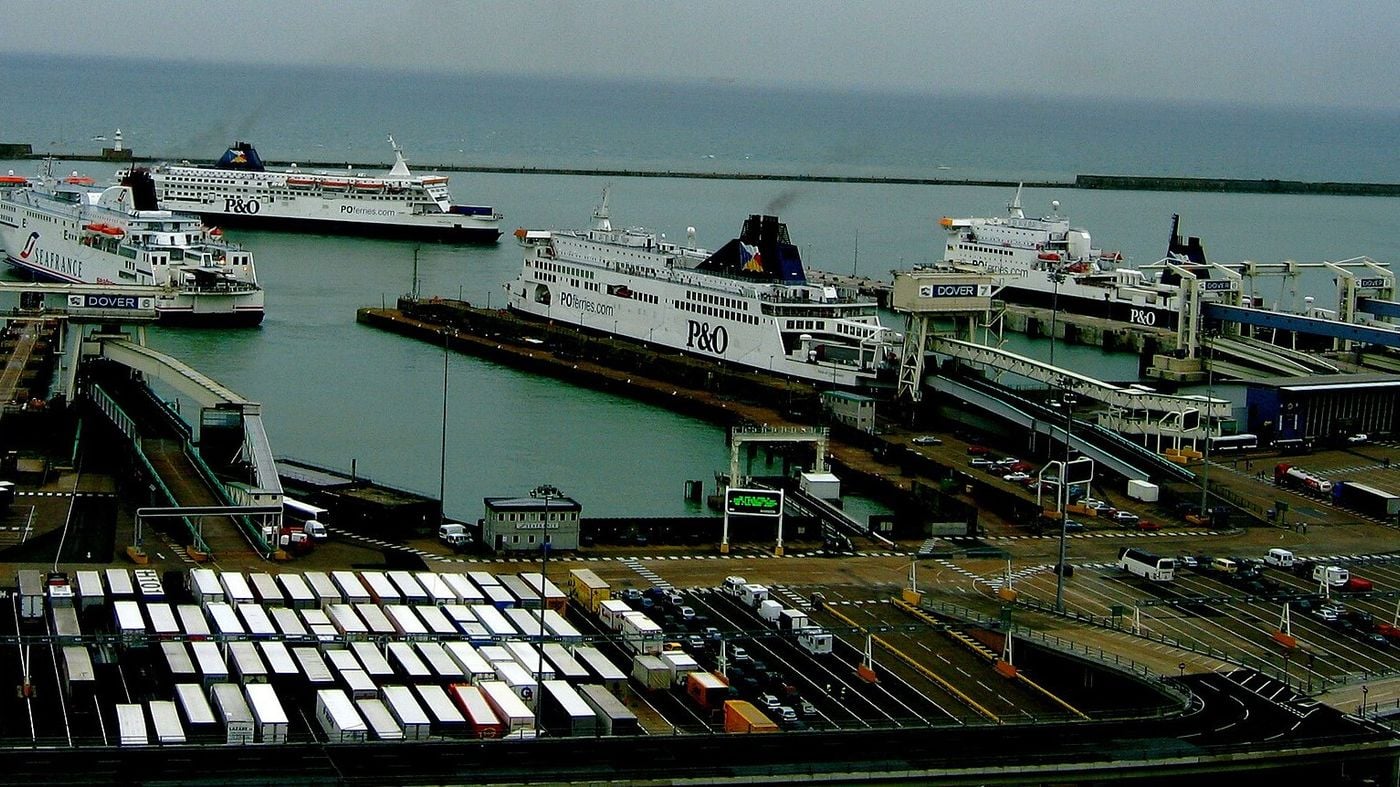
A lorry crossing between Great Britain and the EU meets two sets of systems, one on each side of the crossing. On the British side, HMRC’s Goods Vehicle Movement Service (GVMS) collects the references of every declaration for the load into a single goods movement reference (GMR), which is presented at check-in at Dover, Eurotunnel, Holyhead and the other listed crossings; since 31 January 2025 goods imported from the EU into Great Britain also need an entry summary declaration. On the EU side, the Import Control System 2 (ICS2) has taken entry summary declarations from road carriers since 1 April 2025, with 1 September 2025 as the last date for every road carrier to start using it.
Status: 13 November 2026. This page follows the official texts as read on that date: the GOV.UK guidance on the Goods Vehicle Movement Service and on safety and security declarations (each source below carries its last update date), the European Commission’s ICS2 page and its factsheet for road transport, Articles 5(40) and 127 of the Union Customs Code, Articles 105, 108 and 110 of Delegated Regulation (EU) 2015/2446 in the consolidated text of 1 July 2026, and the ICS2 entry of the UCC Work Programme, Implementing Decision (EU) 2023/2879. Northern Ireland has rules of its own under the Windsor Framework; it appears here only where the GOV.UK texts set it beside Great Britain.
| Item | Into Great Britain from the EU | Into the EU from Great Britain |
|---|---|---|
| Safety and security declaration | Entry summary declaration in HMRC’s Safety and Security GB (S&S GB) service, required from 31 January 2025 | Entry summary declaration (ENS) in ICS2; road carriers from 1 April 2025, all of them by 1 September 2025 at the latest |
| Who lodges it for accompanied road freight | The haulage company (roll-on roll-off accompanied, and road traffic through the Channel Tunnel) | The carrier (Union Customs Code, Article 127(4)), or one of the other persons that article names |
| Time limit | At least 2 hours before arrival for roll-on roll-off freight; at least 1 hour before arrival at the Eurotunnel terminal at Coquelles | By road: at the latest one hour before arrival at the place for which the customs office of first entry is competent (Article 108) |
| Goods movement reference | Needed at GVMS locations (GOV.UK pages word the scope differently, see below); adding the ENS reference to it is optional | Needed for all movements through GVMS locations, in place before the vehicle attends the port of departure |
What GVMS is and what a goods movement reference does
The Goods Vehicle Movement Service is an HM Revenue & Customs (HMRC) service used at the ports listed further down. GOV.UK describes its purpose in one sentence: “The Goods Vehicle Movement Service brings together multiple declaration reference numbers into a single goods movement reference.” The registration page explains that the reference “will link together all the declarations which have been submitted for the goods before they reach their destination”, and that a goods movement reference is needed “for each movement of goods through a border location using the Goods Vehicle Movement Service”.
Registration is required, GOV.UK says, of anyone who imports goods into the UK or exports goods from the UK through a port which uses the service, and a customs agent can register on their behalf. It needs an EORI number starting GB, which can be applied for during registration. The guidance on creating a reference adds that you must enter a reference for all goods contained in a vehicle, trailer or container.
What a reference carries depends on the direction. For goods from the EU to Great Britain, GOV.UK lists the vehicle registration number if the movement is accompanied, or the trailer or container number if it is unaccompanied, together with the references of the declarations that cover the goods: an import Movement Reference Number (MRN) from the Customs Declaration Service, an EORI number where the trader is authorised to make declarations in its own records, the numbers of ATA, eATA or TIR carnets where relevant, or, for transit under the Common Transit Convention, the MRN generated by the New Computerised Transit System (NCTS). Import declarations at GVMS ports, the handbook says, “must be pre-lodged and include the RRS01 additional information code”. For goods from Great Britain to the EU, the reference carries the Declaration Unique Consignment Reference (DUCR) of each combined customs and safety and security export declaration, and the exit summary declaration MRN where an exit summary declaration is needed. How T1 transit and the MRN work is explained in the T1 transit document and NCTS, and the carnet in the TIR carnet explained.
Empty trailers are included. GOV.UK says a goods movement reference is needed “if you’re moving an empty trailer or any other commercial goods that can be declared orally or by conduct” from Great Britain to Northern Ireland, from the EU to Great Britain and from Great Britain to the EU, by selecting the ‘oral or by conduct declarations’ or ‘empty’ option in the service.
Who creates the GMR, and who checks it
The guidance splits the work among three parties.
- The trader sending the goods. Before the goods arrive at the departure port, the trader must give the haulier the movement reference numbers of any import or export declarations, TIR or ATA carnets and Common Transit Convention movements.
- The haulier. GOV.UK’s instruction to hauliers is to “enter references for all the goods contained in the vehicle, trailer or container” and to follow instructions on whether the goods have to be checked by customs on arrival. For goods leaving the UK under ATA or TIR carnets, the reference has to exist before the vehicle attends an Inland Border Facility for endorsement of the documents.
- The carrier, in GOV.UK’s words the business transporting a vehicle for a haulier. At check-in the carrier verifies the reference and cross-checks it against the vehicle, trailers or containers; the handbook says “Vehicles will be turned away at check in if a valid GMR cannot be presented” or if the registration, trailer or container numbers do not match. When the crossing departs, which the handbook defines as the moment the vessel’s bow doors close or, for Eurotunnel, the moment the train leaves the platform, the carrier notifies HMRC and every reference on board changes to ‘embarked’.
The GOV.UK pages do not all describe the EU to Great Britain direction in the same words. The haulier-facing page “Check how to move goods through ports that use the Goods Vehicle Movement Service” (updated 27 May 2025) says that from the EU to Great Britain “a goods movement reference is needed for all movements”. The carrier-facing page “Check if a goods movement reference is valid” (updated 8 October 2025) says that hauliers moving goods from the EU to Great Britain “only need a GMR number if they are moving goods under the Common Transit Convention”. Both texts are quoted here as published on 13 November 2026.
Which crossings use GVMS
GOV.UK keeps the list of locations on one page, last updated on 19 August 2026. It distinguishes ports where the service is always used for roll on roll off (RoRo) movements from ports where the carrier decides, and lists exports separately.
| Category on GOV.UK | Ports (carrier where the list names one) |
|---|---|
| Into Great Britain: always for RoRo movements | Dover, Eurotunnel, Fishguard, Heysham, Holyhead, Liverpool, Pembroke, Newhaven |
| Into Great Britain: the carrier may require it or offer it | Birkenhead (Stena Line), Felixstowe (DFDS), Harwich (Stena Line), Hull (P&O), Immingham (DFDS, Stena Line or A2B-online), Killingholme (Stena Line, CLdN or DFDS), Manchester Ship Canal (Suardiaz), Plymouth, Poole and Portsmouth (Brittany Ferries), Port of Tyne (DFDS), Purfleet (CLdN), Teesport (P&O, CLdN or A2B-online), Thamesport and Tilbury 1 (A2B-online), Tilbury 2 (P&O or DFDS) |
| Out of Great Britain: export declaration submitted as ‘arrived’ before the goods start their journey | Birkenhead (Stena Line), Dover (Irish Ferries, P&O or DFDS), Eurotunnel, Fishguard (Stena Line), Heysham (Stena Line or CLdN), Holyhead (Irish Ferries or Stena Line), Liverpool (Stena Line or CLdN), Pembroke (Irish Ferries) |
| Out of Great Britain: ‘pre-lodged’ export declaration before the goods arrive at the port | Manchester Ship Canal (Suardiaz), Newhaven (DFDS), Plymouth, Poole and Portsmouth (Brittany Ferries), Tilbury 2 (DFDS) |
For Northern Ireland the same page names Belfast with Stena Line, Larne with P&O or the Isle of Man Steam Packet Company, and Warrenpoint with Cronus or CLdN. A further list names the border locations where the service supports Offices of Transit under the Common Transit Convention. The shuttle crossing itself, including how Eurotunnel collects the GMR at its terminals, is described in trucks on ferries, trains and the Channel Tunnel.
After the crossing: inspections and inland border facilities
On arrival in the UK, GOV.UK points hauliers to the online service “check if you need to report for an inspection”, which takes the goods movement reference and shows whether the goods are held. If the goods are held, vehicles arriving at the Port of Dover or Eurotunnel attend an Inland Border Facility for the checks; at all other GVMS locations they proceed to the inspection facility within or near the port. The goods must be taken to the inland border facility directly and in the same condition as at the time of importation. The guidance ends this section with a penalty: “You may be liable to a penalty of up to £2,500 if you do not follow HMRC instructions.”
Safety and security declarations for imports from the EU into Great Britain
A goods movement reference is a customs reference; the safety and security declaration is a separate filing. HMRC’s handbook explains that since leaving the EU, Great Britain is no longer part of a safety and security zone with the EU, and gives the dates of the two steps for traffic with the EU:
- exit summary declarations have been required for exports from Great Britain into the EU since 1 October 2021;
- entry summary declarations have been required for imports into Great Britain from the EU from 31 January 2025.
The same page dates the requirement for freight moved into Northern Ireland from Great Britain to 1 January 2021. Imports into Great Britain are declared in the Safety and Security GB (S&S GB) service; GOV.UK says that this service and ICS2 have no user interfaces, so a declaration is sent as an XML message from compatible software, and a business not established in Great Britain needs an EORI number starting GB. Declarations can be submitted up to 200 days in advance, and once one is accepted a movement reference number is issued and the declaration is risk-assessed.
Who is responsible. The handbook places the legal requirement on the carrier, defined as “the operator of the active means of transport on, or in, which the goods are brought into the customs territory”. For road freight it names the party in each case:
| Mode | Responsible for lodging | Minimum timing requirement |
|---|---|---|
| RoRo, accompanied | The haulage company | 2 hours before arrival |
| RoRo, unaccompanied | The ferry operator | 2 hours before arrival |
| Road traffic through the Channel Tunnel | The haulage company | 1 hour before arrival at the Eurotunnel terminal (at Coquelles, France) |
Short sea journeys into Great Britain are, in the handbook’s list, journeys from the English Channel, or the Atlantic coast of Europe from where it meets the English Channel up to and including the port of Algeciras, and from Norway, Ireland, the Faroe Islands, Iceland and ports on the Baltic Sea and the North Sea; for them the minimum is also 2 hours before arrival. A third party may file on the carrier’s behalf, but only with the carrier’s knowledge and consent, and the handbook adds that the legal liability to make sure a declaration has been submitted “still remains with the carrier”. GOV.UK’s notice to hauliers ahead of 31 January 2025 put it in these words: “As a carrier or haulier, you are legally responsible for submitting safety and security declarations, or ensuring they are submitted by another party on your behalf.”
Changes after filing. A declaration can be amended until the goods arrive at the border, and an amendment overwrites the original, so it contains all the original data plus the change. When ferry or rail services are delayed by more than 2 hours, no amendment is needed as long as the vehicle moves on the same routing and with the same carrier as declared, after the declared departure time, and from the declared port of departure no longer than 12 hours after that time. A declaration cannot be cancelled; GOV.UK says that if the goods will no longer be moved, no action is needed.
Goods without a declaration. The handbook lists goods that need none, among them goods in travellers’ personal luggage and postal consignments under Universal Postal Union rules, and “goods declared to customs orally or by conduct, provided they are not being moved under a transport contract - this includes empty trailers, containers and packaging”. It notes that the list is not exhaustive and refers to Article 104 of the retained Commission Delegated Regulation (EU) 2015/2446.
The link with GVMS. For goods moved into Great Britain through a GVMS port, the entry summary declaration MRNs may be added to the goods movement reference, but GOV.UK calls this step optional. For goods moved into Northern Ireland they are to be included, and the arrival and presentation of goods notifications are then submitted automatically. Where the MRNs are included, the declaration has to be submitted by whichever comes first: the minimum timing requirement or the close of check-in. On non-compliance, HMRC’s handbook says enforcement “will be evidence-based and proportionate” and could involve goods being delayed at the border for further checks and penalties under The Customs Safety and Security (Penalty) Regulations 2019.
ICS2: the EU entry summary declaration for road transport
The European Commission describes the Import Control System 2 as “an advance cargo information system” and says that all economic operators bringing goods to or through the EU “have to declare safety and security data to ICS2, through the Entry Summary Declaration (ENS)”. The obligation comes from the Union Customs Code. Article 127(1) reads: “Goods brought into the customs territory of the Union shall be covered by an entry summary declaration.” Under Article 127(3) it is lodged at the customs office of first entry within a specific time limit, before the goods are brought into the customs territory of the Union.
Who files. Article 127(4) states: “The entry summary declaration shall be lodged by the carrier.” It continues that, notwithstanding the obligations of the carrier, the declaration may be lodged instead by the importer or consignee or other person in whose name or on whose behalf the carrier acts, or by any person who is able to present the goods at the customs office of entry. Article 5(40) defines the carrier, in the context of entry, as “the person who brings the goods, or who assumes responsibility for the carriage of the goods, into the customs territory of the Union”, and for combined transportation as “the person who operates the means of transport which, once brought into the customs territory of the Union, moves by itself as an active means of transport”. The Commission’s road factsheet says: “The road carrier is legally responsible for submitting a complete and accurate entry summary declaration (ENS) in the ICS2 for all goods.”
When. Delegated Regulation (EU) 2015/2446 sets the time limits by mode. For road, Article 108: “the entry summary declaration shall be lodged at the latest one hour before the arrival of the goods at the place for which the customs office of first entry is competent.” For combined transportation, Article 110: where goods arrive on a means of transport which is itself transported on an active means of transport, “the time-limit for lodging the entry summary declaration shall be the time-limit applicable to the active means of transport”. For transport by sea, Article 105(c) sets “at the latest two hours before arrival of the vessel at the first port of entry” for goods coming from, among other origins, ports of the United Kingdom of Great Britain and Northern Ireland, with the exception of ports located in Northern Ireland and ports of the Channel Islands and the Isle of Man.
What it contains. The road factsheet lists a detailed goods description and six-digit HS code, the parties (carrier, consignor, consignee, buyer and seller), and transport information such as the identity of the means of transport, the routing and the transport documents. It says the carrier must obtain the data from “all underlying house transport documents / consignment notes issued by freight forwarders”, whether the forwarder is based in a non-EU country or in the EU. The consignment note itself is the subject of the CMR consignment note explained, and its electronic form of eFTI and e-CMR.
Scope and channels. The factsheet applies to goods, postal consignments included, transported “into or via the EU, Northern Ireland, Norway, or Switzerland by road”, and describes ICS2 as the system “which replaces ICS1 and the New Computerised Transit System (NCTS) P4/5”. Filing needs an EORI number from the customs authority of an EU Member State. The Commission’s page and the factsheet describe three channels: an operator’s own system-to-system access point after mandatory self-conformance testing, an IT service provider filing on its behalf, or the Shared Trader Portal, which the factsheet calls suitable for companies with a small volume of operations. In some countries the ENS particulars can instead go into a combined transit declaration in NCTS Phase 6, described in the T1 transit document and NCTS; the Commission’s news item of 1 June 2026 says that all consignments entering the EU territory by any means of transport as of 1 June 2026 “should have a valid ENS that is submitted either directly to ICS2 or filed in the combined transit declaration through the NCTS Phase 6 in opt-in countries”. For a carrier that is not ready, the factsheet names three consequences: “Goods could be stopped at the EU borders”, the goods “might not be cleared by the customs authorities”, and “Inadequate declarations might either be rejected or subject to intervention, with possible sanctions imposed for non-compliance.”
GOV.UK’s own ICS2 page, written for traders in the UK, lists Great Britain to the EU among the movements for which entry summary declarations are made in ICS2, and adds that in the UK the system is only for goods entering Northern Ireland, while goods moving into Great Britain use the S&S GB service.
ICS2 release 3: the dates for road carriers
ICS2 was rolled out in three releases. The UCC Work Programme describes Release 3 as covering “all goods in maritime and inland waterways and road and rail traffic”, phased in three steps: maritime and inland waterways carriers, then house level filers in that traffic, then road and rail carriers. The Work Programme defines the start date as the earliest date on which the electronic system becomes operational; for ICS2, Member States may allow economic operators to connect gradually until the end of the deployment window, and publish the deadlines and instructions for economic operators on their websites.
| Step | Who connects | Start date | End of the deployment window (at the latest) |
|---|---|---|---|
| 1 | Maritime and inland waterways carriers | 3 June 2024 | 4 December 2024 |
| 2 | House level filers in maritime and inland waterways traffic | 4 December 2024 | 1 April 2025 |
| 3 | Road and rail carriers | 1 April 2025 | 1 September 2025 |
The road factsheet gives the same two dates for road in its own words: 1 April 2025 as the date the “legal requirements to submit the data in the ICS2 enter into force”, and 1 September 2025 as “the latest date by which all road carriers must start using the ICS2”. The factsheet told carriers not ready to start on time to request a deployment window from the National Service Desk of the Member State where their EORI number was registered, at least 1 month before the scheduled go-live date for road transport. The texts differ on one point: recital 8 of the Decision speaks of “starting with maritime carriers in ICS2 from 3 June 2023”, while the Annex gives 3.6.2024 for step 1 and footnote 13 calls that date “the date for deployment of the full Release 3 of ICS2 by all Member States”. The start date for road and rail carriers, 1 April 2025, is the same in the recital, the Annex and the factsheet. Licensing to operate lorries in Great Britain in the first place is a separate matter, set out in goods vehicle operator licences in Great Britain.
Quick answers
- What is a goods movement reference (GMR)?
- A GMR is the single reference, created in HMRC's Goods Vehicle Movement Service, that carries the declaration references for all the goods in one vehicle, trailer or container. GOV.UK says it brings together multiple declaration reference numbers into a single goods movement reference, that you need one for each movement of goods through a border location using the service, and that the carrier will allow you to embark if the goods movement reference is valid.
- Which ports use GVMS?
- GOV.UK lists 8 locations where the Goods Vehicle Movement Service must always be used for roll on roll off movements into Great Britain: Dover, Eurotunnel, Fishguard, Heysham, Holyhead, Liverpool, Pembroke and Newhaven. At 16 more, among them Felixstowe, Hull, Immingham, Portsmouth and Tilbury, the carrier named on the list may require it or offer it. Separate lists cover exports and Northern Ireland.
- Who submits the entry summary declaration for a lorry entering Great Britain from the EU?
- For accompanied roll-on roll-off freight and for road traffic through the Channel Tunnel, HMRC's handbook names the haulage company; for unaccompanied freight it names the ferry operator. Entry summary declarations have been required for imports from the EU since 31 January 2025, at least 2 hours before arrival for roll-on roll-off freight and at least 1 hour before arrival at the Eurotunnel terminal at Coquelles.
- When did ICS2 release 3 start for road carriers?
- On 1 April 2025. The EU's UCC Work Programme gives 1.4.2025 as the start of step 3, road and rail carriers, and 1.9.2025 as the latest date; the Commission's road factsheet calls 1 April 2025 the date the legal requirements enter into force and 1 September 2025 the latest date by which all road carriers must start using the ICS2.
- How long before arrival must a road ENS be lodged in ICS2?
- At the latest one hour before the goods arrive at the place for which the customs office of first entry is competent, under Article 108 of Delegated Regulation (EU) 2015/2446. Where the vehicle carrying the goods is itself transported on an active means of transport, Article 110 applies the time limit of that active means of transport instead.
- Does an empty trailer need a GMR?
- Yes. GOV.UK says you need a goods movement reference if you are moving an empty trailer from the EU to Great Britain, from Great Britain to the EU or from Great Britain to Northern Ireland, using the 'oral or by conduct declarations' or 'empty' option. HMRC's handbook lists empty trailers, containers and packaging among goods that need no entry summary declaration, provided they are not moved under a transport contract.
Sources
- Create a goods movement reference (guidance, updated 9 June 2026) — GOV.UK (HM Revenue & Customs)
- Check how to move goods through ports that use the Goods Vehicle Movement Service (guidance, updated 27 May 2025) — GOV.UK (HM Revenue & Customs)
- List of ports using the Goods Vehicle Movement Service (guidance, updated 19 August 2026) — GOV.UK (HM Revenue & Customs)
- Register for the Goods Vehicle Movement Service (guidance, updated 17 December 2021) — GOV.UK (HM Revenue & Customs)
- Check if a goods movement reference is valid (guidance for carriers, updated 8 October 2025) — GOV.UK (HM Revenue & Customs)
- Goods Vehicle Movement Service technical handbook: processes at the border and during crossing; declaration types (11 March 2026 and 1 June 2026) — GOV.UK (HM Revenue & Customs)
- Making an entry summary declaration (guidance, updated 5 November 2026) — GOV.UK (HM Revenue & Customs)
- Safety and security import requirements: entry summary declarations (technical handbook, updated 11 February 2026) — GOV.UK (HM Revenue & Customs)
- What safety and security declarations are and why we have them (technical handbook, 31 January 2025) — GOV.UK (HM Revenue & Customs)
- Preparing for the new safety and security declaration requirements, with Information for hauliers and carriers of accompanied goods and Customer journey by mode of transport (updated 18 December 2024) — GOV.UK (HM Revenue & Customs)
- Make an entry summary declaration using the Import Control System 2 (guidance, updated 1 January 2026) — GOV.UK (HM Revenue & Customs)
- Import Control System 2 (ICS2), Taxation and Customs Union web page (read 13 November 2026) — European Commission
- ICS2: New data requirements for goods brought into the EU by road transport (factsheet, 2025; listed on the ICS2 page under 10 December 2024) — European Commission, Publications Office of the European Union
- Regulation (EU) No 952/2013 laying down the Union Customs Code, consolidated text of 12 December 2022, Article 5(40) and Article 127 — EUR-Lex, European Union
- Commission Delegated Regulation (EU) 2015/2446, consolidated text of 1 July 2026, Articles 105, 108 and 110 — EUR-Lex, European Union
- Commission Implementing Decision (EU) 2023/2879 of 15 December 2023 establishing the Work Programme for the electronic systems of the Union Customs Code, recital 8 and Annex, Part I and Part II, point 17 (UCC ICS2) — EUR-Lex, European Union