Trucks on ferries, trains and the Channel Tunnel: rest, tachograph and shuttle rules
Rest on a ferry or train under Article 9 of Regulation 561/2006, recording the crossing on the tachograph, and the Channel Tunnel freight shuttle's size, fuel and dangerous goods rules.
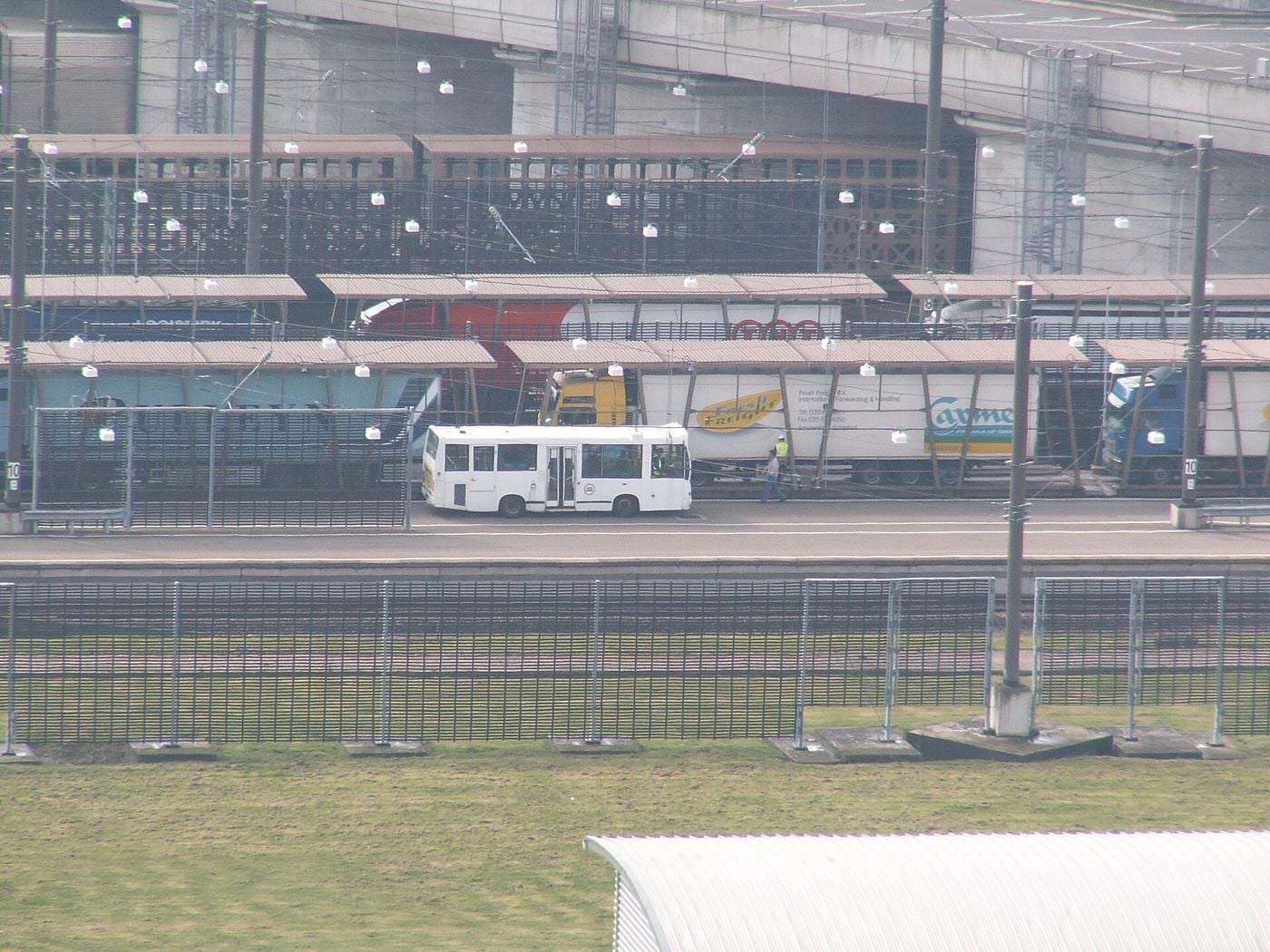
A truck that crosses part of its route on a ferry or a train stays under the EU rules on drivers’ hours and tachographs, which have provisions written for that part of the journey. Article 9(1) of Regulation (EC) No 561/2006, in the wording given by Regulation (EU) 2020/1054, allows the regular daily rest or reduced weekly rest of a driver accompanying a vehicle transported by ferry or train to be interrupted not more than twice by other activities of no more than one hour in total, with a sleeper cabin, bunk or couchette at the driver’s disposal; for a regular weekly rest that derogation applies only where the journey is scheduled for 8 hours or more and the driver has access to a sleeper cabin. Article 34 of Regulation (EU) No 165/2014 has that rest recorded under the ferry/train sign in addition to the rest sign and, where a Member State border is crossed on a ferry or train, the country symbol entered at the port or station of arrival. The truck shuttle through the Channel Tunnel sets its own conditions: on LeShuttle Freight, between Folkestone and Coquelles, the limits are 44 tonnes, 19.40 m, 2.60 m and 4.20 m, vehicles powered by flammable gas or electricity are not carried, and the carriage of dangerous goods is based on the ADR, with a declaration at check-in except for goods in limited quantities.
Status as of 9 November 2026. Read on that day: Regulation (EC) No 561/2006 and Regulation (EU) No 165/2014 in their consolidated texts of 20 August 2020, which carry the amendments made by Regulation (EU) 2020/1054; Regulation (EU) 2020/1054 in its Official Journal text; Council Directive 92/106/EEC in its consolidated text of 1 July 2013; and six pages of LeShuttle Freight, the freight service of Eurotunnel, including its conditions of carriage applicable from 30 July 2025. The operator’s limits are its own, and its conditions of carriage may be amended “at any time and without notice” (condition 15.3).
Rest on board: Article 9 of Regulation (EC) No 561/2006
Article 9(1) opens “By way of derogation from Article 8”, the article on daily and weekly rest periods, and applies “where a driver accompanies a vehicle which is transported by ferry or train”. A regular daily rest period or a reduced weekly rest period taken in that situation “may be interrupted not more than twice by other activities not exceeding one hour in total”, and during it “the driver shall have access to a sleeper cabin, bunk or couchette at their disposal”.
For the regular weekly rest period the second subparagraph narrows the derogation, which “shall only apply to ferry or train journeys where: (a) the journey is scheduled for 8 hours or more; and (b) the driver has access to a sleeper cabin in the ferry or on the train”. Article 8(8) provides that regular weekly rest periods “shall not be taken in a vehicle” but in suitable gender-friendly accommodation with adequate sleeping and sanitary facilities.
| Period | Duration (Article 4) | On board a ferry or train | Provision |
|---|---|---|---|
| Regular daily rest | At least 11 hours, or an uninterrupted period of at least 3 hours followed by one of at least 9 hours | May be interrupted not more than twice by other activities not exceeding one hour in total; sleeper cabin, bunk or couchette at the driver’s disposal | Article 9(1), first subparagraph |
| Reduced weekly rest | Less than 45 hours; under the conditions of Article 8(6), at least 24 consecutive hours | As for the regular daily rest | Article 9(1), first subparagraph |
| Regular weekly rest | At least 45 hours | The derogation applies only where the journey is scheduled for 8 hours or more and the driver has access to a sleeper cabin in the ferry or on the train | Article 9(1), second subparagraph |
| Reduced daily rest | At least 9 hours but less than 11 | Not named in Article 9 | — |
| Travel to take charge of a vehicle, or back, where the vehicle is neither at the driver’s home nor at the operational centre where the driver is normally based | — | Counted as rest or break only if the driver is on a ferry or train and has access to a sleeper cabin, bunk or couchette | Article 9(2) |
Article 9(2) covers the journey to and from a vehicle. Time spent travelling to a location to take charge of a vehicle within the scope of the Regulation, or to return from it, when the vehicle is neither at the driver’s home nor at the employer’s operational centre where the driver is normally based, “shall not be counted as a rest or break unless the driver is on a ferry or train and has access to a sleeper cabin, bunk or couchette”.
The present wording comes from Regulation (EU) 2020/1054 of 15 July 2020, which replaced paragraphs 1 and 2 of Article 9. Its recital 20 gives the reason: “Many road transport operations within the Union involve transport by ferry or by rail for part of the journey. Clear, appropriate provisions regarding rest periods and breaks should therefore be laid down for such operations.”
The break of at least 45 minutes after a driving period of four and a half hours is set separately, by Article 7. The Regulation’s other limits, and how the working-time Directive 2002/15/EC counts the time spent accompanying a vehicle on a ferry or train, are set out in driving time and rest rules.
Recording the crossing on the tachograph
Article 34(5)(b) of Regulation (EU) No 165/2014 has the driver operate the switch mechanisms so that driving time, other work, availability, and breaks, rest, annual leave or sick leave are recorded separately and distinctly, each under its own sign. Regulation (EU) 2020/1054 added point (v): under the sign for “ferry/train”, in addition to the rest sign, “the rest period spent on a ferry or train as required by Article 9 of Regulation (EC) No 561/2006”. The ferry/train entry on a smart tachograph, with its begin and end flags, is covered in tachograph symbols explained; manual entries and the driver card are covered in the digital tachograph and driver card.
The same amendment added the border-crossing entry: the symbol of the country the driver enters after crossing a border of a Member State, at the first stop in that Member State, made “at the nearest possible stopping place at or after the border” (Article 34(6)(f) for record sheets, and Article 34(7) for digital tachographs from 2 February 2022). For a crossing over water or by rail the place differs: “Where the crossing of the border of a Member State takes place on a ferry or train, the driver shall enter the symbol of the country at the port or station of arrival.” How a smart tachograph records border crossings by itself is covered in the smart tachograph explained.
When the sea or rail leg makes it combined transport
Council Directive 92/106/EEC defines combined transport as the transport of goods between Member States where the lorry, trailer, semi-trailer, with or without tractor unit, swap body or container of 20 feet or more uses the road on the initial or final leg and, on the other leg, “rail or inland waterway or maritime services where this section exceeds 100 km as the crow flies” (Article 1). Article 7 covers a trailer or semi-trailer of an own-account undertaking hauled on a final section by a tractor of a hire-or-reward undertaking: that operation is exempt from presentation of the transport document provided for in Article 3, but “another document shall be provided giving evidence of the journey covered or to be covered by rail, by inland waterway or by sea”. The limits on the road legs, the transport document and the statistical terms for trucks on trains, among them the rolling road, are in combined, intermodal and multimodal transport.
The Channel Tunnel freight shuttle
In the operator’s conditions of carriage, the Channel Tunnel is the Fixed Link as defined in the Treaty of Canterbury between the United Kingdom and France, signed on 12 February 1986, and Eurotunnel is the partnership of the Channel Tunnel Group Limited and France-Manche S.A., concessionaires and operators of the tunnel under a concession awarded by the British and French governments dated 14 March 1986. The group changed its corporate name from Groupe Eurotunnel to Getlink on 20 November 2017. The operator dates to May 2023 the announcement of Eurotunnel’s rebrand to LeShuttle, under which the freight service is called LeShuttle Freight.
Commercial vehicles are carried only on the freight shuttles; commercial vans and coaches may use the passenger shuttles, subject to availability and to the conditions for that vehicle (condition 2.3). The freight terminals are at Folkestone in Kent and at Coquelles near Calais. The service runs 24 hours a day, 365 days a year, with no fixed timetable and up to six departures an hour at peak times; a booking is for a day of travel, number-plate recognition identifies the vehicle at check-in, and the vehicle is allocated to the next available departure. The operator gives the crossing as 35 minutes platform to platform, at speeds of up to 140 km/h.
The driver does not stay with the truck. For the crossing, drivers leave their vehicles and a bus takes them to a Club Car, an amenity wagon; on arrival they are taken back to their vehicles. No more than three people, the driver included, may travel per vehicle, and the operator requires all of them to be declared at check-in. Children under 12, animals and drivers or passengers with reduced mobility are not carried on the freight shuttles.
| Item | Operator’s limit | Operator page |
|---|---|---|
| Length | 19.40 m total length | Vehicle restrictions; Help and FAQs |
| Width | 2.60 m, excluding mirrors | Vehicle restrictions; Help and FAQs |
| Height | 4.20 m; aerials lowered and secured before boarding | Vehicle restrictions; safety checklist |
| Weight | 44 tonnes (44,000 kg) | Vehicle restrictions; Help and FAQs |
| Petrol or diesel, alone or with biofuel | Accepted | Vehicle restrictions, fuel table |
| Biofuel, including bioethanol and biodiesel, alone or with petrol or diesel | Accepted | Vehicle restrictions, fuel table |
| Electric, battery or plug-in, as primary or secondary power source | Not accepted | Vehicle restrictions, fuel table |
| LPG, LNG, CNG or another flammable gas, alone or dual-fuel | Not accepted, even with the gas tank empty or the gas mode not selected | Vehicle restrictions; conditions of carriage, condition 8.1 |
| Spare fuel | Up to 60 litres of permitted fuel per transport unit, in suitable portable fuel containers | Help and FAQs |
| Campervans | Not carried on the truck shuttles | Vehicle restrictions |
The operator also “reserves the right to refuse any vehicle considered as unsuitable”. Its safety checklist for freight drivers sets a speed limit of 10 km/h (6 mph) on the shuttle and requires electrical and gas equipment in the cab, the cab heater, refrigerator and camping gas stoves included, to be turned off after loading. The checklist also requires tarpaulins to be correctly attached and in good condition, and all access points into tankers to be fully secured. The conditions of carriage add that Eurotunnel “does not provide ancillary power for freezer units” (condition 9.2.6).
Dangerous goods through the tunnel
The operator states that the carriage of dangerous goods through the Channel Tunnel is based on the ADR, the Agreement concerning the International Carriage of Dangerous Goods by Road. Its conditions of carriage do not permit dangerous goods on passenger shuttles; on freight shuttles their carriage is “restricted and conditional upon prior declaration” under the operator’s dangerous goods policy (condition 6.2). The operator’s answers to drivers add that restrictions depend on factors such as ADR classification, quantity, packaging and documentation, and not all goods are authorised.
Drivers declare dangerous goods at check-in. Account holders can make the declaration in their account, giving the UN number, the current ADR references (class, packing group and classification code where required), the proper shipping name with volume or weight, the number and description of packages, and the net or gross mass. Goods carried in limited quantities under Chapter 3.4 of the ADR need no declaration. An empty tanker that has not been cleaned is treated as full, and the restrictions for the dangerous goods it carried apply. At the Freight Driver Information Centre the paperwork is checked, the vehicle is checked externally and a “DG” sticker with a unique reference is issued, to be affixed to the windscreen.
Border formalities at the two terminals
The operator’s border page says that formalities for goods carried between the United Kingdom and France have been mandatory since Brexit came into effect in 2021, and describes the procedure that Eurotunnel and the French and British authorities have set up. Customs documents are collected at a Pit Stop alongside the security checks, either by scanning the GMR and ELO customs documents, in digital or paper form, or, for drivers with the operator’s Border Pass, by pairing the customs information, collected in advance, with the registration number. From check-in the documents are sent to the French and British authorities. During the crossing the customs status is shown on the Club Car screens and in the operator’s driver app, 20 minutes after departure: green means the vehicle continues its journey, amber means further customs checks on arrival. The page uses “orange” for the same status in its questions and answers.
| Country | Terminal and access road | Secure parking at the terminal | A vehicle with amber customs status goes to | Source |
|---|---|---|---|---|
| United Kingdom | Folkestone, Kent; junction 11A of the M20 | None within the terminal | The Inland Border Facility at Sevington | LeShuttle Freight, Help and FAQs; Border formalities |
| France | Coquelles, near Calais; A16 motorway | The LeShuttle Freight Village within the terminal | Centre Douane SIVEP, for inspections | LeShuttle Freight, Help and FAQs; Border formalities |
The same page states that seafood products go directly to the SIVEP centre in Boulogne-sur-Mer, that an empty vehicle also has to be declared, in ELO for the French authorities, in GVMS for the UK authorities or through the Border Pass, and that safety and security declarations are the carrier’s responsibility, with Eurotunnel collecting or monitoring none of them. Among the customs documents it lists is the transit accompanying document, described in the T1 transit document and NCTS.
Liability and claims on the shuttle
The conditions of carriage applicable from 30 July 2025 limit Eurotunnel’s liability for loss of or damage to commercial goods to 8.33 SDR per kilogram of gross weight lost or damaged, packaging included, or to the purchase value or the depreciation in value if either is lower (condition 10.2.1). Its total liability for a commercial vehicle, which here includes its goods, personal belongings and any towed vehicle or trailer, loaded or empty, may not exceed 70,000 SDR per vehicle (condition 10.2.3). SDR means Special Drawing Rights as defined by the International Monetary Fund (condition 1). A claim for damage or loss during carriage is reported immediately to Eurotunnel’s staff or within 3 business days of the date of carriage by signed-for letter (condition 11.1), and condition 11.3 requires legal proceedings under the conditions to be brought within one year of the date of carriage.
Quick answers
- Can a truck driver take a weekly rest on a ferry or train?
- Article 9(1) of Regulation (EC) No 561/2006 covers it. Where a driver accompanying a vehicle transported by ferry or train takes a regular daily rest or a reduced weekly rest, that period may be interrupted not more than twice by other activities not exceeding one hour in total, and the driver has access to a sleeper cabin, bunk or couchette. For a regular weekly rest, that derogation applies only where the journey is scheduled for 8 hours or more and the driver has access to a sleeper cabin in the ferry or on the train.
- How is a ferry or train crossing recorded on the tachograph?
- Under a separate ferry/train sign. Article 34(5)(b)(v) of Regulation (EU) No 165/2014, added by Regulation (EU) 2020/1054, has the driver record under that sign, in addition to the rest sign, the rest period spent on a ferry or train as required by Article 9 of Regulation (EC) No 561/2006. Where a Member State border is crossed on a ferry or train, the driver enters the symbol of the country at the port or station of arrival (Article 34(6)(f) and 34(7)).
- What are the maximum dimensions and weight for a truck in the Channel Tunnel?
- On LeShuttle Freight, the Channel Tunnel's freight shuttle, the operator's limits as read on its pages on 9 November 2026 are 19.40 m total length, 2.60 m width excluding mirrors, 4.20 m height and 44 tonnes. The operator also reserves the right to refuse any vehicle it considers unsuitable, and campervans are not carried on the truck shuttles.
- Can LNG, CNG or electric trucks use the Channel Tunnel freight shuttle?
- No, according to the operator's vehicle restrictions page read on 9 November 2026. Vehicles powered by LNG, CNG, LPG or another flammable gas, including dual-fuel vehicles, are not accepted even if the gas tank is empty or the gas mode is not selected, and the fuel table marks vehicles with electric power, battery or plug-in, as primary or secondary source as not accepted. Diesel, petrol and biofuel vehicles are accepted.
- Does the driver stay in the truck during the Channel Tunnel crossing?
- No. On LeShuttle Freight the driver leaves the vehicle for the crossing and a bus takes the drivers to a Club Car, an amenity wagon, and back to their vehicles on arrival. The crossing takes 35 minutes platform to platform, and no more than three people, the driver included, may travel per vehicle.
Sources
- Regulation (EC) No 561/2006 on the harmonisation of certain social legislation relating to road transport — consolidated text of 20 August 2020, Articles 4, 7, 8 and 9 — EUR-Lex, European Union
- Regulation (EU) 2020/1054 of 15 July 2020 amending Regulation (EC) No 561/2006 and Regulation (EU) No 165/2014 — recital 20, the new paragraphs 1 and 2 of Article 9 of Regulation 561/2006 and the amendments to Article 34 of Regulation 165/2014 — EUR-Lex, European Union, 15 Jul 2020
- Regulation (EU) No 165/2014 on tachographs in road transport — consolidated text of 20 August 2020, Article 34 — EUR-Lex, European Union
- Council Directive 92/106/EEC on the establishment of common rules for certain types of combined transport of goods between Member States — consolidated text of 1 July 2013, Articles 1 and 7 — EUR-Lex, European Union
- LeShuttle Freight, Vehicle restrictions: dimensions, weight and accepted fuel types (read on 9 November 2026) — Eurotunnel (LeShuttle Freight)
- LeShuttle Freight, Conditions of carriage, applicable from 30 July 2025 (read on 9 November 2026) — Eurotunnel (LeShuttle Freight)
- LeShuttle Freight, Help and FAQs (read on 9 November 2026) — Eurotunnel (LeShuttle Freight)
- LeShuttle Freight, Safety and security for drivers: safety checklist (read on 9 November 2026) — Eurotunnel (LeShuttle Freight)
- LeShuttle Freight, Chemicals and dangerous goods: declaration and check-in (read on 9 November 2026) — Eurotunnel (LeShuttle Freight)
- LeShuttle Freight, Border formalities (read on 9 November 2026) — Eurotunnel (LeShuttle Freight)