Tachograph symbols explained: the pictogram list in Annex IC
A smart tachograph's symbols are the pictograms in Appendix 3 of Annex IC to Regulation (EU) 2016/799: 121 by our count, 63 basic and 58 combinations.
The symbols a smart tachograph may show are the pictograms and pictogram combinations listed in Appendix 3 of Annex IC to Commission Implementing Regulation (EU) 2016/799; by our count that appendix names 121 entries, 63 basic pictograms and 58 combinations. The appendix gives each entry a name and a graphic and does not say what the graphic depicts, so this page follows the appendix group by group under the names it gives.
The graphics are images: in the Regulation each pictogram is a pixel graphic with its name beside it as plain text. The names below are the Regulation’s own. Where a table describes a graphic, the description is our reading of the page image, given only where we were confident of it, and the graphics themselves are not reproduced.
The subject is the smart tachograph. The card types and the printout duties are covered in the digital tachograph and driver card article, the recording of position, border crossings and load and unload operations in the smart tachograph article, and the limits on driving and rest in the driving time and rest rules article. This page lists names and says where in Annex IC each group sits.
Where the list is written down
The list is in Commission Implementing Regulation (EU) 2016/799 of 18 March 2016, “laying down the requirements for the construction, testing, installation, operation and repair of tachographs and their components”, published as OJ L 139 of 26 May 2016, page 1. Article 1(2) sends smart tachographs to Annex IC: their construction, testing, installation, inspection, operation and repair “shall comply with the technical requirements set out in Annex IC”. Article 2(7) defines a smart tachograph, also called a second generation tachograph, as “a digital tachograph complying with Articles 8, 9 and 10 of Regulation (EU) No 165/2014 as well as with Annex IC to this Regulation”.
Appendix 3 of Annex IC is headed “PICTOGRAMS”; Appendix 4 is headed “PRINTOUTS” and Appendix 5 “DISPLAY”. In the original text of the Regulation Appendix 3 ran over OJ L 139, pages 240 to 242; in the consolidated text of 21 August 2023 it occupies pages 303 to 306. That consolidated text carries its own warning, “This text is meant purely as a documentation tool and has no legal effect”, and says the authentic versions are those published in the Official Journal. The history below therefore rests on the Official Journal texts of the amending regulations, and the consolidated text is used for the list of names and for numbered requirements.
Tachographs other than smart tachographs are dealt with elsewhere. Article 1(3) says they “shall continue” to comply with the requirements “of either Annex I to Regulation (EU) No 165/2014 or Annex IB to Council Regulation (EEC) No 3821/85”, “as applicable”. Regulation (EEC) No 3821/85 was repealed by Regulation (EU) No 165/2014, whose Article 47 says “Regulation (EEC) No 3821/85 is hereby repealed. References to the repealed Regulation shall be construed as references to this Regulation.” Annex IB has an Appendix 3 headed “PICTOGRAMS” of its own; in Commission Regulation (EC) No 1360/2002 (OJ L 207, pages 127 to 129) it opens with “The recording equipment may use the following pictograms and pictograms combinations”. We did not read the later amendments or the current form of Annex IB, so this page does not compare its list with Annex IC’s.
How binding the list is
Two provisions speak to it, and they are quoted here rather than reconciled. Requirement PIC_001, the opening requirement of Appendix 3, says: “The tachograph may optionally use the following pictograms and pictogram combinations (or pictograms and combination similar enough to be unambiguously identifiable with these)”. Requirement 157, in point 3.15 “Displaying”, says: “The display of the recording equipment shall use the pictograms or pictograms combinations listed in Appendix 3. Additional pictograms or pictograms combinations may also be provided by the display, if clearly distinguishable from the aforementioned pictograms or pictograms combinations.”
Warnings are handled separately. Requirement 165, in point 3.15.2 “Warning display”, says the equipment “shall display warning information using primarily the pictograms of Appendix 3, completed where needed by additional numerically coded information”, and adds: “A literal description of the warning may also be added in the driver’s preferred language.” Requirement 153 concerns characters rather than pictograms: the display “may use simplified glyphs”, with accented characters shown without the accent as one of its examples.
How the appendix is organised
Appendix 3 has two parts, “1. BASIC PICTOGRAMS” and “2. PICTOGRAM COMBINATIONS”. By our count of the headings and rows, the first has 10 groups and 63 entries and the second 7 groups and 58; the Regulation states no counts.
| Group | Entries |
|---|---|
| People | 5 |
| Actions | 3 |
| Modes of operation | 4 |
| Activities | 6 |
| Duration | 5 |
| Equipment | 14 |
| Functions | 3 |
| Specific conditions, manual entries | 8 |
| Miscellaneous | 11 |
| Qualifiers | 4 |
| Total | 63 |
| Group | Entries |
|---|---|
| Miscellaneous | 13 |
| Cards | 5 |
| Driving | 3 |
| Printouts | 7 |
| Events | 16 |
| Faults | 9 |
| Manual entries procedure | 5 |
| Total | 58 |
In the three tables of basic pictograms that have more than one named column (People, Actions and Modes of operation; Activities and Duration; Equipment and Functions), one graphic stands at the left of each row, and the names in the other columns of the same row share it. The Regulation does not explain this in words, so it is our reading of the layout. The sections below keep names that share a row on one line, and no equivalence between them is drawn from that.
In the tables that follow, the last column describes a graphic only where we could do so with confidence from the page image, and the description is ours, not the Regulation’s. A dash in that column means we do not describe the graphic. A dash in another column means the row lists no name in that group.
People, actions and modes of operation
| People | Actions (same row) | Modes of operation (same row) | Graphic as drawn (our reading) |
|---|---|---|---|
| Company | — | Company mode | — |
| Controller | Control | Control mode | — |
| Driver | Driving | Operational mode | a small ring with a dot at its centre |
| Workshop/test station | Inspection/calibration | Calibration mode | a T shape: a horizontal bar on a short stem |
| Manufacturer | — | — | — |
The appendix does not say what it means for these names to share a graphic.
Activities and durations
| Activities | Duration (same row) | Graphic as drawn (our reading) |
|---|---|---|
| Available | Current availability period | — |
| Driving | Continuous driving time | the same ring with a dot as the Driver row |
| Rest | Current rest period | — |
| Other Work | Current work period | — |
| Break | Cumulative break time | two thick vertical bars side by side |
| Unknown | — | a question mark |
Annex IC lists four driver activities. Requirement 45 says “Driver activity shall be DRIVING, WORK, AVAILABILITY or BREAK/REST.” The appendix names six activities, by our count. We found nothing in Annex IC that says which of “Rest” or “Break” stands for BREAK/REST, or why the appendix has two entries; the appendix lists “Rest” on one row with “Current rest period” and “Break” on one row with “Cumulative break time”, and nothing more is read into that here. Annex IC defines UNKNOWN in a footnote: “UNKNOWN periods correspond to periods where the driver card was not inserted in the recording equipment and for which no manual entry of driver activities was made.” What the limits on driving and rest are in law is set out in the driving time and rest rules article.
Two of the duration names are computed by the equipment itself. Annex IC defines the continuous driving time as “computed as the current accumulated driving times of a particular driver”, counted “since the end of his last” availability, break/rest or unknown “period of 45 minutes or more”, and the cumulative break time as the accumulated availability, break/rest or unknown “times of 15 minutes or more” over the same span. A footnote states what those figures are for: “This way of computing the continuous driving time and the cumulative break time serves in the recording equipment for computing the continuous driving time warning. It does not prejudge the legal interpretation to be made of these times.”
Requirement 160 sets what the equipment shows when nothing else needs displaying: by default the local time, the mode of operation, the current activity of the driver and of the co-driver and, for the driver, either the current continuous driving time and cumulative break time (if the activity is DRIVING) or the duration of the current activity and the cumulative break time (if it is not). Appendix 5, “Display”, gives the formats as a table of images; its text carries only the row names and a key (“D: duration pictogram”, “EF: event or fault pictograms combination”, “O: mode of operation pictogram”). On our reading of the table image, the row for information related to the driver shows the driver-slot pictogram, the D duration pictogram and a time, then the break pictogram (two vertical bars) and a second time.
Equipment and functions
| Equipment | Functions (same row) | Graphic as drawn (our reading) |
|---|---|---|
| Driver slot | — | the numeral 1 |
| Co-driver slot | — | the numeral 2 |
| Card | — | — |
| Clock | — | — |
| Display | Displaying | an empty square outline |
| External storage | Downloading | — |
| Power supply | — | — |
| Printer/printout | Printing | — |
| Sensor | — | a square-wave pulse shape |
| Tyre size | — | — |
| Vehicle/vehicle unit | — | — |
| GNSS facility | — | — |
| Remote Detection facility | — | — |
| ITS interface | — | — |
Annex IC states the purpose of the recording equipment as “to record, store, display, print, and output data related to driver activities”, and says of its parts that “The recording equipment includes cables, a motion sensor, and a vehicle unit” (requirement 1). The vehicle unit “shall be connected to global navigation satellite system(s)” (requirement 3), “shall communicate with remote early detection communication readers” (requirement 4) and “shall include an ITS interface” (requirement 5).
Annex IC, and for the vehicle unit Article 2(10) of the Regulation, define several equipment terms:
- “vehicle unit” (Article 2(10) of the Regulation) means “the tachograph excluding the motion sensor and the cables connecting the motion sensor”;
- “motion sensor” means “a part of the tachograph, providing a signal representative of vehicle speed and/or distance travelled”;
- “tyre size” means “the designation of the dimensions of the tyres (external driving wheels)”;
- “GNSS receiver” means “an electronic device that receives and digitally processes the signals from one or more Global Navigation Satellite System(s) (GNSS in English) in order to provide position, speed and time information”;
- “external GNSS facility” means “a facility which contains the GNSS receiver when the vehicle unit is not a single unit as well as other components needed to protect the communication of position data to the rest of the vehicle unit”;
- “remote communication facility”, “remote communication module” or “remote early detection facility” means “the equipment of the vehicle unit which is used to perform targeted roadside checks”.
The appendix does not state which defined term each of its pictogram names refers to. Where the wording differs, as between the appendix’s “Remote Detection facility” and the defined “remote early detection facility”, pairing them is our reading.
Specific conditions: out of scope, ferry or train, load and unload
| Entry | Graphic as drawn (our reading) |
|---|---|
| Out of scope | the three letters OUT |
| Ferry/train crossing | — |
| Load operation | an arrow pointing up and to the right |
| Unload operation | an arrow pointing down and to the left |
| Simultaneous load/unload operation | arrows in both diagonal directions |
| Load type: passengers | — |
| Load type: goods | a 2 x 2 grid of small blocks |
| Load type: undefined load type | a question mark |
Implementing Regulation (EU) 2021/1228, which applies from 21 August 2023, replaced the paragraph on specific conditions and gave the group the heading “Specific conditions, manual entries”; it now has eight entries. The original text had two entries under “Specific conditions”, “Out of scope” and “Ferry/train crossing”. The other six, the load, unload and simultaneous operations and the three load types, were added by that amendment.
Out of scope. Annex IC defines it: “‘out of scope’ means: when the use of the recording equipment is not required, according to the provisions of Regulation (EC) No 561/2006”. The definition itself lists no journeys; it refers to the provisions of that Regulation. Requirement 62 lets the driver enter it in real time, with a begin and an end. “An opened ‘OUT OF SCOPE’ condition must be automatically closed, by the recording equipment, if a driver card is inserted or withdrawn”, and while it is open it “shall inhibit the following events and warnings: — Driving without an appropriate card, — Warnings associated with continuous driving time.” Requirement 164 adds that when an OUT OF SCOPE or FERRY/TRAIN condition is opened, “the default display must show using the relevant pictogram that the particular condition is opened”.
Ferry/train crossing. Requirement 62 also lets the driver enter “FERRY / TRAIN CROSSING” (begin, end) in real time. The driver “shall enter the FERRY / TRAIN CROSSING begin flag immediately after selecting BREAK/REST on the ferry or train”. An open crossing “must be ended by the recording equipment when any of the following options occurs”:
- “the driver manually ends the FERRY/TRAIN CROSSING, which shall occur upon arrival to destination of the ferry/train, before driving off the ferry/train”;
- “an ‘OUT OF SCOPE’ condition is opened”;
- “the driver ejects his card”;
- “driver activity is computed as DRIVING during a calendar minute in accordance with point 3.4”.
The requirement also says: “A ‘FERRY / TRAIN CROSSING’ shall not occur if an ‘OUT OF SCOPE’ condition is opened.”
Load and unload. Requirement 62a lets the driver “enter and confirm, in real time, information indicating that the vehicle is being loaded, unloaded or that simultaneous load/unload operation is being performed”. How the equipment uses these entries is covered in the smart tachograph article.
Miscellaneous symbols and qualifiers
| Group | Entry | Graphic as drawn (our reading) |
|---|---|---|
| Miscellaneous | Events | an exclamation mark |
| Miscellaneous | Faults | a cross (x) |
| Miscellaneous | Start of daily work period | — |
| Miscellaneous | End of daily work period | — |
| Miscellaneous | Location | a small solid dot |
| Miscellaneous | Manual entry of driver activities | — |
| Miscellaneous | Security/authenticated data/seals | a padlock |
| Miscellaneous | Speed | a right-pointing chevron |
| Miscellaneous | Time | — |
| Miscellaneous | Total/summary | a sigma-like sign |
| Miscellaneous | Digital map/border crossing | — |
| Qualifiers | Daily | the text 24h |
| Qualifiers | Weekly | one vertical bar |
| Qualifiers | Two weeks | two vertical bars |
| Qualifiers | From or to | — |
Implementing Regulation (EU) 2021/1228 replaced the appendix’s “Security” entry with “Security/authenticated data/seals” and added “Digital map/border crossing”; we did not compare the old and new graphics.
The appendix also lists the combinations “Driving time for one week” and “Driving time for two weeks”. In Appendix 5, on our reading of the table image, the row for the driver’s cumulated driving time for the previous and the current week shows the driving pictogram with two vertical bars beside it; in Appendix 3 the qualifier “Two weeks” is drawn as two vertical bars.
Combinations: places, cards, driving and printouts
Part 2 of the appendix is headed “PICTOGRAM COMBINATIONS”. We describe none of its graphics here.
Miscellaneous (13 entries, pages 304 and 305 of the consolidated text):
- Control place
- Location start of daily work period
- Location end of daily work period
- Position after 3 hours accumulated driving time
- From time
- To time
- From vehicle
- Out of scope begin
- Out of scope end
- Position where the vehicle has crossed the border between two countries
- Position where a load operation has occurred
- Position where an unload operation has occurred
- Position where a simultaneous load/unload operation has occurred
By our count five of these thirteen were added by amendments: “Position after 3 hours accumulated driving time” by Implementing Regulation (EU) 2018/502, and the four positions of border crossing and of load, unload and simultaneous operations by Implementing Regulation (EU) 2021/1228. The name “Position after 3 hours accumulated driving time” uses a term Annex IC defines: “accumulated driving time” is “a value representing the total accumulated number of minutes of driving of a particular vehicle”, “only used for triggering the recording of the vehicle position, every time a multiple of three hours of accumulated driving is reached”. Recital 4 of Implementing Regulation (EU) 2018/502 says the Regulation should be amended to enable the position to be stored “with a 3-hour frequency, using a metric that cannot be reset”, and “to avoid confusion with ‘continuous driving time’”. Which positions the tachograph records is covered in the smart tachograph article.
Cards (5 entries, page 305): Driver card; Company card; Control card; Workshop card; No card. What the card types are for is covered in the digital tachograph and driver card article.
Driving (3 entries, page 305): Crew driving; Driving time for one week; Driving time for two weeks.
Printouts (7 entries, page 305): Driver activities from card daily printout; Driver activities from VU daily printout; Events and faults from card printout; Events and faults from VU printout; Technical data printout; Over speeding printout; Historic of inserted cards printout. Appendix 3 ends with the note “Additional pictogram combinations to form printout blocks or record identifiers are defined in Appendix 4.”
Combinations: events, faults and manual entries
Events (16 entries, pages 305 and 306):
- Insertion of a non valid card
- Card conflict
- Time overlap
- Driving without an appropriate card
- Card insertion while driving
- Last card session not correctly closed
- Over speeding
- Power supply interruption
- Motion data error
- Vehicle motion conflict
- Security breach
- Time conflict or time adjustment (by workshop)
- Over speeding control
- Absence of position information from GNSS receiver or Communication error with the external GNSS facility
- Communication error with the remote communication facility
- GNSS anomaly
Faults (9 entries, page 306):
- Card fault (driver slot)
- Card fault (co-driver slot)
- Display fault
- Downloading fault
- Printer fault
- Sensor fault
- VU internal fault
- GNSS fault
- Remote Detection fault
Annex IC defines the two words: “‘event’ means: an abnormal operation detected by the smart tachograph which may result from a fraud attempt”, and “‘fault’ means: abnormal operation detected by the smart tachograph which may come from an equipment malfunction or failure”. The “may” in both is the Regulation’s. Annex IC deals with the detection of events and faults in point 3.9, “Detection of events and/or faults”; what triggers each entry is not part of Appendix 3, and this page does not read it. The fault entries are listed by name only; this page does not cover diagnosing or repairing any of them.
By our reading of the page images, 14 of the 16 event combinations begin with the “Events” pictogram, the exclamation mark, and 2 do not: “Over speeding” and “Over speeding control”. All 9 fault combinations begin with the “Faults” pictogram, the cross. Annex IC defines over speeding as “any period of more than 60 seconds during which the vehicle’s measured speed exceeds the limit for setting the speed limitation device laid down in Council Directive 92/6/EEC”, as last amended.
Annex IC also defines two terms that appear in event names: “‘non-valid card’ means: a card detected as faulty, or which authentication failed, or whose start of validity date is not yet reached, or which expiry date has passed”, and “‘time adjustment’ means: an adjustment of current time; this adjustment can be automatic, using the time provided by the GNSS receiver as a reference, or performed in calibration mode”. The appendix does not tie these definitions to the event names; the link rests on the similarity of the wording. “GNSS anomaly” is also the name of an event in point 3.9.18 of Annex IC (requirement 88a), which is covered in the smart tachograph article.
Manual entries procedure (5 entries, page 306): Still same daily work period ?; End of previous work period ?; Confirm or enter location of end of work period; Enter start time; Enter location of start of work period. Requirement 61 of Annex IC, on the manual entry of driver activities, restricts the activity type of a manual entry: “Activity type shall be WORK, AVAILABILITY or BREAK/REST”.
What changed, and when
The consolidated text lists four amending regulations. Of these we found Appendix 3 amended by two, Implementing Regulations (EU) 2018/502 and (EU) 2021/1228; we did not read the corrigenda or the EEA Joint Committee decision that the Publications Office’s records list for these acts.
| Date of the act | Act | Effect on Appendix 3 |
|---|---|---|
| 18 March 2016 (OJ L 139, 26 May 2016) | Implementing Regulation (EU) 2016/799 | The original appendix, at OJ L 139 pages 240 to 242. Its Article 6 applied “the Annexes” from 2 March 2019. |
| 28 February 2018 (OJ L 85, 28 March 2018) | Implementing Regulation (EU) 2018/502 | 4 entries: one inserted, one renamed, two events added. Article 1(3) also replaced the third paragraph of Article 6, so that “Annex IC shall apply from 15 June 2019”. |
| 16 July 2021 (OJ L 273, 30 July 2021) | Implementing Regulation (EU) 2021/1228 | 14 entries, by our count. Applies from 21 August 2023. |
By our comparison of the original list with the consolidated one, 18 of the 121 entries are not in the original text or have changed: 4 from Implementing Regulation (EU) 2018/502 and 14 from Implementing Regulation (EU) 2021/1228.
Implementing Regulation (EU) 2018/502 changed four entries in point 2 of the appendix. It inserted “Position after 3 hours accumulated driving time” after the lines “Location start of daily work period” and “Location end of daily work period”. It replaced “Time adjustment (by workshop)” with “Time conflict or time adjustment (by workshop)”. It added two events: “Absence of position information from GNSS receiver or Communication error with the external GNSS facility” and “Communication error with the remote communication facility”.
Implementing Regulation (EU) 2021/1228 changed both points of the appendix. By our count of the differences from the original list its 14 entries are:
- six in the group “Specific conditions, manual entries”: Load operation, Unload operation, Simultaneous load/unload operation, and the three load types;
- one renamed, “Security” to “Security/authenticated data/seals”, and one added, “Digital map/border crossing”;
- four position combinations: the border crossing and the load, unload and simultaneous load/unload operations;
- one printout, “Historic of inserted cards printout”;
- one event, “GNSS anomaly”.
Recital 3 of that regulation gives its reason: “Regulation (EU) 2020/1054 requires additional features to be implemented in the smart tachograph.” The introduction to Annex IC, as amended, names among its “new functions” the “detection of border crossings” and the “entry of load and unload operations”. The appendix itself does not link any entry to a function or to a version of the equipment, and PIC_001 says the tachograph “may optionally use” the list; what the amendments record is the date from which each applies and which entries they added.
Country symbols are not pictograms
Appendix 3 has no group for countries. The one entry that names them is the combination “Position where the vehicle has crossed the border between two countries”. The symbols of countries belong to a different provision: Article 34(7) of Regulation (EU) No 165/2014 says “The driver shall enter in the digital tachograph the symbols of the countries in which the daily working period started and finished”, and the smart tachograph article sets out how that entry works.
Annex IC’s data dictionary defines the data type “NationAlpha”: “Alphabetic reference to a country shall be in accordance with the distinguishing signs used on vehicles in international traffic (United Nations Vienna Convention on Road Traffic, 1968).” Annex IC does not print the list. It says the Nation Alpha and Numeric codes “shall be held on a list maintained on the website of the laboratory appointed to carry out interoperability testing”. Requirement 57 defines places as “the country and, in addition where applicable, the region”.
The Commission’s Joint Research Centre publishes a “Nation Codes” page. When we read it on 29 September 2026 it said “Last update: 25/09/2026” and described the codes as “defined in the Appendix I of the regulations EU 1360/2002 and EU799/2016”, which is the page’s wording. It lists, among others, the codes below. It is a Commission list, not Regulation text, and it can change.
| Country as listed | Code as listed |
|---|---|
| Germany | D |
| Spain | E |
| Türkiye | TR |
| Russia | RUS |
| United Kingdom | UK |
What the appendix does not say
- What a graphic depicts. Appendix 3 gives names and pixel graphics. The descriptions in the tables above are our reading of the page images, and only where we were confident of them.
- Which entries appear on which equipment or version. PIC_001 says the tachograph “may optionally use” the list, and the amendments record only which entries were added to the appendix and the date from which the amending regulation applies.
- How far a manufacturer’s graphic may differ from the annex’s. The wording is “similar enough to be unambiguously identifiable”; we found no stated limit.
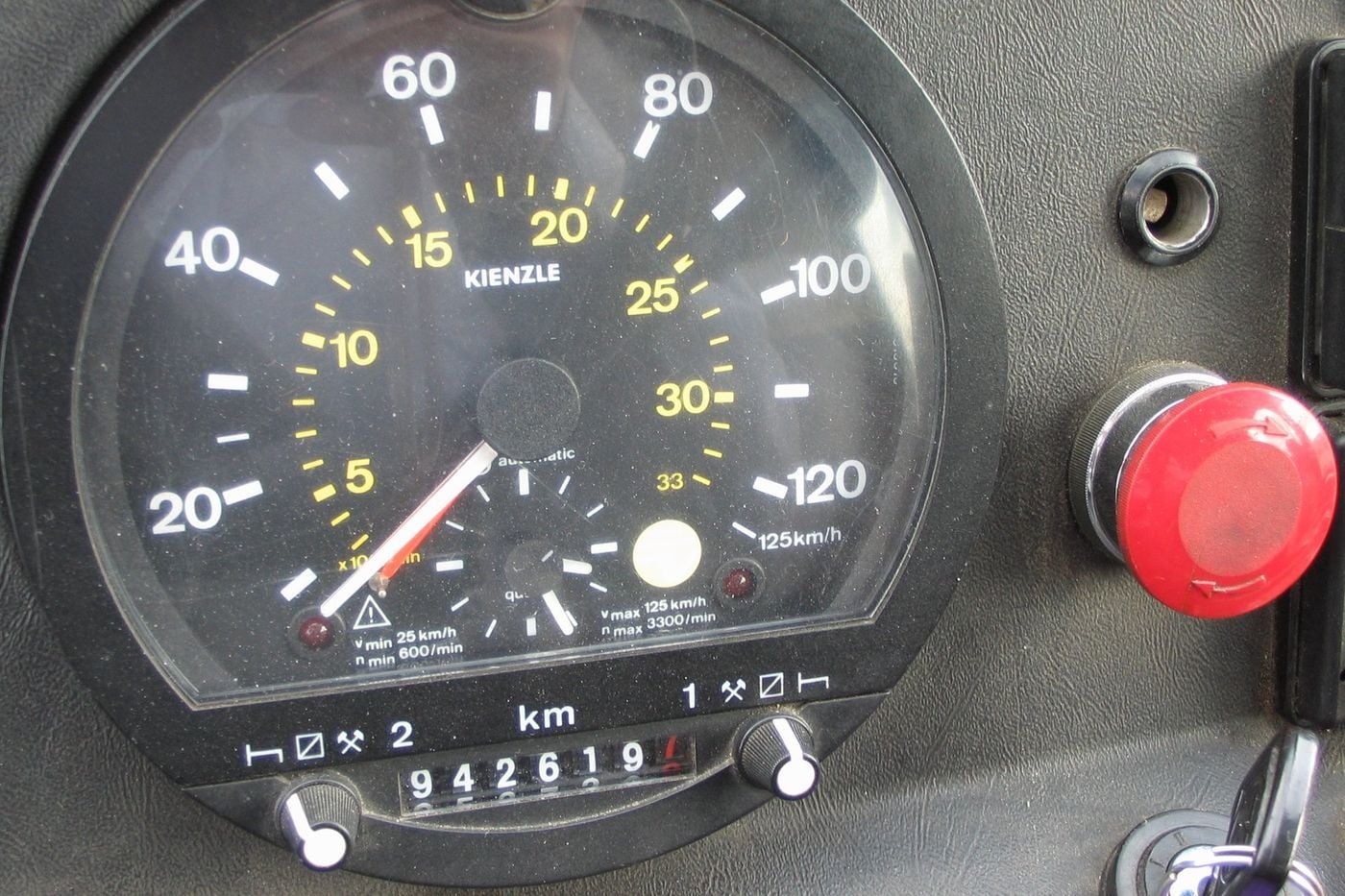
- Symbols on analogue tachographs and on other tachographs than smart ones. The word “pictogram” does not occur in the consolidated text of Regulation (EU) No 165/2014, and we did not source the symbols of analogue tachographs. The cover photograph shows an analogue, paper-disc tachograph in a bus dashboard, with two selector switches marked 1 and 2 and printed symbols beside them. It is not a smart tachograph, so it is outside Annex IC, and its symbols are not explained here.
Quick answers
- Where are the tachograph symbols defined?
- In Appendix 3, headed "PICTOGRAMS", of Annex IC to Commission Implementing Regulation (EU) 2016/799, the annex that Article 1(2) makes the technical requirement for smart tachographs. By our count the appendix names 121 entries, 63 basic pictograms and 58 combinations, and it was amended by Implementing Regulations (EU) 2018/502 and (EU) 2021/1228.
- Are the symbols the same on every tachograph?
- The Regulation words it in two places. Requirement PIC_001 says the tachograph "may optionally use" the listed pictograms and combinations, "or pictograms and combination similar enough to be unambiguously identifiable with these". Requirement 157 says the display "shall use the pictograms or pictograms combinations listed in Appendix 3" and may provide additional ones "if clearly distinguishable". Tachographs other than smart tachographs are subject to other annexes under Article 1(3).
- What does the OUT symbol on a tachograph mean?
- Appendix 3 lists a pictogram named "Out of scope", which by our reading of the page image is the three letters OUT. Annex IC defines 'out of scope' as "when the use of the recording equipment is not required, according to the provisions of Regulation (EC) No 561/2006"; the driver can enter it in real time with a begin and an end, and the equipment closes an open one automatically if a driver card is inserted or withdrawn.
- What does the ferry or train symbol mean?
- Appendix 3 lists "Ferry/train crossing" among its specific conditions. Requirement 62 of Annex IC lets the driver enter "FERRY / TRAIN CROSSING" (begin, end) in real time, and the driver "shall enter the FERRY / TRAIN CROSSING begin flag immediately after selecting BREAK/REST on the ferry or train". The requirement lists four ways an open crossing ends, by our count.
- How many activity symbols does a tachograph have?
- By our count Appendix 3 names six under "Activities": Available, Driving, Rest, Other Work, Break and Unknown. Annex IC itself lists four driver activities in requirement 45 — "DRIVING, WORK, AVAILABILITY or BREAK/REST" — and we found nothing in Annex IC that says which of the appendix's "Rest" and "Break" pictograms stands for BREAK/REST.
- Are the country codes on a tachograph pictograms?
- Not in Appendix 3, which has no group for countries. Annex IC's data dictionary says alphabetic references to a country "shall be in accordance with the distinguishing signs used on vehicles in international traffic (United Nations Vienna Convention on Road Traffic, 1968)", and the list is kept on a laboratory website rather than in the Regulation. The Commission's Joint Research Centre page lists, for example, D for Germany, E for Spain, TR for Türkiye, RUS for Russia and UK for United Kingdom.
Sources
- Commission Implementing Regulation (EU) 2016/799 — consolidated text of 21 August 2023: Annex IC, Appendix 3 (Pictograms) and Appendix 5 (Display), with the definitions and numbered requirements cited in the text — EUR-Lex, European Union
- Commission Implementing Regulation (EU) 2016/799 of 18 March 2016 — original text as published in the Official Journal L 139 of 26 May 2016, Appendix 3 at pages 240 to 242 — EUR-Lex, European Union
- Commission Implementing Regulation (EU) 2018/502 amending Implementing Regulation (EU) 2016/799 — Article 1(3), recitals and the amendment of Appendix 3 — EUR-Lex, European Union
- Commission Implementing Regulation (EU) 2021/1228 amending Implementing Regulation (EU) 2016/799 as regards smart tachographs — Articles 1 and 2, recital 3 and the amendment of Appendix 3 — EUR-Lex, European Union
- Regulation (EU) No 165/2014 on tachographs in road transport — consolidated text of 31 December 2024, Articles 34 and 47 — EUR-Lex, European Union
- Commission Regulation (EC) No 1360/2002 adapting for the seventh time to technical progress Council Regulation (EEC) No 3821/85 — Annex IB, Appendix 3 (Pictograms), OJ L 207 pages 127 to 129 — EUR-Lex, European Union
- Digital Tachograph — Nation Codes (list maintained for the data type NationAlpha of Annex IC) — European Commission, Joint Research Centre