The digital tachograph and driver card: what EU law requires
What Regulation (EU) No 165/2014 says a digital tachograph records, what the four tachograph cards are for, what happens when a driver card is lost or expires, and what a roadside check asks for.
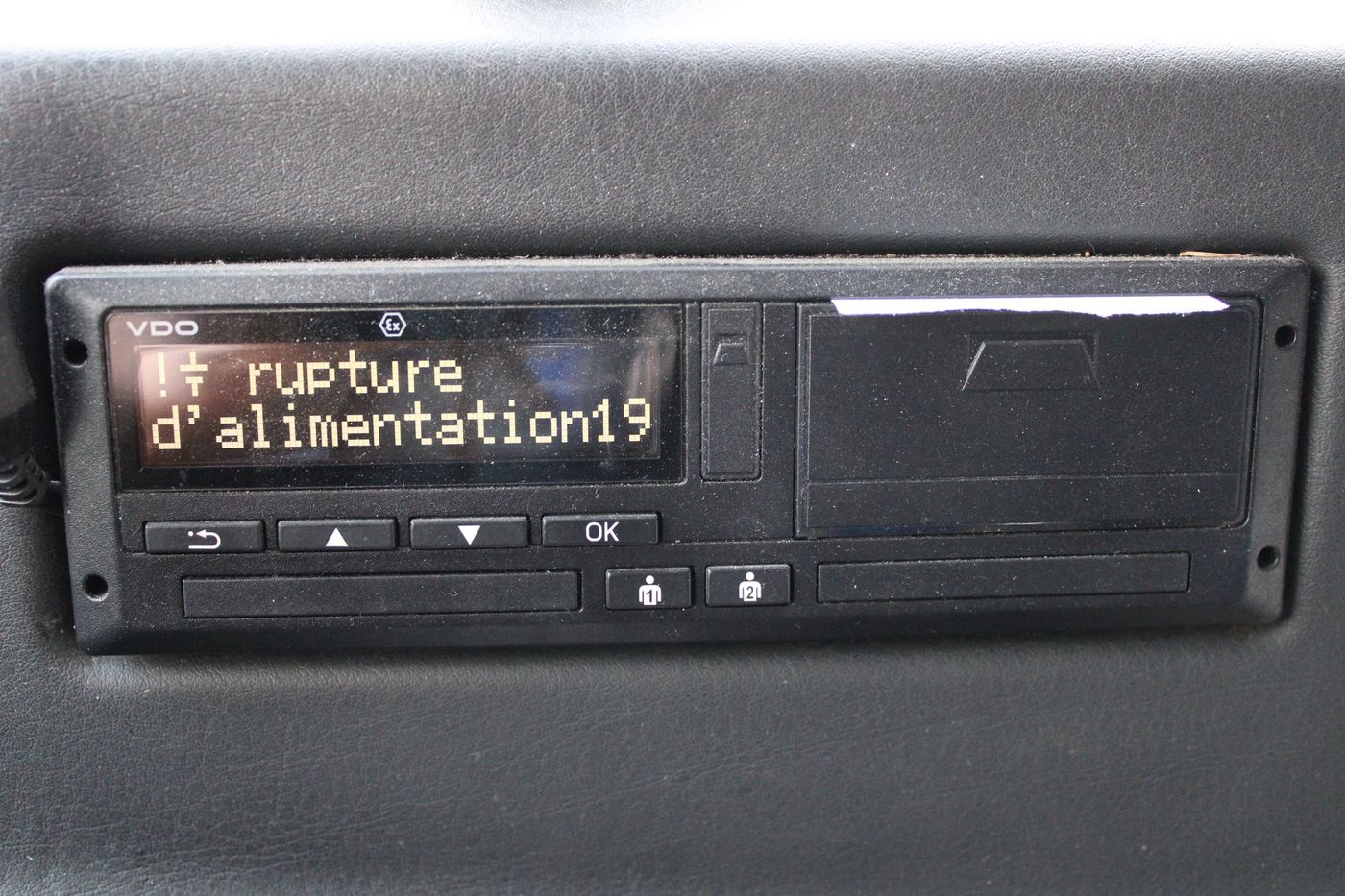
A digital tachograph is a recording device that identifies the person using it by a personal tachograph card; an analogue tachograph uses a paper record sheet instead. Regulation (EU) No 165/2014 defines a “digital tachograph” as “a tachograph using a tachograph card in accordance with this Regulation,” and requires tachographs in vehicles registered in a Member State that are used for the carriage of passengers or goods by road and to which Regulation (EC) No 561/2006 applies. The European Commission sums up what any tachograph is for in one sentence: “The tachograph is the device that records driving time, breaks and rest periods as well as periods of other work and availability of drivers engaged in the carriage of goods or passengers by road.”
What it records, and who has to carry one
Article 4(3) of Regulation (EU) No 165/2014 opens with “Digital tachographs shall record the following data” and lists seven headings: the distance travelled and the vehicle’s speed; time measurement; the position points referred to in Article 8(1); the identity of the driver; the activity of the driver; control, calibration and tachograph repair data, including the identity of the workshop; and events and faults. An analogue tachograph, by contrast, “shall record at least” three of those seven — distance and speed, time measurement, and driver activity. Article 5 then lists the functions a digital tachograph must provide, in unnumbered indents that, by our count, run to 15, opening with “Digital tachographs shall ensure the following functions” and including, among others, recording of drivers’ manual entries; displaying, warning, printing and downloading data to external devices; company locks management; and remote communication. Position recording and remote communication apply only to smart tachographs: Articles 8 and 9, which govern them, sit in the Regulation’s chapter headed “Smart tachograph”. The vehicle unit itself is built for two people: it includes “two smart card interface devices for driver and co-driver,” which is why it has two card slots.
Not every vehicle carries one. Article 3(1) requires that “tachographs shall be installed and used in vehicles registered in a Member State which are used for the carriage of passengers or goods by road and to which Regulation (EC) No 561/2006 applies,” Article 3(2) and (3) let Member States exempt certain vehicles, and Article 3(5) lets a Member State extend the duty to national transport it would not otherwise reach. Which vehicles Regulation (EC) No 561/2006 itself covers — the mass thresholds, the passenger-count threshold, and its own exemptions — is covered in driving time and rest rules; it is not repeated here.
Generations and versions, in one paragraph
An analogue tachograph writes onto a paper record sheet and is not covered further here. Regulation (EC) No 561/2006 brought its Article 27 into force on 1 May 2006; from then, vehicles put into service for the first time and required to carry recording equipment under Regulation (EEC) No 3821/85 had to be fitted with equipment built to Annex IB of that Regulation — the first-generation digital tachograph. The second generation, the smart tachograph, followed: Implementing Regulation (EU) 2021/1228 records that “since June 15th 2019, second generation recording equipment is being installed in vehicles registered in the Union for the first time, and second generation tachograph cards are being issued” — smart tachograph version 1, whose interface with Intelligent Transport Systems was optional. The requirements for version 2 apply from 21 August 2023. Cards cross the generations in both directions: second-generation cards “have been designed to be also used in first generation vehicle units,” and first-generation cards “may continue to be used in any version of second generation vehicle units until their end of validity date,” unless workshops have switched that capability off after a procedure launched by the Commission. Within the second generation, “any version of second generation tachograph cards are interoperable with any version of second generation vehicle units.” The exception is the workshop card: “Second generation vehicle units shall only be able to use second generation workshop cards,” so a smart tachograph “can only be calibrated using second generation workshop cards.” What version 2 itself records, how it detects a border crossing, which vehicles had to be retrofitted by which date, and how often the unit is inspected are covered in the smart tachograph explained.
The four tachograph cards
Regulation (EU) No 165/2014 defines four tachograph cards, each for a different holder and a different job.
| Card | Who it is for | Maximum validity |
|---|---|---|
| Driver card | Issued to a particular driver; identifies the driver and stores driver activity data | 5 years |
| Company card | Issued to a transport undertaking; displays, downloads and prints the data the undertaking has locked | Not set by the Regulation itself; the card’s security certificate runs 5 years |
| Workshop card | Issued to designated staff of a tachograph manufacturer, a fitter, a vehicle manufacturer or a workshop approved by the issuing Member State; tests, calibrates, activates and downloads | 1 year |
| Control card | Issued to a national control authority; reads, prints and downloads data stored in the vehicle unit or in driver cards | Not set by the Regulation itself; the card’s security certificate runs 2 years |
Only the driver card and the workshop card have a validity period written into the Regulation’s own text. The five-year figure for a company card and the two-year figure for a control card come from a different place: requirement CSM_88 in Part B of the appendix on common security mechanisms, which covers the second-generation tachograph system and sets the validity period of the authentication certificate loaded onto the card rather than a stated card-validity rule. The five years for a company card date from Implementing Regulation (EU) 2018/502, which replaced CSM_88; the version published in 2016 gave company cards two years. National authorities pass the figures on to holders as the card’s validity all the same — Germany’s Kraftfahrt-Bundesamt tells applicants the periods are “5 Jahre außer bei Werkstattkarte (1 Jahr) und Kontrollkarte (2 Jahre).”
Getting and renewing a driver card
Article 26(1) gives the job to a single authority: the driver card is issued “by the competent authority of the Member State where the driver has his normal residence,” and cards “shall be issued within one month of the receipt by the competent authority of the request and all necessary documentation.” Normal residence itself is defined precisely — “the place where a person usually lives, that is for at least 185 days in each calendar year, because of personal and occupational ties,” or, for a person with no occupational ties, because of personal ties that show close links to the place. A driver with no normal residence in a Member State or an AETR country is a separate case: “in duly justified and exceptional cases,” Member States may issue a temporary and non-renewable driver card valid for at most 185 days, provided the driver is in a labour-law relationship with an undertaking established in the issuing Member State and, where Regulation (EC) No 1072/2009 applies, presents a driver attestation — an exception, not a general option.
A driver “may hold no more than one valid driver card,” is “only authorised to use his own personalised driver card,” and “shall not use a driver card which is defective or which has expired.” Renewal runs on its own deadline: the driver “shall apply to the competent authorities of the Member State of his normal residence not later than 15 working days before the expiry date of the card,” and the authority must then “supply a new card before the expiry date, provided that the request was sent within the time-limits laid down in paragraph 1.” In Germany, the Fahrpersonalverordnung adds that a renewal request for a driver card may not be made earlier than six months before expiry. A card issued in replacement keeps the expiry date of the card it replaces (Implementing Regulation (EU) 2016/799, Annex IC, requirement 420), and only its replacement index rises by one (requirement 419); a renewed card keeps the same card number, with its replacement index reset to 0 and its renewal index raised by 1 (requirement 421). Germany’s Kraftfahrt-Bundesamt states that a card renewed because the previous one expired is valid from the day after the previous card’s validity ends. A valid card can be withdrawn or suspended only if the competent authorities find “that the card has been falsified, or the driver is using a card of which he is not the holder, or the card held has been obtained on the basis of false declarations and/or forged documents.” Driver cards issued by one Member State “shall be mutually recognised” by the others, and a driver who moves normal residence to a different Member State may ask for the card to be exchanged. When issuing, replacing and, “where necessary,” renewing a driver card, Member States must verify “through electronic data exchange” — the TACHOnet messaging system or a compatible one — that the driver does not already hold another valid driver card.
Lost, stolen, damaged, malfunctioning or expired
A damaged or malfunctioning card is returned to the competent authority of the Member State of the driver’s normal residence. Theft “shall be formally declared to the competent authorities of the State where the theft occurred,” while a loss is reported in a formal declaration to the authorities of the issuing Member State and, if different, to those of the Member State of the driver’s normal residence. In each of these cases the driver has seven calendar days to apply for a replacement to the authorities of the Member State of normal residence, and those authorities then have eight working days from receiving “a detailed request to that effect” to supply it. The eight-working-day period for the authority is the EU figure; the AETR text we read and Türkiye’s 2010 regulation give five working days, while the driver’s seven calendar days are the same in all three.
While the driver waits, driving may continue without a card for up to 15 calendar days — or longer if necessary for the vehicle to return to the premises where it is based — “provided that the driver can prove the impossibility of producing or using the card during that period.” That allowance reaches only a card that is damaged, malfunctioning, lost or stolen; it does not extend to a card that has simply expired, which the driver may not use at all. For each journey in the meantime, Article 35(2) has the driver, at the start, print out the details of the vehicle and enter on that printout details identifying the driver, including a signature, and the periods of other work, availability and rest; and, at the end, print out the periods the tachograph recorded, record any other work, availability and rest since the first printout that the tachograph did not record, and again add identifying details and a signature.
A card issued in replacement keeps the expiry date of the card it replaces (requirement 420). Germany’s Kraftfahrt-Bundesamt handles one case as a renewal instead: a card damaged or malfunctioning outside the warranty period, with no unnatural damage, is renewed, and the new card’s validity begins on the date it is personalised; after theft or loss, the end of validity is always that of the replaced card.
What the driver records, and when a printout is needed
A driver uses a record sheet or driver card “every day on which they drive, starting from the moment they take over the vehicle,” and it is not withdrawn before the daily working period ends unless doing so is otherwise authorised or needed to enter the country symbol after crossing a border. What gets recorded falls under four signs — driving time, other work, availability, and breaks, rest, annual leave or sick leave — with a separate “ferry/train” sign for rest spent on a ferry or train. When the driver is away from the vehicle and cannot use its tachograph, the periods of other work, availability and rest are entered onto the driver card “using the manual entry facility provided for in the tachograph,” and Member States “shall not impose on drivers a requirement to present forms attesting to their activities while away from the vehicle.” Where more than one driver is on board, each “shall ensure that his driver card is inserted into the correct slot,” and the unit may not switch itself to a given activity when the engine or ignition is switched off “unless the driver remains able to choose manually the appropriate category of activity.” At the start and end of the daily working period the driver enters the symbols of the countries where it started and finished, unless the tachograph is automatically recording location data in accordance with Article 8 (Article 34(7), fourth subparagraph); the border-crossing symbol is covered in the smart tachograph explained. Article 32(3) makes it “forbidden to falsify, conceal, suppress or destroy data recorded on the record sheet or stored in the tachograph or on the driver card, or print-outs from the tachograph,” and adds: “No device which could be used to this effect shall be present on the vehicle.”
Regulation (EU) No 165/2014 calls for a printout while a driver card is damaged, malfunctions, or is lost or stolen, at the start and end of each journey as described above (Article 35(2)), and on a control officer’s request: “the transport undertaking and the driver shall ensure that, taking into account the length of the period of service, the printing of data from the tachograph at the request of a control officer can be carried out correctly in the event of an inspection” (Article 33(1)). Regulation (EC) No 561/2006 also allows a printout as one of three places to record the reason when a driver departs from its driving and rest rules, to the extent necessary for the safety of persons, the vehicle or its load, to reach a suitable stopping place — “manually on the record sheet of the recording equipment or on a printout from the recording equipment or in the duty roster” — and its Article 12 applies the same rule to the exceptional extension of driving time for reaching the employer’s operational centre or the driver’s place of residence to take a weekly rest period; both are covered in driving time and rest rules. While the tachograph itself is unserviceable or malfunctioning, Article 37(2) has the driver mark identifying details, including a signature, and the periods no longer recorded or printed out correctly “on the record sheet or sheets” or “on a temporary sheet to be attached to the record sheet or to be kept together with the driver card.” The transport undertaking must have the tachograph repaired by an approved fitter or workshop “as soon as circumstances permit,” and en route if the vehicle cannot return to the undertaking’s premises “within a period of one week calculated from the day of the breakdown or of the discovery of defective operation.”
What to show at a roadside check
Whenever an authorised control officer asks, the driver of a vehicle with a digital tachograph must be able to produce the driver card and “any manual records and printouts made during the current day and the preceding 56 days” (Article 36(2)); the full lists for digital and analogue vehicles are in driving time and rest rules. The 56-day figure is recent: Regulation (EU) 2020/1054 applied it from 31 December 2024 in place of 28 days, and the consolidated text of Directive 2006/22/EC lists both wordings among its infringements, one marked “until 30 December 2024” and the other “as of 31 December 2024.”
A smart tachograph version 2 driver card is built to hold 56 days of activity on its own — its memory “shall be able to hold driver activity data for 56 days,” where “the average activity of a driver is defined for this requirement as 117 activity changes per day” (Annex IC, requirement 292). For a card issued before August 2023, the Commission’s guidance notes that “a vast majority” can store more than 28 days and “a majority” more than 56, and sets out two ways to cover any gap: the undertaking sends the driver an electronic copy of data it has already downloaded, or the driver keeps printouts covering the rolling period of the last 56 days. That guidance is not itself law — the Commission’s page states it “does not commit the European Commission as such.”
Under Directive 2006/22/EC, Article 2(3), the driver must be allowed during a roadside check to contact “the head office, the transport manager or any other person or entity” to provide, before the end of the check, any evidence found to be missing on board — “without prejudice to the driver’s obligation to ensure the proper use of tachograph equipment.” An officer may check compliance with Regulation (EC) No 561/2006 by analysing the record sheets and the data displayed, printed or downloaded from the tachograph or the driver card, or, “failing that,” any other supporting document that justifies non-compliance with a provision (Article 36(3) of Regulation (EU) No 165/2014). How often drivers must be checked and how infringements are graded is covered in driving time and rest rules; how check results feed an operator’s risk rating is in roadworthiness and roadside checks.
Downloading the data, and how long it is kept
The downloading duty falls on the transport undertaking, and its source depends on the tachograph. For vehicles with a smart tachograph, Annex IC of Implementing Regulation (EU) 2016/799, in requirements added by Implementing Regulation (EU) 2021/1228, says the undertaking “shall ensure that all data are downloaded from the vehicle unit and driver cards,” and that “the maximum period within which the relevant data are downloaded shall not exceed: — 90 days for data from vehicle unit; — 28 days for data from the driver card” (requirement 196a). For vehicles with a first-generation digital tachograph, Regulation (EC) No 561/2006 has the undertaking download data “as regularly as is stipulated by the Member State” and “more frequently so as to ensure that all data concerning activities undertaken by or for that undertaking are downloaded” (Article 10(5)(a)(i)), and Commission Regulation (EU) No 581/2010 sets the maxima for that purpose: “(a) 90 days for data from the vehicle unit; (b) 28 days for data from the driver card,” with data downloaded “in such a way that no data is lost.” Recital 3 of Regulation (EU) No 581/2010 — not an operative article — says that “only days with a recorded activity should be counted” when determining those maximum periods.
Retention is set as a minimum. Downloaded data must be kept “for at least twelve months following recording” (requirement 196b, smart tachographs); for first-generation vehicles, Regulation (EC) No 561/2006 requires them to be “kept for at least 12 months following recording” and made accessible to an inspecting officer “either directly or remotely, from the premises of the undertaking.” Regulation (EU) No 165/2014 has the undertaking keep record sheets, and printouts made because a driver card was damaged, malfunctioning, lost or stolen (Article 35), “in chronological order and in a legible form, for at least a year after their use,” give copies of them to the drivers concerned who request them, and give drivers who request them copies of the data downloaded from their driver cards (Article 33(2)). Personal data may be processed only to verify compliance with the Regulation and the other Union acts it lists (Article 7), and national law can add its own periods: Germany’s Fahrpersonalgesetz, § 4(3), has the undertaking store copied data for one year from the time of copying and delete it by 31 March of the calendar year after the one in which the retention period ends.
Article 4(5) provides that access to the data stored in the tachograph and the tachograph card “may be granted at all times” to the competent control authorities and to the relevant transport undertaking “so that it can comply with its legal obligations,” and Article 4(6) that “the downloading of data shall be performed with the minimum of delay to transport undertakings or drivers.” The undertaking is also responsible for ensuring its drivers “are properly trained and instructed as regards the correct functioning of tachographs,” for making regular checks that they use them correctly, and for not giving drivers “any direct or indirect incentives that could encourage the misuse of tachographs” (Article 33(1)). It “shall be liable for infringements of this Regulation committed by their drivers or by drivers at their disposal,” though Member States “may make such liability conditional” on the undertaking’s own breach of the first subparagraph of Article 33(1) and of Article 10(1) and (2) of Regulation (EC) No 561/2006 (Article 33(3)).
Outside the EU: the AETR, and who issues cards where
Where an international road transport operation runs partly outside the EU, Switzerland and the EEA, the AETR applies instead of Regulation (EC) No 561/2006 — how that switch works is set out in driving time and rest rules — and, according to the Commission’s guidance (Question 5, Example 1), “Regulation (EC) No 561/2006 and thus Regulation (EU) No 165/2014 are not applicable to those international road transport operations covered by the AETR.” The AETR — the European Agreement concerning the Work of Crews of Vehicles engaged in International Road Transport — has 53 parties as of 28 September 2026, according to the United Nations Treaty Collection, which lists Türkiye (accession, 16 January 2001) and the Russian Federation among them.
The AETR defines normal residence the same way the EU Regulation does, and, in the consolidated Russian-language text we read — a compilation that states it does not replace the authentic text — its driver-card provisions follow a broadly similar pattern: a maximum validity of five years, a replacement within five working days of a detailed request, seven calendar days for the driver to apply after damage, malfunction, loss or theft, an application no later than 15 working days before expiry, up to 15 calendar days of driving without a card under the same proof condition as the EU rule, downloaded data kept at least 12 months, and record sheets, and printouts made under Article 12(1) of its Annex, kept at least a year. Its roadside-check period is 28 calendar days (Annex, Article 12(7)), not the EU’s current 56. That text includes the amendment it records as entering into force on 20 September 2010, and the United Nations depositary record names no later amendment to the Annex or its appendices: the proposals of amendment it lists after June 2010 all concern article 14 of the Agreement.
Türkiye’s own tachograph regulation, published in the Official Gazette on 21 May 2010, covers vehicles used for international road transport (Article 2(1)) and leaves its application to vehicles in national road transport to the National Authority (Article 2(3)). In the text published on mevzuat.gov.tr, the driver card is issued, at the driver’s request, by the card-issuing authority of the party of which the driver is a citizen (Article 9(4)) and is valid for five years; a replacement is issued within five working days of the card-issuing authority receiving a detailed request after damage, malfunction, loss or theft; the driver applies at least 15 days before expiry, and within seven calendar days after damage, malfunction, loss or theft; driving may continue without a card for up to 15 calendar days; and at a roadside check the driver produces manual records and printouts for the current day and the previous 28 days (“o güne ait ve önceki 28 günlük”) — matching the AETR text above rather than the EU’s current rule. TOBB, citing a 2017 ministry circular, states that driver-card data should be downloaded and sent to the card-issuing authority at least every 25 days, and that vehicle-unit data should be downloaded at least every three months and sent to the card-issuing authority once a month. Türkiye’s tachograph obligations for national transport, and Russia’s own domestic tachograph regime, separate from the AETR card described here, were outside the scope of this article.
The Commission’s guidance, which carries no date, describes the driver cards issued by non-EU parties to the AETR as cards “many of which remain digital ‘non-smart’ driver cards.” It lists the United Kingdom, Norway, Liechtenstein, Iceland and Switzerland as the countries with “identical smart tachograph rules as EU ones,” names Bosnia and Herzegovina and Serbia as having obtained smart tachograph cryptographic certificates from the Commission, “enabling them to issue smart tachograph cards,” and notes that vehicles registered in Ukraine “may be fitted with a smart tachograph.” Türkiye and Russia are not named in its answer on which non-EU AETR parties can use smart tachographs and cards.
Who issues the driver card differs by country.
| Country | Who issues the driver card / where to apply | Source |
|---|---|---|
| Germany | The authority or body competent under the law of the Land; the Kraftfahrt-Bundesamt (KBA) keeps the register of all issued driver, company, workshop and control cards | FPersV § 4(2); KBA |
| Spain | The autonomous communities issue the cards; the Dirección General de Transporte por Carretera y Ferrocarril keeps the register | Ministerio de Transportes y Movilidad Sostenible |
| Türkiye | Applications can be made at the chambers of commerce and industry listed by TOBB-STAUM | TOBB-STAUM |
| Russia (AETR/ЕСТР card) | Applications go through FBU Rosavtotrans’s AIS ЕСТР, under Ministry of Transport Order No 435 of 23 October 2020 | estr.rosavtotransport.ru |
| United Kingdom | DVLA in Great Britain; DVA in Northern Ireland | GOV.UK; nidirect |
The tachograph unit itself
The tachograph fitted to the vehicle is inspected “at least every two years” by an approved workshop, and what that inspection has to check, together with the retrofit and replacement schedule that decided which unit is fitted now, is covered in the smart tachograph explained.
Quick answers
- What is a digital tachograph?
- It is a tachograph that uses a tachograph card: Regulation (EU) No 165/2014 defines a "digital tachograph" as "a tachograph using a tachograph card in accordance with this Regulation." Under Article 4(3), "Digital tachographs shall record" data under seven headings — distance and speed, time measurement, the position points referred to in Article 8(1), the driver's identity, the driver's activity, control, calibration and repair data including the identity of the workshop, and events and faults — although the position points apply only to smart tachographs, since Article 8 sits in the Regulation's chapter headed "Smart tachograph". An analogue tachograph, under Article 4(4), "shall record at least" three of those seven: distance and speed, time measurement, and driver activity.
- How long is a driver card valid, and what about the other tachograph cards?
- A driver card is valid for up to five years: Article 26(6) says "The driver card shall not be valid for more than five years." A workshop card runs for up to a year — Article 25(1): "The period of validity of workshop cards shall not exceed one year" — and the competent authority must renew it within 15 working days of receiving a valid renewal request and all the necessary documentation, or replace a damaged, malfunctioning, lost or stolen one within five working days of receiving a detailed request. The Regulation itself sets no validity period for company or control cards; for second-generation cards, requirement CSM_88 of the implementing rules, as replaced by Implementing Regulation (EU) 2018/502, gives the authentication certificate loaded onto the card five years for a company card and two years for a control card, which national authorities such as Germany's Kraftfahrt-Bundesamt describe to holders as the card's own validity.
- What must a driver do if the driver card is lost, stolen or damaged?
- Apply for a replacement within seven calendar days to the competent authorities of the Member State of the driver's normal residence; theft must also be "formally declared to the competent authorities of the State where the theft occurred." The authorities of the Member State of normal residence must then supply a replacement "within eight working days after their receipt of a detailed request to that effect." A card issued in replacement keeps the expiry date of the card it replaces (Implementing Regulation (EU) 2016/799, Annex IC, requirement 420). Until it arrives, the driver may keep driving without a card for up to 15 calendar days, or longer if necessary for the vehicle to return to its base, "provided that the driver can prove the impossibility of producing or using the card during that period" — and for each journey in the meantime must make printouts at the start and the end and enter on them identifying details, a signature and the periods of other work, availability and rest. None of this covers a card that has simply expired: "A driver shall not use a driver card which is defective or which has expired."
- How often must tachograph data be downloaded?
- The transport undertaking must ensure that the data are downloaded within a maximum period of 90 days for the vehicle unit and 28 days for the driver card. For smart tachographs, Annex IC of Implementing Regulation (EU) 2016/799 (requirement 196a) says "The maximum period within which the relevant data are downloaded shall not exceed: — 90 days for data from vehicle unit; — 28 days for data from the driver card"; for vehicles with a first-generation digital tachograph, Commission Regulation (EU) No 581/2010 sets the same two maxima. Those are ceilings, not a fixed schedule: for first-generation vehicles, Regulation (EC) No 561/2006 has the undertaking download data "as regularly as is stipulated by the Member State" and "more frequently so as to ensure that all data concerning activities undertaken by or for that undertaking are downloaded."
- How long must the operator keep tachograph data?
- At least 12 months for downloaded data. For smart tachographs, Annex IC (requirement 196b) requires downloaded data to be kept "for at least twelve months following recording"; for first-generation vehicles, Regulation (EC) No 561/2006 requires the same "for at least 12 months following recording" and access for an inspecting officer, directly or remotely, from the undertaking's premises. Regulation (EU) No 165/2014 requires record sheets, and printouts made because a driver card was damaged, malfunctioning, lost or stolen (Article 35), to be kept "for at least a year after their use," with copies given to the drivers concerned who request them. These are minimum periods; data-protection rules apply as well (Article 7), and national law may set a deletion deadline — Germany's Fahrpersonalgesetz, § 4(3), requires the data to be deleted by 31 March of the calendar year after the one in which the retention period ends.
- What does a driver have to show at a roadside check?
- In a vehicle with a digital tachograph: the driver card, "any manual records and printouts made during the current day and the preceding 56 days," and the record sheets for any part of that period spent driving a vehicle with an analogue tachograph (Article 36(2) of Regulation (EU) No 165/2014). The 56-day figure has applied since 31 December 2024; before that it was 28 days, and the consolidated text of Directive 2006/22/EC lists both wordings among its infringements, one marked "until 30 December 2024" and the other "as of 31 December 2024." That 56-day figure is an EU one — the AETR text we read gives 28 calendar days for the equivalent duty, and Türkiye's 2010 tachograph regulation also gives 28 days ("o güne ait ve önceki 28 günlük", the current day and the previous 28 days).
Sources
- Regulation (EU) No 165/2014 on tachographs in road transport — consolidated text of 31 December 2024 — EUR-Lex, European Union
- Commission Regulation (EU) No 581/2010 on the maximum periods for the downloading of relevant data from vehicle units and from driver cards — Article 1 and recital 3 — EUR-Lex, European Union
- Regulation (EC) No 561/2006 on the harmonisation of certain social legislation relating to road transport — consolidated text of 31 December 2024, Articles 2, 10 and 12 — EUR-Lex, European Union
- Regulation (EC) No 561/2006 — original text as published in the Official Journal L 102 of 11 April 2006, Articles 27 and 29 — EUR-Lex, European Union
- Regulation (EU) 2020/1054 amending Regulation (EC) No 561/2006 and Regulation (EU) No 165/2014 — Article 2(12) and Article 3 — EUR-Lex, European Union
- Commission Implementing Regulation (EU) 2016/799 laying down the requirements for tachographs and their components — consolidated text of 21 August 2023: Annex IC introduction and requirements 196a, 196b, 292 and 419 to 421; Appendix 11, Part B, requirement CSM_88; Appendix 15, section 2.2 (MIG_001 to MIG_006) — EUR-Lex, European Union
- Commission Implementing Regulation (EU) 2016/799 — original text as published in the Official Journal L 139 of 26 May 2016, Appendix 11, requirement CSM_88 — EUR-Lex, European Union
- Commission Implementing Regulation (EU) 2018/502 amending Implementing Regulation (EU) 2016/799 — Annex, replacement of requirement CSM_88 — EUR-Lex, European Union
- Commission Implementing Regulation (EU) 2021/1228 amending Implementing Regulation (EU) 2016/799 as regards smart tachographs — Article 2, recital 5 and Annex points (2), (18), (26) and (40) — EUR-Lex, European Union
- Directive 2006/22/EC on minimum conditions for the implementation of Regulations (EC) No 561/2006 and (EU) No 165/2014 — consolidated text of 20 June 2024, Article 2(3) and Annex III (infringement I6) — EUR-Lex, European Union
- Questions and answers on tachograph provisions of Mobility Package 1 — Questions 1, 3, 4 and 5 — European Commission, DG Mobility and Transport
- Tachograph — European Commission, DG Mobility and Transport
- European Agreement concerning the Work of Crews of Vehicles engaged in International Road Transport (AETR) — status of participants — United Nations Treaty Collection
- AETR — Chapter XI B 21, status and depositary notifications (PDF) — United Nations Treaty Collection
- European Agreement concerning the Work of Crews of Vehicles engaged in International Road Transport (AETR) — consolidated Russian text, Article 13-bis and Annex Articles 11 to 13 — FBU Rosavtotrans (Russian Federation)
- Fahrpersonalverordnung (FPersV), § 4 — Bundesministerium der Justiz, gesetze-im-internet.de
- Fahrpersonalgesetz (FPersG), § 4 — Bundesministerium der Justiz, gesetze-im-internet.de
- Fragen und Antworten — Fahrtenschreiber — Kraftfahrt-Bundesamt
- Fahrtenschreiberkartenregister (FKR) — Kraftfahrt-Bundesamt
- Solicitud de tarjetas de tacógrafo digital — Ministerio de Transportes y Movilidad Sostenible, Sede electrónica
- Uluslararası Karayolu Taşımacılığı Yapan Araçlarda Kullanılan Takograf Cihazları Hakkında Yönetmelik (Resmî Gazete, 21 May 2010, No 27587) — Articles 2, 9 and 10 — Mevzuat Bilgi Sistemi, Republic of Türkiye
- Bilgilendirme — TOBB — Sayısal Takograf Araştırma ve Uygulama Merkezi (STAUM)
- Veri Toplama ve Analiz Sistemi — bilgilendirme — TOBB
- АИС ЕСТР — приём заявлений на карту — FBU Rosavtotrans (Russian Federation)
- Apply for a driver digital tachograph card — GOV.UK (DVLA)
- Digital tachograph driver cards — nidirect (Driver & Vehicle Agency, Northern Ireland)