The CMR consignment note and e-CMR explained
The 1956 CMR Convention confirms an international road haulage contract by a consignment note in three original copies. Contents, evidential value, liability limit and the 2008 e-CMR Protocol.
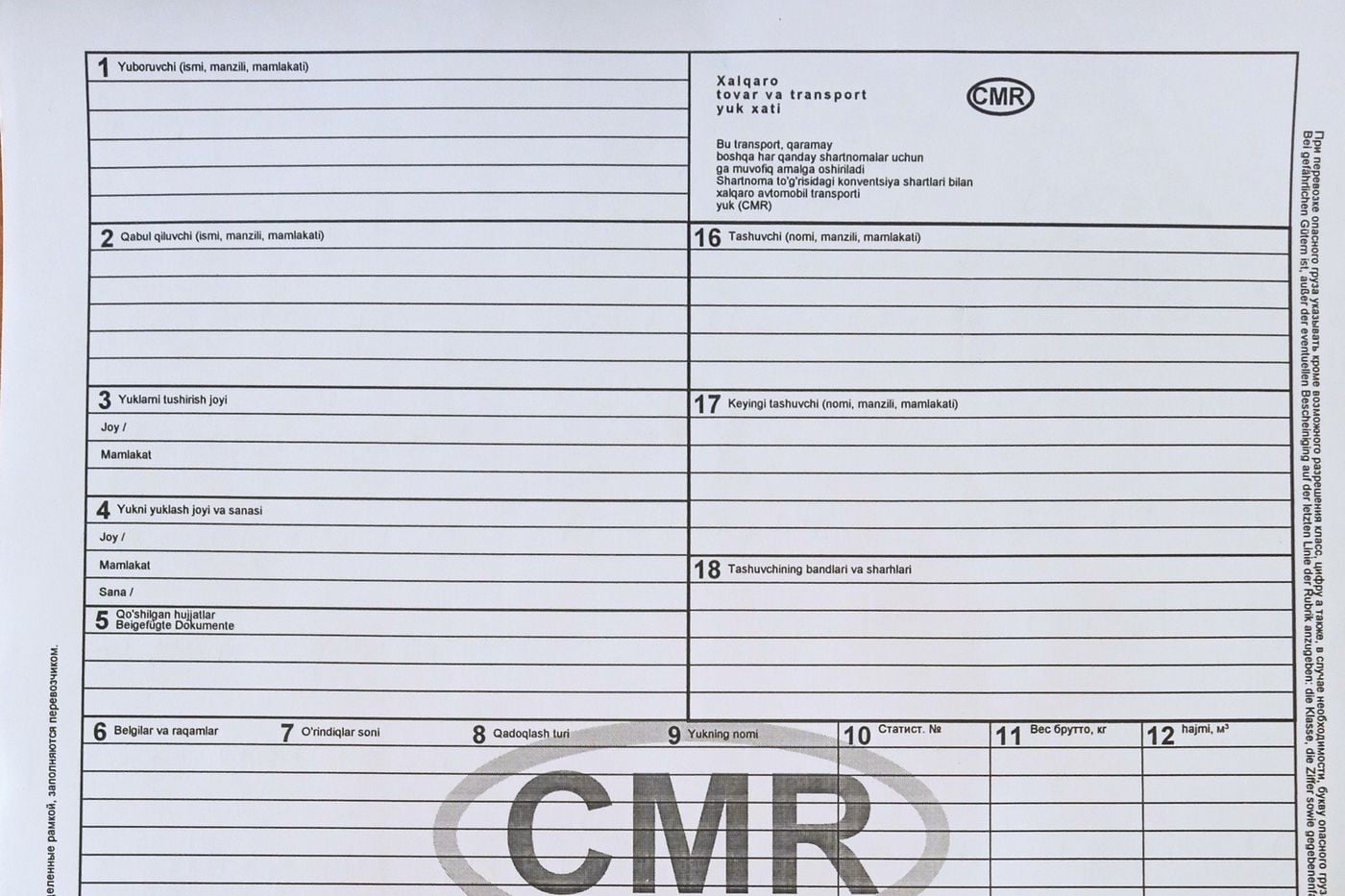
A CMR consignment note is the document that, under the 1956 Geneva Convention, confirms a contract for the international carriage of goods by road: it is made out in three original copies signed by the sender and the carrier. The Convention states that the absence, irregularity or loss of the note does not affect the existence or validity of the contract, and that the note is prima facie evidence of the contract, its conditions and the carrier’s receipt of the goods.
Treaty status figures on this page are those of the UN Treaty Collection (UNTC) as at 28 September 2026.
What the CMR Convention is
The Convention on the Contract for the International Carriage of Goods by Road (CMR) was signed at Geneva on 19 May 1956 and entered into force on 2 July 1961. Its French title is Convention relative au contrat de transport international de marchandises par route (CMR); the English and French texts are each equally authentic. As at 28 September 2026 UNTC lists 58 parties and 9 signatories.
Article 42 opens the Convention for signature or accession to countries members of the Economic Commission for Europe and to countries admitted to the Commission in a consultative capacity under paragraph 8 of its terms of reference. Countries that may participate in certain activities of the Commission under paragraph 11 of its terms of reference may become contracting parties by acceding after its entry into force.
Two later instruments are covered below: a Protocol of 5 July 1978 that changed the liability limit, and an Additional Protocol of 20 February 2008 on the electronic consignment note. The table gives the five countries of this site’s core languages, with the dates UNTC lists under ratification, accession (a). They are instrument dates, not dates of entry into force.
| State | CMR, 1956 | Protocol, 1978 | e-CMR Protocol, 2008 |
|---|---|---|---|
| Germany | signed 19 May 1956, ratified 7 Nov 1961 | signed 1 Nov 1978, ratified 29 Sep 1980 | acceded 5 Jan 2022 |
| Spain | acceded 12 Feb 1974 | acceded 11 Oct 1982 | acceded 11 May 2011 |
| Türkiye | acceded 2 Aug 1995 | acceded 2 Aug 1995 | acceded 31 Jan 2018 |
| Russian Federation | acceded 2 Sep 1983 | acceded 3 Feb 2016 | acceded 6 Mar 2018 |
| United Kingdom of Great Britain and Northern Ireland | acceded 21 Jul 1967 | signed 25 Sep 1978, ratified 5 Oct 1979 | acceded 20 Dec 2019 |
Which carriage it covers
Article 1(1) applies the Convention to every contract for the carriage of goods by road in vehicles for reward, when the place of taking over the goods and the place designated for delivery, as specified in the contract, are situated in two different countries, of which at least one is a contracting country, irrespective of the place of residence and the nationality of the parties. Article 1(2) defines vehicles as motor vehicles, articulated vehicles, trailers and semi-trailers as defined in Article 4 of the Convention on Road Traffic dated 19 September 1949. Article 1(3) extends the Convention to carriage coming within its scope that is carried out by States or by governmental institutions or organizations.
Article 1(4) lists three exclusions: carriage performed under the terms of any international postal convention, funeral consignments and furniture removal. Under Article 1(5) the contracting parties agree not to vary the provisions by special agreements between two or more of them, except to make the Convention inapplicable to their frontier traffic or to authorize, in transport operations entirely confined to their territory, the use of consignment notes representing a title to the goods.
Article 2(1) covers a vehicle carried over part of the journey by sea, rail, inland waterways or air: except where Article 14 applies, if the goods are not unloaded from the vehicle, the Convention nevertheless applies to the whole of the carriage. The paragraph continues with a proviso that this page does not summarise.
The Protocol of Signature, agreed on signing the Convention, states in its point 1 that the Convention shall not apply to traffic between the United Kingdom of Great Britain and Northern Ireland and the Republic of Ireland. Customs transit is a separate matter from the contract of carriage: the TIR procedure and its carnet are covered in the TIR carnet explained.
The consignment note: evidence, not a condition of the contract
Article 4 says the contract of carriage is confirmed by the making out of a consignment note. The absence, irregularity or loss of the note does not affect the existence or the validity of the contract, which remains subject to the Convention. What the note does is set out in Article 9(1): it is prima facie evidence of the making of the contract of carriage, the conditions of the contract and the receipt of the goods by the carrier. The presumption in Article 9(2), described below, applies unless the contrary is proved.
Article 41(1) makes null and void, subject to Article 40, any stipulation that would directly or indirectly derogate from the Convention, without making the other provisions of the contract void. Article 41(2) names in particular a benefit of insurance in favour of the carrier or any other similar clause, and any clause shifting the burden of proof.
Article 6(1)(k) puts into the note a statement that the carriage is subject, notwithstanding any clause to the contrary, to the Convention. If the note lacks it, Article 7(3) makes the carrier liable for all expenses, loss and damage sustained through the omission by the person entitled to dispose of the goods.
Three original copies and who holds them
Article 5(1) provides that the note is made out in three original copies signed by the sender and by the carrier. The signatures may be printed or replaced by the stamps of the sender and the carrier if the law of the country in which the note has been made out so permits. The first copy is handed to the sender, the second accompanies the goods and the third is retained by the carrier. Under Article 5(2), where the goods have to be loaded in different vehicles, or are of different kinds or are divided into different lots, the sender or the carrier has the right to require a separate note for each vehicle used, or for each kind or lot of goods.
Two articles tie rights to particular copies. Article 12(1) gives the sender the right to dispose of the goods, in particular by asking the carrier to stop them in transit, to change the place at which delivery is to take place or to deliver them to a consignee other than the one indicated in the note. Under Article 12(2) that right ceases when the second copy is handed to the consignee or when the consignee exercises his right under Article 13(1). The exercise of the right is subject to conditions, among them, in Article 12(5)(a), that the sender produces the first copy of the note on which the new instructions to the carrier have been entered and indemnifies the carrier against all expenses, loss and damage involved in carrying out the instructions. Article 12(7) makes a carrier who carried out instructions without requiring the first copy to be produced liable to the person entitled to make a claim for any loss or damage caused thereby.
Article 13(1) entitles the consignee, after arrival of the goods at the place designated for delivery, to require the carrier to deliver to him, against a receipt, the second copy of the note and the goods.
Where carriage under a single contract is performed by successive road carriers, Article 34 makes each of them responsible for the performance of the whole operation; the second and each succeeding carrier becomes a party to the contract of carriage, under the terms of the note, by accepting the goods and the note. A carrier accepting the goods from a previous carrier gives the latter a dated and signed receipt and enters his name and address on the second copy of the note (Article 35(1)).
Germany’s Handelsgesetzbuch has a consignment-note provision of its own, separate from the Convention. Under § 408 the carrier may demand that a Frachtbrief be issued; it is made out in three original copies signed by the sender, and § 408(3) puts on a par with it an electronic record that fulfils the same functions, provided that authenticity and integrity are preserved.
What the note must contain
Article 6 works in three tiers. Article 6(1) says the note shall contain these particulars:
- (a) the date of the note and the place at which it is made out;
- (b) the name and address of the sender;
- (c) the name and address of the carrier;
- (d) the place and the date of taking over of the goods and the place designated for delivery;
- (e) the name and address of the consignee;
- (f) the description in common use of the nature of the goods and the method of packing, and, in the case of dangerous goods, their generally recognized description;
- (g) the number of packages and their special marks and numbers;
- (h) the gross weight of the goods or their quantity otherwise expressed;
- (i) charges relating to the carriage: carriage charges, supplementary charges, customs duties and other charges incurred from the making of the contract to the time of delivery;
- (j) the requisite instructions for Customs and other formalities;
- (k) the statement that the carriage is subject, notwithstanding any clause to the contrary, to the Convention.
Article 6(2) adds that, where applicable, the note shall also contain:
- (a) a statement that trans-shipment is not allowed;
- (b) the charges which the sender undertakes to pay;
- (c) the amount of “cash on delivery” charges;
- (d) a declaration of the value of the goods and the amount representing special interest in delivery;
- (e) the sender’s instructions to the carrier regarding insurance of the goods;
- (f) the agreed time-limit within which the carriage is to be carried out;
- (g) a list of the documents handed to the carrier.
Under Article 6(3) the parties may enter in the note any other particulars they deem useful.
Article 7(1) makes the sender responsible for all expenses, loss and damage sustained by the carrier by reason of the inaccuracy or inadequacy of the particulars in Article 6(1)(b), (d), (e), (f), (g), (h) and (j), of the particulars in Article 6(2), and of any other particulars or instructions he gave to enable the note to be made out or for the purpose of their being entered in it. For the Customs or other formalities to be completed before delivery, Article 11(1) has the sender attach the necessary documents to the note or place them at the disposal of the carrier and furnish him with all the information he requires.
When the sender hands dangerous goods to the carrier, Article 22(1) has him inform the carrier of the exact nature of the danger and indicate, if necessary, the precautions to be taken. If this information has not been entered in the note, the burden of proving by other means that the carrier knew the exact nature of the danger rests on the sender or the consignee. The vehicle rules for such carriage are on a separate page: ADR explained: dangerous goods vehicles.
Checks and reservations at loading and at delivery
On taking over the goods the carrier checks, under Article 8(1), the accuracy of the statements in the note as to the number of packages and their marks and numbers, and the apparent condition of the goods and their packaging. Where he has no reasonable means of checking the accuracy of the statements on packages, marks and numbers, Article 8(2) has him enter his reservations in the note together with the grounds on which they are based; such reservations do not bind the sender unless he has expressly agreed to be bound by them in the note. The sender may require the carrier to check the gross weight of the goods or their quantity otherwise expressed, and the contents of the packages. The carrier may claim the cost of such checking, and the result is entered in the note (Article 8(3)).
Article 9(2) turns on those reservations. If the note contains no specific reservations by the carrier, it is presumed, unless the contrary is proved, that the goods and their packaging appeared to be in good condition when the carrier took them over and that the number of packages, their marks and numbers corresponded with the statements in the note.
At delivery Article 30(1) applies. If the consignee takes delivery without duly checking the condition of the goods with the carrier, or without sending him reservations giving a general indication of the loss or damage, the fact of his taking delivery is prima facie evidence that he has received the goods in the condition described in the note. The time limit for the reservations is the time of delivery in the case of apparent loss or damage, and seven days from delivery, Sundays and public holidays excepted, in the case of loss or damage which is not apparent.
The carrier’s liability and its limit, as the text states it
Article 17(1) makes the carrier liable for the total or partial loss of the goods and for damage to them occurring between the time when he takes them over and the time of delivery, as well as for any delay in delivery. Article 17(4) relieves him of liability, subject to Article 18(2) to (5), when the loss or damage arises from special risks inherent in listed circumstances. Among them are the use of open unsheeted vehicles, when their use has been expressly agreed and specified in the note (point (a)), and the handling, loading, stowage or unloading of the goods by the sender, the consignee or persons acting on behalf of either (point (c)). These are rules on the carrier’s liability in Chapter IV of the Convention. Who answers for load securing under the roadside-inspection rules is a separate question, which the page on load securing takes up.
Article 23(1) bases compensation on the value of the goods at the place and time at which they were accepted for carriage. In the original 1956 text Article 23(3) capped compensation at 25 francs per kilogram of gross weight short, the franc being the gold franc weighing 10/31 of a gramme and being of millesimal fineness 900. The Protocol of 5 July 1978, adopted by the Inland Transport Committee of the Economic Commission for Europe at a special session at Geneva, replaced that paragraph: “Compensation shall not, however, exceed 8.33 units of account per kilogram of gross weight short.” Its new Article 23(7) defines the unit of account as the Special Drawing Right as defined by the International Monetary Fund, and provides that the amount is converted into the national currency of the State of the Court seized of the case on the basis of the value of that currency on the date of the judgement or the date agreed upon by the Parties.
The Protocol entered into force on 28 December 1980. As at 28 September 2026 UNTC lists 6 signatories and 48 parties. By our count of the UNTC lists, all 48 are also parties to the Convention, and 10 of the 58 parties to the Convention are not parties to the Protocol: Afghanistan, Azerbaijan, Bulgaria, Kazakhstan, Mongolia, Montenegro, Morocco, Oman, the Syrian Arab Republic and Tajikistan. Germany, Spain, Türkiye, the Russian Federation and the United Kingdom are all parties (see the table above).
The limit in Article 23(3) is one of several rules. The text states the others separately:
| Head | Article | What the text states |
|---|---|---|
| Loss of goods | 23(3) | Compensation shall not exceed 8.33 units of account per kilogram of gross weight short. |
| Carriage charges, Customs duties and other charges | 23(4) | Refunded in full in case of total loss and in proportion to the loss sustained in case of partial loss; no further damages are payable. |
| Damage | 25(2) | If the whole consignment has been damaged, the amount payable in the case of total loss; if part only, the amount payable in the case of loss of the part affected. |
| Delay | 23(5) | If the claimant proves that damage has resulted, the carrier pays compensation for such damage not exceeding the carriage charges. |
| Above the limit | 23(6), 24, 26(1) | Higher compensation may only be claimed where the value of the goods or a special interest in delivery has been declared in accordance with Articles 24 and 26. The sender may, against payment of a surcharge to be agreed upon, declare in the note a value exceeding the limit in Article 23(3), the declared value then being substituted for that limit, or fix the amount of a special interest in delivery in case of loss or damage or of the agreed time-limit being exceeded, by entering it in the note. |
| Wilful misconduct | 29(1) | The carrier may not avail himself of the provisions of the chapter that exclude or limit his liability or shift the burden of proof if the damage was caused by his wilful misconduct or by such default as, in accordance with the law of the court or tribunal seized of the case, is considered equivalent to wilful misconduct. |
e-CMR: the 2008 Additional Protocol
The Additional Protocol to the Convention concerning the Electronic Consignment Note was done at Geneva on 20 February 2008 and entered into force on 5 June 2011. As at 28 September 2026 UNTC lists 8 signatories and 42 parties. The Protocol’s preamble gives its purpose: to supplement the Convention in order to facilitate the optional making out of the consignment note by means of procedures used for the electronic recording and handling of data.
Article 1 defines an electronic consignment note as a consignment note issued by electronic communication by the carrier, the sender or any other party interested in the performance of a contract of carriage to which the Convention applies. It includes particulars logically associated with the electronic communication by attachments or otherwise linked to it, contemporaneously with or after its issue, so as to become part of the note. An electronic signature is data in electronic form attached to or logically associated with other electronic data and serving as a method of authentication.
Article 2(1) allows the consignment note, and any demand, declaration, instruction, request, reservation or other communication relating to the performance of a contract of carriage to which the Convention applies, to be made out by electronic communication. Article 2(2) sets the equivalence: an electronic consignment note that complies with the provisions of the Protocol is considered equivalent to the consignment note referred to in the Convention and has the same evidentiary value and produces the same effects. The equivalence is therefore tied to compliance with the Protocol, whose requirements are these.
- Authentication. Article 3(1) has the parties authenticate the note by a reliable electronic signature that ensures its link with the note. The reliability of the method is presumed, unless otherwise proved, if the signature is uniquely linked to the signatory, is capable of identifying him, is created using means he can maintain under his sole control, and is linked to the data to which it relates in such a manner that any subsequent change of the data is detectable. Article 3(2) allows any other electronic authentication method permitted by the law of the country in which the note has been made out, and Article 3(3) requires the particulars to be accessible to any party entitled thereto.
- Same particulars, integrity. Article 4(1) says the electronic note shall contain the same particulars as the note referred to in the Convention. The procedure used to issue it shall ensure the integrity of the particulars from the time when it was first generated in its final form (Article 4(2)). The procedure for supplementing or amending it shall make any supplement or amendment detectable as such and shall preserve the particulars originally contained in it (Article 4(3)).
- Agreed procedures. Article 5(1) has the parties interested in the performance of the contract agree on the procedures and their implementation, in particular as regards the method for issuing and delivering the note to the entitled party (a); an assurance that it retains its integrity (b); the manner in which the party entitled to the rights arising out of it can demonstrate that entitlement (c); the way confirmation of delivery to the consignee is given (d); the procedures for supplementing or amending it (e); and the procedures for its possible replacement by a consignment note issued by different means (f).
- Reference in the note. Under Article 5(2) the procedures must be referred to in the electronic note and be readily ascertainable.
Article 6(1) has the carrier hand the sender, at the latter’s request, a receipt for the goods and all information necessary for identifying the shipment and for access to the electronic note. Under Article 6(2) the documents referred to in Article 6(2)(g) and Article 11 of the Convention may be furnished by the sender in the form of an electronic communication if the documents exist in this form and if the parties have agreed to procedures enabling a link to be established between them and the electronic note in a manner that assures their integrity.
The Protocol was open for signature at Geneva from 27 to 30 May 2008 inclusive and afterwards at United Nations Headquarters in New York until 30 June 2009 inclusive (Article 7(2)). It is subject to ratification by signatory States and open for accession by non-signatory States which are parties to the Convention (Article 7(3)). It enters into force on the ninetieth day after five such States have deposited their instruments (Article 8(1)), and for each State that ratifies or accedes afterwards on the ninetieth day after that State has deposited its instrument (Article 8(2)). Under Article 9(3) a State that ceases to be a party to the Convention ceases on the same date to be a party to the Protocol.
UNTC shows Belgium as a signatory, on 27 May 2008, with no ratification or accession listed: a signatory, not a party, as at 28 September 2026. By our count of the UNTC lists and the European Union’s list of its 27 member countries, all 27 EU Member States are parties to the CMR and 22 are parties to the e-CMR Protocol. The five that are not are Belgium (signatory only), Croatia, Cyprus, Ireland and Malta.
Where e-CMR meets EU cabotage rules
Article 8(4) of Regulation (EC) No 1072/2009 says that no additional document shall be required to prove that the conditions laid down in that Article have been met. Article 8(4a), added by Regulation (EU) 2020/1055, requires the evidence referred to in Article 8(3) to be presented or transmitted to the authorised inspecting officer of the host Member State on request and within the duration of the roadside check. It “may be presented or transmitted electronically”, using a revisable structured format which can be used directly for storage and processing by computers, “such as” an e-CMR under the 2008 Additional Protocol. Recital (23) of the 2020/1055 Regulation states that the use and transmission of electronic transport information should be recognised as means of proving compliance, and that the format used should ensure reliability and authenticity.
The Commission’s cabotage Q&A says the details are contained in the consignment note or bill of lading, normally in the CMR format, that no additional document is required, and that documents can be presented or transmitted electronically, for example using an electronic consignment note (e-CMR). The seven items of evidence, the time limits and the quota of operations are set out in cabotage and posted drivers. The page on the road transport operator licence covers the establishment rule under which transport contracts are among the documents an undertaking must be able to access at its premises.
Quick answers
- What is a CMR consignment note?
- It is the document by which, under Article 4 of the CMR Convention, the contract for the international carriage of goods by road is confirmed. Article 5(1) provides for three original copies signed by the sender and the carrier, and Article 9(1) makes the note prima facie evidence of the making of the contract, its conditions and the carrier's receipt of the goods. The absence, irregularity or loss of the note does not affect the existence or validity of the contract (Article 4).
- When does the CMR Convention apply to a transport?
- When Article 1(1) is met: a contract for the carriage of goods by road in vehicles for reward, where the place of taking over the goods and the place designated for delivery, as specified in the contract, are in two different countries, at least one of them a contracting country, irrespective of the place of residence and the nationality of the parties. Article 1(4) excludes carriage performed under an international postal convention, funeral consignments and furniture removal.
- What must a CMR consignment note contain?
- Article 6(1) lists the particulars it shall contain, points (a) to (k), from the date and place of making out and the names and addresses of the sender, carrier and consignee to a statement that the carriage is subject, notwithstanding any clause to the contrary, to the Convention. Article 6(2) lists further particulars for where they apply, points (a) to (g), and Article 6(3) lets the parties enter any other particulars they deem useful.
- How many copies of a CMR note are there and who keeps each one?
- Three original copies (Article 5(1)). The first is handed to the sender, the second accompanies the goods and the third is retained by the carrier. After arrival at the place designated for delivery the consignee is entitled to require the second copy and the goods against a receipt (Article 13(1)).
- Is an electronic CMR (e-CMR) legally equivalent to the paper note?
- Yes, where it complies with the 2008 Additional Protocol: Article 2(2) of the Protocol says such an electronic consignment note is equivalent to the note referred to in the Convention and has the same evidentiary value and effects. As at 28 September 2026 the UN Treaty Collection lists 42 parties to the Protocol, among them Germany (acceded 5 January 2022), Spain (11 May 2011), Türkiye (31 January 2018), the Russian Federation (6 March 2018) and the United Kingdom (20 December 2019).
- What is the carrier's liability limit under the CMR Convention?
- 8.33 units of account per kilogram of gross weight short, in Article 23(3) as replaced by the 1978 Protocol; the original 1956 text said 25 francs. The unit of account is the Special Drawing Right of the International Monetary Fund, converted into the national currency of the State of the court seized on the value of that currency on the date of the judgement or a date the parties agreed. As at 28 September 2026 the UN Treaty Collection lists 48 parties to the Protocol. Articles 24 and 26 allow a higher declared value or special interest against a surcharge, and Article 29(1) removes the limits for wilful misconduct.
Sources
- Convention on the Contract for the International Carriage of Goods by Road (CMR), Geneva, 19 May 1956 — certified true copy (English and French) — United Nations Treaty Collection
- Convention on the Contract for the International Carriage of Goods by Road (CMR) — status of treaty XI.B.11, as at 28 September 2026 — United Nations Treaty Collection
- Protocol to the Convention on the Contract for the International Carriage of Goods by Road (CMR), Geneva, 5 July 1978 — certified true copy — United Nations Treaty Collection
- Protocol to the CMR of 5 July 1978 — status of treaty XI.B.11.a, as at 28 September 2026 — United Nations Treaty Collection
- Additional Protocol to the CMR concerning the Electronic Consignment Note, Geneva, 20 February 2008 — certified true copy — United Nations Treaty Collection
- Additional Protocol to the CMR concerning the Electronic Consignment Note — status of treaty XI.B.11.b, as at 28 September 2026 — United Nations Treaty Collection
- Regulation (EC) No 1072/2009 on common rules for access to the international road haulage market — consolidated text of 21 February 2022, Article 8 — EUR-Lex, European Union
- Regulation (EU) 2020/1055 amending Regulations (EC) No 1071/2009, (EC) No 1072/2009 and (EU) No 1024/2012 — EUR-Lex, European Union
- Rules on cabotage as applicable from 21 February 2022 — Questions and Answers — European Commission, Directorate-General for Mobility and Transport
- Handelsgesetzbuch (HGB), § 408 Frachtbrief — Bundesministerium der Justiz, gesetze-im-internet.de
- EU countries — European Union