Mont Blanc and Fréjus road tunnels for trucks and coaches: Euro-class bans, ADR, height, speed and spacing
Which trucks and coaches may use the Mont Blanc and Fréjus road tunnels: Euro-class bans, ADR categories E and C, height limits, speed and spacing, regulation areas and 2026 tolls.
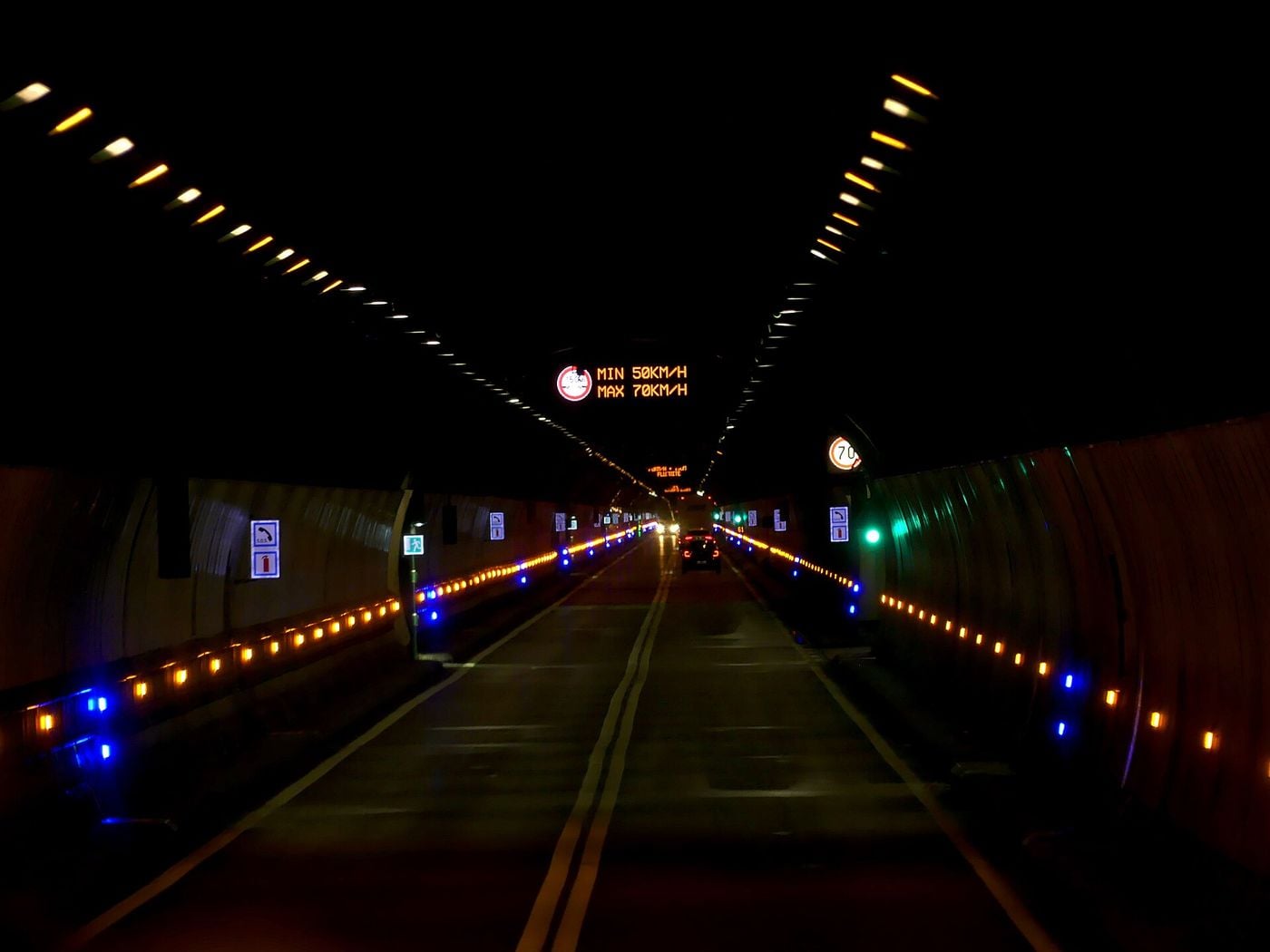
The Mont Blanc and Fréjus road tunnels both cross the border between France and Italy, and each has its own traffic regulation in addition to the general rules of the road. At Mont Blanc, transport vehicles over 3.5 t of Euro 0, 1 and 2, trucks and coaches alike, may not enter, and goods vehicles over 3.5 t of Euro 3 and Euro 4 have been banned since 1 September 2019 and 1 July 2020; every vehicle over 3.5 t has to pass a regulation area at Passy-Le Fayet in France or Aosta in Italy first. At Fréjus, the regulation of 11 July 2023 bans goods vehicles over 3.5 t of Euro 0 to Euro 4 and vehicles taller than 4.30 m. For dangerous goods, Mont Blanc is an ADR category E tunnel; Fréjus is a category C tunnel where admitted loads with orange plates cross under escort. In both tunnels the speed limits are 50 to 70 km/h and moving vehicles keep at least 150 m apart, with longer distances for coaches.
Status as at 18 November 2026. Read on 17 and 18 November 2026: for Mont Blanc, the operator’s Charte des services 2026 with its annex of tariffs at 1 January 2026, its page on heavy vehicles, coaches and dangerous goods, and the cover list of the Haute-Savoie prefectoral orders of 2009 to 2020; for Fréjus, the order of the Prefect of Savoie of 11 July 2023 with its traffic regulation (a scanned document without a text layer, read from the page images, pages 1 to 8 of 9), the operator SFTRF’s classification page and its tariff sheet at 1 January 2026; and the French government’s Bison Futé pages on both tunnels.
The two tunnels side by side
| Rule | Mont Blanc | Fréjus |
|---|---|---|
| Between | Chamonix-Mont-Blanc (Haute-Savoie) and Courmayeur (Aosta Valley) | Modane (Savoie) and Bardonecchia (Piedmont) |
| Length | 11.6 km | 12,895 m |
| Operator | TMB-GEIE, formed by the concession companies ATMB (France) and SITMB (Italy) | The concession companies SFTRF and SITAF |
| Euro-class ban | Transport vehicles over 3.5 t of Euro 0, 1 and 2; goods vehicles over 3.5 t of Euro 3 and 4 | Goods vehicles over 3.5 t of Euro 0 to 4, save a joint special authorisation of the prefects of Savoie and Turin |
| ADR tunnel category | E; UN 2919, 3077, 3082, 3291, 3331, 3359 and 3373 also barred from the access ramps | C; admitted units with orange plates cross under escort |
| Maximum height including load | 4.70 m (Bison Futé) | 4.30 m |
| Speed | 50 km/h minimum, 70 km/h maximum; 50 and 40 km/h at the French and Italian exits | 50 km/h minimum, 70 km/h maximum; 60 km/h for exceptional and dangerous-goods transport |
| Distance between moving vehicles | 150 m; 300 m between a coach and the truck ahead; 1,200 m between two coaches | 150 m; 300 m for a coach following a vehicle over 3.5 t; no two coaches with passengers in the same 2,000 m section |
| Distance when traffic stops | 100 m | 100 m; 200 m for a coach following a vehicle over 3.5 t |
| Overtaking | Banned | Banned for moving vehicles |
How many heavy goods vehicles passed through each of the two tunnels, including in the year of the Mont Blanc tunnel’s closure for renovation work, is shown in trucks crossing the Alps.
Mont Blanc: Euro classes and the regulation areas
Work on the Mont Blanc traffic regulation was launched at the Franco-Italian summit of 29 January 2001; its final text was approved by the intergovernmental commission in January 2002 and, in the words of the operator’s Charte des services 2026, “constamment mis à jour”. Its first item is an access ban for “les véhicules de transport >3,5t PTAC classés dans les catégories Euro 0, Euro 1 et Euro 2” and for “les véhicules de transport de marchandises >3,5t PTAC classés dans les catégories Euro 3 et Euro 4”. PTAC is the maximum authorised mass. The Euro 0 to 2 ban is worded for all transport vehicles, coaches included; the Euro 3 and 4 bans are worded for goods vehicles.
The operator’s page for heavy vehicles gives the registration dates it uses for each step: Euro 0, 1 and 2 are vehicles registered before 1 October 2001; from 1 September 2019 goods vehicles of Euro 3, registered before 1 October 2006, are barred; from 1 July 2020 goods vehicles of Euro 4, registered before 1 October 2009. The Charte sums up the last step as a ban on goods vehicles over 3.5 t “ayant une motorisation inférieure à Euro 5”. It adds that in 2025, 98 % of the heavy vehicles that went through the tunnel were Euro 6. The Euro classes themselves are explained in Euro VI and Euro 7 for trucks.
| Order | Dated | Vehicles banned | From |
|---|---|---|---|
| 2010-3478 | 27 December 2010 | Transport vehicles over 3.5 t, Euro I | 1 January 2011 |
| 2012299-0004 | 25 October 2012 | Transport vehicles over 3.5 t, Euro II | 1 November 2012 |
| DDT-2018-2036 | 27 December 2018 | Goods vehicles over 7.5 t, Euro III | 1 January 2019 |
| DDT-2019-1225 | 24 July 2019 | Goods vehicles over 3.5 t, Euro III | 1 September 2019 |
| DDT-2020-825 | 18 June 2020 | Goods vehicles over 3.5 t, Euro IV | 1 July 2020 |
Bison Futé, the French government’s road traffic information service, gives a different cut-off on its Mont Blanc page. Citing order 2009-3425 and the order of 18 June 2020, it describes as barred since 1 July 2020 vehicles over 3.5 t whose first registration is “antérieure au 1er octobre 2006”, unless the driver shows that the vehicle meets standards equivalent to Euro 5. The operator’s page and its Charte des services 2026 give 1 October 2009 for the Euro 4 step. The same Bison Futé list bars vehicles that cannot reach or keep up 50 km/h and vehicles taller than 4.70 m including load. The orders themselves, in the prefecture’s collection of 2009 to 2020, use the same words: point d bis of Article 2(1) of the traffic regulation, as amended by order DDT-2020-825, bars vehicles over 3.5 t first registered “antérieure au 1er octobre 2006”, and point b of the same paragraph bars vehicles taller than 4.70 m including load.
Vehicles with a maximum authorised mass over 3.5 t, “camions et autocars” in the operator’s words, must obtain an accreditation at the regulation and control area of Passy-Le Fayet in France or of Aosta in Italy before entering the tunnel. The two areas lie 22 and 44 km from the platforms at the tunnel entrances. Compliance is certified by a counterfoil, issued after the vehicle’s dimensions and its European pollution category have been checked. Since 1 February 2023 the two areas have been run directly by the concession companies, ATMB and SITMB. The nature of the goods is checked by the customs service on the French side and by the Polizia Stradale on the Italian side. On the tunnel platforms, trucks and buses pass under a thermographic portal; where it signals an anomaly, the vehicle must stay on the platform for the necessary checks before it crosses.
Exceptional vehicles of category B under the Mont Blanc regulation need an authorisation requested from TMB-GEIE at least four days in advance, according to Bison Futé. The Charte lists a prior authorisation for exceptional vehicles and for other vehicles that need a technical escort because of their dimensions, and the operator’s 2026 tariff sheets for the French and the Italian side both add a supplement of EUR 15.00 for accompanying a vehicle under Article 3 of the traffic regulation.
Mont Blanc: dangerous goods
The operator states that the passage of dangerous goods is subject to the conditions and bans of the ADR for tunnels of category E, “la catégorie la plus restrictive”. The Charte refers to paragraph 1.9.5.2 of ADR 2009 for this classification. In addition, the French and Italian prefectures have banned the transit of goods with UN numbers 2919, 3077, 3082, 3291, 3331, 3359 and 3373 on the access ramps, so vehicles carrying them are not admitted to the tunnel. Which loads a category E tunnel shuts out, by their tunnel restriction code, is set out in ADR explained: dangerous goods vehicles, orange plates and tunnel codes.
Mont Blanc: speed, spacing and coaches
The Mont Blanc tunnel is a single bore with traffic in both directions, and overtaking is banned. The limits are 50 km/h minimum and 70 km/h maximum for all vehicles, with 50 and 40 km/h at the French and Italian exits respectively; the operator gives the average crossing time as 12 minutes at 60 km/h. The regulation sets 150 m between vehicles, 300 m “entre un autobus et le poids lourd qui le précède” and 1,200 m between two buses. Blue lights every 150 m inside the tunnel mark the distance, and the toll barriers release about one vehicle every 8 seconds. When traffic stops, the minimum distance to the vehicle ahead is 100 m.
Speed radars report to the binational police service, present on both platforms. In the Charte’s words, offences can be recorded on either platform “quel que soit le territoire national sur lequel elles ont été commises”.
Fréjus: the 2023 traffic regulation
The Fréjus regulation is annexed to an order of the Prefect of Savoie signed at Chambéry on 11 July 2023. Article 1 of the order states that it cancels and replaces the regulation of 2 July 2021 from the date of signature. The regulation applies to the French part and the French platform “à l’identique de ce qui est prévu pour la partie italienne” (Article 1 of the regulation).
Article 3(1) lists the vehicles banned from the toll barrier onwards. For trucks and coaches these include:
- (d) motor vehicles fitted with snow chains;
- (f) vehicles taller than 4.30 m including load;
- (i) dangerous goods transport units banned from category C tunnels under the ADR in force, except class 2 goods with the classification codes 2A, 2O, 3A and 3O carried in tanks;
- (j) goods vehicles over 3.5 t maximum authorised mass with emissions of EURO 0, EURO 1, EURO 2, EURO 3 and EURO 4, “sauf autorisation spéciale conjointe du préfet de Savoie et du préfet de Turin pour des exigences particulières”.
SFTRF’s classification page puts it in one line: “Les poids lourds en normes Euro 0-1-2-3-4 sont interdits au Tunnel du Fréjus”. Bison Futé’s Fréjus page still shows the version in force from 10 July 2017, citing the order of 7 July 2017: a ban on goods vehicles over 3.5 t of Euro 0, 1 and 2, first registered before 1 October 2001.
Article 3(1)(j) names goods vehicles. SFTRF’s tariff sheet at 1 January 2026 prices coaches of every Euro class: classes 3 and 4 each have rows for “Bus Euro 3” and “Bus Euro 0-1-2” beside the row for heavy goods vehicles of Euro 5–6 and buses of Euro 4–6.
Vehicles running partly or wholly on gas must be declared in advance by their drivers to the operator’s staff, and carry on the windscreen the distinctive mark the operator issues (Article 3 bis).
Article 2 regulates coaches. The concession companies control the access of coaches with passengers so that two coaches are never in the same 2,000 m section at the same time, in each direction. From 15 December to 30 April, “en raison du trafic important d’autocars”, heavy goods vehicles may not go through in either direction on Sundays and public holidays from 08:00 to 09:00 and from 17:00 to 18:00. The concession companies may apply the same measure for special events that bring heavy coach traffic on either side.
Inside the tunnel the maximum speed is 70 km/h and the minimum 50 km/h; exceptional transport and dangerous goods are limited to 60 km/h (Article 5). Moving vehicles keep at least 150 m apart, “sauf les autocars suivant un véhicule de plus de 3,5 tonnes qui doivent, eux, respecter une distance minimum de 300 mètres”; when traffic stops, the distances are 100 m and, for a coach behind a vehicle over 3.5 t, 200 m (Article 6). Overtaking a moving vehicle, U-turns and reversing are banned (Article 11). When the operator records a pressure difference of 750 Pa or more between the two platforms for 30 minutes or more, the tunnel is closed to heavy goods vehicles including ADR loads, coaches are escorted one by one, and the distances rise from 150 m to 300 m between moving vehicles and from 100 m to 200 m between stopped vehicles (Article 7).
Fréjus: dangerous goods and escorts
Article 9 states that the Fréjus road tunnel “est classé en catégorie C, au sens de l’ADR en vigueur”, and adds its own safety prescriptions. Drivers declare their load in advance to the tunnel staff named in Article 15 to obtain the authorisation to transit, with or without escort.
| Load | Transit |
|---|---|
| Units allowed through category C tunnels, including class 2 goods with codes 2A, 2O, 3A and 3O in tanks | With escort |
| Class 1, codes 1.3C and 1.3G, in quantities under 5 t; class 2 with codes 1T, 1TC, 1TF, 1TFC, 1TO, 1TOC, 2T, 2TC, 2TF, 2TFC, 2TO, 2TOC, 4TC, 7T, 7TF, 8T and 8TF in tubes and pressure drums | With escort, between 23:00 and 05:00, tunnel closed in both directions |
| Loads carried under the exemptions of ADR 1.1.3, such as vehicles without orange plates or limited quantity marks | Without escort, after declaration |
| Partial exemption under ADR 1.1.3.6 | Without escort only if the transport document carries the calculated value of note 1 (f) to 5.4.1.1.1; otherwise with escort |
| Limited quantities (ADR Chapter 3.4) | The transport document gives the total gross mass; units marked under ADR 3.4.13 because they carry more than 8 t cross with escort |
| Empty uncleaned packaging; all class 1, including 1.4S; all class 7; empty uncleaned tanks, battery vehicles, tank containers, portable tanks, MEGCs, MEMUs, and vehicles and containers for carriage in bulk | With escort, after declaration |
| Empty uncleaned tanks that held substances under special provision TU 35, without orange plates | Free, without escort, only if appropriate measures have been taken to offset the possible risks |
| Goods with tunnel code (-): UN 1043, 2814, 2900, 2919, 3077, 3082, 3166, 3171, 3291, 3331, 3359, 3373, 3549 | With escort, after declaration |
Banned goods “restent tels quel, sans possibilité de bénéficier de quelque forme d’exemption”, and a transport unit that is hard to identify is treated as banned. Units with orange plates that are admitted are “obligatoirement accompagnées par le service sécurité des exploitants, SFTRF et SITAF”. Convoys of at most seven trucks are formed on the entrance platforms, framed by two patrol vehicles with rotating beacons, and cross at 60 km/h with 150 m between vehicles. Two dangerous-goods convoys may not be in the tunnel at the same time in opposite directions. The tunnel restriction codes and the limited quantity rules are covered in ADR explained and in ADR limited and excepted quantities.
SFTRF’s classification page gives a different time window for its tariff class F, “Marchandises ADR de classe 1, classification 1.3 C & 1.3 G (quantité – 5T) Marchandises ADR de classe 2”: “Transit entre 0h00 et 5h00”. The regulation of 2023 gives 23:00 to 05:00.
Fréjus: exceptional transport
Under Article 8, a vehicle or combination is exceptional transport where it exceeds 4 m in height, 2.55 m in width (2.60 m for refrigerated vehicles) or 18.75 m in length. Vehicles whose maximum speed is below the 50 km/h minimum, tractors towing another tractor and vehicles towed by professionals authorised by the concession company count as exceptional transport too.
| Category | Dimensions | Conditions |
|---|---|---|
| A | Width over 2.55 m (2.60 m refrigerated) and under 2.80 m, or length over 18.75 m and under 25 m, or height over 4 m and under 4.30 m | Admitted without special conditions |
| B | Width over 2.80 m and under 3.50 m, or slow or towed vehicles | Dimensions checked before authorisation; dates and times may be imposed; escorted like dangerous goods; may join a dangerous-goods convoy of at most seven vehicles in total |
| C | Width over 3.50 m and under 6.00 m, or length over 25 m | Dimensions checked before authorisation; dates and times may be imposed; escorted like dangerous goods; uses both lanes, with the tunnel closed in both directions |
Tolls at 1 January 2026
The Mont Blanc tolls are governed by an international agreement between Italy and France and are set and revised on 1 January each year by the intergovernmental commission. The annual correction applies the average inflation rate of the two countries in the previous year, plus any supplements decided by the governments. At both tunnels, class 3 covers vehicles with two axles and a total height over 3 m, and class 4 vehicles with three or more axles and a total height over 3 m. At both, a return ticket in classes 3 and 4 is valid until the end of the fifteenth day after the day of issue.
| Class and vehicle | Mont Blanc, French side (VAT 20 % incl.) | Mont Blanc, Italian side (VAT 22 % incl.) | Fréjus, French platform (VAT 20 % incl.) |
|---|---|---|---|
| Class 3: truck (Fréjus: Euro 5–6) or coach (Fréjus: Euro 4–6) | 201.50 / 313.60 | 204.80 / 318.80 | 201.50 / 313.60 |
| Class 3: coach Euro 3 | – | – | 211.50 / 329.20 |
| Class 3: coach Euro 0-1-2 | – | – | 213.20 / 331.80 |
| Class 4: truck (Fréjus: Euro 5–6) or coach (Fréjus: Euro 4–6) | 404.80 / 635.90 | 411.60 / 646.50 | 404.80 / 635.90 |
| Class 4: coach Euro 3 | – | – | 425.10 / 667.70 |
| Class 4: coach Euro 0-1-2 | – | – | 428.40 / 672.80 |
The Fréjus sheet adds, as single-trip prices for heavy goods vehicles of Euro 5–6: class B (width 2.81 to 3.50 m, slow or towed vehicles) EUR 562.10, class C (width 3.51 to 6 m or length over 25 m) EUR 1,115.70, class F (ADR class 1, classification 1.3 C and 1.3 G, under 5 t, and ADR class 2) EUR 753.10, and the compulsory ADR escort EUR 163.10. At Mont Blanc the supplement for accompanying a vehicle is EUR 15.00 on both sides.
At Mont Blanc, large road haulage companies and groupings of hauliers may take out a subscription contract that counts each transit at 50 % of the return fare, is paid after the event for the previous month’s transits and earns a further discount at the end of the year based on the number of transits. Trucks on post-billing subscription can pay with the interoperable Mont Blanc / Fréjus card; electronic toll systems are not accepted at Mont Blanc. SFTRF also operates the A43 Maurienne motorway, which has its own classes and tariffs; motorway and distance-based truck tolls across Europe are covered in Truck tolls in Europe and the Eurovignette.
Among the documents on its heavy-vehicle page, the Mont Blanc operator publishes the calendar of truck driving bans in France and in Italy. The national bans themselves are set out in Truck driving bans in Europe.
Quick answers
- Can a Euro 4 truck drive through the Mont Blanc tunnel?
- No. Goods vehicles with a maximum authorised mass over 3.5 t of Euro 4 have been banned since 1 July 2020, under order DDT-2020-825 of the Prefecture of Haute-Savoie of 18 June 2020, and those of Euro 3 since 1 September 2019. The operator equates Euro 4 with vehicles registered before 1 October 2009 and Euro 3 with vehicles registered before 1 October 2006. Transport vehicles over 3.5 t of Euro 0, 1 and 2, coaches included, are banned as well.
- Which Euro classes are banned in the Fréjus tunnel?
- Under Article 3(1)(j) of the traffic regulation annexed to the order of the Prefect of Savoie of 11 July 2023, goods vehicles over 3.5 t maximum authorised mass of EURO 0, EURO 1, EURO 2, EURO 3 and EURO 4 may not enter, save a joint special authorisation of the prefects of Savoie and Turin. The operator SFTRF states the same: heavy goods vehicles of Euro 0 to 4 are banned.
- Do the Euro-class bans apply to coaches?
- At Mont Blanc the Euro 0, 1 and 2 ban covers all transport vehicles over 3.5 t, so coaches too, while the Euro 3 and Euro 4 bans are worded for goods vehicles. At Fréjus, Article 3(1)(j) names goods vehicles, and SFTRF's tariff sheet at 1 January 2026 prices coaches of Euro 3 and of Euro 0-1-2 in classes 3 and 4 at their own rates.
- Can dangerous goods go through the Mont Blanc or Fréjus tunnel?
- Mont Blanc is classed in ADR tunnel category E, and the French and Italian prefectures also bar UN 2919, 3077, 3082, 3291, 3331, 3359 and 3373 from the access ramps. Fréjus is in category C: admitted transport units with orange plates cross under escort by the operators' safety service, in convoys of at most seven trucks at 60 km/h, and some class 1 and class 2 goods only between 23:00 and 05:00 with the tunnel closed in both directions.
- What are the height limits in the Mont Blanc and Fréjus tunnels?
- At Fréjus, vehicles taller than 4.30 m including load may not enter (Article 3(1)(f) of the 2023 regulation), and vehicles over 4 m are exceptional transport. For Mont Blanc, the French government's Bison Futé service lists vehicles taller than 4.70 m including load among those barred since 1 July 2020.
Sources
- Charte des services du Tunnel du Mont Blanc 2026 (printed March 2026) — presentation, technical sheet, traffic regulation, heavy-vehicle regulation areas, toll, and annex of tariffs at 1 January 2026 on the French and Italian sides — TMB-GEIE, Tunnel du Mont Blanc
- Poids lourds, autocars et marchandises dangereuses (ADR) — heavy vehicles, coaches and dangerous goods page, read on 17 November 2026 — TMB-GEIE, Tunnel du Mont Blanc
- Règlement de circulation du tunnel du Mont-Blanc: recueil des arrêtés préfectoraux de 2009 à 2020 (Prefecture of Haute-Savoie) — list of orders on the cover page — TMB-GEIE, Tunnel du Mont Blanc
- Tunnel du Mont-Blanc (Cat. E) — principal tunnels, access bans and dangerous goods, read on 17 November 2026 — Bison Futé, French government road traffic information
- Arrêté préfectoral du 11 juillet 2023 portant règlement de circulation du tunnel du Fréjus (Prefect of Savoie) — Article 1 of the order; Articles 1 to 12 bis of the regulation, French version (scanned document, read from the page images) — SFTRF, Société française du tunnel routier du Fréjus, 11 Jul 2023
- Classification tunnel — vehicle classes, maximum height and Euro-class ban, read on 17 November 2026 — SFTRF, Société française du tunnel routier du Fréjus
- Tunnel routier du Fréjus — Tarifs au 01/01/2026, tariffs applied on the French platform (VAT 20 % included) — SFTRF, Société française du tunnel routier du Fréjus
- Tunnel du Fréjus (Cat. C) — principal tunnels, read on 17 November 2026 — Bison Futé, French government road traffic information