Direct vision for trucks and buses: UN Regulation No 167 in EU type-approval and its 01 series
UN Regulation No 167 sets minimum direct-vision volumes for buses and trucks. In EU type-approval it is requirement B9: new types from 7 January 2026, registrations from 7 January 2029.
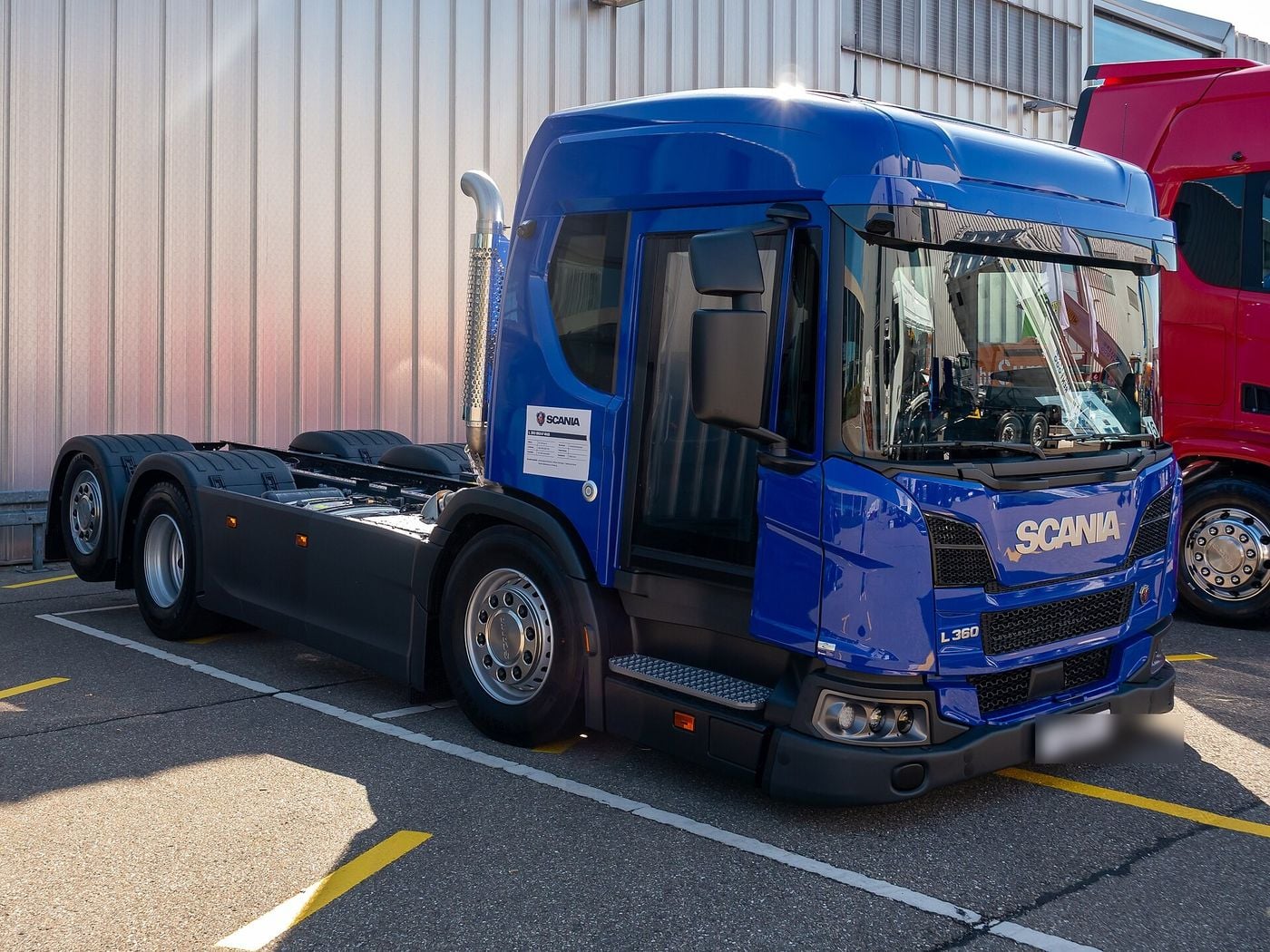
UN Regulation No 167 is the UN regulation on the direct vision of buses and coaches of categories M2 and M3 and trucks of categories N2 and N3: how much of the space around the front and sides of the cab the driver can see without the aid of mirrors or cameras. It measures that view as a volume, seen from three eye points within a fixed assessment volume, assigns each vehicle to one of three levels and sets minimum volumes for each level. In the European Union it is requirement B9 of Annex II to Regulation (EU) 2019/2144, the General Safety Regulation. Since 7 January 2026, national authorities refuse EU type-approval to new vehicle types that do not comply; from 7 January 2029, new vehicles that do not comply may not be registered. Annex I of the EU regulation refers to the original version of UN Regulation No 167, published in the Official Journal on 17 May 2024. The 01 series of amendments, in force at UN level since 12 June 2025 and published in the Official Journal on 16 February 2026, ties the front requirement to the distance between the A-pillars, exempts some heavy Level 3 trucks from the front requirements and sets transitional dates of 1 September 2031 and 1 September 2036.
Status as at 18 November 2026. Read on that day from the Publications Office of the European Union: Regulation (EU) 2019/2144 as published in the Official Journal and in its consolidated text of 2 August 2026; Delegated Regulation (EU) 2025/1122; and the two Official Journal publications of UN Regulation No 167, the original version (OJ L 2024/1065) and the text incorporating the 01 series of amendments (OJ L 2026/272). Both UN texts describe themselves as a documentation tool and name the UN/ECE documents that are the authentic texts; those documents were not read.
Direct vision in the General Safety Regulation
Recital 22 of Regulation (EU) 2019/2144 gives the reason for the rule. EU limits on the overall length of truck combinations led to cab-over-engine designs, and “the high position of the driver led to an increased blind-spot area and poorer direct visibility around the truck cab”. Article 9(5) sets the duty: vehicles of categories M2, M3, N2 and N3 “shall be designed and constructed to enhance the direct visibility of vulnerable road users from the driver seat”, by reducing “to the greatest possible extent the blind spots in front of and to the side of the driver”.
As adopted in 2019, row B9 of Annex II, “Heavy-duty vehicles direct vision”, named no regulatory act and carried note D for the four categories. Commission Delegated Regulation (EU) 2025/1122 of 5 June 2025, published on 12 August 2025, replaced the row so that it names UN Regulation No 167, and added the regulation to Annex I as “Original version of the Regulation”, OJ L 2024/1065 of 17 May 2024, for M2, M3, N2 and N3. Under Article 4(2), type-approval in accordance with the UN Regulations listed in Annex I “shall be considered as EU type-approval”.
Note D sets two dates. From 7 January 2026, national authorities refuse EU type-approval or national type-approval to “any new type of vehicle” that does not comply (Article 16(a)). From 7 January 2029, they consider certificates of conformity of new vehicles that do not comply no longer valid and prohibit the registration of those vehicles (Article 16(b)). How row B9 sits among the other systems and timetables of Annex II is set out in Mandatory driver assistance systems; the categories are explained in Vehicle categories M, N and O.
What UN Regulation No 167 measures
The original version entered into force on 8 June 2023. Paragraph 1.1 applies it to vehicles of categories M2, M3, N2 and N3 with regard to their direct vision “to reduce blind spots to the greatest extent possible, considering the needs of the specific type of vehicle and the operation it is intended for”. Direct vision is “the field of vision from the driver’s eye point that can be seen without the aid of indirect vision devices such as mirrors or cameras” (paragraph 2.1).
The view is taken from three eye points (paragraph 2.3). E2, the forward eye point, lies 1,163.25 mm above and 678 mm behind the accelerator heel point, in a vertical plane through the centre of the driver’s seat. E1 and E3 are defined by a 60° rotation to the left and to the right about the P-point, which lies 98 mm behind E2 (paragraph 2.17). Sightlines from these points that run at a tangent to the first part that would block them, such as an A-pillar, the lower edge of the windscreen, the steering wheel or the wipers, define the direct vision opening lines (paragraph 2.8); the space seen through those lines inside the assessment volume of Annex 4 is the visible volume (paragraph 2.9).
The visible volume has three parts (paragraphs 2.9 to 2.9.3). The nearside visible volume is seen from E1 in left-hand traffic or E3 in right-hand traffic, behind the nearside A-pillar; the front visible volume is seen from E2 between the A-pillars; the offside visible volume is seen behind the A-pillar on the other side. Their sum is the total visible volume. The nearside is the right side of the vehicle in right-hand traffic and the left side in left-hand traffic (paragraph 2.20).
| Boundary | Position | Paragraph |
|---|---|---|
| Forward | 2,000 mm forward of the vehicle frontal plane | 1.1 |
| Nearside | 4,500 mm beyond the vehicle nearside plane | 1.2 |
| Offside | 2,000 mm beyond the vehicle offside plane | 1.3 |
| Rearward | 1,000 mm behind the driver’s eye point E2 | 1.4 |
| Vertical | From the ground plane to a plane 1,602 mm above the ground | 1.5 |
The vehicle tested is “the worst-case vehicle of its type in respect of direct vision” (paragraph 6.2.1). The volume can be quantified with the physical test method of Annex 6, which measures the length of gridlines on several planes as a proxy for volume and allows a tolerance of 0.10 m³ (paragraph 6.3.1), or with the numerical test method of Annex 7, or with another numerical method that the manufacturer shows the approval authority to be at least as accurate (paragraph 6.3.2).
Three levels and how a vehicle is assigned
Paragraph 5.2.1 sorts vehicles into three levels: Level 1, “Vehicles that often travel in urban areas”; Level 2, “Vehicles that sometimes travel in urban areas but have specific operational limitations”; and Level 3, “Vehicles that seldom enter urban areas”. The introduction, which is for information, names the characteristics that good direct vision can compromise as “driver comfort and wellbeing, high power/cooling for high-capacity transport or high ground clearance for off-road operation” (paragraph 0.7).
The level follows from the table in Annex 5. Engine power is the maximum net power as defined by UN Regulation No 85 (paragraph 2.10); a sleeper cab has a compartment behind the driver’s seat intended to be used for sleeping, and a day cab is any other cab (paragraphs 2.11 and 2.12). The axle configuration A×B gives the number of wheel positions and of driven wheel positions; 10×X covers any five-axle configuration (paragraph 2.18). G marks an off-road vehicle, explained in Vehicle categories M, N and O.
| Level | Gross weight (t) | Chassis | Axle configuration | Engine power (kW) | Cab | Category |
|---|---|---|---|---|---|---|
| 1 | ≤ 7.5 | All | All | All | All | N2, N2G |
| 1 | > 7.5 | All | All | All | All | N2 |
| 1 | All | All | All | All | All | M2 |
| 1 | All | All | All | All | All | M3 |
| 1 | ≤ 16 | All | 4×2, 6×2, 6×4, 8×2, 8×4 | All | All | N3 |
| 1 | > 16 | Articulated | 4×2 | All | Day | N3 |
| 1 | > 16 | Articulated | 4×2 | < 265 | Sleeper | N3 |
| 1 | > 16 | Articulated | 6×2 | All | Day | N3 |
| 1 | > 16 | Rigid | 4×2 | All | Day | N3 |
| 1 | > 16 | Rigid | 4×2 | < 265 | Sleeper | N3 |
| 1 | > 16 | Rigid | 6×2 | All | Day | N3 |
| 1 | > 16 | Rigid | 6×4, 8×2, 8×4 | All | Day | N3 |
| 1 | > 16 | Rigid | 6×4, 8×2, 8×4 | < 350 | Sleeper | N3 |
| 2 | > 7.5 | All | 4×4 | All | All | N2G |
| 2 | ≤ 16 | All | 4×2, 6×4, 8×4 | All | All | N3G |
| 2 | > 16 | Articulated | 4×2 | All | Day | N3G |
| 2 | > 16 | Articulated | 4×2 | < 265 | Sleeper | N3G |
| 2 | > 16 | Rigid | 4×2 | All | Day | N3G |
| 2 | > 16 | Rigid | 4×2 | < 265 | Sleeper | N3G |
| 2 | > 16 | Rigid | 6×4, 8×4 | All | Day | N3G |
| 2 | > 16 | Rigid | 6×4, 8×4 | < 350 | Sleeper | N3G |
| 3 | > 16 | Articulated | 4×2 | ≥ 265 | Sleeper | N3, N3G |
| 3 | > 16 | Articulated | 6×2 | All | Sleeper | N3 |
| 3 | > 16 | Articulated | 6×4, 8×2, 8×4 | All | All | N3, N3G |
| 3 | > 16 | Rigid | 4×2 | ≥ 265 | Sleeper | N3, N3G |
| 3 | > 16 | Rigid | 6×2 | All | Sleeper | N3 |
| 3 | > 16 | Rigid | 6×4, 8×2, 8×4 | ≥ 350 | Sleeper | N3, N3G |
| 3 | All | All | 4×4, 6×6, 8×6, 8×8, 10×X | All | All | N3, N3G |
Every M2 and M3 bus or coach is in Level 1, whatever its weight, chassis or power. Level 2 holds only off-road (G) vehicles of categories N2 and N3.
Minimum visible volumes
Under paragraph 5.2.2, vehicles of each level “shall achieve visible volumes in excess of the limit values associated with that level as laid down in Table 1”. Table 1 gives nearside and offside limits for Level 1 only and “Not Specified” for Levels 2 and 3; it gives front and total limits for all three levels. The 01 series keeps the nearside, offside and total figures and changes the front requirement.
| Volume | Level 1 | Level 2 | Level 3 | Text |
|---|---|---|---|---|
| Nearside visible volume | 3.4 | Not specified | Not specified | Both versions |
| Front visible volume | 1.8 | 1.0 | 1.0 | Original version |
| Front visible volume, IAPD at or above the Table 1 value | 1.8 (IAPD ≥ 2,156 mm) | 1.0 (IAPD ≥ 2,154 mm) | 1.0 | 01 series |
| Front visible volume, IAPD below the Table 1 value | Formula of paragraph 5.3 (IAPD < 2,156 mm) | Formula of paragraph 5.3 (IAPD < 2,154 mm) | Formula of paragraph 5.3 | 01 series |
| Subsection frontal visible volume | Paragraph 5.4 | Paragraph 5.4 | Paragraph 5.4 | 01 series |
| Offside visible volume | 2.8 | Not specified | Not specified | Both versions |
| Total visible volume | 11.2 | 8.0 | 7.0 | Both versions |
In the Official Journal table of the 01 series, the 2,154 mm value is printed beside the Level 2 column; the Level 3 column gives 1.0 and “See paragraph 5,3” without a value of its own.
The original version has a separate route for a vehicle that cannot meet the front limit “because of an innovative design, for example where the A-pillars are closer together than in a conventional design” (paragraph 5.3). Such a vehicle may be deemed to comply if it meets all other applicable limits and a test with five poles, 1.40 m tall and 30 mm in diameter, set across the front of the vehicle: the average distance from the vehicle frontal plane to a shoulder marker point placed 0.130 m closer to the vehicle than the centre of each pole, when the top of the pole is just visible from E2, may be no more than 1.65 m for Level 1 and 1.97 m for Levels 2 and 3 (paragraphs 5.3.1 to 5.3.3). The text incorporating the 01 series has no such route; its paragraph 5.3 holds the formulas below.
The 01 series of amendments
The Official Journal of 16 February 2026 published UN Regulation No 167 “Incorporating all valid text up to: 01 series of amendments - Date of entry into force 12 June 2025”. It names four authentic texts: ECE/TRANS/WP.29/2022/140/Rev.1, ECE/TRANS/WP.29/2024/13, ECE/TRANS/WP.29/2024/169 and ECE/TRANS/WP.29/2024/99. The first two digits of an approval number are 01 for the regulation as amended by the 01 series (paragraph 4.3); the original text gives 00 for the regulation in its initial form.
Inter-A-pillar distance and the front volume
The inter-A-pillar distance (IAPD) is “the horizontal distance between the A-pillars”, measured along the y-axis of the vehicle in a horizontal plane through the E-points, or the mean of the same measurement in two horizontal planes at equal heights above and below that plane; which of the two is used is agreed between the manufacturer and the technical service and approved by the type-approval authority (paragraph 2.30). Where the IAPD is less than the value in Table 1, the limit value for the front visible volume V, “measured in mm³”, is set by a formula for each level (paragraph 5.3).
The subsection frontal visible volume (SFVV) is “a portion of the assessment volume that includes the volume directly in front of the vehicle, between the offside and nearside planes” (paragraph 2.9.4). Under paragraph 5.4, “The IAPD shall be measured and the frontal volume calculated using the appropriate IAPD equation for the vehicle level being assessed”; the SFVV is a percentage of that result.
| Level | Formula for V | Paragraph | SFVV | Paragraph |
|---|---|---|---|---|
| Level 1 | V = 392.13379 × IAPD² − 275907.57455 × IAPD + 573475207.82932 | 5.3.1 | 26.1 % of the result calculated | 5.4.1 |
| Level 2 | V = 329.82551 × IAPD² − 480212.23549 × IAPD + 504819967.89481 | 5.3.2 | 16.3 % of the result calculated | 5.4.2 |
| Level 3 | V = 329.82551 × IAPD² − 480212.23549 × IAPD + 504819967.89481 | 5.3.3 | 16.3 % of the result calculated | 5.4.2 |
Our calculation, with the IAPD in millimetres, not a figure in the regulation: at an IAPD of 2,156 mm the Level 1 formula gives about 1.80 m³, and at 2,154 mm the Level 2 and 3 formula gives about 1.00 m³, the values of Table 1. At an IAPD of 2,000 mm the formulas give about 1.59 m³ for Level 1 and 0.86 m³ for Levels 2 and 3.
Exemption for high-capacity N3 vehicles
Paragraph 5.2.2.2, headed “High capacity vehicles and vehicles with competing objectives”, covers N3 vehicles in Level 3 that meet all four design and construction criteria. Such vehicles “do not need to meet the required Front Visible Volume and Subsection Frontal Visible Volume”. The paragraph names only those two volumes; the total visible volume of Table 1 is not among them.
| Point | Criterion |
|---|---|
| (a) | Equipped with a coupling device |
| (b) | 3 axles or more |
| (c) | Maximum engine power of 320 kW or more |
| (d) | Designed with a permissible maximum gross combination weight (GCW) mass “exceeding 60 tons” |
Transitional provisions
The original version has no transitional provisions; the 01 series adds them as paragraph 12.
| Date | Paragraph | What the text says |
|---|---|---|
| From the entry into force of the 01 series (12 June 2025) | 12.1 | No Contracting Party shall refuse to grant or refuse to accept type-approvals under the regulation as amended by the 01 series |
| From 1 September 2031 | 12.2 | Contracting Parties are not obliged to accept type-approvals to the preceding series of amendments first issued after 1 September 2031 |
| Until 1 September 2036 | 12.3 | Contracting Parties shall accept type-approvals to the preceding series of amendments first issued before 1 September 2031 |
| From 1 September 2036 | 12.4 | Contracting Parties are not obliged to accept type-approvals issued to the preceding series of amendments |
| Notwithstanding 12.2 and 12.4 | 12.5 | Contracting Parties shall continue to accept type-approvals issued according to the original version for vehicles not affected by the changes introduced by the 01 series |
Compliance without measuring the volume: M2 and N2
Vehicles that meet the criteria of paragraph 2 of Annex 5 “shall be deemed to comply with the relevant limit without undertaking the quantification of visible volume” (paragraph 5.2.2.1). The introduction explains that the assessment zones derive from those of Class V and VI mirrors on large trucks, and that M2 and N2 vehicles derived from M1 and N1 vehicles “meet or will soon have to meet Regulation No. 125, equally addressing the direct vision of the driver” (paragraph 0.9).
At the manufacturer’s choice, M2 and N2 vehicles not equipped with mirrors of Class V or VI according to UN Regulation No 46 are deemed to comply when at least one of two conditions is met (Annex 5, paragraph 2.1):
- Beltline (paragraph 2.1.1). The vertical distance of the beltline, the lower edge of the transparent area rearward of the windscreen (paragraph 2.29), from the ground is lower than 1,450 mm, or the vertical distance between the beltline and the eye point is greater than 260 mm. The vehicle must also pass paragraph 2.1.1.2: a cylinder 1,200 mm tall and 300 mm in diameter, anywhere in a space between vertical planes 2,000 mm and 2,300 mm in front of the vehicle and planes “400 mm from the driver’s side of the vehicle” and “600 mm from the opposite side”, must be at least partially visible directly from the eye point V2, unless hidden by blind spots created by the A-pillars, windscreen wipers or steering wheel.
- Derived vehicles (paragraph 2.1.2). M2 and N2 vehicles derived from M1 or N1 vehicles approved to UN Regulation No 125 “shall be considered compliant with the requirements of this Regulation” (01 series; the original version reads “shall be considered to have satisfied the requirements on direct vision”). A derived vehicle is one that has, forward of the B-pillars, the same general structure and shape as a pre-existing M1 or N1 vehicle (paragraph 2.28).
The EU entry and the UN text, as published
The two layers carry different versions. Annex I of Regulation (EU) 2019/2144, as amended by Delegated Regulation (EU) 2025/1122, lists UN Regulation No 167 as “Original version of the Regulation”, OJ L 2024/1065. The consolidated text of 2 August 2026 gives the same entry; its list of amending acts ends with Delegated Regulation (EU) 2025/1122, and its row B9 carries note D in the columns M2, M3, N2 and N3. Article 4(3) empowers the Commission to amend Annex I by delegated acts, “introducing and updating references to the UN Regulations, and relevant series of amendments, that apply on a compulsory basis”.
At UN level, the 01 series has been in force since 12 June 2025, and its text was published in the Official Journal on 16 February 2026 as OJ L 2026/272. Both Official Journal publications of UN Regulation No 167 state that “Only the original UN/ECE texts have legal effect under international public law” and refer to the latest version of the UN/ECE status document TRANS/WP.29/343 for the status and date of entry into force.
Related schemes and rules
London’s Direct Vision Standard is a separate permit scheme of Transport for London for Greater London, described in London Direct Vision Standard. Euro NCAP scores direct vision in its truck ratings, explained in How Euro NCAP tests trucks. Mirrors and camera-monitor systems, the devices for indirect vision under UN Regulation No 46, are covered in Camera-monitor systems instead of mirrors, and cab types in Truck cabs explained.
Quick answers
- What is UN R167?
- UN Regulation No 167 is the UN regulation on the approval of buses, coaches and trucks of categories M2, M3, N2 and N3 with regard to their direct vision: the view the driver has without mirrors or cameras. It measures that view as a volume seen from three eye points inside an assessment volume that reaches 2,000 mm ahead of the vehicle, 4,500 mm to the nearside, 2,000 mm to the offside and 1,602 mm up from the ground. Vehicles are assigned to three levels, each with minimum volumes; the minimum total visible volume is 11.2 m³ for Level 1, 8.0 m³ for Level 2 and 7.0 m³ for Level 3. The original version entered into force on 8 June 2023, the 01 series of amendments on 12 June 2025.
- When does the EU direct vision requirement for trucks and buses apply?
- Direct vision is requirement B9 of Annex II to Regulation (EU) 2019/2144 for categories M2, M3, N2 and N3, with note D. Since 7 January 2026 national authorities refuse EU type-approval to any new vehicle type that does not comply with UN Regulation No 167; from 7 January 2029 new vehicles that do not comply may not be registered. Delegated Regulation (EU) 2025/1122 added UN Regulation No 167 to Annex I as its original version, OJ L 2024/1065.
- What are the direct vision levels in UN R167?
- Level 1 is for vehicles that often travel in urban areas, Level 2 for vehicles that sometimes travel in urban areas but have specific operational limitations, and Level 3 for vehicles that seldom enter urban areas (paragraph 5.2.1). Annex 5 assigns the level by gross weight, articulated or rigid chassis, axle configuration, engine power, day or sleeper cab and vehicle category. Every M2 and M3 bus or coach is in Level 1; Level 2 holds only off-road (G) trucks; Level 3 holds, among others, N3 vehicles over 16 t with a 4×2 axle configuration, a sleeper cab and 265 kW or more.
- What changed with the 01 series of amendments to UN R167?
- The 01 series, in force since 12 June 2025 and published in the Official Journal on 16 February 2026, ties the front visible volume to the inter-A-pillar distance (IAPD): 1.8 m³ for Level 1 where the IAPD is at least 2,156 mm and 1.0 m³ for Level 2 where it is at least 2,154 mm, with formulas below those widths. It adds a subsection frontal visible volume of 26.1 % (Level 1) or 16.3 % (Levels 2 and 3) of the calculated frontal volume, exempts Level 3 N3 vehicles with a coupling device, three or more axles, at least 320 kW and a gross combination weight over 60 t from both front requirements, and sets transitional dates of 1 September 2031 and 1 September 2036.
- How can M2 and N2 vehicles comply with UN R167?
- M2 and N2 vehicles are in its scope, but Annex 5 gives them an alternative to the volume measurement. At the manufacturer's choice, M2 and N2 vehicles not equipped with Class V or VI mirrors under UN Regulation No 46 are deemed to comply if they are derived from M1 or N1 vehicles approved to UN Regulation No 125, or if their beltline is lower than 1,450 mm from the ground or more than 260 mm from the eye point in vertical distance, and a 1,200 mm tall cylinder placed 2,000 to 2,300 mm in front of the vehicle is at least partially visible from the eye point V2. Vehicles meeting these criteria are deemed to comply without quantifying the visible volume.
Sources
- Regulation (EU) 2019/2144 of the European Parliament and of the Council of 27 November 2019 on type-approval requirements for motor vehicles and their trailers, and systems, components and separate technical units intended for such vehicles, as regards their general safety and the protection of vehicle occupants and vulnerable road users — Official Journal text (OJ L 325, 16.12.2019): recital 22, Article 4(2) and (3), Article 9(5), Article 16(a) and (b), Annex II row B9 and note D — Publications Office of the European Union, 27 Nov 2019
- Regulation (EU) 2019/2144 — consolidated text of 2 August 2026 (last amending act listed: Delegated Regulation (EU) 2025/1122): Annex I row 167 and Annex II row B9 — Publications Office of the European Union
- Commission Delegated Regulation (EU) 2025/1122 of 5 June 2025 amending Regulation (EU) 2019/2144 to take into account regulatory developments concerning amendments to UN Regulations Nos 25, 34, 79, 100, 117, 127 and 152, and the new UN Regulations Nos 167, 169 and 171 (OJ L, 2025/1122, 12.8.2025): Annex points (1)(h) and (2)(b) — Publications Office of the European Union, 5 Jun 2025
- UN Regulation No 167 – Uniform Provisions Concerning the Approval of Motor Vehicles with Regard to Their Direct Vision [2024/1065], original version, date of entry into force 8 June 2023 (OJ L, 2024/1065, 17.5.2024): paragraphs 0.7, 1.1, 2, 4.3, 5, 6 and Annexes 4 and 5 — Publications Office of the European Union, 17 May 2024
- UN Regulation No 167 – Uniform Provisions concerning the approval of motor vehicles with regard to their Direct Vision [2026/272], incorporating all valid text up to the 01 series of amendments, date of entry into force 12 June 2025 (OJ L, 2026/272, 16.2.2026): paragraphs 0.9, 2.9.4, 2.30, 4.3, 5.2 to 5.4, 6.3, 12 and Annexes 4 and 5 — Publications Office of the European Union, 16 Feb 2026