Which lanes trucks and buses may use on motorways in Europe: the left-lane ban and the two-right-lanes rule by country
Lane bans for trucks and buses on multi-lane roads in Great Britain, Belgium, Germany, Austria, Spain, Italy, Poland and Türkiye: which vehicles each rule names and which lanes it leaves them.
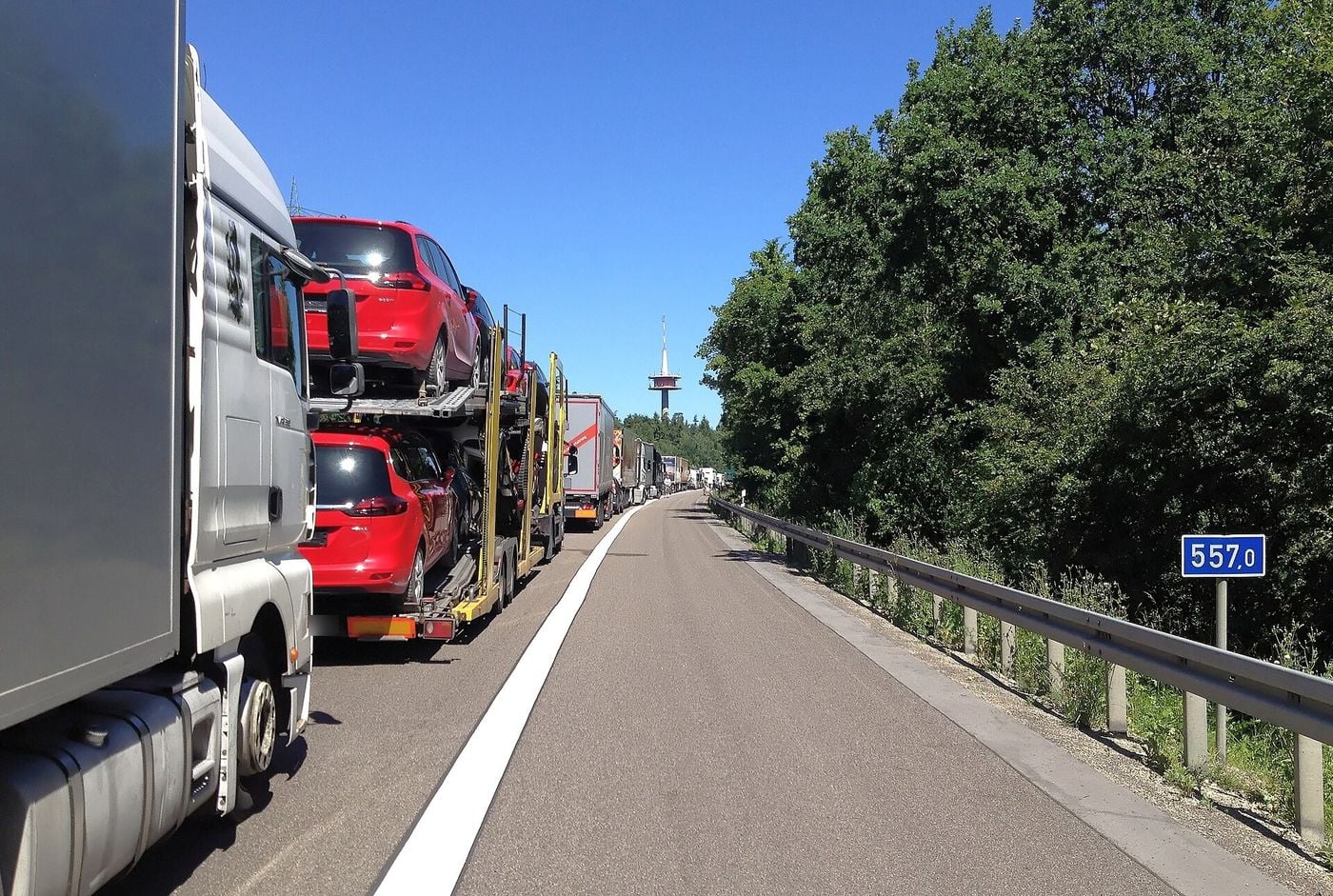
Several European countries keep heavy vehicles out of the outer lanes of roads with three or more lanes in one direction. In Great Britain, rule 265 of the Highway Code bars, except in prescribed circumstances, any vehicle drawing a trailer, goods vehicles over 7.5 tonnes and passenger vehicles over 7.5 tonnes with more than eight passenger seats from the right-hand lane of motorways with three or more lanes, and also goods vehicles over 3.5 t up to 7.5 t, and passenger vehicles with more than eight passenger seats up to 7.5 t, where they must be fitted with a speed limiter. In Belgium, Article 21.3 of the code de la route keeps buses, coaches and other vehicles and combinations with a maximum authorised mass over 3.5 t to the two right-hand lanes of motorways with three or more lanes in the direction of travel, except to follow signs F13 and F15. In Germany, outside built-up areas on carriageways with three marked lanes in one direction, trucks over 3.5 t and all motor vehicles with a trailer may use the left lane only to get in lane for a left turn. In Austria, trucks over 7.5 t may not use the leftmost lane of motorway sections with three or more lanes, under § 46 StVO as the federal Business Service Portal words it. Italy limits goods vehicles over 5 t and vehicles or combinations over 7 m, and Poland vehicles of categories N2 and N3 and combinations over 7 m, to the two right-hand lanes of motorways with three or more lanes, Poland also of expressways. Spain, since 1 October 2026 under Article 31.2 of its Reglamento General de Circulación, has trucks and vans over 3,500 kg and combinations over 7 m drive normally in the rightmost lane, with the next one allowed on the conditions of Article 31.1. Türkiye’s rule, in the wording of Law No. 7574 of 12 February 2026, applies on any road with two or more lanes in the same direction and excludes buses by name. Who is covered differs: buses are named in Great Britain and Belgium, and those over 7 m fall under Italy’s length line, while the German, Spanish and Polish rules name combinations but not buses, the Austrian rule, as the federal portal words it, names neither buses nor combinations, and the Turkish rule excludes buses.
Status as at 14 November 2026. Read on that day: rule 265 of the Highway Code on GOV.UK; § 7 of the Straßenverkehrs-Ordnung on gesetze-im-internet.de; Article 31 of Spain’s Reglamento General de Circulación in the consolidated text of the Boletín Oficial del Estado; Article 176 of Italy’s Codice della strada on Normattiva; Article 16 of Poland’s road traffic act (Prawo o ruchu drogowym) in the consolidated text of the Chancellery of the Sejm of 4 November 2026; Articles 3 and 46 of Türkiye’s Highway Traffic Law No. 2918 on the Mevzuat Bilgi Sistemi. The sources for Austria and Belgium were read on 21 November 2026 and are listed in their sections.
Great Britain drives on the left and the other seven countries on the right, so the outer lane these rules keep heavy vehicles out of is the right-hand lane in Great Britain and the left-hand lane elsewhere.
The rules side by side
| Country | Roads | Vehicles named | Lanes | Legal basis |
|---|---|---|---|---|
| Great Britain | Motorways with three or more lanes | Any vehicle drawing a trailer; goods vehicles over 7.5 t maximum laden weight, and over 3.5 t up to 7.5 t if required to be fitted with a speed limiter; passenger vehicles with more than 8 passenger seats over 7.5 t, and up to 7.5 t if required to be fitted with a speed limiter | Not the right-hand lane, except in prescribed circumstances | Highway Code rule 265 |
| Belgium | Motorways whose carriageway has three or more lanes in the direction of travel | Buses, coaches and other vehicles and combinations with a maximum authorised mass over 3.5 t | Only one of the two lanes on the right-hand side of the carriageway, except to follow signs F13 and F15 | Article 21.3 of the code de la route (Royal Decree of 1 December 1975), until 31 May 2027 |
| Germany | Outside built-up areas, three lanes in one direction marked with sign 340 | Trucks (Lastkraftwagen) over 3.5 t permissible total mass; all motor vehicles with a trailer | The left lane only to get in lane for a left turn | § 7(3c) StVO |
| Austria | Motorway sections with three or more lanes | Trucks (Lastkraftfahrzeuge) over 7.5 t maximum permissible total weight | Not the leftmost lane, except where it is needed to get in lane for the onward journey | § 46 StVO; wording of the federal Business Service Portal, read on 21 November 2026 |
| Spain | Carriageways outside built-up areas with three or more lanes in the direction of travel | Trucks and vans over 3,500 kg maximum authorised mass; special vehicles not obliged to use the hard shoulder; combinations over 7 m | Normally the rightmost lane; the next one on the conditions of Article 31.1 | Article 31.2 RGC, wording in force from 1 October 2026 |
| Italy | Motorways with carriageways of three or more lanes, unless signs say otherwise | Goods vehicles over 5 t mass at full load; vehicles and combinations over 7 m total length | Only the two lanes nearest the right edge; on motorway stretches with the Article 148(14) overtaking ban, the vehicles covered by that ban only the rightmost lane, whatever the number of lanes | Article 176(9) Codice della strada |
| Poland | Motorways and expressways with three or more marked lanes in one direction | Vehicles of categories N2 and N3; combinations over 7 m | Only the two lanes nearest the right edge | Article 16(2a) Prawo o ruchu drogowym |
| Türkiye | Any road with two or more lanes in the same direction, unless a sign says otherwise | All vehicles except motorcycles, cars, kamyonet, panelvan, minibuses and buses | Two lanes: the left lane only to overtake or turn. More than two: the second lane from the right only to overtake; lanes beyond the two rightmost only to turn left | Article 46(2)(e) Law No. 2918 |
Who counts: buses, trailers and the weight lines
The eight texts draw their lines in different places. Great Britain uses maximum laden weight and the speed-limiter requirement, and names passenger vehicles among those covered: those “constructed or adapted to carry more than eight seated passengers in addition to the driver”. Belgium’s text names buses (autobus) and coaches (autocars) alongside other vehicles and combinations with a maximum authorised mass over 3.5 t. Italy uses a mass of 5 t for goods vehicles and a total length of 7 m for any vehicle or combination, so a bus or coach longer than 7 m falls under its rule. Germany, Spain and Poland name goods vehicles by mass or by category and add combinations, but not buses: Germany counts every motor vehicle with a trailer, Spain and Poland combinations over 7 m. Austria’s rule, in the federal portal’s wording, names trucks over 7.5 t and does not mention buses or trailers. Türkiye lists the vehicles that are excepted, and buses and minibuses are among them.
Trailers are counted in six of the eight texts. Great Britain names “any vehicle drawing a trailer”, whatever its weight, and Germany “alle Kraftfahrzeuge mit Anhänger”. Spain, Italy and Poland count a combination once it is longer than 7 m. Belgium counts a combination of vehicles (train de véhicules) by its maximum authorised mass. Türkiye’s text does not mention trailers; a tractor unit (çekici) is not among the excepted vehicles.
The British 3.5 and 7.5 tonne lines are set out in what is an HGV, and the categories N2 and N3 that Poland’s rule uses in vehicle categories M, N and O.
Great Britain: Highway Code rule 265
Rule 265 is in the motorway section of the Highway Code, on the GOV.UK page of rules 253 to 273 (published 1 October 2015, last updated 22 October 2025). It reads: “The right-hand lane of a motorway with three or more lanes MUST NOT be used (except in prescribed circumstances) if you are driving” one of five kinds of vehicle:
- “any vehicle drawing a trailer”
- “a goods vehicle with a maximum laden weight exceeding 3.5 tonnes but not exceeding 7.5 tonnes, which is required to be fitted with a speed limiter”
- “a goods vehicle with a maximum laden weight exceeding 7.5 tonnes”
- “a passenger vehicle with a maximum laden weight exceeding 7.5 tonnes constructed or adapted to carry more than eight seated passengers in addition to the driver”
- “a passenger vehicle with a maximum laden weight not exceeding 7.5 tonnes which is constructed or adapted to carry more than eight seated passengers in addition to the driver, which is required to be fitted with a speed limiter”
The Code’s law references for the rule are “MT(E&W)R reg 12, MT(E&W)(A)R, MT(S)R reg 11 & MT(S)(A)R”, the motorway traffic regulations for England and Wales and for Scotland and their amendments. The rule applies only to motorways with three or more lanes; on a three-lane motorway the right-hand lane is the third lane from the left. The speed limits for the same classes of vehicle are in HGV, lorry and bus speed limits in Great Britain.
Belgium: Article 21.3 of the code de la route
In Belgium the rule is in Article 21.3 of the Royal Decree of 1 December 1975 on the general regulations for road traffic and the use of the public highway (arrêté royal portant règlement général sur la police de la circulation routière et de l’usage de la voie publique), known as the code de la route. In the wording given by the Royal Decree of 21 December 2006, in force since 1 February 2007, it reads:
“Lorsque la chaussée d’une autoroute comporte trois bandes de circulation ou plus dans la direction suivie, les autobus, les autocars et les autres véhicules et trains de véhicules dont la masse maximale autorisée dépasse 3,5 tonnes ne peuvent emprunter une autre bande qu’une des deux bandes situées du côté droit de la chaussée, sauf pour se conformer aux indications des signaux F 13 et F 15.” (Where the carriageway of a motorway has three or more lanes in the direction of travel, buses, coaches and other vehicles and combinations of vehicles whose maximum authorised mass exceeds 3.5 tonnes may not use any lane other than one of the two lanes on the right-hand side of the carriageway, except to follow the indications of signs F13 and F15.)
The text names buses (autobus) and coaches (autocars) besides other vehicles, and it counts a combination of vehicles (train de véhicules) by its maximum authorised mass. It applies on motorways (autoroutes). The decree describes sign F13 as announcing arrows on the carriageway and prescribing the choice of a lane, and sign F15 as prescribing the choice of a direction. Belgium’s speed limits for the same vehicles are in truck and bus speed limits in Europe.
The Code de la voie publique (Royal Decree of 3 June 2024) was published in the Moniteur belge of 20 September 2024. According to the Federal Public Service Mobility and Transport, it will replace the 1975 decree on 1 June 2027; its entry into force, first set for 1 September 2026, was postponed to that date.
Read on 21 November 2026: Article 21.3 in the Dutch consolidated text of the Vlaamse Codex, where its current version is valid until 31 May 2027, and in the French consolidated text on Wallex, in its version in force from 9 November 2023 to 29 February 2024; the page of the Federal Public Service Mobility and Transport on the Code de la voie publique, changed on 14 July 2026; the record of the 2024 decree in the Vlaamse Codex. In both texts of the 1975 decree, the only change marked in Article 21.3 is that of the Royal Decree of 21 December 2006. The Moniteur belge copy of the 2024 decree was not read.
Germany: § 7(3c) StVO
Paragraph 3c of § 7 of the Straßenverkehrs-Ordnung deals with carriageways outside built-up areas where three lanes in one direction are marked with sign 340. Its first two sentences let motor vehicles stay in the middle lane, or, on carriageways with more than three such lanes, in the second lane from the right, where a vehicle is stopped or moving to the right of it, “auch nur hin und wieder” (even only now and then). The third sentence is the truck rule:
“Den linken Fahrstreifen dürfen außerhalb geschlossener Ortschaften Lastkraftwagen mit einer zulässigen Gesamtmasse von mehr als 3,5 t sowie alle Kraftfahrzeuge mit Anhänger nur benutzen, wenn sie sich dort zum Zwecke des Linksabbiegens einordnen.” (Outside built-up areas, trucks with a permissible total mass of more than 3.5 t and all motor vehicles with a trailer may use the left lane only when they get in lane there to turn left.)
The sentence names trucks over 3.5 t and motor vehicles with a trailer; it does not name buses. The paragraph does not mention motorways: it refers to carriageways outside built-up areas with lanes marked in this way.
Austria: § 46 StVO
Austria’s rule rests on § 46 of the Straßenverkehrsordnung (StVO). The wording below is that of the federal Business Service Portal (Unternehmensserviceportal, USP), whose content is the responsibility of two federal ministries, among them the Federal Ministry for Innovation, Mobility and Infrastructure; the page was last updated on 17 February 2026 and was read on 21 November 2026:
“Lastkraftfahrzeuge mit einem höchstzulässigen Gesamtgewicht von mehr als 7,5 t dürfen auf Autobahnabschnitten mit drei oder mehr Fahrstreifen nicht den äußerst linken Fahrstreifen befahren.” (Trucks with a maximum permissible total weight of more than 7.5 t may not use the leftmost lane on motorway sections with three or more lanes.)
The ban “gilt nicht, wenn es notwendig ist, diesen Fahrstreifen zu befahren, um sich für die Weiterfahrt einzuordnen” (does not apply where it is necessary to use this lane in order to get in lane for the onward journey). The portal’s introduction, which lists the bans that apply throughout Austria, calls it a “Fahrverbot auf äußerst linkem Fahrstreifen (auf dritter und vierter Spur)” (ban on the leftmost lane, on the third and fourth lane). The rule as the portal words it names Lastkraftfahrzeuge over 7.5 t; buses are not named.
Spain: Article 31.2 of the Reglamento General de Circulación
Since 1 October 2026 the rule is in Article 31.2 of the Reglamento General de Circulación (Real Decreto 1428/2003), in the wording given by Article único.3 of Real Decreto 518/2026 of 24 June 2026, published on 26 June 2026. Before that date the Reglamento set the lane rule for these vehicles in Article 32. Article 31 covers carriageways outside built-up areas with more than one lane in the same direction. Its paragraph 2 reads, for carriageways with three or more lanes in the direction of travel:
“los conductores de camiones o furgones con masa máxima autorizada superior a 3.500 kilogramos, los de vehículos especiales que no estén obligados a circular por el arcén y los de conjuntos de vehículos de más de siete metros de longitud circularán normalmente por el situado más a la derecha” (drivers of trucks or vans with a maximum authorised mass over 3,500 kg, of special vehicles not obliged to use the hard shoulder and of combinations of vehicles more than 7 m long shall normally drive in the rightmost lane).
They “podrán utilizar el inmediato” (may use the next one) on the same condition and in the same circumstances as paragraph 1 sets out: “cuando las circunstancias del tráfico o de la vía lo aconsejen, a condición de que no entorpezca la marcha de otro vehículo que le siga” (when traffic or road conditions make it advisable, provided that it does not hinder another vehicle following behind). Buses are not named.
Italy: Article 176(9) of the Codice della strada
Article 176 of the Codice della strada (Legislative Decree No. 285 of 30 April 1992) sets the rules for motorways and main extra-urban roads. In its text in force since 14 December 2024, comma 9 reads: “Nelle autostrade con carreggiate a tre o più corsie, salvo diversa segnalazione” (on motorways with carriageways of three or more lanes, unless signs indicate otherwise), drivers of goods vehicles “la cui massa a pieno carico supera le 5 t” (whose mass at full load exceeds 5 t) and drivers of vehicles or combinations “di lunghezza totale superiore ai 7 m” (more than 7 m in total length) may not use lanes other than “delle due più vicine al bordo destro della carreggiata” (the two nearest the right edge of the carriageway).
A second sentence of comma 9 adds that on motorway stretches where the overtaking ban of Article 148, comma 14 applies, “qualunque sia il numero di corsie per carreggiata e salva diversa segnalazione” (whatever the number of lanes per carriageway and unless signs indicate otherwise), drivers of the vehicles covered by that ban must use only “la corsia più vicina al margine destro della carreggiata” (the lane nearest the right edge of the carriageway).
The length criterion is not limited to goods vehicles: it names “veicoli o complessi veicolari”, vehicles or vehicle combinations, so buses and coaches longer than 7 m are covered. Comma 21 sets a fine of 87 to 344 euro for breaches of “le altre disposizioni del presente articolo” (the other provisions of this article); commi 19 and 20, which have fines of their own, do not name comma 9. The last of the update notes attached to comma 21 on Normattiva, note (163), refers to a decree of 31 December 2020 whose changes took effect from 1 January 2021.
Poland: Article 16(2a) of the road traffic act
Article 16(2a) of the Prawo o ruchu drogowym reads: “Kierujący pojazdem kategorii N2 lub N3 […] lub zespołem pojazdów o długości ponad 7 m na autostradzie lub drodze ekspresowej o trzech lub więcej wyznaczonych pasach ruchu na jezdni w jednym kierunku jest obowiązany korzystać wyłącznie z dwóch pasów ruchu przeznaczonych dla danego kierunku, znajdujących się najbliżej prawej krawędzi jezdni.” (The driver of a vehicle of category N2 or N3, or of a combination of vehicles more than 7 m long, on a motorway or expressway with three or more marked lanes on the carriageway in one direction, must use only the two lanes for that direction nearest the right edge of the carriageway.)
For the categories the text refers to Article 4(1)(b) of Regulation (EU) 2018/858 or to Annex 2 to the Act. Buses are not named. The wording quoted is that of the consolidated text prepared by the Chancellery of the Sejm, dated 4 November 2026, which is based on the consolidated act in Dz. U. 2024 poz. 1251 and its amendments up to Dz. U. 2026 poz. 1073.
Türkiye: Article 46(2)(e) of the Highway Traffic Law
Article 46 of the Highway Traffic Law (Karayolları Trafik Kanunu) No. 2918 opens with “Karayollarında trafik sağdan akar” (on highways, traffic flows on the right). Its second paragraph lists duties of drivers “Aksine bir işaret bulunmadıkça” (unless a sign indicates otherwise). Point (e), in the wording of Article 10 of Law No. 7574 of 12 February 2026, applies when driving “Motosiklet, otomobil, kamyonet, panelvan, minibüs ve otobüs dışındaki araçları” (vehicles other than motorcycles, cars, kamyonet, panelvan, minibuses and buses) in the same direction:
- on roads with two lanes, not to use the left lane except to overtake and to turn (“geçme ve dönme dışında soldaki şeridi kullanmamak”);
- on roads with more than two lanes, not to use the second lane from the right except to overtake (“geçme dışında sağdan ikinci şeridi kullanmamak”);
- on roads with more than two lanes, not to use any lane other than the two rightmost except to turn left (“sola dönme dışında en sağdaki iki şerit dışındaki şerit/şeritleri kullanmamak”).
The text speaks of roads (yollar) in general, not only of motorways. Article 3 of the Law defines the excepted classes: a kamyonet is a motor vehicle built to carry goods whose maximum laden weight does not exceed 3,500 kilograms, and a panelvan is a kamyonet whose driver’s compartment is joined to the body and which may have seats besides those of the driver and the person beside them; an otobüs (bus) has more than nine seats including the driver’s, and a bus with no more than seventeen is a minibüs. A kamyon (truck) is defined as a goods motor vehicle with a permissible maximum laden weight over 3,500 kg; it is not among the excepted vehicles, and neither is the çekici (tractor unit).
The fifth paragraph of Article 46, the paragraph on fines, also in the wording of Law No. 7574, sets in its point (b) an administrative fine (“idari para cezası”) of 10,000 Turkish lira for drivers who do not comply with points (c), (e) and (h) of the second paragraph.
What this page does not cover
- France and Russia: the text of the national rule was not read for this page. Other European countries are not covered either.
- Ireland, whose Your Europe page ties an outside-lane rule to vehicle speed limits: that item is in truck and bus speed limits in Europe.
- Overtaking bans for trucks on signed stretches. Italy’s ban under Article 148, comma 14 appears above only as the condition for the rightmost-lane rule.
- Rules for all drivers, such as keeping to the right or not occupying the leftmost lane, bus lanes, and lane rules set by signs.
- Fines other than Italy’s and Türkiye’s. The EU rules for following up traffic offences committed with a vehicle registered in another Member State are in cross-border traffic fines in the EU.
Quick answers
- Can lorries use lane 3 on a motorway in Great Britain?
- On a three-lane motorway the right-hand lane is the third lane from the left, and rule 265 of the Highway Code says the right-hand lane of a motorway with three or more lanes must not be used, except in prescribed circumstances, by any vehicle drawing a trailer, by goods vehicles over 7.5 tonnes maximum laden weight, by goods vehicles over 3.5 and up to 7.5 tonnes that must be fitted with a speed limiter, and by passenger vehicles with more than eight passenger seats: those over 7.5 tonnes, and those up to 7.5 tonnes that must be fitted with a speed limiter.
- May a truck drive in the left lane in Germany?
- Outside built-up areas, on carriageways with three lanes in one direction marked with sign 340, § 7(3c) of the Straßenverkehrs-Ordnung lets trucks (Lastkraftwagen) with a permissible total mass over 3.5 t, and all motor vehicles with a trailer, use the left lane only to get in lane for a left turn. The sentence does not name buses; its trailer clause covers every motor vehicle with a trailer.
- Which lanes may trucks use on motorways with three or more lanes in Spain, Italy and Poland?
- In Spain, Article 31.2 of the Reglamento General de Circulación, in this wording from 1 October 2026, has trucks and vans over 3,500 kg, special vehicles not obliged to use the hard shoulder and combinations over 7 m drive normally in the rightmost lane, with the next lane allowed on the conditions of Article 31.1. In Italy, Article 176(9) of the Codice della strada limits goods vehicles over 5 t and vehicles or combinations over 7 m to the two lanes nearest the right edge, unless signs say otherwise, and limits drivers of the vehicles covered by the Article 148(14) overtaking ban to the rightmost lane on motorway stretches where that ban applies. In Poland, Article 16(2a) of the road traffic act limits N2 and N3 vehicles and combinations over 7 m on motorways and expressways to the two lanes nearest the right edge.
- What is the fine for a truck in the left lane in Türkiye?
- Article 46 of the Highway Traffic Law No. 2918, as amended by Law No. 7574 of 12 February 2026, sets an administrative fine of 10,000 Turkish lira for drivers who do not comply with point (e) of its second paragraph. Unless a sign says otherwise, that point covers every vehicle except motorcycles, cars, kamyonet, panelvan, minibuses and buses: on roads with two lanes in the same direction they may use the left lane only to overtake or turn; on roads with more than two, the second lane from the right only to overtake and the lanes beyond the two rightmost only to turn left.
- Do the lane rules apply to buses and coaches?
- It depends on the country. Great Britain's rule 265 names passenger vehicles with more than eight passenger seats: those over 7.5 tonnes, and those up to 7.5 tonnes that must be fitted with a speed limiter. Belgium's Article 21.3 names buses and coaches (autobus, autocars). Italy's rule covers every vehicle or combination over 7 m in total length. The German, Spanish and Polish rules do not name buses; they name combinations instead (in Germany every motor vehicle with a trailer, in Spain and Poland combinations over 7 m). Austria's rule, as the federal portal words it, names trucks over 7.5 t and does not mention buses. Türkiye's rule excludes buses and minibuses by name.
Sources
- The Highway Code: Motorways (253 to 273), rule 265 — GOV.UK page published 1 October 2015, last updated 22 October 2025, read on 14 November 2026 — Department for Transport, GOV.UK
- Straßenverkehrs-Ordnung (StVO), § 7 Benutzung von Fahrstreifen durch Kraftfahrzeuge, Absatz 3c, read on 14 November 2026 — Federal Ministry of Justice, Germany (gesetze-im-internet.de)
- Real Decreto 1428/2003, de 21 de noviembre, por el que se aprueba el Reglamento General de Circulación — consolidated text, Article 31 in the wording in force from 1 October 2026 (Real Decreto 518/2026, de 24 de junio) and Article 32 in the original text published on 23 December 2003, read on 14 November 2026 — Agencia Estatal Boletín Oficial del Estado, Spain
- Decreto legislativo 30 aprile 1992, n. 285, Nuovo codice della strada — Article 176, text in force from 14 December 2024, commi 9 and 19 to 21 and update note (163), read on 14 November 2026 — Normattiva, Istituto Poligrafico e Zecca dello Stato, Italy
- Ustawa z dnia 20 czerwca 1997 r. Prawo o ruchu drogowym — consolidated text (tekst ujednolicony) of 4 November 2026, based on Dz. U. 2024 poz. 1251 as amended up to Dz. U. 2026 poz. 1073, Article 16, read on 14 November 2026 — Kancelaria Sejmu (Chancellery of the Sejm), Poland, ELI
- Karayolları Trafik Kanunu, Law No. 2918 — consolidated text, Articles 3 and 46, Article 46 as amended by Law No. 7574 of 12 February 2026, read on 14 November 2026 — Mevzuat Bilgi Sistemi, Presidency of the Republic of Türkiye
- Lkw-Fahrverbote: Lkw-Fahrverbot auf äußerst linkem Fahrstreifen, legal basis § 46 StVO — page last updated 17 February 2026, read on 21 November 2026 — Unternehmensserviceportal (USP), Austrian federal government
- Koninklijk besluit van 1 december 1975 houdende algemeen reglement op de politie van het wegverkeer en van het gebruik van de openbare weg (code de la route) — Dutch consolidated text, Article 21.3 as replaced by the Royal Decree of 21 December 2006, version valid until 31 May 2027, read on 21 November 2026 — Vlaamse Codex, Flemish Government, Belgium
- Arrêté royal du 1er décembre 1975 portant règlement général sur la police de la circulation routière et de l'usage de la voie publique — French consolidated text, version in force from 9 November 2023 to 29 February 2024, Article 21.3, read on 21 November 2026 — Wallex, Service public de Wallonie, Belgium
- Code de la voie publique (01/06/2027) — page changed on 14 July 2026, read on 21 November 2026 — Federal Public Service Mobility and Transport, Belgium
- Koninklijk besluit van 3 juni 2024 betreffende de Code van de openbare weg (Code de la voie publique) — record of the federal act, Belgisch Staatsblad of 20 September 2024, NUMAC 2024005817, read on 21 November 2026 — Vlaamse Codex, Flemish Government, Belgium