Truck gearbox types: manual, automated manual, dual-clutch and automatic
How EU law defines the gearbox types of trucks and buses, from synchronised manual and automated manual to dual-clutch and powershift automatic, with the makers' own figures.
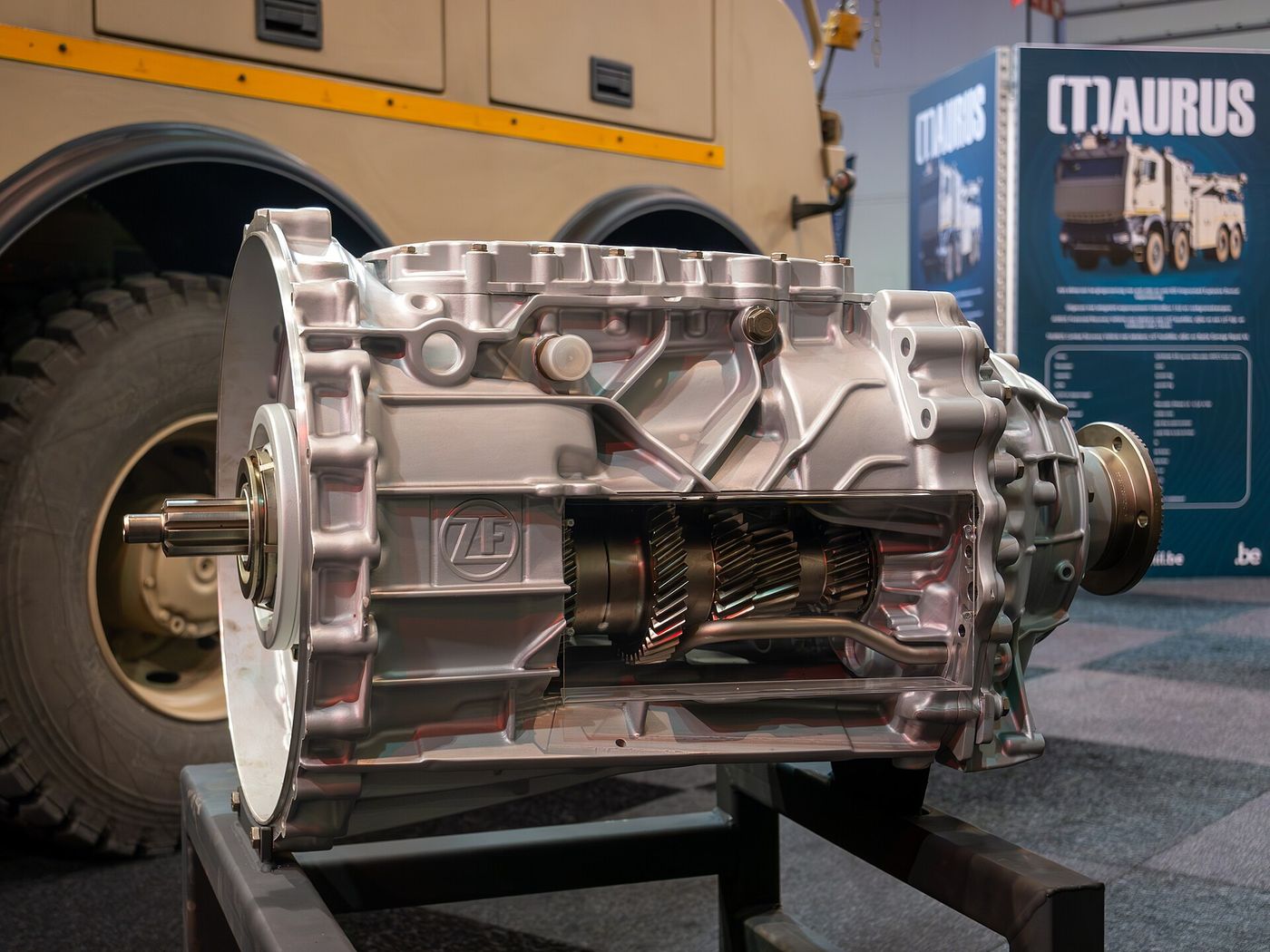
EU law defines four types of truck and bus gearbox in Annex VI to Commission Regulation (EU) 2017/2400, the Regulation under which the CO2 emissions of new medium and heavy lorries and heavy buses are determined. A synchronised manual transmission (SMT) is operated by the driver, who normally changes ratio while a clutch, usually the start-off clutch, disconnects the gearbox from the engine. An automated manual transmission (AMT) engages its gears with tooth clutches, synchronised or not, but an electronic control system makes each shift during a temporary disconnection from the engine. A dual clutch transmission (DCT) has two friction clutches and is declared as an AMT in the CO2 simulation. An automatic powershifting transmission (APT) changes ratio mainly through more than two friction clutches, normally without interrupting traction; the Regulation distinguishes cases with a torque converter in series, in parallel and without one. The Regulation also defines the compound transmission, a gearbox with a large number of forward gears and/or a large ratio coverage that is built from sub-transmissions such as a main section and a range section, and the splitter, which divides the main section gears.
Status as at 28 October 2026. Read on that day: the consolidated text of Regulation (EU) 2017/2400 of 1 January 2026; Volvo Trucks’ fact sheet on I-Shift Dual Clutch of 20 June 2022, its US I-Shift pages and its UK release of 5 May 2022; Scania’s Opticruise brochure, edition 2024.07, its UK S-series specifications page and its Super powertrain page; ZF’s TraXon page; Daimler Truck’s Powerliner release of 13 September 2026; and Allison Transmission’s product pages.
Four types, as the Regulation defines them
The Regulation “shall apply to medium lorries, heavy lorries and heavy buses” (Article 2(1)). Article 3(6) defines a transmission as a device of at least two shiftable gears that changes torque and speed with defined ratios. Annex VI, which sets out how the torque losses of transmissions and torque converters are certified, defines the types in its point 2, and Appendix 12 to that Annex lists the values a manufacturer may enter as the transmission type in the simulation tool.
| Type | Gears engaged by | Shifted by | During the shift | Declared as |
|---|---|---|---|---|
| Synchronised manual transmission, SMT (point 2(18)) | Synchronisers | The driver: “a manually operated transmission” | Normally a temporary disconnection from the engine by a clutch, usually the start-off clutch | SMT |
| Automated manual transmission, AMT (point 2(19)) | Tooth clutches, synchronised or unsynchronised | An electronically controlled system, which the driver can override in a manual mode | A temporary disconnection from the engine | AMT |
| Dual clutch transmission, DCT (point 2(20)) | Tooth clutches, with two friction clutches | An electronically controlled system, with a manual mode for the driver | Not addressed in the definition | AMT |
| Automatic powershifting transmission, APT (point 2(24)) | Mainly more than two friction clutches | An electronically controlled system, with a manual mode for the driver | Shifts “normally performed without traction interruption” | APT-S, APT-P or APT-N |
The definitions of the three self-shifting types describe the control system in almost the same words. For the AMT the text reads: “The ratio shifts are performed by an electronically controlled system managing the timing of the shift, the operation of the clutch between engine and gearbox and the speed and torque of the engine. The system selects and engages the most suitable forward gear automatically, but can be overridden by the driver using a manual mode.” The DCT and APT definitions contain the same words on the manual mode.
The type also appears in the files the simulation tool produces. The customer information file “shall at least contain” among its data the “Transmission type (SMT, AMT, APT, none)” and the “No. of gears” (Annex IV, Part II, points 1.2.5 and 1.2.6). The manufacturer’s records file gives the transmission type as SMT, AMT, APT-S, APT-P or APT-N (Part I, point 1.3.4). A footnote to Table 1 of Appendix 12 settles the dual clutch: “DCT shall be declared as transmission type AMT.” These files and the simulation behind them are described in what VECTO is.
Clutches, synchronisers and torque converters
The type definitions use the Annex’s terms for clutches. A tooth clutch is “a clutch where torque is transferred mainly by normal forces between mating teeth”; it is either engaged or disengaged, and “It is operated in load-free conditions, only (e.g., at gear shifts in a manual transmission)” (point 2(8)). A synchroniser is “a type of tooth clutch where a friction device is used to equalise the speeds of the rotating parts to be engaged” (point 2(11)). A friction clutch “can transmit torque while slipping”, and so can be operated “at start-offs and at powershifts (retained power transfer during a gear shift)” (point 2(10)). The start-off clutch “adapts speed between engine and driving wheels when the vehicle starts off” and is usually located between engine and transmission (point 2(17)).
A torque converter is “a hydrodynamic start-up component either as a separate component of the driveline or transmission with serial or parallel power flow that adapts speed between engine and wheel and provides torque multiplication” (Article 3(7)). Its lock-up clutch is “a friction clutch in a hydrodynamic torque converter; it can connect the input and output sides, thereby eliminating the slip” (point 2(16)). Annex VI distinguishes three cases of the automatic powershift type. Case S is an APT “with serial arrangement of a torque converter and the connected mechanical parts of the transmission”; Case P is one with a parallel arrangement, “e.g. in power split installations” (points 2(22) and 2(23)); Case N is “an APT without a torque converter” (point 2(33)). The input values for the transmission type are named APT-S, APT-P and APT-N.
Range, splitter and crawler gears
The Regulation names the parts that are combined to give a gearbox many ratios. A compound transmission is “a transmission, with a large number of forward gears and/or large ratio coverage, composed of sub-transmissions, which are combined to use most power-transferring parts in several forward gears” (point 2(4)). The related definitions in point 2:
- Main section: “the sub-transmission that has the largest number of forward gears in a compound transmission” (point 2(5)).
- Range section: a sub-transmission “normally in series connection with the main section”. It “usually has two shiftable forward gears”: the lower forward gears of the complete transmission use the low range gear, the higher gears the high range gear (point 2(6)).
- Splitter: “a design that splits the main section gears in two (usually) variants, low- and high split gears, whose gear ratios are close compared to the ratio coverage of the transmission”. It can be a separate sub-transmission, an add-on device, integrated with the main section or a combination of these (point 2(7)).
- Crawler gear: “a low forward gear (with speed reduction ratio that is larger than for the non-crawler gears) that is designed to be used infrequently, e.g., at low-speed manoeuvres or occasional up-hill start-offs” (point 2(13)).
Ratio coverage, which ZF and Scania call spread, is “the ratio of the largest to the smallest forward gear ratios in a transmission” (point 2(3)). When transmission losses are certified, the applicant applies one of the determination methods to “each single forward gear (crawler gears excluded)” (point 3).
The makers’ own descriptions use the same building blocks. Scania’s UK specifications page for the S-series lists, beside the Opticruise G25, G33 and G38, range-change gearboxes with 8 and 8+1 speeds and range-splitter gearboxes with 12 and 12+2 speeds. It describes the 8+1 as “Based on a 4-speed box, plus a planetary section”, with an extra crawler ratio, and the 12+2 as having two extra crawler ratios, with overdrive versions; Opticruise is named as an option for the 8-speed and as available for all range-splitter gearboxes. For the Opticruise, the same page states that “Instead of a reversing gear, a planetary gear is used for reversing”, giving eight reverse gears for speeds up to 30 km/h. Volvo’s fact sheet for I-Shift Dual Clutch describes a main section with “two input shafts, three main forward ratios and one reverse ratio”, a synchronised range gear of planetary type, and main-section dog clutches that are unsynchronised.
The makers give the spread, or its end ratios, in figures. ZF gives a transmission spread of 16.74 for its 12-speed TraXon. Scania gives the ratios of the Opticruise G25 and G33 as running from a crawler gear of 20.8 to an overdrive gear of 0.777, a spread it puts at 60 percent more than that of its previous GRS905 gearbox. Volvo’s I-Shift with Crawler Gears adds one or two gears to the 12-speed I-Shift for Severe Duty: “The 13-speed version has one low crawler gear with a 17.54 to 1 ratio. The 14-speed version has one low crawler gear with a 19.38 to 1 ratio, and one ultra low crawler gear with a 32.04 to 1 ratio. The overall ratio of the I-Shift with Crawler Gears, 41.08 to 1, is more than double that of the I-Shift.” How the gearbox ratio and the axle ratio combine into the overall reduction at the wheels is set out in axle ratios and final drive.
Automated manual gearboxes
Volvo dates its I-Shift to 2001, and its UK release of 5 May 2022 stated: “Today all heavy-duty Volvo trucks are built with I-Shift as standard.” Scania’s S-series page describes the Opticruise’s “fully automated clutch control”, and its brochure states that the G25, G33 and G38 “are identical in regards to the technical build up but are adapted to different engine torques”. ZF dates the global launch of TraXon to 2014. How an AMT carries out a shift, and how gearbox losses enter the CO2 figure, are covered in automated manual transmissions.
| Gearbox | Forward gears | Torque and engines | Other figures from the maker |
|---|---|---|---|
| Scania Opticruise G25 | 14, including a super crawler and an overdrive | 2,500 Nm; engines of 220 to 460 hp | 4 automated-shift reverse gears as standard, 8 as an option |
| Scania Opticruise G33 | 14, including a super crawler and an overdrive | 3,300 Nm; engines of 500 to 660 hp | 4 automated-shift reverse gears as standard, 8 as an option |
| Scania Opticruise G38 | 14, including a super crawler and an overdrive | 3,800 Nm; 770 hp engine | 4 automated-shift reverse gears as standard, 8 as an option |
| Volvo I-Shift for Severe Duty | 12 | Not stated on the page | Standard on Volvo VHD models (Volvo Trucks USA) |
| Volvo I-Shift with Crawler Gears | 13 or 14 | Not stated on the page | Crawler gear of 17.54 to 1 (13-speed); 19.38 to 1 and 32.04 to 1 (14-speed); overall ratio 41.08 to 1 |
| Volvo I-Shift Dual Clutch, SPO2812 | 12, with 4 reverse | 2,800 Nm maximum incoming torque | Up to 80 tonnes gross combination weight; 307 kg without oil |
| ZF TraXon | 12 | Not stated on the page | Transmission spread 16.74; global launch in 2014 |
Mercedes-Benz Trucks presented a new driveline generation, Powerliner, on 13 September 2026, to be introduced in its trucks from April 2027. Its release names five transmissions: the G 211 and G 230, designed as “efficient lightweight solutions for the OM 470 and moderate applications”; the G 291 and G 340 for medium-duty and heavy-duty applications, whose “broad gear spread” supports operation with longer rear-axle ratios; and the G 280 “for particularly heavy and specialized applications, especially in combination with a Turbo Retarder Clutch or large engine-driven power take-offs”. The release does not state their type or their number of gears.
Dual-clutch gearboxes
The Regulation defines the DCT as “an automatically shifting transmission with two friction clutches and several selectable speed ratios that are obtained by the use of tooth clutches” (point 2(20)), and it is declared as transmission type AMT in the simulation. Volvo’s fact sheet of 20 June 2022 describes its I-Shift Dual Clutch as “two gearboxes with two clutches”, integrated into one unit: “Since the gearbox has 12 gears, one shaft holds the six odd-numbered gears, while the other holds the six even-numbered gears.” The clutches are of the dry type. “Powershifting is possible for every single-step gear change except when changing the range gear (gear 6-7)”, and the fact sheet adds that in certain cases the gearbox performs a normal gear change, depending on the software strategy and on factors such as the gross combination weight and the throttle position. Clutch operation is controlled by the gear changing system, and “there is no clutch pedal”.
Torque-converter automatics
An APT obtains its ratios mainly through friction clutches, and in the Regulation’s words “Shifts are normally performed without traction interruption (friction clutch to friction clutch)” (point 2(24)). Allison Transmission, which lists series for trucks and for transit, coach and school buses, describes its automatics this way: “Allison Automatic transmissions incorporate a hydraulic torque converter that connects the engine to the transmission via a planetary gear set.” Its product pages state that its transmissions “are equipped with a torque converter instead of a dry clutch”.
| Series | Forward gears | Power, up to | Torque, up to | GVW, up to | Applications Allison names |
|---|---|---|---|---|---|
| 1000 and 2000 Series | 5 or 6 | 365 hp (272 kW) | 950 Nm (700 lb-ft) | 15,000 kg (33,000 lb) | Pickup and delivery trucks, utility vehicles, shuttle buses, emergency vehicles |
| 9-Speed | “nine forward ranges and three overdrive ranges” | 380 hp (283 kW) | 1,220 Nm (900 lb-ft) | 26,000 kg (57,000 lb) | Pickup and delivery, transit and coach buses, construction, mining, defence, motorhomes |
| 3000 Series | 6 | 450 hp (336 kW) | 1,695 Nm (1,250 lb-ft) | 44,500 kg (98,100 lb) | Distribution, refuse, utility services, fire and emergency, transit buses |
| 4000 Series | 6 or 7 | 800 hp (597 kW) | 3,200 Nm (2,360 lb-ft) | 110,000 kg (242,550 lb) | Construction, energy, mining and defence |
| 6000 Series | Up to 6, with 2 reverse | 1,025 hp (764 kW) | 3,729 Nm (2,750 lb-ft) | Not stated | Off-highway trucks, oil field rigs and cranes |
Allison describes the 9-Speed as an uprated variant of the 2000 Series. The model table on its 4000 Series page gives six forward ranges and one reverse for the 4000 and 4500, and seven forward and two reverse ranges for the 4700, 4800 and 4900 and for the 4970 TerraTran. For transit and coach buses Allison lists the 1000 and 2000 Series, the 9-Speed, the 3000 Series and the 4000 Series, beside its eGen Flex hybrid system and its eGen Power electric axles. Its 8000 Series, with six or seven forward gears, and its 9000 Series, with eight, are for mining vehicles, oil field equipment and cranes.
Retarder and power take-off
The Regulation defines two devices that makers list as options on their gearboxes. A retarder is “an auxiliary braking device in a vehicle powertrain; aimed for permanent braking” (point 2(21)); a power take-off is “a device on a transmission or an engine to which an auxiliary driven device, e.g., a hydraulic pump, can be connected” (point 2(14)). Volvo’s fact sheet states: “A power take-off, compact retarder and emergency power steering pump can be fitted to the transmission.” Scania lists its retarder and a selection of power take-offs as options on its range-change and range-splitter gearboxes, and Allison’s 6000 Series has “optional retarder capability” and is provisioned for a power take-off. The retarder types and their brake torques are covered in retarders and engine braking.
Gearboxes in hybrid and electric drivelines
The values for the transmission type in Appendix 12 also include “IHPC Type 1”, an integrated hybrid electric vehicle powertrain component, which Annex Xb defines as “a combined system of multiple electric machine systems together with the functionality of a multi-speed gearbox characterised by a shared housing of all components”, with one input shaft and one output shaft. An integrated electric powertrain component, or IEPC, is in the same Annex “a combined system of an electric machine system together with the functionality of either a single- or multi-speed gearbox or a differential or both”, and has no input shaft for feeding propulsion torque into it. The customer information file allows “none” as the transmission type. The gearboxes and electric axles of current electric trucks are described in electric trucks explained, and the drive options side by side in heavy-vehicle powertrains.
Quick answers
- What types of gearbox do trucks and buses have?
- Regulation (EU) 2017/2400, which governs how the CO2 emissions of new medium and heavy lorries and heavy buses are determined, defines four in its Annex VI: the synchronised manual transmission (SMT), which the driver shifts, normally while a clutch disconnects it from the engine; the automated manual transmission (AMT), whose tooth-clutch gears an electronic control system shifts during a temporary disconnection from the engine; the dual clutch transmission (DCT), with two friction clutches; and the automatic powershifting transmission (APT), with more than two friction clutches and shifts normally made without traction interruption. A DCT is declared as an AMT in the CO2 simulation.
- What is the difference between an automated manual and an automatic truck gearbox?
- In the EU definitions an AMT obtains its ratios with tooth clutches and changes them during a temporary disconnection of the gearbox from the engine. An automatic powershifting transmission (APT) obtains its ratios mainly with more than two friction clutches and normally shifts without traction interruption; the Regulation distinguishes cases with a torque converter in series, in parallel and without one, and its input values for the type are APT-S, APT-P and APT-N. Allison describes its automatics as having a hydraulic torque converter that connects the engine to the transmission via a planetary gear set.
- What do range and splitter mean on a truck gearbox?
- Both are parts of a compound transmission. The range section is a sub-transmission, normally in series with the main section, that usually has two gears: the lower gears of the complete gearbox use the low range gear, the higher gears the high range gear. A splitter divides the main section gears, usually into low and high split gears whose ratios lie close together relative to the ratio coverage of the gearbox. Volvo's I-Shift Dual Clutch has a main section with three forward ratios and a planetary range gear; Scania describes its 8+1-speed gearbox as a 4-speed box plus a planetary section.
- How many gears does a truck gearbox have?
- It depends on the line. ZF's TraXon, Volvo's I-Shift for Severe Duty and Volvo's I-Shift Dual Clutch have 12 forward gears, and Volvo's crawler versions 13 or 14. Scania's Opticruise G25, G33 and G38 have 14, including a super crawler and an overdrive, and Scania's UK S-series page also lists range-change gearboxes with 8 and 8+1 speeds and range-splitter gearboxes with 12 and 12+2. Allison's 1000 and 2000 Series automatics have five or six forward gears, its 3000 Series six, its 4000 Series six or seven and its 9-Speed nine forward ranges.
- Is a dual-clutch truck gearbox an automatic or an automated manual?
- EU law defines the dual clutch transmission separately, as an automatically shifting transmission with two friction clutches and ratios obtained with tooth clutches, and requires it to be declared as transmission type AMT in the CO2 simulation. Volvo's I-Shift Dual Clutch has 12 forward gears on two input shafts, one for the odd and one for the even gears, and can powershift at every single-step change except the range change between 6th and 7th gear.
Sources
- Commission Regulation (EU) 2017/2400 of 12 December 2017 on the determination of the CO2 emissions and fuel consumption of heavy-duty vehicles, consolidated text of 1 January 2026: Articles 2 and 3, Annex IV Parts I and II, Annex VI points 2 and 3 and Appendix 12, Annex Xb point 2 — EUR-Lex, Publications Office of the European Union, 1 Jan 2026
- I-Shift Dual Clutch, SPO2812: fact sheet, version 04 of 20 June 2022 — Volvo Trucks, 20 Jun 2022
- I-Shift with Crawler Gears (read on 28 October 2026) — Volvo Trucks USA
- I-Shift for Severe Duty (read on 28 October 2026) — Volvo Trucks USA
- Volvo Trucks increases I-Shift gearbox shifting speed by up to 30% (press release, 5 May 2022) — Volvo Trucks UK, 5 May 2022
- Scania Opticruise gearbox G25, G33 and G38: brochure, edition 2024.07 — Scania CV AB
- S-series specifications: gearbox options (read on 28 October 2026) — Scania Great Britain
- Scania Super powertrain: Opticruise gearbox information (read on 28 October 2026) — Scania CV AB
- TraXon, automated manual transmission for heavy vehicles: campaign page for India (read on 28 October 2026) — ZF Friedrichshafen AG
- Mercedes-Benz Trucks Powerliner: new driveline generation with four percent lower fuel consumption (press release, 13 September 2026) — Daimler Truck AG, 13 Sept 2026
- Products: transmission models and their ratings capability (read on 28 October 2026) — Allison Transmission
- 1000 Series and 2000 Series (read on 28 October 2026) — Allison Transmission
- 9-Speed (read on 28 October 2026) — Allison Transmission
- 3000 Series (read on 28 October 2026) — Allison Transmission
- 4000 Series, with the model table of forward and reverse ranges (read on 28 October 2026) — Allison Transmission
- 6000 Series (read on 28 October 2026) — Allison Transmission
- 8000 Series (read on 28 October 2026) — Allison Transmission
- 9000 Series (read on 28 October 2026) — Allison Transmission
- Automatics vs AMTs (read on 28 October 2026) — Allison Transmission
- Propulsion solutions for transit and coach buses (read on 28 October 2026) — Allison Transmission