Freightliner
Freightliner eCascadia
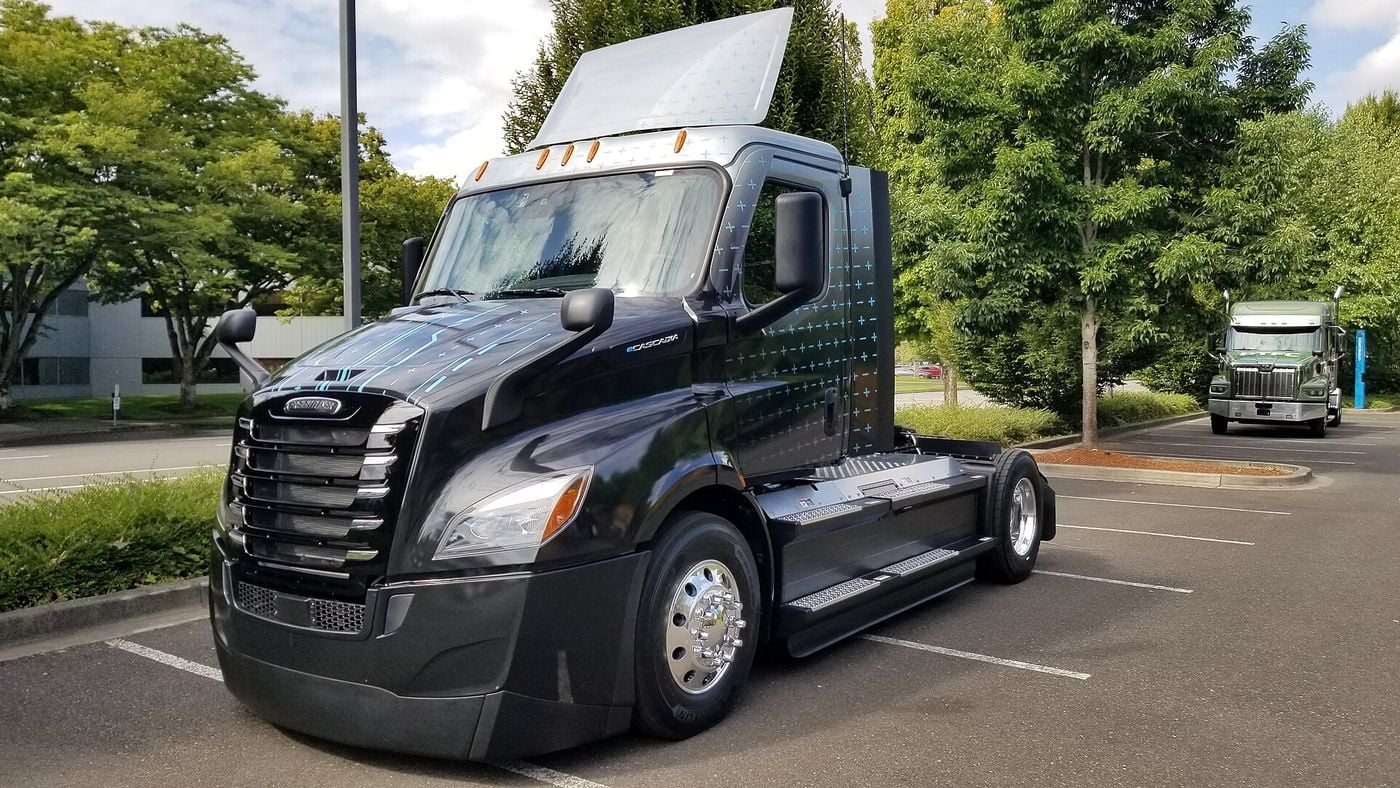
The battery-electric Class 8 day-cab tractor on Freightliner's US pages: 291 or 438 kWh usable, 320 to 470 HP, 4x2 or 6x4, up to 82,000 lbs. GCW and CCS1 charging up to 270 kW.
- 2 configurations
- 240/296/317/350 kW

Model overview
- Segment
- Long-haul tractor
- Axle configurations
- 2 (4x2…)
- Transmission
- Integrated in the Detroit eAxle
- Battery
- up to 438 kWh
- Charging
- 270 kW (CCS1)
- Electric motor
- 240/296/317/350 kW
Axle configurations: 4x2 · 6x4
The Freightliner eCascadia is a battery-electric Class 8 tractor with a day cab and a single or tandem drive axle, as listed on Freightliner’s US website. Freightliner describes it as “built on the proven, aerodynamic Cascadia platform” and says it has the same efficient shape as the Cascadia. Of the documents cited, all read on 4 November 2026, only Freightliner’s electric truck FAQ article carries a date, 29 February 2024; the eCascadia product and specifications pages, Detroit’s ePowertrain page and four other Freightliner articles print none.
Overview and generations
Freightliner’s launch article says “the series-production eCascadia has officially launched” after more than one million test miles and loads delivered for real fleets. It calls the truck the latest generation of Freightliner’s electric semi trucks and lists these design improvements:
- Charging. Dual-port charging, with 0% to 80% in as little as 90 minutes when the truck has the 438 kWh battery pack.
- Grille. An updated grille that increases airflow around the nose of the truck and improves aerodynamic performance.
- Battery protection. Side-impact protection panels designed to absorb collision forces and protect the high-voltage batteries from cracks or punctures.
- Packaging. A Detroit eAxle that Freightliner says minimizes weight and maximizes use of space, so that the truck can be specified with standard wheel ends, tighter axle spacing and a shorter wheelbase than the pre-production eCascadia.
No document opened gives the date of the launch, the start of series production or a production plant. The product page says the truck is in operation with a number of North American fleets and is available for reservations.
Earlier trucks. Freightliner’s article “State of Charge: 2021 Electric Trends and Milestones” says Freightliner electric semi trucks have been running the roads since 2018, and that the Customer Experience Fleet Program of Daimler Truck North America reached the million-mile mark in 2021.
Figures in an undated article. Freightliner’s article on driving the eCascadia, which points readers to dealers for pre-ordering, gives a 475 kWh battery, up to 250 miles of range, recharging of 80% in 90 minutes and a two-speed transmission. Its battery and range figures differ from those of the specifications page, and no document opened explains the difference.
Cab
The specifications page lists one cab, a day cab with a BBC (bumper to back of cab) of 116 inches. Freightliner’s product page names a new grille, two aerodynamic packages and LED lighting on the exterior; no document opened describes the two packages.
Inside, the product page lists a two-screen digital dash and a tilt and telescoping steering wheel with multi-function controls as standard, along with fully customizable LED-backlit switches, ergonomic seats and noise-reduction technology. Freightliner’s FAQ article adds touch screen displays and visual displays that show how energy flows across the chassis.
Electric drive
The drive is the Detroit ePowertrain, which Detroit describes as Detroit eAxles and batteries working together. It defines an eAxle as an electric drivetrain component that integrates an electric motor, transmission and specialized electronics in a compact unit. The specifications page gives the propulsion as “Tandem or single Detroit eAxle”, with these ratings:
| Drive | Horsepower | Usable capacity |
|---|---|---|
| Tandem drive | 425 HP (317 kW) or 470 HP (350 kW) | 438 kWh |
| Single drive | 320 HP (240 kW) or 395 HP (296 kW) | 291 kWh or 438 kWh |
Detroit’s ePowertrain page lists two eAxle designs and says they can be combined:
- Dual motor. Max torque 23,000 lb-ft, max power 395 hp.
- Single motor. Max torque 11,500 lb-ft, max power 195 hp.
The FAQ on the product page says the eCascadia is available with a single-motor eAxle of 11,500 lb-ft max torque and a dual-motor eAxle of 23,000 lb-ft max torque, and speaks of “100% torque potential from 0 miles-per-hour”. No document opened says which eAxle or combination gives each rating in the table, or whether the ratings are continuous or peak.
Transmission
Detroit says the eAxle integrates the transmission. Freightliner’s article on driving the eCascadia names “a two-speed transmission that applies continuous torque to the motor from a standstill”. The specifications page gives no gear count, and no document opened gives ratios.
Axles, suspension and brakes
The specifications page speaks of single and tandem drive. The FAQ on the product page names the 4x2 and 6x4 configurations and gives them the ranges the specifications page gives single and tandem drive. No document opened gives wheelbases, axle or suspension ratings, brake hardware or tyre sizes.
Freightliner’s FAQ article says regenerative braking is controlled the same as a traditional Jake Brake or engine brake, with a lever switch on the side of the steering wheel, and that the further the lever is shifted down, the more stopping power is received. It says energy recaptured when descending hills is stored and used during other portions of the route.
Dimensions and weights
| Item | Figure |
|---|---|
| Length | 273 or 306 in |
| Width | 100.7 in |
| Height | 116.2 in (157.4 in with roof fairing) |
| Max GCW, tandem drive | 82,000 lbs. |
| Max GCW, single drive | 65,000 lbs. |
| Approximate kerb weight, 4x2 standard-range | 16,350 |
| Approximate kerb weight, 4x2 long-range | 18,750 |
| Approximate kerb weight, 6x4 | 21,800 |
The FAQ prints the three kerb weights with no unit, directly after a sentence in pounds. It gives the maximum gross combined weight for the eCascadia and trailer as 82,000 lbs., and the product page header gives “UP TO” that figure; the split between tandem and single drive is on the specifications page. Freightliner’s article on driving the eCascadia footnotes the same 82,000 lbs. as “GVW for the eCascadia”. The specifications page gives no gross vehicle weight rating. The ratings themselves are explained in GVWR, GCWR and GAWR.
Freightliner’s documents give lengths in inches, weights in pounds and range in miles, and no document opened gives metric figures for them.
Battery
The specifications page gives a usable capacity of 438 kWh for tandem drive and of 291 kWh or 438 kWh for single drive. The FAQ on the product page speaks of two battery capacity offerings, and of standard-range and long-range 4x2 trucks. Installed and usable capacity are two different figures; no document opened gives the installed capacity, the cell chemistry, the voltage or the number of packs.
Detroit’s ePowertrain page lists three battery options, of 194, 291 and 438 kWh. Freightliner’s FAQ article gives the 194 kWh pack to the Class 6 eM2 and 291 and 438 kWh to the eCascadia.
The same article describes a battery monitoring system that checks for abnormal heat or voltage fluctuations and a gas detection system that alerts the driver to potential gas leaks from the battery pack. It also describes preconditioning: with the truck plugged in before a shift, the feature warms the cabin, defrosts the windshield and brings the battery to its proper temperature. It says electric trucks warm the cab with electric heating elements rather than engine waste heat.
Range as Freightliner states it
| Configuration | Usable capacity | Typical range |
|---|---|---|
| Tandem drive (6x4) | 438 kWh | 220 miles |
| Single drive long-range (4x2) | 438 kWh | 230 miles |
| Single drive standard range (4x2) | 291 kWh | 155 miles |
The specifications page says range will vary depending on drive axle and battery configuration, load, driver behavior, environmental conditions and other factors. It says the stated range is derived from 1,000,000+ miles of real operation experience on Freightliner’s Innovation and Customer Experience (CX) Fleets, and is calculated for typical load profiles in the target applications and with usage of regenerative braking. The FAQ on the product page says the ranges assume a gradually diminishing load, consistent usage of regenerative braking and routes that start on a full charge. How makers state such figures is covered in how electric-truck range is declared.
Freightliner’s FAQ article says field studies showed that most daily ranges for fleets focused on port drayage, intermodal transport and regional-haul routes typically fall between 100 to 200 miles, and that this influenced the design. The product page calls the truck “ready for any short-haul route”. The FAQ article says Freightliner engineers tested the truck in extremely high and low temperatures, and it refers routes consistently below -4°F to Detroit eConsulting for a route analysis.
Charging
The eCascadia uses CCS1 DC charging, which Freightliner’s FAQ article calls the standard charging protocol for electric vehicles in North America. The specifications page gives the charging power as “Up to 180 kW with single port charging / up to 270 kW, with dual port charging”. The FAQ article gives up to 180 kW per port and the option of two charge ports with the 438 kWh battery, which “could potentially receive 270 kilowatts of power”. The charging methods themselves are covered in charging electric trucks and buses.
- 0% to 80%. The specifications page gives “80% in ~90 min.” and the product page “as little as 90 minutes”. The launch article ties the time to dual-port charging with the 438 kWh battery pack; the FAQ article gives it, in optimal conditions, for the 291 kWh pack or for dual-port charging with the 438 kWh pack.
- Outside optimal conditions. The FAQ article gives three to four hours for the eCascadia.
- Zero to full. Detroit’s ePowertrain page gives average times of 2 to 6 hours for the 291 kWh battery and 2 to 6 hours for the 438 kWh battery.
Freightliner’s “State of Charge” article says Detroit eFill chargers, a line of charging solutions, were launched in May 2021.
Safety and driver-assistance systems
Freightliner says the Detroit Assurance suite comes standard on the eCascadia. Its safety article lists these systems:
- Side Guard Assist. Detects objects and people along the passenger side of the truck.
- Active Side Guard Assist (ASGA). Engages at 12 mph or less. When a moving cyclist or pedestrian is detected on the passenger side and the tractor initiates a right turn, it applies braking, in addition to visual and audible warnings. The launch article says it adds to the standard Side Guard Assist.
- Active Brake Assist 5. Calculates the truck’s speed and distance to other vehicles to determine if a warning or braking action is needed.
- Adaptive Cruise Control to 0 MPH. Adjusts the cruising speed to maintain a following distance from other vehicles.
- Active Lane Assist. Reduces road vibrations, improves low-speed maneuverability and increases ease of steering through micro-adjustments. The launch article says it can automatically steer the truck back into its lane and keep it centered, and calls the eCascadia the first Freightliner to come standard with it.
The safety article adds Intelligent High Beams, automatic wipers and headlamps, Tailgate Warning, Lane Departure Warning and video capture using Bendix SafetyDirect. The FAQ article’s list of the standard suite also has Brake Hold Mode. The product page applies the words “industry-first” to Side Guard Assist; the launch and safety articles apply them to Active Side Guard Assist.
High-voltage protection. Freightliner’s FAQ article says impact sensors throughout the truck open the high-voltage interlock loop in a collision to cut electrical flow, and that the driver has an emergency stop button designed to instantly shut off the high-voltage circuit. It says accessible low-voltage cables give first responders a way to shut down the high-voltage system, and that the high-voltage circuit remains isolated from the chassis in water submersion. It says Freightliner Emergency Response Guides are available for download; such guides are the subject of rescue sheets and emergency-response guides.
Connectivity
The product page lists Detroit Connect with automatic charging management and battery-health monitoring for multiple vehicles, real-time route planning and changes, post-trip reports for drivers on range and battery lifespan, and safety data gathered from the Detroit Assurance suite. It also names Detroit eConsulting, a support team on infrastructure and route planning.
Source notes
Freightliner’s specifications page, read on 4 November 2026: Class 8; day cab 116” BBC; tandem or single Detroit eAxle; tandem drive 425 HP (317 kW) or 470 HP (350 kW), usable capacity 438 kWh, typical range 220 miles, max GCW 82,000 lbs.; single drive 320 HP (240 kW) or 395 HP (296 kW), usable capacity 291 kWh or 438 kWh, typical range 155 miles (standard range) or 230 miles (long-range), max GCW 65,000 lbs.; length 273” or 306”, width 100.7”, height 116.2” (157.4” with roof fairing); charging 80% in ~90 min., up to 180 kW with single port and up to 270 kW with dual port. The FAQ on the product page gives the 4x2 and 6x4 configurations, approximate curb weights of 16,350 (4x2 standard-range), 18,750 (4x2 long-range) and 21,800 (6x4), with no unit printed, and a single-motor eAxle of 11,500 lb-ft and a dual-motor eAxle of 23,000 lb-ft max torque. Detroit’s ePowertrain page gives the single-motor eAxle 195 hp and the dual-motor eAxle 395 hp max power, and average zero-to-full charging times of 2 to 6 hours for both the 291 kWh and the 438 kWh battery. Freightliner’s FAQ article of 29 February 2024 names CCS1 DC charging. An undated Freightliner article gives a 475 kWh battery, up to 250 miles of range and a two-speed transmission.
Quick answers
- What axle configurations does the Freightliner eCascadia come in?
- 4x2, 6x4.
- Which transmission does the Freightliner eCascadia use?
- Transmission: Integrated in the Detroit eAxle.
- What battery capacity does the Freightliner eCascadia have?
- Battery: up to 438 kWh; Charging: 270 kW (CCS1).
Articles that mention the Freightliner eCascadia
More Freightliner on this site
Sources
- eCascadia (product page) — Freightliner Trucks
- Freightliner eCascadia Specs — Freightliner Trucks
- Detroit ePowertrain — Detroit (Daimler Truck North America)
- You Asked, We Answered: Electric Truck FAQs (29 February 2024) — Freightliner Trucks, 29 Feb 2024
- eCascadia: Launched and Ready to Flip the Electric Switch — Freightliner Trucks
- What it's like to Drive the eCascadia: 5 Most Surprising Features — Freightliner Trucks
- eCascadia: 3 Ways That Next-level Safety Comes Standard — Freightliner Trucks
- State of Charge: 2021 Electric Trends and Milestones — Freightliner Trucks