Freightliner
Freightliner Cascadia
The fifth-generation Cascadia as Freightliner specifies it: Detroit DD13 and DD15 in Gen 5 and Gen 6 form, the Cummins X15N, two cab lengths, 12-speed automated gearboxes and ABA6.
- 2007—
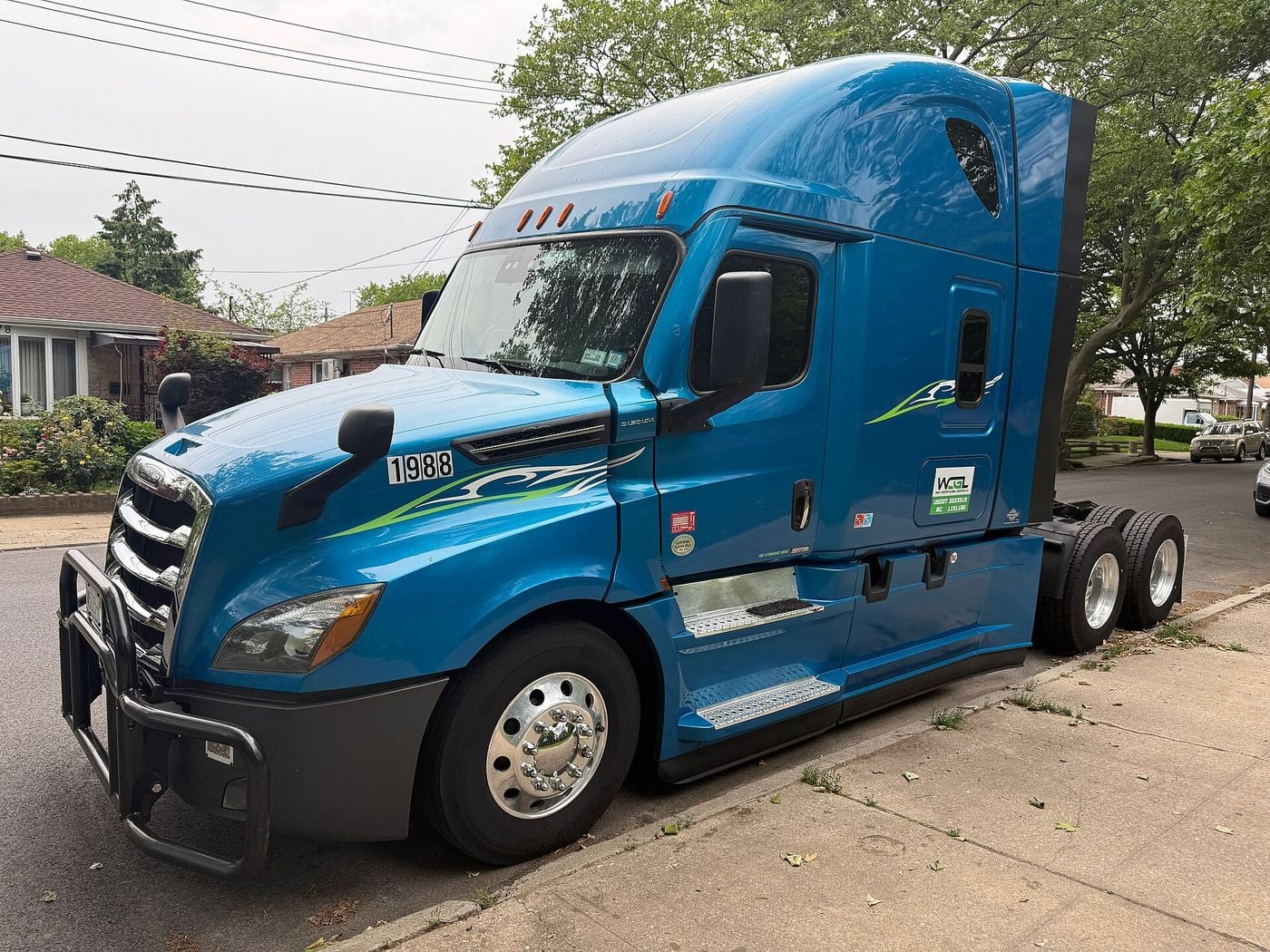

Model overview
- Segment
- Long-haul tractor
- Produced
- 2007—
- Transmission
- Detroit DT12 On-Highway Series 12-speed automated manual (DT12-HE, DT12-HL), standard; Eaton Cummins Endurant 12-speed optional
The Cascadia is Freightliner’s on-highway tractor, and Daimler Truck North America (DTNA) calls it the industry’s best-selling Class 8 truck. Its fifth generation was unveiled on 15 October 2024 and was scheduled to begin production in mid-2025. Freightliner’s specifications page lists it with Detroit DD13 and DD15 engines in two generations, a Cummins natural gas engine, two cab lengths with day cab and sleeper versions, and two 12-speed automated gearboxes. Class 8 is the heaviest gross vehicle weight rating class in 49 CFR 565.15, 33,001 pounds and over; how that rating works is explained in GVWR, GCWR and GAWR.
Overview and generations
DTNA’s release of 15 October 2024 says customers have bought more than one million Cascadias since the model’s original introduction in 2007, and that over four generations the truck has delivered fuel efficiency gains of more than 35 percent. It credits the fifth generation’s aerodynamic changes with an additional fuel economy benefit of 1.9 percent: a new hood design, a redesigned A-pillar deflector, three-piece front wheel well closeouts, a hood-to-bumper seal and new bumper air ducts that direct airflow around the underbody and tyres.
The release offered the new Max Aero Bumper as an option. Freightliner’s specifications page, read on 30 September 2026, lists it among the standard aerodynamic features, together with drive wheel covers, integrated antennas and a detachable rain tray with quick rear engine access; chassis fairings with enhanced skirts, 24-inch side extenders with seals and an optimised roof fairing are standard on sleeper and mid-roof cabs.
Cab
Freightliner names the two cab lengths by BBC, the bumper-to-back-of-cab measurement, and offers three roof and cab types on them:
| Cab | BBC | Sleeper length |
|---|---|---|
| Day cab | 116 or 126 | – |
| Sleeper cab, Mid-Roof XT | 116 or 126 | 48, 60 or 72 |
| Sleeper cab, Raised Roof | 116 or 126 | 60 or 72 |
The page gives no overall length, width or height. Standard inside are a 5-inch LCD instrument cluster, a 7-inch touchscreen with Apple CarPlay and Android Auto, a tilt-telescoping steering column, a one-piece windshield and an HVAC system with six dash-mounted vents and eight blower speeds; in a day cab the rear windows give a combined viewable area of 56 by 22 inches. Freightliner’s Fifth Generation page describes a telescoping ladder to the top bunk as the industry’s first. Among the options are a Driver’s Lounge package with a Murphy bed, a dinette table, two seats with seatbelts, a TV mount and an AC outlet with a 1,800-watt inverter or pre-wire, and a parked HVAC system against idling. What a sleeper cab is for, and how cab types compare, is covered in truck cabs explained.
Engines
| Engine | Power | Torque | Availability |
|---|---|---|---|
| Detroit Gen 5 DD13 | 370–525 HP | 1,250–1,850 lb-ft | Current |
| Detroit Gen 5 DD15 | 425–505 HP | 1,550–1,850 lb-ft | Current |
| Detroit Gen 6 DD13 | 410–525 HP | 1,450–1,850 lb-ft | January 2027 |
| Detroit Gen 6 DD15 | 425–505 HP | 1,650–1,900 lb-ft | January 2027 |
| Cummins X15N (natural gas) | 400–500 HP | 1,450–1,850 lb-ft | Current |
Freightliner gives power in horsepower and torque in pound-feet and publishes no kilowatt or newton-metre figures, so none are recorded here. For orientation, 525 hp is about 391 kW and 1,900 lb-ft about 2,576 Nm (our arithmetic).
Detroit Gen 6. On 27 August 2026 DTNA announced that customers could specify Gen 6 DD13 and DD15 engines in Freightliner and Western Star trucks from 1 September. It says the lineup is designed to meet EPA 2027 emissions requirements, that about 75% of its core components carry over from the previous generation, and that it went through three years of testing and more than 8 million miles of real-world validation. Freightliner’s specifications page marks the Gen 6 engines as available in January 2027, lists the Gen 6 DD13 as the standard engine of the 116-inch Cascadia and the Gen 6 DD15 of the 126-inch one, and names 2027-compliant aftertreatment technology among the standard drivetrain features.
What changed since the launch. The October 2024 release gave the Detroit engines at launch ratings of up to 505hp and 1,850 lb-ft; the specifications page now lists the Gen 5 DD13 at up to 525 HP. The same release said the Cummins X15 and the X15N, which it calls “the first natural gas engine designed specifically for heavy-duty and on-highway truck applications”, would be available in 2025 and 2026 respectively, with 400 to 605 hp and 1,450 to 2,050 lb-ft between them. The specifications page lists the X15N at the ratings in the table and the diesel X15 among the options as available from January 2027.
Transmission
Both gearboxes on the specifications page are 12-speed automated manual transmissions: the Detroit DT12 On-Highway Series, in DT12-HE and DT12-HL versions, which is the standard fit, and the Eaton Cummins Endurant. The pages read for this record give no gear ratios and no axle ratios.
Axles, suspension and brakes
Freightliner writes axle and suspension ratings with a k, in thousands of pounds by the usual North American notation; the page does not spell out the unit.
- Front axles: Detroit 12k, 12.5k, 13.3k and 14.7k; Meritor MFS 12k, 12.5k, 13.3k and 14.7k; Hendrickson Steertek NXT 12.5k and 13.3k.
- Rear axles: Detroit single axles 20k and 23k and tandem 40k; Meritor single 20k and 23k and tandem 40k and 46k.
- Front suspension: Freightliner Airliner 12.5k, 13.3k and 14.6k; Hendrickson Airtek 12.5k and 13.3k; Freightliner Taperleaf 12.5k, 13.3k and 14.6k.
- Rear suspension: Freightliner Airliner single axle 21k and 23k and tandem 40k and 46k; Airliner with Optimaax 40k.
The standard specification is a Detroit 12k steer axle with a Detroit 23k single or 40k tandem rear axle, both with Axle Lube Management 2.0, Meritor air disc brakes with Positive Pad Retraction, a TRW single THP-60 power steering gear and up to 50 degrees of wheel cut. Wabco and Bendix air disc brakes for steer and drive axles, wide-base single wheels and tyres and Wabco ECAS are options. Freightliner prints no wheel formula; a single rear axle makes the tractor a 4x2 and a tandem a 6x4, as explained in axle configurations.
Safety and driver-assistance systems
The Detroit Assurance suite with Active Brake Assist 6 (ABA6) is standard. The specifications page describes ABA6 as full automatic emergency braking for moving and stationary vehicles, offset vehicles and vehicles at an angle, visible vehicles in curves or in multiple lanes, and for moving and stationary pedestrians and bicyclists. The standard suite also lists Cross Traffic Assist, Active Side Guard Assist 2, Adaptive Cruise Control to 0 mph, Side Guard Alert 2, Front Guard Alert, Lane Departure Warning, Traffic Sign Display, a tailgate warning, a forward-facing camera, automatic wipers and headlamps and Intelligent High Beam, beside the Intelligent Braking Control System with an electronic park brake, Enhanced Stability Control and dual-stage LED headlights with automatic defogging and deicing.
DTNA’s release explains two of these. The Intelligent Braking Control System is brake-by-wire with backup pneumatics; its Endurance Braking blends the engine retarder and the service brakes when the pedal is applied, and the electronic park brake enables Rollaway Mitigation, designed to apply the parking brake automatically when the driver leaves the seat. The release also counts four new short-range radar sensors and an improved long-range radar sensor in the fifth generation.
Options include Active Lane Assist 2, Active Speed Intervention, the MirrorCam camera system, a panic button in the sleeper, the LifeGuard RollTek rollover restraint with seat-mounted airbags and a steering-wheel airbag for the driver.
Freightliner’s specifications page gives no kerb weight and no gross combination weight rating. This page follows Freightliner’s US website.
Source notes
Engines on Freightliner’s specifications page, in the maker’s units: Detroit Gen 5 DD13: 370-525 HP and 1250-1850 lb-ft; Detroit Gen 5 DD15: 425-505 HP and 1550-1850 lb-ft; Detroit Gen 6 DD13: 410-525 HP and 1450-1850 lb-ft; Detroit Gen 6 DD15: 425-505 HP and 1650-1900 lb-ft, both Gen 6 engines marked “Available January 2027”; Cummins X15N 400-500 HP and 1450-1850 lb-ft, with the diesel Cummins X15 listed among the options as available January 2027. As standard the 116” BBC Cascadia takes the Gen 6 DD13 and the 126” BBC Cascadia the Gen 6 DD15, with 2027-compliant aftertreatment. For orientation, 525 hp is about 391 kW and 1,900 lb-ft about 2,576 Nm (our arithmetic). DTNA’s release of 15 October 2024 gave the Detroit DD13 and DD15 at launch ratings of up to 505hp and 1,850 lb-ft, and the Cummins X15 and X15N, due in 2025 and 2026, 400 to 605 hp and 1,450 to 2,050 lb-ft; it counted more than one million Cascadias sold since 2007, fuel efficiency gains of more than 35 percent over four generations, a further 1.9 percent from the fifth generation’s aerodynamics, four new short-range radar sensors, and production from mid-2025. DTNA’s release of 27 August 2026 opened ordering for Gen 6 DD13 and DD15 engines from 1 September, designed to meet EPA 2027 emissions requirements, with about 75% of core components carried over, three years of testing and more than 8 million miles of validation. Cabs: day cab at 116” or 126” BBC; Mid-Roof XT sleeper at 116” or 126” BBC with a 48”, 60” or 72” sleeper; Raised Roof sleeper at 116” or 126” BBC with a 60” or 72” sleeper. Interior: 5” LCD instrument cluster, 7” touchscreen, HVAC with six dash vents and eight blower speeds, day-cab rear windows of 56” x 22” combined viewable area, 24” side extenders standard on sleeper and mid-roof cabs, and an optional AC outlet with a 1,800-watt inverter. Transmissions: 12 speed, Detroit DT12 On-Highway Series (DT12-HE, DT12-HL) or Eaton Cummins Endurant. Front axles: Detroit and Meritor MFS 12k, 12.5k, 13.3k and 14.7k, Hendrickson Steertek NXT 12.5k and 13.3k. Rear axles: Detroit single 20k and 23k, tandem 40k; Meritor single 20k and 23k, tandem 40k and 46k. Front suspension: Freightliner Airliner and Taperleaf 12.5k, 13.3k and 14.6k, Hendrickson Airtek 12.5k and 13.3k. Rear suspension: Freightliner Airliner single 21k and 23k, tandem 40k and 46k, Airliner with Optimaax 40k. Standard: Detroit 12k steer axle, Detroit 23k single or 40k tandem rear axle with Axle Lube Management 2.0, TRW single THP-60 power steering gear, up to 50-degree wheel cut, Detroit Assurance with Active Brake Assist 6 (ABA6), Active Side Guard Assist 2, Side Guard Alert 2, Adaptive Cruise Control to 0 mph; optional Active Lane Assist 2. Class 8 under 49 CFR 565.15 is 33,001 lbs. and over.
Quick answers
- When did production of the Freightliner Cascadia start?
- Production of the Freightliner Cascadia started in 2007.
- Which transmission does the Freightliner Cascadia use?
- Transmission: Detroit DT12 On-Highway Series 12-speed automated manual (DT12-HE, DT12-HL), standard; Eaton Cummins Endurant 12-speed optional.
More Freightliner on this site
Sources
- Freightliner Cascadia specifications — Freightliner Trucks
- Fifth Generation Cascadia — Freightliner Trucks
- Freightliner unveils Fifth Generation Cascadia (15 October 2024) — Daimler Truck North America
- Daimler Truck North America Opens Ordering for Detroit Gen 6 Engines, Built on a Proven Platform (27 August 2026) — Daimler Truck North America
- 49 CFR 565.15 — Content requirements, Table II: Gross Vehicle Weight Rating Classes — eCFR, National Archives