Otokar
Otokar e-Centro
Otokar's battery-electric low-floor minibus, 6.6 m long: a 140 kW, 1,200 Nm motor, a 110 kWh Li-ion NMC battery, close to 200 km and 32 passengers; Level 4 autonomous version.
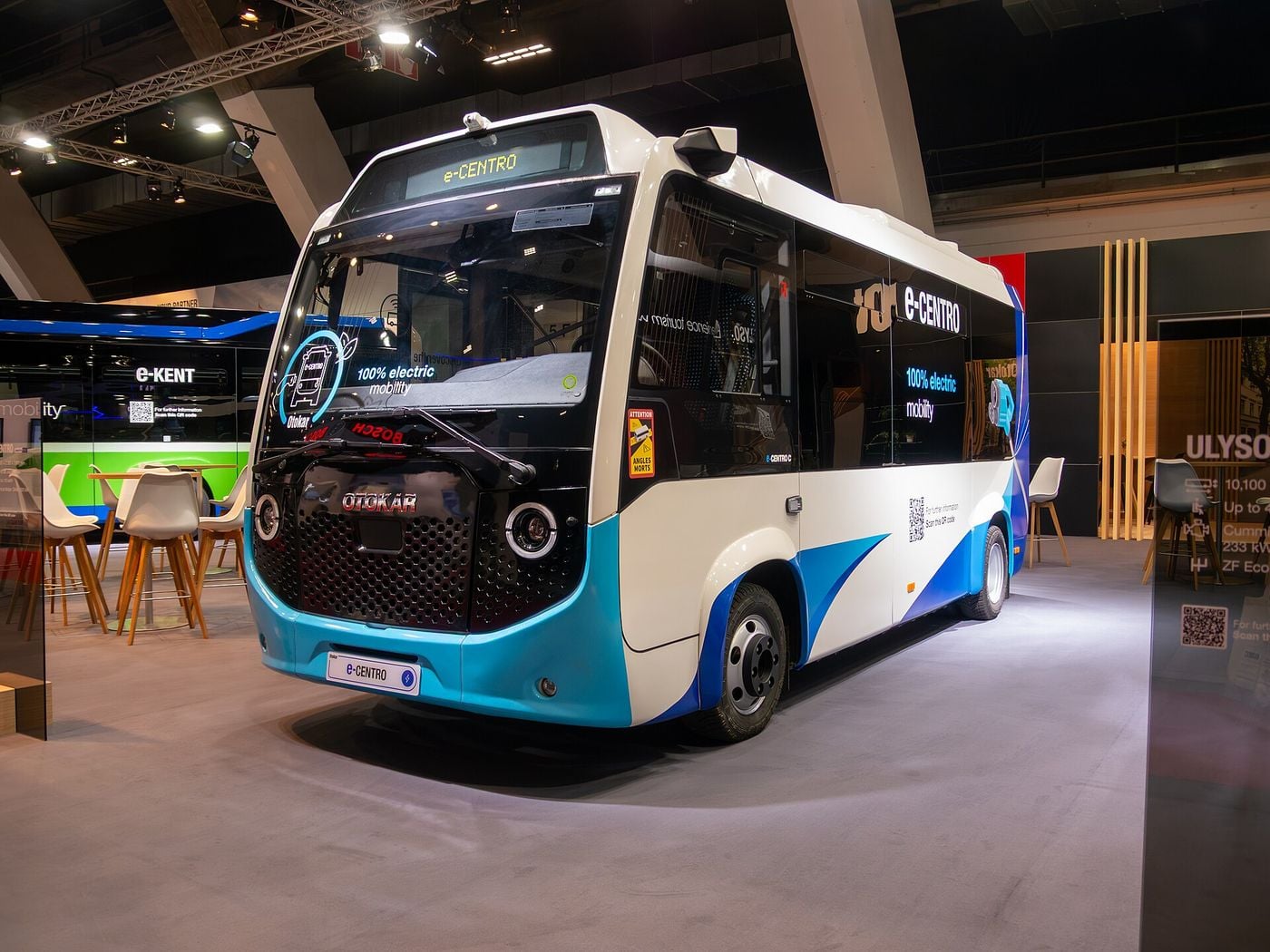

Model overview
- Segment
- Bus
- Battery capacity
- 110 kWh
- Range
- 200 km
- Charging
- 90 kW
- Electric motor
- 140 kW peak
The Otokar e-Centro is a battery-electric, low-floor bus 6.6 metres long. Otokar’s Turkish product page lists it under “Mikrobüs” (minibus) and calls it Otokar’s “çevre dostu %100 elektrikli otobüsü” (environment-friendly 100% electric bus); Otokar’s Turkish city-bus range brochure calls it a “%100 elektrikli mikrobüs”. The figures on this page come from Otokar’s own documents: the e-CENTRO product page on Otokar’s Turkish commercial-vehicle site, read on 8 November 2026, which carries no date; the city-bus range brochure “Şehir içi Otobüsler”, document code KS87TE-24, which prints no other date; and four Otokar news items on the autonomous e-Centro, dated 6 August 2025, 17 November 2025, 14 August 2026 and 4 September 2026. Otokar’s Kent city buses, which the same brochure lists, are described in Otokar Kent.
Specifications by document
The product page prints a short strip of figures; the brochure prints one panel for the e-Centro and one for the autonomous e-Centro. The brochure’s footer says that its technical specifications are nominal (“Teknik özellikler nominal bilgiler kapsamaktadır”) and that its pictures are representative (“Görseller temsilidir”).
| Row | Product page | Brochure, e-Centro panel | Brochure, autonomous e-Centro panel |
|---|---|---|---|
| Maximum power | 140 kW | 140 kW | 140 kW |
| Maximum torque | 1,200 Nm | 1,200 Nm | 1,200 Nm |
| Battery | Li-ion NMC, 110 kWh | Li-ion Otokar, printed as “110 kW” | – |
| Charging | 1.5 hours | 2.5 hours with 90 kW DC charging | – |
| Range | close to 200 km on one charge | up to 200 km | up to 200 km |
| Energy recovery | 25% | 25% | – |
| Length | 6.6 m | 6.6 m | 6 m |
| Passenger capacity | 32 (standard layout) | 32 | 32 |
Body, length and passengers
The product page gives a vehicle length (“Araç Uzunluğu”) of 6.6 m and a passenger capacity of 32 in the standard layout (“Standart Yerleşim Düzeni 32 Yolcu Kapasitesi”); the brochure prints “6,6 metre” and “32 Yolcu Kapasiteli”. Neither document divides the 32 into seats and standing places. The product page describes a low-floor body that allows step-free entry (“basamaksız girişe imkan sağlayan alçak tabanlı gövde tasarımı”) and a wheelchair ramp (“engelli rampası”); the brochure lists “Alçak tabanlı ve engelli rampalı” (low floor, with wheelchair ramp). Low floors and ramps on buses are covered in bus accessibility.
Otokar says on the product page that the e-Centro was designed for environment-friendly, quiet and highly efficient transport in “tarihi şehirler, turistik bölgeler ve sıfır emisyonlu bölgelerde” (historic cities, tourist areas and zero-emission zones), and the brochure says that its compact dimensions give it high manoeuvrability even in narrow streets (“kompakt boyutları ile dar sokaklarda bile yüksek manevra kabiliyeti”). No Otokar document opened gives a width, height, wheelbase, turning circle, weight, axle load or door layout.
Electric motor and energy recovery
Both documents give the electric motor a maximum power of 140 kW and a maximum torque of 1,200 Nm: “Maksimum Güç 140 kW” and “Maksimum Tork 1200 Nm” on the product page, “Max.Güç: 140 kW” and “Max.Tork: 1200 Nm” in the brochure. The product page says that the motor makes driving easy even on the city’s difficult and steep roads (“şehrin zor ve dik yol koşullarında dahi kolayca sürüş imkanı sağlıyor”). No document opened names the motor’s maker or gives a continuous rating, a gearbox, a top speed, the driven axle or a wheel formula.
According to the product page, regenerative braking recovers 25% of the energy from braking and deceleration in city traffic (“frenleme ve yavaşlamalardan %25 oranında enerji geri kazanımı”); the brochure prints “Geri Kazanım: 25%”. How regeneration works on buses is explained in regenerative braking in trucks and buses.
Battery, range and charging
The product page gives the battery as “Li-ion NMC 110 kWh” and says that the e-Centro’s Li-ion NMC batteries charge in as little as 1.5 hours (“1.5 saat gibi hızlı bir sürede doluyor”) and give a range of close to 200 km on one charge (“tek şarj ile 200 km’ye yakın menzil”). The brochure prints the battery as “Li-ion Otokar 110 kW”, with kW where the product page has kWh, and says that the e-Centro carries an Otokar-branded battery (“Otokar markalı bataryası”); it gives the charging time as “2,5 saat / 90 kW DC şarj ile” (2.5 hours with 90 kW DC charging) and the range as up to 200 km.
Neither document names a test cycle for the range, a charging standard or connector, an AC charging figure or the state of charge the two times refer to, and neither says whether 110 kWh is installed or usable capacity. NMC and the other cell chemistries are described in battery chemistries in heavy trucks, the two capacity figures in installed vs usable battery capacity, and DC charging of buses in charging electric trucks and buses.
Autonomous e-Centro
Both the product page and the brochure carry an autonomous version, “Otonom e-CENTRO”. The product page says that Otokar’s autonomous vehicle, the e-CENTRO with Level 4 driving technology (“Seviye 4 sürüş teknolojisine sahip”), can travel without needing a driver, was developed to comply with traffic rules, detects its position precisely, can run without interruption at any hour of the day regardless of the weather, and pulls in to the stops on a set route so that passengers can get on and off. The brochure’s panel, headed “Sürücüsüz teknoloji” (driverless technology), gives the same motor figures, 32 passengers, a range of up to 200 km, a low floor with a wheelchair ramp, and a length of “6 metre” where the e-Centro panel prints “6,6 metre”.
Otokar’s news item of 6 August 2025 reports that TÜV Rheinland tested the Autonomous e-Centro at the Smart City test track of the ZalaZONE proving ground in Hungary. Over a 30-day programme the bus completed more than 600 autonomous driving function test runs across 148 scenario variations, among them collision avoidance, emergency braking, junction crossings, overtaking and evasive manoeuvres, stopping at and departing from bus stops, and interactions with pedestrians; TÜV Rheinland’s field test team also operated it for five days on two routes on public roads in Hungary. Otokar calls it “the first Turkish Autonomous vehicle which was tested by TÜV Rheinland”, says that it “is now ready for type approval”, and states that all software development, testing and implementation were carried out in-house.
In Spain the Autonomous e-Centro “officially started service on November 11, 2025, in Mercamadrid”, according to Otokar’s news item of 17 November 2025, which calls it “Otokar’s CCAM Level 4+ autonomous urban bus”. The item names Otokar’s Spanish dealer Somauto as the supplier and Alsa as the operator, and says that Otokar’s Level 4+ technology was tested by INSIA, that the Directorate General of Traffic (DGT) approved the technical documentation, and that “The DGT authorization allowed the Autonomous e-Centro to be used on controlled public roads, within supervised testing and validation programs.” It says that the bus’s manoeuvring capabilities include “swerving, overtaking, reverse driving, U-turns, uphill/downhill management, roundabout and unregulated intersection management”.
In Austria, ÖBB Postbus “chose Otokar as technology partner” for a bus with SAE Level 4 functionality, according to Otokar’s news item of 14 August 2026. The autonomous e-Centro was presented at a press conference in Vienna on 13 August 2026 for a pilot operation at the European Forum Alpbach, held from 24 August to 4 September 2026, with a trained safety driver on board as Austrian law requires. The item gives the bus up to 32 passengers and “barrier-free low-floor access with a wheelchair ramp”, and says that the e-Centro “is planned to be deployed in regular operation at the Wolfurt Campus”, connecting companies at the Campus Wolfurt industrial park to the S-Bahn. Otokar’s item of 4 September 2026, datelined Alpbach, 3 September 2026, reports passenger operation in Alpbach, free of charge and with a safety driver on board, and names the vehicle “Autonomous e-CENTRO C”. The rules for driverless buses in the EU, Germany and Great Britain are set out in automated and driverless trucks and buses.
The diesel Centro
The brochure’s range table lists the Centro under “Dizel” (diesel) and the e-Centro under “Elektrikli” (electric), and the product page’s menu lists “CENTRO” and “e-CENTRO” under “Mikrobüs”. The brochure’s Centro panel, headed “Efsane geri döndü” (the legend is back), says that “Otokar’ın efsane şehir içi aracı yollara geri döndü” (Otokar’s legendary city vehicle is back on the road) and gives a Cummins Euro 6 engine of 107 kW at 2,900 rpm and 400 Nm at 1,500 rpm, a low floor, a length of 6.6 m, and 11 fixed seats, 6 folding seats and 14 standing passengers. No document opened gives the dates of the earlier Centro or the year the e-Centro was introduced.
Source notes
The figures above are from Otokar’s Turkish e-CENTRO product page, read on 8 November 2026: an electric motor with a maximum power of 140 kW and a maximum torque of 1,200 Nm; a Li-ion NMC battery of 110 kWh, which Otokar does not call installed or usable; a range close to 200 km on one charge, with no test cycle named; a charging time of 1.5 hours, with no charging power; 25% energy recovery through regenerative braking; a length of 6.6 m; and a passenger capacity of 32 in the standard layout, with no split into seats and standing places. Otokar’s Turkish city-bus range brochure, document code KS87TE-24, gives the same power, torque, length, capacity and energy recovery, prints the battery as “Li-ion Otokar 110 kW”, and gives the range as up to 200 km and the charging time as 2.5 hours with 90 kW DC charging; its panel for the autonomous e-Centro gives the same motor figures, capacity and range and a length of 6 m. No Otokar document opened gives a width, height, wheelbase, weight, axle load, door layout, gearbox, top speed or charging standard. Otokar’s news items describe the autonomous e-Centro as having Level 4 technology: “Level 4” in the item of 6 August 2025, “CCAM Level 4+” in the item of 17 November 2025 and “SAE Level 4” in those of 14 August and 4 September 2026.
Quick answers
- What battery capacity does the Otokar e-Centro have?
- Battery capacity: 110 kWh; Range: 200 km; Charging: 90 kW.
Articles that mention the Otokar e-Centro
More Otokar on this site
Sources
- e-CENTRO — ürün sayfası (Türkiye, Turkish) — Otokar Otomotiv ve Savunma Sanayi A.Ş.
- Şehir içi Otobüsler — city bus range brochure (document code KS87TE-24) — Otokar Otomotiv ve Savunma Sanayi A.Ş.
- Otokar’s Autonomous e-Centro Successfully Passes Tests By Tüv Rheinland — Otokar Otomotiv ve Savunma Sanayi A.Ş., 6 Aug 2025
- Spain to Use Otokar’s Autonomous e-CENTRO — Otokar Otomotiv ve Savunma Sanayi A.Ş., 17 Nov 2025
- ÖBB Postbus Tests Fully Autonomous Electric Bus in Public Transport — Otokar Otomotiv ve Savunma Sanayi A.Ş., 14 Aug 2026
- ÖBB Launches Passenger Service with Autonomous Otokar e-Centro in Alpbach — Otokar Otomotiv ve Savunma Sanayi A.Ş., 4 Sept 2026