Minibuses explained: M2 and M3, Classes A and B and the D1 licence
Minibus is not a term of the EU approval regulation or licence directive: over eight passenger seats a bus is M2 up to 5 t or M3 above; D1 stops at 16 passengers and 8 m.
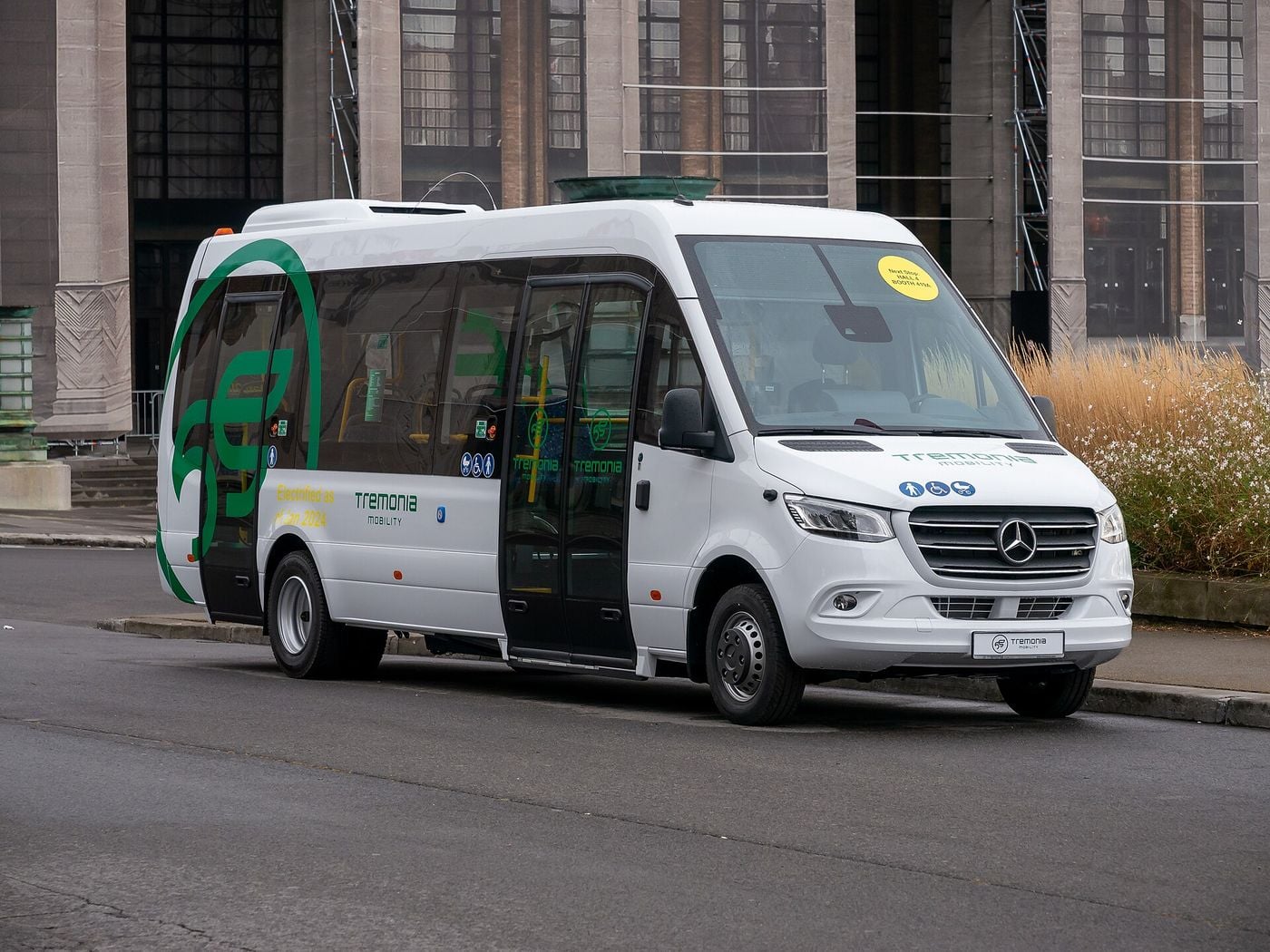
Minibus is a maker’s word, not a category in the EU and UN texts that sort small buses. It does not occur in Regulation (EU) 2018/858, which sorts vehicles into categories for approval, in Directive 2006/126/EC on driving licences, or in UN Regulation No. 107 on the general construction of buses (the texts listed below, as read on 9 November 2026). Those texts place a small bus by four lines instead. More than eight seating positions in addition to the driver’s take a passenger vehicle out of category M1 and into M2 or M3; a maximum mass of 5 tonnes divides M2 from M3; a capacity of 22 passengers in addition to the driver divides Classes A and B of UN Regulation No. 107 from its Classes I, II and III; and the category D1 driving licence stops at 16 passengers and a length of 8 metres. The makers use the word on both sides of those lines. Daimler Buses calls the Mercedes-Benz Sprinter Mobility 23, for up to eight passengers at 3.5 t, a minibus, and the 8.5-metre Sprinter City 75 at 6.8 t as well; Otokar’s brochure of 2026 calls the 6.6-metre Centro, with a capacity of 34 passengers, a mikrobüs.
Status as of 9 November 2026. Read that day: the Official Journal texts of Regulation (EU) 2018/858 of 30 May 2018 and of Directive 2006/126/EC of 20 December 2006, each in its English, German, Spanish, French, Italian and Polish versions; three Daimler Truck press releases on Mercedes-Benz minibuses, of 3 December 2018, 12 September 2019 and 21 June 2021, and the vehicle fact sheets of 21 June 2021; Otokar’s urban vehicle brochures of 2023 and 2026; and Temsa’s home page. UN Regulation No. 107 is quoted from the text the Official Journal published on 29 January 2026, which incorporates all valid text up to the 10 and 11 series of amendments, in a copy saved on 28 September 2026. The Regulation and the Directive are quoted from their texts as first published in the Official Journal.
Four lines in the texts
| Line | Text | At or below the line | Above the line |
|---|---|---|---|
| Eight seating positions in addition to the driver’s | Regulation (EU) 2018/858, Article 4(1)(a) | M1, which also has no space for standing passengers | M2 or M3, whether or not the vehicle has space for standing passengers |
| Maximum mass of 5 tonnes | Regulation (EU) 2018/858, Article 4(1)(a)(ii) and (iii) | M2 | M3 |
| 22 passengers in addition to the driver | UN Regulation No. 107, paragraphs 2.1.1 and 2.1.2 | Class A, designed to carry standing passengers, or Class B, not designed to carry them | Class I, II or III |
| 16 passengers in addition to the driver, and a length of 8 m | Directive 2006/126/EC, Article 4(4)(h) and (j) | Category D1 licence, both limits met; a trailer of up to 750 kg maximum authorised mass may be added | Category D licence, defined as more than eight passengers in addition to the driver |
| 3,500 kg maximum authorised mass and eight passengers in addition to the driver | Directive 2006/126/EC, Article 4(4)(b) | Category B licence, both limits met | Outside category B |
The lines measure different things, so they do not coincide. Category M2 has a mass limit and no length limit, category D1 has a length limit and no mass limit, and the classes of UN Regulation No. 107 count passengers, seated and standing. Each text’s own definitions are set out in vehicle categories M, N and O, bus classes and bus driving licences.
The mass that sorts M2 from M3 is a figure the manufacturer states. Annex I to Regulation (EU) 2018/858 reads maximum mass as the “technically permissible maximum laden mass” (introductory part, point 1.4), and UN Regulation No. 107 defines that as “the maximum mass of the vehicle based on its construction and performance, stated by the manufacturer”, which “is used to determine the vehicle category” (paragraph 2.19). Category B and the trailer limits of the licence directive are written in a different term, maximum authorised mass.
How seats are counted
The eight-seat line depends on what counts as a seating position. Annex I to Regulation (EU) 2018/858 sets the rules in point 2.1 of its introductory part:
- Only seats “designed for use when the vehicle is travelling on the road” count (2.1.1). Seats designed for use when the vehicle is stationary do not, where they are “clearly identified to users either by means of a pictogram or a sign with an appropriate text” (2.1.2).
- Each individual seat is one seating position. On a bench seat, “any space having a width of at least 400 mm measured at the seat cushion level” is one (2.1.3(a) and (b)), unless features such as a fixed console box or an unpadded area, or a floor pan such as a tunnel, keep the manikin from sitting or placing its feet in a natural way (2.1.3(c)). For vehicles covered by UN Regulations No. 66 and No. 107 the 400 mm is aligned with the minimum space required for one person in the various classes of vehicle (2.1.4).
- “When seat anchors for a removable seat are present in a vehicle, the removable seat shall be counted in the determination of the number of the seating positions” (2.1.5).
- “An area intended for an occupied wheelchair shall be regarded as one seating position” (2.1.6).
UN Regulation No. 107 makes room for vehicles with seating intended for use at a standstill. “Vehicles which contain seating intended solely for use when the vehicle is stationary, but which are not designed to carry more than 8 persons (excluding the driver) when in motion”, for which it names mobile libraries, mobile churches and mobile hospitality units, have to meet its requirements “only to the extent that they are compatible with their intended use and function” (paragraphs 1.3 and 1.3.2).
Daimler states the capacity of its minibuses for wheelchair users in seats and wheelchair places together. The Sprinter Mobility 23, 5.9 metres long with a gross vehicle weight rating of 3.5 t, “has room for up to eight passengers, a maximum of four wheelchair bays or a mix thereof”, and the release adds that it “can be driven with just a Class B driving licence”; the Sprinter Mobility 45, rated at 5.0 t, has “room for up to 19 passengers or six wheelchair bays” (release of 3 December 2018). Category B of Directive 2006/126/EC covers motor vehicles with a maximum authorised mass not exceeding 3,500 kg “designed and constructed for the carriage of no more than eight passengers in addition to the driver” (Article 4(4)(b)).
Classes A and B: 22 passengers or fewer
UN Regulation No. 107 applies to “every single-deck, double-deck, rigid or articulated vehicle of category M2 or M3” (paragraph 1.1). It leaves out vehicles for the secure transport of persons, ambulances, off-road vehicles and vehicles specially designed for the carriage of school children (paragraph 1.2). For vehicles “having a capacity not exceeding 22 passengers in addition to the driver” it has two classes (paragraph 2.1.2). Class A covers “vehicles designed to carry standing passengers; a vehicle of this class has seats and shall have provision for standing passengers”, and Class B “vehicles not designed to carry standing passengers; a vehicle of this class has no provision for standing passengers”. Its definition of a low floor vehicle reaches Class A: a vehicle of Class I, II or A “in which at least 35 per cent of the area available for standing passengers” forms an area without steps “and includes access to at least one service door” (paragraph 2.1.4).
A vehicle “may be regarded as belonging in more than one Class”, and may then be approved for each class to which it corresponds (paragraph 2.1.1.4). Daimler’s release of 21 June 2021 gives two capacities for the 7.4-metre Sprinter City 45: “As a category A vehicle, the Sprinter City 45 can carry up to 22 passengers, and as a category I vehicle it can carry as many as 28 passengers.”
Among the construction rules, every vehicle needs at least two doors, “either two service doors or one service door and one emergency door” (paragraph 7.6.1.1). Vehicles of Classes A and B must have at least one exit on each side, and their service doors on the side of the vehicle nearer the side of the road for the direction of traffic the vehicle is designed for (paragraph 7.6.2.2). Under the circumstances of paragraph 7.6.1.8, a driver’s door in a Class A or B vehicle may count as an emergency door for passengers, provided it meets the emergency-door dimensions and the requirements of paragraph 7.6.1.7.2 and the space for the driver’s seat communicates with the main passengers’ compartment through an appropriate passage (paragraph 7.6.1.9). The gangway, door and standing-space figures of the two classes are set out in bus classes.
The licence line: 16 passengers and 8 metres
Category D1 of Directive 2006/126/EC covers “motor vehicles designed and constructed for the carriage of no more than 16 passengers in addition to the driver and with a maximum length not exceeding 8 m”, which “may be combined with a trailer having a maximum authorised mass not exceeding 750 kg” (Article 4(4)(h)). The minimum age for D1 and D1E is 21, “without prejudice to the provisions for the driving of such vehicles in Directive 2003/59/EC” (point (i)). A D1 licence is issued only to drivers already entitled to drive category B vehicles (Article 6(1)(a)), and a category D licence is also valid for D1 (Article 6(2)(f)).
The D1 definition sets no mass, and the M2 definition no length. Against the makers’ figures below, the two 8.5-metre Daimler models are longer than the 8 metres of D1, and the four Sprinter Transfer models, 5.9 to 7.7 metres long, have room for 12 to 22 passengers.
The ages and exceptions that apply to D1 today, and what a later directive changes, are set out in bus driving licences. Article 6(4)(a) lets Member States, after consulting the Commission, authorise on their territory the driving of D1 vehicles with a maximum authorised mass of 3,500 kg, “excluding any specialised equipment intended for the carriage of disabled passengers”, by category B holders over 21 who obtained that licence at least two years earlier, where the vehicles are used by non-commercial bodies for social purposes and the driver provides his services on a voluntary basis. How Great Britain applies it is covered in driving a minibus on a car licence.
What makers call a minibus
Daimler’s release of 21 June 2021 describes the Mercedes-Benz minibus range as four series built on the Sprinter: “The specialised Sprinter City covers urban and suburban regular-service, the flexible Sprinter Transfer takes care of inter-city routes, school bus services, excursions and shuttle services; the Sprinter Mobility transports passengers with restricted mobility, and the Sprinter Travel stands for tourism.” The same release places the range in “the segment of minibuses with a permissible gross vehicle weight greater than 3.5 tonnes”. In the model names, “the first digit is based on the length variant of the base vehicle, but the second digit now indicates its weight category” (release of 3 December 2018).
The releases describe two ways of building them. The Sprinter Transfer 35 “is based on the original body of the Sprinter with high roof”. The Sprinter City 75 is based on the chassis of the Sprinter “but only up to the B‑pillar. Aft of the B-pillar is a self-supporting integral minibus skeleton”, and the Sprinter Travel 75 on the same chassis “only up as far as the B‑pillar”. Both have a wheelbase of 5,100 mm in the release of 21 June 2021, which says of the Travel 75 that it “surpasses the longest wheelbase version of the Mercedes‑Benz Sprinter by 775 millimetres”. Their twin-tyred rear axle with air suspension was “developed exclusively for Mercedes-Benz minibuses”.
Otokar’s urban vehicle brochure of 2026 lists the Centro as an alçak tabanlı mikrobüs (low-floor minibus), 6.6 metres long with a capacity of 34 passengers, and the battery-electric e-Centro at 6.6 metres and 32 passengers. Both of its brochures state that the technical data are nominal. Temsa’s home page lists the Prestij under a Midibus product group, and a news headline of 18 June 2025 on the same page calls the model “TEMSA’s Midibus Icon”.
| Model | Document | Length | Passengers or seats | Gross vehicle weight |
|---|---|---|---|---|
| Mercedes-Benz Sprinter Mobility 23 | Daimler release, 3 December 2018 | 5.9 m | Up to 8 passengers, up to 4 wheelchair bays, or a mix | 3.5 t |
| Mercedes-Benz Sprinter Mobility 45 | Daimler release, 3 December 2018 | — | Up to 19 passengers or 6 wheelchair bays | 5.0 t |
| Mercedes-Benz Sprinter Transfer 23, 35, 45 and 55 | Daimler release, 3 December 2018 | 5.9, 7.0, 7.4 and 7.7 m | 12 to 22 passengers across the series; Transfer 23: 13+1 | 3.55 to 5.5 t across the series |
| Mercedes-Benz Sprinter Transfer 35 | Daimler release, 3 December 2018 | 6.97 m | 15+1 as standard; 18+1 or 19+1 as options | 5.0 to 5.5 t |
| Mercedes-Benz Sprinter City 45 | Daimler release, 21 June 2021 | 7.4 m | Up to 22 passengers as Class A, up to 28 as Class I | — |
| Mercedes-Benz Sprinter City 75 | Daimler releases, 3 December 2018 and 21 June 2021; fact sheet, 21 June 2021 | 8.5 m; 8,486 mm in the fact sheet | Up to 38 passengers; up to 19 passenger seats in the Interurban equipment line | 6.8 t; 6,800 kg in the fact sheet |
| Mercedes-Benz Sprinter Travel 75 | Daimler releases, 12 September 2019 and 21 June 2021; fact sheet, 21 June 2021 | 8.5 m; 8,486 mm in the fact sheet | 18 passenger seats as standard; up to 21 and a co-driver’s seat on request | 6.5 t in 2019; 6.8 t in 2021 |
| Otokar Centro | Otokar brochure, 2026 | 6.6 m | 34 passengers (2023 brochure: 11 fixed and 6 folding seats, 14 standing) | — |
| Otokar e-Centro | Otokar brochure, 2026 | 6.6 m | 32 passengers | — |
Some of Daimler’s figures differ between its documents. The Sprinter Travel 75’s permissible gross weight is 6.5 t in the launch release of 12 September 2019 and 6.8 tonnes “now” in the release of 21 June 2021, whose fact sheet gives 6,800 kg for the test vehicle. The City 75’s wheelbase is 5,095 mm, 770 mm longer than the longest Sprinter wheelbase, in the release of 3 December 2018, and 5,100 mm in the documents of 2021. The release of 3 December 2018 also describes the City 75’s city layout: up to five folding seats on the driver’s side and two on the door side of the low-floor zone, a further eleven seats at the rear and, when the folding seats are not in use, “standing room for up to 26 passengers”. For the Otokar Centro the 2023 brochure gives “11 sabit koltuk + 6 katlanır koltuk + 14 ayakta yolcu” and the 2026 brochure “34 Yolcu Kapasitesi”.
Other small buses have pages of their own: the Karsan e-JEST, the Iveco Daily, the Temsa Prestij and the Otokar Sultan. Laden weights, seats, lengths and widths across bus ranges are set out in bus weight and seating capacity and bus and coach dimensions, school buses built to US rules in school bus types and dimensions, and a statistical definition of the mini-bus and the Turkish legal term minibüs in the truck and bus glossary.
Battery-electric minibuses
For three battery-electric minibuses the makers’ own documents give a category, a gross weight or both: Karsan’s for the e-JEST, and IVECO BUS’s for the eDaily Minibus and the eDAILY LE, two minibuses of the range set out on the Iveco Daily page.
| Model | Document | Length | Category and class | Passengers | Gross weight |
|---|---|---|---|---|---|
| Karsan e-JEST | Karsan catalogue (English), 3 June 2026 | 5,845 mm | “M2 / M3 Category & Class A” | Up to 20; example layouts up to 19 as M2 Class A and up to 20 as M3 Class A | 5,000 / 5,200 kg (“Gross Vehicle Weight”) |
| IVECO BUS eDaily Minibus | IVECO BUS technical sheet, read 14 November 2026 | 7,618 mm | — | Up to 22 | 7,200 kg (“G.V.W. max permitted weight”) |
| IVECO BUS eDAILY LE | IVECO BUS release, 3 October 2025 | 7.6 m | “Compliant with category M3, Class I” | Up to 27 | — |
Karsan’s catalogue prints the gross vehicle weight as “5.000 / 5.200” and does not say which weight belongs to which version. Otokar’s brochure of 2026 gives the e-Centro no category or mass.
Directive 2009/33/EC on clean road transport vehicles, in its consolidated text of 20 May 2024 (still the latest on 14 November 2026), defines a road transport vehicle as one of category M or N as defined in Article 4(1) of Regulation (EU) 2018/858 (Article 4(3)), and its Annex deals with categories M2 and M3, on either side of that Regulation’s 5-tonne line, in different tables. Category M2 has a row in Table 2, “Emission thresholds for clean light-duty vehicles”, with M1 and N1: a clean vehicle of those categories is defined by a maximum tail-pipe emission in CO2 g/km and by real-driving pollutant emissions below a percentage of the applicable emission limits, as laid down in that table (Article 4(4)(a)), and the targets for clean light-duty vehicles are those of Table 3 (Article 5(1)). The M2 row reads 50 g/km of CO2 and 80 % for real-driving (RDE) air pollutant emissions as a percentage of the emission limits until 31 December 2025, and 0 g/km, with “n.a.” for RDE emissions, from 1 January 2026, the start of the second reference period, which runs to 31 December 2030. The bus column of Table 4 is headed “Buses (vehicle category M3)”, and for M3, as for N2 and N3, a clean vehicle is one using alternative fuels as that point defines them, with the exclusions and conditions it sets out (Article 4(4)(b)). Article 3(2)(b) takes “vehicles of category M3 other than Class I and Class A vehicles” out of the directive altogether. The bus targets of Table 4, and the question of which text now defines Class I and Class A, are set out in the Clean Vehicles Directive and public bus procurement.
Quick answers
- What is a minibus in EU law?
- The word is not used in Regulation (EU) 2018/858 on vehicle approval, in Directive 2006/126/EC on driving licences or in UN Regulation No. 107 on bus construction. Those texts draw lines instead: a passenger vehicle with more than eight seating positions in addition to the driver's is category M2 if its maximum mass does not exceed 5 tonnes and M3 if it does; UN Regulation No. 107 puts vehicles for not more than 22 passengers in addition to the driver into Class A, built for standing passengers, or Class B, not built for them; and the category D1 licence covers no more than 16 passengers and a length of no more than 8 metres.
- Is a minibus category M2 or M3?
- It depends on its maximum mass, the technically permissible maximum laden mass stated by the manufacturer. Under Article 4(1)(a) of Regulation (EU) 2018/858, a vehicle with more than eight seating positions in addition to the driver's is M2 up to 5 tonnes and M3 above, whether or not it has space for standing passengers. Daimler's releases give its Sprinter Transfer minibuses 3.55 to 5.5 t gross vehicle weight and the Sprinter City 75 6.8 t, but do not state an M2 or M3 category for any model.
- How many passengers can a minibus on a D1 licence carry?
- No more than 16 in addition to the driver, in a vehicle no more than 8 metres long, under Article 4(4)(h) of Directive 2006/126/EC; a trailer of up to 750 kg maximum authorised mass may be added. The minimum age for D1 is 21 under point (i), without prejudice to the provisions of Directive 2003/59/EC for the driving of such vehicles. A category B licence covers up to eight passengers in addition to the driver and a maximum authorised mass of 3,500 kg (Article 4(4)(b)).
- How are seats counted for the eight-seat limit?
- Annex I to Regulation (EU) 2018/858 counts each individual seat as one seating position, and on a bench any space at least 400 mm wide at cushion level. A removable seat counts when its anchors are present, and an area intended for an occupied wheelchair counts as one seating position. Seats designed for use when the vehicle is stationary, and clearly identified to users by a pictogram or sign, are not counted.
- How long and heavy are minibuses?
- Daimler's Sprinter-based minibuses run from 5.9 metres and a 3.5 t gross vehicle weight rating for the Sprinter Mobility 23 to 8.5 metres and 6.8 t for the Sprinter City 75 and Sprinter Travel 75. Otokar's 2026 brochure gives its Centro and e-Centro 6.6 metres, with capacities of 34 and 32 passengers.
Models in this article
Sources
- Regulation (EU) 2018/858 of the European Parliament and of the Council of 30 May 2018 on the approval and market surveillance of motor vehicles and their trailers — Official Journal text of 14 June 2018: Article 4(1)(a); Annex I, introductory part, points 1.4 and 2.1 — EUR-Lex, European Union, 30 May 2018
- Directive 2006/126/EC of the European Parliament and of the Council of 20 December 2006 on driving licences (Recast) — Official Journal text of 30 December 2006: Article 4(4)(b) and (h) to (j), Article 6(1), 6(2) and 6(4) — EUR-Lex, European Union, 20 Dec 2006
- UN Regulation No. 107 — Uniform provisions concerning the approval of category M2 or M3 vehicles with regard to their general construction [2026/139] (OJ L, 29.1.2026), incorporating all valid text up to the 10 and 11 series of amendments — paragraphs 1, 2.1 to 2.1.4, 2.19, 7.6.1.1, 7.6.1.8, 7.6.1.9 and 7.6.2.2 — Official Journal of the European Union / UNECE, 29 Jan 2026
- Press release of 3 December 2018 on the new generation of Mercedes-Benz minibuses based on the new Sprinter: Sprinter City 75, Sprinter Transfer and Sprinter Mobility — Daimler Truck, newsroom, 3 Dec 2018
- Press release of 12 September 2019 on the Mercedes-Benz buses shown at the Busworld show — section on the world premiere of the Sprinter Travel 75 — Daimler Truck, newsroom, 12 Sept 2019
- Press release of 21 June 2021 on the Mercedes-Benz minibus range: Sprinter City, Sprinter Transfer, Sprinter Mobility and Sprinter Travel — Daimler Truck, newsroom, 21 Jun 2021
- Vehicle fact sheets: Mercedes-Benz Sprinter City 75 Interurban equipment line (DO-MB 9992) and Sprinter Travel 75 (DO-MB 4358), technical data (21 June 2021) — Daimler Truck, newsroom, 21 Jun 2021
- Şehir içi araçlar aile broşürü 2026 (urban vehicle family brochure, 2026): Centro and e-Centro — Otokar
- Şehir içi otobüsler (urban buses brochure, 2023): Centro and e-Centro — Otokar
- TEMSA home page: product menu and news headline of 18 June 2025 (read on 9 November 2026) — TEMSA
- Directive 2009/33/EC on the promotion of clean road transport vehicles in support of low-emission mobility, consolidated text of 20 May 2024: Articles 3(2)(b), 4(3), 4(4) and 5(1); Annex, Tables 2 to 4 — EUR-Lex, Publications Office of the European Union, 20 May 2024
- e-JEST catalogue (English), dated 3 June 2026: technical specifications and passenger capacity and layout alternatives — Karsan, 3 Jun 2026
- eDaily Minibus — technical sheet (read on 14 November 2026) — IVECO BUS
- IVECO BUS unveils its new eDAILY LE minibus at Busworld Brussels (press release of 3 October 2025) — IVECO BUS, 3 Oct 2025