Truck, bus and road freight glossary: the terms and the texts that define them
Short definitions of truck, bus, trailer and road freight terms, each in the words of the EU, UN, national or trade text that defines it, most with a link to a page that covers it further.
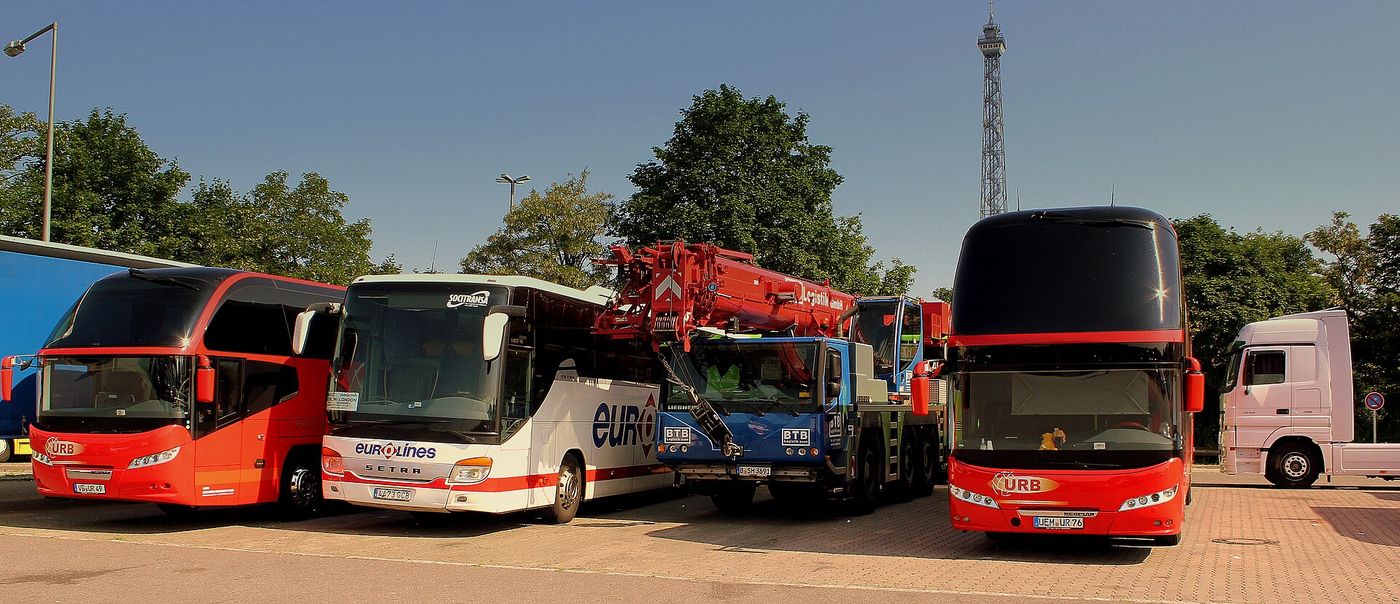
This glossary gives the meaning of truck, bus, trailer and road freight terms in the words of the texts that define them: EU and UN texts, the laws and regulations of Germany, Spain, Türkiye, Great Britain and the United States, British government pages, the statistical glossary of Eurostat, the UN Economic Commission for Europe and the International Transport Forum, European Commission pages, the Eurovignette sales portal and, for freight forwarding, FIATA. Each entry names its source and, where this site has a page that covers the subject further, links to it.
Status as of 8 October 2026. Every text was read on that day, in the version named in the source list. The EU consolidated texts say of themselves that they are “meant purely as a documentation tool” and that the authentic texts are those published in the Official Journal; for the TIR Convention and UN Regulation No. 13, the versions read point instead to the original United Nations texts. German, Spanish and Turkish quotations keep the original words, with our translation in brackets. The entries added on 9 November 2026 rest on texts read on that day, in the versions named in the source list.
Logistics and the transport trade
Freight transport logistics
In the European Commission’s Communication COM(2006) 336 of 28 June 2006, freight transport logistics “covers the planning, organisation, management, control and execution of freight transport operations in the supply chain” (section 2). The Communication, a policy text of the Commission and not legislation, gives the definition “For the purposes of this Communication”. More in what is logistics.
Third-party logistics (3PL)
The same Communication defines the term from the side of the organisation that uses the providers: “‘Third-party logistics’ means that an organisation uses external logistics providers that supply all or a considerable number of its logistical activities” (section 2). More in what is logistics.
Logistics operator
Spain’s Land Transport Act, Ley 16/1987 (LOTT), defines logistics operators as undertakings specialised in organising, managing and controlling, “por cuenta ajena” (for the account of others), the supply, transport, storage or distribution of goods that their customers need (Article 122). Türkiye’s Road Transport Regulation defines the lojistik işletmecisi as natural and legal persons who, besides the actual carriage, take delivery of their customers’ goods and undertake all or part of services such as loading, storage, packing and distribution under their own supervision and control (Article 4(1)(ğğ)). More in what is logistics.
Freight forwarder
FIATA, the International Federation of Freight Forwarders Associations, which describes itself as “a non-governmental organisation”, defined freight forwarding and logistic services in 2004 as “services of any kind relating to the carriage (performed by single mode or multimodal transport means), consolidation, storage, handling, packing or distribution of goods”, with ancillary and advisory services. Under German law the forwarding contract obliges the Spediteur “die Versendung des Gutes zu besorgen” (to arrange the dispatch of the goods) (Commercial Code, HGB § 453(1)).
Freight broker (United States)
In 49 U.S.C. 13102, whose definitions apply to the part of the US Code on motor carriers, water carriers, brokers and freight forwarders, a broker is a person, other than a motor carrier or an employee or agent of one, that as a principal or agent sells, offers for sale, negotiates for, or holds itself out as selling, providing or arranging for, “transportation by motor carrier for compensation” (13102(2)). The freight forwarder, among the other elements of its definition, “assumes responsibility for the transportation from the place of receipt to the place of destination”, and the same section counts it among carriers (13102(3) and (8)).
Carrier and road haulage operator
Regulation (EC) No 1071/2009 defines “the occupation of road haulage operator” as “the activity of any undertaking transporting goods for hire or reward by means either of motor vehicles or combinations of vehicles” (Article 2(1)). In Germany’s Commercial Code the carrier, the Frachtführer, undertakes to carry the goods to the destination and deliver them there to the consignee (HGB § 407(1)). More in road transport operator licence.
Transport for hire or reward and transport on own account
The Glossary for transport statistics of Eurostat, the UNECE and the International Transport Forum defines transport for hire or reward as “Carriage for remuneration of persons or goods on behalf of third parties” and transport on own account as “Transport which is not for hire or reward”. More in what is logistics.
Tonne-kilometre
The same glossary defines the tonne-kilometre by road as a “Unit of measurement of goods transport which represents the transport of one tonne by road over one kilometre”, counting “the distance actually run”. More in what is logistics.
Cabotage
Regulation (EC) No 1072/2009 defines cabotage operations as “national carriage for hire or reward carried out on a temporary basis in a host Member State” (Article 2(6)), that is, a Member State “in which a haulier operates other than the haulier’s Member State of establishment” (Article 2(3)). More in cabotage and posted drivers.
Transport manager and road passenger transport operator
Regulation (EC) No 1071/2009 defines the transport manager as “a natural person employed by an undertaking or, if that undertaking is a natural person, that person or, where provided for, another natural person designated by that undertaking by means of a contract, who effectively and continuously manages the transport activities of that undertaking” (Article 2(5)). The same Article defines the occupation of road passenger transport operator as the activity of any undertaking operating passenger transport services for the public or for specific categories of users, in return for payment by the person transported or by the transport organiser, by means of motor vehicles “so constructed and equipped as to be suitable for carrying more than nine persons, including the driver, and intended for that purpose” (Article 2(2)). More in road transport operator licence.
Journey, long journey and means of transport (animal transport)
Council Regulation (EC) No 1/2005 on the protection of animals during transport defines a journey as “the entire transport operation from the place of departure to the place of destination, including any unloading, accommodation and loading occurring at intermediate points in the journey”, and a long journey as “a journey that exceeds 8 hours, starting from when the first animal of the consignment is moved” (Article 2(j) and (m)). Means of transport are “road or rail vehicles, vessels and aircraft used for the transport of animals”, and a vehicle is “a means of transport fitted with wheels which is propelled or towed” (Article 2(n) and (z)). More in livestock trucks and animal transport rules.
Vehicles and combinations
Lorry, truck and rigid lorry
In Annex I, Part C of Regulation (EU) 2018/858 the lorry, bodywork code BA, is “A vehicle that is designed and constructed exclusively or principally for conveying goods. It may also tow a trailer.” Regulation (EU) 2019/1242 calls “a lorry that is not designed or constructed for the towing of a semi-trailer” a rigid lorry (Article 3(6)), and US federal rules define a truck as a motor vehicle “designed primarily for the transportation of property or special purpose equipment” (49 CFR 571.3). More in vehicle categories M, N and O.
Van, pick-up truck and kamyonet
In the same Part C the van, code BB, is “A lorry with the compartment where the driver is located and cargo area within a single unit”; the pick-up truck, code BE, has a maximum mass not exceeding 3,500 kg, and its seating positions and cargo area are not in a single compartment. Türkiye’s Road Traffic Law No. 2918 defines the kamyonet as a motor vehicle built to carry goods, “Azami yüklü ağırlığı 3.500 kilogramı geçmeyen” (whose maximum laden weight does not exceed 3,500 kilograms) (Article 3). More in vehicle categories M, N and O.
Vehicle categories M, N and O
Article 4(1) of Regulation (EU) 2018/858 places motor vehicles designed and constructed “primarily for the carriage of passengers and their luggage” in category M and those designed and constructed “primarily for the carriage of goods” in category N; category O “consists of trailers”. Each category is divided by maximum mass, M also by seating positions. UN R.E.3, a consolidated resolution of the UNECE World Forum WP.29, sets out the same categories (paragraph 2). More in vehicle categories M, N and O.
Semi truck and tractor unit
Annex I, Part C of Regulation (EU) 2018/858 defines the tractor unit for semi-trailer, code BC, as “A towing vehicle that is designed and constructed exclusively or principally to tow semi-trailers”; for such a vehicle “the maximum mass to be considered for classifying the vehicle shall include the maximum mass of the semi-trailer borne by the fifth wheel coupling” (introductory part, point 2.2.1). US federal rules define the truck tractor as “a self-propelled commercial motor vehicle designed and/or used primarily for drawing other vehicles” (49 CFR 390.5T; the Code of Federal Regulations notes that section 390.5 is suspended indefinitely). Neither definition uses the everyday name semi truck. More in what is a semi truck.
Semi-trailer
In Regulation (EU) 2018/858 a semi-trailer is “a trailer in which the axle, or axles are positioned behind the centre of gravity of the vehicle (when uniformly loaded)”, with a connecting device that transmits horizontal and vertical forces to the towing vehicle (Article 3(33)). Türkiye’s Road Traffic Law No. 2918 uses the term yarı römork; the word dorse occurs neither in that Law nor in the Road Transport Regulation (our search of both current texts on 8 October 2026). More in what is a semi truck.
Trailer, drawbar trailer and centre-axle trailer
Regulation (EU) 2018/858 defines a trailer as “any non-self-propelled vehicle on wheels designed and constructed to be towed by a motor vehicle” (Article 3(17)), whereas Directive 96/53/EC defines a trailer as a vehicle intended to be coupled to a motor vehicle “excluding semi-trailers” (Article 2). Annex I, Part C of the Regulation then separates the drawbar trailer (DB), the centre-axle trailer (DC) and the rigid drawbar trailer (DE) by their axles, the vertical load on the towing vehicle and the coupling. More in what is a semi truck.
Articulated vehicle and road train
Directive 96/53/EC defines a vehicle combination as either “a road train consisting of a motor vehicle coupled to a trailer” or “an articulated vehicle consisting of a motor vehicle coupled to a semi-trailer” (Article 2). The Glossary for transport statistics counts articulated vehicles with a further trailer attached as road trains. More in what is a semi truck.
Road tractor
The term has different meanings in different texts. In Annex I, Part C of Regulation (EU) 2018/858 the road tractor, code BD, is a towing vehicle designed and constructed “to tow trailers other than semi-trailers”; in UN R.E.3 (paragraph 1.8) a road tractor is designed, exclusively or primarily, “to haul other road vehicles which are not power-driven (mainly semi–trailers)”, and the Glossary for transport statistics uses the same words. More in what is a semi truck.
Link semi-trailer and converter dolly
Annex I to Regulation (EU) 2018/858 defines the link semi-trailer, code DF, as “A semi-trailer with a fifth wheel mounted at the rear such that the link semi-trailer could tow another semi-trailer”, and the converter dolly, code SJ, as “A vehicle of category O equipped with a fifth-wheel coupling to support a semi-trailer with a view to converting the latter into a trailer” (Part C, point 5.5; Part A, point 5.9). 49 CFR 390.5T provides that “A semitrailer equipped with an auxiliary front axle (converter dolly) shall be considered a full trailer”. More in what is a semi truck.
King pin and fifth wheel
In Annex I, Part C of Regulation (EU) 2018/858 the semi-trailer, code DA, is built to be coupled to a tractor unit or to a converter dolly, and “The coupling to be used for a vehicle combination shall consist of a king pin and a fifth wheel”; for the rigid drawbar trailer, code DE, the coupling “shall not consist of a king pin and a fifth wheel” (points 5.1 and 5.4). More in kingpin and fifth wheel.
Masses and weight classes
Maximum mass and maximum permissible mass
Annex I to Regulation (EU) 2018/858 states that “‘Maximum mass’ means the ‘technically permissible maximum laden mass’” (introductory part, point 1.4), the mass by which its vehicle categories are divided. Regulation (EC) No 561/2006, on driving times, breaks and rest periods, defines “maximum permissible mass” as “the maximum authorised operating mass of a vehicle when fully laden” (Article 4(m)). More in truck weights: GVW and GCW.
Gross vehicle weight rating and Class 8 (United States)
In US federal rules the gross vehicle weight rating (GVWR) is “the value specified by the manufacturer as the loaded weight of a single vehicle” (49 CFR 571.3). Table II of 49 CFR 565.15 groups the ratings into classes for the information submitted to NHTSA; its top class reads “Class 8—Greater than 14968 kg. (33,001 lbs. and over)”. More in GVWR, GCWR and GAWR.
HGV and LGV (Great Britain)
HGV stands for heavy goods vehicle on GOV.UK, and the Goods Vehicles (Licensing of Operators) Act 1995 defines a heavy goods vehicle as a goods vehicle, or a vehicle combination including a goods vehicle, “that has a maximum laden weight exceeding 3.5 tonnes” (section 58(1)). LGV stands for large goods vehicle on the pages of the Driver and Vehicle Standards Agency, and for light goods vehicle in the Department for Transport’s vehicle licensing statistics. Section 121 of the Road Traffic Act 1988 defines, for Part IV of the Act, a large goods vehicle as a motor vehicle, other than a medium-sized goods vehicle, “constructed or adapted to carry or to haul goods and the permissible maximum weight of which exceeds 7.5 tonnes”. More in what is an HGV.
Buses and coaches
Bus and coach
Directive 96/53/EC defines a bus as “a vehicle with more than nine seats including the driver’s seat, constructed and equipped to carry passengers and their luggage” (Article 2). The Glossary for transport statistics separates the bus, designed to carry more than 24 persons including the driver, seated and standing (classes I and II of R.E.3), from the motor coach, designed to seat 24 or more persons including the driver and “constructed exclusively for the carriage of seated passengers” (class III). More in bus classes.
Bus classes I, II, III, A and B
UN R.E.3 divides vehicles of categories M2 and M3 by capacity (paragraph 2.2.4). Above 22 passengers in addition to the driver, Class I is built with areas for standing passengers, Class II principally for seated passengers with limited standing space, and Class III “exclusively for the carriage of seated passengers”; up to 22, Class A is designed to carry standing passengers and Class B is not. More in bus classes.
Minibus and midibus
The Glossary for transport statistics defines the mini-bus as a passenger road motor vehicle “designed to carry 10-23 seated or standing persons (including the driver)”, referring to classes A and B of R.E.3. Türkiye’s Road Traffic Law No. 2918 calls an otobüs with not more than seventeen seats including the driver a minibüs (Article 3); the word midibüs occurs neither in that Law nor in the Road Transport Regulation (our search of both current texts on 8 October 2026). More in vehicle categories M, N and O.
Articulated bus
Directive 96/53/EC defines an articulated bus as “a bus consisting of two rigid sections connected to each other by an articulated section”, whose two passenger compartments are intercommunicating; “Connection and disconnection of the two sections shall be possible only in a workshop” (Article 2). The Directive “shall not apply to articulated buses comprising more than one articulated section” (Article 1(3)). UN Regulation No. 107 on the general construction of vehicles of categories M2 and M3 defines an articulated vehicle as one “which consists of two or more rigid sections which articulate relative to one another”, whose passenger compartments intercommunicate “so that passengers can move freely between them” (paragraph 2.1.3). More in articulated and bi-articulated buses.
Double-deck bus
UN Regulation No. 107 defines a double-deck vehicle as “a vehicle where the provided spaces for passengers are arranged, at least in one part, in two superimposed levels and spaces for standing passengers are not provided in the upper deck” (paragraph 2.1.6), and a double-decker articulated vehicle as an articulated vehicle whose passenger compartments intercommunicate “on at least one deck” (paragraph 2.1.3.1). Under Directive 96/53/EC a bus “may have one or two decks” (Article 2). More in double-decker buses.
Low floor bus
In UN Regulation No. 107 a low floor vehicle “is a vehicle of Class I, II or A in which at least 35 per cent of the area available for standing passengers (or in its forward section in the case of articulated vehicles, or in its lower deck in the case of double-decker vehicles) forms an area without steps and includes access to at least one service door” (paragraph 2.1.4). More in bus accessibility.
Trolleybus
UN Regulation No. 107 defines a trolleybus as “a vehicle, electrically driven by energy from external, overhead contact wires”; for the purposes of the Regulation the term also covers such vehicles “having an additional internal means of propulsion (dual mode vehicles) or having a means of temporary external guidance (guided trolleybuses)” (paragraph 2.1.8). More in trolleybuses.
Cabs, axles and bodies
Day cab and sleeper cab
Regulation (EU) 2019/1242 on CO2 emission standards for heavy-duty vehicles defines a sleeper cab as “a type of cab that has a compartment behind the driver’s seat intended to be used for sleeping” and a day cab as “a type of cab that is not a sleeper cab”; the cab type is one of the criteria by which the Regulation defines the vehicle sub-groups of heavy-duty vehicles of category N (Annex I, point 1.1.1). More in truck cabs.
Axle configuration
Commission Regulation (EU) 2017/2400 sorts heavy lorries into vehicle groups by axle configuration, such as 4 × 2, 6 × 2, 6 × 4 and 8 × 4, chassis configuration and technically permissible maximum laden mass (Annex I, Table 1). A hydraulically driven axle is treated as a non-drivable one and is not taken into consideration for establishing the axle configuration (Annex III, point 5). More in axle configurations.
Box, curtain-sided, conditioned, tipper and low floor bodies
Annex I to Regulation (EU) 2018/858 supplements the bodywork codes, where necessary, with two digits for the kind of body (Part C, point 1.4). Its Appendix 2 lists, among others, the box body, the conditioned body “with insulated walls and equipment to maintain the interior temperature”, the curtain-sided body, the tipper, the tank and the low floor trailer. More in trailer types.
Swap body
The Glossary for transport statistics defines a swap body as “A freight-carrying unit optimised to road vehicle dimensions and fitted with handling devices for transfer between modes, usually road/rail”; the main feature that distinguishes it from a container is its sizing to road vehicles, and some swap bodies “are equipped with folding legs on which the unit stands when not on the vehicle”. More in swap bodies.
Intermodal, multimodal and combined transport
The Glossary for transport statistics defines intermodal freight transport as “Multimodal transport of goods, in one and the same intermodal transport unit by successive modes of transport without handling of the goods themselves when changing modes”, and multimodal freight transport as “Transport of goods by at least two different modes of transport”. Directive 92/106/EEC defines combined transport as transport of goods between Member States in which a lorry, trailer, semi-trailer, swap body or container of the kinds it lists “uses the road on the initial or final leg of the journey and, on the other leg, rail or inland waterway or maritime services”, under the distance conditions of its Article 1. More in combined and intermodal transport and swap bodies.
Conditioned vehicle and ATP
Directive 96/53/EC defines a conditioned vehicle as one whose superstructures “are specially equipped for the carriage of goods at controlled temperatures and whose side walls, inclusive of insulation, are each at least 45 mm thick” (Article 2). ATP is the Agreement on the International Carriage of Perishable Foodstuffs and on the Special Equipment to be used for such Carriage, done at Geneva on 1 September 1970 (UN Treaty Collection). More in ATP and refrigerated transport.
Power take-off (PTO)
Commission Regulation (EU) 2017/2400 defines a power take-off (PTO) as “a device on a transmission or an engine to which an auxiliary driven device, e.g., a hydraulic pump, can be connected”, and the power take-off drive mechanism as “a device in a transmission that allows the installation of a power take-off (PTO)” (Annex VI, points 2(14) and 2(15)). More in power take-off.
Loader crane
The scope of the European standard EN 12999:2020, Cranes — Loader cranes, as published in the catalogue of EVS, the Estonian Centre for Standardisation and Accreditation, specifies “minimum requirements for design, calculation, examinations and tests of hydraulic powered loader cranes and their mountings on vehicles or static foundations”; it applies, among others, to loader cranes designed to be installed on “road vehicles, including trailers, with load carrying capability” and on demountable bodies, and it “does not cover hazards related to the lifting of persons”. The same catalogue lists the 2020 edition as withdrawn from 1 April 2025 and EVS-EN 12999:2020+A1:2025 as the newest version, valid from that date. More in truck-mounted loader cranes.
Mobile elevating work platform (MEWP)
The scope of EN 280-1:2022, as published in the EVS catalogue, covers “all types and sizes of Mobile Elevating Work Platform (MEWP, see 3.1) intended to move persons to working positions where they are carrying out work from the work platform (WP)”, with the intention that persons get on and off the work platform only at access positions at ground level or on the chassis. Machines designed for the handling of goods and equipped with work platforms as interchangeable equipment “are regarded as MEWPs”, and tail lifts are among the machines to which the standard does not apply (scope 1.1 and 1.3). More in bucket trucks and truck-mounted aerial platforms.
Tail lift
The scope of EN 1756-1:2021, Tail lifts — Platform lifts for mounting on wheeled vehicles — Safety requirements — Part 1: Tail lifts for goods, as published in the EVS catalogue, sets “safety requirements for design of tail lifts as defined in 3.1 for mounting on wheeled goods vehicles”. It applies to tail lifts “used for the purpose of loading and/or unloading such vehicles”, “equipped with a platform to support loads which comprise goods, an operator, or a combination of the two” and “with a maximum lifting height not exceeding 3 m above ground when the platform is unloaded”, among other cases it lists. More in tail lifts.
Conspicuity marking, contour marking and line marking
UN Regulation No. 48 on the installation of lighting and light-signalling devices defines a conspicuity marking as “a device intended to increase the conspicuity of a vehicle, when viewed from the side or rear (or in the case of trailers, additionally from the front), by the reflection of light emanating from a light source not connected to the vehicle, the observer being situated near the source” (paragraph 2.5.9). A contour marking is a conspicuity marking intended to indicate “the horizontal and vertical dimensions (length, width and height) of a vehicle”, as a full contour marking that indicates the outline of the vehicle by a continuous line or as a partial contour marking that indicates the horizontal dimension by a continuous line and the vertical dimension by marking the upper corners; a line marking is a conspicuity marking intended to indicate “the horizontal dimensions (length and width) of a vehicle by a continuous line” (paragraphs 2.5.9.1 to 2.5.9.2). More in contour marking and conspicuity tape.
Rear underrun protective device and lateral protection device
UN Regulation No. 58 requires the vehicles within its scope to be “so constructed and/or equipped as to offer effective protection over their whole width against under-running” in the event of rear collision with vehicles of categories M1 and N1 (paragraph 2.1); a rear underrun protective device, RUPD, “normally consists of a cross-member and links to the chassis side members or other structural members of the vehicle” (paragraph 3.1.3). UN Regulation No. 73 describes the lateral protection device, LPD, as longitudinal members and links to the chassis side members or other structural parts of the vehicle, “designed to offer effective protection to unprotected road users against the risk of falling under the sides of the vehicle and being caught under the wheels” (paragraph 2.1.4). More in underrun protection and Mansfield bars.
Drivers and dangerous goods
Driving time, break and rest
Regulation (EC) No 561/2006 defines a break as “any period during which a driver may not carry out any driving or any other work and which is used exclusively for recuperation”, rest as “any uninterrupted period during which a driver may freely dispose of his time”, and driving time as “the duration of driving activity recorded” by the recording equipment or manually (Article 4(d), (f) and (j)). More in driving time and rest rules.
Tachograph and driver card
Regulation (EU) No 165/2014 defines the tachograph as “the equipment intended for installation in road vehicles to display, record, print, store and output automatically or semi-automatically details of the movement, including the speed, of such vehicles” and details of certain periods of activity of their drivers (Article 2(2)(a)), and the driver card as “a tachograph card, issued by the authorities of a Member State to a particular driver, which identifies the driver and allows for the storage of driver activity data” (Article 2(2)(f)). More in digital tachograph and driver card.
Driver CPC and code 95
Directive (EU) 2022/2561 makes the driving of vehicles that need a licence of category C1, C1 + E, C, C + E, D1, D1 + E, D or D + E, by the drivers within its scope, subject to “a compulsory initial qualification and compulsory periodic training” (Articles 1 and 3(1)), certified by a certificate of professional competence, the CPC (recital 13). On the basis of the CPC, the competent authorities of the Member States mark the harmonised Union code “95” alongside the corresponding licence categories, on the driving licence or on the driver qualification card (Article 10(1)). More in driver CPC.
ADR
The UN Treaty Collection lists the Agreement concerning the International Carriage of Dangerous Goods by Road (ADR), done at Geneva on 30 September 1957, and records the adoption of a Protocol amending its title. Directive 2008/68/EC, which applies to the transport of dangerous goods by road, rail or inland waterway within or between Member States, defines ADR as “the European Agreement concerning the International Carriage of Dangerous Goods by Road, concluded at Geneva on 30 September 1957, as amended” (Articles 1(1) and 2(1)). More in the ADR driver training certificate.
Driving licence categories C1, C, D1 and D
Directive 2006/126/EC on driving licences places in category C1 motor vehicles, other than those in categories D1 or D, whose maximum authorised mass exceeds 3,500 kg but does not exceed 7,500 kg and which are “designed and constructed for the carriage of no more than eight passengers in addition to the driver”; category C covers the same vehicles above 3,500 kg without the upper limit (Article 4(4)(d) and (f)). Category D1 covers motor vehicles “designed and constructed for the carriage of no more than 16 passengers in addition to the driver and with a maximum length not exceeding 8 m”, and category D motor vehicles “designed and constructed for the carriage of more than eight passengers in addition to the driver” (Article 4(4)(h) and (j)). A vehicle of each of the four categories may be combined with a trailer with a maximum authorised mass not exceeding 750 kg; categories C1E, CE, D1E and DE cover combinations in which the towing vehicle is of category C1, C, D1 or D and the trailer (for C1E and CE also the semi-trailer) has a maximum authorised mass of over 750 kg, for C1E with an authorised mass of the combination not exceeding 12,000 kg (Article 4(4)(e), (g), (i) and (k)). Directive (EU) 2025/2205 repeals Directive 2006/126/EC with effect from 26 November 2029, except for Article 6(4), point (c), which is repealed with effect from 26 November 2027 (Article 30(1)). More in truck driving licences and bus driving licences.
Group 1 and Group 2 drivers
Annex III to Directive 2006/126/EC, on the minimum standards of physical and mental fitness for driving a power-driven vehicle, classifies drivers in two groups: Group 1, “drivers of vehicles of categories A, A1, A2, AM, B, B1 and BE”, and Group 2, “drivers of vehicles of categories C, CE, C1, C1E, D, DE, D1 and D1E” (point 1). Group 2 applicants “shall undergo medical examinations before a driving licence is first issued to them”, and thereafter drivers “shall be checked in accordance with the national system in place in the Member State of normal residence whenever their driving licence is renewed” (point 4). National legislation may apply the Group 2 provisions to drivers of category B vehicles who use their driving licence for professional purposes, such as taxis and ambulances (point 1.3). More in medical standards for truck and bus drivers.
Posted driver and bilateral transport operation
Directive (EU) 2020/1057 lays down specific rules for posting drivers in the road transport sector. Under its Article 1(3) a driver “shall not be considered to be posted” for the purpose of Directive 96/71/EC when performing bilateral transport operations in respect of goods, that is, “the movement of goods, based on a transport contract, from the Member State of establishment” to another Member State or to a third country, or from another Member State or a third country to the Member State of establishment. The same applies to bilateral transport operations in respect of passengers (Article 1(4)) and to transit through a Member State without loading or unloading freight and without picking up or setting down passengers (Article 1(5)). “A driver performing cabotage operations as defined in Regulations (EC) No 1072/2009 and (EC) No 1073/2009 shall be considered to be posted under Directive 96/71/EC” (Article 1(7)). More in cabotage and posted drivers.
Documents, customs and charges
CMR consignment note
The Convention on the Contract for the International Carriage of Goods by Road (CMR), Geneva, 19 May 1956, applies to contracts for the carriage of goods by road in vehicles for reward when the place of taking over of the goods and the place designated for delivery are in two different countries, at least one of them a contracting country (Article 1(1)). “The contract of carriage shall be confirmed by the making out of a consignment note” (Article 4), and “The consignment note shall be made out in three original copies signed by the sender and by the carrier” (Article 5(1)). More in the CMR consignment note.
TIR carnet
Under the TIR Convention of 14 November 1975 a TIR transport is “the transport of goods from a Customs office of departure to a Customs office of destination under the procedure, called the TIR procedure, laid down in this Convention” (Article 1(a)); it must be guaranteed by authorised associations and “performed under cover of a TIR Carnet”, or carried out by the eTIR procedure (Article 3(b)). A TIR carnet “shall be valid for one journey only” (Article 17(2)). More in the TIR carnet.
External transit, T1 and NCTS
Under the Union Customs Code the external transit procedure allows non-Union goods to “be moved from one point to another within the customs territory of the Union” without import duty, other charges or, as long as they do not prohibit entry or exit, commercial policy measures (Article 226(1)). From 21 September 2027 the same rule is Article 135(1) of Regulation (EU) 2026/2108, the new Union Customs Code. The Convention of 20 May 1987 calls the common transit procedure “the T1 procedure or the T2 procedure, as the case may be” (Article 2(1)), and the European Commission describes the New Computerised Transit System (NCTS) as “a trans-European digital customs system designed to streamline management and control of goods moving under Union and Common Transit procedures”. More in the T1 transit document and NCTS.
Toll, user charge and Eurovignette
Directive 1999/62/EC defines a toll as an amount payable for a vehicle “based on the distance travelled on a given infrastructure and on the type of the vehicle”, and a user charge as an amount whose payment “confers the right for a vehicle to use for a given period the infrastructures” referred to in its Article 7(1) and (2) (Article 2(7) and (16)); the word vignette does not occur in the Directive (our search of its consolidated text). The sales portal of the Eurovignette calls it “a road user charge” for heavy goods vehicles with a gross vehicle weight of at least 12 tonnes, required on 8 October 2026 in Luxembourg and Sweden. More in truck tolls in Europe and the Eurovignette.
CO2 emission class
Article 7ga of Directive 1999/62/EC requires Member States to vary infrastructure charges and user charges for heavy-duty vehicles and to establish CO2 emission classes 1 to 5: class 4 for low-emission heavy-duty vehicles, class 5 for zero-emission vehicles, classes 2 and 3 for vehicles whose CO2 emissions lie set margins below the emission reduction trajectory of their sub-group, and class 1 for all others. More in EU road tolls and CO2 classes.
Electronic consignment note (e-CMR)
The Additional Protocol to the CMR concerning the Electronic Consignment Note, done at Geneva on 20 February 2008, defines the electronic consignment note as “a consignment note issued by electronic communication by the carrier, the sender or any other party interested in the performance of a contract of carriage to which the Convention applies”, including particulars logically associated with or linked to the electronic communication (Article 1). An electronic consignment note that complies with the Protocol “shall be considered to be equivalent to the consignment note referred to in the Convention” and has the same evidentiary value and effects (Article 2(2)). More in eFTI and e-CMR.
eFTI and eFTI platform
Regulation (EU) 2020/1056 on electronic freight transport information defines eFTI as “a set of data elements that are processed by electronic means for the purpose of exchanging regulatory information among the economic operators concerned and between the economic operators concerned and competent authorities”, and an eFTI platform as “a solution based on information and communication technology (ICT), such as an operating system, an operating environment, or a database, intended to be used for the processing of eFTI” (Article 3(4) and (10)). An eFTI service provider is “a natural or legal person which provides an eFTI service to the economic operators concerned on the basis of a contract” (Article 3(13)). More in eFTI and e-CMR.
Emissions and vehicle technology
Euro VI and Euro 7
Regulation (EC) No 595/2009 is the regulation “on type-approval of motor vehicles and engines with respect to emissions from heavy duty vehicles (Euro VI)”. Regulation (EU) 2024/1257 (Euro 7) applies to new types of vehicles of categories M2, M3, N2, N3, O3 and O4 from 29 May 2028 and to new vehicles of those categories from 29 May 2029 (Article 21), and repeals Regulation (EC) No 595/2009 with effect from 1 July 2031 (Article 20). More in Euro 6 and Euro 7.
Selective catalytic reduction (SCR) and reagent
Commission Regulation (EU) No 582/2011, which implements the Euro VI Regulation, defines a deNOx system as “a selective catalytic reduction (hereinafter ‘SCR’) system, NOx adsorber, passive or active lean NOx catalyst or any other exhaust after-treatment system designed to reduce emissions of oxides of nitrogen (NOx)” (Article 2(6)). The Euro 7 Regulation defines a low-reagent driver warning system as one designed “to warn the user of the low level of the consumable reagent and to ensure the use of the reagent” (Article 3(70)). More in SCR and AdBlue.
VECTO
Commission Regulation (EU) 2017/2400 has the Commission provide free of charge “a simulation tool”, which “shall be used for the purposes of determining CO2 emissions and fuel consumption of new vehicles” (Article 5(1) and (3)). A page of the Commission’s Directorate-General for Climate Action describes VECTO, the Vehicle Energy Consumption calculation TOol, as “the new simulation tool developed by the European Commission to determine CO2 emissions and fuel consumption from heavy-duty vehicles (HDVs)”. More in what is VECTO.
Endurance braking system and engine brake
UN Regulation No. 13 on braking defines an endurance braking system as “an additional braking system having the capability to provide and to maintain a braking effect over a long period of time without a significant reduction in performance”, which “may comprise a single device or a combination of several devices” (paragraphs 2.15 and 2.15.1). Among the kinds of brake it names the engine brake, “when the forces are derived from an artificial increase in the braking action, transmitted to the wheels, of the engine” (paragraph 2.6). More in retarders and engine braking.
Zero-emission, low-emission and vocational heavy-duty vehicles
Regulation (EU) 2019/1242 defines a zero-emission heavy-duty vehicle as, among other cases, “a heavy-duty motor vehicle without an internal combustion engine, or with an internal combustion engine that emits not more than 3 g CO2/(tkm) or 1 g CO2/(pkm)” as determined in accordance with Regulation (EU) 2017/2400; a trailer “equipped with a device that actively supports its propulsion”, with no internal combustion engine or one that emits less than 1 g CO2/kWh, also counts (Article 3(11)). A low-emission heavy-duty vehicle is one, other than a zero-emission vehicle, “with specific CO2 emissions of less than half of the reference CO2 emissions of all vehicles in the vehicle sub-group” to which it belongs (Article 3(12)). A vocational vehicle is a heavy-duty vehicle “intended to be used for specific duties” that fulfils the criteria of Annex I, point 1.2: for rigid vehicles of category N, one of the supplements to the bodywork code listed there, as entered in the certificate of conformity, and for tractors, a maximum speed not exceeding 79 km/h (Article 3(9)). More in EU CO2 standards for trucks and buses.
Alternative fuels and high-power recharging point
Regulation (EU) 2023/1804 on the deployment of alternative fuels infrastructure (AFIR) defines alternative fuels as “fuels or power sources which serve, at least partly, as a substitute for fossil oil sources in the energy used for transport and which have the potential to contribute to its decarbonisation and enhance the environmental performance of the transport sector”. Its list groups electricity, hydrogen and ammonia as “alternative fuels for zero-emission vehicles, trains, vessels or aircraft”; biomass fuels, including biogas, and biofuels, and synthetic and paraffinic fuels, including ammonia, produced from renewable energy as “renewable fuels”; and compressed and liquefied natural gas, liquefied petroleum gas and synthetic and paraffinic fuels produced from non-renewable energy as “non-renewable alternative fuels and transitional fossil fuels” (Article 2(4)). A recharging point is “a fixed or mobile, on-grid or off-grid interface for the transfer of electricity to an electric vehicle” that can recharge only one electric vehicle at a time, and a high-power recharging point is “a recharging point with a power output of more than 22 kW for the transfer of electricity to an electric vehicle” (Article 2(48) and (31)). More in AFIR truck-charging targets.
Sound level limit phases and AVAS
Annex III to Regulation (EU) No 540/2014 on the sound level of motor vehicles sets limit values in dB(A) in three phases: “Phase 1 applicable for new vehicle types from 1 July 2016”, “Phase 2 applicable for new vehicle type from 1 July 2020 and for first registration from 1 July 2022” and “Phase 3 applicable for new vehicle type from 1 July 2024 and for first registration from 1 July 2026”. The Regulation defines the Acoustic Vehicle Alerting System (AVAS) as “a system for hybrid electric and pure electric vehicles which provides sound to signal the vehicle’s presence to pedestrians and other road users” (Article 3(22)). More in truck and bus noise limits.
Synchronised manual, automated manual and dual clutch transmissions
Annex VI to Commission Regulation (EU) 2017/2400 defines the synchronised manual transmission (SMT) as “a manually operated transmission with two or more selectable speed ratios that are obtained using synchronisers”, and the automated manual transmission or automatic mechanically-engaged transmission (AMT) as “an automatically shifting transmission with two or more selectable speed ratios that are obtained using tooth clutches (un-/synchronised)”, whose shifts are performed by an electronically controlled system and which “can be overridden by the driver using a manual mode” (points 2(18) and 2(19)). The dual clutch transmission (DCT) is “an automatically shifting transmission with two friction clutches and several selectable speed ratios that are obtained by the use of tooth clutches” (point 2(20)). More in truck gearbox types and automated manual transmissions.
Torque converter and automatic powershifting transmission
Commission Regulation (EU) 2017/2400 defines a torque converter as “a hydrodynamic start-up component either as a separate component of the driveline or transmission with serial or parallel power flow that adapts speed between engine and wheel and provides torque multiplication” (Article 3(7)), and the automatic powershifting transmission (APT) as “an automatically shifting transmission with more than two friction clutches and several selectable speed ratios that are obtained mainly by the use of those friction clutches”, whose shifts are “normally performed without traction interruption (friction clutch to friction clutch)” (Annex VI, point 2(24)). A lock-up clutch is “a friction clutch in a hydrodynamic torque converter; it can connect the input and output sides, thereby eliminating the slip” (Annex VI, point 2(16)). More in truck gearbox types.
Camera-monitor device for indirect vision
UN Regulation No. 46 defines devices for indirect vision as devices “to observe the traffic area adjacent to the vehicle which cannot be observed by direct vision”, which “can be conventional mirrors, camera-monitors or other devices able to present information about the indirect field of vision to the driver” (paragraph 2.1). In a camera-monitor device for indirect vision the field of vision “is obtained by means of a camera-monitor combination”: the camera “renders an image of the outside world and then converts this image into a signal (e.g. video signal)”, and the monitor “converts a signal into images that are rendered into the visual spectrum” (paragraphs 2.1.2 to 2.1.2.2). More in camera-monitor systems instead of mirrors.
Advanced emergency braking system and intelligent speed assistance
Regulation (EU) 2019/2144 on general safety type-approval requirements defines an advanced emergency braking system as “a system which can automatically detect a potential collision and activate the vehicle braking system to decelerate the vehicle with the purpose of avoiding or mitigating a collision”, and intelligent speed assistance as “a system to aid the driver in maintaining the appropriate speed for the road environment by providing dedicated and appropriate feedback” (Article 3(10) and (3)). More in mandatory driver assistance systems.
Automated vehicle and fully automated vehicle
Regulation (EU) 2019/2144 defines an automated vehicle as “a motor vehicle designed and constructed to move autonomously for certain periods of time without continuous driver supervision but in respect of which driver intervention is still expected or required”, and a fully automated vehicle as “a motor vehicle that has been designed and constructed to move autonomously without any driver supervision” (Article 3(21) and (22)). More in automated and driverless trucks and buses.
Quick answers
- What is the difference between a lorry and a tractor unit?
- In Annex I, Part C of Regulation (EU) 2018/858 the lorry, bodywork code BA, is a vehicle designed and constructed exclusively or principally for conveying goods, which may also tow a trailer, while the tractor unit for semi-trailer, code BC, is a towing vehicle designed and constructed exclusively or principally to tow semi-trailers. Regulation (EU) 2019/1242 calls a lorry that is not designed or constructed for the towing of a semi-trailer a rigid lorry.
- What is the difference between a bus and a coach?
- The Glossary for transport statistics of Eurostat, the UNECE and the International Transport Forum separates the bus, designed to carry more than 24 persons including the driver, seated and standing (classes I and II of UN R.E.3), from the motor coach, designed to seat 24 or more persons including the driver and constructed exclusively for the carriage of seated passengers (class III). Directive 96/53/EC defines a bus as a vehicle with more than nine seats including the driver's seat, constructed and equipped to carry passengers and their luggage.
- What is the difference between a toll and a vignette?
- Directive 1999/62/EC defines a toll as an amount payable for a vehicle based on the distance travelled on a given infrastructure and on the type of the vehicle, and a user charge as an amount whose payment confers the right for a vehicle to use the infrastructures for a given period; the word vignette does not occur in its consolidated text. In the words of its sales portal, the Eurovignette, required on 8 October 2026 in Luxembourg and Sweden, is a road user charge for heavy goods vehicles with a gross vehicle weight of at least 12 tonnes.
Sources
- Communication from the Commission COM(2006) 336 final, Freight Transport Logistics in Europe – the key to sustainable mobility, Brussels, 28 June 2006 — section 2 — EUR-Lex, European Union, 28 Jun 2006
- Ley 16/1987, de 30 de julio, de Ordenación de los Transportes Terrestres (LOTT) — consolidated text, last update published on 15 April 2026, Article 122 — Agencia Estatal Boletín Oficial del Estado, Spain
- Karayolu Taşıma Yönetmeliği (Road Transport Regulation, Resmî Gazete of 8 January 2018, No. 30295) — consolidated text with amendments up to the Resmî Gazete of 16 May 2026, No. 33255, Article 4 — Mevzuat Bilgi Sistemi, Presidency of the Republic of Türkiye
- Law No. 2918, Karayolları Trafik Kanunu (Road Traffic Law) — current text, Article 3 — Mevzuat Bilgi Sistemi, Presidency of the Republic of Türkiye
- About freight forwarding — the definition of freight forwarding and logistic services adopted and published in 2004 — FIATA, International Federation of Freight Forwarders Associations
- FIATA Updates Model Rules on Freight Forwarding Services — press release, Cape Town, 3 October 2019, with the paragraph About FIATA — FIATA, International Federation of Freight Forwarders Associations, 3 Oct 2019
- Handelsgesetzbuch (German Commercial Code) — §§ 407 and 453 — Bundesministerium der Justiz and juris, gesetze-im-internet.de, Germany
- 49 U.S.C. 13102, Definitions — United States Code, 2024 Edition — U.S. Government Publishing Office, govinfo, United States
- Regulation (EC) No 1071/2009 on the occupation of road transport operator — consolidated text of 21 February 2022, Article 2 — EUR-Lex, European Union
- Regulation (EC) No 1072/2009 on access to the international road haulage market — consolidated text of 21 February 2022, Article 2 — EUR-Lex, European Union
- Glossary for transport statistics, 5th edition (2019) — road transport and intermodal freight transport chapters — Eurostat, United Nations Economic Commission for Europe and International Transport Forum
- Regulation (EU) 2018/858 on the approval and market surveillance of motor vehicles and their trailers — consolidated text of 2 August 2026, Articles 3 and 4 and Annex I (introductory part, Part A, Part C and Appendix 2) — EUR-Lex, European Union
- Regulation (EU) 2019/1242 setting CO2 emission performance standards for new heavy-duty vehicles — consolidated text of 10 September 2026, Article 3 and Annex I — EUR-Lex, European Union
- Council Directive 96/53/EC laying down the maximum authorised dimensions and weights for certain road vehicles — consolidated text of 14 August 2019, Article 2 — EUR-Lex, European Union
- Consolidated Resolution on the Construction of Vehicles (R.E.3), Revision 7, ECE/TRANS/WP.29/78/Rev.7, 15 May 2023 — paragraphs 1 and 2 — United Nations Economic Commission for Europe, World Forum for Harmonization of Vehicle Regulations (WP.29), 15 May 2023
- 49 CFR 390.5T Definitions and the Effective Date Note on 49 CFR 390.5 — Code of Federal Regulations, annual edition revised as of 1 October 2025 — U.S. Government Publishing Office (govinfo), United States
- 49 CFR 571.3 Definitions — Code of Federal Regulations, annual edition revised as of 1 October 2025 — U.S. Government Publishing Office (govinfo), United States
- 49 CFR 565.15, Table II — Gross Vehicle Weight Rating Classes — Code of Federal Regulations, annual edition revised as of 1 October 2025 — U.S. Government Publishing Office (govinfo), United States
- Regulation (EC) No 561/2006 (driving times, breaks and rest periods) — consolidated text of 31 December 2024, Article 4 — EUR-Lex, European Union
- Goods Vehicles (Licensing of Operators) Act 1995, section 58 (general interpretation) — latest available revised text — legislation.gov.uk, The National Archives, United Kingdom
- Road Traffic Act 1988, section 121 (interpretation of Part IV) — latest available revised text — legislation.gov.uk, The National Archives, United Kingdom
- Become a qualified heavy goods vehicle (HGV) or bus driver — GOV.UK (Driver and Vehicle Licensing Agency and Driver and Vehicle Standards Agency)
- Become an LGV driving instructor — GOV.UK (Driver and Vehicle Standards Agency)
- Vehicle licensing statistics: notes and definitions — updated 23 September 2026 — GOV.UK (Department for Transport and Driver and Vehicle Licensing Agency), 23 Sept 2026
- Commission Regulation (EU) 2017/2400 on the determination of the CO2 emissions and fuel consumption of heavy-duty vehicles — consolidated text of 1 January 2026, Article 5, Annex I and Annex III — EUR-Lex, European Union
- Council Directive 92/106/EEC on common rules for certain types of combined transport of goods between Member States — consolidated text of 1 July 2013, Article 1 — EUR-Lex, European Union
- Regulation (EU) No 165/2014 on tachographs in road transport — consolidated text of 31 December 2024, Article 2 — EUR-Lex, European Union
- Directive (EU) 2022/2561 on the initial qualification and periodic training of drivers of certain road vehicles for the carriage of goods or passengers (codification) — recital 13 and Articles 1, 3 and 10 — EUR-Lex, European Union, 14 Dec 2022
- Directive 2008/68/EC on the inland transport of dangerous goods — consolidated text of 12 May 2026, Articles 1 and 2 — EUR-Lex, European Union
- Agreement concerning the International Carriage of Dangerous Goods by Road (ADR), Geneva, 30 September 1957 — status of treaty XI.B.14 as at 7 October 2026 — United Nations Treaty Collection
- Agreement on the International Carriage of Perishable Foodstuffs and on the Special Equipment to be used for such Carriage (ATP), Geneva, 1 September 1970 — status of treaty XI.B.22 as at 7 October 2026 — United Nations Treaty Collection
- Convention on the Contract for the International Carriage of Goods by Road (CMR), Geneva, 19 May 1956 — certified text, Articles 1, 4 and 5 — United Nations Treaty Collection
- Council Decision 2009/477/EC publishing in consolidated form the text of the TIR Convention of 14 November 1975 as amended — consolidated text of 1 June 2025, Articles 1, 3 and 17 of the Convention — EUR-Lex, European Union
- Regulation (EU) No 952/2013 laying down the Union Customs Code — consolidated text of 12 December 2022, Article 226 — EUR-Lex, European Union
- Convention of 20 May 1987 on a common transit procedure — consolidated text of 1 November 2025, Article 2 — EUR-Lex, European Union
- New Computerised Transit System (NCTS) — European Commission, Directorate-General for Taxation and Customs Union
- Directive 1999/62/EC on the charging of vehicles for the use of road infrastructures — consolidated text of 24 December 2025, Articles 2 and 7ga — EUR-Lex, European Union
- Eurovignette — information for users — AGES, on behalf of the Eurovignette countries
- Regulation (EC) No 595/2009 on type-approval of motor vehicles and engines with respect to emissions from heavy duty vehicles (Euro VI) — consolidated text of 1 September 2020, title — EUR-Lex, European Union
- Regulation (EU) 2024/1257 on type-approval of motor vehicles and engines with respect to their emissions and battery durability (Euro 7) — consolidated text of 23 September 2026, Articles 3, 20 and 21 — EUR-Lex, European Union
- Commission Regulation (EU) No 582/2011 implementing and amending Regulation (EC) No 595/2009 with respect to emissions from heavy duty vehicles (Euro VI) — consolidated text of 12 March 2026, Article 2 — EUR-Lex, European Union
- Vehicle Energy Consumption calculation TOol - VECTO — European Commission, Directorate-General for Climate Action
- UN Regulation No. 13 — Uniform provisions concerning the approval of vehicles of categories M, N and O with regard to braking, Official Journal of the European Union L 2026/746, 13 April 2026 — paragraphs 2.6 and 2.15 — EUR-Lex, European Union, 13 Apr 2026
- Regulation (EU) 2026/2108 establishing the Union Customs Code and the European Union Customs Authority, and repealing Regulation (EU) No 952/2013 — Articles 135, 284 and 287 — EUR-Lex, European Union
- UN Regulation No. 107 — Uniform provisions concerning the approval of category M2 or M3 vehicles with regard to their general construction, Official Journal of the European Union L 2026/139, 29 January 2026 — paragraphs 2.1.3 to 2.1.8 — EUR-Lex, European Union, 29 Jan 2026
- Regulation No 46 of the Economic Commission for Europe of the United Nations (UNECE) — Uniform provisions concerning the approval of devices for indirect vision and of motor vehicles with regard to the installation of these devices, Official Journal of the European Union L 237, 8 August 2014 — paragraphs 2.1 to 2.1.2.2 — EUR-Lex, European Union, 8 Aug 2014
- UN Regulation No 48 — Uniform provisions concerning the approval of vehicles with regard to the installation of lighting and light-signalling devices, incorporating Supplement 1 to the 07 series of amendments, Official Journal of the European Union L 347, 30 September 2021 — paragraph 2.5.9 — EUR-Lex, European Union, 30 Sept 2021
- Regulation No 58 of the Economic Commission for Europe of the United Nations (UN/ECE) — rear underrun protective devices (RUPDs) and rear underrun protection, incorporating the 03 series of amendments, Official Journal of the European Union L 49, 20 February 2019 — paragraphs 2.1 and 3.1.3 — EUR-Lex, European Union, 20 Feb 2019
- Regulation No 73 of the Economic Commission for Europe of the United Nations (UN/ECE) — lateral protection devices (LPD), incorporating the 01 series of amendments, Official Journal of the European Union L 122, 8 May 2012 — paragraph 2.1.4 — EUR-Lex, European Union, 8 May 2012
- Regulation (EU) 2019/2144 on type-approval requirements for motor vehicles and their trailers as regards their general safety — consolidated text of 2 August 2026, Article 3 — EUR-Lex, European Union
- Council Regulation (EC) No 1/2005 on the protection of animals during transport and related operations — consolidated text of 14 December 2019, Article 2 — EUR-Lex, European Union
- Directive 2006/126/EC on driving licences (Recast) — consolidated text of 1 November 2020, Article 4 and Annex III — EUR-Lex, European Union
- Directive (EU) 2025/2205 on driving licences — Article 30 — EUR-Lex, European Union, 22 Oct 2025
- Directive (EU) 2020/1057 laying down specific rules with respect to Directive 96/71/EC and Directive 2014/67/EU for posting drivers in the road transport sector — Article 1 — EUR-Lex, European Union, 15 Jul 2020
- Regulation (EU) 2020/1056 on electronic freight transport information — consolidated text of 9 January 2025, Article 3 — EUR-Lex, European Union
- Additional Protocol to the Convention on the Contract for the International Carriage of Goods by Road (CMR) concerning the Electronic Consignment Note, Geneva, 20 February 2008 — certified true copy, Articles 1 and 2 — United Nations Treaty Collection, 20 Feb 2008
- Regulation (EU) 2023/1804 on the deployment of alternative fuels infrastructure (AFIR) — consolidated text of 8 January 2026, Article 2 — EUR-Lex, European Union
- Regulation (EU) No 540/2014 on the sound level of motor vehicles and of replacement silencing systems — consolidated text of 27 May 2019, Article 3 and Annex III — EUR-Lex, European Union
- EVS-EN 12999:2020 Cranes — Loader cranes: catalogue entry with scope, status and standard history (read on 28 October 2026) — EVS, Estonian Centre for Standardisation and Accreditation
- EVS-EN 280-1:2022 Mobile elevating work platforms — Part 1: Design calculations — Stability criteria — Construction — Safety — Examinations and tests: catalogue entry with scope (read on 9 November 2026) — EVS, Estonian Centre for Standardisation and Accreditation
- EVS-EN 1756-1:2021 Tail lifts — Platform lifts for mounting on wheeled vehicles — Safety requirements — Part 1: Tail lifts for goods: catalogue entry with scope (read on 9 November 2026) — EVS, Estonian Centre for Standardisation and Accreditation