What is a power take-off (PTO) on a truck? Types, mounting and ratings
A PTO lets a truck's gearbox or engine drive a hydraulic pump. The EU definition, clutch-dependent and independent types, mounting positions and the torque and speed figures makers publish.
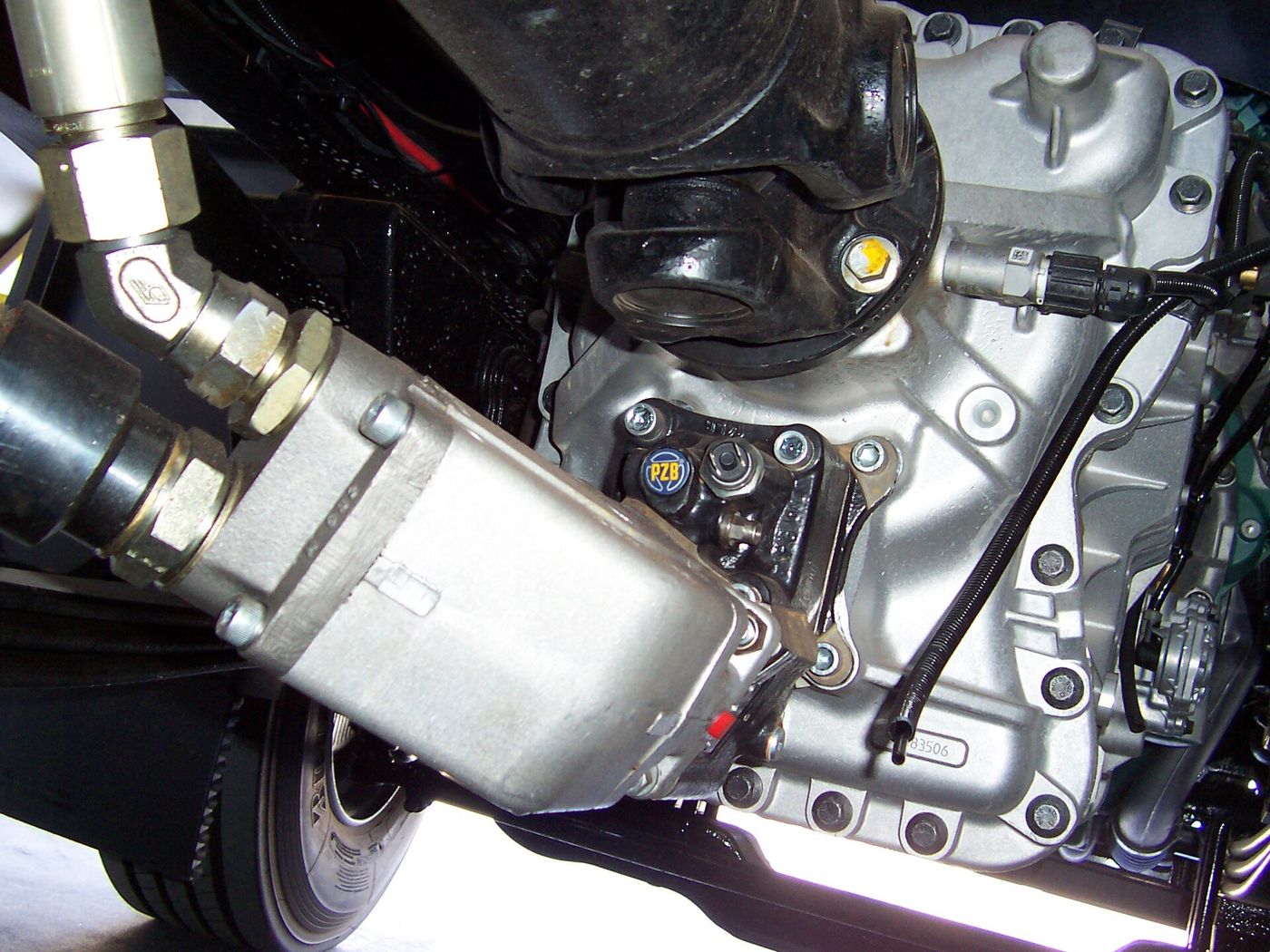
A power take-off, or PTO, is a device on a truck’s gearbox or engine that drives auxiliary equipment, generally through a hydraulic pump: the hydraulics of a tipper, a loader crane, a mixer or a refuse body, for example. Regulation (EU) 2017/2400 defines it as “a device on a transmission or an engine to which an auxiliary driven device, e.g., a hydraulic pump, can be connected”. Volvo and Mack class PTOs in two families: clutch dependent, mounted on the gearbox and designed for work with the truck parked, and clutch independent, mounted on the engine and mainly used for work while driving.
Status as at 4 November 2026. Read on that day: Regulation (EU) 2017/2400 in its Official Journal text of 29 December 2017, in six language versions, without the later amending acts; Volvo Trucks North America’s body builder instructions for the VN, dated November 2025; Mack’s for its VECU5 trucks, dated December 2023; Peterbilt’s 2024 heavy-duty body builder manual; Volvo Trucks’ PTR-DM fact sheet of 17 June 2024; Scania’s parts list for power take-offs and hydraulics; and data sheets from two PTO makers, Muncie and Hydreco. The figures belong to the units and the document dates named.
The definition in EU law and what makers add
Annex VI to the Regulation, which deals with gearbox data for CO2 certification, gives the definition at point 2(14). Point 2(15) separates out the part inside the gearbox: a power take-off drive mechanism is “a device in a transmission that allows the installation of a power take-off (PTO)”. Annex IX repeats the definition at point 2(25) and adds that “a power take-off is usually optional”. The Regulation’s other language versions read Nebenabtrieb in German, toma de fuerza in Spanish, przystawka odbioru mocy in Polish, presa di potenza in Italian and prise de force in French.
Peterbilt’s manual says a PTO “provides a way to divert some or all of the trucks engine power to another component”. Volvo’s and Mack’s instructions start from the equipment, which needs a PTO “either when the truck is stationary or when it is in motion”. The work “is generally carried out by equipment which is powered by a hydraulic motor”; the motor, a pump and associated equipment form the basis of the hydraulic system, and the pump provides the pressure and flow. Mack lists two pump types, fixed displacement and variable displacement. In a load sensing system the variable pump “supplies the correct amount of flow required by the various work functions currently engaged”.
Clutch dependent and clutch independent
Volvo’s and Mack’s documents use the same sentence: “Power take-offs are classified into two family variants: Clutch dependent and Clutch independent”.
| Clutch dependent | Clutch independent | |
|---|---|---|
| Mounted | “on the transmission” | Volvo: “either on the front of the engine or rear of the timing cover”. Mack: “either on the front of the engine or the flywheel housing” |
| Intended use | “designed to work when the truck is parked” | “mainly used when work is to be done when driving” |
| Link to the clutch | “stop working when the clutch pedal is depressed” (Volvo); “stop rotating” (Mack) | Mack, on its rear engine PTO: “dependent only on the engine power” |
| Uses named | Dump trucks, mobile cranes, tank trucks | Refrigerated, hook lifts, concrete mixer, snow plows and sand spreaders |
| Unit codes | PTR (single, rear-facing), PTRD (double) | REPTO, also coded PTER (rear of the engine) |
The documents also describe cases that cross this division. Mack says trucks for cement mixers or dump trucks “may use a rear-mounted engine PTO”, although dump trucks stand in its clutch-dependent list. Volvo’s fact sheet for the PTR-DM, a clutch-dependent gearbox unit, says that on a diesel or gas vehicle it “can be used when the vehicle is standing still or when driving at low speeds”.
Volvo’s instructions for I-Shift and Mack’s for mDRIVE give the limit in the same words: with a gearbox PTO in use while moving, “the transmission will only be able to operate in the starting gear that was selected”, and the maximum vehicle speed “is usually around 6 mph”. When the PTO is engaged and Drive is selected, the transmission control unit releases the clutch and applies the countershaft brake, which stops the PTO until the driver releases the brake pedal and applies the throttle. The gearbox itself is the subject of automated manual transmissions; the gearbox families are in truck gearbox types.
What individual bodies take from a PTO is set out with each body: tipper trucks, truck-mounted loader cranes, truck mixers and concrete pumps and refuse collection vehicles.
Where a PTO is mounted
Peterbilt’s manual, under its headings for transmission-mounted PTOs and manual transmissions, says “This is the most common type of PTO that is used”.
| Position | Drive and details | Document |
|---|---|---|
| Rear of the gearbox | PTR single and PTRD double units, rear-mounted. The PTR-DM is “driven via the intermediate shaft of the gearbox” | Volvo instructions and fact sheet |
| Side or bottom of a manual gearbox | Medium-duty: 6-bolt openings on the right and left. Heavy-duty: “a 6 bolt PTO on the right and an 8 bolt PTO on the bottom left” | Peterbilt |
| Through the gearbox | Thru shaft or extended countershaft: “the counter shaft extends out through the back of the transmission” | Peterbilt |
| Openings on an Allison automatic | 4000 series at 1 and 8 o’clock, 3000 series at 4 and 8 o’clock, viewed from the back; 4000HS: none | Peterbilt |
| Rear of the engine (REPTO) | On the rear of the flywheel housing, driven by the timing gear (Mack) or the “rear gear train” (Peterbilt). The flange “will always be turning when the engine is running”; cement mixer and feed lot uses | Volvo, Mack, Peterbilt |
| Front of the engine | With a hydraulic pump “in front of the engine (or bumper)”. Uses named: refuse, dump body with spreading apparatus, roll on/off and hook lifts, municipal trucks with multiple hydraulic equipment needs | Mack |
| Split shaft (driveshaft PTO) | “the PTO drive is after the transmission output shaft speed sensor, i.e., on a split shaft”. Uses named: concrete pumpers, vacuum bodies, high-pressure liquid transfer | Mack |
Mack sets the rear and front engine positions side by side for two trucks of the same frame length and overall length. With the front engine PTO the wheelbase is about 46 to 53 cm (18 to 21 in) shorter, because of the pump ahead of the engine, and Mack puts the higher payload of the REPTO truck under the US Federal Bridge Law at 545 to 680 kg (1,200 to 1,500 lb).
The output comes in three forms in Volvo’s and Mack’s documents: “keyed shaft, SAE drive flange or internal splined DIN”. The DIN 5462/ISO 7653 connection takes a directly mounted pump, and an SAE flange such as SAE 1410 serves, in Mack’s words, “shaft-driven accessories”. The code HPE means a hydraulic pump mounted to an engine PTO. Scania’s bodybuilding parts list, which gives part numbers but no ratings, separates PTOs on engines from those on gearboxes and lists connections from DIN 90 to DIN 150, SAE 1310 and SAE 1410.
Independent PTO makers publish data for gearbox openings. Hydreco describes its PA43 for Allison transmissions as “a constant mesh Hotshift PTO”, and lists an internal clutch system with “Ability to engage when moving”. Muncie’s Allison 4000 pages list clutch shift series, A20 and A40, and constant drive series, A30 and A50, for Allison’s 10-bolt opening.
How a PTO is rated
Three figures recur: the permitted torque, the power and the speed ratio. Mack writes the ratio as “1:X.x (1 = engine, X.x = power take-off)”, so at 1:1.26 the PTO turns 1.26 times per engine revolution; Muncie gives the same thing as a percentage of engine speed. On a gearbox unit the ratio depends on the gearbox. Volvo’s fact sheet says “Rpm and output are governed by the gear ratio of the gearbox and the speed of the engine”, and its North American table gives the PTR-DM four values: 1.35 and 1.72 with an overdrive I-Shift, 1.06 and 1.35 with a direct one, in the Low/Neutral-1 and High/Neutral-2 columns.
| Unit | Position and connection | Permitted torque | Power | Speed ratio | Document |
|---|---|---|---|---|---|
| PTR-DM | Rear of gearbox, DIN 5462/ISO 7653 | 600 Nm | 100 kW, continuous | Depends on the gearbox | Volvo fact sheet, June 2024 |
| PTR-DM | Rear of I-Shift, DIN 5462 | 600 Nm (443 ft-lb) | 100 kW (134 hp) | 1.06 to 1.72 | Volvo VN, 11.2025 |
| PTR-FL | Rear of I-Shift, SAE 1300 flange | 600 Nm (443 ft-lb) | 100 kW (134 hp) | 0.73 to 1.18 | Volvo VN, 11.2025 |
| PTR-D, PTR-F | Rear of I-Shift, DIN 5462 or SAE 1410 flange | 1,000 Nm (737 ft-lb) | 150 kW (200 hp) | 0.7 to 1.15 | Volvo VN, 11.2025 |
| PTER with EPTT650 or EPTT1000 | Rear of D13 engine, with I-Shift, Regional models | 650 or 1,000 Nm while driving | Not given | Not given | Volvo VN, 11.2025 |
| MP7 REPTO | Rear of engine, DIN 5462 or SAE 1350/1410 | 850 Nm (630 ft-lb) stationary; 651 Nm (480 ft-lb) above 5 km/h (3 mph) | Not given | 1:1.08 (DIN), 1:1.26 (SAE) | Mack, 12.2023, p. 34 |
| MP8 REPTO | Rear of engine, DIN 5462 or SAE 1350/1410 | 1,003 Nm (740 ft-lb) stationary; 651 Nm (480 ft-lb) above 5 km/h (3 mph) | Not given | 1:1.26 | Mack, 12.2023, pp. 34–35 |
| MP8 front PTO | Front of engine | 678 Nm (500 ft-lb) | 134 kW (180 hp) at 1,800 rpm | Not given | Mack, 12.2023, p. 40 |
| On PACCAR 12-speed and Endurant | 8-bolt, bottom of gearbox | Not given | 95 hp, stationary and at low speeds in gears 2, 4 and R2 | Not given | Peterbilt, 2024 |
| On PACCAR TX-18 and Endurant XD | 8-bolt bottom and 4-bolt rear of gearbox | 610 lb-ft, combined | 160 hp, combined | 111 % | Peterbilt, 2024 |
| Peterbilt REPTO | Rear of engine, 1350/1410 flange | Not given | Not given | PX-9 1.15:1, MX-13 1.2:1, MX-11 1.3:1, Cummins ISX12N 1.32:1 | Peterbilt, 2024 |
| Muncie A50 series | Allison 4000 series, 10-bolt opening | 284 to 565 lb-ft, continuous | 54 to 108 hp at 1,000 PTO rpm | 121 to 241 % | Muncie ALLI-06, Rev. 05-26 |
| Hydreco PA43 | Side of Allison 5000/6000 and 8000/9000 | 630 to 730 Nm (465 to 538 ft-lb), intermittent | 66 to 76.4 kW at 1,000 rpm output shaft | 87 to 159 % | Hydreco, 2015 |
Mack’s document carries two sets of REPTO torque figures. The specification tables on pages 34 and 35 are those above. The overview table on page 33 prints “1000 (738)” below 5 km/h and “650 (479)” above it, for both the MP7 and the MP8, under a heading that reads ft-lb (Nm).
Volvo and Mack state the link between the figures: “Engine torque is equal to power take-off torque x gear ratio.” Muncie’s table shows the effect at the gear that drives the PTO. The rating falls as the ratio rises, from 565 lb-ft at 121 percent of engine speed to 284 lb-ft at 241 percent, and in each row of the A50 series the torque times the ratio comes to about 685 lb-ft, the figure Muncie’s footnote gives as “the Allison drive gear rating (for single PTO)”.
Volvo’s fact sheet marks the 100 kW of the PTR-DM with a condition: “Gearbox oil cooler is required if used power exceeds 75 kW for more than 15 minutes.” Mack gives the same threshold for its transmission-mounted units, 100 hp (75 kW) for 15 minutes. The documents also give the direction of rotation. Volvo’s PTR-FL and PTR-DM turn counter-clockwise viewed from the rear and its PTR-D and PTR-F clockwise, while Mack and Peterbilt say a REPTO rotates in the same direction as the engine.
How it is engaged, and PTO as an engine speed function
On the PTR-DM, a switch on the instrument panel works a solenoid valve. The valve regulates compressed air to a control cylinder, whose piston moves a selector fork and an engaging sleeve that connects the connecting shaft to the PTO input shaft. Hydreco’s codes for the PA43 list four engagement types: continuous, electric/hydraulic at 12 V or 24 V, and hydraulic.
In the makers’ documents PTO also names a control function. Volvo and Mack note that the term “has come to mean both the function of maintaining constant engine speed during use of auxiliary equipment, as well as a term for the auxiliary equipment itself”, and they compare the function to “cruise control for the engine”. They list two types. Electronic Hand Throttle is standard equipment, worked from the cruise control switches. “Physical” or “wired” PTO is most commonly associated with engine- or transmission-driven accessories; the equipment is usually wired to the PTO function controller, so that engaging one activates the other. With I-Shift or mDRIVE, an Output Control function makes it possible “to prevent engagement of the auxiliary equipment until certain conditions are met”, such as the park brake being set or engine speed being within a range. Peterbilt’s manual has PTO Mode Control and PTO Speed Control for its MX engines.
On electric trucks
Volvo’s fact sheet applies the PTR-DM to electric trucks as well. Speed and output are then governed by the gearbox ratio and the speed of the electric motors, and the unit “can be used only when the vehicle is at a standstill”. Scania’s parts list has a separate entry for ePTO on electric vehicles. Electric and electro-mechanical PTOs named for particular chassis are listed in refuse collection vehicles and tipper trucks.
How EU CO2 certification counts a disengaged PTO
Under Regulation (EU) 2017/2400 manufacturers determine the CO2 figures of new heavy vehicles with a simulation tool, VECTO, and a PTO has its own entries in the Regulation. In the text as published in 2017, “Transmission testing can be done with or without power take-off drive mechanism and/or power take-off” (Annex VI, point 3.1.3.5). The losses of a PTO are then taken from standard values. Annex IX, point 3.6, says these values represent the “power losses in usual drive mode when the PTO is switched off/disengaged”, while consumption with the PTO engaged is “added by the Vehicle Energy Consumption calculation Tool”. Annex III has two input parameters for it, PTOShaftsGearWheels (P247) and PTOOtherElements (P248), and the manufacturer’s records file has a line “Power take off (yes/no)” (Annex IV, Part I, point 1.3.8).
| Shafts and gear wheels | Tooth clutch (incl. synchroniser) or sliding gearwheel | Multi-disc clutch | Multi-disc clutch and oil pump |
|---|---|---|---|
| Only the drive shaft of the PTO | 50 | 1,000 | 2,000 |
| Drive shaft and/or up to 2 engaged gearwheels | 300 | 1,500 | 3,000 |
| Drive shaft and/or more than 2 engaged gearwheels | 600 | 2,000 | 4,000 |
A drive mechanism alone with only one engaged gearwheel above the specified oil level, and no additional gearmesh, counts as 0 W.
Quick answers
- What is a PTO on a truck?
- A power take-off is a device on the gearbox or the engine to which equipment such as a hydraulic pump is connected. Regulation (EU) 2017/2400 defines it as "a device on a transmission or an engine to which an auxiliary driven device, e.g., a hydraulic pump, can be connected". Volvo and Mack say the work is generally carried out by equipment powered by a hydraulic motor, which a pump supplies with pressure and flow. Among the uses they name are dump trucks, mobile cranes, tank trucks, concrete mixers and hook lifts; Mack also names refuse bodies.
- What is the difference between a clutch-dependent and a clutch-independent PTO?
- Volvo and Mack class PTOs in these two families. A clutch-dependent PTO is mounted on the transmission, is "designed to work when the truck is parked" and stops when the clutch pedal is depressed; their examples are dump trucks, mobile cranes and tank trucks. A clutch-independent PTO sits on the engine, at the front or at the flywheel housing, and is "mainly used when work is to be done when driving"; their examples are refrigerated bodies, hook lifts, concrete mixers and snow plows or sand spreaders.
- What is a REPTO?
- A rear engine PTO: a clutch-independent PTO mounted on the rear of the flywheel housing and driven by the engine's timing gear or rear gear train. Peterbilt says its flange "will always be turning when the engine is running" and names cement mixer and feed lot applications. Mack's specification tables give its MP7 REPTO 850 Nm (630 ft-lb) stationary and its MP8 REPTO 1,003 Nm (740 ft-lb) stationary, and both 651 Nm (480 ft-lb) above 5 km/h (3 mph).
- Can a truck's PTO be used while driving?
- It depends on the type. Volvo and Mack describe clutch-independent PTOs as mainly for work while driving; Volvo limits the D13 engine PTO with I-Shift to 650 or 1,000 Nm while driving, depending on the variant. A gearbox PTO used on the move leaves I-Shift or mDRIVE in the selected starting gear, with a maximum vehicle speed usually around 6 mph. Volvo's PTR-DM fact sheet says that unit can be used at a standstill or at low speeds on a diesel or gas truck, and only at a standstill on an electric one.
- What does a PTO ratio such as 1:1.26 or 111 percent mean?
- It gives the speed of the PTO against the speed of the engine. Mack writes 1:X.x with 1 for the engine, so at 1:1.26 the PTO turns 1.26 times per engine revolution. Peterbilt says the two PTOs on the PACCAR TX-18 and Endurant XD "operate at 111% of engine speed". Volvo and Mack state that engine torque equals PTO torque times the gear ratio, and in Muncie's Allison 4000 table the rated torque falls from 565 lb-ft at 121 percent of engine speed to 284 lb-ft at 241 percent.
Sources
- Commission Regulation (EU) 2017/2400 of 12 December 2017 as published (OJ L 349, 29.12.2017, p. 1): Annex III (parameters P247 and P248), Annex IV Part I point 1.3.8, Annex VI points 2(14), 2(15) and 3.1.3.5, Annex IX points 2(25), 2(26) and 3.6 with Table 10; English, German, Spanish, Polish, Italian and French versions — EUR-Lex, Official Journal of the European Union, 12 Dec 2017
- Body Builder Instructions: Power Take-off (PTO), VN(4), Section 9, USA189992363, date 11.2025 — Volvo Trucks North America
- Fact sheet: Power take-off PTR-DM, gearbox medium-speed PTO, 600 Nm, version 08 of 17 June 2024 — Volvo Trucks, 17 Jun 2024
- Body Builder Instructions: Power Take-off (PTO) (VECU5), PI, AN, GR, LR, TE, Section 9, USA175498142, date 12.2023 — Mack Trucks
- 2024 HD Body Builder Manual, Section 8: Power Take-Off (PTO) — Peterbilt Motors Company
- Bodybuilding part numbers: Power take-off and Hydraulic system — Scania
- Application pages ALLI-06: Allison 4000 series, 10-bolt opening, Rev. 05-26 — Muncie Power Products
- Technical data sheet: PA43 Series power take-off, version control 2015 01 A — Hydreco