Truck-mounted loader cranes: EN 12999, machinery law and examinations in service
EU machinery law excludes vehicles, not machinery mounted on them. What EN 12999 covers, the move to Regulation (EU) 2023/1230 on 20 January 2027, lifting moments and national examination rules.
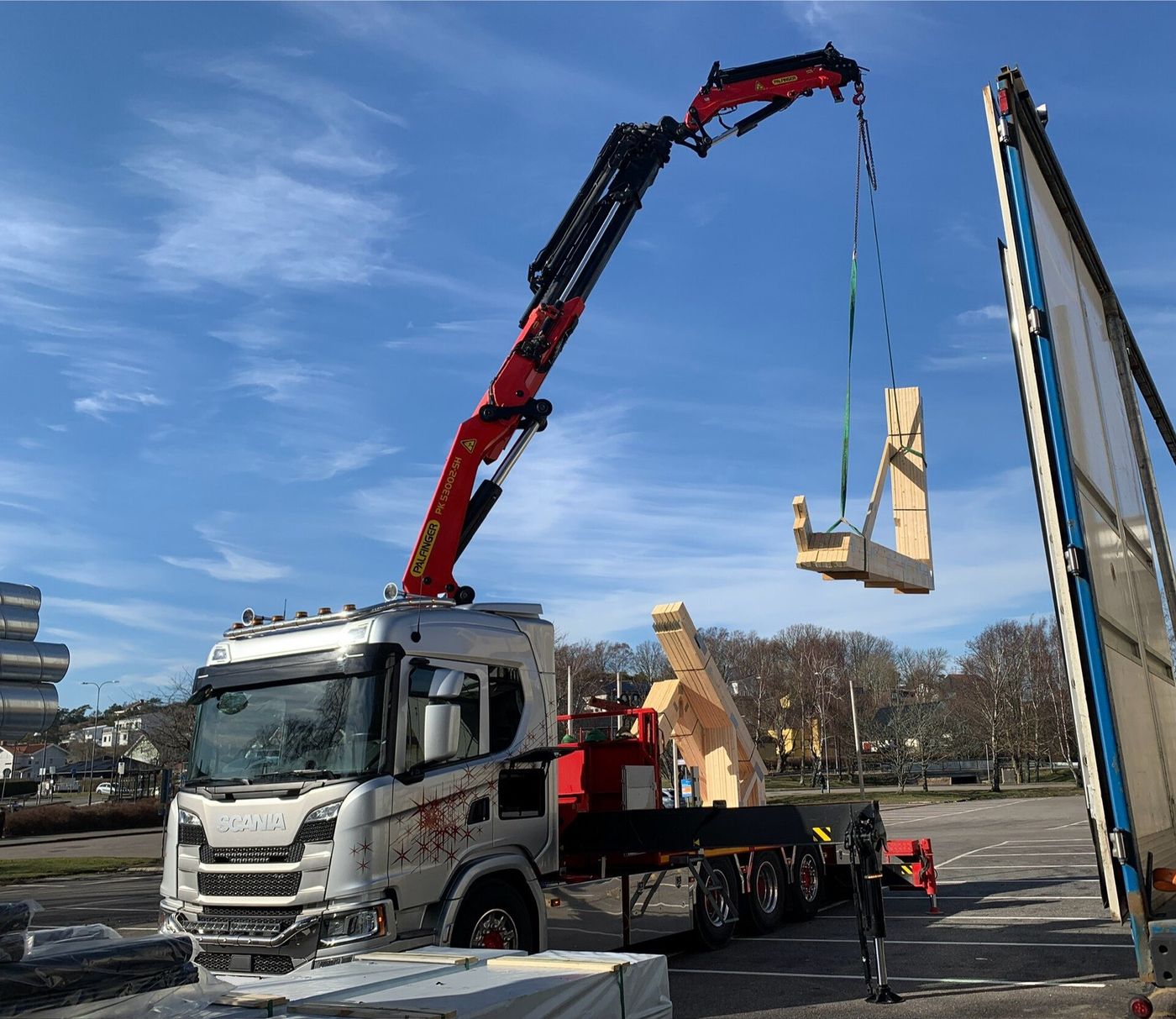
A truck-mounted loader crane is a hydraulic crane installed on a goods vehicle. Its European standard, EN 12999, covers loader cranes on road vehicles and trailers with load-carrying capability, on tractors whose towed trailer carries the goods, on demountable bodies, on other carriers and on static foundations. EU machinery law excludes motor vehicles and their trailers from its scope “except for machinery mounted on those vehicles”, in the words of Regulation (EU) 2023/1230, which replaces Directive 2006/42/EC on 20 January 2027. For cranes in service, national rules differ: in Germany a truck loader crane is examined at least once a year, and in Great Britain lifting equipment exposed to deterioration liable to result in dangerous situations is thoroughly examined at least every 12 months, or every 6 months if it lifts persons, or in accordance with an examination scheme.
Status as at 28 October 2026. Read on that day: Directive 2006/42/EC and Regulation (EU) 2023/1230 in their Official Journal texts, and the corrigendum of 4 July 2023 to the Regulation; the catalogue entry of the Estonian standards body EVS for EN 12999:2020; the German Betriebssicherheitsverordnung as last amended by Article 27 of the Act of 18 December 2025; regulations 1, 2, 3, 8 and 9 of the Lifting Operations and Lifting Equipment Regulations 1998 on legislation.gov.uk; the loader crane page of Poland’s Office of Technical Inspection (UDT); and the loader crane pages of Palfinger, Hiab, Fassi and Amco Veba. Neither EU text was read in a consolidated version.
What EN 12999 covers
EN 12999, Cranes — Loader cranes, “specifies minimum requirements for design, calculation, examinations and tests of hydraulic powered loader cranes and their mountings on vehicles or static foundations”. The scope of the 2020 edition, as given in the catalogue of EVS, the Estonian standards body, applies to loader cranes designed to be installed on:
- “road vehicles, including trailers, with load carrying capability”;
- “tractors (road or agricultural), where only a towed trailer has capability to carry goods”;
- “demountable bodies to be carried by any of the above”;
- other types of carriers, such as separate loaders, crawlers, rail vehicles and non-seagoing vessels;
- static foundations.
It also applies to loader cranes fitted with special tools or interchangeable equipment, such as a grapple, a clamshell bucket or a pallet clamp, as specified in the operator’s manual. It does not apply to loader cranes on board sea-going vessels or to articulated boom systems designed as integral parts of special equipment such as forwarders. It “does not cover hazards related to the lifting of persons”, and a note adds: “The use of cranes for lifting of persons can be subject to specific national regulations.” The 2020 edition is not applicable to loader cranes manufactured before its publication; for cranes designed earlier, the provisions on stress calculations in the edition valid at the time of their design still apply.
EVS lists three Estonian editions: EVS-EN 12999:2011+A2:2018 from 16 March 2018, EVS-EN 12999:2020 from 2 November 2020 and EVS-EN 12999:2020+A1:2025, valid from 1 April 2025, the day the 2020 edition was withdrawn. It files the standard under Directive 2006/42/EC and states that the withdrawn edition “still has the presumption of conformity in the meaning of regulation 2006/42/EC”, and that the presumption “is valid until a corresponding amendment is published in the Official Journal of the European Union”. How the Commission lists such standards for the Machinery Directive, by implementing decision, is shown under truck mixers and concrete pumps. Amco Veba states that all its cranes for CE markets “have been aligned with new update of European Standards EN12999:2020” and EN 13849. How the standards for refuse collection vehicles deal with the loader cranes some of them carry is set out under refuse collection vehicles.
Machinery mounted on a vehicle
Directive 2006/42/EC excludes the motor vehicles and trailers covered by the type-approval Directive 70/156/EEC “with the exclusion of machinery mounted on these vehicles” (Article 1(2)(e)). Regulation (EU) 2023/1230 excludes the motor vehicles and trailers within the scope of Regulation (EU) 2018/858 “except for machinery mounted on those vehicles” (Article 2(2)(g)). Both texts count as machinery an assembly “ready to be installed and able to function as it stands only if mounted on a means of transport” (Article 2(a) of the Directive, Article 3(1)(c) of the Regulation). How a vehicle that carries fixed equipment is categorised for type approval is set out under vehicle categories M, N and O.
Cranes are not among the categories in Annex IV of the Directive or Annex I of the Regulation, the lists of machinery to which the specific procedures of Article 12(3) and (4) of the Directive, or Article 25(2) and (3) of the Regulation, apply. For machinery not listed, the Directive prescribes “the procedure for assessment of conformity with internal checks on the manufacture of machinery provided for in Annex VIII” (Article 12(2)), and the Regulation “the internal production control procedure (module A) set out in Annex VI” (Article 25(4)). Both lists include devices for the lifting of persons, or of persons and goods, involving a hazard of falling from a vertical height of more than three metres (Annex IV point 17 of the Directive, Annex I Part B point 14 of the Regulation). Both indicative lists of safety components include “monitoring devices for loading and movement control in lifting machinery” (Annex V point 8 of the Directive, Annex II point 8 of the Regulation).
The supplementary requirements for lifting operations are in section 4 of Annex I to the Directive and of Annex III to the Regulation, under the same numbers.
| Point | Subject | What the texts require |
|---|---|---|
| 4.1.2.1 | Stability | The stability required by section 1.3.1 is maintained in service and out of service, including all stages of transportation, assembly and dismantling, during foreseeable component failures and during the tests carried out in accordance with the instructions |
| 4.1.2.3 | Mechanical strength | Static test coefficient, as a general rule, 1.5 for manually operated machinery and lifting accessories and 1.25 for other machinery; dynamic test coefficient, as a general rule, 1.1, with simultaneous movements tested under the least favourable conditions |
| 4.1.3 | Fitness for purpose | The static and dynamic tests are performed on all lifting machinery ready to be put into service; where it cannot be assembled in the manufacturer’s premises, the measures are taken at the place of use, by the manufacturer in the Regulation’s wording |
| 4.2.2 | Loading control | Machinery whose power source is other than manual effort, with a maximum working load of not less than 1,000 kg or an overturning moment of not less than 40,000 Nm, is fitted with devices to warn the driver and prevent dangerous movements in the event of overloading or of the overturning moment being exceeded |
| 4.3.3 | Marking | The maximum working load is prominently marked; where it depends on the configuration, each operating position has a load plate giving the working load for each configuration, preferably as a diagram or tables |
| 4.4.2 | Instructions | The maximum working load and, where appropriate, a copy of the load plate or load table; the reactions at the supports or anchors |
From the Directive to the Regulation
Regulation (EU) 2023/1230 was adopted on 14 June 2023 and published in the Official Journal on 29 June 2023. As first published, it was to apply from 14 January 2027 and to repeal Directive 2006/42/EC with effect from that day; a corrigendum published on 4 July 2023 replaced the date with 20 January 2027 in both provisions (Articles 51(2) and 54). From then, references to the Directive “shall be construed as references to this Regulation” (Article 51(2)). Member States “shall not impede” the making available on the market of products placed on the market in conformity with the Directive before 20 January 2027 (Article 52(1), as corrected).
Lifting moment, capacity and outreach
Palfinger, Hiab and Fassi class their loader cranes by a figure in tonne-metres: Palfinger writes mt and calls the figure the lifting moment, Hiab writes Tm and Fassi tm, which its Italian pages spell out as tonnellate/metro. Palfinger’s model pages list the moment separately from the largest load and the reach, as a maximum lifting moment, a maximum lifting capacity in kilograms and a maximum hydraulic outreach in metres. Hiab’s product finder labels its tonne-metre figure “Lifting Capacity”, for example 10 Tm for the HIAB X-HiPro 112. The German rules below set their threshold in kilonewton-metres.
The maxima of one model can come from different versions. Each of the four Palfinger model pages in the table below lists the crane in lettered versions. For the PK 880 TEC, the 82.8 mt maximum is the figure of version C, with an outreach of 10.9 m and a crane weight of 7,160 kg; version H reaches 21.7 m at 75 mt and weighs 8,450 kg. The page notes that the outreaches stated “are with a boom angle of 20° and are therefore not the maximum”.
| Model | Max. lifting moment | Max. lifting capacity | Max. hydraulic outreach | Dead weight (std) | Stabiliser spread (std) | Fitting space required (std) | Pump capacity |
|---|---|---|---|---|---|---|---|
| PK 250 TEC | 23.5 mt | 7,100 kg | 20 m | 2,525 kg | 5.6 m | 1.05 m | 80–100 l/min |
| PK 580 TEC | 55.5 mt | 20,000 kg | 21.2 m | 4,670 kg | 7.8 m | 1.43 m | 90–120 l/min |
| PK 880 TEC | 82.8 mt | 25,000 kg | 21.7 m | 7,160 kg | 8.6 m | 1.64 m | 2 × 100–130 l/min |
| PK 1650 TEC | 124.8 mt | 32,000 kg | 21 m | 11,610 kg | 10.0 m | not listed | 2 × 100–120 l/min |
All four are listed with a maximum operating pressure of 385 bar, and the first three with a folded width of 2.55 m. Palfinger says the TEC range “runs from 23 to 125 mt”; its other ranges are MLT and SLD. The makers’ pages also name the main parts. Palfinger’s boom tip control coordinates the “main boom, knuckle boom and extensions”, a fly jib can extend the working range, and its HPSC system “calculates stability from the actual position of every stabilizer”. Hiab’s light-capacity range includes “stiff-boom or smaller knuckle-boom cranes”, and Amco Veba, part of the Hyva group since 2007, lists “more than 50 models of truck mounted cranes”, made up of “articulated truck mounted cranes, telescopic boom cranes and special models”.
| Maker | Classes as published | Source |
|---|---|---|
| Hiab (HIAB and EFFER brands) | Light capacity, under 12 Tm; mid capacity, 12–30 Tm; heavy capacity, 30–100 Tm; super heavy capacity, over 100 Tm. On Hiab’s site, EFFER introduces the iQ.2255 HP and iQ.2655 HP as “the legacy of a 200tm and 250tm range crane” | Hiab, loader cranes page and EFFER iQ.2255 HP and iQ.2655 HP page |
| Fassi | Light-duty cranes from 1 to 20 tm; medium-duty cranes from 20 tm upwards; heavy-duty cranes over 40 tm; a special series | Fassi Gru, English home page |
| Palfinger | Small, light-duty, medium-duty and heavy-duty classes, with no figures on the loader crane page; the TEC range from 23 to 125 mt | Palfinger, loader crane page and TEC range page |
On the truck
Poland’s Office of Technical Inspection (UDT) describes the loader crane, żuraw przenośny (przeładunkowy), as a crane mounted on a lorry between the driver’s cab and the load body or at the rear of the vehicle, used to load goods onto the vehicle and unload them; under the same heading it includes forestry cranes for loading timber. Both EU texts list among the contents of the instructions, where applicable, “assembly, installation and connection instructions, including drawings, diagrams and the means of attachment and the designation of the chassis or installation on which the machinery is to be mounted” (section 1.7.4.2(i), in the Directive’s wording; the Regulation reads “machinery or related product”). Hiab offers “standard installation solutions”, which it says “support bodybuilders and installers”.
Palfinger, Fassi and Hiab state the space and the vehicles their cranes are meant for. For three of the four cranes in the table above, Palfinger lists the fitting space required, from 1.05 m for the PK 250 TEC to 1.64 m for the PK 880 TEC. Fassi says its light cranes can also be fitted to light trucks of 3.5 tonnes total mass, and describes its medium cranes as intended for two- and three-axle trucks and its heavy cranes as mountable on three- or four-axle trucks. Hiab says the EFFER iQ.1400 HP “fits in the common 32 GVW setup, with 4 or 5 axles”. The axle layouts are explained under axle configurations.
Palfinger lists a pump capacity for each crane, from 80–100 l/min for the PK 250 TEC to 2 × 100–130 l/min for the PK 880 TEC. Hiab describes its ePTO as “an electro-hydraulic power pack for cranes” that “sits alongside the traditional engine-driven system, enabling operators to work with the truck engine switched off”. How air suspension behaves when a power take-off is engaged for a crane body is covered under air suspension, and power take-off for cranes on electric truck chassis under tipper trucks.
Palfinger’s optional LOAD module “uses the truck’s inclination to detect the ballast on the vehicle and unlocks extra outreach when the truck is loaded”, and the stabiliser spread it lists for the standard versions runs from 5.6 m on the PK 250 TEC to 10.0 m on the PK 1650 TEC.
Examinations in service
Germany. The Betriebssicherheitsverordnung (BetrSichV), in force since 1 June 2015, names truck loader cranes, Lkw-Ladekrane, among the cranes whose examinations Annex 3 Section 1 sets out. For the examination after assembly and before first use, its table enters “Prüfung entfällt wegen § 14 Absatz 1 Satz 3”, a reference to the sentence of § 14(1) under which items examined and documented in a conformity assessment procedure need not be examined again. The recurring examination is “mindestens jährlich”, at least once a year, by a person qualified to carry out examinations (zur Prüfung befähigte Person, § 2(6)). For truck loader cranes with a load moment of more than 300 kNm or a boom longer than 15 m, the rules for vehicle cranes (Fahrzeugkrane) apply: in addition, an expert examiner (Prüfsachverständiger) examines the crane at least every four years of operation, in the 13th year of operation and at least once a year after that. An expert examiner must, among other conditions, have trained as an engineer or have comparable knowledge, and have at least three years’ experience in the design, construction, maintenance or examination of cranes. After exceptional events the crane is examined by a qualified person, and after changes subject to examination, by an expert examiner (point 3.4). Records are kept for the whole period of use (point 3.3), and where the crane is used at different sites, proof of the last examination has to be available at the place of use (§ 14(7)).
Great Britain. The Lifting Operations and Lifting Equipment Regulations 1998 (LOLER), in force since 5 December 1998, apply to “lifting equipment”, which regulation 2 defines as “work equipment for lifting or lowering loads”, including its attachments used for anchoring, fixing or supporting it; the regulations read do not name loader cranes. A thorough examination, by a competent person, is required before an employer first puts lifting equipment into service, unless it has not been used before and the employer has received a declaration of conformity made not more than 12 months earlier, or, where it comes from another person’s undertaking, it is accompanied by physical evidence of its last thorough examination (regulation 9(1)). Where safety depends on the installation conditions, one is required after installation and before first use, and after assembly at a new site or in a new location (regulation 9(2)). Equipment exposed to conditions causing deterioration liable to result in dangerous situations is examined at least every 6 months if it is for lifting persons or is an accessory for lifting, at least every 12 months otherwise, or in accordance with an examination scheme, and each time exceptional circumstances liable to jeopardise its safety have occurred (regulation 9(3)). Lifting equipment that leaves an employer’s undertaking, or comes from another’s, must be accompanied by physical evidence of the last thorough examination (regulation 9(4)), and every lifting operation must be “properly planned by a competent person”, “appropriately supervised” and “carried out in a safe manner” (regulation 8). The Regulations apply in Great Britain (regulation 3); the rules for Northern Ireland were not read.
Poland. According to UDT, all loader cranes of the heading żuraw przenośny (przeładunkowy) are subject to technical supervision. Those with a lifting capacity of up to 250 kg, other than cranes for moving persons, are under simplified supervision: they need no notification to UDT and no examinations, but maintenance and operation by persons with the appropriate qualifications, which for operation are not required on hand-driven devices. For the others, operation depends on registration and a UDT decision permitting operation, preceded by an acceptance examination, which is carried out for every device except factory-new harvesters and forwarders, machines UDT files under the same heading; in service they undergo periodic examinations under full supervision, or ad hoc control examinations under limited supervision, at the intervals set for the type of device. The page gives neither the form of supervision nor the interval for loader cranes above 250 kg. Among the legal bases it names are the Act of 21 December 2000 on technical supervision, the Council of Ministers’ regulation of 7 December 2012 on the types of technical devices under supervision and the regulation of 30 October 2018 on technical supervision of materials handling devices; these texts themselves were not read.
| Country | Rule read | Periodic examination | Source |
|---|---|---|---|
| Germany | BetrSichV, Annex 3 Section 1; names Lkw-Ladekrane | At least once a year by a qualified person; above 300 kNm load moment or 15 m boom, also by an expert examiner at least every 4 years of operation, in the 13th year and at least yearly after that | BetrSichV of 3 February 2015, as last amended by the Act of 18 December 2025 (gesetze-im-internet.de) |
| Great Britain | LOLER 1998, regulations 8 and 9; lifting equipment in general | Where exposed to deterioration liable to result in dangerous situations: thorough examination at least every 12 months, every 6 months for equipment for lifting persons and lifting accessories, or under an examination scheme | legislation.gov.uk, regulations 1, 2, 3, 8 and 9 |
| Poland | Technical supervision of the żuraw przenośny (przeładunkowy), as described by UDT; legal texts not read | Up to 250 kg, other than for persons: none. Above: periodic or ad hoc control examinations at intervals set by type; interval not verified | UDT, page Żuraw przenośny |
| France | Not verified | Not verified | No national text read |
| Italy | Not verified | Not verified | No national text read |
| Spain | Not verified | Not verified | No national text read |
| Türkiye | Not verified | Not verified | No national text read |
| Russia | Not verified | Not verified | No national text read |
Quick answers
- What is a truck-mounted loader crane?
- A hydraulic crane installed on a goods vehicle. Poland's Office of Technical Inspection describes it as a crane mounted on a lorry between the driver's cab and the load body or at the rear of the vehicle, used to load goods onto the vehicle and unload them. Its European standard, EN 12999, covers loader cranes on road vehicles and trailers with load-carrying capability, on tractors whose towed trailer carries the goods, on demountable bodies, on other carriers and on static foundations, but not hazards related to the lifting of persons.
- Which EU law applies to a loader crane on a truck?
- EU machinery law excludes motor vehicles and their trailers, but not machinery mounted on them. Directive 2006/42/EC applies until Regulation (EU) 2023/1230 takes over on 20 January 2027, the date set by a corrigendum of 4 July 2023 in place of 14 January 2027. Member States may not impede the making available of products placed on the market in conformity with the Directive before that date.
- What does tm mean on a loader crane?
- Tonne-metres, the unit of the figure by which Palfinger, Hiab and Fassi class their cranes: Palfinger writes mt and calls the figure the lifting moment, Hiab writes Tm and Fassi tm, which its Italian pages spell out as tonnellate/metro. Palfinger lists the moment separately from the largest load, giving its PK 880 TEC a maximum lifting moment of 82.8 mt, a maximum lifting capacity of 25,000 kg and a maximum hydraulic outreach of 21.7 m.
- Does a loader crane need an overload protection device?
- Under point 4.2.2 of the essential requirements in Directive 2006/42/EC and Regulation (EU) 2023/1230, lifting machinery whose power source is other than manual effort, with a maximum working load of not less than 1,000 kg or an overturning moment of not less than 40,000 Nm, must be fitted with devices that warn the driver and prevent dangerous movements when it is overloaded or the overturning moment is exceeded. Under point 4.3.3, where the maximum working load depends on the configuration, each operating position needs a load plate.
- How often does a truck loader crane have to be examined?
- It depends on the country. In Germany at least once a year by a person qualified to carry out examinations, and for cranes with more than 300 kNm load moment or a boom longer than 15 m also by an expert examiner at least every four years of operation, in the 13th year and at least once a year after that. In Great Britain, lifting equipment exposed to deterioration liable to result in dangerous situations is thoroughly examined at least every 12 months, every 6 months if it lifts persons, or in accordance with an examination scheme. In Poland the inspection authority's page gives no interval.
Sources
- Directive 2006/42/EC of the European Parliament and of the Council of 17 May 2006 on machinery — Official Journal text (OJ L 157, 9.6.2006): Articles 1, 2 and 12, Annex I sections 1.7.4.2 and 4, Annexes IV and V — Publications Office of the European Union, 17 May 2006
- Regulation (EU) 2023/1230 of the European Parliament and of the Council of 14 June 2023 on machinery — Official Journal text (OJ L 165, 29.6.2023): Articles 2, 3, 25, 51, 52 and 54, Annexes I, II and III — Publications Office of the European Union, 14 Jun 2023
- Corrigendum to Regulation (EU) 2023/1230 on machinery (OJ L 169, 4.7.2023), points 5, 6 and 10 — Publications Office of the European Union, 4 Jul 2023
- EVS-EN 12999:2020 Cranes — Loader cranes: catalogue entry with scope, status and standard history (read on 28 October 2026) — EVS, Eesti Standardimis- ja Akrediteerimiskeskus (Estonia)
- Betriebssicherheitsverordnung (BetrSichV) of 3 February 2015, as last amended by Article 27 of the Act of 18 December 2025 — § 2(6), § 14 and Annex 3 Section 1 (Krane) — Federal Ministry of Justice, Germany (gesetze-im-internet.de)
- The Lifting Operations and Lifting Equipment Regulations 1998 (SI 1998/2307), regulation 1: citation and commencement — legislation.gov.uk (The National Archives)
- The Lifting Operations and Lifting Equipment Regulations 1998, regulation 2: interpretation — latest available revised text — legislation.gov.uk (The National Archives)
- The Lifting Operations and Lifting Equipment Regulations 1998, regulation 3: application — latest available revised text — legislation.gov.uk (The National Archives)
- The Lifting Operations and Lifting Equipment Regulations 1998, regulation 8: organisation of lifting operations — legislation.gov.uk (The National Archives)
- The Lifting Operations and Lifting Equipment Regulations 1998, regulation 9: thorough examination and inspection — latest available revised text — legislation.gov.uk (The National Archives)
- Żuraw przenośny (przeładunkowy): definition, form of technical supervision, legal basis, procedure and types of examination (read on 28 October 2026) — Urząd Dozoru Technicznego (UDT), Poland
- Loader cranes: ranges and crane classes (read on 28 October 2026) — Palfinger
- TEC range: control system, HPSC and HPSC-Plus, questions and answers (read on 28 October 2026) — Palfinger
- PK 250 TEC: technical data (read on 28 October 2026) — Palfinger
- PK 580 TEC: technical data (read on 28 October 2026) — Palfinger
- PK 880 TEC: technical data and versions (read on 28 October 2026) — Palfinger
- PK 1650 TEC: technical data (read on 28 October 2026) — Palfinger
- Loader cranes: capacity classes and standard installation solutions (read on 28 October 2026) — Hiab
- Loader crane features and functions: ePTO (read on 28 October 2026) — Hiab
- Product finder, loader cranes, HIAB brand: first page of results (read on 28 October 2026) — Hiab
- EFFER iQ.1400 HP (read on 28 October 2026) — Hiab
- EFFER iQ.2255 HP and iQ.2655 HP (read on 28 October 2026) — Hiab
- Fassi Gru home page: heavy-duty, medium-duty and light-duty cranes (read on 28 October 2026) — Fassi Gru
- Gamma leggera: le gru leggere (read on 28 October 2026) — Fassi Gru
- Gamma media: le gru medie (read on 28 October 2026) — Fassi Gru
- Gamma pesante: le gru pesanti (read on 28 October 2026) — Fassi Gru
- Amco Veba home page: cranes for CE markets and EN 12999:2020 (read on 28 October 2026) — Amco Veba
- Truck cranes: product line (read on 28 October 2026) — Amco Veba
- About Amco Veba (read on 28 October 2026) — Amco Veba