ECAS air suspension: how ride height is controlled
Height sensors, a control unit and solenoid valves hold an air-sprung truck or bus at a set ride height. What ECAS adds, and how Directive 96/53/EC defines air suspension.
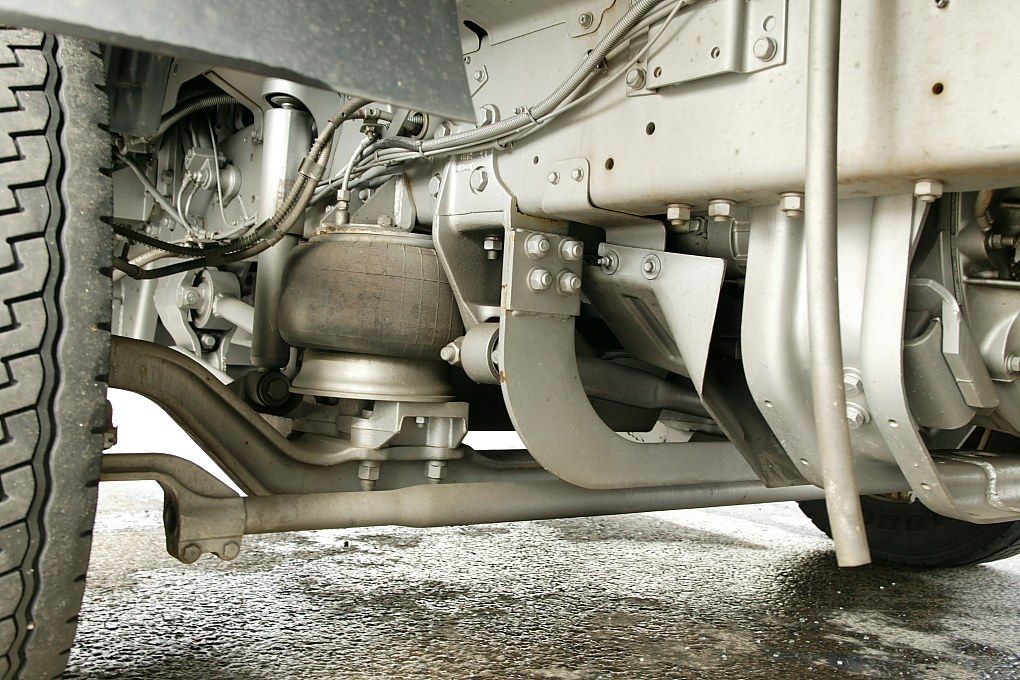
In an electronically controlled air suspension, sensors measure the distance between the axles and the chassis, an electronic control unit compares that height with target values, and solenoid valves let air into or out of the air springs to correct it. A mechanical levelling valve keeps the height constant at changing load with a lever and a rod; the electronic system adds levels the driver can select and store, raising and lowering at loading docks and for swap bodies, kneeling on buses, lift-axle control and traction help. Directive 96/53/EC, the EU weights and dimensions directive, defines air suspension by the share of the spring effect that the air spring provides, at least 75 per cent, and attaches several higher weight limits to it; the definition does not mention how the ride height is controlled.
Names used by the makers
ECAS is ZF’s name. Its fact sheet of July 2023 is titled “Electronically Controlled Air Suspension (ECAS)” and presents the system as OptiRide, a WABCO product line that came to ZF with its acquisition of WABCO in spring 2020. Knorr-Bremse calls its system Electronic Leveling Control (ELC). Volvo Trucks North America’s body builder instructions for the VN describe ECS, “Electronically Controlled Suspension”. Mercedes-Benz Buses lists “Air suspension via electronic level control system (ENR)” in the equipment table of its eCitaro data sheet, while the Mercedes-Benz Actros/Arocs operating instructions of October 2025 and MAN’s eTGS/eTGX manual (copy deadline April 2026) speak of a “level control system” and of “level control”. DAF’s bodybuilder guidelines for the LF, CF and XF105, an edition of April 2010, write “ECAS air-suspension” for the system on its own trucks. On trailers, Knorr-Bremse names its electro-pneumatic air suspension iLvl.
The air spring, and the valve that levels it without electronics
Haldex’s trailer application guide describes air springs as “the load-bearing springs for the body load in motor vehicles and trailers”. It notes that air suspension “possesses almost no intrinsic damping”, so air-sprung axles need dampers with higher forces in the tension and compression stages than leaf-sprung axles, and that air spring bellows absorb lateral forces only to a limited extent, so the wheels or axles have to be held by links, arms and anti-roll bars. Haldex also gives the reason for controlling the spring at all: to keep the natural frequency of the body as constant as possible under varying loads, the ratio of spring rate to weight has to stay the same, and the large difference in weight between an empty and a loaded vehicle makes “the need for a controllable spring ever more urgent”.
Not every axle is air-sprung. MAN’s eTGS and eTGX can have air/air or leaf/air suspension depending on the specification, and with leaf/air only the rear axles are air-suspended; DAF’s 2010 guidelines address “vehicles with front leaf / rear air-suspension or full air-suspension”. On the rear suspension of the Volvo VN the air spring works together with a Z-shaped leaf spring, and Volvo says the air suspension gives a smooth ride whether the vehicle is loaded or unloaded and reduces wear on tyres and chassis.
The non-electronic way to hold the height is the levelling valve. Volvo’s VN instructions describe a height control valve mounted inside the frame rail, its lever linked by a rod to the air spring support crossbeam: as weight is applied the frame is forced down, the linkage pushes the lever up and air flows into the air spring; as weight is removed the frame rises, the lever is pulled down and air is released from the air spring. Knorr-Bremse puts the purpose in one line: the level control valve “ensures the air springs of the axle suspension maintain a consistent chassis height, regardless of the vehicle load”. Haldex lists levelling valves with added functions: versions with a zero point adjustment port provide a second ride height, which Haldex says can be useful when a lift axle is up and more ground clearance is needed, and a version with height limitation works with a raise/lower valve to restrict lifting when a maximum permissible body height is reached.
Raising and lowering by hand needs no electronics either. Knorr-Bremse’s lifting/lowering valves “allow for manual control of the air volume in the air springs in order to lift or lower the vehicle chassis as needed”, Haldex’s COLAS valve “is used to raise and lower the deck of commercial vehicles”, and on the Volvo VN a dash-mounted switch lets the driver raise or lower the suspension when connecting or disconnecting a trailer.
What the electronic system is made of
Height sensors. WABCO’s OptiRide brochure for buses and coaches (SP9941, September 2018) says height sensors “constantly measure the distance between the axles and the vehicle body” and send the data to the ECU; Knorr-Bremse’s ELC uses distance sensors that measure the distance between the chassis and the axle beams. In WABCO’s maintenance manual MM1315 (Revised 05-20) the sensor is mounted on the chassis and linked to the axle housing; a lever moves an armature inside an inductive coil, so a change in the distance between chassis and axle changes the sensor’s analogue signal.
Pressure sensors. MM1315 says the axle loads are determined by pressure sensors attached to the suspension bellows. Volvo’s ECS uses “the electronic level sensors, pressure sensors, solenoid valves and air bellows to adjust the height and axle load on the vehicle”, and ZF’s 2023 fact sheet lists axle load monitoring, which “continuously checks axle load and alerts the driver of overload”.
Control unit. Volvo describes the loop: the ECS “compares the current level with expected values and adjusts the level by inflating or deflating air from the suspension air springs”. In WABCO’s brochure the ECU receives driver input from the control panel and controls the solenoid valve.
Solenoid valve block. In MM1315 several solenoid valves can be combined into one compact valve block; they “control the air volume within the suspension air bellows by either increasing or decreasing the pressure as required by the ECU”, with air ports to the air supply and to the bellows and an exhaust port. Knorr-Bremse’s list of the main ELC components names kneeling valves, 1-channel and 2-channel valves, front axle valves, lift axle valves, pressure sensors, level transmitters and electronic control units.
Controls. MM1315 describes a hand-held remote control, held in a bracket on the instrument panel or behind or below the driver’s seat, that the driver uses to change the frame height for loading and unloading and for connecting or disconnecting trailers. On the Actros/Arocs, depending on the vehicle equipment, the level control is operated from a unit on the driver’s seat, an external unit on the vehicle body, buttons on the instrument panel or the multimedia system; on the MAN eTGS/eTGX the frame height is set and stored with a remote control on the side of the driver’s seat, buttons or the multifunction steering wheel. Volvo’s switch list for the VN names a ride height recall switch, a loading level adjustment switch, an air suspension dump switch, an ECS traction mode switch and an alternative load distribution switch.
Link to the brakes. MM1315 states that OptiRide “operates in conjunction with the WABCO anti-lock braking system (ABS)”, cannot function correctly without it, and uses information from the ABS to determine vehicle speed and wheel slippage.
A separate control unit or an integrated actuator: ZF’s three layouts
ZF’s fact sheet of July 2023 shows three layouts side by side: ECAS with a cab-mounted ECU, ECAS with a frame-mounted ECU, and ECAS with a “Smart Pneumatic Actuator”. The actuator “integrates electronic control unit, solenoid valves and pressure sensors into one smart pneumatic actuator”; data processing runs on the actuator, the ECAS application software is hosted on the vehicle’s domain controller, and ZF says this “split system intelligence eliminates the need for a separate ECAS electronic control unit”. ZF offers the actuator with one to three channels “to enable tailored side-specific chassis height and/or lift axle control”, and it communicates over CAN bus. ZF describes the new solution as having a “simplified system layout and higher integration level”; these are ZF’s descriptions of its own product.
Knorr-Bremse’s description of ELC is functional: it “uses an electronic controller to offer the main functions of level compensation, level adjustment, lift axle regulation and load distribution for vehicles with air springs”.
Where the air comes from
Haldex describes two arrangements on motor vehicles. In the first, the air suspension takes its air from the ancillary consumer circuit (connection 23 or 24) after the quadruple-circuit protection valve, which then has to give priority to filling brake circuits 21 and 22. “In most instances”, Haldex says, the air suspension is supplied at a higher pressure than the braking system: the air is taken between the governor valve and the quadruple-circuit protection valve and fed through a pressure protection valve to the air suspension air tank, which Haldex says allows smaller air spring bellows and tanks and shorter filling and exhausting times. On trailers the air suspension is supplied from the service brake supply, and the two circuits are isolated from each other by a pressure protection valve. Volvo’s air line list for the VN includes a line from the Air Production Modulator to the rear ECS solenoid valve. How the air is produced, treated and divided into circuits is set out in the truck compressed-air system.
What the functions are
Holding the level as the load changes
MM1315 describes automatic level control: the system continually monitors the axle-to-frame distances, and when the height deviates from the preset nominal level, solenoid valves exhaust or pressurise the bellows; “There are pre-selected restrictions for when the height corrections can be made.” WABCO’s bus brochure says OptiRide maintains the nominal level “regardless of the freight load or number of passengers loading or unloading”. Under inclination level control the ECU can adjust the pressure in all bellows together or in individual bellows, to compensate for inclinations caused by unbalanced loads or uneven road surfaces; Knorr-Bremse says ELC “can also compensate for an asymmetrical load distribution”. On the MAN eTGS/eTGX, after the ignition is switched on the frame is lifted or lowered to the last set level.
Levels the driver selects and stores
Besides the nominal level, MM1315 describes additional levels the driver selects with dash switches, to raise the vehicle for rough surfaces or to lower it, and a recovery switch that returns it to the nominal level. Both WABCO’s remote control and the Mercedes-Benz Actros/Arocs have memory presets, M1 and M2, that store a chassis height and call it up again. MAN lists, depending on the equipment, a driving height, an unladen driving height, a highest and a lowest level and further programmable levels. WABCO’s bus brochure describes a high ride function for sharp break-overs such as railroad tracks and steep angles such as driveways and entrance ramps, with a limited height feature that prevents the driver from overinflating the air springs, and a low ride function for areas with low overhangs and canopies. The Actros/Arocs manual describes a raised driving level on vehicles for bulk cargo, “for improved ride comfort”, and a manoeuvring level. ZF’s 2023 fact sheet lists speed-dependent driving levels, automatic height adjustments that ZF says optimise aerodynamics to help improve fuel efficiency.
Height changes are conditional. According to MM1315, before the system can automatically change the vehicle height, certain requirements, selected via parameters, have to be met; for driver-selected changes “the status of the doors, parking brake, transmission, vehicle speed and vehicle height may be considered”, and “The requirements are determined by the OEM.” On the MAN eTGS/eTGX the level control can, depending on the equipment, be switched off; the vehicle then “behaves similar to a vehicle with leaf suspension”, and lifting, lowering and automatic level adjustment are not possible.
Loading docks, swap bodies and coupling
Knorr-Bremse says that in trucks the system can lift or lower the loading surface to the different heights of loading ramps, and that otherwise “just a few centimeters of difference could make it difficult to drive forklifts or lift trucks onto such surfaces”. ZF’s 2023 list includes fast loading and unloading, which “adapts chassis height at the loading dock to different ramp heights”, quick drop and hook, chassis raising and lowering “to ease coupling and uncoupling”, and heeling, which “enables raising of the tractor chassis above ride height for easy unloading of liquid goods”. WABCO’s 2018 tractor brochure (SP1746) says OptiRide “eliminates load from the landing gear by an electronic switch, instead of the labor intensive manual crank”.
The Mercedes-Benz manual states: “It is necessary to raise or lower the chassis to pick up or set down swap bodies or semitrailers.” After a height change the chassis has to be returned to driving level before the journey continues, and the same manual describes storing a constant chassis height for loading and unloading with the vehicle switched off, which depends on sufficient reservoir pressure in the compressed-air system. The frame heights that swap-body carriers are built for are listed under swap bodies.
Power take-off, tippers and cranes
The Actros/Arocs manual lists forced lowering among the special functions of the level control system: “When you engage a power take-off, the vehicle is completely lowered on all air-sprung axles. This increases the tipping stability of the vehicle.” With residual air bellows pressure readjustment, which depends on the equipment, the air suspension pressure on each axle is monitored and raised or lowered “until it matches a parameterisable value”. On the MAN eTGS/eTGX, setting a level may be blocked on a vehicle with a tipper body, crane body or outrigger system as soon as the PTO is activated, and the vehicle is then lifted or lowered automatically to a predefined level; after the PTO is switched off, the frame returns to driving height as soon as driving mode D or R is selected. For crane bodies, DAF’s 2010 guidelines say the ECAS air suspension “should be equipped with the function to deflate the air-suspension to low residual pressure to protect the air-bellows”. What DAF’s guidelines ask of air suspension during tipping is covered under tipper trucks.
Lift axles, tag axles and traction help
ZF’s 2023 fact sheet lists lift axle control, “load-dependent lifting of a rear axle”, which ZF says reduces rolling resistance to help optimise fuel efficiency and tyre life, and traction help, which “mitigates imminent traction-loss through temporary axle load transfer” for starting on low-friction surfaces. MM1315 describes the load transfer on a vehicle with a tag axle: when the ABS detects wheel slip, it signals OptiRide, which changes the pressures in the rear axles’ bellows to transfer weight from the non-driven tag axle to the drive axle; the driver can also start it with a dash switch, and there are pre-selected restrictions on when it can be activated and how much weight can be transferred.
The Actros/Arocs manual says that raising the leading and trailing axles reduces rolling resistance, and with it tyre wear and fuel consumption, and that the leading or trailing axle “is lowered shortly before the permissible axle load is reached”. On vehicles for large capacity transport the trailing axle can only have its load reduced, not be raised, and on vehicles with four air-sprung axles the trailing axle is lowered automatically when the parking brake is applied, which the manual says increases the braking effect. Its starting-off aid, for when the wheels are spinning on a slippery carriageway, increases the axle load on the rear axle. Knorr-Bremse’s lift axle valve (LAV) controls lift axles “fully automatically according to the vehicle load” in electro-pneumatic braking systems.
UN Regulation No. 107, on the general construction of buses and coaches, defines the device in Annex 11, paragraph 2.9: an “axle-lift device” is permanently fitted to reduce or increase the load on the axle or axles according to the loading conditions, either “by raising the wheels clear off the ground/lowering them to the ground” or “without raising the wheels off the ground, (e.g. in the case of air suspension systems, or other systems)”, in order to reduce tyre wear when the vehicle is not fully laden and/or to make moving off on slippery ground easier by increasing the load on the driving axle. When the vehicle height is measured, the effect of an axle-lift device “shall be taken into account” (Annex 11, 2.2.3), and the calculations of 3.2.1.2 for vehicles with retractable axles “shall be carried out with the axles lowered” (3.2.1.5). For trucks, the weights directive’s rule on the share of weight on the driving axles is explained under axle configurations.
Kneeling on buses
Kneeling lowers a stationary bus so that passengers can get on and off more easily. WABCO’s bus brochure says that when the vehicle is stationary it can be raised and lowered to make entry and exit easier, and that a built-in interlock “requires the door to be shut, parking brake applied and vehicle in neutral prior to kneeling”. In MM1315’s front kneeling, the switch makes the system exhaust air from the front bellows while the rear suspension stays at nominal level, which “lowers the vehicle at the entry door step”. Knorr-Bremse describes kneeling that lowers one side of the bus, the entry side, and says it can also be used to balance uneven load distributions and to optimise road traction in winter conditions. Mercedes-Benz Buses’ eCitaro data sheet lists air suspension via its ENR system and kneeling as separate equipment lines.
UN Regulation No. 107 regulates kneeling systems on buses and coaches. The definition in paragraph 2.31, the Annex 8 rule on kneeling systems and retractable steps and the speed limit while the vehicle is lowered are covered under bus accessibility. Annex 8 adds three rules on the controls: “A switch shall be required to enable operation of the kneeling system” (3.11.2.1); any control that starts the lowering or raising of the bodywork relative to the road “shall be clearly identified and be under the direct control of the driver” (3.11.2.2); and “The lowering process shall be capable of being stopped and immediately reversed by a control both within the reach of the driver, whilst seated in the cab, and also adjacent to any other operating controls provided for the operation of the kneeling system” (3.11.2.3). Unless otherwise stated, the regulation’s measurements are made with the vehicle at its mass in running order on smooth, horizontal ground and in the normal condition for travel, and under paragraph 5.5, “If a kneeling system is fitted, it shall be set so the vehicle is at its normal ride height for travel”; where a surface must be horizontal or at a specific angle, paragraph 5.6 adds that a kneeling system fitted to the vehicle “shall not be in operation”.
On trailers
On trailers, Haldex and Knorr-Bremse both connect air suspension control to their electronic trailer braking systems. Haldex offers conventional lift axle valves, fully pneumatic or half-automatic with a manual raise/lower button, and electrically controlled ones used with its EB+ system, which Haldex says adds functions such as traction support. When its COLAS raise/lower valve is electrically connected to EB+ through a solenoid valve, the system provides an automatic return to ride height at a speed threshold. Haldex also points out that the bellows pressure, which depends on the load at any instant, can be used to control the automatic load-sensing valve or EBS.
Knorr-Bremse’s iTEBS X trailer braking system, whose volume deliveries Knorr-Bremse announced on 19 December 2023, combines the electronic control unit, sensors and pneumatic brake control with functions such as ABS and load-dependent braking, and one of its versions, LAC, has an integrated lift axle valve. Its parking and manoeuvring valve (POM) controls the air suspension’s lift and lower function with a lever; with the new Chassis Suspension Module (CSM) it can also be used with conventional air suspension, and it is compatible with Knorr-Bremse’s iLvl system for electro-pneumatic air suspension. Knorr-Bremse names “the user-friendly implementation of a second ride height” among the iLvl benefits the system supports.
UN Regulation No. 13 ties one braking requirement to air suspension: subject to its transitional provisions and exclusions, paragraph 5.2.2.23 requires a vehicle stability function on O3 and O4 trailers with no more than three axles that are equipped with air suspension. The detail is set out under trailer brakes and EBS.
What EU weights law attaches to air suspension
Directive 96/53/EC gave the reason in its recital (16) of 1996: “to prevent excessive road damage and to ensure manoeuvrability”, preference “should be given to pneumatic or equivalent suspension rather than mechanical suspension”. Annex II, titled “Conditions relating to equivalence between certain non-air suspension systems and air suspension for vehicle driving axle(s)”, gives the definition: “A suspension system is considered to be air suspended if at least 75 % of the spring effect is caused by the air spring.” A suspension recognised as equivalent must meet the limits of points 2.2 to 2.5 for the frequency and damping measured during a free transient low-frequency vertical oscillation of the sprung mass above a driving axle or bogie, with the suspension carrying its maximum load: each axle “must be fitted with hydraulic dampers”, the mean damping ratio “must be more than 20 % of critical damping”, the damping ratio with all hydraulic dampers removed or incapacitated “must be not more than 50 %” of that ratio, and the frequency of the sprung mass “must not be higher than 2,0 Hz”. Paragraph 4 of the annex lays down the test procedures.
Annex I attaches the condition to four limits. For three-axle motor vehicles (point 2.3.2), four-axle motor vehicles with two steering axles (2.3.3) and the tandem axles of motor vehicles with an axle spacing of 1.3 m or more but less than 1.8 m (3.5.3), the higher limit applies “where the driving axle is fitted with twin tyres and air suspension or suspension recognized as being equivalent within the Community as defined in Annex II, or where each driving axle is fitted with twin tyres and the maximum weight of each axle does not exceed 9,5 tonnes”, in the wording of 2.3.3. The margin for a four-axle articulated vehicle whose semi-trailer axles are more than 1.8 m apart (2.2.4.2) has no twin-tyre alternative: it requires that the maximum authorised weights of the motor vehicle and of the semi-trailer’s tandem axle are respected and that “the driving axle is fitted with twin tyres and air suspension or suspension recognized as being equivalent within the Community as defined in Annex II”. The tonnages themselves are set out under GVW, GCW and axle loads and axle configurations. Neither annex says anything about how the ride height is controlled.
The provisions quoted here are those of the consolidated text of 14 August 2019. As at 23 October 2026, the European Parliament’s Legislative Observatory lists the proposal to amend the directive, procedure 2023/0265(COD), published on 11 July 2023 as COM(2023)0445, at the stage “Awaiting Council’s 1st reading position”; Parliament’s first-reading decision is dated 12 March 2024.
Who sets the parameters
Where the documents speak of settings, they place them with the vehicle manufacturer or the body builder. MM1315 says that because of the variety of suspension types and vehicle features, a particular set of parameters was developed for each vehicle type, that these parameters determine some of the features of the configuration, and that the requirements for height changes “are determined by the OEM”. The Actros/Arocs manual describes residual air bellows pressure working to “a parameterisable value” and refers to the body builder’s operating instructions when a special function has to be reactivated. DAF’s 2010 guidelines refer the installation of the residual-pressure function to DAF Sales Engineering.
Quick answers
- What does ECAS do on a truck or bus?
- It keeps the ride height at a set level as the load changes: height sensors measure the distance between axle and chassis, a control unit compares it with target values, and solenoid valves inflate or deflate the air springs. Depending on the maker and the equipment, the same system stores driver-selected levels, raises and lowers the chassis for loading docks, swap bodies and trailer coupling, lowers a stationary bus for passengers (kneeling), and controls lift axles and traction help.
- What is the difference between a levelling valve and electronic level control?
- A levelling valve holds the height mechanically: a rod linked to the axle moves a lever that lets air into the air spring when the frame drops under load and releases air when the frame rises. An electronic system measures the height with sensors and switches solenoid valves from a control unit, so it can hold stored levels, act on one axle or one side, and control lift axles. ZF's 2023 actuator puts the control unit, solenoid valves and pressure sensors in one unit.
- What counts as air suspension under EU weight rules?
- Under Annex II of Directive 96/53/EC a suspension is air suspended if "at least 75 % of the spring effect is caused by the air spring". A suspension recognised as equivalent must have hydraulic dampers on each axle, a mean damping ratio of more than 20 % of critical damping, a damping ratio with the dampers removed or incapacitated of not more than 50 % of that value, and a sprung-mass frequency not higher than 2.0 Hz (points 2.2 to 2.5). Several higher limits in Annex I apply only with air suspension or an equivalent on the driving axle.
- What rules apply to kneeling on a bus?
- UN Regulation No. 107, Annex 8, requires a switch to enable the kneeling system (3.11.2.1), controls that are clearly identified and under the direct control of the driver (3.11.2.2), and a lowering process that can be stopped and immediately reversed both from the driver's seat and next to any other kneeling controls (3.11.2.3). Under 3.11.2.4 the vehicle may not be driven at more than 5 km/h while it is lower than the normal height of travel.
- Can air suspension lift an axle or move load onto the drive axle?
- Where the system controls a lift or tag axle, yes. ZF lists load-dependent lifting of a rear axle and traction help by temporary axle load transfer, and WABCO's manual MM1315 describes moving pressure from the tag axle bellows to the drive axle bellows when the ABS detects wheel slip. UN Regulation No. 107, Annex 11, defines an axle-lift device as one that raises the wheels or, as with air suspension, changes the axle load without raising them.
Models in this article
Sources
- Electronically Controlled Air Suspension (ECAS) — OptiRide fact sheet, 07/2023 — ZF Friedrichshafen AG
- OptiRide electronically controlled air suspension for bus, coach and motor home, SP9941 (09.2018) — WABCO (now ZF)
- OptiRide electronically controlled air suspension for tractors, SP1746 (09.2018) — WABCO (now ZF)
- Maintenance Manual MM1315 (Revised 05-20): OptiRide ECAS for buses and trucks with CAN II (SAE J1939), Section 1 Introduction — WABCO (now ZF)
- Electronic Leveling Control for Trucks and Buses — Knorr-Bremse
- Electronic Leveling Control (service new parts: main components of ELC systems) — Knorr-Bremse TruckServices
- Compressed air valves: levelling valves, lift axle valves, park and shunt valves, lifting/lower valves — Knorr-Bremse
- Bus systems: level control — Knorr-Bremse
- Successful launch: Knorr-Bremse rolls out latest generation of iTEBS X electronic trailer braking system (19 December 2023) — Knorr-Bremse newsroom
- Body Builder Instructions VN (4), Section 6: Axle and Suspension (Date 11.2025) — Volvo Trucks North America
- Body Builder Instructions VN (4), Section 5: air brake system schematics and routing, air line list (Date 9.2025) — Volvo Trucks North America
- Trailer application guide: Air suspension, system description — Haldex Europe
- Trailer application guide: Air suspension, levelling valves — Haldex Europe
- Trailer application guide: Air suspension, raise-lower valves, general — Haldex Europe
- Trailer application guide: Air suspension, lift axle — Haldex Europe
- Actros/Arocs operating instructions (Actros/Arocs/10.2025 ENG): Level control system and Additional axles, printed pages 330–343 — Mercedes-Benz Trucks (Daimler Truck)
- Manual: Breakdown assistance, towing, recovery — eTGS and eTGX (copy deadline 04/2026), Level control: functional description — MAN Truck & Bus SE
- Bodybuilders' guidelines DAF LF, CF and XF105, update 2010-04 — DAF Trucks
- Technical data and equipment — the eCitaro — Mercedes-Benz Buses (Daimler Buses)
- Council Directive 96/53/EC laying down maximum authorised dimensions and weights (consolidated text, 14 August 2019): Annex I and Annex II — EUR-Lex, Publications Office of the European Union
- Council Directive 96/53/EC of 25 July 1996, OJ L 235, 17.9.1996: recital (16) — EUR-Lex, Publications Office of the European Union
- Procedure file 2023/0265(COD): Road vehicles: maximum weights and dimensions (read on 23 October 2026) — European Parliament, Legislative Observatory
- UN Regulation No. 107 — approval of category M2 or M3 vehicles with regard to their general construction [2026/139]: paragraphs 5.5 and 5.6, Annex 8 paragraph 3.11.2, Annex 11 paragraphs 2.2.3, 2.9 and 3.2.1.5 — Official Journal of the European Union, L series, 2026/139, 29 January 2026 (UNECE text)
- UN Regulation No. 13 — approval of vehicles of categories M, N and O with regard to braking [2026/746]: paragraph 5.2.2.23 — Official Journal of the European Union, L series, 2026/746, 13 April 2026 (UNECE text)