Yutong
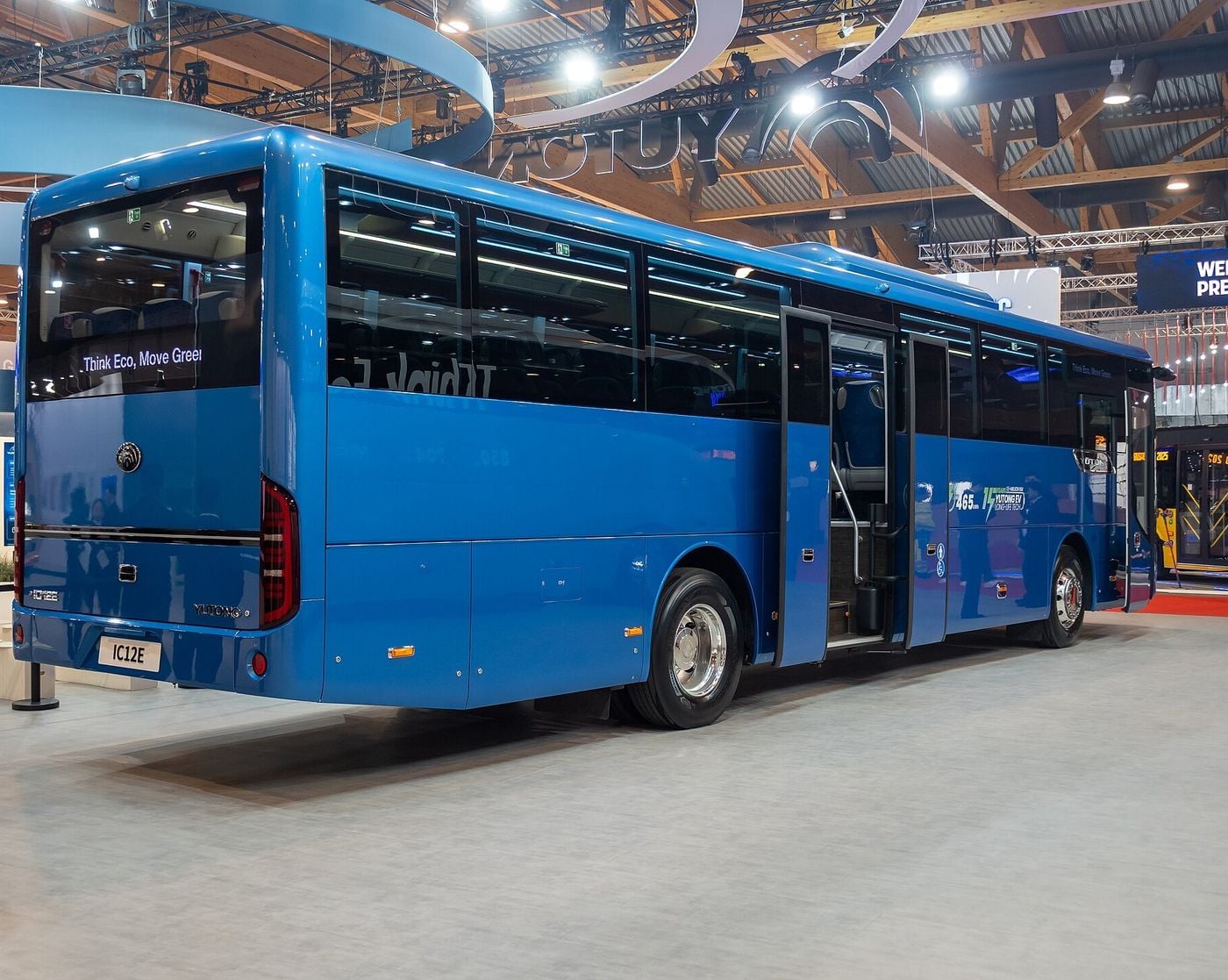
Yutong IC12E
Yutong's 12-metre battery-electric intercity bus: a 399.92 or 465.99 kWh battery, a drive rated at 215 or 250 kW with 350 kW peak, up to 3,800 N·m and up to 59+1+1 seats.
- 215/250 kW
- 12.66 m
- 19.5 t

Model overview
- Segment
- Bus
- Gross vehicle
- 19 500 kg
- Battery capacity
- 399.92–465.99 kWh
- Electric motor
- 215/250 kW · 350 kW peak
- Length
- 12 660 mm
- Wheelbase
- 6 380 mm
- Capacity
- Up to 59+1+1
The IC12E is a 12-metre battery-electric intercity bus from Yutong Bus Co., Ltd. of Zhengzhou, China. Yutong’s product page calls it “a premium battery-electric intercity bus”, and the page and the brochure carry the line “High Standard Battery Electric Intercity Bus”. The figures on this page come from Yutong’s own documents on its international English site, en.yutong.com, all read on 8 November 2026: the “IC12E(2026)” product page and its specification page (both undated), a second product page headed “Yutong IC12E 12m Electric Intercity Bus” (undated), the “Yutong IC Series” brochure (January 2026 edition), and three Yutong news releases dated 20 June, 14 July and 11 August 2025. The overview grid above follows the IC12E(2026) specification table. Yutong’s product pages say “Product availability varies by country.” Yutong’s place among the makers that sell buses in Europe is covered in who builds buses and coaches in Europe.
Model line and launch
Yutong presented the IC12E at the UITP Summit 2025 in Hamburg, held from 15 to 18 June 2025, under the theme “Think Eco, Move Green”. The release of 20 June 2025 calls it “a new-generation battery electric intercity bus – specifically designed for the European market” and says it “is specifically engineered for high-frequency intercity operations”. The release of 11 August 2025 reports the bus’s first European media evaluation, by Sustainable Bus in Italy, and says: “The vehicles have now been officially handed over to the Italian operator V.I.T.A. in the Aosta Valley, an Alpine region in the north west of Italy.” It gives no number of vehicles. The same release says that with the introduction of the IC12E, “Yutong expands its European portfolio into the electric intercity bus segment”.
Yutong’s site carries two IC12E product pages. The page headed “IC12E(2026)” gives a range of up to 675 km in its text and “Up to 61” seats in its header; the page headed “Yutong IC12E 12m Electric Intercity Bus” gives a range of up to 610 km in its text and 61 seats in its header. Both give the same two battery capacities. The IC series brochure of January 2026 carries the 2026 figures, and its parameter table has a second column for the longer IC15E.
Under the heading “Global service cases”, the brochure and the second product page say: “In September 2019, ICE12 were used for Provence’s battery electric intercity routes”. No document opened gives the ICE12’s specifications or a start of series production for the IC12E.
The 2025 road test
The release of 20 June 2025 announced: “Starting June 19, the IC12E will undergo a three-day, 1,200 km comprehensive road test across four European countries.” The release of 14 July 2025 reports a route of 1,272 km across Germany, Denmark, Sweden and Norway, ending in Oslo.
| Stage | What the release states |
|---|---|
| Hamburg to Copenhagen | 510 km on a single charge; SOC from 99% to 28%, “with about 173km showing on the range indicator” |
| Copenhagen to Gothenburg | 327 km |
| Charging test | SOC from 13% to 99% “in just 1 hour and 40 minutes by using single plug” |
| Norway | “a maximum gradient of 20%” on continuous uphill roads |
| Whole route, 1,272 km | total power consumption 926 kWh, an average of 0.7 kWh/km “(under non-full load conditions)” |
The release names no charging power and no charger for the charging test.
Battery and range
The IC12E(2026) product page says: “IC12E standard configuration is 399.92 kWh while optional is 465.99 kWh, enabling a range of up to 675km.” The specification table lists “Battery (kWh) 399.92/465.99”, and the headers of both product pages give “399/465”. No document says whether these are installed or usable capacities; the difference is set out in installed vs usable battery capacity. No document opened names the cell chemistry, the system voltage, a charging power or a charging connector.
The brochure words the range “a possible range of up to 675km(SORT2)”, and the specification table gives “Maximum driving range 675 km”. The second product page gives “a range of up to 610 km” for the same two capacities, and the release of 20 June 2025 says “With a maximum range of 610 km under SORT2 conditions”. No document ties either figure to one of the two batteries. What SORT is, and how bus makers declare range, is set out in electric buses explained.
The brochure describes a “Yutong YESS battery protection system” made up of “collision-resistant battery compartment design, battery pack MSD safety device, triple-layer protective structure, advanced liquid cooling/heating technology, and 24-hour battery monitoring system”. The brochure and the 2026 product page say that “The battery, motor and electric control system achieves IP68 & IP6K9K protection”. The brochure attributes a battery service life of “15 years/1.5 million kilometers” to liquid cooling.
Electric drive and gradeability
The specification table lists one drive rating as standard (●) and one as optional (○). It names no motor maker, motor type or number of motors.
| Row | Standard | Optional |
|---|---|---|
| Rated/peak power (kW) | 215/350 | 250/350 |
| Rated/peak torque (N·m) | 1,260/3,100 | 1,680/3,800 |
| Maximum gradeability | 14% (15 km/h, 20s) | 25% (15 km/h, 20s) |
The product page and the brochure describe “a high-power drive motor” that “delivers a maximum torque of 3,800 N·m and can climb gradients up to 20%”; in the table, 3,800 N·m is the optional rating’s peak torque. The release of 20 June 2025 also gives “a 20% maximum gradeability”. The documents do not reconcile the 20% of the text with the 14% and 25% of the table.
The brochure and the second product page carry the label “Third-generation high-efficiency motor”, and the brochure says the IC series is built on an “EV-specific platform YEA”. The product page says the bus “features stepless speed regulation for smoother operation”; no document names a gearbox. It lists as energy-saving configurations “high-efficiency motors, variable-frequency water pumps, Michelin low-rolling-resistance tires, ECAS that dynamically adjusts with vehicle speed, and electronic rearview mirrors”.
Dimensions and weights
| Row | Figure |
|---|---|
| Length × width × height | 12,660 × 2,550 × 3,500 mm |
| Interior height | 2,060 mm |
| Wheelbase | 6,380 mm |
| Front / rear overhang | 2,840 / 3,440 mm |
| Minimum turning diameter | 19 m |
| Approach / departure angle | 7.5° / 8° |
| Luggage compartment volume | up to 4.5 m³ |
| Maximum manufacturer’s total mass | 19,500 kg |
| Maximum total mass of the chassis | 20,500 kg |
The headers of both product pages give the length as 12 m. The brochure adds in its text: “The vehicle has a curb weight of 13,200 kg and a max bearing capacity of 19,500 kg under standard conditions.”
Axles, suspension and tyres
As standard, the specification table lists a Molead independent front axle with a rated load of 7,500 kg and a Molead drive axle with a rated load of 13,000 kg; as the option, a ZF independent front axle and a ZF drive axle with the same rated loads. No document prints a wheel formula.
The table gives the suspension system as “Airbag suspension”. The product page says the bus “includes front double wishbone and rear four-link suspension to reduce jolts on uneven roads”, and the brochure: “Front double wishbones, rear four-link non-independent suspensions, air springs and specialized pistons together minimize impacts of uneven roads.” The ECAS named in the energy-saving list adjusts with vehicle speed; how ECAS holds a ride height is set out in ECAS air suspension.
The tyres are Goodyear 295/80R22.5 as standard and Michelin 295/80R22.5 as the option; the energy-saving list names “Michelin low-rolling-resistance tires”. No document opened gives the brake type.
Body, doors and passenger area
The brochure describes “A high-strength frame and robust closed-ring structure for 2 million km operation” and says: “The vehicle utilizes 700MPa ultra-high strength steel, which is three times stronger than Q235 steel.” It lists “Complete vehicle cathodic electrophoresis”, and the product page says: “Yutong Y.E.S electrocoating tech ensures no structural corrosion for over 15 years.” On noise, the brochure says: “Premium raw materials and advanced NVH calibration effectively isolate chassis and ambient travel noise.”
Outside, the product page describes a front wall “with modern horizontal lines” and a front bumper with “a beveled design with vertical fog lights”. Inside, it describes “A minimalist encircling cabin design with integrated dashboard” and “Large luggage racks for easier luggage access”. The door is described as “Yutong In-House Electric Plug-sliding Door. Core components rated for 2 million open/close cycles over a 20-year service life.” No document gives the number of doors.
The specification table gives the seats as “Up to 59+1+1”, and the product page and the brochure say “The vehicle seats up to 59 passengers and offers a luggage compartment volume of 4.5 cubic meters.” The header of the 2026 product page gives “Up to 61” seats and the second product page 61. No document says what the two 1s of “59+1+1” denote. At the driver’s place, the product page gives “over 910 mm from the steering wheel center to the guardrail behind the driver”.
Heating and air conditioning
The specification table lists “Cling electric heating and cooling A/C (refrigerating capacity: 32,000 Kcal/h, heating capacity: 30,000 Kcal/h, compressor made in China)”. The product page describes “An Integrated thermal management system for air conditioning, battery, and electric drive” that “optimizes complete vehicle heat flow”.
Safety and driver-assistance systems
The brochure and the second product page say: “To comply with EU GSR, active safety technologies are developed for pre-accident driving, hazard warning, and intervention control.” The brochure continues: “Intelligent driving assistance systems are equipped to enhance capabilities of danger warning, prevention and avoidance, reducing collision and rollover risks.” Its safety graphic carries the labels AEBS, ACC, FCW, MOIS, LDW and BSIS, and the stages “Engine torque limit”, “AEBS activates auxiliary brake” and “AEBS activates service brake”; it does not mark the systems as standard or optional. Which driver assistance systems EU rules require on new buses, and from when, is set out in mandatory driver assistance systems.
On passive safety the brochure says: “Key technologies for accident protection, rescue and escape are developed in areas of frontal collision, rollover, passenger protection, and fire safety to enhance bus passive safety.” It also says: “IoV realizes remote firmware updates for the vehicle control unit, body controller, instruments, and gateway.” Electronic rearview mirrors are in the energy-saving list above.
Source notes
The figures above are from Yutong’s IC12E(2026) parameter page on en.yutong.com (undated, read 8 November 2026) and its IC series brochure, January 2026 edition: a 12,660 mm long, 2,550 mm wide and 3,500 mm high battery-electric intercity bus with a 6,380 mm wheelbase, front and rear overhangs of 2,840 and 3,440 mm, an interior height of 2,060 mm, a minimum turning diameter of 19 m and approach and departure angles of 7.5 and 8 degrees; a battery of 399.92 kWh as standard or 465.99 kWh as an option, which the documents do not split into installed and usable capacity; a drive rated at 215 kW with 350 kW peak and 1,260 N·m rated and 3,100 N·m peak torque as standard, or 250 kW with 350 kW peak and 1,680 N·m rated and 3,800 N·m peak torque as an option; Molead axles as standard and ZF axles as an option, rated at 7,500 kg front and 13,000 kg drive; air suspension, independent at the front; a maximum manufacturer’s total mass of 19,500 kg, a maximum total mass of the chassis of 20,500 kg and, in the brochure, a kerb weight of 13,200 kg; up to 59+1+1 seats and up to 4.5 cubic metres of luggage space. The documents disagree on range, gradeability and seats: the 2026 pages and the brochure give up to 675 km (SORT2 in the brochure), while the second IC12E product page and the release of 20 June 2025 give 610 km; the parameter table gives 14 per cent as standard and 25 per cent as an option (at 15 km/h for 20 s), the product text 20 per cent; the parameter table gives up to 59+1+1 seats, the product text up to 59 passengers, the 2026 product page’s header up to 61 and the second product page 61. No document gives a charging power, a connector, a battery chemistry, a usable capacity, a door count or a start of series production. Yutong presented the IC12E as a new generation at the UITP Summit 2025 in Hamburg, and reported a 1,272 km road test across Germany, Denmark, Sweden and Norway in July 2025 and a hand-over to the Italian operator V.I.T.A. in August 2025; the brochure says ICE12 buses were used on battery electric intercity routes in Provence in September 2019.
Quick answers
- What is the gross vehicle weight of the Yutong IC12E?
- Gross vehicle weight: 19 500 kg.
- What battery capacity does the Yutong IC12E have?
- Battery capacity: 399.92–465.99 kWh.
- How long is the Yutong IC12E?
- Length: 12 660 mm; Wheelbase: 6 380 mm.
- How many passengers does the Yutong IC12E carry?
- Capacity: Up to 59+1+1.
More Yutong on this site
Sources
- IC12E(2026) — product page — Yutong Bus Co., Ltd.
- IC12E(2026) Specifications — parameter page — Yutong Bus Co., Ltd.
- Yutong IC12E 12m Electric Intercity Bus — product page — Yutong Bus Co., Ltd.
- Yutong IC Series — High Standard Battery Electric Intercity Bus (brochure, January 2026 edition) — Yutong Bus Co., Ltd.
- Yutong Debuts New Generation Battery Electric Intercity Bus IC12E at UITP Summit Hamburg 2025, Showcasing Electrification Innovation — Yutong Bus Co., Ltd., 20 Jun 2025
- Yutong IC12E Conquers Full-Scenario Challenge Across Four Nordic Countries, Redefining "High Standard Battery Electric Intercity Bus"! — Yutong Bus Co., Ltd., 14 Jul 2025
- Sustainable Bus Test Drives the IC12E — Yutong Bus Co., Ltd., 11 Aug 2025