Running electric trucks and buses: maintenance, warranty, training, driving
What makers' service lists, battery warranty terms, high-voltage qualification rules, recuperation settings and rescue documents say about running electric trucks and buses.
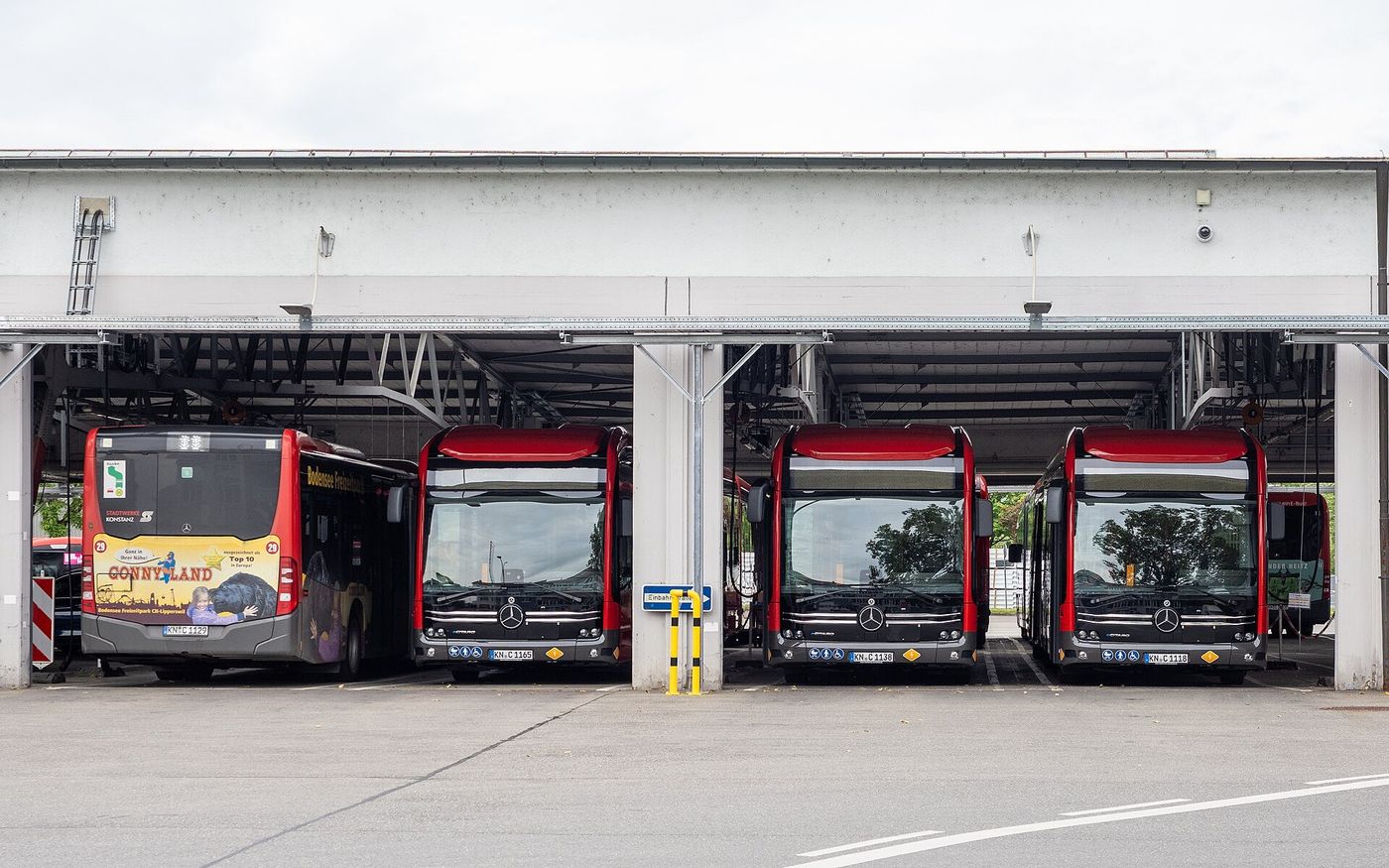
Running an electric truck or bus involves seven things, which this page takes in turn as the makers and public bodies word them: maintenance, battery warranty, who may work on the high-voltage system, driving and driver training, regenerative braking at the annual test in Great Britain, depot charging and rescue documents. Each maker defines its own terms and units (a battery warranty, for instance, is stated in months, years, kilometres, charging cycles, energy use or a state-of-health threshold), so the page sets each statement down beside its source and ranks none of them. This series describes the vehicle and its operation, not its repair. Fault diagnosis, disassembly and part-replacement procedures are not here.
The sources are makers’ contract lists, terms, product sheets, web pages and press releases, German guidance from the statutory accident insurance (DGUV), the heavy-goods-vehicle inspection manual of the Driver and Vehicle Standards Agency (DVSA), the Institute of the Motor Industry (IMI) and two EU directives, on driving licences and on driver qualification, all read on 29 September 2026. No independent measurement of brake or tyre wear or of battery state of health was opened, so a claim about a vehicle stays with the maker that made it. Translations from the German are ours.
Maintenance: what the service lists name
Volvo Trucks’ Service Contracts page, which carries no date, gives separate lists for diesel and gas-powered trucks and for electric trucks. By our count the Blue list for electric trucks has ten “Maintenance & checks” items and the diesel-and-gas Blue list seven. The electric list has no “Engine oil change”, “Belt & tensioner replacement” or “Particulate filter (DPF)” item, all three of which the diesel-and-gas list names. Both Gold lists name “Brake discs” and “Brake pads” under “Wear & tear components”.
Volvo’s electric-truck FAQ, which says that unless stated otherwise it refers to the cab-over-engine models FH Aero, FH, FM, FMX, FM Low Entry, FE and FL, states: “The maintenance intervals are roughly the same, but servicing is different than servicing a traditional driveline.” MAN’s eTGX page says: “The average use of new MAN eTrucks can be less maintenance and wear-intensive than diesel vehicles – this depends very much on use.” Neither statement carries a figure.
Scania’s UK terms for the repair and maintenance of battery-electric vehicles (publication date 14 December 2023, governed by the laws of England and Wales) define “Flexible Maintenance Services” as vehicle maintenance “that is not periodical as set out in a Vehicle-specific plan or schedule at the time of Vehicle delivery”, and separately define “Maintenance” as maintaining a vehicle “according to its individualised program of scheduled maintenance”. Among the elements that, unless the parties agree otherwise in writing, are not part of the services are “battery charging (of any kind)” (clause 4.3.2) and repair, renewal or replacement of a propulsion battery or management system “due to capacity loss caused by natural degradation” (clause 4.3.3).
Battery warranties: how each maker words them
The table sets out, alphabetically by maker and newest release first within a maker, how each document words its battery statement. It is not a ranking.
| Maker and vehicle | Document | What it says |
|---|---|---|
| DAF, XG Electric and XG⁺ Electric | XG Electric infosheet (no printed date); press release of 13 January 2026 | Infosheet (XG Electric): DAF is “guaranteeing 70% State of Health over 8 years or 4 MWh/kWh of energy use” and says this is equivalent to 4,000 charging cycles. Release: the LFP batteries “come with an eight-year warranty”. |
| Daimler Buses, NMC4 battery for the eCitaro range | Releases of 24 February 2026 and 25 March 2025 | February 2026: “guarantees a 10-year lifespan for the new NMC4 batteries and additionally offers optional customer-specific coverage of up to 15 years”. March 2025: “to guarantee a service life of eight years for the new NMC4 batteries” and “to offer an optional extended warranty with a term of twelve years”. |
| MAN, eTrucks | MAN electric-trucks overview page (no date) | “a forecasted effective useful life of up to 1.6 million kilometres or up to 13 years (depending on the type of use)” for the batteries: a forecast, not a warranty. |
| Mercedes-Benz, eActros 600 | eActros 600 product sheet, GB edition (no printed date) | The “factory-direct guarantee covers the entire vehicle, the ePowertrain and the high-voltage batteries”. Footnote: “Entire vehicle (max. 12 months with unlimited mileage), the ePowertrain (max. 36 months or 360,000 km) and the high-voltage batteries (max. 72 months or 720,000 km or 1,800 charging cycles). For ePowertrain and high-voltage batteries, whichever is reached first. A warranty case for the high-voltage batteries occurs if the state of health falls below 80% under the specified conditions for the high-voltage batteries.” |
| Renault Trucks, E-Tech T 780, T 585 and T 540 | Release of 15 September 2026 | “All three models carry a standard battery warranty for up to six years or 720,000 km, extendable to 10 years via the Serenity Pack.” |
| Renault Trucks, long-distance electric trucks | Release of 18 November 2025 | “Renault Trucks guarantees their performance up to 8 years or 1 million kilometres (as part of a subscription to the Serenity Pack offer).” |
| Volvo, electric trucks | Volvo’s electric-truck FAQ on batteries and charging (no date) | Of the Volvo Service Contract for electric trucks: “The contract also guarantees the battery function beyond the two-year driveline guarantee that comes with the truck.” |
The units differ (DAF’s is “MWh/kWh”, and the state-of-health thresholds are 80% in the Mercedes-Benz footnote and 70% in the DAF infosheet). Renault Trucks’ figures are tied to a standard warranty in one release and to a subscription in the other, Volvo’s battery statement rests on a service contract, and MAN’s figure is a forecast. Detail for single vehicles is on eActros 600 explained and on the model pages for the DAF XG Electric, Renault Trucks E-Tech T and Mercedes-Benz Citaro.
High-voltage work: who may do what
DGUV Information 209-093 (edition August 2021) is German guidance, published by the statutory accident insurance (DGUV) in cooperation with the motor trades association ZDK. It is not an EU rule, and this page does not extend it to other countries. It lists “Personen- und Lastkraftwagen, Omnibusse” among the land vehicles it covers and excludes “spurgeführten Fahrzeugen (z. B. Bahnen, Oberleitungsbussen)”, track-guided vehicles such as trains and trolleybuses. For series-production vehicles it sets four levels:
- S, “Sensibilisierte Person”, for “Bedienen von Fahrzeugen”, operating vehicles, which the guide says “beinhaltet das Anschließen an Ladeeinrichtungen und das Nachfüllen von Betriebsstoffen”: includes connecting to charging equipment and topping up consumables.
- 1S, “Fachkundig unterwiesene Person”, for “Allgemeine Arbeiten”, general work “die nicht unmittelbar das HV-System betreffen”, not directly concerning the high-voltage system, after instruction of “mindestens 2 UE”, at least 2 teaching units.
- 2S, “Fachkundige Person (FHV)”. The guide says work on high-voltage systems in the de-energised state may be done only by such persons or “unter Leitung und Aufsicht einer FHV”, under the direction and supervision of one. It gives three entry routes: at least 80 UE for route A (at least 8 of them practical), at least 16 UE for route B (at least 8 practical), and for route C an individually determined time with at least 8 UE of practice. Competence is to be proved by a test and documented.
- 3S, “Fachkundige Person für Arbeiten an unter Spannung stehenden HV-Komponenten”, for work on live high-voltage components. Its prerequisites include at least a 2S qualification, an age of at least 18, a completed first-aid course including cardiopulmonary resuscitation (9 teaching units) and “mindestens einjährige praktische berufliche Erfahrung im KFZ- oder Elektrobereich”, at least one year of practical professional experience in the motor-vehicle or electrical field. The training is at least 24 UE, at least 16 of them practical.
A UE (Unterrichtseinheit, teaching unit) “entspricht einer Zeitdauer von 45 Minuten”, equals 45 minutes.
The Institute of the Motor Industry (IMI) describes IMI TechSafe as “a recognition of skills, qualification achievements and a commitment to CPD within the IMI Professional Register”, obtained by an “opt-in request” and “retained through successful completion of specific CPD requirements over a three year CPD cycle”. On 2 June 2026 the IMI wrote that it “is calling on the government for IMI TechSafe to be mandated across four key areas of the automotive sector”, one of them “electric vehicles, where high-voltage safety and battery health are essential”; on our reading, that means it is not mandated today.
Volvo’s electric-truck safety FAQ says a workshop role unique to electric trucks has been introduced, and that the person with this role “is responsible for performing decommissioning and commissioning, and for ensuring safe conditions for other technicians to perform work on the truck”.
Driving: recuperation levels and driver training
Two makers describe their regenerative braking settings in different terms. Daimler Truck’s release of 10 October 2023 on the eActros 600 says “the driver can choose between five different recuperation levels” and: “Recuperation puts less strain on the brakes of the eActros 600, which is a positive side effect.” DAF’s XG Electric infosheet says of its One Pedal Drive: “The maximum amount of available braking power has three levels: 33%, 67%, or 100% of the maximum motor power, and can be manually adjusted using the right-hand stalk.” The level counts are each maker’s own and are not converted or compared here. How UN Regulation No 13 treats regenerative braking is on retarders and engine braking explained.
DAF offers driver training: it says its Driver Academy “provides driver training that covers charging, range, regenerative braking and other key points when driving an electric truck”.
Directive (EU) 2025/2205 on driving licences (Official Journal, 5 November 2025) lists topics on which the theory test is to ask questions for all vehicle categories, among them “knowledge of safety aspects related to alternatively-fuelled vehicles” and “charging of electrical vehicles”, “the content and form of the questions being left to the discretion of each Member State”. Under Article 29(1), “by 26 November 2028, Member States shall adopt and publish the measures necessary to comply with this Directive” and “they shall apply those measures from 26 November 2029”. The calendar and the bus categories are on bus driving licences explained. Driver CPC is a different instrument (see Driver CPC explained): on our reading of the codified directive, Directive (EU) 2022/2561, its Annex I contains no item specific to electric vehicles, since the word “electric” does not occur in the text (our search). National syllabuses were not opened.
Regenerative braking at the annual test in Great Britain
DVSA publishes its HGV inspection manual on GOV.UK, where the page says it “Applies to England, Scotland and Wales”; the edition used here is the one “from 1 April 2026”. The manual says it “is not a legal interpretation of Regulations”, so what follows is what DVSA’s manual tells examiners, not a statement of law.
Section IM58, “Additional Braking Devices”, says of hybrid and electric vehicles “where the power train equipment acts as a regenerative brake, the unit(s) should be inspected as if it is an additional braking device. This should be marked on the technical record.” Section IM71, “Service Brake Performance”, says: “If the regenerative system cannot be disconnected from the service brake, a decelerometer brake test is required. If the regenerative system can be disconnected and the vehicle control system allows a roller brake test this must be carried out.” It adds: “Brake testing HEVs and EVs with a regenerative brake system must be appropriately charged (appropriately in this context, means the warning light is not illuminated).” The EU framework for periodic inspection is on HGV roadworthiness and roadside checks; nothing on this page extends DVSA’s manual to it.
Depot charging and preconditioning
Volvo’s battery FAQ, which carries no date, gives an expectation rather than a finding: “Initially we believe that the majority of trucks will be charged at the customer’s home base overnight.” Renault Trucks’ release of 18 November 2025 says its Driver App lets drivers “monitor charging status and remotely prepare their vehicle (pre-conditioning of the cab and batteries)”.
For buses, a Daimler Truck release of 18 November 2024 describes the Omniplus Battery Monitoring service as recognising “when a bus is parked with fully charged batteries for an extended period of time” and recommending “not charging them fully until shortly before the next scheduled journey start in order to preserve the battery”. A second release of the same day, on the eMobility Days, says of the new NMC4 battery: “The battery’s longer service life is achieved thanks to more gentle charging, with a maximum charging capacity of 150 kW, as well as regular rapid charging processes, with a charging capacity of up to 300 kW.” These are statements by the maker about its own buses and batteries. The eCitaro’s charging routes are on city bus propulsion.
Rescue sheets and emergency-response guides
Volvo’s electric-truck safety FAQ, which carries no date, says: “information documents compliant with ISO 17840 have been created for all our electric models. These documents are available in over 25 languages, on vehicleinfo.volvotrucks.com and in the app Emergency Response Guides for Android and iOS tablets.”
Renault Trucks’ safety page for the E-Tech T and C has 16 language and country sections by our count. Its English section lists an “Emergency response guide Renault Trucks E-Tech T & C” and, for emergency service personnel, “Product information on electric trucks” for the tractor and the rigid version. The English guide has eight pages, each marked “Version number 07/2023”. Its numbered headings include “1. Identification / recognition”, “6. In case of fire”, “7. In case of submersion” and “8. Towing / transportation / storage”; the steps under them are not reproduced on this page.
For buses, a Daimler Truck release of 2 October 2025 on Omniplus digital services says that if the temperature and other parameters of the high-voltage battery “unexpectedly exceed certain limit values, the horn and hazard warning lights are switched on in the vehicle”, the warning is “transmitted to the Omniplus On portal” and “a telephone number previously stored by the customer is called”.
Related pages on this site: electric trucks explained, electric buses explained, city bus propulsion and eActros 600 explained.
Quick answers
- Do electric trucks need less maintenance than diesel trucks?
- By our count Volvo's electric Blue service list has ten items against seven on its diesel-and-gas Blue list, and it has no "Engine oil change", "Belt & tensioner replacement" or "Particulate filter (DPF)" item, all three of which the diesel-and-gas list names. Volvo's electric-truck FAQ says "The maintenance intervals are roughly the same, but servicing is different than servicing a traditional driveline", and MAN says the average use of new MAN eTrucks "can be less maintenance and wear-intensive than diesel vehicles – this depends very much on use". Neither statement carries a figure, and no independent comparison was opened.
- How long is the battery warranty on an electric truck?
- For the eActros 600 high-voltage batteries the Mercedes-Benz product sheet gives a maximum of 72 months or 720,000 km or 1,800 charging cycles, whichever is reached first, with a warranty case if the state of health falls below 80% under the specified conditions. Renault Trucks' release of 15 September 2026 gives the E-Tech T 780, T 585 and T 540 a standard battery warranty for up to six years or 720,000 km, extendable to 10 years via the Serenity Pack, and DAF's XG Electric infosheet says it is "guaranteeing 70% State of Health over 8 years or 4 MWh/kWh of energy use". Makers word it in different units, and the figures are listed here without ranking.
- Who is allowed to work on the high-voltage system of an electric truck or bus?
- German guidance, DGUV Information 209-093 (edition August 2021), sets four levels for series-production vehicles, and work on high-voltage systems in the de-energised state may be done only by level 2S persons or under their direction and supervision; its entry route A is at least 80 teaching units of 45 minutes, at least 8 of them practical, with a test and documentation. That is German guidance, not an EU rule. The Institute of the Motor Industry describes IMI TechSafe as "a recognition of skills, qualification achievements and a commitment to CPD within the IMI Professional Register", and on 2 June 2026 it called on the government to mandate it, which on our reading means it is not mandated today.
- How is regenerative braking checked at the annual test in Great Britain?
- In the edition of DVSA's HGV inspection manual from 1 April 2026, which applies to England, Scotland and Wales, section IM58 says that where the power train equipment acts as a regenerative brake "the unit(s) should be inspected as if it is an additional braking device" and that this should be marked on the technical record. Section IM71 says that if the regenerative system cannot be disconnected from the service brake "a decelerometer brake test is required", while if it can be disconnected and the vehicle control system allows a roller brake test "this must be carried out". It adds that brake testing of HEVs and EVs with a regenerative brake system "must be appropriately charged (appropriately in this context, means the warning light is not illuminated)". The manual says it "is not a legal interpretation of Regulations".
- What do Daimler Buses' releases say about charging an electric bus to preserve the battery?
- Daimler Buses says the longer service life of its new NMC4 battery "is achieved thanks to more gentle charging, with a maximum charging capacity of 150 kW, as well as regular rapid charging processes, with a charging capacity of up to 300 kW" (release of 18 November 2024). A release of the same day describes the Omniplus Battery Monitoring service as recognising "when a bus is parked with fully charged batteries for an extended period of time" and recommending "not charging them fully until shortly before the next scheduled journey start in order to preserve the battery". Both are statements by the maker about its own buses and batteries.
- Where do rescue services find information on an electric truck?
- Volvo says information documents compliant with ISO 17840 have been created for all its electric models, available in over 25 languages on vehicleinfo.volvotrucks.com and in an Emergency Response Guides app for Android and iOS tablets. Renault Trucks publishes an emergency response guide and, for emergency service personnel, product information on electric trucks for the tractor and rigid versions of the E-Tech T and C, on a safety page with 16 language and country sections by our count.
Models in this article
Sources
- Service contracts — lists for diesel and gas-powered trucks and for electric trucks — Volvo Trucks
- FAQ: Products and services — electric trucks — Volvo Trucks
- FAQ: Batteries and charging — electric trucks — Volvo Trucks
- FAQ: Safety — electric trucks — Volvo Trucks
- The MAN eTGX — maintenance and repair of the battery — MAN Truck & Bus
- MAN electric trucks: model overview — MAN Truck & Bus
- Repair and Maintenance for Battery Electric Vehicles — General Terms (UK market; publication date 14 December 2023) — Scania, 14 Dec 2023
- The new eActros 600 — product sheet — Mercedes-Benz Trucks
- Mercedes-Benz Trucks celebrates world premiere of the battery electric long-haul truck eActros 600 — Daimler Truck, 10 Oct 2023
- Two premieres and a complete electric portfolio: Renault Trucks takes the stage at IAA Transportation 2026 — Renault Trucks, 15 Sept 2026
- A range of 600 km: Renault Trucks unveils its long-distance electric trucks — Renault Trucks, 18 Nov 2025
- DAF introduces XG and XG⁺ Electric — DAF Trucks N.V., 13 Jan 2026
- DAF XG Electric — infosheet — DAF Trucks
- e-Mobility — DAF Driver Academy and MultiSupport service plans — DAF Trucks
- Daimler Buses presents eCitaro K and eMobility Services at mobility move 2025 in Berlin — Daimler Truck, 25 Mar 2025
- Daimler Buses presents the Mercedes-Benz eCitaro with new NMC4 battery and eMobility services at mobility move 2026 in Berlin — Daimler Truck, 24 Feb 2026
- Daimler Buses is presenting its latest vehicle developments, battery solutions and services for electric bus fleets at the eMobility Days — Daimler Truck, 18 Nov 2024
- Omniplus: New digital services for electric buses — Daimler Truck, 18 Nov 2024
- Omniplus: Digital services for greater safety and efficiency — Daimler Truck, 2 Oct 2025
- DGUV Information 209-093: Qualifizierung für Arbeiten an Fahrzeugen mit Hochvoltsystemen (edition August 2021) — Deutsche Gesetzliche Unfallversicherung (DGUV)
- What is IMI TechSafe and why should it be mandated — Institute of the Motor Industry (IMI), 2 Jun 2026
- IMI TechSafe — Institute of the Motor Industry (IMI)
- MOT inspection manual: HGVs — Driver and Vehicle Standards Agency (GOV.UK), 19 Feb 2026
- Heavy goods vehicle (HGV) inspection manual (from 1 April 2026) — sections 58 and 71 — Driver and Vehicle Standards Agency
- Safety — Renault Trucks E-Tech T & C (emergency response guides and product information for emergency services) — Renault Trucks
- Emergency response guide Renault Trucks E-Tech T & C (en-GB) — Renault Trucks
- Directive (EU) 2025/2205 on driving licences — Annex II, Part I, Title A, point 2, and Article 29 (OJ L, 5.11.2025) — Publications Office of the European Union, 22 Oct 2025
- Directive (EU) 2022/2561 on the initial qualification and periodic training of drivers of certain road vehicles (codification) — Annex I (OJ L 330, 23.12.2022) — Publications Office of the European Union, 14 Dec 2022