Tow trucks and recovery vehicles: wreckers, rotators, slide beds and EU rules
Wreckers, rotators and slide beds as Miller Industries, Jerr-Dan and Boniface rate them, and the EU and British rules that name recovery vehicles, from drivers' hours to type approval.
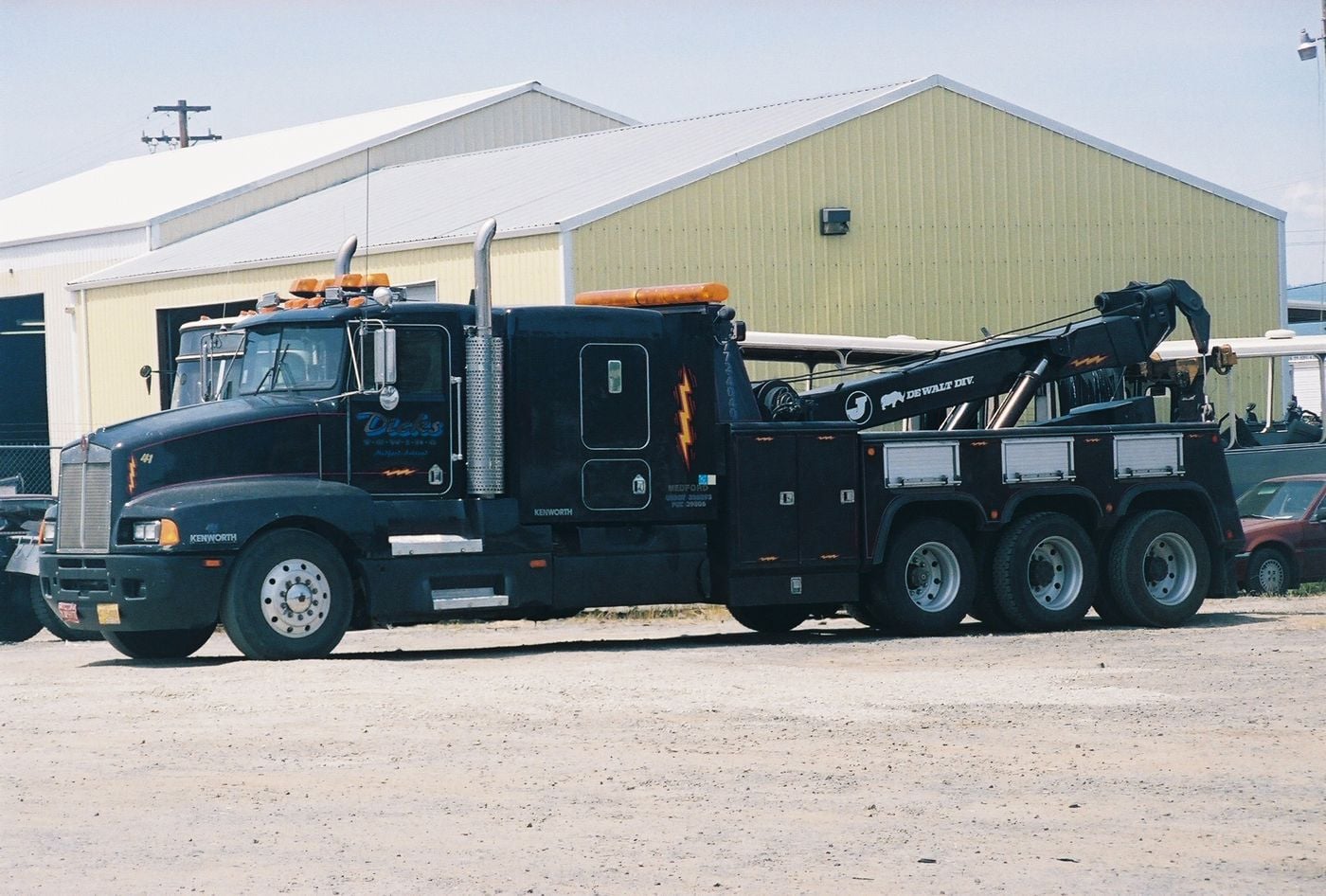
A tow truck, called a recovery vehicle in EU type approval and in British law, is a truck chassis fitted with equipment for moving broken-down or damaged vehicles. The makers build it in three main forms. A wrecker lifts and tows with a recovery boom, winches and an underlift; on a rotator the boom also turns, through 360 degrees; and a slide bed, listed as a carrier by Miller Industries and Jerr-Dan, loads the vehicle onto a bed that moves back and tilts to a low load angle. Miller Industries, whose wreckers and rotators carry the Century and Vulcan names, Jerr-Dan, an Oshkosh Corporation company, and Boniface Engineering publish ratings for each form: the boom of Miller’s Vulcan 812 / Century 300 wrecker is rated at 8,000 lbs, the retracted booms of Miller’s Century 1150 and Jerr-Dan’s JD50/60 HDR 1000 rotators at 100,000 lbs. In European Union law, Regulation (EC) No 561/2006 on driving times, breaks and rest periods, in force since 11 April 2007, “shall not apply” to carriage by road by “specialised breakdown vehicles operating within a 100 km radius of their base” (Article 3(f)). Regulation (EU) 2018/858 on vehicle approval, which has applied since 1 September 2020, lists “Recovery vehicle” among the two-digit supplements to a vehicle’s bodywork code.
Status as at 28 October 2026. Read on that day: the product pages of Miller Industries, Jerr-Dan and Boniface Engineering listed below and Miller’s 2024 brochure for its Century heavy-duty integrated wreckers; the Official Journal texts of Regulation (EC) No 561/2006 and Regulation (EU) 2018/858 in English, German, Spanish, French, Italian and Polish, with the English consolidated texts of Regulation 561/2006 and of Regulation (EU) No 165/2014 of 31 December 2024 and of Regulation 2018/858 of 2 August 2026; and, for Great Britain, two statutory instruments on legislation.gov.uk and the April 2025 edition of Transport for London’s Direct Vision Standard guidance for operators.
Three forms, and how the makers group them
Miller Industries sorts its range into car carriers, light duty, heavy duty, rotators, special transport and military, and gives a span of capacities for the first four. Jerr-Dan’s range is made up of carriers, wreckers and rotators, and in each weight class its wreckers come as integrated or independent models. Boniface Engineering lists slidebeds, heavy-duty units, rotators and a four-axle trailer; its rotators are three Century models, and it describes its Recoverer Trident as blending a Century 9055 with its own Maxireach Lowline H or Lowline I under-lift. The range pages do not say which component a group’s capacity rates.
| Maker | Group | Capacities or models as stated |
|---|---|---|
| Miller Industries | Car carriers | 5-ton to 20-ton |
| Miller Industries | Light duty | 4-ton to 12-ton |
| Miller Industries | Heavy duty | 16-ton to 50-ton |
| Miller Industries | Rotators | 16-ton to 100-ton |
| Jerr-Dan | Carriers | Light duty 6 ton (12,000 lb); medium duty 8.5 ton (17,000 lbs); heavy duty 10 or 15 ton (20,000 to 30,000 lbs); industrial (wood) 6, 8.5, 10 or 15 ton; multi-car, for 3 to 4 cars |
| Jerr-Dan | Wreckers, integrated | Light duty 8,000 lbs; medium duty 12 ton (24,000 lbs); heavy duty 25, 35 or 50 ton (50,000 to 100,000 lbs) |
| Jerr-Dan | Wreckers, independent | Light duty 8 or 10 ton (16,000 to 20,000 lbs); medium duty 8 to 12 ton; heavy duty 35 or 60 ton (70,000 to 120,000 lbs) |
| Jerr-Dan | Rotators | JD35/40, 35/40 ton (70,000 lb); JD50/60 HDR 1000, 50/60 ton (100,000 lb) |
| Boniface Engineering | Slidebeds | T35, Champion 3.5T, Champion 5T, VLA 3T, VLA 5T |
| Boniface Engineering | Heavy duty | Interstater MK6, Recoverer Trident |
| Boniface Engineering | Rotators | Century 1075S, Century 1140, Century 1150 |
What the ratings measure
Miller and Boniface end each block of specifications with the same note: “All ratings are based on structural factors only, not vehicle capacities or capabilities. Specifications shown are approximations and may vary depending on chassis selected.”
The ratings change with the position of the equipment. Miller rates the boom of its Century 5230 at 60,000 lbs retracted and 16,000 lbs extended, both at 30°, and its underlift at 35,000 lbs at 54 in and 16,000 lbs at 128 in; it lists a separate “Tow Rating” of 80,000 lbs. Winch ratings on the Century 1150 and the Boniface Recoverer Trident are given for the first layer on the drum: 50,000 lbs for the Century, and “14 Tonne @ 1st Layer (EN14492 Compliant)” for the Recoverer. For beds, Miller notes that the platform rating of its 12 Series LCG carrier “is based on equally distributed load”, and Boniface gives its bed ratings with the letters “UDL”.
Wreckers: boom, winches and underlift
Boniface describes what its heavy under-lifts are for: “To tow many of today’s modern trucks and coaches with moulded components and aerodynamics, operators need a low profile under-lift that copes with long overhangs and the capacity to lift heavy weights.” Its Interstater MK6 under-lift is rated at 33 tonnes retracted and 9 tonnes extended; the Maxireach Lowline H version reaches 2.04 m retracted and 4.34 m extended, the Lowline I 1.86 m and 3.79 m. On the Recoverer Trident the three-stage boom is rated at 45.4 tonnes retracted and 8.17 tonnes extended, both at 30°, with a maximum boom height of 7.59 m and 5.48 m of hydraulic extension, and the under-lift at 25 tonnes retracted and 9 tonnes extended. For recoveries “on narrow roads or to maintain minimal lane blockage”, Boniface offers Sidewinder front hydraulic legs “that rotate out up to 90 degrees”.
Miller’s 2024 brochure for its Century heavy-duty integrated wreckers runs from the 4024, which Miller calls a single-axle unit, with a 20-ton boom, to the 9055, with a 50-ton three-stage boom and two 50,000 lb winches. The brochure gives the Low Rider underlift 144 in of reach and the “Coach” Low Rider up to 160 in, to haul “pumpers, packers, coaches, and fire trucks”; for the 9055 Miller names mixers, packers and buses. At the light end, Miller’s Vulcan 812 / Century 300 has a recovery boom rated at 8,000 lbs at the boom end swivel, an 8,000 lb planetary winch with 100 ft of 3/8 in cable, and a wheel lift rated at 4,000 lbs extended, with a maximum reach of 73 in and a tow rating of 7,500 lbs.
| Maker and model | Boom rating | Winches | Underlift, retracted and extended | Tow rating |
|---|---|---|---|---|
| Miller Vulcan 812 / Century 300 | 8,000 lbs at the boom end swivel | One planetary, 8,000 lbs | Wheel lift 4,000 lbs extended; maximum reach 73 in | 7,500 lbs |
| Miller Century 4024 | 20 ton | Two of 20,000 lbs | 24,000 lbs at 39 in; 12,000 lbs at 103 in | 50,000 lbs |
| Miller Century 5130 | 25 ton | Two of 25,000 lbs | 35,000 lbs at 54 in; 16,000 lbs at 128 in | 80,000 lbs |
| Miller Century 5230 | 60,000 lbs (30 ton) retracted, 16,000 lbs extended, both at 30° | Two of 25,000 lbs | 35,000 lbs at 54 in; 16,000 lbs at 128 in | 80,000 lbs |
| Miller Century 7035 | 35 ton | Two of 35,000 lbs | 35,000 lbs at 59 in; 16,000 lbs at 138 in, with the optional “Street” Lowrider | 80,000 lbs |
| Miller Century 9055 | 50 ton, three-stage boom | Two of 50,000 lbs | 55,000 lbs at 55 in; 17,000 lbs at 138 in, with the optional “Street” Lowrider | 80,000 lbs |
| Boniface Interstater MK6 | Not given | “your choice of winches” | 33 tonnes; 9 tonnes; reach 2.04 m retracted and 4.34 m extended with the Maxireach Lowline H | Not given |
| Boniface Recoverer Trident | 45.4 tonnes retracted, 8.17 tonnes extended, both at 30° | 14 tonnes at the first layer, stated as EN 14492 compliant | 25 tonnes; 9 tonnes; reach 2.08 m retracted and 4.38 m extended with the Maxireach Lowline H | Not given |
Rotators
On a rotator the boom turns on the body. Miller presents its Century 1150 together with the Vulcan 950 and calls it a “50 Ton Heavy Duty Rotator Wrecker” with “360° of continuous boom rotation, a 3-stage recovery boom, optional deck and turret mounted winches” and an SDU-4 underlift; on the 1150R the turret travels 60 in from front to rear on a patented roller system. Miller gives the 1150 front outriggers with a 262 in stance and rear outriggers with a 220 in stance. Jerr-Dan’s JD50/60 HDR 1000 has a three-stage recovery boom, a load chart it describes as “360 Degree Operational” and scissor-style outriggers in two versions, S100 and S130, with footprints of 191 in and 220 in. Boniface lists the same Century 1150 with its own H-Maxireach Lowline and I-Lowline underlifts besides the SDU-4, and gives its figures in metric units. The two pages for the 1150 do not agree on every figure: Miller’s gives a maximum boom angle of 66° and the SDU-4 underlift’s extended rating at 143 1/2 in, Boniface’s 60° and 3,556 mm.
| Model and page | Boom, retracted and extended | Reach, height and rotation | Winch | Underlift, retracted and extended |
|---|---|---|---|---|
| Century 1150, Miller’s page | 100,000 lbs; 25,000 lbs | Extension 248 in; maximum height 495 in; rotation 360°; maximum angle 66° | 50,000 lbs at the first layer of the drum, two-speed planetary | SDU-4 Low Rider: 55,000 lbs at 54 in; 17,000 lbs at 143 1/2 in |
| Century 1150, Boniface’s page | 45,359 kg (100,000 lbs); 11,339 kg (25,000 lbs); both at 30° | Extension 6,299 mm; maximum hook height 12,573 mm; rotation 360°; maximum angle 60° | 22,679 kg (50,000 lbs), two-speed planetary | H-Maxireach Lowline: 33,000 kg by 1,995 mm; 9,000 kg by 4,295 mm |
| Jerr-Dan JD50/60 HDR 1000 | 100,000 lbs; 20,000 lbs; both at 30° | Maximum boom length 41 ft; maximum hook height 513 in | Options of 50,000, 35,000 or 20,000 lb | 565 underlift: 56,500 lbs; 17,600 lbs. 350 underlift: 35,000 lbs; 16,000 lbs. Tow capacity 80,000 lbs |
Slide beds and carriers
Boniface’s VLA 5T, for “Very Low Angle”, uses double rack-and-pinion drives to move the bed backwards and forwards, for a load angle between 6 and 8 degrees depending on the chassis, and Boniface says it can handle “box trucks or larger vans with long overhangs that drag when you load them on a conventional slidebed”. With the optional “2T Second Car Lift”, Boniface says, it can transport several vehicles at once. The smaller T35 is designed and built on a chassis of 3.5 tonnes gross vehicle weight and uses what Boniface calls a “roll tip design”, which tips and slides the bed.
Miller’s 12 Series LCG, for “Low Center of Gravity”, has a deck 5 to 6 in lower than conventional carriers, which Miller says allows taller loads such as forklifts or man-lifts. On most air-ride chassis with the air dumped its load angle is less than 11 degrees, and it has a 20-degree dump angle for unloading damaged vehicles or equipment. It comes in deck lengths of 20.5, 21, 21.5 and 22 ft, with a 12,000 lbs worm gear winch; its wheel lift is rated at 4,000 lbs extended, and its tow rating is 10,000 lbs. Jerr-Dan’s carriers run from a light-duty 6 ton model to heavy-duty 10 and 15 ton models, with an industrial (wood) line and a multi-car carrier for 3 to 4 cars. Trucks and trailers with upper and lower decks for carrying cars are described in car transporter trucks and trailers.
| Maker and model | Bed | Bed rating | Load angle | Winch |
|---|---|---|---|---|
| Boniface T35 | 4.6 m by 2.05 m, aluminium | 1.5 tonnes UDL | Minimum 7°, depending on chassis | 2.25 tonnes, stated as EN 14492 compliant |
| Boniface VLA 5T | 7 m by 2.3 m, aluminium | 5 tonnes UDL | Minimum 6° to 8°, depending on chassis | 3.6 tonnes, stated as EN 14492 compliant |
| Miller 12 Series LCG | 20.5, 21, 21.5 or 22 ft long, 102 in wide outside, aluminium or steel | 12,000 lbs, based on equally distributed load | Less than 11° on most air-ride chassis with the air dumped; dump angle 20° | 12,000 lbs, worm gear |
The chassis underneath
Each of these units is mounted on a truck chassis, and the makers’ pages give figures for the chassis. For the Vulcan 812 / Century 300, Miller suggests a gross vehicle weight rating of 14,500 lbs and at least 60 in from cab to axle; for the 12 Series LCG it lists a gross vehicle weight rating of 19,500 to 26,000 lbs. For the Century 5230 Miller lists a front axle of 13,200 lbs and a rear axle of 40,000 lbs. For the Century 1150 Miller gives a minimum front axle of 20,000 lbs and rear axle of 46,000 lbs, or 52,000 lbs for the 1150R, and adds that “heavier specifications may be required depending on chassis and equipment weight”. Jerr-Dan gives its JD50/60 HDR 1000 a minimum front axle rating of 20,000 lbs, a minimum rear axle rating of 46,000 lbs and a minimum gross vehicle weight rating of 86,000 lbs. Boniface’s T35 retains the original axles and running gear of its 3.5-tonne chassis.
EU rules: drivers’ hours and tachographs
Regulation (EC) No 561/2006 lays down the EU rules on driving times, breaks and rest periods, set out in driving time and rest rules. It applies to carriage by road within the EU and between the EU, Switzerland and the countries of the European Economic Area (Article 2(2)). Article 3 lists the carriage to which it “shall not apply”, and point (f) is “specialised breakdown vehicles operating within a 100 km radius of their base”. The point reads the same in the consolidated text of 31 December 2024, and “specialised breakdown vehicles” is not among the terms defined in Article 4.
Regulation (EU) No 165/2014 on tachographs takes its scope from the same text: tachographs “shall be installed and used in vehicles registered in a Member State which are used for the carriage of passengers or goods by road and to which Regulation (EC) No 561/2006 applies” (Article 3(1)). For national transport operations, Member States “may require the installation and use of tachographs” in any of the vehicles for which paragraph 1 does not otherwise require them (Article 3(5)). The devices are described in the digital tachograph and driver card.
EU type approval: bodywork code 24
Regulation (EU) 2018/858 governs the approval of motor vehicles and their trailers. Its list of special purpose vehicles, in Annex I, Part A, point 5, includes motor caravans, ambulances, mobile cranes and a “special group” for special purpose vehicles that fit none of its definitions, and does not name recovery vehicles. They appear in the bodywork coding of Part C instead. Vehicles of categories N and O get a two-letter bodywork code (point 1.3), which where necessary is “supplemented by two digits”, especially for the lorry (BA), the chassis-cab or chassis-cowl (BX) and the four kinds of trailer (point 1.4). In the list of those digits, Appendix 2, number 24 is “Recovery vehicle”; the same list gives tippers 10, concrete mixers 15, refuse collection vehicles 18 and fire engines 31. The consolidated text of 2 August 2026 has the same wording for these points. Categories N and O are explained in vehicle categories M, N and O explained.
The two Regulations name the vehicle in these words in six of their language versions:
| Language | Regulation 561/2006, Article 3(f) | Regulation 2018/858, Annex I, Appendix 2, item 24 |
|---|---|---|
| English | specialised breakdown vehicles | Recovery vehicle |
| German | spezielle Pannenhilfefahrzeuge | Abschleppwagen |
| Spanish | vehículos especializados en la reparación de averías | De asistencia |
| French | véhicules spécialisés de dépannage | Dépanneuse |
| Italian | carri attrezzi specializzati | Carro attrezzi |
| Polish | pojazdami specjalistycznymi pomocy drogowej | Pojazd ratowniczy |
Great Britain
In Great Britain, recovery vehicles appear in operator licensing, in the special types rules and in London’s HGV Safety Permit Scheme. Schedule 3 to the Goods Vehicles (Licensing of Operators) Regulations 1995, which lists the classes of vehicles for which an operator’s licence is not required, includes “A recovery vehicle.” (Part I, paragraph 27); the scope of those exemptions is set out in goods vehicle operator licences in Great Britain. The Road Vehicles (Authorisation of Special Types) (General) Order 2003 makes road recovery vehicles one of its four recognised categories of special vehicles, with abnormal indivisible load vehicles, mobile cranes and engineering plant (article 10(1)), and defines them in Schedule 4 (article 10(4)); the Order is described in low-loader trailers and abnormal loads. Transport for London’s Direct Vision Standard guidance for operators, in its April 2025 edition, lists “Breakdown organisations/recovery vehicles” as “Fully exempt for specified vehicles” from its HGV Safety Permit Scheme; the conditions are in London’s Direct Vision Standard.
Quick answers
- What is the difference between a wrecker, a rotator and a slide bed?
- They are three forms of tow truck. A wrecker lifts and tows with a recovery boom, winches and an underlift: Miller's Century 5230 has a 30-ton recovery boom, two 25,000 lb winches and 128 in of underlift reach. On a rotator the boom also turns: Miller gives its Century 1150 continuous boom rotation through 360°. A slide bed, which Miller and Jerr-Dan list as a carrier, loads the vehicle onto a bed that moves back and tilts: Boniface gives its VLA 5T a minimum load angle of 6 to 8 degrees, depending on the chassis.
- How much can a heavy tow truck lift?
- Miller's Century 1150 and Jerr-Dan's JD50/60 HDR 1000 rotators are rated at 100,000 lbs with the boom retracted, and at 25,000 lbs and 20,000 lbs extended; Boniface rates the boom of its Recoverer Trident at 45.4 tonnes retracted and 8.17 tonnes extended, both at 30°. Miller's range page gives its rotators 16-ton to 100-ton capacities, and Jerr-Dan's range menu gives its heavy-duty independent wreckers 35 or 60 ton (70,000 to 120,000 lbs). Miller and Boniface add that 'All ratings are based on structural factors only, not vehicle capacities or capabilities.'
- Do EU driving time rules apply to tow truck drivers?
- Regulation (EC) No 561/2006, which lays down the EU rules on driving times, breaks and rest periods, 'shall not apply' to carriage by road by 'specialised breakdown vehicles operating within a 100 km radius of their base' (Article 3(f)). The point is unchanged in the consolidated text of 31 December 2024, and the term is not among the definitions in Article 4. Tachographs are required in vehicles 'to which Regulation (EC) No 561/2006 applies' (Article 3(1) of Regulation (EU) No 165/2014), and for national transport operations Member States may require them in other vehicles (Article 3(5)).
- Is a recovery vehicle a special purpose vehicle in EU type approval?
- Regulation (EU) 2018/858 does not name recovery vehicles in its list of special purpose vehicles in Annex I, Part A, point 5. They appear as the two-digit bodywork supplement 24, 'Recovery vehicle', added where necessary to the two-letter bodywork code of an N-category vehicle such as a lorry (BA) or a chassis-cab (BX), or of a trailer (Annex I, Part C, point 1.4 and Appendix 2). The consolidated text of 2 August 2026 reads the same.
- What load angle does a slide-bed tow truck have?
- The makers give it per model: Boniface a minimum load angle of 6 to 8 degrees for its VLA 5T and 7 degrees for its T35, both depending on the chassis, and Miller less than 11 degrees for its 12 Series LCG carrier on most air-ride chassis with the air dumped. Miller gives the same carrier a 20-degree dump angle for unloading damaged vehicles or equipment.
Sources
- Regulation (EC) No 561/2006 of the European Parliament and of the Council of 15 March 2006 on the harmonisation of certain social legislation relating to road transport — Official Journal text, Articles 1 to 4 and 29, in English, German, Spanish, French, Italian and Polish — EUR-Lex, European Union, 15 Mar 2006
- Regulation (EC) No 561/2006 — consolidated text of 31 December 2024, Articles 2 to 4 — EUR-Lex, European Union
- Regulation (EU) No 165/2014 on tachographs in road transport — consolidated text of 31 December 2024, Article 3 — EUR-Lex, European Union
- Regulation (EU) 2018/858 of the European Parliament and of the Council of 30 May 2018 on the approval and market surveillance of motor vehicles and their trailers — Official Journal text, Article 91, Annex I Part A point 5, Part C and Appendix 2, in English, German, Spanish, French, Italian and Polish — EUR-Lex, European Union, 30 May 2018
- Regulation (EU) 2018/858 — consolidated text of 2 August 2026, Annex I Part A point 5, Part C and Appendix 2 — EUR-Lex, European Union
- The Goods Vehicles (Licensing of Operators) Regulations 1995 (SI 1995/2869) — Schedule 3, Part I, paragraph 27, latest available revised text, read on 28 October 2026 — legislation.gov.uk (The National Archives)
- The Road Vehicles (Authorisation of Special Types) (General) Order 2003 (SI 2003/1998) — article 10, latest available revised text, read on 28 October 2026 — legislation.gov.uk (The National Archives)
- Direct Vision Standard: Guidance for operators (April 2025) — section 7, exemptions to the HGV Safety Permit Scheme — Transport for London
- Products — range overview with capacities (read on 28 October 2026) — Miller Industries
- Vulcan 812 / Century 300 — light-duty wrecker product page (read on 28 October 2026) — Miller Industries
- Century 5230 — heavy-duty integrated wrecker product page (read on 28 October 2026) — Miller Industries
- Heavy Duty Integrated 4024 - 9055 — Century brochure, 2024 (read on 28 October 2026) — Miller Industries Towing Equipment Inc.
- Century 1150 — 50-ton rotator product page (read on 28 October 2026) — Miller Industries
- 12 Series - LCG — car carrier product page (read on 28 October 2026) — Miller Industries
- Rotator JD50/60 HDR 1000 — product page, with the carrier, wrecker and rotator range menu (read on 28 October 2026) — Jerr-Dan, LLC
- Boniface Interstater MK6 — heavy-duty under-lift unit product page (read on 28 October 2026) — Boniface Engineering
- Boniface Recoverer Trident — heavy-duty recovery unit product page (read on 28 October 2026) — Boniface Engineering
- Century 1150 — rotator product page, metric figures (read on 28 October 2026) — Boniface Engineering
- Boniface VLA 5T — slidebed product page (read on 28 October 2026) — Boniface Engineering
- Boniface T35 — slidebed product page (read on 28 October 2026) — Boniface Engineering