Trailer manufacturers in Europe: owners, plants and the figures they report
Schmitz Cargobull, Krone, Kögel, Wielton, Schwarzmüller and the silo, reefer and heavy-haulage specialists: owners, plants and the figures each maker reports.
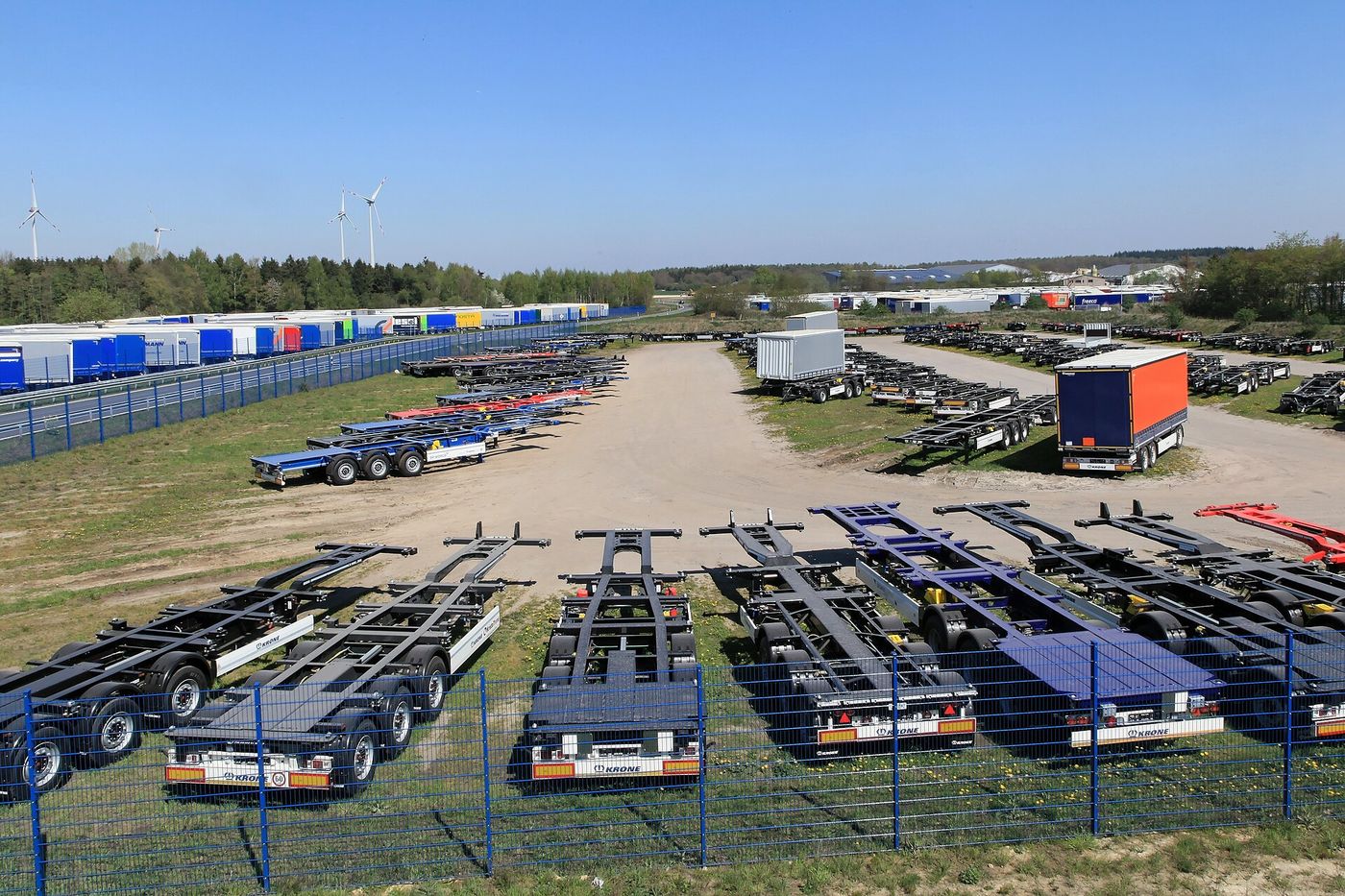
Among the companies that build semi-trailers in Europe, Schmitz Cargobull, Krone and Kögel are German family businesses; the Wielton Group, with its head office at Wieluń in Poland, has its parent company listed on the Warsaw Stock Exchange, and its brands include Fruehauf, Langendorf, Viberti, Cardi, Lawrence David and Guillén; and Austria’s Schwarzmüller now appears among the companies of the Krone group, after an investment Krone announced in June 2024. Beside them work specialists: Feldbinder for silo and tank vehicles, Chereau for refrigerated vehicles, and Goldhofer, Faymonville and Nooteboom for heavy and abnormal loads. Schmitz Cargobull’s own factories are in Germany, Lithuania, Spain, Türkiye, Romania and the United Kingdom; it sold more than 47,000 vehicles in its financial year to 31 March 2026 and reports that one in four trailers newly registered in Europe comes from it.
Status as at 27 October 2026. Read on that day: the company, history or location pages of the ten makers named below; Schmitz Cargobull’s press releases on five financial years between 2018/19 and 2025/26 and on its plants and partnerships; Krone’s sustainability report for the financial year 2024/2025; and the Wielton Group’s results releases, results presentation and fact sheet for 2024 and the first half of 2025.
The makers at a glance
What each trailer body is for — curtainsider, box, reefer, tipper, silo, skeletal, low loader — is set out in trailer types explained; the groups behind the tractor units are in who builds trucks in Europe.
| Maker | Base | Owner | What it builds | Figures it reports |
|---|---|---|---|---|
| Chereau | not verified | not verified | Refrigerated semi-trailers, rigid-truck bodies and other refrigerated bodies | Turnover €240 million in 2025; 3,404 vehicles produced and more than 1,000 employees, no year stated |
| Faymonville | Production in Luxembourg, Belgium, Poland, Italy and the USA | Independent family company | Semi-trailers, low-bed trailers, modular and self-propelled vehicles, from 5 t to 25,000 t and beyond | Turnover €515 million in 2025; more than 1,530 employees and capacity 3,500 vehicle units a year, no year stated |
| Feldbinder | Winsen (Luhe), Germany | Family company, second generation in charge since 2018 | Silo and tank semi-trailers, silo and tank rail wagons, silo and tank containers | 950 employees, no year stated |
| Goldhofer | Memmingen, Germany | Foundation-owned | Heavy and special transport vehicles for payloads from 25 t to over 15,000 t; airport technology | Annual sales approximately €333 million and over 1,000 employees, no year stated; about 47,000 vehicles delivered by 2025 |
| Kögel | Burtenbach, Germany | Ulrich Humbaur, owner since 2009 | Tarpaulin, box and refrigerated trailers, swap systems, tippers, container chassis, platform trailers | Turnover around €380 million, approximately 1,000 employees, capacity approximately 13,000 trailers a year, no year stated |
| Krone Commercial Vehicle Group | Werlte, Germany; group holding at Spelle | Bernard Krone family foundation, sole owner of the holding | Semi-trailers, trailers, swap systems and special vehicles; trailer axles (GIGANT); moving floor trailers (Knapen) | Krone Group as a whole, agricultural machinery included: revenue around €2.3 billion and 6,461 employees in 2024/2025 |
| Nooteboom | Wijchen, Netherlands | Nooteboom family, fifth generation | Trailers for abnormal road transport, payloads of 20 to 200 tonnes | Turnover approximately €100 million; more than 500 employees; no year stated |
| Schmitz Cargobull | Germany; founded at Altenberge in 1892 | Family-run; the Schmitz and Hoffmann families sit on its Family Council | Curtainsider, box, refrigerated and tipper semi-trailers, container chassis; its own transport refrigeration units | More than 47,000 vehicles sold and turnover approximately €2.25 billion in 2025/26; over 6,000 employees, no year stated |
| Schwarzmüller | Freinberg, Austria | Owner family Paletar; Krone investment announced in June 2024 | More than 150 vehicle types: lightweight trailers, tippers, tankers, low-loaders, walking floor and timber vehicles, truck bodies; container transporters (Hüffermann) | Turnover €390 million and 1,950 employees, as given in June 2024 |
| Wielton Group | Wieluń, Poland | Parent company listed on the Warsaw Stock Exchange | Semi-trailers, trailers and truck bodies; agricultural trailers (Wielton Agro) | 14,503 units sold and revenue PLN 2,104.8 million in 2024; around 3,100 employees in April 2025 |
Schmitz Cargobull
In 1892 Franz Heinrich Schmitz took over his father’s smithy at Altenberge in the Münsterland. The firm built its first trailer in 1935 and in December 1998 changed its name from Schmitz-Anhänger to Schmitz Cargobull. It is family-run: the Schmitz and Hoffmann families are represented on the Family Council, which the company calls “the most important decision-making body in the company”.
Its 2025/26 financial year ran from 1 April 2025 to 31 March 2026. Sales rose to more than 47,000 vehicles, from 42,620 the year before, and turnover to approximately €2.25 billion, from €2.16 billion; EBITDA was €45.6 million and EBIT minus €13.3 million. For 2026/27 the company plans to sell approximately 49,000 vehicles. Its earlier releases count vehicles produced: approximately 63,500 in 2018/19, 46,124 in 2019/20, 42,470 in 2020/21, 61,082 in 2021/22 and 57,122 in 2022/23. The release on 2025/26 states the company’s market share in one line: “25 percent market share: one in four newly registered trailers in Europe comes from Schmitz Cargobull”.
In Germany its releases name the curtainsider plant at Altenberge, which also houses the central axle production, and the refrigerated box-body plant at Vreden, where in September 2024 the company announced more than €50 million of investment in production capacity for refrigerated and box semi-trailers. Outside Germany, its largest site by the company’s account is Panevėžys in Lithuania, taken over in 1999; Zaragoza in Spain opened in 2002 and gained a new, expanded plant in 2022, with a capacity of 60 units a day on one production line; Adapazarı in Türkiye began curtainsider production in April 2017 and added box-body and tipper semi-trailers the same year; Manchester opened in 2021; and Oradea in Romania began operating in early 2026, building curtainsider and tipper semi-trailers for the Central European market, with an annual capacity of up to 4,000 vehicles expected in future. A 2024 release gave the production network as “ten plants in Germany, Lithuania, Spain, England, Turkey, Slovakia and Australia”; the release of September 2026 gives “factories in Germany, Lithuania, Spain, Turkey, Romania and the UK”.
Schmitz Cargobull has also taken stakes in other makers. It holds 48 percent of GT Trailers, a family-run maker of high-volume bodies and trailers in the Opole region of Poland. In April 2024 GRW, as majority shareholder, and Schmitz Cargobull took over Van Hool’s trailer business, with its silo and tanker vehicles. The planned full acquisition of the lightweight-construction specialist Berger Fahrzeugtechnik was still subject to regulatory approvals in September 2026, and in July 2026 Schmitz Cargobull acquired a majority stake in the Australian trailer manufacturer Freighter Group. The company also makes transport refrigeration units for refrigerated box semi-trailers such as its own S.KO COOL.
Krone Commercial Vehicle Group
Krone began as a smithy founded by Bernhard Krone in 1906 and started building commercial vehicles at Werlte in 1971; by the company’s account, the fourth generation of the family has taken over running it. Its holding, Bernard Krone Holding SE & Co. KG at Spelle, is solely owned by the Bernard Krone family foundation and has two operating sub-groups, KRONE Agriculture SE for agricultural machinery and KRONE Commercial Vehicle SE. For the financial year from 1 August 2024 to 31 July 2025 the whole group, agricultural machinery included, reported revenue of around €2.3 billion (€2.4 billion a year earlier), earnings before taxes of €40.1 million (€107.0 million) and 6,461 employees.
The commercial vehicle side, by the same report, builds semi-trailers, trailers, swap systems and special vehicles at Werlte, Herzlake, Lübtheen and Dinklage in Germany, at Tire in Türkiye, at Deurne in the Netherlands and at sites of the Schwarzmüller Group. The Tire plant opened in 2013 with Türkiye, the Middle East, Central Asia and Africa as its target markets. The companies of the group include Brüggen at Herzlake, a supplier of swap systems, dryliners, CEP vehicles and components with approximately 870 employees; GIGANT at Dinklage, which makes trailer axles and has belonged to the group since 2013; and Knapen at Deurne, a maker of moving floor trailers with approximately 240 employees, all of whose shares Krone acquired in 2019. Celsineo, a refrigeration unit for refrigerated semi-trailers, is a joint brand of Krone and Liebherr.
The Wielton Group and its brands
Wielton was founded in January 1996 at Wieluń, where the group has its head office; its parent company, Wielton S.A., is listed on the Warsaw Stock Exchange. The group’s strategy, in its own words, is “based on organic growth and acquisitions”: Viberti and Cardi in Italy and Fruehauf in France in 2015, with 100 percent of Fruehauf SAS from May 2017, Langendorf in Germany in May 2017, Lawrence David in Britain in September 2018 and Guillén Desarrollos Industriales in Spain in 2021. It describes itself as one of the three largest manufacturers of semi-trailers, trailers and car bodies in Europe and gives five production centres in Europe and 204,000 semi-trailers produced in total.
In 2024 the group sold 14,503 units, down from 20,954 in 2023, on revenue of PLN 2,104.8 million (PLN 3,225.2 million); its release on those results, of April 2025, gave a workforce of around 3,100, more than 1,600 of them at Wieluń. In the first half of 2025 it sold 7,563 units, against 7,877 a year earlier, on revenue of PLN 1,035.1 million.
Langendorf, which the group describes as a family company with more than 125 years of experience, builds tipper and low-bed semi-trailers, transporters for precast concrete elements and for glass, and special vehicles at a 60,000 m² plant in Waltrop. Fruehauf’s plant at Auxerre dates from 1958, and the group credits Fruehauf with more than 4,000 semi-trailers a year. Viberti was founded in Turin in 1922 and Cardi in Verona in 1919. Wielton’s releases single out Lawrence David’s home-delivery bodies and pillarless curtainsider trailers, and Guillén, with a history going back to 1895, builds curtainsider, van and sub-container trailers.
Wielton publishes its position market by market, measured by registrations. In the first half of 2025 Fruehauf kept first place in France with 18.9 percent, the group was third in Poland with 14.0 percent and Lawrence David moved up to fourth in Great Britain with 6.2 percent.
| Market | Registrations 2024 | Change on 2023 | Group brands counted | Wielton Group position and share |
|---|---|---|---|---|
| Central and Eastern Europe | 15,179 | down 18.8% | Wielton | 5th, 6.1% |
| France | 17,779 | down 17.3% | Fruehauf | 1st, 16.9% |
| Germany | 46,655 | down 7.8% | Langendorf, Wielton GmbH | 5th, 2.6% |
| Great Britain | 16,365 | down 22.1% | Lawrence David, Wielton | 5th, 6.8% |
| Italy | 13,509 | down 13% | Viberti, Fruehauf | 5th, 7.5% |
| Poland | 17,742 | down 31.4% | Wielton, Langendorf | 2nd, 13.2% |
| Spain | 14,986 | up 6.2% | Guillén | 8th, 2.6% |
Kögel
Kögel began in Ulm in 1934, when Franz Xaver Kögel took over the wagon business of his teacher Georg Schmid; Ulrich Humbaur has owned the company since 2009. Its headquarters and main production site are at Burtenbach in Bavaria, with further production at Duingen in Germany and at Choceň in the Czech Republic, where it builds a good 350 frames a week. Its company page gives a production capacity of approximately 13,000 trailers a year, turnover of around €380 million, approximately 1,000 employees and an export share of approximately 80 percent, without naming a year. The range runs from tarpaulin trailers such as the Kögel Cargo to box and refrigerated trailers, swap systems, tippers, the PORT container chassis and platform vehicles, and Kögel says its employees have produced “well over half a million vehicles”.
Schwarzmüller
The Schwarzmüller Group traces itself to the blacksmith’s shop “Josef Schwarzmüller”, founded in Passau in 1871. Its headquarters and Hanzing production plant are at Freinberg in Austria, where the plant was founded in 1939; it added plants at Dunaharaszti in Hungary in 1990 and Žebrák in the Czech Republic in 1993, and in 2020 acquired Hüffermann Transportsysteme at Neustadt (Dosse) in Germany. When the Krone Group announced its investment on 27 June 2024, Schwarzmüller was given as a group with annual turnover of €390 million, 1,950 employees, four production sites and branches in nine other countries, making more than 150 types of vehicle: lightweight trailers, tipper semi-trailers and tankers, low-loaders, walking floor and timber vehicles, truck bodies and, from Hüffermann, container transporters for the waste disposal sector. The announcement gave no size for Krone’s stake and said that the owner family Paletar would remain on the boards and in the operational business.
The specialists: silo and tank, refrigerated, heavy haulage
Feldbinder was founded in 1975 by Otto Feldbinder and Jan-Dirk Beckmann to build silo superstructures and has had its headquarters at Winsen (Luhe) since 1980; the second generation has run it since 1 April 2018. Since the end of 2011 it has produced only at its two German sites: Winsen, with 116,000 m² of industrial area, where it processes aluminium for silo vehicles, and Lutherstadt Wittenberg, with 110,000 m², where it builds tankers for the chemical, food and mineral oil industries, silo, tank and gas rail wagons, and containers of aluminium, stainless steel and titanium. It gives its workforce as 950.
Chereau builds refrigerated heavy vehicles: semi-trailers, rigid-truck bodies and other refrigerated bodies. Its home page gives turnover of €240 million for 2025 and, without naming a year, 3,404 vehicles produced, export sales of 52 percent and market shares of 42.2 percent in France and 11.2 percent in Europe; it does not say which segment the shares measure.
Goldhofer, headquartered at Memmingen, began as a forge in 1705 and is owned by a foundation. It builds vehicles for payloads from 25 t to over 15,000 t on more than 100,000 m² of factory premises at Memmingen, where more than 990 of its over 1,000 employees work, and has a second business area, airport technology, for aircraft and cargo handling. It gives annual sales of approximately €333 million and says it had delivered about 47,000 vehicles to more than 160 countries by 2025.
Faymonville, an independent family company that grew over six generations from a blacksmith’s workshop, builds semi-trailers, low-bed trailers, modular vehicles and self-propelled vehicles for loads from 5 t to 25,000 t and beyond. Its six production facilities are in Luxembourg, which it calls the largest manufacturing site in the group and its centre of technology and development; in Belgium, its competence centre for automation, robotics and mechanical processing; in Poland, the core facility for MAX Trailer and the main supplier of vehicle chassis; in Italy, where the sites specialise in self-propelled vehicles; and in the USA. It reports turnover of €515 million in 2025, more than 1,530 employees and a production capacity of 3,500 vehicle units a year.
Nooteboom goes back to the smithy Willem Nooteboom opened at Kethel, near Rotterdam, in 1881, and is run by the fifth generation of the family. In 2010 it sold its Kennis and Floor brands and has since concentrated on abnormal road transport. From its head office at Wijchen it builds trailers for payloads of 20 to 200 tonnes, with more than 500 employees and turnover of approximately €100 million.
Plants by country
| Country | Makers and sites | Source |
|---|---|---|
| Austria | Schwarzmüller: Freinberg, group headquarters and Hanzing plant | Schwarzmüller, locations |
| Belgium | Faymonville: competence centre for automation, robotics and mechanical processing | Faymonville, company page |
| Czech Republic | Kögel: Choceň. Schwarzmüller: Žebrák | Kögel, locations; Schwarzmüller, locations |
| France | Fruehauf (Wielton Group): Auxerre | Wielton Group, Fruehauf page |
| Germany | Schmitz Cargobull: Altenberge, Vreden. Krone: Werlte, Herzlake, Lübtheen, Dinklage. Kögel: Burtenbach, Duingen. Feldbinder: Winsen (Luhe), Lutherstadt Wittenberg. Goldhofer: Memmingen. Langendorf (Wielton Group): Waltrop. Hüffermann (Schwarzmüller Group): Neustadt (Dosse) | Schmitz Cargobull, releases of 2024; Krone, sustainability report 2024/2025; Kögel, locations; Feldbinder, plant pages; Goldhofer, locations; Wielton Group, Langendorf page; Schwarzmüller, locations |
| Hungary | Schwarzmüller: Dunaharaszti | Schwarzmüller, locations |
| Italy | Faymonville: sites for self-propelled vehicles. Viberti (Wielton Group): not verified | Faymonville, company page |
| Lithuania | Schmitz Cargobull: Panevėžys | Schmitz Cargobull, history |
| Luxembourg | Faymonville: the group’s largest manufacturing site | Faymonville, company page |
| Netherlands | Knapen (Krone): Deurne. Nooteboom: Wijchen, head office | Krone, sustainability report 2024/2025; Nooteboom, about us |
| Poland | Wielton: Wieluń. Faymonville: MAX Trailer core facility. GT Trailers (48 percent Schmitz Cargobull): Opole region | Wielton Group, release on the first half of 2025; Faymonville, company page; Schmitz Cargobull, release of September 2026 |
| Romania | Schmitz Cargobull: Oradea, operating since early 2026 | Schmitz Cargobull, release on 2025/26 |
| Slovakia | Schmitz Cargobull: not verified; listed in 2024, not in the list of September 2026 | Schmitz Cargobull, releases of 2024 and 2026 |
| Spain | Schmitz Cargobull: Zaragoza. Guillén (Wielton Group): production facility, location not stated | Schmitz Cargobull, history; Wielton, about us |
| Türkiye | Schmitz Cargobull: Adapazarı. Krone: Tire | Schmitz Cargobull, history; Krone, locations |
| United Kingdom | Schmitz Cargobull: Manchester. Lawrence David (Wielton Group): truck-body production, location not stated | Schmitz Cargobull, history; Wielton Group, results presentation for 2024 |
What the figures cover
The makers count their figures in different ways. Schmitz Cargobull’s financial year runs from 1 April to 31 March and Krone’s from 1 August to 31 July; Wielton reports by calendar year, in Polish złoty. Krone’s revenue and headcount include its agricultural machinery, Goldhofer’s sales its airport technology and Wielton’s units its agricultural trailers and truck bodies, and Feldbinder builds rail wagons and containers beside its road vehicles. Schmitz Cargobull’s release on 2025/26 counts vehicles sold, its earlier releases vehicles produced; Kögel and Faymonville give production capacity, Goldhofer a running total of vehicles delivered. Kögel, Nooteboom and Feldbinder put no year to their figures and Goldhofer none to its sales and headcount; Faymonville and Chereau date only their turnover, and Schwarzmüller’s figures date from the announcement of June 2024. The market shares are the makers’ own statements: Schmitz Cargobull’s 25 percent is of trailers newly registered in Europe, Wielton’s are of registrations country by country, and Chereau’s page does not say what its shares measure.
Quick answers
- Which companies make semi-trailers in Europe?
- Among them are Schmitz Cargobull, Krone and Kögel in Germany; the Wielton Group in Poland, whose brands include Fruehauf, Langendorf, Viberti, Cardi, Lawrence David and Guillén; and Schwarzmüller in Austria, which Krone now lists among its group companies after an investment announced in June 2024. Specialists include Feldbinder for silo and tank vehicles, Chereau for refrigerated vehicles, and Goldhofer, Faymonville and Nooteboom for heavy and abnormal loads.
- How many trailers does Schmitz Cargobull sell a year?
- More than 47,000 vehicles in its 2025/26 financial year, which ran from 1 April 2025 to 31 March 2026, up from 42,620 a year earlier, on turnover of approximately €2.25 billion. Schmitz Cargobull reports that one in four trailers newly registered in Europe comes from it, a 25 percent market share, and plans to sell approximately 49,000 vehicles in 2026/27.
- Who owns Fruehauf trailers?
- The Polish Wielton Group, whose parent company Wielton S.A. is listed on the Warsaw Stock Exchange. Wielton acquired Fruehauf in 2015 and took 100 percent of the French company Fruehauf SAS in May 2017. By Wielton's figures, Fruehauf held first place in France in 2024 with 16.9 percent of trailer and semi-trailer registrations.
- Is Schwarzmüller part of Krone?
- Krone announced its investment in the Austrian Schwarzmüller Group on 27 June 2024 and now lists Schwarzmüller among the companies of its group; its sustainability report for 2024/2025 counts Schwarzmüller sites among its commercial vehicle production sites. The announcement gave no size for the stake, put Schwarzmüller's annual turnover at €390 million and its workforce at 1,950, and said the owner family Paletar would remain on the boards and in the operational business.
- Which companies build low-loaders and heavy-haulage trailers in Europe?
- Among them are Goldhofer of Memmingen in Germany, which builds vehicles for payloads from 25 t to over 15,000 t; Faymonville, with production facilities in Luxembourg, Belgium, Poland, Italy and the USA and a range from 5 t to 25,000 t and beyond; and Nooteboom of Wijchen in the Netherlands, which builds trailers for abnormal road transport with payloads of 20 to 200 tonnes. Langendorf, part of the Wielton Group, builds low-bed semi-trailers and Schwarzmüller low-loaders.
Models in this article
Sources
- Press release on the 2025/26 financial year (1 April 2025 to 31 March 2026): vehicles sold, turnover, market share, the Oradea plant and acquisitions (September 2026) — Schmitz Cargobull
- The history of Schmitz Cargobull: origins, plants outside Germany, partnerships and the Family Council — Schmitz Cargobull
- Press release on the 2018/19 business year (September 2019) — Schmitz Cargobull
- Press release on the 2019/20 financial year (October 2020) — Schmitz Cargobull
- Press release on the 2020/21 financial year (October 2021) — Schmitz Cargobull
- Press release on the 2022/23 financial year (September 2023) — Schmitz Cargobull
- Press release on the Global Production Benchmarking study and the production network (2024) — Schmitz Cargobull
- Press release: Schmitz Cargobull invests over 50 million euros in its Vreden site (September 2024) — Schmitz Cargobull
- Press release: Schmitz Cargobull and GT Trailers present new solutions for city logistics (September 2026) — Schmitz Cargobull
- Our company at a glance: history and the KRONE group of companies — Krone Commercial Vehicle Group
- Our locations at a glance — Krone Commercial Vehicle Group
- Nachhaltigkeitsbericht 2024/2025 (sustainability report for the financial year 1 August 2024 to 31 July 2025), ESRS 2 BP-1, ESRS 2 SBM-1 and ESRS S1-5 — Bernard Krone Holding SE & Co. KG
- Schwarzmüller becomes a strategic partner in the Krone Commercial Vehicle Group (27 June 2024) — Schwarzmüller, 27 Jun 2024
- History: pioneers for 150 years — Schwarzmüller
- Locations: production sites and establishments — Schwarzmüller
- About Kögel: Kögel in facts and figures — Kögel Trailer
- History: from Ulm into the world — Kögel Trailer
- Kögel Trailer locations — Kögel Trailer
- Press release on the results for 2024 (30 April 2025) — Wielton Group, 30 Apr 2025
- Results presentation FY 2024 (30 April 2025), slides 10 and 11 and the market slides for Great Britain — Wielton Group, 30 Apr 2025
- Press release on the results for the first half of 2025 (30 September 2025) — Wielton Group, 30 Sept 2025
- Fact sheet: results for the first half of 2025 — Wielton Group
- About us: Wielton S.A., group structure and history — Wielton
- Group structure: Wielton — Wielton Group
- Group structure: Fruehauf — Wielton Group
- Group structure: Langendorf — Wielton Group
- Welcome to Feldbinder (home page) — Feldbinder
- History: tradition and innovation since 1975 — Feldbinder
- Plant Winsen — Feldbinder
- Plant Wittenberg — Feldbinder
- Company profile — Goldhofer AG
- Locations — Goldhofer AG
- About the Faymonville Group — Faymonville
- Home page: from a blacksmith's workshop over six generations — Faymonville
- About us: Nooteboom Trailers and the history of five generations since 1881 — Nooteboom Trailers
- Home page: key figures — CHEREAU
- Espace presse (press area): key figures and press kits — CHEREAU