Bucket trucks and truck-mounted aerial platforms: EN 280-1, OSHA rules and makers' figures
A bucket truck carries a boom with a platform for people. What EN 280-1:2022 and OSHA's 29 CFR 1910.67 and 1926.453 cover, the boom types and what the makers publish.
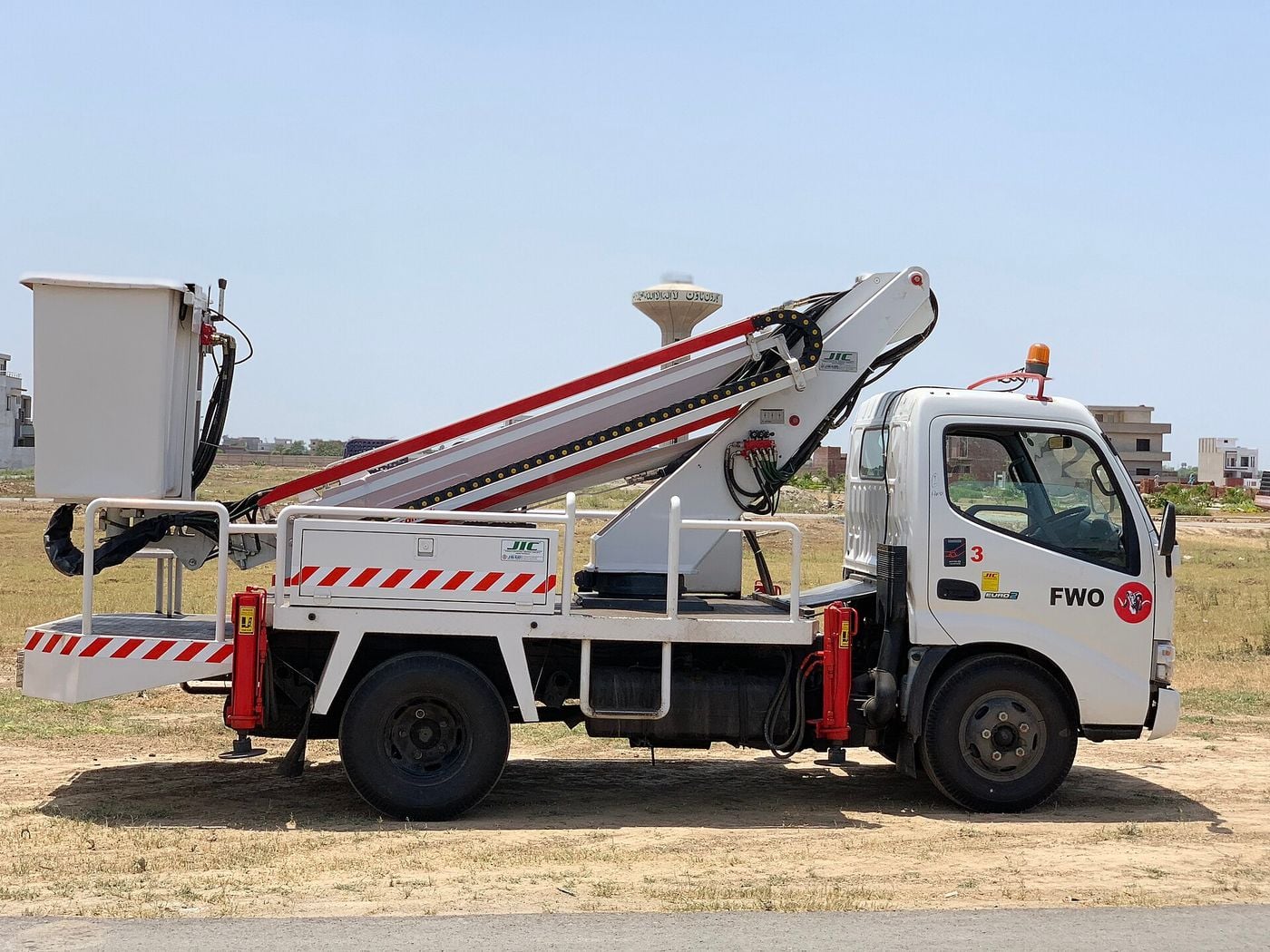
A bucket truck is a truck that carries a boom with a platform for people at its tip, the bucket or basket, to place workers at a working position above the ground. The US federal workplace rules call the equipment an aerial device or aerial lift: 29 CFR 1910.67 defines an aerial device as any vehicle-mounted device, telescoping or articulating or both, used to position personnel, and the platform as any “personnel-carrying device (basket or bucket)” that is a component of an aerial device. In Europe the same machine is a truck-mounted aerial work platform, one form of the mobile elevating work platform (MEWP) of the European standard EN 280-1:2022, which applies to its design, stability, construction and the examinations and tests before it is first put into service. Altec offers its aerial units for the electric utility, telecommunications, tree care, construction, and lights and signs markets; Palfinger gives working heights of 13 to 90 m for its range and Ruthmann 100 m for its T 1000 HF, on a 53 t truck. Aerial ladders and platforms for fire services fall outside both EN 280-1 and 29 CFR 1910.67.
Status as at 9 November 2026. Read on that day: sections 1910.67 and 1926.453 of Title 29 of the Code of Federal Regulations in the annual edition revised as of 1 July 2025, on govinfo; the catalogue records of EN 280-1:2022 and EN 280:2013+A1:2015 kept by Genorma and by the NSAI standards shop in Dublin, run by Intertek Inform; and the product pages of Altec, Terex Utilities and Versalift in North America and of Ruthmann and Palfinger in Europe.
What the names cover
Bucket truck is the trade name the North American makers use. Terex Utilities heads its range “Telescopic Bucket Trucks”, Altec sorts its inventory into bucket trucks of 29 to 49 ft, 50 to 74 ft and 75 ft and up, and Versalift describes itself as a manufacturer of “bucket trucks, digger derricks, cable placers and high reach aerial lifts”. The federal text uses aerial device and aerial lift and, in the heading of § 1910.67, “Vehicle-mounted elevating and rotating work platforms”. It names the parts too: the vehicle is any carrier that is not manually propelled, and the mobile unit the combination of an aerial device, its vehicle and related equipment (paragraphs (a)(8) and (a)(6)).
Ruthmann sells its STEIGER range in German as LKW-Arbeitsbühnen or Hubarbeitsbühnen; Palfinger’s English pages say “truck-mounted aerial work platform”. The European standard’s term is the MEWP, a machine “intended to move persons to working positions where they are carrying out work from the work platform (WP) with the intention that persons are getting on and off the work platform only at access positions at ground level or on the chassis” (EN 280-1:2022, scope 1.1).
A boom truck is something else in Altec’s catalogue: its “Boom Truck Cranes” are telescopic cranes, such as the AC40E-152S with a load rating given as 40 t (36.3 tonne) and a 152 ft (46.3 m) boom, listed apart from its aerial devices. Cranes on trucks are covered in truck-mounted loader cranes. § 1910.67 and EN 280-1 each count certain lifting machines fitted with a personnel platform as platforms. § 1910.67(a)(4) says that “Telescopic derricks with personnel platform attachments shall be considered to be extensible boom platforms when used with a personnel platform”, and a note to scope 1.1 of EN 280-1 that “Machines designed for the handling of goods which are equipped with work platforms as interchangeable equipment are regarded as MEWPs.”
Boom types
The two federal sections list five types of vehicle-mounted aerial devices “used to elevate personnel to jobsites above ground”: extensible boom platforms, aerial ladders, articulating boom platforms, vertical towers, and a combination of any of them (§ 1910.67(b)(1), § 1926.453(a)(1)). Paragraph (a) of § 1910.67 defines four of them:
- an articulating boom platform is an aerial device with “two or more hinged boom sections”;
- an extensible boom platform is an aerial device, other than a ladder, “with a telescopic or extensible boom”;
- an aerial ladder consists of “a single- or multiple-section extensible ladder”;
- a vertical tower is designed “to elevate a platform in a substantially vertical axis”.
Aerial equipment “may be made of metal, wood, fiberglass reinforced plastic (FRP), or other material”, may be powered or manually operated, and counts as an aerial lift whether or not it can rotate about a substantially vertical axis.
The makers’ catalogues group their models in their own terms. Altec offers aerial devices that are insulating or non-insulating, telescopic or telescopic articulating, and overcenter or non-overcenter; for its LR860-E70 it gives two maximum reaches, 48.4 ft (14.8 m) overcenter and 44.8 ft (13.7 m) non-overcenter, and for the non-overcenter AA55+ it lists “Platform reaches ground in non-overcenter position”. Versalift’s filters are articulated telescopic, telescopic, overcenter, non-overcenter, high access and van-mounted aerial lifts, next to cable placers and digger derricks. Terex Utilities’ telescopic range comes in three series, LT, TL and TRX. Palfinger divides its truck-mounted range into articulated models, telescopic models under and over 3.5 t, the larger with what it calls an X-Jib, and kits and special solutions.
EN 280-1 classifies by stability and by travel rather than by boom. A Group A MEWP is one where “the vertical projection of the centre of the area of the platform in all platform configurations at the maximum chassis inclination specified by the manufacturer is always inside the tipping lines”; Group B is all others. A Type 1 MEWP may travel only in its transport position; a Type 2 travels with the platform raised under control from a point at the chassis, a Type 3 under control from the platform, and the two can be combined (scope 1.4).
Insulated booms
29 CFR 1910.67 defines an insulated aerial device as one “designed for work on energized lines and apparatus” (paragraph (a)(5)). The North American makers state the insulation of each model:
- Altec lists the AT40G, from its AT Series designed for the electric utility industry, as “Insulating, ANSI Category C, 46 KV and Below”, and the LR860-E70, a tree care unit with insulating lower and upper booms, as ANSI Category C as standard and Category B as an option.
- Terex gives its LT40 a “Category ‘C’ Rating Per ANSI A92.2” and a filament-wound fibreglass boom that, in its words, “provides both strength and insulating properties to the boom”; its model list marks every telescopic model shown as insulated.
- Versalift marks each model insulated, non-insulated or optional, and for its VST-8000 series gives an upper boom insulation gap of 108 in and a lower boom insulation gap of 24 in.
The federal sections require electrical tests in conformance with Section 5 of ANSI A92.2-1969, and allow equivalent DC voltage tests approved by the manufacturer or an equivalent entity in place of the AC test (§ 1910.67(c)(3), § 1926.453(b)(3)). For operations near overhead electric lines, § 1910.67(b)(4) refers to § 1910.333(c)(3). EN 280-1 leaves this field out: among the hazards it does not cover is “work from the platform on external live electric systems” (scope 1.2 b).
The US federal rules
Two sections of Title 29 of the Code of Federal Regulations, in the chapter of the Occupational Safety and Health Administration, carry almost the same text: § 1910.67, “Vehicle-mounted elevating and rotating work platforms”, and § 1926.453, “Aerial lifts”. Both make the American National Standard ANSI A92.2-1969, “Vehicle Mounted Elevating and Rotating Work Platforms”, including its appendix, the basis for design and construction. The table sets out their dates and some of the points where they differ.
| Point | § 1910.67 | § 1926.453 |
|---|---|---|
| Designed and constructed to ANSI A92.2-1969 | Aerial lifts acquired on or after 1 July 1975 | Aerial lifts acquired for use on or after 22 January 1973 |
| Older lifts that do not meet ANSI A92.2-1969 | May not be used after 1 July 1976 unless modified to conform | May not be used after 1 January 1976 unless modified to conform |
| Field modification for uses other than those intended by the manufacturer | Certified in writing by the manufacturer or an equivalent entity, such as a nationally recognized testing laboratory, paragraph (b)(2) | The same, paragraph (a)(2) |
| Firefighting equipment and the carrier vehicle | Not covered, except the requirement that the vehicle be a stable support for the aerial device, paragraph (b)(3) | No such paragraph |
| Equivalent standards | No such note | Non-mandatory Appendix C to the subpart lists examples of national consensus standards considered to give employee protection equivalent to ANSI A92.2-1969 |
A field modification must be certified to conform with ANSI A92.2-1969 and the section, and “to be at least as safe as the equipment was before modification”. Paragraph (b)(3) of § 1910.67 reads: “The requirements of this section do not apply to firefighting equipment or to the vehicles upon which aerial devices are mounted, except with respect to the requirement that a vehicle be a stable support for the aerial device.”
Both sections also set requirements for the equipment itself:
- articulating boom and extensible boom platforms “primarily designed as personnel carriers” have both platform (upper) and lower controls; the upper controls are in or beside the platform, the lower controls “shall provide for overriding the upper controls”, and controls are plainly marked as to their function (§ 1910.67(c)(2)(ix), § 1926.453(b)(2)(ix));
- critical hydraulic and pneumatic components, “those in which a failure would result in a free fall or free rotation of the boom”, meet the bursting safety factor of Section 4.9 of ANSI A92.2-1969, and noncritical components have a bursting safety factor of at least 2 to 1 (§ 1910.67(c)(4), § 1926.453(b)(4));
- welding conforms to listed standards of the American Welding Society (§ 1910.67(c)(5), § 1926.453(b)(5)).
The rest of paragraph (c)(2) of § 1910.67 and of paragraph (b)(2) of § 1926.453 sets requirements for the use of extensible and articulating boom platforms at work. Altec states that its aerial devices “meet or exceed all applicable ANSI Standards as of the date of manufacture”.
The European standard: EN 280-1:2022
EN 280-1:2022, Mobile elevating work platforms — Part 1: Design calculations — Stability criteria — Construction — Safety — Examinations and tests, comes from CEN technical committee CEN/TC 98, Lifting platforms. Genorma’s catalogue record gives it as published, stage 60.60 on 16 February 2022, with 128 pages in English, and lists a revision, FprEN 280-1, as in development. It replaced EN 280:2013+A1:2015, which the NSAI catalogue shows as superseded by EN 280-1:2022 on 26 February 2022.
The standard “specifies safety requirements and measures for all types and sizes” of MEWP and is applicable to “the structural design calculations and stability criteria, construction, safety examinations and tests before MEWPs are first put into service” (scope 1.1 and 1.2). It does not cover the hazards arising from use in potentially explosive atmospheres, work from the platform on external live electric systems, the use of compressed gases for load-bearing components, getting on and off the platform at changing levels, or specific applications such as railways and ships covered by national or local regulations. The list in the 2013 edition also named electromagnetic incompatibility.
Scope 1.3 lists the machines to which EN 280-1 does not apply and, for all but fairground equipment, points to other standards:
- fire-fighting and fire rescue appliances, EN 1777:2010, which with the turntable ladder standards is covered in fire engines on truck chassis;
- tail lifts, EN 1756-1:2021 and EN 1756-2:2004+A1:2009, covered in tail lifts explained;
- unguided work cages suspended from lifting appliances, EN 1808:2015;
- machinery serving fixed landings, mast climbing work platforms, lifting tables, fairground equipment, aircraft ground support equipment, and elevating operator positions on rail dependent storage and retrieval equipment and on industrial trucks.
How EU machinery law treats machinery mounted on a vehicle, including the entry it gives to devices for lifting persons, is set out in truck-mounted loader cranes.
The NSAI record of the 2013 edition lists the national standards it treats as equivalents.
| Country | National edition listed | Source |
|---|---|---|
| Germany | DIN EN 280:2016-04, identical | NSAI catalogue record of EN 280:2013+A1:2015 |
| United Kingdom | BS EN 280:2013+A1:2015, listed once as identical and once as equivalent; also BS EN 280:2013, identical | NSAI catalogue record of EN 280:2013+A1:2015 |
| France | NF EN 280:2013+A1:2015, identical | NSAI catalogue record of EN 280:2013+A1:2015 |
| Spain | UNE-EN 280:2014 and UNE-EN 280:2014+A1:2016, identical | NSAI catalogue record of EN 280:2013+A1:2015 |
| Poland | PN EN 280:2013+A1:2015, identical | NSAI catalogue record of EN 280:2013+A1:2015 |
| Netherlands | NEN EN 280:2013+A1:2015, identical | NSAI catalogue record of EN 280:2013+A1:2015 |
| Belgium | NBN EN 280:2013+A1:2015, identical | NSAI catalogue record of EN 280:2013+A1:2015 |
| Norway | NS EN 280:2013+A1:2015, identical | NSAI catalogue record of EN 280:2013+A1:2015 |
| Ireland | I.S. EN 280:2013, identical | NSAI catalogue record of EN 280:2013+A1:2015 |
| Italy | Not verified | Not listed in the NSAI record |
| Türkiye | Not verified | Not listed in the NSAI record |
| Russia | Not verified | Not listed in the NSAI record |
Chassis, weight and licence
Ruthmann sorts its truck-mounted range by the weight class of the carrier vehicle, under 3.5 t, under 5.5 t, under 7.5 t and over 7.5 t, with separate lists for vans under 3.5 t and under 5.5 t. Its product data name a driving licence category for each model: C1 for the T 170, which it describes as designed for 7.49 t chassis (“konzipiert für 7,49 t-Chassis”), C1 or C1E for the T 330 XS at 7.49 t, and C or CE for the T 570 HF at 26 t and the T 1000 HF at 53 t. What the categories allow is set out in truck driving licences, and rigid chassis of 7.5 to 26 t in box trucks and rigid distribution trucks.
Palfinger gives its range as compatible with chassis “ranging from 3.5 to 48 metric tons”. It builds its TEC models for the 3.5 t class, with working heights of 19 to 28 m, and writes that they can also go “on a 3.5-ton or bigger chassis”; with their lower weight, it says, more options can be fitted “without exceeding the registration weight”. In North America Terex names the US weight class: it gives the TRX55 for “a Class 5 or 6 chassis” and says the LT40 is “typically mounted on a Class 5 truck chassis”. The classes are set out in GVWR, GCWR and GAWR explained.
The chassis also enters the published heights. Altec’s height figures are “Based on chassis frame height of 40 inches (1016 mm)”. For the road, Ruthmann gives the overall length and height of each vehicle and the permissible set-up inclination, and Versalift a stowed travel height: up to 10.5 ft for its TEL-29 series, 11.1 ft for its VST-40/55-HD series and 12.42 ft for its VST-8000 series.
What the makers publish
The height figures do not all measure the same thing. Altec’s product pages give the height from the ground to the bottom of the platform; Terex, Ruthmann and Palfinger give working height, Arbeitshöhe in Ruthmann’s German. Versalift gives both: up to 29.92 ft to the bottom of the platform and a working height of 34.92 ft for its TEL-29 series, and 54.5 ft and 61.1 ft for its VST-40/55-HD series. Its figures for the VST-8000 series differ by page: up to 99.5 ft to the bottom of the platform and working heights up to 99.75 ft on the product page, a working height of up to 104.5 ft in the product list. The North American makers print US units; Altec and Terex add metric figures.
| Maker and model | Height | Side reach | Platform capacity | Insulation |
|---|---|---|---|---|
| Altec AT40G, articulating telescopic | 40.6 ft (12.4 m) to bottom of platform | 29.7 ft (9.1 m) | 400 lb (181.4 kg) | ANSI Category C, 46 kV and below |
| Altec AA55+, articulating non-overcenter | 55.1 ft (16.8 m) to bottom of platform | 37.7 ft (11.5 m) | — | — |
| Altec LR860-E70, articulating overcenter | 70.3 ft (21.4 m) to bottom of platform | 48.4 ft (14.8 m) overcenter, 44.8 ft (13.7 m) non-overcenter | 400 lb; 450 lb option on non-rotating platforms | ANSI Category C; Category B optional |
| Terex LT40 | 45.6 ft (13.8 m) working height | 26 ft (8 m) without outriggers, 29 ft (9 m) with | 400 lb (181 kg) | Category C per ANSI A92.2 |
| Terex TRX55 | 59 ft 6 in (18.2 m) working height | 33 ft 6 in (10.2 m) | 500 lb (226 kg) | Insulated |
| Terex TL55 | 60 ft (18.3 m) working height | 38 ft 3 in (11.7 m) | 600 lb (272 kg); jib 1,500 lb (680 kg) | Insulated |
| Terex TL80/112 | 112 ft (34 m) working height with its hydraulic lift, 80 ft without | 63 ft 3 in (19.3 m) | 700 lb (317 kg); material handling 2,000 lb (907 kg) | Insulated |
| Versalift TEL-29 series | Up to 29.92 ft to bottom of platform | Up to 22.67 ft | Up to 350 lb | Optional |
| Versalift VST-40/55-HD series | Up to 54.5 ft to bottom of platform | Up to 33.33 ft | Up to 600 lb | Insulated |
| Versalift VST-8000/8500/9000/9500 series | Up to 99.5 ft to bottom of platform | Up to 61.67 ft | Up to 800 lb | Insulated |
Ruthmann, headquartered in Gescher-Hochmoor in the Münsterland, builds its truck-mounted and tracked platforms at sites in Germany and Italy. Its pages also list Versalift models, which it sells as an official dealer for “our TIME sister company”; Versalift’s own site is signed “A Time Manufacturing Company”. Palfinger’s overview gives maximum working heights of 17 to 28 m for its telescopic models under 3.5 t, 30 to 90 m with 20 to 41 m of lateral reach for its telescopic models over 3.5 t, and 11 to 24 m for its kits.
| Model | Working height | Reach | Basket load | Gross vehicle weight | Licence | Length and height | Permissible set-up inclination |
|---|---|---|---|---|---|---|---|
| T 170 | 17 m | 15 m; 12 m all round with 100 kg in the basket | 350 kg | 7.49 t | C1 | 7.48 m, 3.46 m | 5° |
| T 330 XS | 33 m | 21.75 m | 350 kg | 7.49 t | C1, C1E | 8.43 m, 3.6 m | 5° |
| T 570 HF | 57 m | 41 m | 600 kg | 26 t | C, CE | 11.9 m, 3.9 m | 2° |
| T 1000 HF | 100 m | 39 m | 600 kg | 53 t | C, CE | 16.35 m, 3.95 m | 1° |
Battery and hybrid platform drives
Palfinger offers a battery pack for its TEC models that, it says, enables “hybrid or fully electric operation for a whole day”; “With this system, the engine remains switched off during platform operation”. Ruthmann lists hybrid versions of several models, the TB 270 PRO Hybrid and TBR 230 Hybrid at 3.49 t and the T 510 HF, T 570 HF, T 650 HF, T 700 HF and T 750 HF Hybrid among the trucks over 7.5 t, and writes that it is developing natural gas, fully electric and hybrid alternatives “to aerial work platforms powered by conventional fuels”. Its list for trucks under 3.5 t includes a Versalift VTL-145-F – Electric with 14.4 m of working height. For the AT40G, Altec lists “Hybrid adaptation available with standard electronic systems” and an engine start/stop system among the options.
Quick answers
- What is a bucket truck?
- A truck that carries a boom with a platform for people at its tip, the bucket or basket, to place workers at a working position above the ground. The US federal rules call it an aerial device or aerial lift: 29 CFR 1910.67 defines an aerial device as any vehicle-mounted device, telescoping or articulating or both, used to position personnel, and the platform as any 'personnel-carrying device (basket or bucket)' that is a component of an aerial device. In Europe it is a truck-mounted aerial work platform, a form of the mobile elevating work platform (MEWP) of EN 280-1:2022.
- Which standard covers truck-mounted aerial work platforms in Europe?
- EN 280-1:2022, Mobile elevating work platforms, drawn up by CEN/TC 98. It applies to the structural design calculations and stability criteria, construction, safety examinations and tests before a MEWP is first put into service. It replaced EN 280:2013+A1:2015, which NSAI's catalogue shows as superseded on 26 February 2022, and Genorma's record lists a revision, FprEN 280-1, as in development. Fire-fighting and fire rescue appliances, for which it points to EN 1777:2010, and tail lifts are outside its scope.
- Which OSHA rules apply to bucket trucks?
- 29 CFR 1910.67, Vehicle-mounted elevating and rotating work platforms, and 29 CFR 1926.453, Aerial lifts. Both require aerial lifts to be designed and constructed to ANSI A92.2-1969: those acquired on or after 1 July 1975 under section 1910.67, those acquired for use on or after 22 January 1973 under section 1926.453. A lift may be field modified for other uses only if the manufacturer or an equivalent entity, such as a nationally recognized testing laboratory, certifies the modification in writing. Section 1910.67 does not apply to firefighting equipment or to the carrier vehicle, except that the vehicle be a stable support for the aerial device.
- What is an insulated bucket truck?
- 29 CFR 1910.67 defines an insulated aerial device as one 'designed for work on energized lines and apparatus'. Makers rate their booms against ANSI categories: Altec lists its AT40G as 'Insulating, ANSI Category C, 46 KV and Below', and Terex gives its LT40, which has a filament-wound fibreglass boom, a Category C rating per ANSI A92.2. EN 280-1 does not cover the hazards of work from the platform on external live electric systems.
- How high do truck-mounted aerial platforms reach?
- Palfinger gives working heights of 13 to 90 m for its range, on chassis of 3.5 to 48 t; Ruthmann gives 100 m of working height and 39 m of reach for its T 1000 HF at 53 t, and 33 m for its T 330 XS at 7.49 t; Terex gives 112 ft (34 m) for its TL80/112. The figures do not all measure the same height: Altec's product pages give the height from the ground to the bottom of the platform, Versalift's give both that height and the working height, and Terex, Ruthmann and Palfinger give the working height.
Sources
- 29 CFR 1910.67 Vehicle-mounted elevating and rotating work platforms — Code of Federal Regulations, Title 29, annual edition revised as of 1 July 2025, paragraphs (a), (b) and (c) — U.S. Government Publishing Office (govinfo); rules of the Occupational Safety and Health Administration, 1 Jul 2025
- 29 CFR 1926.453 Aerial lifts — Code of Federal Regulations, Title 29, annual edition revised as of 1 July 2025, paragraphs (a) and (b) and the note to the section — U.S. Government Publishing Office (govinfo); rules of the Occupational Safety and Health Administration, 1 Jul 2025
- EN 280-1:2022 Mobile elevating work platforms — Part 1: Design calculations — Stability criteria — Construction — Safety — Examinations and tests: catalogue record with scope 1.1 to 1.4 and life cycle, read on 9 November 2026 — Genorma
- EN 280:2013+A1:2015 Mobile elevating work platforms: catalogue record with scope 1.1 and 1.2, read on 9 November 2026 — Genorma
- EN 280:2013+A1:2015: catalogue record with status, superseded date and international equivalents, read on 9 November 2026 — NSAI Standards shop (Intertek Inform)
- Aerial Devices — product line page, read on 9 November 2026 — Altec
- LR860-E70 Articulating Overcenter Aerial Device — general specifications and features — Altec
- AT40G Articulating Telescopic Aerial Device — general specifications and features — Altec
- AA55+ Articulating Non-Overcenter Aerial Device — general specifications and features — Altec
- Boom Truck Cranes — product line page with load ratings and boom lengths — Altec
- Telescopic Bucket Trucks — model list with working height, side reach and platform capacity — Terex Utilities
- TL55 telescopic bucket truck — TL Series model page and specifications — Terex Utilities
- TL80/112 telescopic transmission bucket truck — model page and specifications — Terex Utilities
- TRX55 telescopic bucket truck — model page and specifications — Terex Utilities
- Hi-Ranger LT40 — model page and specifications — Terex Utilities
- Products — list of bucket trucks, digger derricks and aerial lifts with working height, reach and platform capacity, read on 9 November 2026 — Versalift
- VST-8000/8500/9000/9500 Series — product page and specifications — Versalift
- VST-40/55-HD Series — product page and specifications — Versalift
- TEL-29 Series — product page and specifications — Versalift
- Ruthmann home page: about Ruthmann, brands and classes of working platforms, read on 9 November 2026 — Ruthmann
- Produkte — list filtered to trucks under 3.5 t, with total weight, working height and reach, read on 9 November 2026 — Ruthmann
- Produkte — list filtered to trucks over 7.5 t (Über 7.5 t LKW), with total weight, working height and reach, read on 9 November 2026 — Ruthmann
- STEIGER T 170 — Produktdaten — Ruthmann
- STEIGER T 330 XS — Produktdaten — Ruthmann
- STEIGER T 570 HF — Produktdaten — Ruthmann
- STEIGER T 1000 HF — Produktdaten — Ruthmann
- Aerial work platforms — range overview: articulated, telescopic under and over 3.5 t, kits and special solutions — Palfinger
- The new AWP TEC range — 3.5 t class aerial work platforms — Palfinger