Tail lifts and liftgates explained: types, capacities, EN 1756-1 and LOLER
A tail lift, or liftgate, is a powered platform at the rear of a van, truck or trailer. The four stowage types, makers' capacities and weights, EN 1756-1:2021 and how LOLER's wording reads.
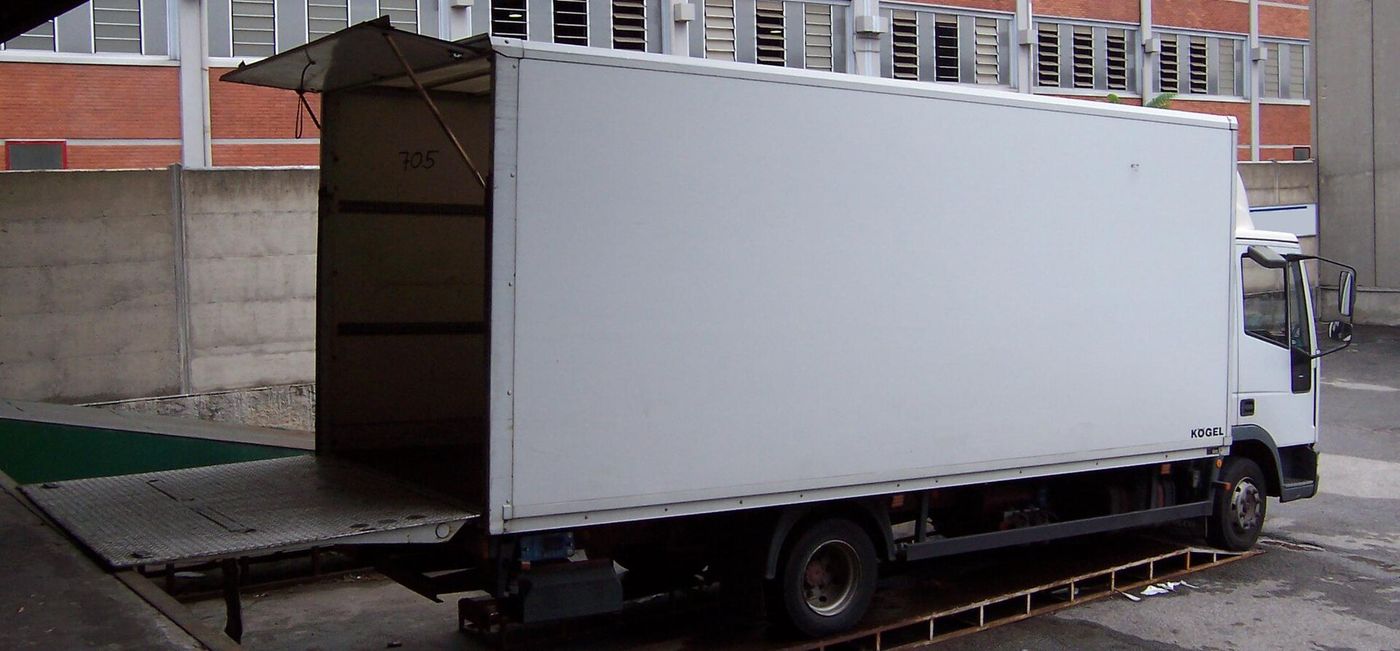
A tail lift, which the US maker Maxon Lift calls a liftgate, is a powered platform fixed to the rear of a van, truck or trailer that moves goods between the ground and the load floor. The makers’ ranges read here divide by where the platform goes for the journey: upright behind the body (cantilever), folded under the floor (tuck-away), stored under the vehicle and extended from there (retractable), or on columns or rails at the rear. Published capacities run from 300 kg on a van lift to 3,000 kg at Bär Cargolift and Anteo, and to 6,600 lbs at Maxon Lift. In the EU, EN 1756-1:2021 is the harmonised standard for goods tail lifts listed by Commission Implementing Decision (EU) 2023/1586 of 26 July 2023. In Great Britain, the Lifting Operations and Lifting Equipment Regulations 1998 define lifting equipment by what it does and do not name the tail lift in the regulations read.
Status as of 5 November 2026. Read on 4 and 5 November 2026: Implementing Decision (EU) 2023/1586 in its Official Journal text, regulations 4 to 7 of the 1998 Regulations, the Health and Safety Executive’s overview of them and its page on lifting equipment, and the tail lift pages of Bär Cargolift (Germany), Anteo (Italy) and Maxon Lift (United States), with Maxon’s product line brochure M-227-0526. Read on 28 October 2026: Directive 2006/42/EC, Regulation (EU) 2023/1230 and its corrigendum of 4 July 2023, and regulations 1, 2, 3, 8 and 9 of the 1998 Regulations. Not read: the text of EN 1756-1, of which only the title is known here; Bär’s portfolio brochures; the pages of any other tail lift maker; and any later amendment of the Decision. Neither EU machinery text was read in a consolidated version.
What a tail lift is
The title of its European standard describes the device: “Platform lifts for mounting on wheeled vehicles”. Bär Cargolift describes its van version as “a hydraulically operated tail lift fitted to the rear of a panel van”, lifting goods and transport equipment such as pallets or trolleys “between the ground and the load area”. The names vary by market and maker: tail lift in the English title of the standard and at Bär, which also writes tail gate; liftgate at Maxon in the United States; Hubladebühne in the German title of the standard and Ladebordwand in Bär’s German wording; sponda idraulica at Anteo in Italy. Bär and Maxon both use the word cantilever for the type that closes upright.
Makers size their ranges to the vehicle. Bär builds its VanLift for specific panel vans, 13 models from the Mercedes-Benz Sprinter to the Toyota Proace Max, at 600 kg or, depending on the vehicle, 500 kg. It states that transporter chassis of up to 7.5 t are usually fitted with 750 kg lifts, offers its S2 and S4L models for medium-duty trucks of up to 18 t gross vehicle weight, and its S4 series for trucks with or without a trailer, trailers and semi-trailers, up to 3,000 kg. Maxon’s brochure sorts its range by gross vehicle weight: light-duty up to 14,000 lbs, medium-duty 14,001 to 26,000 lbs and heavy-duty from 26,001 lbs, with the C2 for pickups, service bodies, stakebed and van bodies at 1,300 to 1,600 lbs. The chassis and bodies themselves are covered under box trucks and rigid distribution trucks and, for semi-trailers, trailer types.
Four ways to stow the platform
Bär gives free access to the doors “when loading and unloading on a ramp” as the reason for a lift that folds away, and Maxon says of its Tuk-A-Way that the platform “is neatly out of the way when not needed and/or in the case of dock loading”. The capacities below are the makers’ own, in their own units.
| Type | Platform on the road | Bär Cargolift | Anteo | Maxon Lift |
|---|---|---|---|---|
| Cantilever | Upright behind the body, in some versions as its door | Standard: 750 to 3,000 kg | Sponde a battuta: 600 to 3,000 kg | Conventional (GPC): 1,700 to 4,400 lbs |
| Tuck-away | Folded under the floor | Falt: 1,000, 1,500 and 2,000 kg | Ripieghevoli (REP): 600 to 2,000 kg | Tuk-A-Way: 2,000 to 5,500 lbs |
| Retractable or slider | Stored under the vehicle, extended from there | RetFalt and Ret/HydFalt: 1,500 to 3,000 kg | Retrattili: 800 to 3,000 kg | Slidelift: 3,300 to 5,500 lbs |
| Column or rail | On columns or rails at the rear | None on the pages read | A colonna: 500 to 2,000 kg | Columnlift (BMR): 3,500 to 6,600 lbs; Railift: 2,000 to 6,000 lbs |
| Van lift | Behind the van, folded at the rear door, inside the load space or under the frame, by model | VanLift: 600 kg, 500 kg depending on the vehicle | Veicoli commerciali: 300 to 800 kg | GPC X1-LDF: 1,300 lbs |
Cantilever. Bär writes of “the platform standing at the rear of the vehicle”. Maxon calls its version conventional, “the original style of liftgate”, “stored flush against the door of trucks or trailers”, and adds that such lifts often serve as the actual door or tailgate. Anteo’s F3CL17 FRIDGE and F3CL22 FRIDGE are for insulated bodies with no rear doors, with insulating material integrated in the aluminium platform, which Anteo says lets the vehicle reach a thermal K below 0.4. On Bär’s Standard range the platform “can be up to three metres high”.
Tuck-away. Bär’s Falt “folds down under the vehicle floor” in the driving position, which it says allows “non-restrictive ramp loading”; the platform is unfolded by hand with spring assistance, and Bär states that on refrigerated bodies the insulation value of the body floor “is fully maintained”. Anteo presents its REP range for variable or occasional use with the option of backing up to a loading dock. Maxon says it introduced the first Tuk-A-Way in 1957, “so that the platform can fold and stow under the truck body in the dock ready position”.
Retractable or slider. Bär’s RetFalt slides out hydraulically and has a platform folded once, unfolded by hand. Its Ret/HydFalt group has a platform folded twice, by hand on the R42 and hydraulically on the H42, a type Bär has offered since 1994. Maxon’s slider-type gates “stow horizontally underneath the truck or trailer” and, needing no extension plates, “can accommodate roll-up as well as swing doors”. Anteo’s F3RECL22 CC can be used either way, as a retractable lift or as a cantilever.
Column or rail. Anteo’s column lifts are bolted by their columns to the rear uprights of the body, and Anteo names vehicles with no rear overhang, where the weight of the lift is decisive for the vehicle’s capacity. Its F3DD models are built to order for one- or two-deck bodies at 1,000, 1,500 and 2,000 kg. Maxon’s BMR Columnlift takes loads of up to 6,600 lbs. Maxon says it was first to bring the rail-style liftgate to the United States during the 1970s, and the platform of its RCT “stores below bed height in a dock-ready position”. Its brochure gives the DMD range as 2,200 to 3,300 lbs, while the page of the DMD with Dock Impact Bumpers also lists 1,800 lbs.
Van lifts and half platforms. Bär’s FreeAccess platform is folded in the driving position and “allows free access to the right rear door”; unfolded it has room and capacity for one pallet with a forklift or up to four trolleys. Anteo sells half platforms (F3MH075, F3V050F, F3V075F), lifts for inside the vehicle (F3IV032, F3IV050) and an under-frame lift positioned at the side of the vehicle (F3RE030/60). Maxon’s GPC X1-LDF for cargo vans has “a fold-over platform”.
Special duties. Maxon’s RC-CS and BMR-CS and Anteo’s F3CO10B and F3CO15B are built for gas cylinders, the Anteo models with guard rails to contain them. Anteo’s F3CLA30 has a platform that tilts down to the ground for livestock vehicles. Its F3BC1 and F3BC2, at 150 and 300 kg, are hydraulic arms for loading cuts of meat rather than platforms.
Capacity, platform depth and weight
A capacity figure goes with a position of the load. Bär’s portfolio brochures pair load capacities with load diagrams and platform dimensions. Its web pages give the BC 750 S2S a 750 mm load distance and the S4 series a load moment of up to 30 kNm, and state of two-cylinder lifts that they “are generally limited in the platform heights available to prevent overloading caused by incorrectly positioned loads”.
Maxon states capacities in pounds; the 6,600 lbs of the BMR is about 2,990 kg at 0.4536 kg per pound. Its pages give platforms of 60 x 80 inches on the GPT and up to 52 x 80 inches on the TE-25/TE-30.
The weight of the lift comes off the payload, and the makers present it that way: Bär’s BC 750 S2L, for use where “the emphasis is on payload”, “lifts 750 kg and weighs only 160 kg”. Bär puts the weight difference between aluminium and steel platforms at 100 kg to 200 kg. How payload relates to gross vehicle weight is set out under truck weights.
| Model | Type | Capacity | Platform depth | Weight |
|---|---|---|---|---|
| Bär BC 750 S2L | Cantilever | 750 kg | Not on the page read | 160 kg |
| Bär VanLift (BC 600 A2V, BC 600 S2V) | Van lift | 600 kg, 500 kg depending on the vehicle | Not on the page read | About 169 to 200 kg |
| Anteo F3IV032 | Van lift, inside the vehicle | 320 kg | 800 or 1,300 mm | From 140 kg |
| Anteo F3CL076 | Cantilever | 750 kg | 1,600 to 2,000 mm | From 178 kg |
| Anteo F3CL10 | Cantilever | 1,000 kg | 1,600 to 2,600 mm | From 290 kg |
| Anteo F3CL17 HL AB | Cantilever, for a low trailer coupling | 1,700 kg | 1,600 to 2,600 mm | From 450 kg |
| Anteo REP 06 LR | Tuck-away | 600 kg | 950 to 1,550 mm | From 211 kg |
| Anteo REP 12/1 | Tuck-away | 1,150 kg | 1,133 to 1,500 mm | From 310 kg |
| Anteo REP 15/2 | Tuck-away | 1,500 kg | 1,133 to 1,583 mm | From 386 kg |
| Anteo F3RE080 AM | Retractable | 800 kg | 1,165 to 1,550 mm | From 295 kg |
| Anteo F3RE17 CC | Retractable | 1,700 kg | 1,300 to 2,000 mm | From 545 kg |
| Anteo F3RECL22 CC | Retractable and cantilever | 2,200 kg | 1,683 to 2,033 mm | From 625 kg |
| Anteo F3CO05 | Column | 500 kg | 880 to 1,480 mm | From 120 kg |
| Anteo F3CO10 | Column | 1,000 kg | 1,200 to 1,650 mm, including a 300 mm fixed ramp | From 235 kg |
| Anteo F3DD-G | Column, one or two decks | Up to 2,000 kg | 2,600 mm | From 900 kg |
Cylinders and ride
Makers describe their lifts by their cylinders. Bär’s F2 tuck-away lifts have two lifting cylinders, and the F4 adds two tilting cylinders for tilt adjustment at any height. Anteo’s REP range runs from one lifting cylinder (REP 12/1, REP 15/1) through two (REP 15/2) to two lifting and two rotation cylinders (REP 15/4), and its F3CL 10, 17, 22 and 30 have four cylinders plus one for the hydraulic link to the ground. Maxon’s X1 design “eliminates two cylinders”, and its X4 has “2 lifting and 2 tilting cylinders that are stacked above each other”. Anteo’s model pages list a supply of 12 or 24 V on most models and 12 V on some van lifts.
The makers also separate lifts by how the platform travels. Anteo’s level-ride models keep it parallel to the ground and have a tapered tip in place of an automatic hydraulic link to the ground. Maxon’s brochure has three ride types, and lists standard ride for loads stable on the platform such as boxes, drums and pallets, level-ramping ride for pallet jacks and wheeled carts and for uneven or unstable surfaces, and level ride for high or tall carts and for large and unwieldy loads.
Coupling, underrun bar, swap body and noise
A tail lift shares the rear of the chassis with the trailer coupling and the underrun bar. Bär writes that “Mounting on drawbar trailers usually leaves little space for a tail lift”, and gives its S4A a clearance of 590 mm at the rear of the vehicle. Its S4U has a hydraulic underrun bar, and its S4V an underrun bar with four vertical and seven horizontal positions for trailers with cranked drawbars. Anteo’s F3CL17 and F3CL22 HL AB have an approved underrun bar that is raised for coupling and put back after uncoupling. Maxon lists underride certifications under FMVSS and CMVSS for its GPSLR. A through-loading truck and trailer in which the truck’s tail lift forms the bridge is described under box trucks.
On semi-trailers, Bär offers the R2T and R4T, the R4C for steering-axle semi-trailers and the R4K for city semi-trailers with a 1,300 mm frame rail. Maxon’s RA is a slider for trailer side doors.
Bär states that all its Ret/HydFalt lifts can be mounted on BDF swap bodies and that, with optional lifting arm stops and bridge plate, the vehicle can change between bodies to EN 284 of sizes C 715 and C 745, and C 782 after modification. What those bodies are is set out under swap bodies.
For loading in noise-sensitive places, Bär offers PIEK equipment, which it says keeps the lift quieter than 62 dB(A) in use and which it describes as formerly certified by the PIEK organisation in the Netherlands.
What a platform takes at one lift is a separate figure from what a body holds: Bär names up to five food trolleys at once for its Standard series. Pallet counts for whole trailers are under how many pallets fit in a trailer.
EN 1756-1 and EU machinery law
EN 1756-1:2021, “Tail lifts - Platform lifts for mounting on wheeled vehicles - Safety requirements - Part 1: Tail lifts for goods”, is row 146 of Part Three (C-type standards) of Annex I to Implementing Decision (EU) 2023/1586, which entered into force on its publication on 2 August 2023. Row 147 is EN 1756-2:2004+A1:2009, Part 2, tail lifts for passengers. Annex II gives 11 October 2023 as the date of withdrawal of the reference of the earlier goods edition, EN 1756-1:2001+A1:2008. Recital 1 states the effect of a listed reference: machinery manufactured in conformity with such a standard “is to be presumed to comply with the essential health and safety requirements covered by such a harmonised standard”.
Two makers refer to the standard on their pages. Bär writes: “In accordance with the European standard for tail lifts, EN 1756-1, trolleys must be secured on the platform with a trolley stop.” Anteo links its adoption of EN 1756-1 to an optional device, Smart Safe, that shows a light in the cab if the platform is no longer in its correct rest position.
How EU machinery law treats machinery mounted on a vehicle, and the move from Directive 2006/42/EC to Regulation (EU) 2023/1230 on 20 January 2027, are set out under truck-mounted loader cranes. Neither text names tail lifts; in the texts read, the Decision’s list is what connects them to the Directive.
LOLER in Great Britain, and other countries
The Lifting Operations and Lifting Equipment Regulations 1998 (LOLER) came into force on 5 December 1998 and apply in Great Britain. Regulation 2 defines “lifting equipment” as “work equipment for lifting or lowering loads”, including its attachments used for anchoring, fixing or supporting it, and “work equipment” as “any machinery, appliance, apparatus, tool or installation for use at work (whether exclusively or not)”. Regulations 1 to 9, the ones read, do not name the tail lift, and so do not themselves apply those definitions to it. The Health and Safety Executive (HSE) does name it: its page “Safe lifting by machine”, under the heading “Lifting equipment covered by LOLER”, lists “vehicle tail lifts and cranes fitted to vehicles” among its examples of lifting equipment. The HSE’s overview page states that “LOLER only applies to lifting equipment which is used at work” and adds that most lifting equipment will also fall within the Supply of Machinery (Safety) Regulations. Those Regulations were not read. What LOLER requires of lifting equipment in general in service is set out under truck-mounted loader cranes.
| Country | Rule read | What it says on tail lifts | Source |
|---|---|---|---|
| European Union | Implementing Decision (EU) 2023/1586, Annex I, Part Three, rows 146 and 147 | Lists EN 1756-1:2021 and EN 1756-2:2004+A1:2009 as harmonised standards for machinery in support of Directive 2006/42/EC | Official Journal L 194, 2.8.2023 |
| Great Britain | LOLER 1998, regulations 1 to 9 | The regulations do not name them and define lifting equipment as work equipment for lifting or lowering loads; the HSE’s examples of lifting equipment include vehicle tail lifts | legislation.gov.uk; HSE pages |
| Germany | Not verified | Not verified | No national text read on tail lifts |
| France | Not verified | Not verified | No national text read on tail lifts |
| Italy | Not verified | Not verified | No national text read on tail lifts |
| Spain | Not verified | Not verified | No national text read on tail lifts |
| Poland | Not verified | Not verified | No national text read on tail lifts |
| Türkiye | Not verified | Not verified | No national text read on tail lifts |
| Russia | Not verified | Not verified | No national text read on tail lifts |
| United States | Not verified | Not verified | No federal text read on tail lifts |
Quick answers
- What is a tail lift on a truck?
- A powered platform fixed to the rear of a van, truck or trailer that moves goods, pallets or trolleys between the ground and the load floor. Maxon in the United States calls it a liftgate, and the title of the European standard calls it a platform lift for mounting on wheeled vehicles. Its own weight comes off the payload: 160 kg for Bär's 750 kg BC 750 S2L, and from 545 kg for Anteo's 1,700 kg F3RE17 CC.
- What are the main types of tail lift?
- The makers' ranges read here fall into four, by where the platform goes for the journey. A cantilever lift closes upright behind the body, in some versions as its door. A tuck-away lift folds under the floor. A retractable or slider lift is stored under the vehicle and extended from there. A column or rail lift travels on columns or rails at the rear. Van lifts are a lighter group, some with a half or folding platform that leaves one rear door free.
- How much can a tail lift carry?
- In the ranges read, from 300 kg on an Anteo van lift to 3,000 kg at Bär Cargolift and Anteo, and 6,600 lbs, about 2,990 kg, on Maxon's BMR column lift. Bär states that transporter chassis of up to 7.5 t are usually fitted with 750 kg lifts. A capacity goes with a position of the load: Bär gives its BC 750 S2S a 750 mm load distance.
- Which standard covers tail lifts in the EU?
- EN 1756-1:2021 for goods and EN 1756-2:2004+A1:2009 for passengers. Both are in Annex I to Commission Implementing Decision (EU) 2023/1586 of 26 July 2023, the list of harmonised standards drafted in support of Directive 2006/42/EC on machinery. Annex II gives 11 October 2023 as the date of withdrawal of the earlier goods edition, EN 1756-1:2001+A1:2008. Regulation (EU) 2023/1230 replaces the Directive on 20 January 2027.
- Is a tail lift lifting equipment under LOLER?
- The Health and Safety Executive lists "vehicle tail lifts and cranes fitted to vehicles" among its examples of lifting equipment covered by LOLER. Regulations 1 to 9 of LOLER 1998, the ones read here, do not name tail lifts. Regulation 2 defines lifting equipment as "work equipment for lifting or lowering loads", and work equipment as any machinery, appliance, apparatus, tool or installation for use at work. The HSE's overview page states that LOLER only applies to lifting equipment which is used at work.
Sources
- Commission Implementing Decision (EU) 2023/1586 of 26 July 2023 on harmonised standards for machinery drafted in support of Directive 2006/42/EC — Official Journal text (OJ L 194, 2.8.2023): recital 1, Articles 1, 2 and 4, Annex I Part Three rows 146 and 147, Annex II row for EN 1756-1:2001+A1:2008 — Publications Office of the European Union, 26 Jul 2023
- Directive 2006/42/EC of the European Parliament and of the Council of 17 May 2006 on machinery — Official Journal text (OJ L 157, 9.6.2006) — Publications Office of the European Union, 17 May 2006
- Regulation (EU) 2023/1230 of the European Parliament and of the Council of 14 June 2023 on machinery — Official Journal text (OJ L 165, 29.6.2023): Articles 51 and 54 — Publications Office of the European Union, 14 Jun 2023
- Corrigendum to Regulation (EU) 2023/1230 on machinery (OJ L 169, 4.7.2023), points 5 and 10 — Publications Office of the European Union
- The Lifting Operations and Lifting Equipment Regulations 1998 (SI 1998/2307), regulation 1: citation and commencement — legislation.gov.uk
- The Lifting Operations and Lifting Equipment Regulations 1998 (SI 1998/2307), regulation 2: interpretation — legislation.gov.uk
- The Lifting Operations and Lifting Equipment Regulations 1998 (SI 1998/2307), regulation 3: application — legislation.gov.uk
- The Lifting Operations and Lifting Equipment Regulations 1998 (SI 1998/2307), regulation 4: strength and stability — legislation.gov.uk
- The Lifting Operations and Lifting Equipment Regulations 1998 (SI 1998/2307), regulation 5: lifting equipment for lifting persons — legislation.gov.uk
- The Lifting Operations and Lifting Equipment Regulations 1998 (SI 1998/2307), regulation 6: positioning and installation — legislation.gov.uk
- The Lifting Operations and Lifting Equipment Regulations 1998 (SI 1998/2307), regulation 7: marking of lifting equipment — legislation.gov.uk
- The Lifting Operations and Lifting Equipment Regulations 1998 (SI 1998/2307), regulation 8: organisation of lifting operations — legislation.gov.uk
- The Lifting Operations and Lifting Equipment Regulations 1998 (SI 1998/2307), regulation 9: thorough examination and inspection — legislation.gov.uk
- Lifting Operations and Lifting Equipment Regulations 1998 (LOLER): overview (read on 4 November 2026) — Health and Safety Executive
- Safe lifting by machine: lifting equipment covered by LOLER (read on 5 November 2026) — Health and Safety Executive
- Bär Cargolift Standard: load capacity 1,000 kg to 3,000 kg (read on 4 November 2026) — Gerd Bär GmbH
- Bär Cargolift Standard / FreeAccess 750 kg (read on 4 November 2026) — Gerd Bär GmbH
- Bär Cargolift Falt: the tuck-away lift (read on 4 November 2026) — Gerd Bär GmbH
- Bär Cargolift RetFalt: the retractable tail lift with single folded platform (read on 4 November 2026) — Gerd Bär GmbH
- Bär Cargolift Ret/HydFalt: the retractable tail gate with double folded platform (read on 4 November 2026) — Gerd Bär GmbH
- Bär VanLift Standard / FreeAccess (read on 4 November 2026) — Gerd Bär GmbH
- Aluminium platforms made by BÄR (read on 4 November 2026) — Gerd Bär GmbH
- Sponde a battuta: range page, in Italian (read on 5 November 2026) — Anteo
- Sponde retrattili: range page, in Italian (read on 4 November 2026) — Anteo
- Sponde ripieghevoli: range page, in Italian (read on 5 November 2026) — Anteo
- Sponde a colonna: range page, in Italian (read on 5 November 2026) — Anteo
- Sponde per veicoli commerciali: range page, in Italian (read on 5 November 2026) — Anteo
- Sponde speciali: range page, in Italian (read on 5 November 2026) — Anteo
- F3CL076, model page with specifications, in Italian (read on 5 November 2026) — Anteo
- F3CL10, model page with specifications, in Italian (read on 5 November 2026) — Anteo
- F3CL17 HL AB, model page with specifications, in Italian (read on 5 November 2026) — Anteo
- F3CL17 FRIDGE, model page with specifications, in Italian (read on 5 November 2026) — Anteo
- REP 06 LR, model page with specifications, in Italian (read on 5 November 2026) — Anteo
- REP 12/1, model page with specifications, in Italian (read on 5 November 2026) — Anteo
- REP 15/2, model page with specifications, in Italian (read on 5 November 2026) — Anteo
- F3RE080 AM, model page with specifications, in Italian (read on 4 November 2026) — Anteo
- F3RE15 LR, model page with specifications, in Italian (read on 5 November 2026) — Anteo
- F3RE17 CC, model page with specifications, in Italian (read on 5 November 2026) — Anteo
- F3RECL22 CC, model page with specifications, in Italian (read on 4 November 2026) — Anteo
- F3CO05, model page with specifications, in Italian (read on 5 November 2026) — Anteo
- F3CO10, model page with specifications, in Italian (read on 5 November 2026) — Anteo
- F3CO10B, model page with specifications, in Italian (read on 5 November 2026) — Anteo
- F3DD-G, model page with specifications, in Italian (read on 5 November 2026) — Anteo
- F3IV032, model page with specifications, in Italian (read on 5 November 2026) — Anteo
- F3RE030/60, model page with specifications, in Italian (read on 5 November 2026) — Anteo
- Maxon gates at a glance: product line brochure M-227-0526, pages 1 and 2 (read on 5 November 2026) — Maxon Lift Corp.
- Conventional liftgates (read on 5 November 2026) — Maxon Lift Corp.
- GPC 33/44 X4 (read on 5 November 2026) — Maxon Lift Corp.
- GPC X1-LDF (read on 5 November 2026) — Maxon Lift Corp.
- Tuk-A-Way liftgates (read on 5 November 2026) — Maxon Lift Corp.
- GPT (read on 5 November 2026) — Maxon Lift Corp.
- TE-25/TE-30 (read on 5 November 2026) — Maxon Lift Corp.
- Slidelift liftgates (read on 5 November 2026) — Maxon Lift Corp.
- GPSLR (read on 5 November 2026) — Maxon Lift Corp.
- Columnlift liftgates (read on 5 November 2026) — Maxon Lift Corp.
- Railift liftgates (read on 5 November 2026) — Maxon Lift Corp.
- RCT (read on 5 November 2026) — Maxon Lift Corp.
- DMD with Dock Impact Bumpers (read on 5 November 2026) — Maxon Lift Corp.