Dangerous goods classes and orange plates: ADR danger labels and hazard identification numbers
ADR 2025 sorts dangerous goods into classes numbered 1 to 9, each with its danger labels. What the orange plate's hazard identification number means, with all 97 numbers listed.
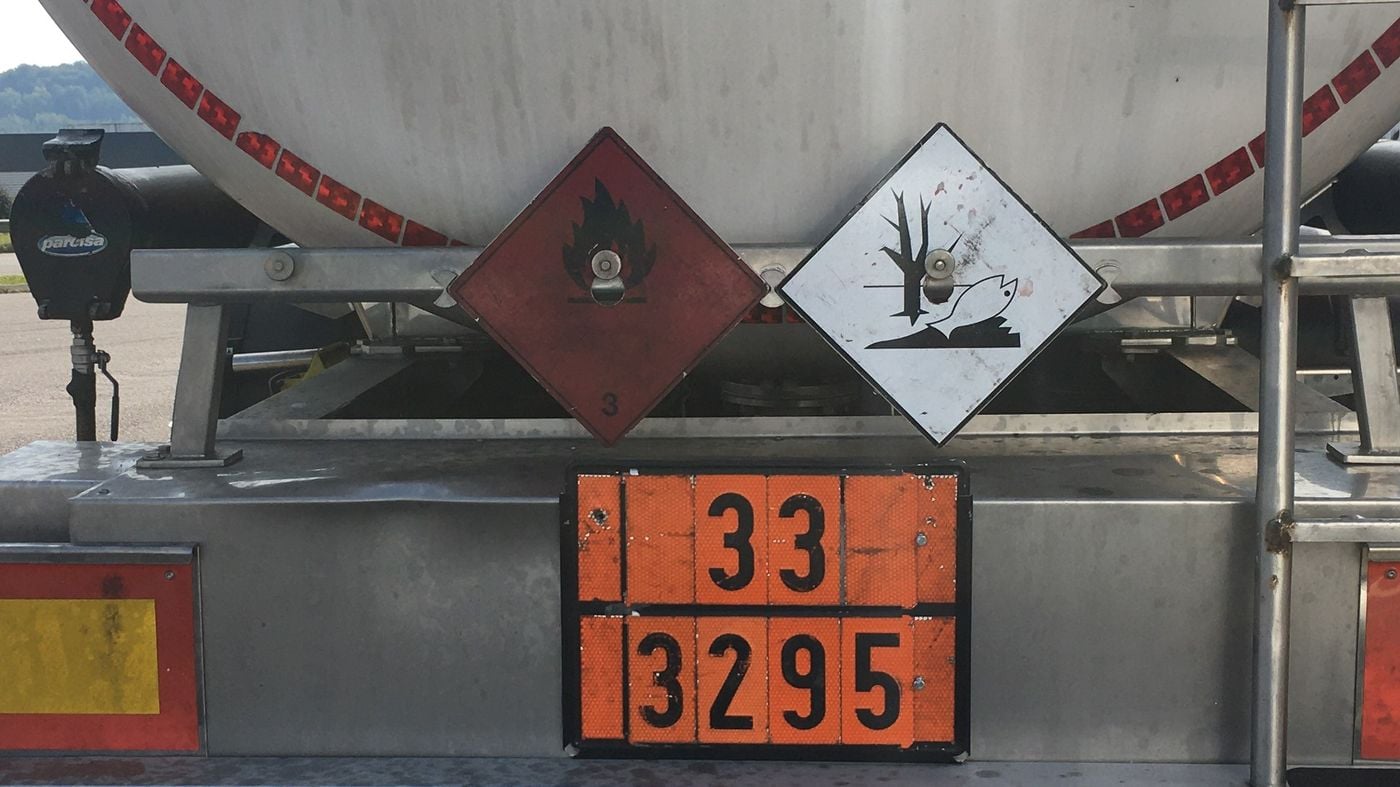
ADR sorts dangerous goods into thirteen classes numbered from 1 to 9. Classes 1, 2, 3, 7, 8 and 9 carry a single number; the figures 4, 5 and 6 are each shared by several classes: 4.1, 4.2 and 4.3; 5.1 and 5.2; 6.1 and 6.2 (2.1.1.1). Every entry in a class carries a four-digit UN number (2.1.1.2). Each class has its own diamond-shaped danger labels for packages; vehicles and containers carry larger placards that correspond to them. The orange plate is a separate marking: two plates, front and rear, on every transport unit carrying dangerous goods, and, in the cases set out in 5.3.2.1, among them tanks and some bulk loads, plates with two numbers, a hazard identification number of two or three figures above the four-figure UN number. The text cited here is ADR 2025. Directive 2008/68/EC applies ADR’s Annexes A and B, as applicable from 1 January 2025, to the carriage of dangerous goods by road within and between the Member States of the European Union.
Status as of 28 October 2026. Read on that day: ADR 2025 (ECE/TRANS/352) in its French text, as published by the Swiss Federal Roads Office — Volume I for the Introduction, the definitions in 1.2.1, Chapter 2.1 and the opening sub-sections of each class in Chapter 2.2, and Volume II for 5.2.2.2, 5.3.1 and 5.3.2 — and 49 CFR 173.2 in the annual edition revised as of 1 October 2025. The text of Directive 2008/68/EC used is its consolidated version of 12 May 2026. Where ADR’s wording is given in English below, it is translated from the French text.
Thirteen classes, numbered 1 to 9
The list is in 2.1.1.1. Each class is defined by the properties set out in sub-section 2.2.x.1 of its own section of Chapter 2.2 (2.1.2.1), and ADR calls each of 4.1 to 6.2 a class in its own right. Goods listed or defined in sub-section 2.2.x.2 of a class are not accepted for carriage (2.1.2.4).
| Class | Heading in 2.1.1.1 | What the heading covers | Label models |
|---|---|---|---|
| 1 | Explosive substances and articles | Explosive substances, pyrotechnic substances, explosive articles, and substances and articles manufactured to produce a practical explosive or pyrotechnic effect (2.2.1.1.1) | 1, 1.4, 1.5, 1.6 |
| 2 | Gases | Pure gases, mixtures of gases, mixtures of gases with other substances, and articles containing them. A gas has a vapour pressure above 300 kPa (3 bar) at 50 °C, or is completely gaseous at 20 °C at the standard pressure of 101.3 kPa (2.2.2.1.1) | 2.1, 2.2, 2.3 |
| 3 | Flammable liquids | Liquids with a vapour pressure of not more than 300 kPa (3 bar) at 50 °C, not completely gaseous at 20 °C and 101.3 kPa, and with a flash-point of not more than 60 °C; also liquids and molten solids with a higher flash-point carried hot at or above it (UN 3256), and liquid desensitized explosives (2.2.3.1.1) | 3 |
| 4.1 | Flammable solids, self-reactive substances, polymerizing substances and solid desensitized explosives | Flammable substances and articles and desensitized explosives that are solids, self-reactive substances whether liquid or solid, and polymerizing substances (2.2.41.1.1) | 4.1 |
| 4.2 | Substances liable to spontaneous combustion | Pyrophoric substances, liquid or solid, which ignite within five minutes of contact with air even in small quantities, and self-heating substances and articles, which are liable to self-heat in contact with air without an energy supply and can ignite only in large amounts (several kilograms) and after long periods (hours or days) (2.2.42.1.1) | 4.2 |
| 4.3 | Substances which, in contact with water, emit flammable gases | Substances which react with water to give off flammable gases liable to form explosive mixtures with air, and articles containing them (2.2.43.1.1) | 4.3 |
| 5.1 | Oxidizing substances | Substances which, while not necessarily combustible themselves, may, generally by yielding oxygen, cause or contribute to the combustion of other material, and articles containing them (2.2.51.1.1) | 5.1 |
| 5.2 | Organic peroxides | Organic peroxides and organic peroxide formulations (2.2.52.1.1): organic substances containing the bivalent -O-O- structure, which may be considered derivatives of hydrogen peroxide (2.2.52.1.3) | 5.2 |
| 6.1 | Toxic substances | Substances known from experience, or presumed from experiments on animals, to be liable in a relatively small quantity, by a single or short-duration action, to harm human health or cause death by inhalation, skin absorption or ingestion (2.2.61.1.1) | 6.1 |
| 6.2 | Infectious substances | Substances known or reasonably expected to contain pathogens: micro-organisms such as bacteria, viruses, parasites and fungi, and other agents such as prions, which can cause disease in humans or animals (2.2.62.1.1) | 6.2 |
| 7 | Radioactive material | Any material containing radionuclides where both the activity concentration and the total activity in the consignment exceed the values in 2.2.7.2.2.1 to 2.2.7.2.2.6 (2.2.7.1.1) | 7A, 7B, 7C, 7E |
| 8 | Corrosive substances | Substances which by chemical action cause irreversible damage to the skin or, if they leak, can seriously damage or even destroy other goods or the means of transport; also substances that form a corrosive liquid only with water, or give off corrosive vapour or mist with the natural moisture of the air (2.2.8.1.1) | 8 |
| 9 | Miscellaneous dangerous substances and articles | Substances and articles which, during carriage, present a danger not covered by the other classes (2.2.9.1.1) | 9, 9A |
By way of derogation, a note to 2.2.3.1.1 puts diesel fuel, gas oil and light heating oil, including synthetic products, with a flash-point above 60 °C and not above 100 °C in Class 3, under UN 1202. Class 9 is subdivided into codes M1 to M11 (2.2.9.1.2), among them lithium batteries and sodium ion batteries (M4), environmentally hazardous substances (M6 to M8) and substances carried hot (M9 and M10).
Every entry has a UN number, which 1.2.1 defines as the four-digit identification number of a substance or article taken from the UN Model Regulations, themselves defined as the Model Regulations annexed to the 23rd revised edition of the UN Recommendations on the Transport of Dangerous Goods (ST/SG/AC.10/1/Rev.23). ADR’s introduction states that the structure of its Annexes A and B corresponds to that of the UN Model Regulations, the International Maritime Dangerous Goods Code (IMDG Code) and the rail regulations RID. The entries run from individual ones for a well-defined substance, such as UN 1090 acetone, through generic entries and specific n.o.s. entries to general n.o.s. entries such as UN 1993 flammable liquid, n.o.s. (2.1.1.2). Table A of Chapter 3.2 lists every entry in UN number order with, among other things, its name, class, packing group or groups and the labels to be affixed (2.1.2.2). For packing purposes, substances other than those of Classes 1, 2, 5.2, 6.2 and 7, and other than the self-reactive substances of Class 4.1, are assigned to packing group I (high danger), II (medium danger) or III (low danger); articles are not assigned to packing groups (2.1.1.3).
Divisions in Class 1, groups in Class 2
Within Class 1, each substance or article is assigned to a division and to a compatibility group, and its classification code is made up of the division number and the compatibility group letter (2.2.1.1.4). The divisions are defined in 2.2.1.1.5:
- 1.1 — a mass explosion hazard, that is an explosion which affects almost the entire load virtually instantaneously;
- 1.2 — a projection hazard but not a mass explosion hazard;
- 1.3 — a fire hazard and a minor blast or projection hazard, or both, but not a mass explosion hazard: substances and articles whose combustion gives rise to considerable radiant heat, or which burn one after another with minor blast or projection effects;
- 1.4 — only a minor explosion hazard in the event of ignition or initiation during carriage, with the effects largely confined to the package;
- 1.5 — very insensitive substances which have a mass explosion hazard, but with very little probability of initiation or of transition from burning to detonation under normal conditions of carriage;
- 1.6 — extremely insensitive articles without a mass explosion hazard, the hazard being limited to the explosion of a single article.
For Class 2, paragraph 2.2.2.1.2 subdivides its substances and articles into nine categories, among them compressed, liquefied, refrigerated liquefied and dissolved gases, and 2.2.2.1.3 assigns them, other than aerosols and chemicals under pressure, to groups by hazardous property: A asphyxiant, O oxidizing, F flammable, T toxic, and the combinations TF, TC, TO, TFC and TOC, with any group containing T taking precedence over all others and F over A and O. A note to the same paragraph records that the UN Model Regulations, the IMDG Code and the ICAO Technical Instructions assign gases to one of three divisions according to their primary hazard: 2.1 flammable gases (the groups with a capital F), 2.2 non-flammable, non-toxic gases (A or O) and 2.3 toxic gases (T, TF, TC, TO, TFC and TOC). ADR’s label models for gases carry those three numbers.
Danger labels
A danger label is a square set on one of its points, at least 100 mm by 100 mm, with a line inside running about 5 mm from the edge (5.2.2.2.1.1.2). Under 5.2.2.2.1 the upper half carries the symbol and the lower half the class number, except that Classes 4.1, 4.2 and 4.3 show the figure 4 and Classes 6.1 and 6.2 the figure 6. On Class 1 labels the division number and compatibility group letter appear in the lower half, above the class number; on those for Divisions 1.4, 1.5 and 1.6 the division number appears in the upper half in place of a symbol, and the lower half shows the class number and the compatibility group letter. Except on model 9A, text such as the UN number or words describing the hazard may be added as long as it does not hide or diminish the other elements, and the corresponding labels required for other modes of transport, with minor variations that do not affect their obvious meaning, may also be accepted (5.2.2.2.1).
| Model | For | Symbol and its colour | Background | Figure in the bottom corner |
|---|---|---|---|---|
| 1 | Divisions 1.1, 1.2 and 1.3 | Exploding bomb, black | Orange | 1, black |
| 1.4 | Division 1.4 | The figures 1.4, black | Orange | 1, black |
| 1.5 | Division 1.5 | The figures 1.5, black | Orange | 1, black |
| 1.6 | Division 1.6 | The figures 1.6, black | Orange | 1, black |
| 2.1 | Flammable gases | Flame, black or white | Red | 2, black or white |
| 2.2 | Non-flammable, non-toxic gases | Gas cylinder, black or white | Green | 2, black or white |
| 2.3 | Toxic gases | Skull and crossbones, black | White | 2, black |
| 3 | Class 3 | Flame, black or white | Red | 3, black or white |
| 4.1 | Class 4.1 | Flame, black | White with seven vertical red stripes | 4, black |
| 4.2 | Class 4.2 | Flame, black | Upper half white, lower half red | 4, black |
| 4.3 | Class 4.3 | Flame, black or white | Blue | 4, black or white |
| 5.1 | Class 5.1 | Flame over a circle, black | Yellow | 5.1, black |
| 5.2 | Class 5.2 | Flame, black or white | Upper half red, lower half yellow | 5.2, black |
| 6.1 | Class 6.1 | Skull and crossbones, black | White | 6, black |
| 6.2 | Class 6.2 | Three crescents on a circle, black | White | 6, black |
| 7A | Category I-WHITE | Trefoil, black | White | 7, black |
| 7B | Category II-YELLOW | Trefoil, black | Upper half yellow with a white border, lower half white | 7, black |
| 7C | Category III-YELLOW | Trefoil, black | Upper half yellow with a white border, lower half white | 7, black |
| 7E | Fissile material | None; the word FISSILE in the upper half | White | 7, black |
| 8 | Class 8 | Liquids spilling from two glass test tubes and attacking a hand and a metal, black | Upper half white, lower half black with a white border | 8, white |
| 9 | Class 9 | Seven vertical stripes in the upper half, black | White | 9 underlined, black |
| 9A | Class 9 | Seven vertical stripes in the upper half and, in the lower half, a group of cells and batteries, one of them damaged, with a flame, black | White | 9 underlined, black |
The notes column of 5.2.2.2.2 adds the following. On model 1 the division and the compatibility group are left blank where explosive properties are the subsidiary hazard. Model 6.2 may carry, in black in its lower half, a mention that the contents are infectious substances and a request to notify the public health authorities immediately in case of damage or leakage. Models 7A, 7B and 7C carry RADIOACTIVE, CONTENTS and ACTIVITY in black in the lower half, with one, two or three red vertical bars after RADIOACTIVE, and 7B and 7C a TRANSPORT INDEX box; 7E carries a CRITICALITY SAFETY INDEX box.
Placards on vehicles and containers
Under 5.3.1.1.1, placards are affixed to the outside walls of containers, bulk containers, MEGCs, MEMUs, tank-containers, portable tanks and vehicles as Section 5.3.1 prescribes, and correspond to the labels prescribed in column (5) and, where applicable, column (6) of Table A for the goods on board. A placard is the same diamond at least 250 mm by 250 mm, with its inner line 12.5 mm from the edge and the class or division number, and for Class 1 the compatibility group letter, at least 25 mm high (5.3.1.7.1). For Class 7 the placard is model 7D (5.3.1.1.3): upper half yellow, lower half white, trefoil and text black, and the word RADIOACTIVE in the lower half is optional so that the space can carry the UN number of the consignment instead (5.3.1.7.2). Class 9 is placarded with model 9; label model 9A is not to be used for placarding (5.3.1.1.4). Where a vehicle or container holds substances or articles of different Class 1 divisions, only the placard of the most dangerous is shown, in the order, from most to least dangerous, 1.1, 1.5, 1.2, 1.3, 1.6, 1.4, and Division 1.4, compatibility group S, needs no placard (5.3.1.1.2). Where goods of more than one class are on board, a subsidiary-hazard placard is not needed if a primary or subsidiary hazard placard already shows that hazard (5.3.1.1.5).
| Vehicle or unit | Placards | Paragraph |
|---|---|---|
| Container, bulk container, MEGC, tank-container or portable tank | Both sides and each end; two opposite sides for a flexible bulk container | 5.3.1.2 |
| Vehicle carrying such containers | The same placards on both sides and at the rear, only if those on the containers are not visible from outside the vehicle | 5.3.1.3 |
| Vehicle carrying goods in bulk, tank-vehicle, battery-vehicle, MEMU, vehicle with demountable tanks | Both sides and the rear; with several compartments carrying two or more dangerous goods, on both sides at the compartments concerned and one of each model at the rear | 5.3.1.4.1 |
| Vehicle carrying packages of Class 1, other than Division 1.4, compatibility group S | Both sides and the rear | 5.3.1.5.1 |
| Vehicle carrying Class 7 in packagings or IBCs, other than excepted packages | Both sides and the rear | 5.3.1.5.2 |
| Empty tank-vehicle, battery-vehicle, tank-container, MEGC, MEMU or portable tank, not cleaned and not degassed; empty bulk vehicle or container, not cleaned | The placards required for the previous load | 5.3.1.6.1 |
Orange plates: which ones carry the numbers
Every transport unit carrying dangerous goods displays two orange plates, one at the front and one at the rear (5.3.2.1.1), made to the specification in 5.3.2.2.1, which allows a black horizontal line across the middle of the plate. The table below sets out where 5.3.2.1 calls for the hazard identification number and the UN number on them. The dimensions, the fire resistance, the rules for empty tanks and for covering plates, and the transitional measure for old plates are in ADR explained: dangerous goods vehicles, orange plates and tunnel codes, which also covers the quantity limits of 1.1.3.6.
| Case | Plates | Numbers | Paragraph |
|---|---|---|---|
| Any transport unit carrying dangerous goods | Two, front and rear; an uncoupled trailer keeps one at its rear | None required by this paragraph. On an uncoupled trailer whose tanks are marked under 5.3.2.1.3, the plate left at the rear corresponds to the most dangerous substance in the tank or to UN 3475 | 5.3.2.1.1 |
| Tank-vehicles, battery-vehicles and transport units with one or more tanks, where column (20) of Table A gives a hazard identification number | In addition, on the sides of each tank, tank compartment or battery-vehicle element, parallel to the vehicle’s axis | Hazard identification number (column 20) and UN number (column 1) of each substance in that tank, compartment or element; for MEMUs only tanks of 1,000 litres or more and bulk containers | 5.3.2.1.2 |
| Tanks carrying only UN 1202, 1203, 1223 or 3475, or aviation fuel classified under UN 1268 or 1863, and no other dangerous substance | The side plates of 5.3.2.1.2 are not needed if the front and rear plates carry the numbers in the next column | Hazard identification number and UN number for UN 3475 or, without it, for the most dangerous substance carried, the one with the lowest flash-point | 5.3.2.1.3 |
| Vehicles, containers and bulk containers carrying unpackaged solids or articles, or packaged radioactive material with a single UN number to be carried under exclusive use, with no other dangerous goods, where column (20) gives a hazard identification number | In addition, on the sides of each vehicle or container, parallel to the vehicle’s axis | Hazard identification number and UN number of each substance carried in bulk, or of the packaged radioactive material | 5.3.2.1.4 |
| Plates under 5.3.2.1.2 or 5.3.2.1.4 on containers, bulk containers, tank-containers, MEGCs or portable tanks that are not clearly visible from outside the carrying vehicle | The same plates on both sides of the vehicle as well; not required for vehicles carrying bulk containers, tanks or MEGCs of not more than 3,000 litres | As on the containers | 5.3.2.1.5 |
| Transport units carrying a single dangerous substance and no non-dangerous goods | The side plates of 5.3.2.1.2, 5.3.2.1.4 and 5.3.2.1.5 are not needed when the front and rear plates carry the numbers in the next column | Hazard identification number and UN number of that substance | 5.3.2.1.6 |
On a plate with numbers, the hazard identification number goes in the upper half and the UN number in the lower half, separated by a black horizontal line across the middle (5.3.2.2.2). The example in 5.3.2.2.3 describes the upper field as two or three figures, preceded where appropriate by the letter X, and the lower field as four figures. The amendments that apply from 1 January 2027, among them new wording for 5.3.2.1.4 and 5.3.2.1.6, are listed in ADR explained. Tank bodies and tank trailers are described in tanker trucks and tank trailers, and the driver’s ADR training certificate in the ADR driver training certificate explained.
Reading the hazard identification number
The hazard identification number has two or three figures, and in general each figure indicates a hazard (5.3.2.3.1).
| Figure | Hazard |
|---|---|
| 2 | Emission of gas due to pressure or to chemical reaction |
| 3 | Flammability of liquids (vapours) and gases, or self-heating liquid |
| 4 | Flammability of solids, or self-heating solid |
| 5 | Oxidizing (fire-intensifying) effect |
| 6 | Toxicity or risk of infection |
| 7 | Radioactivity |
| 8 | Corrosivity |
| 9 | Risk of spontaneous violent reaction |
A note adds that the risk under figure 9 includes the possibility, from the nature of the substance, of a risk of explosion, disintegration or polymerization reaction following the release of considerable heat or of flammable and/or toxic gases. The same paragraph adds four rules:
- A doubled figure indicates an intensification of that particular hazard.
- A zero follows the figure where a single figure is enough to indicate the hazard of a substance.
- Eighteen combinations have a special meaning: 22, 323, 333, 362, 382, 423, 44, 446, 462, 482, 539, 606, 623, 642, 823, 842, 90 and 99. Each is defined in 5.3.2.3.2 and marked † in the tables below.
- The letter X in front of the number indicates that the substance reacts dangerously with water. ADR adds that for such substances water may be used only with the approval of experts.
Class 1 works differently: its hazard identification number is the classification code in column (3b) of Table A, made up of the division number under 2.2.1.1.5 and the compatibility group letter under 2.2.1.1.6. Paragraph 5.3.2.3.2 gives the meaning of the hazard identification numbers shown in column (20) of Table A: 97 numbers in ADR 2025, 15 of them with the X.
The 97 hazard identification numbers
| Number | Meaning |
|---|---|
| 20 | Asphyxiant gas, or gas with no subsidiary hazard |
| 22 † | Refrigerated liquefied gas, asphyxiant |
| 223 | Refrigerated liquefied gas, flammable |
| 225 | Refrigerated liquefied gas, oxidizing (fire-intensifying) |
| 23 | Flammable gas |
| 238 | Gas, flammable corrosive |
| 239 | Flammable gas which can spontaneously lead to a violent reaction |
| 25 | Oxidizing (fire-intensifying) gas |
| 26 | Toxic gas |
| 263 | Toxic gas, flammable |
| 265 | Toxic gas, oxidizing (fire-intensifying) |
| 268 | Toxic gas, corrosive |
| 28 | Gas, corrosive |
| Number | Meaning |
|---|---|
| 30 | Flammable liquid (flash-point from 23 °C to 60 °C inclusive), or flammable liquid or molten solid with a flash-point above 60 °C, heated to a temperature equal to or above its flash-point, or self-heating liquid |
| 323 † | Flammable liquid which reacts with water, emitting flammable gases |
| X323 | Flammable liquid which reacts dangerously with water, emitting flammable gases |
| 33 | Highly flammable liquid (flash-point below 23 °C) |
| 333 † | Pyrophoric liquid |
| X333 | Pyrophoric liquid which reacts dangerously with water |
| 336 | Highly flammable liquid, toxic |
| 338 | Highly flammable liquid, corrosive |
| X338 | Highly flammable liquid, corrosive, which reacts dangerously with water |
| 339 | Highly flammable liquid which can spontaneously lead to a violent reaction |
| 36 | Flammable liquid (flash-point from 23 °C to 60 °C inclusive), slightly toxic, or self-heating liquid, toxic |
| 362 † | Flammable liquid, toxic, which reacts with water, emitting flammable gases |
| X362 | Flammable liquid, toxic, which reacts dangerously with water, emitting flammable gases |
| 368 | Flammable liquid, toxic, corrosive |
| 38 | Flammable liquid (flash-point from 23 °C to 60 °C inclusive), slightly corrosive, or self-heating liquid, corrosive |
| 382 † | Flammable liquid, corrosive, which reacts with water, emitting flammable gases |
| X382 | Flammable liquid, corrosive, which reacts dangerously with water, emitting flammable gases |
| 39 | Flammable liquid which can spontaneously lead to a violent reaction |
| Number | Meaning |
|---|---|
| 40 | Flammable solid, or self-reactive substance, or self-heating substance, or polymerizing substance |
| 423 † | Solid which reacts with water, emitting flammable gases, or flammable solid which reacts with water, emitting flammable gases, or self-heating solid which reacts with water, emitting flammable gases |
| X423 | Solid which reacts dangerously with water, emitting flammable gases, or flammable solid which reacts dangerously with water, emitting flammable gases, or self-heating solid which reacts dangerously with water, emitting flammable gases |
| 43 | Spontaneously flammable (pyrophoric) solid |
| X432 | Spontaneously flammable (pyrophoric) solid which reacts dangerously with water, emitting flammable gases |
| 44 † | Flammable solid in the molten state at an elevated temperature |
| 446 † | Flammable solid, toxic, in the molten state at an elevated temperature |
| 46 | Flammable or self-heating solid, toxic |
| 462 † | Toxic solid which reacts with water, emitting flammable gases |
| X462 | Solid which reacts dangerously with water, emitting toxic gases |
| 48 | Flammable or self-heating solid, corrosive |
| 482 † | Corrosive solid which reacts with water, emitting flammable gases |
| X482 | Solid which reacts dangerously with water, emitting corrosive gases |
| Number | Meaning |
|---|---|
| 50 | Oxidizing (fire-intensifying) substance |
| 539 † | Flammable organic peroxide |
| 55 | Strongly oxidizing (fire-intensifying) substance |
| 556 | Strongly oxidizing (fire-intensifying) substance, toxic |
| 558 | Strongly oxidizing (fire-intensifying) substance, corrosive |
| 559 | Strongly oxidizing (fire-intensifying) substance which can spontaneously lead to a violent reaction |
| 56 | Oxidizing (fire-intensifying) substance, toxic |
| 568 | Oxidizing (fire-intensifying) substance, toxic, corrosive |
| 58 | Oxidizing (fire-intensifying) substance, corrosive |
| 59 | Oxidizing (fire-intensifying) substance which can spontaneously lead to a violent reaction |
| Number | Meaning |
|---|---|
| 60 | Toxic or slightly toxic substance |
| 606 † | Infectious substance |
| 623 † | Toxic liquid which reacts with water, emitting flammable gases |
| 63 | Toxic substance, flammable (flash-point from 23 °C to 60 °C inclusive) |
| 638 | Toxic substance, flammable (flash-point from 23 °C to 60 °C inclusive), corrosive |
| 639 | Toxic substance, flammable (flash-point not above 60 °C), which can spontaneously lead to a violent reaction |
| 64 | Toxic solid, flammable or self-heating |
| 642 † | Toxic solid which reacts with water, emitting flammable gases |
| 65 | Toxic substance, oxidizing (fire-intensifying) |
| 66 | Highly toxic substance |
| 663 | Highly toxic substance, flammable (flash-point not above 60 °C) |
| 664 | Highly toxic solid, flammable or self-heating |
| 665 | Highly toxic substance, oxidizing (fire-intensifying) |
| 668 | Highly toxic substance, corrosive |
| X668 | Highly toxic substance, corrosive, which reacts dangerously with water |
| 669 | Highly toxic substance which can spontaneously lead to a violent reaction |
| 68 | Toxic substance, corrosive |
| 69 | Toxic or slightly toxic substance which can spontaneously lead to a violent reaction |
| Number | Meaning |
|---|---|
| 70 | Radioactive material |
| 768 | Radioactive material, toxic and corrosive |
| Number | Meaning |
|---|---|
| 80 | Corrosive or slightly corrosive substance |
| X80 | Corrosive or slightly corrosive substance which reacts dangerously with water |
| 823 † | Corrosive liquid which reacts with water, emitting flammable gases |
| 83 | Corrosive or slightly corrosive substance, flammable (flash-point from 23 °C to 60 °C inclusive) |
| X83 | Corrosive or slightly corrosive substance, flammable (flash-point from 23 °C to 60 °C inclusive), which reacts dangerously with water |
| 836 | Corrosive or slightly corrosive substance, flammable (flash-point from 23 °C to 60 °C inclusive), toxic |
| 839 | Corrosive or slightly corrosive substance, flammable (flash-point from 23 °C to 60 °C inclusive), which can spontaneously lead to a violent reaction |
| X839 | Corrosive or slightly corrosive substance, flammable (flash-point from 23 °C to 60 °C inclusive), which can spontaneously lead to a violent reaction and which reacts dangerously with water |
| 84 | Corrosive solid, flammable or self-heating |
| 842 † | Corrosive solid which reacts with water, emitting flammable gases |
| 85 | Corrosive or slightly corrosive substance, oxidizing (fire-intensifying) |
| 856 | Corrosive or slightly corrosive substance, oxidizing (fire-intensifying), toxic |
| 86 | Corrosive or slightly corrosive substance, toxic |
| 88 | Highly corrosive substance |
| X88 | Highly corrosive substance which reacts dangerously with water |
| 883 | Highly corrosive substance, flammable (flash-point from 23 °C to 60 °C inclusive) |
| 884 | Highly corrosive solid, flammable or self-heating |
| 885 | Highly corrosive substance, oxidizing (fire-intensifying) |
| 886 | Highly corrosive substance, toxic |
| X886 | Highly corrosive substance, toxic, which reacts dangerously with water |
| 89 | Corrosive or slightly corrosive substance which can spontaneously lead to a violent reaction |
| Number | Meaning |
|---|---|
| 90 † | Environmentally hazardous substance; miscellaneous dangerous substances |
| 99 † | Miscellaneous dangerous substances carried hot |
Where these classes apply
Directive 2008/68/EC applies these rules in the European Union. Its Article 1(1) reads: “This Directive shall apply to the transport of dangerous goods by road, by rail or by inland waterway within or between Member States, including the activities of loading and unloading, the transfer to or from another mode of transport and the stops necessitated by the circumstances of the transport.” For the road, Annex I, Section I.1 sets the rules as “Annexes A and B to the ADR, as applicable with effect from 1 January 2025, it being understood that ‘contracting party’ is replaced by ‘Member State’ as appropriate.” One national option in Section I.2 concerns the hazard identification number itself; it is set out in ADR explained.
In the United States, 49 CFR 173.2 uses the same numbers under names of its own: “The hazard class of a hazardous material is indicated by either the class or division number or the class name.” Its table calls 4.1 to 6.2 divisions of Classes 4, 5 and 6, names Divisions 2.1 to 2.3 for gases, and lists Classes 3, 7, 8 and 9 without divisions. FORBIDDEN MATERIALS (173.21) and FORBIDDEN EXPLOSIVES (173.54) head the table without a number. The hazardous materials endorsement of a US commercial driver’s license is covered in CDL classes and endorsements.
| Class | Division | Class or division name | Definitions in |
|---|---|---|---|
| 1 | 1.1 | EXPLOSIVES (WITH A MASS EXPLOSION HAZARD) | 173.50 |
| 1 | 1.2 | EXPLOSIVES (WITH A PROJECTION HAZARD) | 173.50 |
| 1 | 1.3 | EXPLOSIVES (WITH PREDOMINATELY A FIRE HAZARD) | 173.50 |
| 1 | 1.4 | EXPLOSIVES (WITH NO SIGNIFICANT BLAST HAZARD) | 173.50 |
| 1 | 1.5 | VERY INSENSITIVE EXPLOSIVES; BLASTING AGENTS | 173.50 |
| 1 | 1.6 | EXTREMELY INSENSITIVE DETONATING SUBSTANCES | 173.50 |
| 2 | 2.1 | FLAMMABLE GAS | 173.115 |
| 2 | 2.2 | NON-FLAMMABLE COMPRESSED GAS | 173.115 |
| 2 | 2.3 | POISONOUS GAS | 173.115 |
| 3 | — | FLAMMABLE AND COMBUSTIBLE LIQUID | 173.120 |
| 4 | 4.1 | FLAMMABLE SOLID | 173.124 |
| 4 | 4.2 | SPONTANEOUSLY COMBUSTIBLE MATERIAL | 173.124 |
| 4 | 4.3 | DANGEROUS WHEN WET MATERIAL | 173.124 |
| 5 | 5.1 | OXIDIZER | 173.127 |
| 5 | 5.2 | ORGANIC PEROXIDE | 173.128 |
| 6 | 6.1 | POISONOUS MATERIALS | 173.132 |
| 6 | 6.2 | INFECTIOUS SUBSTANCE (ETIOLOGIC AGENT) | 173.134 |
| 7 | — | RADIOACTIVE MATERIAL | 173.403 |
| 8 | — | CORROSIVE MATERIAL | 173.136 |
| 9 | — | MISCELLANEOUS HAZARDOUS MATERIAL | 173.140 |
Quick answers
- What are the 9 classes of dangerous goods?
- ADR 2.1.1.1 lists thirteen classes numbered from 1 to 9: Class 1 explosive substances and articles; 2 gases; 3 flammable liquids; 4.1 flammable solids, self-reactive substances, polymerizing substances and solid desensitized explosives; 4.2 substances liable to spontaneous combustion; 4.3 substances which, in contact with water, emit flammable gases; 5.1 oxidizing substances; 5.2 organic peroxides; 6.1 toxic substances; 6.2 infectious substances; 7 radioactive material; 8 corrosive substances; 9 miscellaneous dangerous substances and articles. The figures 4, 5 and 6 are each shared by several classes.
- What do the numbers on an orange plate mean?
- The upper number is the hazard identification number, two or three figures, sometimes preceded by the letter X; the lower one is the four-figure UN number of the substance (ADR 5.3.2.2.2). In the hazard number, 2 stands for emission of gas due to pressure or to chemical reaction, 3 for flammability of liquids (vapours) and gases or a self-heating liquid, 4 for flammability of solids or a self-heating solid, 5 for an oxidizing (fire-intensifying) effect, 6 for toxicity or risk of infection, 7 for radioactivity, 8 for corrosivity and 9 for the risk of spontaneous violent reaction. A doubled figure indicates an intensification of that hazard, and a zero follows a single figure that is enough on its own (5.3.2.3.1).
- What does X mean on a hazard warning plate?
- A letter X in front of the hazard identification number shows that the substance reacts dangerously with water, and ADR adds that for such substances water may be used only with the approval of experts (5.3.2.3.1). The list in 5.3.2.3.2 of ADR 2025 has 15 numbers with the X, among them X80, a corrosive or slightly corrosive substance which reacts dangerously with water, and X88, a highly corrosive substance which reacts dangerously with water.
- What does 33 mean on an orange plate?
- Hazard identification number 33 is a highly flammable liquid with a flash-point below 23 °C (ADR 5.3.2.3.2). Number 30 is a flammable liquid with a flash-point from 23 °C to 60 °C inclusive, a flammable liquid or molten solid with a flash-point above 60 °C heated to or above its flash-point, or a self-heating liquid; 333 is a pyrophoric liquid; 336 and 338 are highly flammable liquids that are also toxic or corrosive.
- Does every orange plate carry numbers?
- Not necessarily. ADR 5.3.2.1.1 requires two orange plates, front and rear, on every transport unit carrying dangerous goods, made to the specification in 5.3.2.2.1, which allows a black horizontal line across the middle; that paragraph does not itself call for numbers on them. Where column (20) of Table A gives a hazard identification number, the hazard identification number and the UN number are required on plates on the sides of each tank, tank compartment or battery-vehicle element (5.3.2.1.2), and on the sides of vehicles and containers carrying unpackaged solids or articles, or packaged radioactive material with a single UN number under exclusive use, with no other dangerous goods (5.3.2.1.4). A transport unit carrying a single dangerous substance and no non-dangerous goods does not need those side plates when its front and rear plates carry the numbers of that substance (5.3.2.1.6).
Sources
- ADR 2025, Volume I (ECE/TRANS/352), French text — Introduction, definitions in 1.2.1, Chapter 2.1 and the opening sub-sections of each class in Chapter 2.2 — United Nations Economic Commission for Europe, as published by the Swiss Federal Roads Office (FEDRO)
- ADR 2025, Volume II (ECE/TRANS/352), French text — 5.2.2.2 danger labels, 5.3.1 placarding and 5.3.2 orange-coloured plate marking, including the list of hazard identification numbers in 5.3.2.3.2 — United Nations Economic Commission for Europe, as published by the Swiss Federal Roads Office (FEDRO)
- Directive 2008/68/EC on the inland transport of dangerous goods, consolidated text of 12 May 2026 — Articles 1 and 2 and Annex I, Sections I.1 and I.2 — EUR-Lex, European Union, 12 May 2026
- 49 CFR 173.2, Hazardous material classes and index to hazard class definitions — annual edition revised as of 1 October 2025 — U.S. Government Publishing Office, govinfo, 1 Oct 2025