End-of-life vehicles: what Regulation (EU) 2026/1738 means for trucks, buses and trailers
From 1 September 2031 EU end-of-life vehicle rules reach trucks, buses and trailers: free delivery for scrapping, depollution, parts removed before shredding, producer duties and export checks.
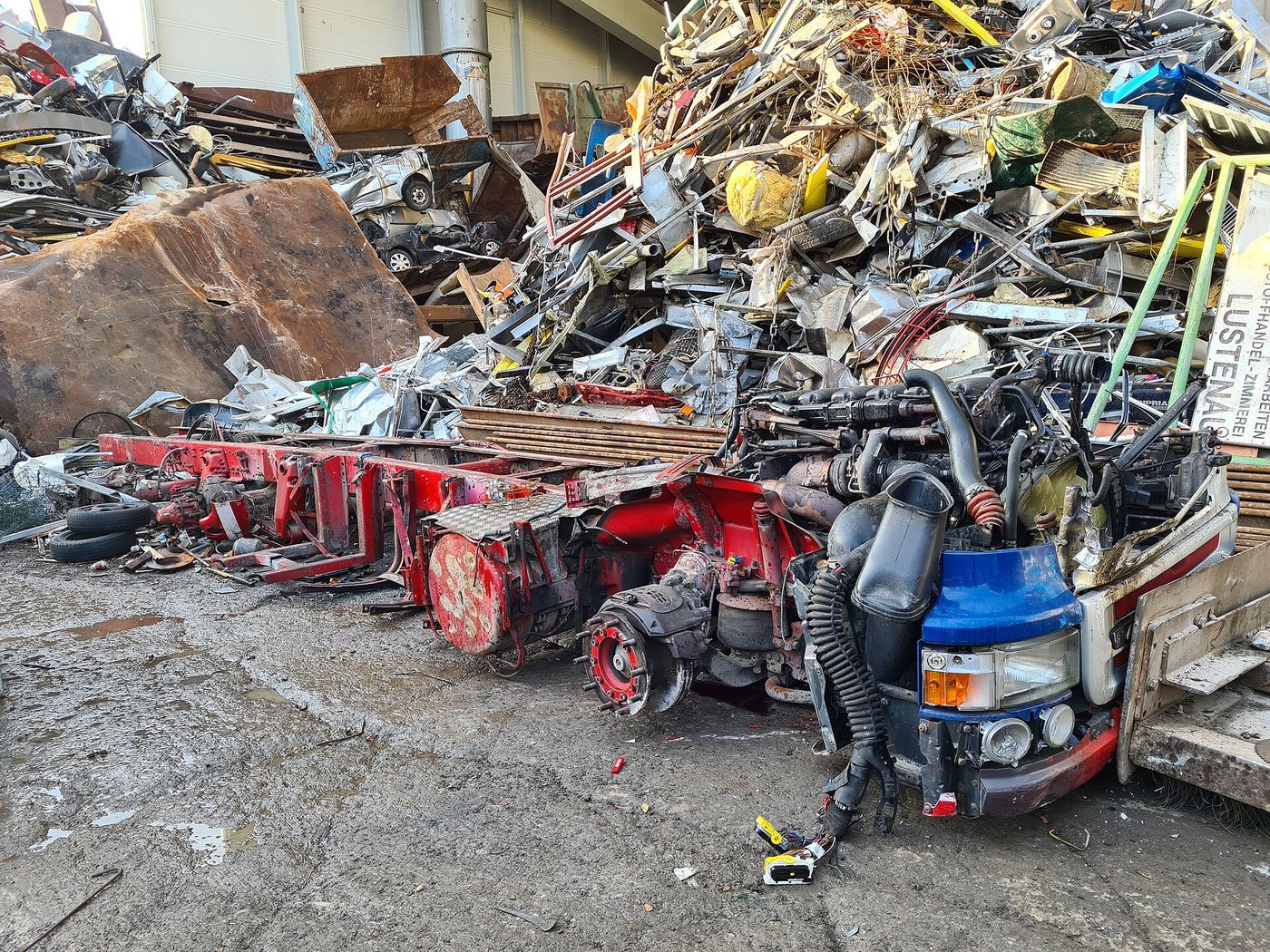
Regulation (EU) 2026/1738 on circularity requirements for vehicle design and on management of end-of-life vehicles, adopted on 8 July 2026 and published in the Official Journal on 24 July 2026, brings buses and coaches (categories M2 and M3), trucks (N2 and N3) and trailers (O) under EU end-of-life rules for the first time. For them it applies from 1 September 2031, and only in part (Article 2). From that date a truck, bus or trailer that has become waste has to be delivered to an authorised treatment facility or a collection point, free of charge for the last owner unless essential parts are missing or waste has been added; the facility issues a certificate of destruction, depollutes the vehicle and removes batteries, e-drive motors, catalytic converters, rims and tyres before shredding; producers carry extended producer responsibility; and a used vehicle may leave the EU only if it is not waste and is roadworthy. The recyclability rates, recycled-content quotas, Digital Circularity Vehicle Passport and recycling targets written for cars and vans do not apply to these categories.
Status as of 26 October 2026. This page is based on the Official Journal text of Regulation (EU) 2026/1738, retrieved from the EU Publications Office between 24 and 26 October 2026 in English, with the German, Spanish, French, Italian and Polish versions. Article numbers are those of the Regulation. Commission acts adopted under it are not covered here.
Why trucks, buses and trailers are covered now
Directive 2000/53/EC on end-of-life vehicles and Directive 2005/64/EC on the reusability, recyclability and recoverability of vehicles apply only to passenger cars (M1) and light commercial vehicles (N1), which recital 10 of the Regulation puts at “approximately 85 % of all vehicles registered in the Union”. Lorries, buses and trailers, the recital continues, “are not subject to any Union legislation concerning their eco-design and management at their end-of-life phase”. The same recital explains why they do not get the full car regime: there is a lack of comprehensive information on how such vehicles are treated at the end of their life. What it extends to them is collection, mandatory delivery to authorised treatment facilities, depollution, mandatory removal of certain parts before shredding, the landfill conditions for shredder waste, information from manufacturers on removing parts, and extended producer responsibility.
The export rules include them because problems with exported used vehicles concern, “as studies show, larger vehicles” too (recital 12). Recital 116 gives the reason for the later date: application to these categories “should be deferred in order to provide sufficient time for operators to comply with the new requirements”, in particular for permits of treatment facilities able to depollute and treat such vehicles.
Directive 2000/53/EC is repealed with effect from 1 September 2028 and Directive 2005/64/EC with effect from 31 August 2032 (Article 57). The Regulation entered into force on the twentieth day after its publication and applies in general from 1 September 2028 (Article 59).
Which vehicles, and from which date
Article 2(1)(c) applies the Regulation from 1 September 2031 to vehicles and end-of-life vehicles of categories M2, M3, N2, N3 and O as referred to in Article 4(1) of the type-approval Regulation (EU) 2018/858; the categories themselves are explained in vehicle categories M, N and O. Special purpose vehicles of the same categories follow on the same date (Article 2(1)(d)), with a narrower set of rules: besides the provisions that do not apply to the other vehicles of these categories, Article 2(5) disapplies to them Articles 7, 11, 14, 15, 17 to 19, 36 and 37(1) and the export chapter, Articles 38 to 46; Article 5 does not apply to them either (Article 2(6)(b)), and their producers’ financial contributions cover only collection and depollution (Article 20(3)).
Outside the Regulation altogether (Article 2(2)) are vehicles produced in small series, vehicles built or adapted for use by the armed services only, vehicles of historical interest as defined in Directive 2014/45/EU while they hold that status, vehicles officially recognised as of special cultural interest under the procedure of Annex II, trailer caravans, and special purpose vehicles of categories M2, M3, N2, N3 or O produced by a small-volume manufacturer.
Where a truck or bus is built in stages, Articles 4 to 13 do not apply to the parts type-approved in the multi-stage type-approval other than the base vehicle; the rest of the Regulation applies to them as far as it applies to the category (Article 2(6)(a)).
What applies to categories M2, M3, N2, N3 and O
Article 2(3) lists the provisions that do not apply to these categories; Article 2(6) narrows some of the others.
| Provision | Articles | For these categories |
|---|---|---|
| Reusability, recyclability and recoverability rates; substances; minimum recycled content | 4, 5, 6 | Do not apply (Article 2(3)) |
| Design for removal and replacement of parts | 7 | Applies to new types type-approved from 1 September 2032, only for entries 1, 3, 4 and 5 of Annex VIII Part C (Article 2(6)(d)) |
| Manufacturers’ general obligations, circularity strategy, recycled-content declaration | 8, 9, 10 | Do not apply (Article 2(3)) |
| Information on removal and replacement of parts | 11 | Applies |
| Labelling of parts and materials; Digital Circularity Vehicle Passport | 12, 13 | Do not apply (Article 2(3)) |
| Competent authorities, treatment permits | 14, 15 | Apply |
| Extended producer responsibility, registration, financing | 16 to 20 | Apply, except Article 16, point (b), on meeting the Article 33 targets (Article 2(6)(f)) |
| Fee modulation; cost allocation for vehicles scrapped in another Member State | 21, 22 | Do not apply (Article 2(3)) |
| Collection, delivery, certificate of destruction | 23, 24, 25 | Apply |
| Treatment, shredding, depollution | 26, 27, 28 | Apply |
| Mandatory removal of parts before shredding | 29 | Applies to entries 1, 2, 3, 4, 5, 7, 10 and 11 of Annex VIII Part C only (Article 2(6)(h)) |
| Reuse, recycling and recovery targets | 33 | Does not apply (Article 2(3)) |
| Landfill ban for shredder fractions | 34 | Applies |
| Shipments of end-of-life vehicles counting towards targets | 35(2) | Does not apply (Article 2(3)) |
| Used vehicle or end-of-life vehicle; transfer of ownership | 36, 37 | Apply |
| Export of used vehicles to third countries | 38 to 46 | Apply; controls from 1 September 2031 (Article 39(1)) |
Inspections, enforcement, penalties and reporting under Articles 47 to 50 apply to these categories only for the obligations that apply to them (Article 2(6)(i)).
The dates written into the articles
Several articles carry a start date of their own, 1 September 2029: the manufacturers’ information duty (Article 11(1)), extended producer responsibility (Article 16(1)), the rules for shredding (Article 27(1)), mandatory removal of parts (Article 29(1)), labelling of traded used parts (Article 31(1)) and the landfill ban (Article 34). For categories M2, M3, N2, N3 and O the scope provision, Article 2(1)(c), sets 1 September 2031.
Of these, Article 27(1) is the only one that names the heavy categories itself. From 1 September 2029, shredding operators shall request that end-of-life vehicles, or “large structural parts and components from the chassis or bodywork” of end-of-life vehicles of categories N2, N3, M2, M3 and O delivered for shredding or cutting, are depolluted, stripped of the parts to be removed under Article 29 and accompanied by a copy of the certificate of destruction. The text read for this page does not say how that date relates to the 1 September 2031 date of Article 2(1)(c).
Two dates lie later. Article 7 concerns new vehicle types type-approved from 1 September 2032, and from the same day Article 55 amends Annex II to Regulation (EU) 2018/858 so that its entry G13 “Circularity” refers to Regulation (EU) 2026/1738 (Annex XI, Article 59(2)).
Delivery, free of charge, and the certificate of destruction
The owner of a vehicle that becomes an end-of-life vehicle, and any operator acting for the owner, shall deliver it to an authorised treatment facility or a collection point “without undue delay” (Article 24(1)). Delivery is free of charge for the last owner unless the vehicle lacks essential parts or contains added waste (Article 24(2)). Essential parts are in particular e-drive motors, electric vehicle batteries, engines and multiple large pieces of bodywork (Article 24(3)). A missing traction battery does not end free delivery if the last owner documents that a professional operator handled it in accordance with Regulation (EU) 2023/1542 (Article 24(4)), and vehicles declared technical total losses by insurance companies are delivered free even with essential parts missing (Article 24(5)).
Producers, or the producer responsibility organisations acting for them, set up collection systems that cover the whole territory of each Member State, accept end-of-life vehicles irrespective of their origin and collect waste parts from repairs (Article 23(2) and (3)). A collection point that is not itself a treatment facility needs a permit and must pass each vehicle to an authorised treatment facility within two months of receipt (Article 23(5)).
On delivery, the authorised treatment facility issues a certificate of destruction to the last owner, in electronic form and following the template of Annex X, and notifies the national authorities electronically (Article 25(1) and (2)). Registration authorities cancel a vehicle’s registration “only after receiving the certificate of destruction” (Article 25(4)), and a certificate issued in one Member State is recognised in all others (Article 25(5)).
When a used vehicle counts as waste
An end-of-life vehicle is a vehicle that is waste under Directive 2008/98/EC or according to Annex I (Article 3(2)). Annex I, Part A, makes a vehicle an end-of-life vehicle when it meets any of its criteria, among them: it has been cut into pieces or dismantled for reuse of its parts; burnt until the engine or passenger compartment is completely destroyed; submerged above the dashboard; it has steering, braking, suspension or other listed components, or its chassis or shell, that can technically be neither repaired nor replaced; it has been handed over to a collection point or treatment facility; or an insurer has declared it a total technical loss. Part B lists indicative criteria, such as a missing VIN or repair costs that, added to the current value, exceed the estimated market value after repair. If one of them applies, a technical assessment by an independent automotive expert determines the repairs needed for a roadworthiness certificate, the owner decides whether to discard the vehicle, and a vehicle that has not obtained a roadworthiness certificate within five years of it is considered an end-of-life vehicle.
An economic operator selling a used vehicle within the EU shows prospective buyers documentation that it is not an end-of-life vehicle: proof that it is roadworthy under Directive 2014/45/EU, or an Annex I assessment (Article 36(1)). Private sellers need it only where an insurer has declared the vehicle a total economic loss, or where the sale is concluded entirely online without physical handover (Article 36(2)). Insurers assessing accident damage also assess whether the vehicle is an end-of-life vehicle (Article 37(1)). Periodic tests and the roadworthiness certificate itself are explained in roadworthiness tests and roadside checks.
Treatment: depollution and the parts removed before shredding
Any undertaking treating end-of-life vehicles needs a permit under Directive 2008/98/EC (Article 15(1)). The authorised treatment facility treats a vehicle within 12 months of delivery (Article 26(2)) and depollutes it within 30 days of delivery, before any further treatment (Article 28(1)). Annex VIII Part B lists what comes out: fuel, motor, transmission, gearbox, power steering and hydraulic oils, cooling liquids, antifreeze, brake fluids, refrigerants, diesel exhaust fluids and any other fluids or gases. Airbags, liquefied petroleum gas and compressed natural gas tanks, hydrogen tanks and other potentially explosive parts are neutralised (Annex VIII Part B, point 3), and batteries are removed separately (Article 28(4)). A facility permitted to treat electric vehicles assesses a traction battery with suspected damage within 24 hours of delivery and keeps it in a separate quarantined area equipped against battery fires (Annex VIII Part A, point 4).
Before shredding or compacting, the facility removes the parts listed in Annex VIII Part C (Article 29(1)). For categories M2, M3, N2, N3 and O, eight of the nineteen entries apply (Article 2(6)(h)):
- electric vehicle batteries, including their battery management systems, onboard chargers and casings (entry 1);
- LMT batteries (entry 2), SLI batteries (entry 3) and portable batteries (entry 4);
- e-drive motors, including their casings, associated control units and wiring (entry 5);
- catalytic converters (entry 7);
- rims (entry 10) and tyres (entry 11).
Parts with a reuse, remanufacturing or refurbishment potential are removed in a non-destructive manner unless the facility demonstrates disproportionate costs that the expected revenue cannot compensate (Article 29(1)). None of these eight entries is marked in Part C as eligible for the post-shredder exemption of Article 29(2). Batteries are then treated under Article 70 of the Battery Regulation (Annex VIII Part F); what that Regulation requires of truck and bus batteries is set out in the EU Battery Regulation for trucks and buses.
Removed parts are assessed for reuse, remanufacturing, refurbishment or recycling, and those fit for reuse, remanufacturing or refurbishment are labelled with the part’s name and the facility that removed it (Article 30, Annex VIII Part D). From 1 September 2029, shredder residues may not be landfilled if they exceed the metal and organic carbon limits of Annex VIII Part G (Article 34).
What manufacturers have to provide
For new vehicle types that have been type-approved, manufacturers give waste management operators, publishers of technical information and repair and maintenance operators “unrestricted, standardised and non-discriminatory access” to the information listed in Annex VI (Article 11(1)). It covers electric vehicle batteries and battery packs, parts containing the fluids of Annex VIII Part B, the parts of Annex VIII Part C, parts containing certain critical raw materials, and digitally coded parts whose coding prevents their repair, maintenance or replacement in another vehicle, unless the information is available under other Union legislation. For a traction battery, Annex VI asks for the original equipment number, location, weight, chemistry, instructions for safe discharging, technical instructions on removal and replacement, and the tools needed. Manufacturers provide the information through communication platforms, free of charge, but may collect reasonable and proportionate charges covering the actual administrative costs of making it accessible (Article 11(3)). The access rules that already apply to repair information under type-approval law are described in repair information access rights.
Manufacturers also make rescue and emergency response guidance available to emergency services (Article 11(2)); what truck and bus makers publish today is collected in rescue sheets and emergency response guides.
Article 7 applies to these categories only for entries 1, 3, 4 and 5 of Part C: electric vehicle batteries, SLI batteries, portable batteries and e-drive motors (Article 2(6)(d)). Each vehicle of a new type type-approved from 1 September 2032 shall be designed so that it does not hinder the removal of those parts by treatment facilities (Article 7(1)), and so that treatment facilities or repair and maintenance operators can remove and replace electric vehicle batteries, battery packs and e-drive motors in a readily and non-destructive manner during the use and waste phases (Article 7(2)). “Manufacturers shall not hinder the removal and replacement of vehicle parts and components using software updates, unless otherwise provided for in Union law” (Article 7(5)).
Producer responsibility
A producer is any manufacturer, importer or distributor that makes a vehicle available for the first time in a Member State on a professional basis (Article 3(23)). Producers have extended producer responsibility for those vehicles: they ensure that the vehicles are collected and treated when they become end-of-life vehicles (Article 16). They may do so individually, with a guarantee covering insolvency, or through an authorised producer responsibility organisation (Articles 17, 18 and 20(4)). Each Member State establishes or uses an existing register of producers by 31 August 2029, and a producer may make vehicles available in a Member State only once registered there (Article 19).
The producer’s financial contributions cover the costs of collection, transport and treatment, taking into account the revenue operators earn from used parts, depolluted vehicles and secondary raw materials, plus awareness campaigns, the notification system of Article 25 and administrative costs (Article 20(1)). Recital 10 says producer responsibility should apply to these categories, “covering the costs of their collection and depollution at their end-of-life”. For a vehicle type-approved in stages, the producer of the base vehicle is considered the producer of the completed vehicle and may collect pro rata contributions from the manufacturers of the other parts type-approved in the multi-stage type-approval, limited to depollution and part removal costs; microenterprises are exempt from those contributions (Article 20(5)).
Export of used vehicles from 1 September 2031
“From 1 September 2031, used vehicles to be exported shall be subject to the controls and requirements laid down in this Chapter” (Article 39(1)). A used vehicle may be exported only if it is not an end-of-life vehicle and is “roadworthy at the date of lodging the export declaration”, unless it is recognised as of special cultural interest (Article 39(3)). For each vehicle, customs receive the VIN, the Member State of last registration and a statement that these conditions are met (Article 39(4)).
Customs are to check roadworthiness automatically against national vehicle registers through the Commission’s MOVE-HUB system (Articles 40 and 46). The Commission adopts the implementing acts for MOVE-HUB by 30 September 2028; national registers are to be connected within two years and MOVE-HUB to the EU Customs Single Window Certificates Exchange System within four years of their adoption (Article 46). Until the customs link works, customs exchange information and cooperate with the competent authorities (Article 39(5)). Where there are reasonable grounds to doubt compliance, customs suspend release (Article 42); the vehicle is released if the competent authority does not ask within four working days to keep the suspension, or approves the release (Article 43(1)). Through the MOVE-HUB link, customs notify the exit to the registration authority of the Member State of last registration, which records the export (Article 43(3)).
An end-of-life vehicle may be treated in another Member State or outside the EU if its shipment complies with Regulation (EU) 2024/1157 (Article 35(1)).
What the Commission is to review
By 31 December 2035 the Commission reports on the application of the Regulation (Article 56(1)). The report evaluates “the need to extend the scope of this Regulation, in particular provisions of Chapters II and III, as well as Chapter IV Section II” to categories M2, M3, N2, N3 and O, that is the circularity requirements, the manufacturers’ obligations and the producer responsibility section; the scope for vehicles approved in multi-stage type-approval; and the extension of recycling targets to categories not covered by Article 33 (Article 56(2)). Where appropriate, the report comes with a legislative proposal.
Quick answers
- When does the EU End-of-Life Vehicles Regulation apply to trucks and buses?
- From 1 September 2031. Regulation (EU) 2026/1738 applies from that date to vehicles and end-of-life vehicles of categories M2, M3, N2, N3 and O, and to special purpose vehicles of those categories (Article 2(1)(c) and (d)). Export controls on used vehicles also start on 1 September 2031 (Article 39(1)). The design rule of Article 7 concerns new vehicle types type-approved from 1 September 2032. The End-of-Life Vehicles Directive 2000/53/EC, repealed with effect from 1 September 2028 (Article 57), covers only passenger cars (M1) and light commercial vehicles (N1).
- Is it free to scrap a truck or bus under the new EU rules?
- As a rule, yes. Delivery of an end-of-life vehicle to an authorised treatment facility or collection point is free of charge for the last owner unless essential parts are missing or waste has been added (Article 24(2)). Essential parts are in particular e-drive motors, electric vehicle batteries, engines and multiple large pieces of bodywork. A missing traction battery does not end free delivery if the owner documents that a professional operator handled it, and vehicles declared technical total losses by insurers are delivered free even with essential parts missing.
- Which parts must be removed from a scrapped truck or bus before shredding?
- For categories M2, M3, N2, N3 and O, eight entries of Annex VIII Part C apply (Article 2(6)(h)): electric vehicle batteries with their management systems, onboard chargers and casings; LMT batteries; SLI batteries; portable batteries; e-drive motors with their casings, control units and wiring; catalytic converters; rims; and tyres. Parts with reuse, remanufacturing or refurbishment potential must be removed without destroying them, unless the facility shows disproportionate costs (Article 29(1)).
- Can a used truck or bus still be exported from the EU after 2031?
- Yes, if it is not an end-of-life vehicle and is roadworthy on the date the export declaration is lodged (Article 39(3)). Customs receive the VIN, the Member State of last registration and a statement that both conditions are met. Customs can suspend release; the vehicle is released if the competent authority does not ask within four working days to keep the suspension, or approves it. Exit from the EU is then recorded in the vehicle register of last registration.
- Does the Regulation set recycling targets for trucks and buses?
- No. Article 2(3) disapplies to categories M2, M3, N2, N3 and O the reuse, recycling and recovery targets of Article 33, the recyclability and recoverability rates of Article 4, the substance rules, recycled content, part labelling and the Digital Circularity Vehicle Passport. By 31 December 2035 the Commission must report on whether to extend the circularity requirements, the manufacturers' obligations, the producer responsibility section and the recycling targets to these categories (Article 56).
Sources
- Regulation (EU) 2026/1738 of the European Parliament and of the Council of 8 July 2026 on circularity requirements for vehicle design and on management of end-of-life vehicles (OJ L, 2026/1738, 24.7.2026) — recitals 10, 12 and 116, Articles 2, 3, 7, 11, 14 to 20, 23 to 31, 33 to 46, 55 to 57 and 59, Annexes I, II, VI, VIII, X and XI — EUR-Lex, European Union, 8 Jul 2026