The EU Battery Regulation for trucks and buses: which batteries, which duties, which dates
Which truck, bus and trailer batteries Regulation (EU) 2023/1542 covers, what applies now, what starts on 18 February 2027 and what still waits for Commission acts.
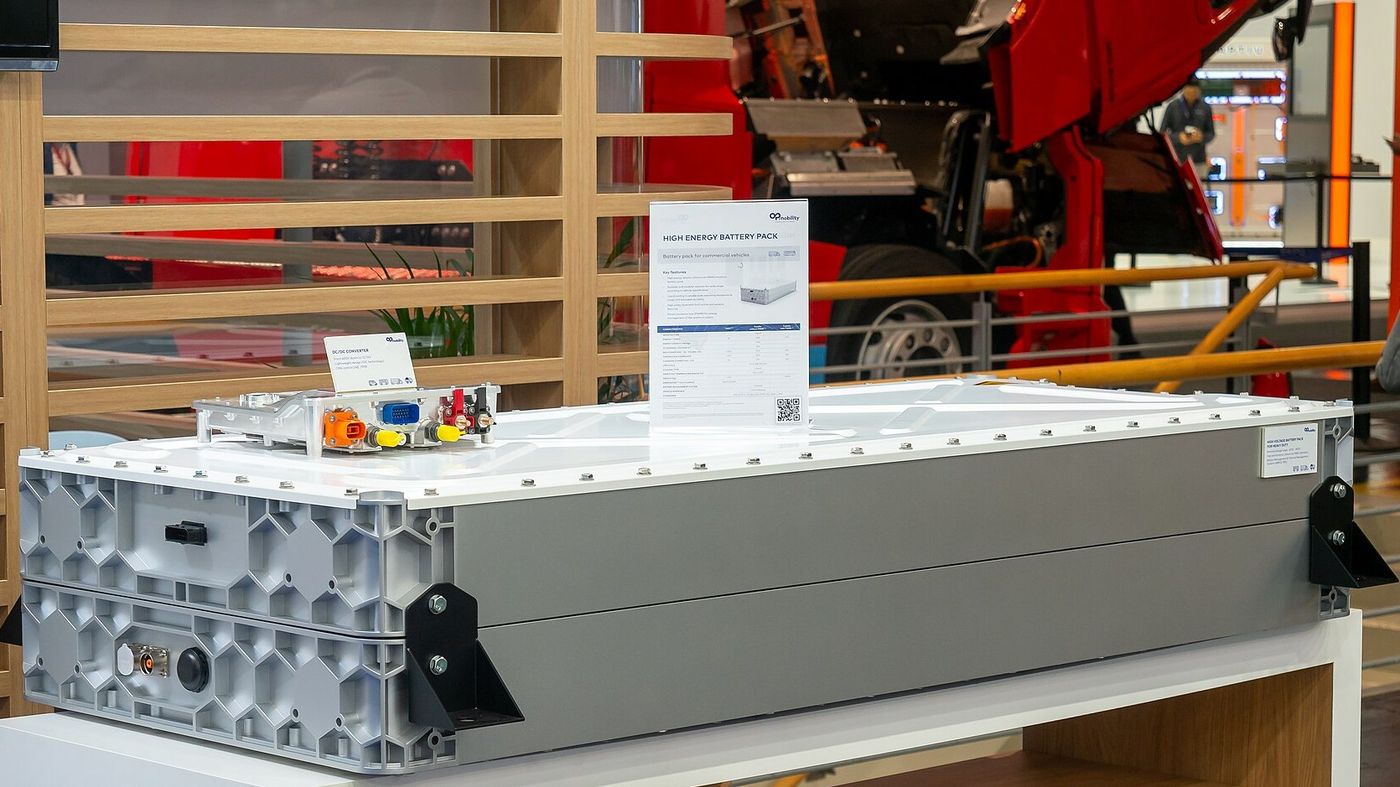
Regulation (EU) 2023/1542 on batteries and waste batteries has applied in every EU Member State since 18 February 2024, and it treats the traction battery of an electric or hybrid truck, bus, coach or trailer as an “electric vehicle battery”: its definition names vehicle categories M, N and O. For those batteries a performance and durability document and state-of-health data in the battery management system have been required since 18 August 2024, producer registration and free take-back since 18 August 2025, and a QR code with a battery passport is required from 18 February 2027. Due diligence on cobalt, natural graphite, lithium and nickel starts on 18 August 2027 for economic operators above a turnover threshold, after Regulation (EU) 2025/1561 moved it back by two years. The carbon footprint declaration and the new labels have no fixed start date, because the Commission acts they depend on had not been adopted on 6 October 2026. A truck’s starter battery is an “SLI battery”: it gets labels, a QR code and free take-back, but no passport.
Status as of 6 October 2026. Read that day: the Official Journal text of Regulation (EU) 2023/1542 and the EUR-Lex consolidated text of 13 August 2026; the three Regulations that have amended it, (EU) 2024/1781, (EU) 2025/1561 and (EU) 2026/1738; the EUR-Lex records of acts amending or based on it; the European Commission’s “Have your say” records for the acts still pending; and the European Parliament’s Legislative Observatory files for the amending proposals. The consolidated text is a documentation tool without legal effect; article numbers below are those of the Regulation.
The obligations and their dates at a glance
| Obligation | Article | Electric vehicle battery | SLI battery | Applies from |
|---|---|---|---|---|
| Document with performance and durability values (Annex IV, Part A) | 10(1) | Yes | No | 18 August 2024 |
| State-of-health data (Annex VII) in the battery management system | 14(1) | Yes | No | 18 August 2024 |
| Conformity assessment (except Article 17(2)); obligations of manufacturers, importers and distributors | 17, Chapter VI | Yes | Yes | 18 August 2024 |
| Separate collection symbol | 13(4) | Yes | Yes | 18 August 2025 |
| Producer registration, extended producer responsibility, free take-back | 55, 56, 61 | Yes | Yes | 18 August 2025 |
| Label with general information (Annex VI, Part A); capacity label | 13(1), 13(2) | Yes (general) | Yes (general and capacity) | 18 August 2026 or 18 months after the implementing act enters into force, whichever is later; act not adopted |
| QR code | 13(6) | Yes, leading to the passport | Yes | 18 February 2027 |
| Battery passport | 77 | Yes | No | 18 February 2027 |
| Battery due diligence policies | 48 | Economic operators placing batteries on the market, above the Article 47 turnover threshold | 18 August 2027 (was 18 August 2025) | |
| Carbon footprint declaration | 7(1) | Yes | No | 18 February 2025 or 12 months after the delegated or implementing act enters into force, whichever is latest; neither adopted |
| Carbon footprint performance class and label | 7(2) | Yes | No | 18 August 2026 or 18 months after the acts enter into force, whichever is latest; not adopted |
| Maximum life-cycle carbon footprint | 7(3) | Yes | No | 18 February 2028 or 18 months after the delegated act enters into force, whichever is later; not adopted |
| Documentation of recycled cobalt, lead, lithium and nickel | 8(1) | Where those metals are in active materials | 18 August 2028 or 24 months after the delegated act enters into force, whichever is later; draft only | |
| Minimum recycled content: 16 % cobalt, 85 % lead, 6 % lithium, 6 % nickel | 8(2) | Where those metals are in active materials | 18 August 2031 | |
| Minimum recycled content: 26 % cobalt, 85 % lead, 12 % lithium, 15 % nickel | 8(3) | Where those metals are in active materials | 18 August 2036 | |
Which batteries in trucks, buses and trailers are covered
The Regulation applies to all categories of batteries “regardless of their shape, volume, weight, design, material composition, chemistry, use or purpose”, including batteries incorporated into products (Article 1(3)). What a battery must do depends on its category, and three of the five categories matter for trucks, buses and trailers.
Electric vehicle battery. Article 3(1)(14) covers “a battery that is specifically designed to provide electric power for traction in hybrid or electric vehicles of categories M, N or O as provided for in Regulation (EU) 2018/858”. The same definition sets a weight condition of more than 25 kg, but only for vehicles of category L. Article 4(1) of Regulation (EU) 2018/858 defines category M as motor vehicles designed and constructed primarily for the carriage of passengers, with M2 and M3 having more than eight seating positions besides the driver’s and a maximum mass up to and above 5 tonnes respectively; category N as goods vehicles, with N2 above 3.5 tonnes up to 12 tonnes and N3 above 12 tonnes; and category O as trailers. The traction battery of a battery-electric or hybrid truck, city bus or coach is therefore an electric vehicle battery, and so is a battery specifically designed to provide traction power in a hybrid or electric trailer.
SLI battery. Article 3(1)(12) defines a starting, lighting and ignition battery as one “specifically designed to supply electric power for starting, lighting, or ignition and that can also be used for auxiliary or backup purposes in vehicles, other means of transport or machinery”.
Industrial battery. Article 3(1)(13) includes “any other battery that weighs more than 5 kg and that is neither an electric vehicle battery, an LMT battery, nor an SLI battery”. A battery on a vehicle that is designed neither for traction nor for starting, lighting or ignition is thus measured against this definition. For industrial batteries the passport applies above a capacity of 2 kWh, and the carbon footprint rules apply to rechargeable industrial batteries above 2 kWh.
Where a battery can be considered to fall under more than one category, it is deemed to fall under the category with the strictest requirements for the purposes of Chapter II, the sustainability and safety chapter (Article 1(3)).
What already applies: documents, battery data, conformity and collection marks
Performance and durability document. Since 18 August 2024 electric vehicle batteries “shall be accompanied by a document containing values for the electrochemical performance and durability parameters set out in Part A of Annex IV” (Article 10(1)). Part A lists rated capacity in Ah and capacity fade, power and power fade, internal resistance and its increase, where applicable energy round trip efficiency and its fade, and the expected lifetime in cycles and calendar years. The technical documentation must explain how the values were measured, including the discharge and charge rates and the depth of discharge in the cycle-life test (Part B). Article 10 provides for minimum values, to be laid down in delegated acts, only for rechargeable industrial batteries above 2 kWh and for LMT batteries (paragraphs 2, 3 and 5); for electric vehicle batteries the duty is the document.
State-of-health data. Since the same date the battery management system of an electric vehicle battery must hold up-to-date data for the parameters of Annex VII (Article 14(1)); for electric vehicle batteries Annex VII names one parameter, “state of certified energy (SOCE)”. Read-only access to those data is given to the person who has legally purchased the battery, including independent operators, for purposes listed in Article 14(2), such as evaluating residual value or remaining lifetime. Article 14(5) states that the Article applies in addition to vehicle type-approval law. How these provisions relate to the state-of-health thresholds in makers’ warranty terms is set out in how electric truck battery warranties are defined.
Conformity. Conformity assessment (Article 17) and the obligations of manufacturers, importers and distributors (Chapter VI) have applied since 18 August 2024 (Article 96(2)(b)); the exception is Article 17(2), on assessing compliance with Articles 7 and 8, which applies 12 months after the first publication of the list of notified bodies. The EU declaration of conformity states that compliance with Articles 6 to 10, 12, 13 and 14 has been demonstrated (Article 18(1)), and the CE marking is affixed before the battery is placed on the market or put into service (Article 20(2)).
Marks and substances. Since 18 August 2025 all batteries have had to carry the separate collection symbol (Article 13(4)). Batteries containing more than 0.002 % cadmium or more than 0.004 % lead are also marked Cd or Pb beneath it (Article 13(5)). Annex I limits mercury to 0.0005 % by weight in all batteries, “whether or not present in and incorporated into appliances, light means of transport or other vehicles”.
Producer responsibility and free take-back since 18 August 2025
Chapter VIII, on waste batteries, has applied since 18 August 2025 (Article 96(2)(c)). The Regulation’s definition of “producer” extends to batteries “incorporated in appliances, light means of transport or other vehicles”: among others, it covers anyone established in a Member State who “supplies for the first time in that Member State on a professional basis” such batteries from another Member State or a third country (Article 3(1)(47)(c)). Producers register in each Member State where they first make batteries available, and may make them available there, “including those incorporated in appliances, light means of transport or other vehicles”, only once registered (Article 55(2)); the application names the battery category and chemistry (Article 55(3)(c)).
Producers of SLI, industrial and electric vehicle batteries, or the producer responsibility organisation they appoint, “shall take back, free of charge and without an obligation on the end-user to buy a new battery, nor to have bought the battery from them” all waste batteries of the category they first made available in that Member State, “regardless of their nature, chemical composition, condition, brand, or origin” (Article 61(1)). Their financial contributions cover separate collection, transport and treatment, among other costs (Article 56(4)). Distributors take back waste SLI, industrial and electric vehicle batteries at or in the vicinity of their retail outlet (Article 62(1)(b)), limited to the categories they have or had in their offer (Article 62(2)(b)), and treatment facilities for end-of-life vehicles hand over the waste batteries they remove to producers, producer responsibility organisations or selected waste management operators (Article 65(1)).
The QR code and the battery passport from 18 February 2027
From 18 February 2027 all batteries “shall be marked with a QR code” (Article 13(6)). For an electric vehicle battery, or an industrial battery above 2 kWh, the code leads to the battery passport; for an SLI battery it leads to the label information, the declaration of conformity, the due diligence report, the waste information of Article 74 and the amount of cobalt, lead, lithium or nickel recovered from waste in its active materials.
Article 77(1): “From 18 February 2027 each LMT battery, each industrial battery with a capacity greater than 2 kWh and each electric vehicle battery placed on the market or put into service shall have an electronic record (‘battery passport’).” Responsibility lies with the economic operator placing the battery on the market. It attributes the unique identifier to which the QR code links, with the QR code and identifier complying with the ISO/IEC 15459 series or their equivalent (Article 77(3)), and it “shall ensure that the information in the battery passport is accurate, complete and up to date”, with the option of authorising another operator in writing to act on its behalf (Article 77(4)). Under Article 77(10), added by Regulation (EU) 2024/1781, the operator placing the battery on the market or putting it into service uploads the unique identifier to the digital product passport registry of that Regulation, which its Article 13(1) required the Commission to set up by 19 July 2026.
| Who may see it | Information |
|---|---|
| The public (battery model) | Label information of Annex VI Part A; material composition including chemistry, hazardous substances and critical raw materials; carbon footprint information of Article 7; responsible sourcing information from the due diligence report; recycled content; rated capacity in Ah; minimal, nominal and maximum voltage; original power capability; expected lifetime in cycles and the reference test; capacity threshold for exhaustion (electric vehicle batteries only); period of the commercial warranty for calendar life; EU declaration of conformity |
| Persons with a legitimate interest and the Commission (battery model) | Detailed composition including cathode, anode and electrolyte materials; part numbers and sources for spares; dismantling information such as exploded diagrams, disassembly sequences and tools; safety measures |
| Notified bodies, market surveillance authorities and the Commission | Results of test reports proving compliance |
| Persons with a legitimate interest (individual battery) | Performance and durability values at placing on the market and after status changes; state of health under Article 14; status as original, repurposed, re-used, remanufactured or waste; use data including charge and discharge cycles, negative events such as accidents, temperature and state of charge |
The rated capacity in the passport is a figure in ampere-hours under reference conditions (Annex IV), not the kWh figures in truck data sheets; those are explained in installed vs usable battery capacity. A battery that is repurposed or remanufactured gets a new passport linked to the original one, and the duty passes to the operator who places it on the market; when the battery becomes waste the duty passes to the producer, the producer responsibility organisation or the selected waste management operator (Article 77(7)). The passport “shall cease to exist after the battery has been recycled” (Article 77(8)).
Who counts as a person with a legitimate interest is left to an implementing act that Article 77(9) required by 18 August 2026. The Commission’s record for it, read on 6 October 2026, lists the initiative as planned, with adoption scheduled for the fourth quarter of 2026. Annex XIII also lists carbon footprint information among the public items, and the Regulation includes passport information “to the extent applicable to the category or sub-category of battery concerned” (Article 77(2)); the texts read for this page do not say how a passport shows carbon footprint data before Article 7 applies.
Carbon footprint: in the Regulation, waiting for the Commission
Article 7(1) requires a carbon footprint declaration “for each battery model per manufacturing plant”. It contains administrative information on the manufacturer, the battery model, the location of the plant, the carbon footprint “calculated as kg of carbon dioxide equivalent per one kWh of the total energy provided by the battery over its expected service life”, the footprint by life-cycle stage, the identification number of the EU declaration of conformity and a web link to a public version of the supporting study. Annex II defines that total energy as the number of cycles multiplied by the energy delivered in each cycle, and allows a different functional unit in exceptional cases, “such as for batteries for hybrid non-plug-in vehicles”.
For electric vehicle batteries the declaration applies from “18 February 2025 or 12 months after the date of entry into force either of the delegated act or of the implementing act”, whichever is latest; the Commission was to adopt both by 18 February 2024. The Commission’s records, read on 6 October 2026, list the methodology delegated act and the format implementing act at the draft stage, after a feedback period from 30 April to 28 May 2024; the planned adoption periods they give, the third quarter of 2025 and the second quarter of 2026, have passed. EUR-Lex lists no adopted act. The start date therefore depends on acts not yet adopted.
Two further steps follow the same pattern. A label with the carbon footprint performance class applies from 18 August 2026 or 18 months after the acts establishing the classes and the label format enter into force, whichever is latest (Article 7(2)); the Commission’s record for the classes lists the initiative as planned, with adoption in the fourth quarter of 2026. A maximum life-cycle carbon footprint applies from 18 February 2028 or 18 months after the delegated act setting it enters into force, whichever is later (Article 7(3)); that act was due by 18 August 2026, and the Commission’s list of battery initiatives read for this page contains no record for it.
Recycled content and the new labels
From 18 August 2028, or 24 months after the methodology delegated act enters into force if that is later, electric vehicle batteries, SLI batteries and industrial batteries above 2 kWh (except those with exclusively external storage) “that contain cobalt, lead, lithium or nickel in active materials” must be accompanied by documentation on the share of those metals recovered from waste, per battery model, year and plant (Article 8(1)). The delegated act was due by 18 August 2026; the Commission published a draft for feedback from 12 August to 9 September 2026, and its record gives the third quarter of 2026 for adoption. The minimum shares themselves are written into Article 8 with fixed dates: 16 % cobalt, 85 % lead, 6 % lithium and 6 % nickel from 18 August 2031, and 26 % cobalt, 85 % lead, 12 % lithium and 15 % nickel from 18 August 2036. Which chemistries truck makers state for their packs, and so which of these metals they contain, is covered in battery chemistries in heavy trucks.
The general label of Article 13(1) lists the manufacturer, the battery category and identification, the place and date of manufacture, the weight, the capacity, the chemistry, hazardous substances other than mercury, cadmium or lead, the usable extinguishing agent and critical raw materials above 0.1 % (Annex VI, Part A). SLI batteries also carry a capacity label (Article 13(2)). Both apply from “18 August 2026 or 18 months after the date of entry into force of the implementing act referred to in paragraph 10, whichever is the latest”. That act was due by 18 August 2025; the Commission’s draft was open for feedback from 15 December 2025 to 26 January 2026, and EUR-Lex lists no adopted act. Because 18 August 2026 has passed, the labels become mandatory 18 months after the act enters into force.
Due diligence: what Regulation (EU) 2025/1561 changed
Regulation (EU) 2025/1561 of 18 July 2025 amends only Article 48. In paragraph 1 it replaces “18 August 2025” by “18 August 2027”; in paragraph 5 it replaces “18 February 2025” by “26 July 2026”. It entered into force on the day after its publication in the Official Journal of 30 July 2025. Its recitals give the reasons: the designation of notified bodies “is taking longer than expected”, and the dates for the Commission’s guidelines should be harmonised with those under Directive (EU) 2024/1760 on corporate sustainability due diligence. It does not touch the passport or QR code dates.
As amended, Article 48(1) reads: “From 18 August 2027, economic operators that place batteries on the market or put them into service shall fulfil the due diligence obligations”. The policies cover the raw materials of Annex X, cobalt, natural graphite, lithium and nickel and their compounds needed for active materials. They are verified and periodically audited by a notified body (Article 48(2)), documentation is kept for 10 years after the last battery made under the policy has been placed on the market (Article 48(3)), and the operator publishes a report on its policy each year (Article 52(3)). Chapter VII does not apply to economic operators with a net turnover below EUR 40 million in the financial year preceding the last one that are not part of a group exceeding that limit on a consolidated basis (Article 47). Article 48(5) required the Commission to publish guidelines by 26 July 2026; whether they had been published could not be confirmed from the official sources read for this page.
Removal from the vehicle, and what Regulation (EU) 2026/1738 amends
The Battery Regulation’s removability and replaceability rule, Article 11, concerns portable batteries and LMT batteries and applies from 18 February 2027 (Article 96(2)(a)); it does not cover electric vehicle batteries. Their removal from vehicles is addressed in the End-of-Life Vehicles Regulation (EU) 2026/1738, which applies to vehicles of categories M2, M3, N2, N3 and O from 1 September 2031 (Article 2(1)(c)) and lists in Article 2(3) the provisions that do not apply to them. Article 7, under whose paragraph 2 each vehicle of a new type type-approved from 1 September 2032 under Regulation (EU) 2018/858 “shall be designed to enable, in a readily and non-destructive manner, the removal and replacement of electric vehicle batteries and their battery packs”, and Article 11, on information for the removal and replacement of electric vehicle batteries and other parts, are not on that list. How those articles will work in the type-approval of heavy vehicles is beyond this page.
Regulation (EU) 2026/1738 amends the Battery Regulation in one place: Article 53 replaces the table in Annex I, with effect from 13 August 2026 (Article 59(2)). The new entries limit cadmium, lead and hexavalent chromium in batteries incorporated in vehicles of categories M1 and N1, with exemptions such as SLI batteries in 12 V applications. None of the new entries names categories M2, M3, N2, N3 or O; the mercury limit for all batteries and the cadmium and lead limits for portable batteries remain.
Buses bought by public authorities
Article 85 requires contracting authorities and contracting entities, when procuring “batteries or products containing batteries” under the public procurement directives, to take account of the environmental impacts of those batteries over their life cycle. Award criteria become binding 12 months after the first delegated act setting them enters into force, and the Commission adopts that act 12 months after the latest of the delegated acts under Articles 7(2), 8(1), 9(2) and 10(5), none of which had been adopted on 6 October 2026. The Commission’s proposal for a Public Procurement Act, COM(2026) 590 of 9 September 2026, would delete Article 85; references to it would be read as references to Article 54 of the new act. The vehicle-side procurement rules for buses are covered in the Clean Vehicles Directive and public bus procurement.
Amendments proposed but not adopted
| Proposal | What it would change in the Battery Regulation | Status |
|---|---|---|
| COM(2025) 501, small mid-cap enterprises (2025/0130(COD)) | Article 47: due diligence threshold raised from EUR 40 million to EUR 150 million; Article 52(3): first report one year after the Article 48(1) date, then at least every three years | Agreed text approved in committee on 2 July 2026; awaiting Parliament’s first-reading position; plenary indicated for 23 November 2026 |
| COM(2025) 504, digitalisation and common specifications (2025/0134(COD)) | Documentation and the EU declaration of conformity in electronic form; a “digital contact” for manufacturers and importers; amendments to Annexes VIII, IX and XIII | Agreed text approved in committee on 14 July 2026; awaiting Parliament’s first-reading position; plenary indicated for 23 November 2026 |
| COM(2025) 981, environmental simplification (2025/0397(COD)) | Producer definition, point (d): covers sellers established elsewhere whatever the selling technique, not only distance contracts; hazardous substances on the label defined as substances of very high concern; LMT batteries removable at module level | A “mandate for negotiations with the European Parliament” recorded in EUR-Lex with a document of 19 June 2026; awaiting committee decision in Parliament; plenary indicated for 23 November 2026 |
| COM(2026) 590, Public Procurement Act (2026/0265(COD)) | Article 85 deleted; references to it to be read as references to Article 54 of the new act | Proposal of 9 September 2026 |
The Commission proposals are the texts as tabled; the agreed texts approved in committee were not available to this page, and the adopted wording may differ.
The Commission regulations under the Battery Regulation that EUR-Lex records as published in the Official Journal by 6 October 2026 concern recyclers and Member States rather than vehicle or battery makers: Delegated Regulation (EU) 2025/606 sets the method for calculating recycling efficiency and the recovery of materials from waste batteries, and Implementing Regulation (EU) 2025/2289 sets the format in which Member States report collection and treatment data. Access to repair information for the vehicle as a whole comes from type-approval law, set out in repair information access rights.
Quick answers
- Does the EU battery passport apply to electric trucks and buses?
- Yes. Regulation (EU) 2023/1542 defines an electric vehicle battery as one specifically designed to provide electric power for traction in hybrid or electric vehicles of categories M, N or O, which covers buses and coaches, trucks and trailers. From 18 February 2027 each electric vehicle battery placed on the market or put into service shall have a battery passport (Article 77(1)), reached through a QR code on the battery. The economic operator placing the battery on the market attributes its unique identifier and ensures that the passport information is accurate, complete and up to date (Article 77(3) and (4)).
- What will a truck battery passport contain?
- Annex XIII sets four levels of access. The public part covers the battery model: label information, material composition, carbon footprint, responsible sourcing and recycled content information, rated capacity, voltages, power, expected lifetime in cycles, a capacity threshold for exhaustion for electric vehicle batteries and the period of the commercial warranty for calendar life. Dismantling information and safety measures are for persons with a legitimate interest and the Commission; test reports are for notified bodies, market surveillance authorities and the Commission. Data on the individual battery, including its state of health and negative events such as accidents, are for persons with a legitimate interest only.
- Is a truck's starter battery covered by the EU Battery Regulation?
- Yes, as an SLI battery: one specifically designed to supply electric power for starting, lighting or ignition. It has had to carry the separate collection symbol since 18 August 2025, must carry a QR code from 18 February 2027, and has fallen under producer registration and free take-back since 18 August 2025. From 18 August 2031, SLI batteries that contain lead in active materials must contain a minimum of 85 % lead recovered from waste. SLI batteries need no battery passport and no carbon footprint declaration.
- When does the carbon footprint declaration start for electric truck batteries?
- No date is fixed yet. Article 7(1) applies it to electric vehicle batteries from 18 February 2025 or 12 months after the entry into force of the Commission's methodology delegated act or format implementing act, whichever is latest. On 6 October 2026 neither act had been adopted: the Commission's records list both at the draft stage after a feedback period from 30 April to 28 May 2024, and EUR-Lex lists no adopted act. The performance-class label and the maximum threshold depend on further acts in the same way.
- What did Regulation (EU) 2025/1561 change in the Battery Regulation?
- Two dates in Article 48. The due diligence obligations of economic operators that place batteries on the market or put them into service now apply from 18 August 2027 instead of 18 August 2025, and the Commission's deadline for its due diligence guidelines moved from 18 February 2025 to 26 July 2026. The Regulation entered into force on the day after its publication in the Official Journal of 30 July 2025 and changed no other provision.
- Does the Battery Regulation require truck and bus batteries to be removable?
- No. Its removability and replaceability rule, Article 11, covers portable batteries and LMT batteries and applies from 18 February 2027. Removal of electric vehicle batteries from vehicles is addressed by the End-of-Life Vehicles Regulation (EU) 2026/1738, which applies to categories M2, M3, N2, N3 and O from 1 September 2031. Its Article 7, on designing vehicles of new types type-approved from 1 September 2032 so that electric vehicle batteries can be removed and replaced in a readily and non-destructive manner, is not among the provisions it disapplies for those categories.
Sources
- Regulation (EU) 2023/1542 concerning batteries and waste batteries, 12 July 2023 (OJ L 191, 28.7.2023) — EUR-Lex, European Union
- Regulation (EU) 2023/1542 — consolidated text of 13 August 2026 (incorporating Regulations (EU) 2024/1781, 2025/1561 and 2026/1738 and corrigenda) — EUR-Lex, European Union
- Regulation (EU) 2025/1561 amending Regulation (EU) 2023/1542 as regards obligations of economic operators concerning battery due diligence policies, 18 July 2025 (OJ L 2025/1561, 30.7.2025) — EUR-Lex, European Union
- Regulation (EU) 2026/1738 on circularity requirements for vehicle design and on management of end-of-life vehicles, 8 July 2026 (OJ L 2026/1738, 24.7.2026) — Articles 2, 7, 11, 53 and 59, Annex XII — EUR-Lex, European Union
- Regulation (EU) 2024/1781 establishing a framework for the setting of ecodesign requirements for sustainable products, 13 June 2024 — Articles 13 and 78 — EUR-Lex, European Union
- Regulation (EU) 2018/858 on the approval and market surveillance of motor vehicles and their trailers — Article 4, vehicle categories — EUR-Lex, European Union
- Have your say: Carbon footprint methodology for electric vehicle batteries (delegated regulation, initiative 13877), record read 6 October 2026 — European Commission
- Have your say: Format of the carbon footprint declaration for batteries (implementing regulation, initiative 13878), record read 6 October 2026 — European Commission
- Have your say: Carbon footprint label classes for electric vehicle batteries (delegated regulation, initiative 14312), record read 6 October 2026 — European Commission
- Have your say: Batteries – definition of labelling requirements (implementing regulation, initiative 14456), record read 6 October 2026 — European Commission
- Have your say: Commission Implementing Regulation on access rights to certain parts of the battery passport (initiative 16473), record read 6 October 2026 — European Commission
- Have your say: Methodology for calculation and verification of recycled content in batteries (delegated regulation, initiative 14858), record read 6 October 2026 — European Commission
- COM(2025) 501 final — proposal extending SME mitigating measures to small mid-caps, Article 5 amending Regulation (EU) 2023/1542, 21 May 2025 — European Commission
- COM(2025) 504 final — proposal on digitalisation and common specifications, Article 6 amending Regulation (EU) 2023/1542, 21 May 2025 — European Commission
- COM(2025) 981 final — proposal amending Regulation (EU) 2023/1542 and Regulation (EU) 2024/1244 as regards simplification, 10 December 2025 — European Commission
- COM(2026) 590 final — proposal for a Public Procurement Act, deleting Article 85 of Regulation (EU) 2023/1542, 9 September 2026 — European Commission
- Legislative Observatory procedure file 2025/0130(COD), small mid-cap enterprises, read 6 October 2026 — European Parliament
- Legislative Observatory procedure file 2025/0134(COD), digitalisation and common specifications, read 6 October 2026 — European Parliament
- Legislative Observatory procedure file 2025/0397(COD), simplification in the areas of batteries and industrial emissions reporting, read 6 October 2026 — European Parliament
- Commission Delegated Regulation (EU) 2025/606 of 21 March 2025 establishing the methodology for calculation and verification of rates for recycling efficiency and recovery of materials from waste batteries — EUR-Lex, European Union
- Commission Implementing Regulation (EU) 2025/2289 of 13 November 2025 on the format for the reporting of data and the assessment methods and operational conditions for the collection and treatment of waste batteries — EUR-Lex, European Union
- EUR-Lex records for Regulation (EU) 2023/1542: consolidated versions, acts amending it, acts based on it and documents whose title cites it (Publications Office CELLAR query, 6 October 2026) — Publications Office of the European Union