EU CO2 standards for trucks and buses: 2019/1242, 2024/1610 and 2026/1046
What Regulation (EU) 2019/1242 asks of truck, bus and trailer makers: the 2024 amendment's two sets of 2030–2040 percentages, the manufacturer mechanism, and what the 2026 credit amendment changed.
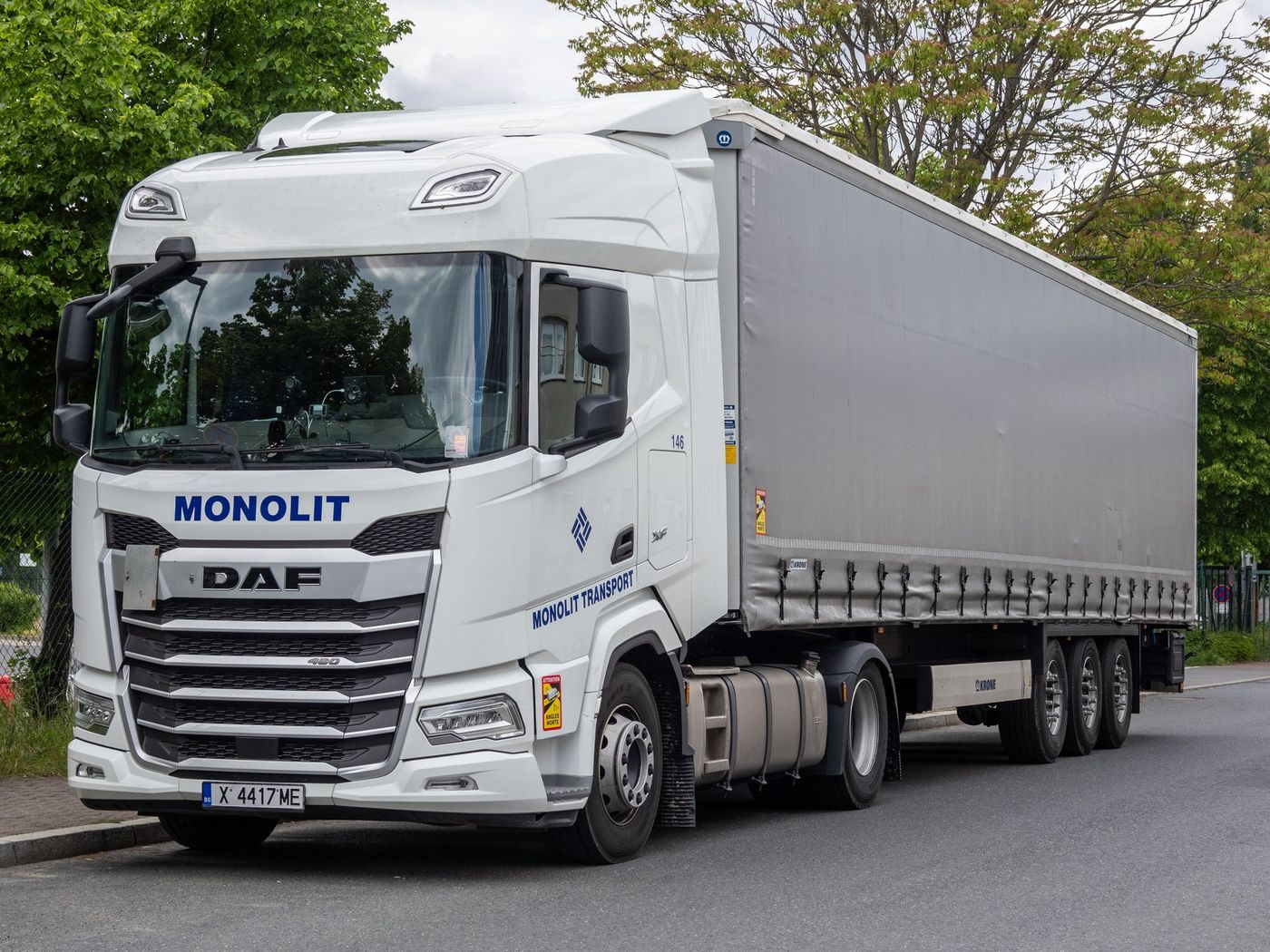
Regulation (EU) 2019/1242, as strengthened by Regulation (EU) 2024/1610, sets CO2 emission performance standards for new heavy-duty vehicles: Article 3a(1) says the average CO2 emissions of the Union fleet of new heavy-duty motor vehicles “shall be reduced” by 45% for the reporting periods of 2030 to 2034 (all vehicle sub-groups other than vocational vehicles), by 65% for 2035 to 2039 and by 90% from 2040, compared with the reporting period of 2019. Annex I point 4.3.1 separately sets targets per vehicle sub-group for the same periods, 43%, 64% and 90% for the lorry, coach and interurban-bus sub-groups other than vocational vehicles, and Regulation (EU) 2026/1046 of 29 April 2026 changed how emission credits are calculated for the reporting periods of 2025 to 2029, while its recital (2) calls it essential that the level of the targets “remain unchanged”.
The 45% and the 43% are two different figures in the same regulation, one for the Union fleet average and one per sub-group, and this page always says which. The Commission determines a specific CO2 emissions target for each manufacturer (Article 6), and the excess CO2 emissions premium of Article 8(1) is imposed on the manufacturer. This page reads the Official Journal texts and the consolidated text of 10 September 2026; it gives no view on compliance costs, on whether the targets can be met, or on what industry bodies say.
One regulation and the acts that changed it
| Act | Dated | Official Journal |
|---|---|---|
| Regulation (EU) 2019/1242, setting CO2 emission performance standards for new heavy-duty vehicles | 20 June 2019 | OJ L 198, 25.7.2019, p. 202 |
| Regulation (EU) 2024/1610, as regards strengthening the standards and integrating reporting obligations | 14 May 2024 | 6.6.2024 |
| Commission Delegated Regulation (EU) 2025/1045 | 20 May 2025 | 25.7.2025 |
| Regulation (EU) 2026/1046, as regards the calculation of emission credits for the reporting periods of the years 2025 to 2029 | 29 April 2026 | 7.5.2026 |
| Commission Delegated Regulation (EU) 2026/1282, amending and correcting Annexes IV and V | 12 June 2026 | 21.8.2026 |
As adopted in 2019. Article 1 gave two dated percentages: “(a) for the reporting periods of the year 2025 onwards by 15 %;” and “(b) for the reporting periods of the year 2030 onwards by 30 %, unless decided otherwise pursuant to the review referred to in Article 15.” Its reference period was “the period from 1 July 2019 to 30 June 2020 (‘the reference period’), excluding vocational vehicles”. Article 1 was later replaced by Regulation (EU) 2024/1610, and the percentages now in force are in Article 3a(1), below.
2024/1610. Signed on 14 May 2024 and published on 6 June 2024. Its Article 5 says: “This Regulation shall enter into force on the twentieth day following that of its publication in the Official Journal of the European Union. It shall apply from 1 July 2024.” Counting twenty days from 6 June gives 26 June 2024, our arithmetic; Article 17(2) of Regulation (EU) 2019/1242 as amended gives the same date for the start of the Commission’s delegated powers, “for a period of five years from 26 June 2024”. Its title also says it integrates reporting obligations, amends Regulation (EU) 2018/858 and repeals Regulation (EU) 2018/956, and Article 3 repealed Regulation (EU) 2018/956 “with effect from 1 July 2024”.
Corrigendum. The Official Journal text of 6 June 2024 printed the sub-group codes of the Annex I point 4.3.1 rows “Trailers” and “Semi-trailers” in each other’s rows. A corrigendum of 29 October 2024 (OJ L, 2024/90661) put them right and left the percentages, 7.5% and 10%, as they were. A second corrigendum, of 7 November 2025, concerns Annex IV Part B, not the targets. This page therefore prints no trailer or semi-trailer sub-group codes.
2026/1046. Signed at Strasbourg on 29 April 2026 and published on 7 May 2026. Its Article 2 says it “shall enter into force on the twentieth day following that of its publication”, which is 27 May 2026 by our arithmetic. The regulation’s own footnote gives the Parliament’s position as 12 March 2026 and the Council’s decision as 30 March 2026; the Parliament’s procedure file records the Commission proposal, COM(2025)0784, as published on 16 December 2025.
Delegated acts. The consolidated text also lists Commission Delegated Regulation (EU) 2025/1045 of 20 May 2025, published on 25 July 2025, and Commission Delegated Regulation (EU) 2026/1282 of 12 June 2026, published on 21 August 2026. The title of the second says it is “amending and correcting Annexes IV and V to Regulation (EU) 2019/1242” “as regards the data to be monitored, reported and published”; its Article 3 sets entry into force on the twentieth day after publication, 10 September 2026 by our arithmetic. Of the first, this page relies on what the consolidated text shows: the sub-groups 11-EHC, 12-EHC and 16-EHC, discussed below. The text of 2025/1045 itself is not among the sources of this page.
The consolidated text. The version of 10 September 2026 carries the sentence “This text is meant purely as a documentation tool and has no legal effect.” This page uses it as a reading aid and cites the Official Journal acts for the law.
What is covered
Article 2(1) applies the Regulation to new vehicles in these categories: “(a) M2 and M3;” “(b) N1, N2 and N3, provided that the vehicles do not fall under Regulation (EU) 2019/631;” and “(c) O3 and O4.” The Regulation calls the vehicles of all three points heavy-duty vehicles, and those of points (a) and (b) heavy-duty motor vehicles.
As adopted in 2019 the scope was narrower. Article 2(1) applied to “new heavy-duty vehicles of categories N2 and N3 that meet the following characteristics: (a) rigid lorries with an axle configuration of 4×2 and a technically permissible maximum laden mass exceeding 16 tonnes; (b) rigid lorries with an axle configuration of 6×2; (c) tractors with an axle configuration of 4x2 and a technically permissible maximum laden mass exceeding 16 tonnes; and (d) tractors with an axle configuration of 6x2.” Regulation (EU) 2024/1610 replaced that with the categories above.
A vehicle counts as new “in a given reporting period, if they are registered in the Union for the first time in that reporting period and have not been previously registered outside the Union”, and “A previous registration outside the Union that was made less than three months before registration in the Union shall not be taken into account.” A reporting period is, in Article 3(3a), “the period from 1 July of a given year to 30 June of the following year”. Registration statistics are cut by their own windows and categories, which the registrations page explains.
Vehicles outside the targets. The Article 3a(1) percentages apply to the fleet “other than special purpose vehicles, off-road vehicles and off-road special purpose vehicles”. Recital (26) names “agricultural and forestry tractors, vehicles designed and constructed for use by national defence, including armed services, and track-laying vehicles” and says “those vehicles are not required to meet the CO2 emissions reduction targets set in this Regulation”. Recital (28) says the same of “certain heavy-duty vehicle sub-groups which are type-approved, but for which CO2 emissions reductions are not determined yet for technical reasons”, and gives as examples “special purpose vehicles, such as mobile cranes, carriers of hydraulic multi-equipment or exceptional load transport vehicles”, “heavy-duty vehicles with more than four axles or more than two driven axles”, and “small buses with a technically permissible maximum laden mass (TPMLM) of less than or equal to 7,5 tonnes, and small lorries with a TPMLM of less than or equal to 5 tonnes”. Article 3a(5) adds: “Heavy-duty vehicles registered for use by armed services shall not be subject to the requirements of this Regulation if a Member State decides not to report them in accordance with Part A of Annex IV.”
Vocational vehicles. Article 3(9) defines a “vocational vehicle” as “a heavy-duty vehicle intended to be used for specific duties which, according to the information in its certificate of conformity, as reported by Member States, fulfils the criteria laid down in point 1.2 of Annex I”. Recital (33) names “refuse collection vehicles, tippers or concrete mixers” as examples and says vocational vehicles “represent approximately 2 % of heavy-duty vehicles CO2 emissions and approximately 4 % of sales”. It continues: “Vocational vehicles should therefore be exempted until 2029 from the calculation of average specific CO2 emissions of manufacturers. For the period 2030 to 2034, only zero-emission vocational vehicles should be accounted for that calculation. From 2035, all vocational vehicles should be accounted for that calculation.” Article 4(c) writes the middle step into the text: in the reporting periods of 2030 to 2034, “new zero-emission vocational vehicles falling within the scope of point 1.1.1 of Annex I” are taken into account in a manufacturer’s average specific CO2 emissions.
Two sets of percentages, both in the 2024 amendment
Regulation (EU) 2024/1610 put both sets into the Regulation. Article 3a(1) is written on a fleet average. Annex I point 4.3.1 is written per vehicle sub-group, and Article 3a(2) says: “The vehicle sub-groups shall contribute to the CO2 emissions reduction targets referred to in paragraph 1, in accordance with point 4.3 of Annex I.” Recital (31) says fleet-wide targets “should be translated into specific CO2 emissions targets for vehicle sub-groups determined on the basis of the technical characteristics of the heavy-duty vehicles they comprise”. This page does not reconcile the two sets of figures.
| Reporting periods of the years | Reduction | Applies to |
|---|---|---|
| 2025 to 2029 | 15% | vehicle sub-groups 4-UD, 4-RD, 4-LH, 5-RD, 5-LH, 9-RD, 9-LH, 10-RD and 10-LH |
| 2030 to 2034 | 45% | all vehicle sub-groups other than vocational vehicles |
| 2035 to 2039 | 65% | all vehicle sub-groups |
| 2040 onwards | 90% | all vehicle sub-groups |
| Row label | Sub-groups as printed | 2025–2029 | 2030–2034 | 2035–2039 | From 2040 |
|---|---|---|---|---|---|
| Medium lorries | 53, 54 | 0 | 43% | 64% | 90% |
| Heavy lorries > 7,4t | 1s, 1, 2, 3 | 0 | 43% | 64% | 90% |
| Heavy lorries > 16 t with 4x2 and 6x4 axle configurations | 4-UD, 4-RD, 4-LH, 5-RD, 5-LH, 9-RD, 9-LH, 10-RD, 10-LH | 15% | 43% | 64% | 90% |
| Heavy lorries > 16 t with special axle configurations | 11, 12, 16 (consolidated text: also 11-EHC, 12-EHC, 16-EHC) | 0 | 43% | 64% | 90% |
| Vocational vehicles | 53v, 1sv, 1v, 2v, 3v, 4v, 5v, 9v, 10v, 11v, 12v, 16v | 0 | 0 | 64% | 90% |
| Coaches and interurban buses (rfsg) | 32-C2, 32-C3, 32-DD, 34-C2, 34-C3, 34-DD, 31-L2, 33-L2 | 0 | 43% | 64% | 90% |
| Primary vehicles of coaches and interurban buses (rfpsg) | 32-C2, 32-C3, 32-DD, 34-C2, 34-C3, 34-DD, 31-L2, 33-L2 | 0 | 43% | 64% | 90% |
| Trailers | not printed here | 0 | 7.5% | 7.5% | 7.5% |
| Semi-trailers | not printed here | 0 | 10% | 10% | 10% |
Point 4.3.1 adds: “For reporting periods of the years before 2025, all CO2 emissions reduction targets rfsg and rfpsg shall be 0.” Read across the two tables, the fleet figure and the sub-group figure are 45% and 43% for 2030 to 2034, 65% and 64% for 2035 to 2039, and 90% and 90% from 2040.
- The 15%. Article 3a(1)(a) gives it to nine named sub-groups, 4-UD, 4-RD, 4-LH, 5-RD, 5-LH, 9-RD, 9-LH, 10-RD and 10-LH, and only for the reporting periods of 2025 to 2029. Every other row of the sub-group table is 0 in that period.
- Vocational vehicles. Article 3a(1)(b) excludes them from the 45%, and their row is 0 for 2030 to 2034. For the goods-vehicle sub-groups subject to targets under Article 3a(1), points (b), (c) and (d), and Article 3a(3), point 4.2 of Annex I says: “However, in reporting periods of the years before 2035, vocational vehicle sub-groups shall not be included.”
- Extra heavy combination lorries. In the consolidated text the special-axle row also lists “11, 12, 16, 11-EHC, 12-EHC, 16-EHC” at the same 43%, 64% and 90%, and the consolidated text marks point 4.3.1 as amended by Delegated Regulation (EU) 2025/1045. Article 3(25) defines an “extra heavy combination lorry” as “a heavy-duty vehicle of category N3 suitable for use in a vehicle combination and meeting all the following design and construction criteria: (a) having three axles or more; (b) with an engine rated power of at least 400 kW; (c) designed with a technically permissible maximum laden mass (TPMLM) of the combination of more than 60 tonnes”.
Which baseline: the reference periods
Three definitions carry the timing. A “reporting period of the year Y” is, in Article 3(3), “the period from 1 July of the year Y to 30 June of the year Y+1”. A “reference period” is, in Article 3(3b), “the reporting period of a given year with respect to which the regulatory CO2 emissions reduction obligations for a certain vehicle sub-group are specified under this Regulation”. And “reference CO2 emissions” are, in Article 3(1), “the average of the specific CO2 emissions in the reference period of all new heavy-duty vehicles in each of the vehicle sub-groups, determined in accordance with point 3 of Annex I”.
So the years in both tables are reporting periods, not calendar years. “2030 to 2034” begins on 1 July 2030, “2035 to 2039” on 1 July 2035 and “2040 onwards” on 1 July 2040, our arithmetic from the definition. Recital (4) of Directive (EU) 2025/2459 says manufacturers “have a CO2 emissions reduction target of 43 % by 2030, as set out in Regulation (EU) 2019/1242” and that “The first year when manufacturers are to achieve that target is the reporting period 2030, with a deadline of 30 June 2031”.
There are two different baselines here, and they are not to be confused. The “compared to the average CO2 emissions of the reporting period of the year 2019” of Article 3a(1) is the comparison year of the fleet percentages in the first table. Annex I point 3.2 is another table: it says which reporting period is the reference period of each vehicle sub-group.
| Vehicle sub-group | Reference period |
|---|---|
| 4-UD, 4-RD, 4-LH, 5-RD, 5-LH, 9-RD, 9-LH, 10-RD, 10-LH | 2019 |
| 1, 2, 3, 11, 12, 16 | 2021 |
| All others | 2025 |
On our reading of Annex I point 4.1.1, a manufacturer’s specific CO2 emissions target is a sum over vehicle sub-groups in which each sub-group’s reference CO2 emissions are reduced by that sub-group’s percentage from point 4.3.1; the formula is not reproduced here. On the table’s wording, every sub-group it does not list takes the reporting period of 2025 as its reference period, and on our reading that includes sub-group 1s, which is in the 4.3.1 row “Heavy lorries > 7,4t” but not in the “1, 2, 3, 11, 12, 16” line, the medium lorries, the vocational vehicles, the coaches and interurban buses, the trailers and the semi-trailers. How the reference emissions and their publication date feed the road-toll classes is on the road tolls page.
Buses, coaches and trailers
Urban buses. Point 4.2 of Annex I lists the urban-bus sub-groups as “subject to zero-emission heavy-duty vehicles targets according to Article 3d”. Article 3d(1) says: “For heavy-duty vehicles referred to in the fourth column of the table in point 4.2 of Annex I (‘urban buses’), manufacturers shall comply with the 90 % and 100 % minimum shares of zero-emission heavy-duty vehicles in their fleet of new heavy-duty vehicles in accordance with point 4.3.2 of Annex I.” Point 4.3.2 gives the row “Urban buses” 0 for reporting periods before 2030, 90% for 2030 to 2034, and 100% for 2035 to 2039 and from 2040. It is a minimum share of zero-emission vehicles, not an emission-reduction percentage. The definition of a zero-emission heavy-duty vehicle in Article 3(11) is on the powertrains page. Article 3d and the public-procurement rules of Article 3e are covered on city bus propulsion and bus fleet operating costs.
Coaches and interurban buses. They stay on the percentage path: the sub-group table gives them 0 for 2025 to 2029, then 43%, 64% and 90%, and a second row with the same percentages for their primary vehicles. Recital (36) says “regional and long-distance buses and coaches, including for transport in rural areas, remain subject to the CO2 emissions reduction targets for heavy-duty vehicles”. For category M, Article 7a(b) attributes vehicles “to the primary vehicle manufacturer as defined in Article 3, point (29), of Regulation (EU) 2017/2400”; that definition is not among the texts read for this page.
Trailers and semi-trailers. They are in scope as categories O3 and O4. Recital (32) says: “Since the CO2 emissions related to trailers have a strong impact on the overall CO2 emissions and energy consumption of heavy-duty motor vehicles, CO2 emissions reduction targets should also be set for trailers.” Article 3a(3) says: “The CO2 emissions related to the Union fleet of new trailers shall be reduced in accordance with point 4.3 of Annex I.” The sub-group table gives trailers 0 for 2025 to 2029 and 7.5% for each later period, and semi-trailers 0 and then 10% for each later period. Article 7a(c) attributes category O vehicles “to the vehicle manufacturer as defined in Article 2, point (5), of Commission Implementing Regulation (EU) 2022/1362”. The trailer types themselves are on trailer types explained.
How a manufacturer is measured
- Average specific CO2 emissions (Article 4). “Starting from 1 July 2020, and in each subsequent reporting period, the Commission shall determine for each manufacturer the average specific CO2 emissions in g/tkm for the preceding reporting period”. Point 2.2 of Annex I gives the unit as g/tkm for heavy-duty vehicles of categories N and O and g/pkm for category M.
- Specific target (Articles 3(5) and 6). “For the reporting period of the year 2025 and for each subsequent reporting period, the Commission shall determine for each manufacturer a specific CO2 emissions target for the preceding reporting period.”
- Zero- and low-emission factor (Article 5). It is determined “until the reporting period of the year 2029”. “For the reporting periods from 2025 to 2029, the zero- and low-emission factor shall be determined on the basis of a 2 % benchmark”, and it “shall reduce the average specific CO2 emissions of a manufacturer by a maximum of 3 %”; the contribution of zero-emission heavy-duty vehicles of category N outside the nine sub-groups of Article 3a(1)(a) is limited to a maximum of 1.5%. Recital (22) says: “That incentive mechanism should therefore be removed from 2030.”
- Credits and debts (Article 7). For the reporting periods of 2025 to 2039, “account shall be taken of its emission credits or emission debts”. Debts are capped: “the total emission debt of a manufacturer shall not exceed 5 % of the manufacturer’s specific CO2 emissions target multiplied by the number of heavy-duty vehicles of the manufacturer in that period” (the ‘emission debt limit’). “However, any remaining emission debts shall be cleared in the reporting periods of the years 2029, 2034 and 2039”, and credits are taken into account “only in any of the reporting periods of the 7 years that follow the reporting period during which they have been acquired”. Credits acquired in 2019 to 2024 count towards “the specific CO2 emissions target of the reporting period of the year 2025 only”. Article 7(2) says the trajectories “shall be set for each manufacturer in accordance with point 5.1.2 of Annex I, based on the following linear trajectories”: between the reference CO2 emissions and the target for 2025 or 2030, then between the targets for 2025 and 2030, 2030 and 2035, and 2035 and 2040.
- Transfers (Article 6a). Vehicles may be transferred between manufacturers if “the request is jointly submitted by the transferring and the receiving manufacturer”; for vehicles other than zero-emission ones the two must “belong to a group of connected manufacturers”; and for zero-emission vehicles transferred between manufacturers outside such a group, the number transferred to a manufacturer must not exceed “5 % of all its new heavy-duty vehicles registered in a given reporting period”.
- Few vehicles (Article 6b). “If a manufacturer registers fewer than 100 new heavy-duty vehicles in a given reporting period”, its average specific CO2 emissions and its specific target “shall be set at ‘0’ for that reporting period”. The exemption “shall not apply” in a given reporting period “if the manufacturer so requests”, “if the manufacturer requests a transfer of heavy-duty vehicles in accordance with Article 6a”, or if the manufacturer is part of a group of connected manufacturers that “collectively registered more than 100 heavy-duty vehicles in that reporting period” or that includes a manufacturer to which either of the first two cases applies. Recital (41) gives two purposes for the exemption: “to avoid disproportionally high compliance costs” and “to reduce the administrative burden”.
- Excess emissions premium (Article 8). “Where a manufacturer is found, pursuant to paragraph 2, to have excess CO2 emissions in a given reporting period from 2025 onwards, the Commission shall impose an excess CO2 emissions premium, calculated in accordance with the following formula: (excess CO2 emissions premium) = (excess CO2 emissions × 4 250 EUR/gCO2/tkm).” A manufacturer is deemed to have excess emissions where the sum of its debts less the sum of its credits exceeds the debt limit in the reporting periods of 2025 to 2028, 2030 to 2033 or 2035 to 2038; where that sum is positive in the reporting periods of 2029, 2034, 2039 and 2040; or, “from the reporting period of the year 2041 onwards”, where its average specific CO2 emissions exceed its specific target. “The excess CO2 emissions premiums shall be considered as revenue for the general budget of the European Union.” As adopted in 2019, Article 8(1) had two rates, 4 250 EUR/gCO2/tkm for 2025 to 2029 and 6 800 EUR/gCO2/tkm from 2030 onwards; the amended text has one.
- Lists and reporting (Articles 11, 13a, 13b). “By 30 April each year, the Commission shall, by means of implementing acts, publish a list” that includes, “from 1 July 2026, for each manufacturer, its specific CO2 emissions target for the preceding reporting period” and its “excess CO2 emissions in the preceding reporting period”. The reporting period of 2025 ended on 30 June 2026, so the first list carrying a target and excess emissions is due by 30 April 2027, our arithmetic. On the reporting side, “By 30 September of each year” the competent authorities of the Member States report data “for the previous reporting period of 1 July to 30 June”, and, under Article 13b(1), manufacturers and other entities responsible for determining a vehicle’s CO2 emissions also report by 30 September: “they shall report those data to the Commission for each new heavy-duty vehicle with a date of determination, or of assessment, falling within the reporting period ending on 30 June”.
- Fines on data (Article 13f). The Commission may impose an administrative fine where reported data deviate from the manufacturer’s records file or the engine type-approval certificate and “the deviation is intentional or due to serious negligence”, or where data are not submitted by the deadline “and the delay cannot be duly justified”. The fines “shall not exceed EUR 30 000 for each heavy-duty vehicle concerned by deviating or delayed data”. They are fines on data, separate from the premium.
What Regulation 2026/1046 changed, and what it did not
Article 1(1) replaces point (a) of Article 7(1), the definition of emission credits:
“(a) the difference between the CO2 emissions reduction trajectory as referred to in paragraph 2 for the reporting period of the year 2025 and the average specific CO2 emissions of that manufacturer for the reporting periods of the years 2025 to 2029 and the difference between the CO2 emissions reduction trajectory for reporting periods of years other than 2025 to 2029 and the average specific CO2 emissions of that manufacturer for the same reporting period, if that difference is positive (‘emission credits’); or”
Article 1(2) amends Annex I, and the Annex to the Regulation replaces the table in point 5.2 and adds a definition of ET2025(NO)Y and ET2025(M)Y. Reading the new table beside the one it replaced in Regulation (EU) 2024/1610, our comparison, two cells differ: in the column for 2025 ≤ Y < 2030, the credit formulas cCO2(NO)Y and cCO2(M)Y, which used the terms ET(NO)Y and ET(M)Y, now use ET2025(NO)Y and ET2025(M)Y. The debt rows dCO2(NO)Y and dCO2(M)Y, and the columns for 2019 ≤ Y < 2025 and 2030 ≤ Y < 2040, are the same in both tables. This page does not derive credit amounts from the formulas.
The Regulation gives its reasons in its recitals. Recital (2): “It is therefore essential that the level of the CO2 emissions reduction targets established under Regulation (EU) 2019/1242 remain unchanged.” Recital (3): “In order to facilitate compliance with the targets applicable as of 2030 and in light of the delay in the deployment of the public charging infrastructure along motorways for heavy-duty vehicles, manufacturers should be able to generate more emission credits before that year, which might also incentivise the earlier deployment of zero-emission heavy-duty vehicles.” Recital (4): “During the reporting periods of the years 2025 to 2029, manufacturers should collect emission credits if their specific CO2 emissions are below the specific CO2 emissions target rather than below the CO2 emissions reduction trajectory.” Recital (5): “As the deployment of zero-emission urban buses is already advanced and their use is not negatively affected by a possible lack of public charging infrastructure along motorways, this Regulation should not apply to urban buses.”
What it left as it was: in the consolidated text of 10 September 2026, Article 3a(1)(b) to (d) still read 45%, 65% and 90%, and the percentages of Annex I points 4.3.1 and 4.3.2 are those in the tables above.
What comes next
Article 15(1) sets a date for a review: “By 31 December 2027, the Commission shall review the effectiveness and impact of this Regulation, in particular as regards the objective of climate neutrality at the latest by 2050, and submit a report to the European Parliament and to the Council with the results of that review.” The report “shall, where appropriate, be accompanied by a legislative proposal to amend this Regulation”. The Commission “shall particularly assess” a list of items from (a) to (m), which are subjects of assessment, not a list of changes. Among them:
- (a) “the number of registrations of zero-emission heavy-duty vehicles in Member States”;
- (b) “the progress in the deployment of public and private alternative fuels recharging and refuelling infrastructure for heavy-duty vehicles covered by this Regulation, as well as the existence of infrastructural constraints in third countries on the operation of newly EU-registered heavy-duty vehicles outside the Union”;
- (d) “whether the continuation of the exemption set out in Article 6b for manufacturers producing few vehicles is still justified”;
- (f) “the level of the excess CO2 emissions premium, to ensure that it exceeds the average marginal costs of the technologies needed to meet the CO2 emissions reduction targets”;
- (g) the inclusion in the reduction targets of small lorries with a TPMLM “less or equal to 5 tonnes” and of “special purpose vehicles, off-road vehicles and off-road special purpose vehicles”;
- (i) “the role of a carbon correction factor in the transition towards zero-emission mobility in the heavy-duty vehicles sector”, and (j) “the role of a methodology for registering heavy-duty vehicles running exclusively on CO2 neutral fuels, in conformity with Union law and with the Union climate-neutrality objective” (the fuels themselves are on LNG and bio-LNG trucks);
- (l) “the possibility of developing a common Union methodology for the assessment, and the consistent data reporting, of the full lifecycle CO2 emissions of new heavy-duty vehicles that are placed on the Union market”.
Article 3c sets another date: “By 30 June 2027, the Commission shall submit to the European Parliament and to the Council a report which contains an analysis of the potential need for and impact of initiatives to increase the share of zero-emission heavy-duty motor vehicles owned or leased by large fleet operators.” It is a date for a Commission report. The first reporting period of the 45% of Article 3a(1)(b) and of the 90% urban-bus share begins on 1 July 2030, our arithmetic from the definition of the reporting period.
This page does not assess whether the targets will be met, what they cost, or what industry or campaign bodies say about them, and it does not explain the formulas of Annex I beyond the wording it quotes.
Quick answers
- What are the EU CO2 reduction targets for new trucks and buses?
- Regulation (EU) 2019/1242, as amended by Regulation (EU) 2024/1610, has two sets of percentages for the reporting periods of 2030 to 2034, 2035 to 2039 and from 2040: 45%, 65% and 90% in Article 3a(1), for the average CO2 emissions of the Union fleet of new heavy-duty motor vehicles against the reporting period of 2019 (the 45% is for all vehicle sub-groups other than vocational vehicles), and 43%, 64% and 90% in Annex I point 4.3.1, per vehicle sub-group, for the lorry, coach and interurban-bus sub-groups (vocational vehicles 0 for 2030 to 2034, trailers 7.5% and semi-trailers 10%). For urban buses, Article 3d(1) and Annex I point 4.3.2 set minimum shares of zero-emission vehicles in a manufacturer's fleet of new heavy-duty vehicles instead: 90% for 2030 to 2034 and 100% for 2035 to 2039 and from 2040.
- Is the 2030 EU truck CO2 target 43% or 45%?
- Both figures are in the amended Regulation (EU) 2019/1242, and they are not the same thing: Article 3a(1)(b) sets 45% for the average CO2 emissions of the Union fleet of new heavy-duty motor vehicles, for all vehicle sub-groups other than vocational vehicles, for the reporting periods of 2030 to 2034, while Annex I point 4.3.1 sets 43% per vehicle sub-group for the same periods (0 for vocational vehicles, 7.5% for trailers and 10% for semi-trailers). Recital (4) of Directive (EU) 2025/2459 speaks of manufacturers having 'a CO2 emissions reduction target of 43 % by 2030, as set out in Regulation (EU) 2019/1242'. This page does not reconcile the two sets of figures.
- Do the EU CO2 standards apply to buses, coaches and trailers?
- Yes. Article 2(1) covers categories M2 and M3, N1, N2 and N3 (where they do not fall under Regulation (EU) 2019/631) and O3 and O4. Annex I point 4.3.1 gives coaches and interurban buses 0 for the reporting periods of 2025 to 2029 and then 43%, 64% and 90%, trailers 0 and then 7.5%, and semi-trailers 0 and then 10%, while point 4.3.2 gives urban buses a minimum zero-emission share of 90% for 2030 to 2034 and 100% from 2035.
- Who pays the premium if a manufacturer misses its EU CO2 target?
- The Commission imposes it on the manufacturer: under Article 8(1), where a manufacturer is found to have excess CO2 emissions in a reporting period from 2025 onwards, the premium is the excess CO2 emissions multiplied by EUR 4,250 per gCO2/tkm. Article 8(4) says the premiums 'shall be considered as revenue for the general budget of the European Union'. As adopted in 2019, Article 8(1) also had a rate of EUR 6,800 per gCO2/tkm from 2030 onwards; the amended text has a single rate.
- What did Regulation (EU) 2026/1046 change?
- Regulation (EU) 2026/1046 of 29 April 2026 changed how emission credits are calculated for the reporting periods of 2025 to 2029: it replaced point (a) of Article 7(1) and the table in point 5.2 of Annex I, where the credit formulas for 2025 to 2029 now use the terms ET2025(NO)Y and ET2025(M)Y. Its recital (2) says it is essential that the level of the targets 'remain unchanged', and its recital (5) says the Regulation 'should not apply to urban buses'.
- When will the EU review the heavy-duty CO2 standards?
- Article 15(1) of Regulation (EU) 2019/1242 says 'By 31 December 2027, the Commission shall review the effectiveness and impact of this Regulation' and submit a report to the European Parliament and to the Council, which 'shall, where appropriate, be accompanied by a legislative proposal to amend this Regulation'. Article 3c separately sets 30 June 2027 for a Commission report analysing the potential need for and impact of initiatives to increase the share of zero-emission heavy-duty motor vehicles owned or leased by large fleet operators.
Sources
- Regulation (EU) 2019/1242 setting CO2 emission performance standards for new heavy-duty vehicles, consolidated text of 10 September 2026 (documentation tool, no legal effect) — EUR-Lex (Publications Office of the European Union)
- Regulation (EU) 2019/1242 setting CO2 emission performance standards for new heavy-duty vehicles, as published in the Official Journal of 25 July 2019 — Official Journal of the European Union (EUR-Lex)
- Regulation (EU) 2024/1610 amending Regulation (EU) 2019/1242 as regards strengthening the CO2 emission performance standards for new heavy-duty vehicles and integrating reporting obligations (OJ L, 6.6.2024) — Official Journal of the European Union (EUR-Lex)
- Corrigendum to Regulation (EU) 2024/1610 (Annex I, table 4.3.1, trailers and semi-trailers), OJ L, 2024/90661, 29.10.2024 — Official Journal of the European Union (EUR-Lex)
- Regulation (EU) 2026/1046 amending Regulation (EU) 2019/1242 as regards the calculation of emission credits for heavy-duty vehicles for the reporting periods of the years 2025 to 2029 (OJ L, 7.5.2026) — Official Journal of the European Union (EUR-Lex)
- Commission Delegated Regulation (EU) 2026/1282 amending and correcting Annexes IV and V to Regulation (EU) 2019/1242 as regards the data to be monitored, reported and published (OJ L, 21.8.2026) — Official Journal of the European Union (EUR-Lex)
- Directive (EU) 2025/2459 amending Directive 1999/62/EC as regards the extension of the period in which zero-emission heavy-duty vehicles can benefit from significantly reduced rates of infrastructure or user charges or from exemptions to pay them (recital 4: reporting period 2030, deadline 30 June 2031) — Official Journal of the European Union (EUR-Lex)
- Procedure file 2025/0423(COD): Calculation of emission credits for heavy-duty vehicles for the reporting periods of the years 2025 to 2029 — European Parliament Legislative Observatory