Peterbilt
Peterbilt 537 / 548
Peterbilt's medium-duty Model 537 (Class 7) and Model 548 (Class 8): PACCAR PX-7 and PX-9 and Cummins natural gas engines, the TX-8 gearbox, axle ratings, cab and equipment.

Model overview
- Segment
- Distribution
- Transmission
- PACCAR TX-8 8-speed automatic; Allison 2000, 3000 and 4000 Series 6-speed automatic; Eaton FR/FS/RT manual (FR/RT on the 548) with 6, 9 or 10 speeds; Eaton UltraShift automated with 10 speeds (10 and 11 speeds on the 548)
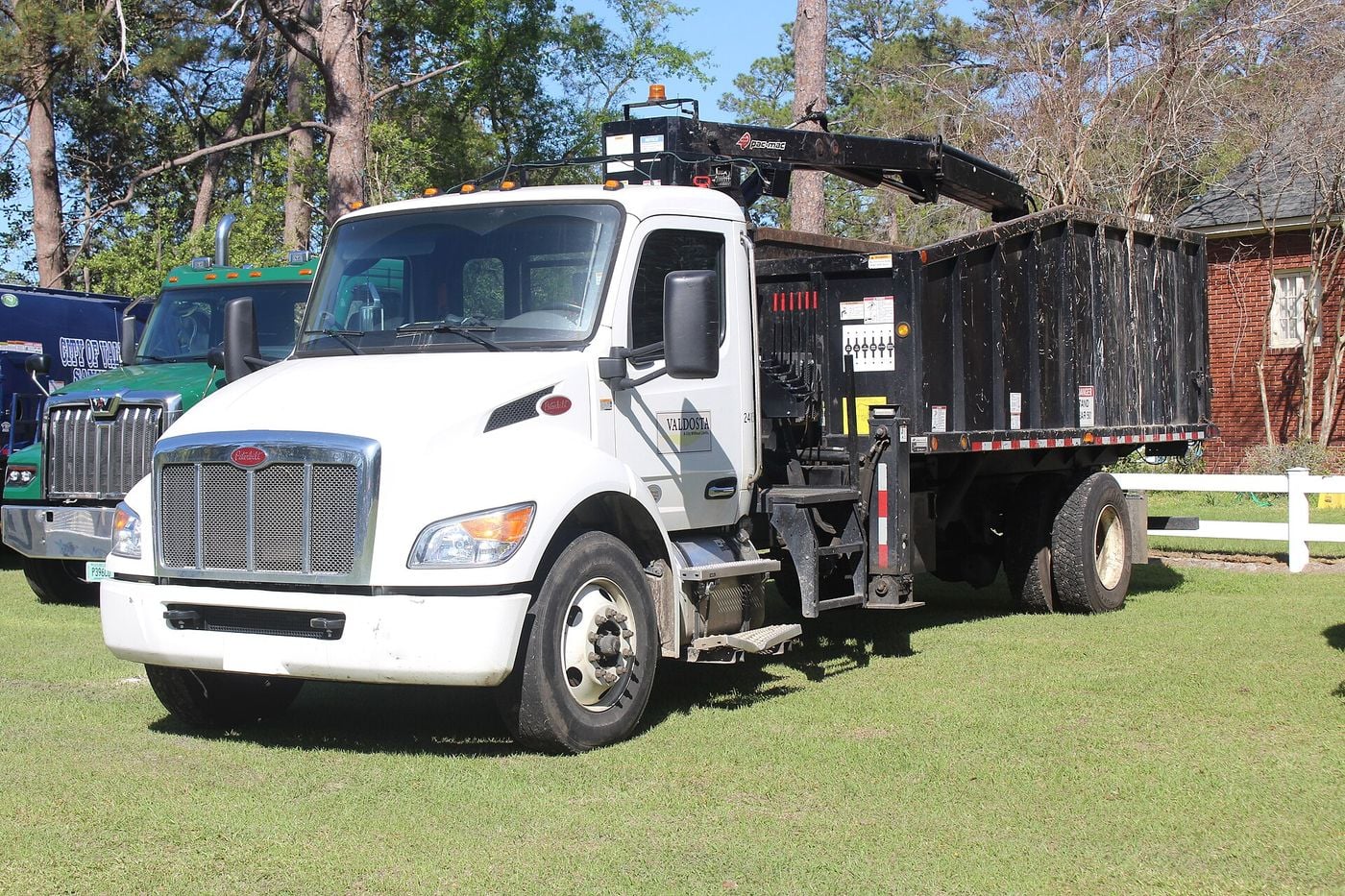
The Model 537 and the Model 548 are trucks that Peterbilt lists under “Medium Duty”. Peterbilt offers the 537 as a Class 7 truck or tractor with a GVWR of up to 33,000 lb and rates the 548 in Class 8 with a GVWR of up to 66,000 lb; the US weight classes are explained in GVWR, GCWR and GAWR. This page is built from Peterbilt’s 537 and 548 product pages, read on 4 November 2026; the two model sales sheets dated 2/2022 (PETE-9925 and PETE-9926); Peterbilt’s undated “New Medium Duty” exterior and interior features guides; and the two PACCAR PX-9 spec sheets on Peterbilt’s site, for EPA 2021 and EPA 2024.
Overview and generations
| Model 537 | Model 548 | |
|---|---|---|
| Class | 7 | 8 |
| Used for | Service/Maintenance, Tow, Dump, Pickup/Delivery | Snowplows/Crane, Bucket/Boom, Other Upfits |
| GVWR | Up to 33,000 lbs. | Up to 66,000 lbs. |
| Max horsepower | 200 - 380 hp | 260 - 380 hp |
| Peak torque | 520 - 1,250 lb-ft | 660 - 1,250 lb-ft |
| Front axle | 8,000 - 13,200 lbs. | Up to 20,000 lbs. |
| Rear axle | 17,000 - 25,000 lbs. | Up to 46,000 lbs. |
| Hoods, bumper to back of cab (BBC) | 107 or 109 in | 107 or 109 in |
| Roof heights | 74 in flat, 78 in curved | 74 in flat, 78 in curved |
| Fuel tanks | 50, 60, 70, 80 and 100 gallons | 50, 60, 70, 80 and 100 gallons |
| Engines (sales sheet) | PACCAR PX-7, PX-9 or CNG | PACCAR PX-7, PX-9, or CNG |
Peterbilt’s pages call the trucks “The new Model 537” and “The new Model 548”. The exterior features guide says the 2.1-metre cab “is wider than the previous conventional cab”, and the 537 page gives the cab floor as lower “than previous models”. The download lists on both pages name a “2021 New Medium Duty Body Builder Manual” beside a “2017 Medium Duty Body Builder Manual”. No document opened gives a launch date or a start of production, or names the earlier models.
Peterbilt says the 537 “can be configured to exceed the demands of many vocational applications” and gives it two cab roof heights, three hood configurations, a through-rail option and a variety of bumper and electrical wiring options. It says the 548 is “built to exceed the demands of Class 8 specialty applications”, calls it “a rugged workhorse” that is “designed to handle heavier vocational jobs”, and gives it two roof heights, a full range of suspension options and a variety of hood and cab configurations. Another Peterbilt truck, the Model 579, has its own page: Peterbilt 579.
The download list on the 537 page also names a “Model 548EV, 537EV & 536EV Body Builder Manual” and a “Medium Duty BEV Features Guide”; no document opened gives figures for the electric versions.
Cab
Both product pages list an all-aluminium cab; the 548 page calls it “strong, lightweight, corrosion-resistant”, and its sales sheet names stamped aluminium panels. The exterior features guide gives the two roofs different materials, a “standard steel flat roof” and an “optional aluminum curved roof”. The product pages list the flat roof at 74 inches, for overhead equipment, and the curved roof at 78 inches, with 4 inches of additional headroom. The cab is 2.1 metres wide, and the guides say it seats three. The 537 page says the floor is 3.5 inches lower than on previous models; the exterior guide says it is lowered 4 inches. The 548 page lists air-ride or rigid cab mounts. Cab types in general are covered in truck cabs explained.
Two SMC aero hoods have BBC dimensions of 107 and 109 inches, both, according to Peterbilt, designed to maximise visibility. The 548 page describes a three-piece aero hood and an anti-blow-down lock cylinder that prevents accidental hood closing, and names a stainless steel Peterbilt grille. A third hood, in Metton, is listed as “109 BBC FEPTO/REPTO/AWD with Stationary Grille”: its grille is fixed, with pull-through rails and a 24-inch bumper extension for front-mounted equipment. The options lists add 4-inch fender flares with integrated turn signals.
The 537 page counts three bumper options: one-piece channel, painted or chrome; one-piece aero composite, painted or in-mold colour; and three-piece aero metal. The options lists name bright and painted one-piece taper steel, bright three-piece steel with a breakaway feature, and single-piece aero in paint or in-mold colour. The exterior guide says all bumper options allow for integrated collision mitigation technology.
Both product pages list halogen headlights; the 548 page names a halogen assembly with a complex reflector and an integrated daytime running lamp and turn signal, and LED fog lights. Both pages say LED headlights are available on Peterbilt’s medium-duty trucks; Peterbilt says the low beams exceed the glare requirement by 28 percent, that the high beams reach 65 percent further than traditional halogen lights, and that the LED headlights use half the power of halogen lights. The cab-mounted mirrors combine large flat glass with integrated convex mirrors, with heating elements and motorised glass available; the 548 page lists look-down hood and side mirrors. Entry is by stair-style steps on the under-cab battery box; the 548 page calls the steps self-cleaning and also lists internal and external grab handles and a wide door opening.
Inside, both pages list a low-profile ergonomic dash, an A-panel cluster with a 7-inch digital display, which Peterbilt calls “the largest in the medium duty market”, a modular B-panel and a multi-function steering wheel. The 537 page says the B-panel takes a storage bin, auxiliary gauges or switches or a flat panel for aftermarket equipment (the interior guide adds the SmartNav display); that page and the interior guide also name multiplexed switches and a contoured steering wheel with cruise, audio and display controls. The cab seats three on a bench seat, with vinyl and cloth standard and premium seats, an air-ride seat and a two-person passenger seat listed. Trim comes in Charcoal and Gray, in cloth or vinyl, with a curved or flat roof headliner; dark kick panels are standard and metal door kick plates are available. A removable centre console holds deep cup holders, two USB ports and two 12-volt ports, and the LED dome light has two reading lights and ambient lighting, with an upgraded Bluetooth microphone in the interior guide. Both product pages give the interior storage as 6.1 cubic feet, across rear wall, dash, door, header, under-seat, centre console and tray; the interior guide gives 4.6 cubic feet.
The shifter is mounted on the dash with Allison and Eaton UltraShift gearboxes and on the column with the PACCAR TX-8. The 548 page adds an HVAC system that it says delivers rapid cooling, heating and defrosting, power door locks, window and mirror controls on the door armrest, and a chambered map pocket in the door. Both options lists name a RAM mount; the 548 page calls RAM mounts optional and says they attach to the dash.
Engines
The sales sheets list PACCAR PX-7 and PX-9 or CNG engines, and the 548 sheet says “Peterbilt offers two proprietary engines, the PACCAR PX-7 and PX-9”. The options lists on the product pages print these data, all for inline six-cylinder engines:
| PACCAR PX-9 | PACCAR PX-7 | Cummins L9N (natural gas) | Cummins B6.7N (natural gas) | |
|---|---|---|---|---|
| Listed on | 537, 548 | 537, 548 | 537, 548 | 537 |
| Displacement | 8.9 L | 6.7 L | 8.9 L | 6.7 L |
| Horsepower | 260 - 380 hp | Up to 325 hp (537); 280-325 hp (548) | 300 hp | 200 - 240 hp |
| Peak torque, lb-ft | 860 - 1,250 | Up to 750 | 860 | 520 - 560 |
| Bore x stroke, mm | 114x145 | 107x124 | – | – |
| Dry weight | 1,695 lbs. | 1,150 lbs. | – | – |
| Oil system capacity | 29 U.S. qts | 19.5 U.S. qts | – | – |
| Governed speed | 2,100 - 2,200 rpm | 2,600 rpm | – | – |
| Clutch engagement torque | 500 lb-ft @ 700 rpm | 400 lb-ft @ 700 rpm | – | – |
| Base warranty | 2 years/250K MI/400K KM | 3 years/unlimited miles | – | – |
| Certification | EPA 2021 | EPA 2021 | EPA 2018 | EPA 2018 |
The PX-7 data on both pages carry the footnote “360 hp in Fire Rating”. The 537 page’s text, which speaks of “Five engine options”, prints other figures for three of these engines and adds a gasoline engine that has no row in the options list:
| Engine | Power and torque |
|---|---|
| 9-liter PACCAR PX-9 | 260 to 450 horsepower, up to 1,250 lb.-ft. of torque |
| 7-liter PACCAR PX-7 | 260 horsepower and up to 750 lb.-ft. of torque |
| 7-liter Cummins B6.7 Octane (gasoline) | 200–300 horsepower, up to 660 lb-ft of torque |
| Cummins L9N (natural gas) | 250-320 horsepower, 660-1,000 lb.-ft. of torque |
| Cummins B6.7N (natural gas) | 200-240 horsepower, 520-560 lb.-ft. of torque |
The 548 page’s text names “PACCAR PX-9 and PX-7 diesel engines, Cummins B6.7N and L9 natural gas engines”; its options list has no B6.7N row.
PACCAR’s two PX-9 spec sheets, both in the download lists of the 537 and 548 pages, give the same bore, stroke, displacement, dry weight, oil capacity, governed speed and clutch engagement torque as the options lists, a horsepower span of 260-450 HP, and these ratings:
| Peak horsepower | Peak torque, lb-ft @ rpm |
|---|---|
| 260 | 860 @ 1,200 |
| 270 | 860 @ 1,200 |
| 300 | 860 @ 1,200 |
| 330 | 1,000 @ 1,200 |
| 350 | 1,050 @ 1,200 |
| 360 | 1,150 @ 1,200 |
| 370 | 1,250 @ 1,200 |
| 380 | 1,250 @ 1,200 |
| 380 | 1,150 @ 1,200 |
| 400 | 1,250 @ 1,200 |
| 450 | 1,250 @ 1,200 |
Both sheets carry the footnotes “Also Fire Service Rating” and “Fire Service Rating Only”. PACCAR says the engine has “one of the highest power-to-weight ratios in its class” and is available “in both medium and heavy-duty configurations”. The certification differs by document: EPA 2021 on the product pages and the 2021 sheet, EPA 2024 on the 2024 sheet. No Peterbilt or PACCAR document opened gives kilowatt or newton-metre figures for these engines. The PX-7 has its own page, PACCAR PX-7 engine; the L9N is noted on the Cummins L9 engine page.
Both pages list exhausts on the right-hand side of the cab, horizontal or at the back of the cab, aftertreatment on the right under the cab or under the frame, and an engine-mounted air cleaner with dual side air intakes.
Transmissions
| Gearbox | Type | Application | Model 537 | Model 548 |
|---|---|---|---|---|
| PACCAR TX-8 | 8-speed automatic | Pickup & Delivery, Vocational | 57,000 lbs. GCWR; 1,000 lb.-ft. | 57,000 lbs. GCWR |
| Allison 2000, 3000 and 4000 Series | 6-speed automatic | Pickup & Delivery, Vocational, Severe Duty | Listed | Listed |
| Eaton manual | Manual | – | FR/FS/RT, 6, 9, 10 speeds | FR/RT, 6, 9, 10 speeds |
| Eaton UltraShift | Automated | – | 10 speed | 10 and 11 speeds |
The 537 page gives the TX-8 “a maximum torque rating of 1,000 lb.-ft.”. Peterbilt lists a lifetime oil filter, extended service intervals and a column-mounted shift stalk for it, and the exterior guide says it offers “up to a 5% fuel economy benefit over competitive transmissions”. Automated gearboxes in general are covered in automated manual transmissions.
Axles, suspension and brakes
| Component | Model 537 | Model 548 |
|---|---|---|
| Front axles | 8,000 - 13,200 lbs.; Dana, Meritor, Hendrickson | 12,000 – 20,000 lbs.; PACCAR, Dana, Meritor, Hendrickson |
| Front suspension | 8,000 - 13,200 lbs.; mono leaf, taper leaf | 8,000 – 20,000 lbs.; mono leaf, taper leaf |
| Rear axles | 17,000 - 25,000 lbs.; Meritor, Dana | 19,000 – 46,000 lbs.; Meritor, Dana |
| Rear suspension | 18,000 - 23,000 lbs.; Peterbilt, Reyco, NeWay | 13,500 – 46,000 lbs.; mono leaf, taper leaf, NeWay |
| Pusher and tag axles | – | Up to two lift axles, 8,000 – 20,000 lbs.; Hendrickson, Watson & Chalin |
The exterior features guide describes “new proprietary single drive rear suspensions” from Peterbilt, in ratings from 13,500 to 18,000 lb. Both options lists name AWD (all-wheel drive). No document opened prints a list of wheel formulas or gives the brake types; wheel formulas in general are explained in axle configurations.
Frame, electrical system and tanks
The 537 page lists stamped steel cross members and a through-rail option; the 548 page lists one-piece stamped steel, one-piece cast aluminium and five-piece “Hucked, Bolted, Welded” cross members. Both list a battery box, printed as “ICBB, LHUC and BOC”, in aluminium or steel, air tanks (dual or single on the 548 page) and a toolbox; the 548 page adds a space-saver battery box.
Peterbilt says the VMUX multiplex electrical system “provides common electrical architecture for seamless body integration and advanced programming for a wide variety of applications”. Both pages list “Electric Over Air”, a prewired switch with a pigtail outside the cab, and connectors for 12-pin remote throttle, 14-pin body lighting, RP-170 body lighting, RP 1226, J1939 CAN and snow plow lighting.
The D-shaped aluminium fuel tanks come in sizes of 50, 60, 70, 80 and 100 gallons, and both pages list a D-shaped DEF tank without a volume. No document opened gives a kerb weight, a wheelbase or overall dimensions for either model.
Safety and driver-assistance systems
Both pages list lane keeping assist, adaptive cruise control, automatic emergency braking with enhanced collision mitigation, lane departure warning, highway departure braking and side object detection. The 537 sales sheet names collision mitigation, stability control and side object detection, and the interior guide says the integrated collision mitigation technology “delivers an added layer of protection in challenging driving conditions”. Peterbilt also lists SmartLINQ connected-truck technologies, with remote diagnostics, vehicle tracking and fuel economy and idle time data.
Source notes
Peterbilt’s product pages, read on 4 November 2026: Model 537, Class 7, GVWR up to 33,000 lb, 200-380 hp and 520-1,250 lb-ft, front axles 8,000-13,200 lb, rear axles 17,000-25,000 lb; Model 548, Class 8, GVWR up to 66,000 lb, 260-380 hp and 660-1,250 lb-ft, front axles up to 20,000 lb, rear axles up to 46,000 lb. Engines in the pages’ options lists, in the maker’s units: PACCAR PX-9, 8.9 l, 260-380 hp and 860-1,250 lb-ft; PACCAR PX-7, 6.7 l, up to 325 hp on the 537 page and 280-325 hp on the 548 page, up to 750 lb-ft; Cummins L9N natural gas, 8.9 l, 300 hp and 860 lb-ft; Cummins B6.7N natural gas, 6.7 l, 200-240 hp and 520-560 lb-ft (537 page). The 537 page’s text also names the Cummins B6.7 Octane gasoline engine; PACCAR’s PX-9 sheets give 260-450 hp. Hoods of 107 and 109 in BBC, roof heights of 74 in (flat) and 78 in (curved), a cab 2.1 m wide, fuel tanks of 50 to 100 gallons. No document opened gives kW or N·m figures, a kerb weight, a wheelbase or overall dimensions.
Quick answers
- Which transmission does the Peterbilt 537 / 548 use?
- Transmission: PACCAR TX-8 8-speed automatic; Allison 2000, 3000 and 4000 Series 6-speed automatic; Eaton FR/FS/RT manual (FR/RT on the 548) with 6, 9 or 10 speeds; Eaton UltraShift automated with 10 speeds (10 and 11 speeds on the 548).
More Peterbilt on this site
Sources
- Model 537 (product page) — Peterbilt Motors Company
- Model 548 (product page) — Peterbilt Motors Company
- Model 537 sales sheet (PETE-9925, 2/2022) — Peterbilt Motors Company
- Model 548 sales sheet (PETE-9926, 2/2022) — Peterbilt Motors Company
- New Medium Duty Exterior Features guide — Peterbilt Motors Company
- New Medium Duty Interior Features guide — Peterbilt Motors Company
- EPA 2024 PX-9 spec sheet (2024PX9SPEC) — PACCAR Inc., via peterbilt.com
- PX-9 spec sheet, EPA 2021 (2021PACCARPX9SPEC) — PACCAR Inc., via peterbilt.com