Parking heaters and coolers on trucks and buses: air, water and high-voltage heaters, UN R122 and ADR
Air and water parking heaters and high-voltage heaters on trucks and buses as their makers describe them, the UN Regulation No 122 approval rules, ADR 9.2.5 and battery air conditioning.
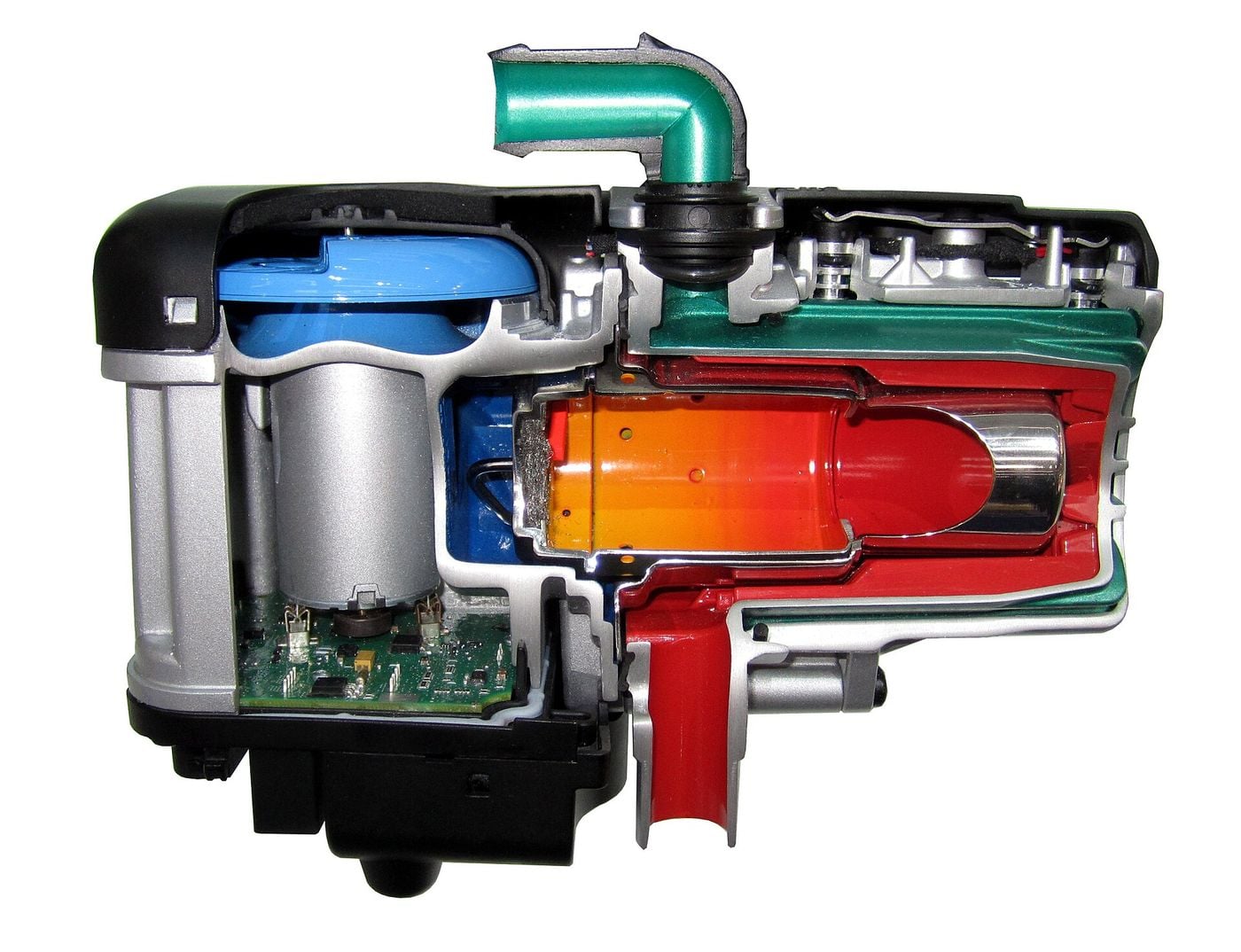
A parking heater warms a vehicle while it stands with its engine off: the cab of a truck, the passenger compartment of a bus or coach and, in the water-heater type, the engine itself. Webasto writes that its truck heaters “keep drivers warm, even when the vehicle is stationary and without the engine running”. Webasto and Eberspächer both describe two kinds of fuel-burning heater in the same way: an air heater warms air and blows it into the cab, and a water heater sits in the vehicle’s coolant circuit and can preheat the engine as well. UN Regulation No 122 calls such a device a combustion heater and sets the rules under which it, and a vehicle fitted with it, are approved; ADR adds rules of its own in section 9.2.5 for combustion heaters on dangerous goods vehicles. For battery-electric trucks and buses, Webasto offers electric high-voltage heaters. On the cooling side, the US Environmental Protection Agency’s list of idling reduction technologies for trucks that are no longer SmartWay verified names battery air conditioning systems among its technology types.
Status as at 14 November 2026. Read on that day: UN Regulation No 122 as published in the Official Journal of the European Union of 30 June 2010 (the original version with Supplement 1), in six language versions; Webasto’s pages on truck heating and on its high-voltage heaters; two Eberspächer pages on fuel-operated heaters; and EPA’s list of formerly SmartWay-verified idling reduction technologies, last updated on 7 April 2026. ADR 2025 was read in the official Turkish edition of Volume II, saved on 13 November 2026; the English and French authentic texts of ADR were not read.
Air heaters and water heaters
UN Regulation No 122 (R122) sorts combustion heaters into types by three features: the fuel type, “e.g. liquid or gaseous”, the transfer medium, “e.g. air or water”, and the vehicle location, “e.g. passenger compartment or load area” (paragraph 6.1.3). The makers’ air and water heaters differ in the second of these, the transfer medium.
Air heaters. Webasto’s truck page says its Air Top models “heat the air directly with a heat output of between 2 and 5.5 kW and blow it into the interior”, and that the air outlet can be located under the driver’s seat or in the sleeping area, for example. Eberspächer says its Airtronic air heaters “draw in cool ambient or outside air, heat it up, and release it into the passenger compartment”. Its product page gives a power range of 2 to 8 kW for the family and names, as an example of use, “keeping driver’s cabs or motor homes warm at night”.
Water heaters. “Water heaters are integrated into the vehicle’s coolant circuit”, Webasto writes; once the coolant is warm, air is heated and flows into the passenger compartment through the vehicle fan, and the heaters can also preheat the engine “so that it starts more easily”. Eberspächer describes its Hydronic in the same terms: “Since the Eberspächer Hydronic is integrated in the cooling water circuit, it heats not only the passenger compartment but can also pre-heat the engine of suitable vehicles at standstill.” For this group R122 has one exception: combustion heaters located outside the passenger compartment and using water as a transfer medium are deemed to comply with its air-quality and temperature tests, Annexes 4 and 5 (paragraph 6.2.1, Note 2).
| Maker | Heater family | Type | Heat output, maker’s figure |
|---|---|---|---|
| Webasto | Air Top | Air heater | 2 to 5.5 kW |
| Eberspächer | Airtronic | Air heater | 2 to 8 kW |
| Webasto | Water heaters | Water (coolant) heater | 5 to 35 kW |
| Eberspächer | Hydronic | Water (coolant) heater | 4 to 35 kW |
| Webasto | High-voltage heaters for battery electric trucks | Electric heater | 5 to 12 kW |
Webasto adds that its air and water heaters can be integrated into 12 and 24 V environments and can heat with alternative fuels such as HVO and GtL, and that there are versions with an Arctic Start function for temperatures as low as -40 degrees Celsius and with automatic altitude adjustment up to 5,500 m. It writes that heating a stationary truck in this way “may help reduce fuel consumption and emissions associated with engine idling”. Eberspächer names diesel, gasoline and ethanol as fuels for its pre-heaters, and lists a timer, a radio remote control, a smartphone and voice control among the operating elements it offers for them.
High-voltage heaters on electric trucks and buses
“For battery electric trucks, Webasto offers high-voltage heaters (HVH) with heating outputs between 5 and 12 kW”, its truck page says. Webasto describes them as converting direct current into heat “with virtually no loss”, gives “more than 95 percent” as the share converted into heat and a service life between 12,000 and 25,000 operating hours, and says they “can heat both the cabin and the vehicle batteries”. Its high-voltage heater page says the 800 V heaters are used for cars and for commercially used electric vehicles “such as trucks, buses, construction and agricultural machinery”. It describes the HVH 120 as a solution especially for commercial vehicles, with a heat output of up to 12 kW and a voltage range of up to 880 V; the HVH 100 Compact delivers up to 10 kW at up to 880 V, and the HVH 50/70 covers 100 to 490 volts.
Eberspächer names fuel-burning heaters for electric vehicles as well: on plug-in hybrid and battery electric vehicles, it writes, its fuel operated heaters “help maintain the necessary range when outside temperatures are cold”.
R122’s test table does not mention electric heaters. The table in paragraph 6.2.1, which assigns the test annexes to each heating system, has rows for engine waste-heat systems using water, air or oil and for gaseous and liquid fuel heaters, and no row for an electric heater; Annexes 6 to 9, which add requirements, deal with combustion heaters. The depot side of heating an electric bus, preconditioning the interior while the batteries charge, is covered in electric bus depot charging and preconditioning, and the electric truck itself in electric trucks explained.
UN Regulation No 122: approval of heating systems
R122 is read here as published in the Official Journal of the European Union L 164 of 30 June 2010. That text incorporates the valid text up to Corrigendum 2 to the original version and Supplement 1, whose date of entry into force it gives as 22 July 2009. The Official Journal prints the reminder: “Only the original UN/ECE texts have legal effect under international public law.” It is not a current consolidated version, and later amendments are not covered here.
R122 applies to all vehicles of categories M, N and O in which a heating system is fitted (paragraph 1.1), and grants two kinds of approval: Part I, of a vehicle type with regard to its heating system, and Part II, of a heating system with regard to its operational safety (paragraphs 1.2 and 1.3). Part I contains a general duty in paragraph 5.2.1: “The passenger compartment of every vehicle shall be fitted with a heating system.” A heating system for the load area, if a vehicle has one, must comply with the Regulation. The first two digits of an approval number give the series of amendments, which in the 2010 text is 00, “corresponding to the Regulation in its original form” (paragraph 4.2).
Paragraph 6.1.2 defines the device: “‘Combustion heater’ means a device directly using liquid or gaseous fuel and not using the waste heat from the engine used for propulsion of the vehicle.” Paragraph 6.2 sets three general requirements: the heated air entering the passenger compartment shall be no more polluted than the air at the vehicle’s inlet, driver and passengers must not be able to touch parts or heated air liable to cause burns during road use, and the exhaust emissions of combustion heaters must stay within acceptable limits.
Requirements for the vehicle installation
Paragraph 5.3 sets the requirements that a combustion heater’s installation in a vehicle type must meet. Among them:
- Buses and coaches. “In the case of M2 and M3 vehicles, the combustion heater must not be positioned in the passenger compartment”; an installation in an effectively sealed envelope that also meets the fire-risk condition may be used (paragraph 5.3.2.3).
- Fire. The heater “shall not constitute a risk of fire, even in the case of overheating” (paragraph 5.3.2.2).
- Fuel. The fuel filler must not be in the passenger compartment (paragraph 5.3.3.1), and “A notice, indicating that the heater must be shut down before refuelling, must be affixed to the fuelling point” (paragraph 5.3.3.3).
- Exhaust and combustion air. The exhaust outlet must be located so that emissions cannot enter the vehicle through ventilators, heated air inlets or opening windows (paragraph 5.3.4.1), and the combustion air must not be drawn from the passenger compartment (paragraph 5.3.5.1).
- Engine stop. “The heating system must be switched off automatically and the supply of fuel must be stopped within five seconds when the vehicle’s engine stops running. If a manual device is already activated, the heating system can stay in operation.” (paragraph 5.3.8.1)
Vehicles of category O, trailers, with liquid fuel heaters are deemed to comply with paragraph 5.3 (paragraph 5.3.1.2).
Test limits
Annex 5 measures surface and air temperatures after the heater has run for one hour at maximum output in still air, with a wind speed of not more than 2 m/s and all windows closed.
| Part of the heating system | Limit |
|---|---|
| Parts likely to come into contact with the driver during normal road use | 70 °C for uncoated metal, 80 °C for other materials |
| Parts behind the driver’s seat, and in the case of overheating | 110 °C |
| M1 and N vehicles: parts likely to come into contact with seated passengers, outlet grille excepted | 110 °C |
| M2 and M3 vehicles: parts likely to come into contact with passengers | 70 °C for uncoated metal, 80 °C for other materials |
| Exposed parts outside the passenger compartment, and in the case of overheating | 110 °C |
| Heated air entering the passenger compartment, at the centre of the outlet | 150 °C |
Annex 6 limits the dry, undiluted exhaust of a combustion heater after one hour at maximum output at an ambient temperature of 20 ± 10 °C: 0.1 % by volume of CO, 200 ppm of NOx and 100 ppm of HC for both gaseous and liquid fuel heaters, and a value of 1 for gaseous and 4 for liquid fuel heaters in the Bacharach reference unit of ASTM D 2156. In conditions equivalent to a vehicle speed of 100 km/h the CO value must not exceed 0.2 % by volume.
Annex 7 adds the requirements for the heater itself. Safety equipment must control the heater in an emergency: if no flame is obtained at start-up or the flame goes out during operation, the ignition and switching times for the fuel supply must not exceed four minutes for liquid fuel heaters and, for gaseous fuel heaters, one minute with a thermoelectric or 10 seconds with an automatic flame supervision device. The combustion chamber and heat exchanger of a water heater must withstand twice the normal operating pressure or 2 bar (gauge), whichever is greater. The heater carries a label with the manufacturer’s name, the model number and type, the rated output in kilowatts and the fuel type, and where relevant the operating voltage and gas pressure. “A clearly visible tell-tale in the operator’s field of view shall inform when the combustion heater is switched on or off.” (Annex 7, point 7.1)
Annex 8 sets separate safety requirements for heaters burning liquefied petroleum gas (LPG), depending on whether they can also be used while the vehicle is moving.
Buses and coaches
For M2 and M3 vehicles, R122 bars a combustion heater from the passenger compartment and sets lower surface limits for parts that passengers can touch, as set out above. Webasto’s pages name buses for both fuel-operated and high-voltage heaters. Webasto’s truck page lists its Thermo Top Pro 120/150 as “12/15 kW parking heaters for buses, trucks and marine”, and its high-voltage heater page names buses among the commercial electric vehicles for its 800 V heaters. The place of a combustion heater in a bus’s fire protection under UN Regulation No 107 is covered in bus fire safety explained, and reading a coach’s data sheet against the EU and UN texts in how to read a coach specification sheet.
Dangerous goods vehicles: R122 Annex 9 and ADR 9.2.5
R122’s Annex 9 “applies to certain vehicles for which the European Agreement concerning the International Carriage of Dangerous Goods by Road (ADR) contains specific requirements concerning combustion heaters and their installation” (paragraph 1). It uses the vehicle designations EX/II, EX/III, AT, FL, OX and MEMU “as defined in Chapter 9.1 of the ADR” (paragraph 2); what these designations mean is explained in ADR explained. The communication form for a vehicle type approval records whether “The vehicle is approved according to the requirements of Annex 9 (ADR): Yes/No” (Annex 1, Part 2, Appendix 1, item 10).
For all six designations, the heater and its exhaust gas routing must be designed, located, protected or covered so as to prevent any unacceptable risk of heating or ignition of the load (paragraph 3.1.1). The text considers this fulfilled where any fuel tank supplying the heater lets leaking fuel drain to the ground without touching hot parts of the vehicle or the load, a petrol tank has an effective flame trap at the filler opening or a hermetic closure, and the exhaust is directed or protected so as not to endanger the load, with a clearance of at least 100 mm or a thermal shield for exhaust parts directly below a diesel tank. Paragraph 3.1.2 reads: “The combustion heater shall be switched on manually. Programming devices shall be prohibited.” For EX/II, EX/III and MEMU vehicles, “Combustion heaters using gaseous fuels are not permitted” (paragraph 3.2). For FL vehicles, the heater must be put out of operation by at least three methods: “Intentional manual switching off from the driver’s cab”, stopping the engine, after which the driver may restart the heater manually, and the start-up of a feed pump on the motor vehicle for the dangerous goods carried (paragraph 3.3.1). For the last two, the supply of combustion air must be interrupted “after an after-running cycle of not more than 40 seconds”, and only heaters whose heat exchanger has been proven to withstand that reduced cycle may be used (paragraph 3.3.2).
ADR 2025 places combustion heaters in section 9.2.5, between the vehicle propulsion system in 9.2.4 and speed limitation devices in 9.2.6. Table 9.2.1 marks which of its paragraphs apply to which vehicle; the content column below summarises the official Turkish edition in English.
| Paragraph | Content | EX/II | EX/III | AT | FL |
|---|---|---|---|---|---|
| 9.2.5.1 | Combustion heaters meet the relevant technical requirements of UN Regulation No. 122, as amended | X | X | X | X |
| 9.2.5.2 | Heaters and their exhaust gas routing designed, located, protected or covered to prevent an unacceptable risk of heating or ignition of the load | X | X | X | X |
| 9.2.5.3 | Put out of operation by manual switch-off from the driver’s cab, by stopping the engine, and by starting the feed pump for the dangerous goods carried | – | – | – | X |
| 9.2.5.4 | Combustion air supply interrupted after an after-running cycle of not more than 40 seconds; heat exchanger proven to withstand it | – | – | – | X |
| 9.2.5.5 | Switched on manually; programming devices prohibited | X | X | X | X |
| 9.2.5.6 | Heaters using gaseous fuels not permitted | X | X | – | – |
Table 9.2.1 attaches one note to 9.2.5.1 to 9.2.5.5: they apply to motor vehicles equipped after 30 June 1999; for vehicles equipped before 1 July 1999, compliance was compulsory by 1 January 2010; and where the date of equipment is not known, the date of first registration is used. 9.2.5.6 carries no such note.
Chapter 9.3 sets additional requirements for complete or completed EX/II and EX/III vehicles carrying explosive substances and articles of Class 1 in packages, and its section 9.3.2 adds further rules on combustion heaters. Under 9.3.2.1 they may be fitted to EX/II and EX/III vehicles only to heat the driver’s cab or the engine; they must meet 9.2.5.1, 9.2.5.2, 9.2.5.5 and 9.2.5.6 (9.3.2.2). The heater’s switch may be fitted outside the driver’s cab, and proof that the heat exchanger withstands the reduced after-running cycle is not required (9.3.2.3). No combustion heater, and no fuel tank, power source, combustion or heating air intake or exhaust pipe outlet needed for its operation, may be fitted in the load compartment (9.3.2.4).
Parking coolers
R122’s title names heating systems only. EPA’s list of idling reduction technologies for trucks that are no longer SmartWay verified, last updated on 7 April 2026, names “BAC (Battery Air Conditioning Systems)” among its technology types, beside auxiliary power units and generator sets (APU/GS) and electrified parking spaces or truck stop electrification (EPS/TSE). Webasto’s truck heating page describes its truck range as “Engine-independent truck heating and air-conditioning” and lists parking coolers as one of its product groups. The current SmartWay list and the US federal and Californian rules on idling are covered in truck idling rules in the US, and the EU rules on the refrigerants in vehicle air conditioning in F-gas rules for vehicle air conditioning and reefer units.
What the sources read do not say
- National traffic rules on running an engine or a heater while parked are not part of R122 or ADR and are not covered here. The rules of several European countries on running the engine while parked are covered in running the engine of a parked truck or bus in Europe.
- ADR was read in its 2025 edition; amendments after that edition were not read.
- The English and French authentic texts of ADR 2025 were not read. Paragraphs 9.2.5.1 and 9.2.5.4 refer to other paragraphs by number; those cross-references are not reproduced here.
- No maker page with technical figures for a parking cooler on a truck was read, so none is given.
- The heat outputs, voltages and service lives above are the makers’ own figures.
Quick answers
- What is a parking heater on a truck?
- A heater that warms the cab, and in the water-heater type also the engine, while the truck stands with its engine off. Webasto describes its truck heaters as keeping drivers warm “even when the vehicle is stationary and without the engine running”. Fuel-burning parking heaters are combustion heaters in UN Regulation No 122: devices that burn liquid or gaseous fuel directly and do not use the waste heat of the propulsion engine.
- What is the difference between an air heater and a water heater?
- An air heater warms air and blows it into the cab; Webasto gives 2 to 5.5 kW for its Air Top models and Eberspächer 2 to 8 kW for its Airtronic family. A water heater is integrated into the vehicle’s coolant circuit, warms the cab through the vehicle’s own fan and can also preheat the engine; Webasto gives 5 to 35 kW for its water heaters and Eberspächer 4 to 35 kW for its Hydronic. UN Regulation No 122 names the transfer medium, air or water, as one of the features that distinguish types of combustion heater.
- Which regulation approves parking heaters?
- UN Regulation No 122 on heating systems of vehicles of categories M, N and O. In the text published in the EU Official Journal of 30 June 2010 it provides two approvals: of a vehicle type with regard to its heating system, and of a heating system with regard to its operational safety. Among its requirements, a combustion heater must not be positioned in the passenger compartment of an M2 or M3 bus or coach, except in an effectively sealed envelope, and the heating system must switch off automatically and stop the fuel supply within five seconds when the engine stops, unless a manual device is already activated.
- What does ADR say about parking heaters on dangerous goods vehicles?
- ADR 2025 section 9.2.5 applies to combustion heaters on EX/II, EX/III, AT and FL vehicles. They must meet the relevant requirements of UN Regulation No 122, be switched on manually, and programming devices are prohibited (9.2.5.5); gaseous-fuel heaters are not permitted on EX/II and EX/III vehicles, and FL vehicles have their own switch-off rules with an after-running cycle of not more than 40 seconds. Paragraphs 9.2.5.1 to 9.2.5.5 apply to motor vehicles equipped after 30 June 1999; for vehicles equipped before 1 July 1999 compliance was compulsory by 1 January 2010.
- What heaters do electric trucks and buses use?
- Webasto offers high-voltage heaters, which convert direct current into heat, for battery electric trucks with heating outputs between 5 and 12 kW, says they can heat both the cabin and the batteries, and says its 800 V heaters are used in commercial electric vehicles such as trucks and buses; its HVH 120 has up to 12 kW and a voltage range of up to 880 V. Eberspächer writes that its fuel operated heaters help maintain the range of plug-in hybrid and battery electric vehicles when outside temperatures are cold.
Sources
- Regulation No 122 of the Economic Commission for Europe of the United Nations (UN/ECE) — Uniform technical prescriptions concerning the approval of vehicles of categories M, N and O with regard to their heating systems, as published in the Official Journal of the European Union L 164 of 30 June 2010, p. 231 (original version, incorporating Corrigendum 2 and Supplement 1): paragraphs 1, 4, 5 and 6, Annex 1 and Annexes 5 to 9; English, German, French, Italian, Spanish and Polish versions — Publications Office of the European Union, 30 Jun 2010
- ADR 2025, Volume II (official Turkish edition): Table 9.2.1, section 9.2.5 Combustion heaters and section 9.3.2 (saved on 13 November 2026, read on 14 November 2026) — Republic of Türkiye, Ministry of Transport and Infrastructure (UHDGM)
- Heating solutions for trucks: fuel-operated and high-voltage heaters (read on 14 November 2026) — Webasto
- High Voltage Heater (HVH), original equipment manufacturer page (read on 14 November 2026) — Webasto
- Fuel operated heaters: Airtronic air heaters and Hydronic water heaters (read on 14 November 2026) — Eberspächer Climate Control Systems
- Fuel operated heating solutions, OEM heating solutions for passenger cars and trucks (read on 14 November 2026) — Eberspächer Group
- Formerly SmartWay Verified List of Idling Reduction Technologies (IRTs) for Trucks (last updated 7 April 2026) — U.S. Environmental Protection Agency, 7 Apr 2026