F-gas rules for vehicle air conditioning and reefer units
Regulation (EU) 2024/573 on leak checks, records, recovery, training and servicing bans; for heavy duty vehicle and van air conditioning, operators' leak checks and recovery start on 12 March 2027.
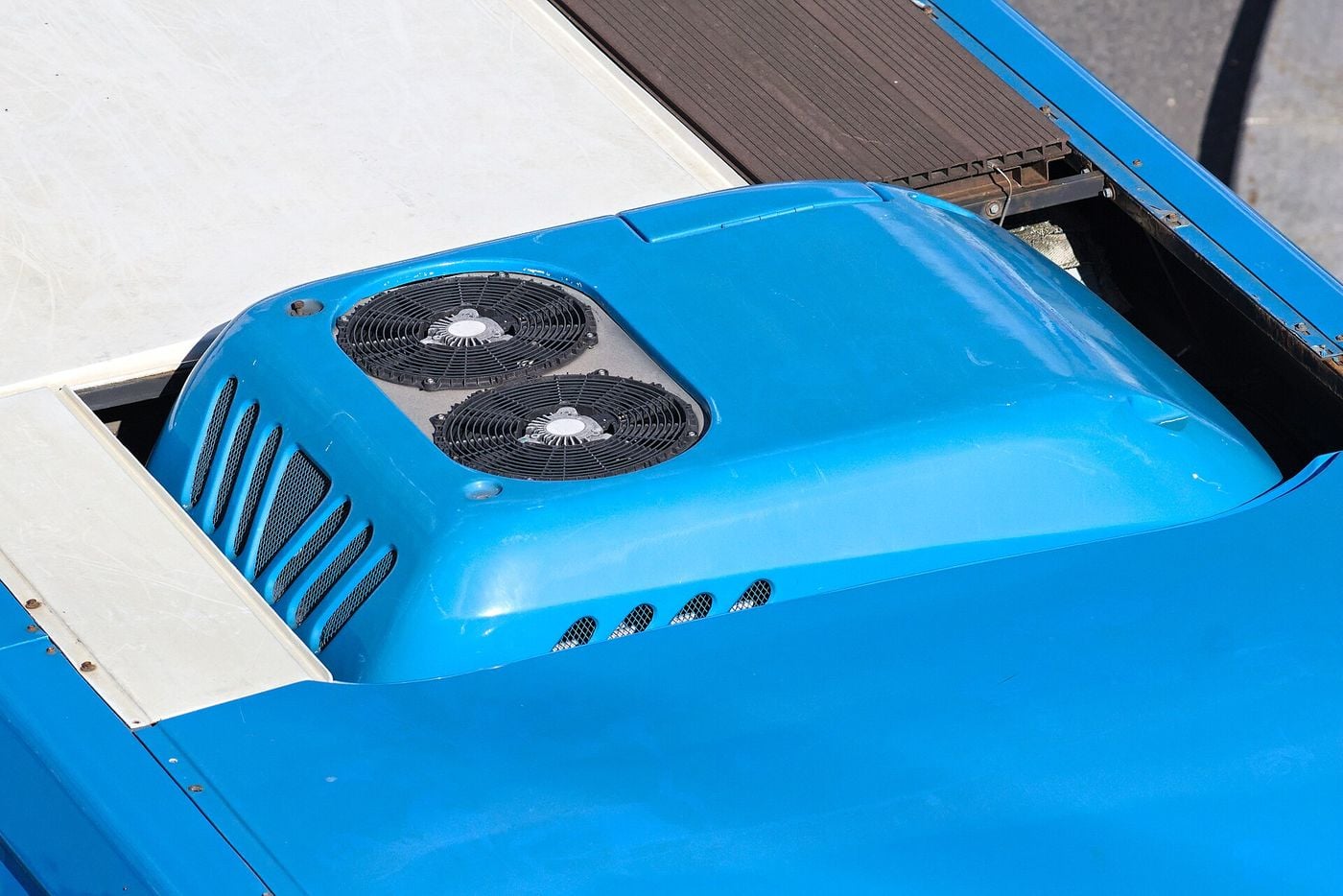
In the European Union the refrigerant in the cooling unit of a refrigerated truck or trailer, and in the air conditioning of heavy duty vehicles and vans, falls under Regulation (EU) 2024/573 on fluorinated greenhouse gases, the F-gas Regulation. It entered into force on 11 March 2024, twenty days after its publication in the Official Journal on 20 February 2024 (Article 38), and repealed Regulation (EU) No 517/2014 (Article 37(1)). For the refrigeration units of refrigerated trucks over 3.5 tonnes and of refrigerated trailers, the operator’s duties to have the equipment checked for leaks by certified persons above a set charge, to keep records of those checks and to have the gas recovered by certified persons apply now. For air-conditioning equipment and heat pumps in heavy duty vehicles and vans, and for the refrigeration units of light-duty vehicles and intermodal containers, the operator’s leak-check and recovery duties start on 12 March 2027. Since 1 January 2026, Annex I gases with a global warming potential (GWP) of 2,500 or more may not be used to service air-conditioning equipment and heat pumps, except reclaimed or recycled gases used under set conditions in existing equipment, an exception that ends on 1 January 2032; for refrigeration equipment the same kind of ban has applied since 1 January 2025. The Regulation’s list of products that may no longer be placed on the market has no entry for vehicle air conditioning or transport refrigeration units.
Status as at 27 October 2026. Read on that day: the text of Regulation (EU) 2024/573 as published in the Official Journal of 20 February 2024, in its English version and in its German, Spanish, French, Italian and Polish versions. Amendments made after that publication, the Commission’s implementing acts under the Regulation and Directive 2006/40/EC, to which it refers, were not among the texts read.
The vehicle equipment the Regulation names
The Regulation applies to the gases listed in its Annexes I, II and III, “whether alone or as mixtures”, and to “products and equipment, and parts thereof, containing fluorinated greenhouse gases or whose functioning relies upon those gases” (Article 2). Equipment counts as mobile when it is “normally in transit during operation” (Article 3(21)).
Three vehicle definitions follow in Article 3. A refrigerated truck is “a motor vehicle with a mass of more than 3,5 tonnes that is designed and constructed primarily to carry goods and that is equipped with a refrigeration unit” (point 23); a refrigerated light-duty vehicle is the same at 3.5 tonnes or less (point 25). A refrigerated trailer is “a vehicle that is designed and constructed to be towed by a road vehicle or a tractor, primarily to carry goods and that is equipped with a refrigeration unit” (point 24), with no mass limit in the definition.
Article 5(3) sorts the mobile equipment into three groups, and Article 8(3) repeats them for recovery:
- (a) “refrigeration units of refrigerated trucks and refrigerated trailers”;
- (b) “refrigeration units of refrigerated light-duty vehicles, intermodal containers, including reefers, and train wagons”;
- (c) “air-conditioning equipment and heat pumps in heavy duty vehicles, vans, non-road mobile machinery used in agriculture, mining and construction operations, trains, metros, trams and aircraft”.
The Regulation uses the word reefer only in point (b) of Articles 5(3) and 8(3), among intermodal containers; refrigerated trailers are in point (a). It does not define heavy duty vehicles or vans, and it does not name buses or coaches. The trailer body itself is described in trailer types explained. Recital 14 gives the reason for covering transport: “Refrigeration and air-conditioning equipment contained in a means of transport have particularly high leakage rates due to the vibrations that occur during transport.”
A further category runs alongside the three groups: air-conditioning equipment in “motor vehicles falling within the scope of Directive 2006/40/EC”, the Directive “relating to emissions from air conditioning systems in motor vehicles” (Articles 4(7), 8(4) and 10(1)). For recovery, Article 8(10) also names “road vehicles outside the scope of Directive 2006/40/EC”. The Regulation does not itself list which vehicles the Directive covers.
The leak-check, record and recovery duties are addressed to operators, and the leak-check duty to manufacturers as well. The operator is defined as “the undertaking exercising actual power over the technical functioning of products, equipment or facilities covered by this Regulation, or the owner designated by a Member State as being responsible for the operator’s obligations in specific cases” (Article 3(5)).
| Group | Operator’s leak checks and recovery | Leak checks carried out by | Recovery carried out by | Installation, servicing, repair |
|---|---|---|---|---|
| (a) Refrigeration units of refrigerated trucks and refrigerated trailers | Not deferred: Articles 5(5) and 8(5) name only points (b) and (c) | Certified (Articles 5(3) and 10(1)(b)) | Certified (Articles 8(1) and 10(1)(c)) | Certified natural persons (Article 10(1)(a)); legal persons certified too (Articles 4(7) and 10(2)) |
| (b) Refrigeration units of refrigerated light-duty vehicles, intermodal containers including reefers, and train wagons | From 12 March 2027 (Articles 5(5) and 8(5)) | Certified (Articles 5(3) and 10(1)(b)) | Attestation (Article 8(4)) | Certified natural persons (Article 10(1)(a)); legal persons certified too (Articles 4(7) and 10(2)) |
| (c) Air-conditioning equipment and heat pumps in heavy duty vehicles, vans and the other listed means of transport | From 12 March 2027 (Articles 5(5) and 8(5)) | Attestation (Article 5(4)) | Attestation (Article 8(4)) | Attestation for maintenance or servicing and repair (Articles 4(7) and 10(1), second subparagraph, point (c)) |
Which gases, and how their warming potential is counted
Annex I lists hydrofluorocarbons (HFCs) and other fluorinated compounds; Section 1 of Annex II lists unsaturated hydro(chloro)fluorocarbons. The global warming potential is the warming effect of one kilogram of a gas relative to one kilogram of CO₂, over 100 years unless otherwise specified (Article 3(1)). A tonne of CO₂ equivalent is the weight of the gas in metric tonnes multiplied by its GWP (Article 3(3)). For a mixture, the GWP is the average of its components’ values weighted by their share of the weight (Annex VI).
| Gas | Chemical name or formula | Listed in | GWP |
|---|---|---|---|
| HFC-32 | difluoromethane | Annex I, Section 1 | 675 |
| HFC-125 | pentafluoroethane | Annex I, Section 1 | 3,500 |
| HFC-134a | 1,1,1,2-tetrafluoroethane | Annex I, Section 1 | 1,430 |
| HFC-143a | 1,1,1-trifluoroethane | Annex I, Section 1 | 4,470 |
| HFC-1234yf | CF₃CF=CH₂ | Annex II, Section 1 | 0.501 |
| HFC-1234ze and isomers | CHF=CHCF₃ | Annex II, Section 1 | 1.37 |
Leak checks: thresholds, intervals and dates
Article 5(1) requires operators and manufacturers to ensure that equipment is checked for leaks when it contains 5 tonnes of CO₂ equivalent or more of Annex I gases, or 1 kilogram or more of gases listed in Section 1 of Annex II, not contained in foams. For HFC-134a, with its Annex I GWP of 1,430, 5 tonnes of CO₂ equivalent is about 3.5 kg (5,000 divided by 1,430, our arithmetic). For HFC-1234yf the threshold is set by weight, at 1 kg.
Hermetically sealed equipment is exempt if it is labelled as such and contains less than 10 tonnes of CO₂ equivalent of Annex I gases or less than 2 kg of Annex II Section 1 gases (Article 5(1)). The definition of hermetically sealed equipment requires, among other things, joints with “a tested leakage rate of less than 3 grams per year” (Article 3(9)).
The duty reaches the mobile equipment through Article 5(3). Checks on the refrigeration units in points (a) and (b) are carried out by certified natural persons; checks on the air-conditioning equipment and heat pumps in point (c) by persons holding at least a training attestation (Article 5(4)). For points (b) and (c), Article 5(5) provides that the leak-check duty and its intervals “shall not apply to operators of mobile equipment under paragraph 3, points (b) and (c), until 12 March 2027”. For point (c) the duty “shall be deemed to be fulfilled provided that the mobile air-conditioning equipment and the heat pumps are subject to a regular inspection regime that includes leak checks” (Article 5(7)).
| Charge | Without a leakage detection system | With a leakage detection system |
|---|---|---|
| Less than 50 t CO₂ equivalent, or less than 10 kg | At least every 12 months | At least every 24 months |
| 50 to less than 500 t CO₂ equivalent, or 10 to less than 100 kg | At least every 6 months | At least every 12 months |
| 500 t CO₂ equivalent or more, or 100 kg or more | At least every 3 months | At least every 6 months |
A leakage detection system is “a calibrated mechanical, electrical or electronic device for detecting leakage of fluorinated greenhouse gases which, on detection, alerts the operator” (Article 3(26)). The duty to install one, in Article 6, covers stationary equipment only.
Where a leak is detected, the equipment is to be “repaired without undue delay” (Article 4(5)). For equipment subject to leak checks, a certified person then checks the repair after at least 24 hours of operation and no later than one month after the repair; for the mobile equipment in Article 5(3), points (a), (b) and (c), “a leak check may be carried out directly after a repair” (Article 4(5)). The intentional release of the gases into the atmosphere is prohibited where it “is not technically necessary for the intended use” (Article 4(1)).
Records
For each piece of equipment that has to be checked for leaks, the operator keeps records of the quantity and type of gas it contains, the quantities added during servicing or because of leakage with the date, the quantity recovered, whether added gas was recycled or reclaimed, the undertaking that serviced, checked or recovered with its certificate number, the dates and results of the leak checks and repairs, and, after decommissioning, the measures taken to recover and dispose of the gas (Article 7(1)). Unless the records are held in a database set up by the Member State’s authorities, the operator keeps them for at least 5 years, the undertaking doing the work keeps copies for the same period, and the records are made available to the competent authority or the Commission on request (Article 7(2)).
Recovery of the gas
Article 8(1) requires operators to ensure that the gases are recovered and, after the equipment is decommissioned, “recycled, reclaimed or destroyed”. For the refrigeration units of refrigerated trucks and trailers (point (a)) the recovery is done by certified natural persons (Article 10(1), first subparagraph, point (c)). For points (b) and (c), and for air-conditioning equipment in motor vehicles within the scope of Directive 2006/40/EC, “only natural persons holding at least a training attestation” are “considered to be appropriately qualified” (Article 8(4)); the operator’s recovery duty for points (b) and (c) applies “from 12 March 2027” (Article 8(5)). The same attestation level applies to recovery from air-conditioning equipment in road vehicles outside the scope of that Directive (Article 8(10)).
Recovered gases “shall not be used for filling or refilling equipment unless the gas has been recycled or reclaimed” (Article 8(6)). The depollution of scrapped trucks, buses and trailers, with the fluids and gases removed, is described in end-of-life vehicles and Regulation (EU) 2026/1738.
Certificates and training attestations
Article 10(1) sets two levels for natural persons. A certificate is needed for the installation, maintenance or servicing, repair or decommissioning of the equipment in Article 5(3), points (a) and (b), for its leak checks, and for recovery from the refrigeration units of refrigerated trucks and trailers. At least a training attestation is needed for the maintenance or servicing, repair and recovery of air-conditioning equipment in motor vehicles within the scope of Directive 2006/40/EC; for recovery from the equipment in Article 8(3), points (b) and (c); and for the maintenance or servicing, repair and leak checks of the equipment in Article 5(3), point (c). Both levels cover the gases concerned “or involving relevant alternatives to fluorinated greenhouse gases, including natural refrigerants, where relevant”. Legal persons doing installation, servicing, repair or decommissioning of the refrigeration units in points (a) and (b) are certified as well (Article 10(2)).
The certification programmes cover, among other subjects, emission prevention, recovery and the “safe handling of equipment containing flammable or toxic gases or operating under high-pressure or involving other relevant risks” (Article 10(5)). Article 10(8) required the Commission to lay down minimum requirements for certification programmes and training attestations by implementing acts by 12 March 2026; Member States then have one year from the entry into force of that act to establish or adapt their programmes (Article 10(3) and (4)). The texts read for this page do not show whether that act has been adopted.
Certificates and training attestations issued under Regulation (EU) No 517/2014 “shall remain valid, in accordance with the conditions under which they were originally issued” (Article 10(9)). By 12 March 2027 Member States must require certified natural persons to take refresher training or an evaluation at least every 7 years, and holders of a certificate or attestation under the old Regulation must do so for the first time no later than 12 March 2029. Member States recognise certificates and attestations issued in another Member State (Article 10(10)), and an undertaking may assign a covered activity to another undertaking only after verifying that it holds the necessary certificates (Article 10(12)).
The gases themselves follow the qualification. Purchases of Annex I and Annex II Section 1 gases for installing, servicing or repairing the equipment concerned are limited to certificate holders and to undertakings employing holders of a certificate or a training attestation, and sellers may sell such gases only to them (Article 11(6)). Qualifications for work on the high-voltage systems of electric trucks and buses are a separate matter, set out in who may work on high-voltage trucks and buses.
Servicing bans by global warming potential
Article 13(3) prohibits the use of fluorinated greenhouse gases with a GWP of 2,500 or more for the maintenance or servicing of refrigeration equipment with a charge of 40 tonnes of CO₂ equivalent or more and, “From 1 January 2025”, of “any refrigeration equipment”. It does not apply to military equipment or to equipment designed to cool products below minus 50 °C. Until 1 January 2030, reclaimed gases in containers labelled under Article 12(7), and recycled gases recovered from such equipment and used by the undertaking that recovered them or for which they were recovered, remain allowed for existing refrigeration equipment.
Article 13(4) extends the ban to air conditioning: “From 1 January 2026, the use of fluorinated greenhouse gases listed in Annex I, with a global warming potential of 2 500 or more, for the maintenance or servicing of air-conditioning equipment and heat pumps shall be prohibited.” The same reclaimed and recycled exceptions run there until 1 January 2032. Paragraphs 3 and 4 do not use the word stationary. Paragraph 5, which from 1 January 2032 extends the ban to gases with a GWP of 750 or more, is limited to “stationary refrigeration equipment, with the exclusion of chillers”. At the substantiated request of a Member State’s competent authority, the Commission may authorise an exemption from paragraph 4 or 5 for up to 4 years where its assessment points to a verified shortage of reclaimed and recycled gas (Article 13(6)).
Non-refillable containers are covered by a separate rule. Point 1 of Annex IV lists “Non-refillable containers for fluorinated greenhouse gases listed in Annex I, empty, partially or fully filled, used to service, maintain or fill refrigeration, air-conditioning or heat pump equipment”, with 4 July 2007 as the date of the placing-on-the-market prohibition, and Article 11(3) also prohibits the import, supply, use and export of non-refillable containers for Annex I and Annex II Section 1 gases.
Labels
Article 12(1) allows refrigeration equipment, air-conditioning equipment and heat pumps, among other products, to be placed on the market, supplied or made available only if they are labelled. The label states that the product contains fluorinated greenhouse gases or relies on them, gives the accepted industry designation of the gas or its chemical name, and gives the quantity in weight and in CO₂ equivalent, or the quantity for which the equipment is designed, together with the gas’s GWP (Article 12(3)). Equipment retrofitted with a different gas is relabelled. The label is “clearly legible and indelible”, placed next to the service ports or on the part containing the gas, and written in the official languages of the Member State concerned (Article 12(4)). The same information goes into instruction manuals and, for gases with a GWP of 150 or more, into “descriptions used for advertising” (Article 12(16)).
Article 12 has applied from 1 January 2025 (Article 38), with Article 12 of Regulation (EU) No 517/2014 continuing until 31 December 2024 (Article 37(2)). Bus and coach model pages on this site quote makers’ documents that give the refrigerant quantity of the air-conditioning system in kilograms and in tonnes of CO₂ equivalent: the MAN Lion’s Intercity, the Neoplan Tourliner and the Setra TopClass.
No placing-on-the-market ban for vehicle systems, and the 2027 review
Annex IV lists the products and equipment that may no longer be placed on the market, with their dates (Article 11(1)). Its refrigeration, chiller and air-conditioning entries stand under the headings “STATIONARY REFRIGERATION”, “STATIONARY CHILLERS” and “STATIONARY AIR-CONDITIONING EQUIPMENT AND STATIONARY HEAT PUMPS”; it has no entry for vehicle air conditioning or for transport refrigeration units. Under “OTHER PRODUCTS AND EQUIPMENT”, point 15 covers “Tyres that contain fluorinated greenhouse gases listed in Annex I” from 4 July 2007, and Article 13(2) prohibits “The use of SF₆ to fill vehicle tyres”.
Article 35(3) sets the next step for vehicles: “By 1 July 2027, the Commission shall publish a report assessing whether cost-effective, technically feasible, energy-efficient and reliable alternatives exist, which make the replacement of fluorinated greenhouse gases possible in mobile refrigeration and mobile air-conditioning equipment, and where appropriate, put forward a legislative proposal to the European Parliament and to the Council to amend the list set out in Annex IV.” The ATP insulation categories and the temperature-record rules for refrigerated transport are covered in refrigerated transport: temperature records and the ATP insulation test.
Checks and penalties
The competent authorities of the Member States carry out risk-based checks, including on-site visits and verification of documentation and equipment (Article 29). Member States lay down the penalties and had to notify the Commission of them before 1 January 2026 (Article 31(1)). For unlawful production, import, export, placing on the market or use of the gases or of products and equipment containing them, the maximum administrative fine must be at least five times the market value of the gases or products concerned, and at least eight times where the infringement is repeated within five years (Article 31(4)).
Quick answers
- When do F-gas leak checks start for air conditioning in heavy duty vehicles?
- For operators, on 12 March 2027. Article 5(3)(c) of Regulation (EU) 2024/573 brings air-conditioning equipment and heat pumps in heavy duty vehicles and vans under the leak-check duty of Article 5(1), and Article 5(5) defers that duty for their operators until 12 March 2027. It applies where the equipment contains 5 tonnes of CO₂ equivalent or more of the gases listed in Annex I, or 1 kg or more of those in Section 1 of Annex II, such as HFC-1234yf. The checks are carried out by persons holding at least a training attestation, and the duty is deemed fulfilled where the equipment is subject to a regular inspection regime that includes leak checks (Article 5(7)).
- How often must the cooling unit of a refrigerated trailer be checked for leaks?
- It depends on the charge (Article 5(6) of Regulation (EU) 2024/573): at least every 12 months below 50 tonnes of CO₂ equivalent of Annex I gases or below 10 kg of Annex II Section 1 gases; every 6 months from 50 up to 500 tonnes or from 10 up to 100 kg; every 3 months at 500 tonnes or 100 kg and more. Where a leakage detection system is installed, the intervals are 24, 12 and 6 months. The duty covers the refrigeration units of refrigerated trucks and trailers holding at least 5 tonnes of CO₂ equivalent of Annex I gases or 1 kg of Annex II Section 1 gases, and the checks are done by certified natural persons.
- Can HFC-134a still be used to service vehicle air conditioning?
- The ban of Article 13(4) of Regulation (EU) 2024/573, which has applied since 1 January 2026, covers the use of Annex I gases with a global warming potential of 2,500 or more for the maintenance or servicing of air-conditioning equipment and heat pumps. Annex I gives HFC-134a a global warming potential of 1,430, below that threshold. The single HFCs in Annex I above it include HFC-125 (3,500) and HFC-143a (4,470), and a mixture's value is the average of its components weighted by their share of its weight (Annex VI). Reclaimed or recycled gases of 2,500 or more remain allowed for existing equipment until 1 January 2032, under the conditions of Article 13(4).
- Who may recover the refrigerant from a reefer unit or a vehicle air conditioner?
- From the refrigeration units of refrigerated trucks and refrigerated trailers, natural persons certified under Article 10 of Regulation (EU) 2024/573 (Articles 8(1) and 10(1)). From the refrigeration units of refrigerated light-duty vehicles and intermodal containers, and from air-conditioning equipment and heat pumps in heavy duty vehicles and vans, persons holding at least a training attestation (Article 8(4)); for those groups the operator's recovery duty applies from 12 March 2027 (Article 8(5)). Recovered gases may be used for filling or refilling only once they have been recycled or reclaimed (Article 8(6)).
- Does the F-gas Regulation ban fluorinated gases in new vehicle air conditioning?
- Not in the text published on 20 February 2024. Annex IV of Regulation (EU) 2024/573, the list of products and equipment that may no longer be placed on the market, groups its refrigeration, chiller and air-conditioning entries under stationary headings and has no entry for vehicle air conditioning or transport refrigeration units. Article 35(3) requires the Commission to publish by 1 July 2027 a report on whether alternatives make the replacement of fluorinated greenhouse gases possible in mobile refrigeration and mobile air-conditioning equipment and, where appropriate, to propose an amendment to Annex IV.
Models in this article
Sources
- Regulation (EU) 2024/573 of the European Parliament and of the Council of 7 February 2024 on fluorinated greenhouse gases, amending Directive (EU) 2019/1937 and repealing Regulation (EU) No 517/2014 — Official Journal text of 20 February 2024: recital 14, Articles 1 to 13, 29, 31, 35, 37 and 38, Annexes I, II, IV and VI — EUR-Lex, European Union, 7 Feb 2024