Electronic stability control on trucks and buses: UN R13 Annex 21, EU GSR row C7 and US FMVSS No. 136
Which trucks and buses must have electronic stability control: UN Regulation No 13 paragraph 5.2.1.32 and Annex 21, the EU registration date of 6 July 2022 and the US FMVSS No. 136 dates.
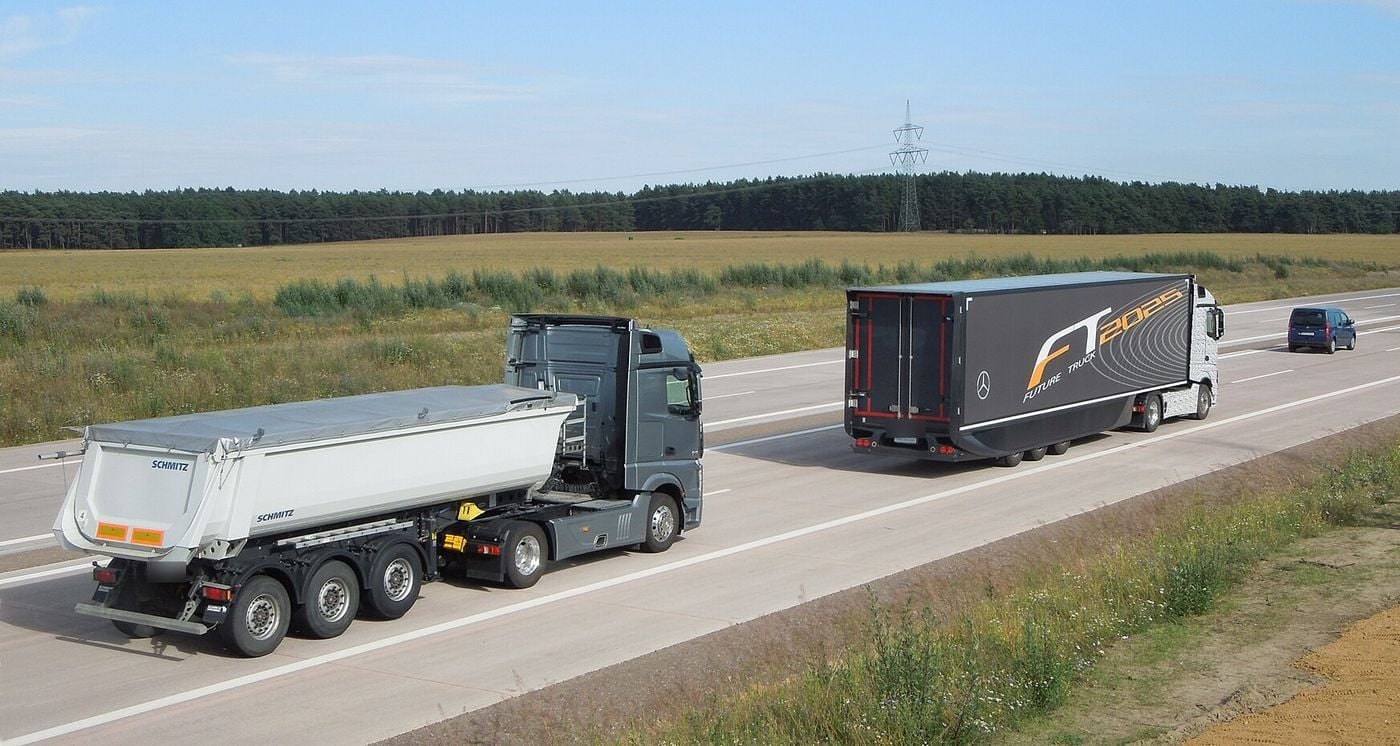
Electronic stability control is required, with exemptions, on new trucks and buses in the European Union and on new heavy truck tractors and buses in the United States, under different texts. UN Regulation No 13, as published in the Official Journal of the European Union at OJ L 2026/746, calls it a vehicle stability function and requires it, with roll-over control and directional control and the technical requirements of its Annex 21, on vehicles of categories M2, M3 and N2, on N3 trucks with no more than three axles and on two kinds of four-axle N3 truck (paragraph 5.2.1.32). A footnote exempts, among others, off-road and special purpose vehicles, Class I and Class A buses, and articulated buses and coaches. In the EU, row C7 of Annex II of the General Safety Regulation, Regulation (EU) 2019/2144, ties registration to it: since 6 July 2022 new vehicles that do not comply may not be registered. In the United States, Federal Motor Vehicle Safety Standard No. 136 requires an electronic stability control system on truck tractors and buses with a gross vehicle weight rating above 11,793 kg (26,000 lb), on some of them from 2017 and 2018 and on all those in its scope manufactured on or after 1 August 2019.
Status as at 14 November 2026. Read on that day: UN Regulation No 13, 13 series, as published at OJ L 2026/746 of 13 April 2026, in its English, German, Spanish, Polish, Italian and French versions; the consolidated text of Regulation (EU) 2019/2144 of 2 August 2026; the final rule establishing FMVSS No. 136 at 80 FR 36050 of 23 June 2015 and the amending final rule at 82 FR 50089 of 30 October 2017, both in the Federal Register; and 49 CFR 571.136 in the annual edition of the Code of Federal Regulations revised as of 1 October 2025.
The rules at a glance
| Jurisdiction | Legal basis | Vehicles | What the system must do | Dates | Source of the row |
|---|---|---|---|---|---|
| European Union | Regulation (EU) 2019/2144, Annex II row C7 “Stability control”, citing UN Regulation No 13 and UN Regulation No 140 | Under UN R13 paragraph 5.2.1.32: M2, M3, N2; N3 with no more than 3 axles; four-axle N3 up to 25 t with wheel diameter code up to 19.5, or with two driven rear axles and only non-driven axles elsewhere; exemptions in footnote 16 | Roll-over control and directional control, meeting Annex 21 of UN R13; not required below 20 km/h or in reverse | Registration of non-complying new vehicles prohibited from 6 July 2022 (Annex II note A) | Regulation (EU) 2019/2144, consolidated text of 2 August 2026; UN Regulation No 13, OJ L 2026/746 |
| United States | FMVSS No. 136, 49 CFR 571.136 | Truck tractors and buses with a GVWR above 11,793 kg (26,000 lb), with the exclusions of S3 | An ESC system with the nine attributes of S4, passing the J-turn tests of S5.3; operational except below 20 km/h (12.4 mph), in reverse or during initialization | Certain three-axle tractors from 1 August 2017; buses above 14,969 kg (33,000 lb) from 24 June 2018; all vehicles in scope from 1 August 2019 | 80 FR 36050 (23 June 2015); 82 FR 50089 (30 October 2017); 49 CFR 571.136, edition of 1 October 2025 |
What the texts mean by stability control
UN Regulation No 13 defines the “Vehicle Stability Function” in paragraph 2.34 as “an electronic control function for a vehicle which improves the dynamic stability of the vehicle”. It includes one or both of two control functions (2.34.1). Directional control is a function that “assists the driver, in the event of under steer and over steer conditions, within the physical limits of the vehicle in maintaining the direction intended by the driver in the case of a power-driven vehicle” (2.34.2.1). Roll-over control is a function that “reacts to an impending roll-over in order to stabilise the power-driven vehicle or towing vehicle and trailer combination or the trailer during dynamic manoeuvres within the physical limits of the vehicle” (2.34.2.2). For the trucks and buses it covers, paragraph 5.2.1.32 requires both.
FMVSS No. 136 uses the term electronic stability control system and defines it in S4 by nine attributes. The system must be able to apply and adjust the brake torques “individually at each wheel position on at least one front and at least one rear axle” of the truck tractor or bus, both to induce a correcting yaw moment that limits oversteer and understeer and to reduce lateral acceleration for rollover stability. It is computer-controlled with a closed-loop algorithm; it has means to determine lateral acceleration and yaw rate, to estimate side slip, to estimate vehicle or combination mass, to monitor the driver’s steering inputs and to modify engine torque; and when installed on a truck tractor it has “the means to provide brake pressure to automatically apply and modulate the brake torques of a towed trailer”. S2 gives the purpose of the standard: “to reduce crashes caused by rollover or by directional loss-of-control”. Of the three performance requirements in S5.3, the third is headed Roll Stability Control Test (S5.3.3).
Which trucks and buses UN Regulation No 13 covers
Paragraph 5.2.1.32 opens: “Subject to the provisions of paragraph 12.3. of this Regulation, all vehicles of the following categories shall be equipped with a vehicle stability function”. The list, by vehicle category, is:
- (a) M2, M3 and N2, with footnote 16;
- (b) N3 “having no more than 3 axles”;
- (c) N3 “with 4 axles, with a maximum mass not exceeding 25t and a maximum wheel diameter code not exceeding 19.5”;
- (d) N3 “with 4 axles, with two power-driven axles in the rear axle group and only non-driven axles in the other axle group(s), including off-road vehicles”.
The paragraph closes: “The vehicle stability function shall include roll-over control and directional control and meet the technical requirements of Annex 21 to this Regulation.” Beyond three axles, the list names only the two four-axle cases (c) and (d).
Footnote 16 reads: “The following are exempt from this requirement”. It names:
- off-road vehicles;
- special purpose vehicles, with the examples “mobile plant using nonstandard vehicle chassis, mobile cranes, hydro-static driven vehicles in which the hydraulic drive system is also used for braking and auxiliary functions”, and vehicles with a non-standard chassis on which the lateral acceleration or yaw rate sensors needed for the function “cannot be installed within the specified area close to the center of gravity of the vehicle without compromising its special purpose”;
- category N2 vehicles with all of these features: a gross vehicle mass between 3.5 and 7.5 tonnes, a non-standard low-frame chassis, more than two axles and hydraulic transmission;
- “Class I and Class A buses of categories M2 and M3” (see bus classes);
- “articulated buses and coaches”;
- “N2 tractors for semi-trailer with a Gross Vehicle Mass (GVM) between 3.5 and 7.5 tonnes”.
The opening words refer to the transitional provision of paragraph 12.3: “Until 1 September 2026, Contracting Parties applying this Regulation shall accept type approvals to the preceding series of amendments, first issued before 1 September 2024.” That date has passed.
For EU type-approval, Annex I of Regulation (EU) 2019/2144, in its consolidated text of 2 August 2026, lists UN Regulation No 13 for categories M2, M3, N and O at its 11 series of amendments, published in OJ L 42 of 18 February 2016. The paragraph numbers and quotations on this page are those of the 13 series published at OJ L 2026/746.
What Annex 21 requires of a truck or bus
Annex 21 sets the “Special requirements for vehicles equipped with a vehicle stability function” for paragraphs 5.2.1.32, 5.2.1.33 and 5.2.2.23 (paragraph 1.1). Its section 2.1, on power-driven vehicles, describes what each control function must be able to do (2.1.1):
- directional control must be able “to automatically control individually the speed of the left and right wheels on each axle or an axle of each axle group by selective braking”, based on comparing actual vehicle behaviour with the behaviour demanded by the driver;
- roll-over control must be able “to automatically control the wheel speeds on at least two wheels of each axle or axle group by selective braking or automatically commanded braking”, based on actual vehicle behaviour that may lead to roll-over.
In both cases the function is not required below 20 km/h, until the initial start-up self-test and plausibility checks have been completed, when the vehicle is driven in reverse, or when it has been automatically or manually disabled. Where the function is disabled automatically to provide increased traction, the disablement and its reinstatement have to be automatically linked to the operation that changes the functionality of the drive train; a manually disabled function “shall be automatically reinstated at the initiation of each new ignition cycle”; and a constant optical warning signal tells the driver that the function is disabled.
Paragraph 2.1.2 lists what the function must contain besides selective or automatically commanded braking: the ability to control engine power output; for directional control, actual vehicle behaviour determined from yaw rate, lateral acceleration, wheel speeds and the driver’s inputs to the braking and steering systems and to the engine; for roll-over control, from the vertical force on the tyres, or at least lateral acceleration and wheel speeds, and the driver’s inputs to the braking system and the engine. In both cases “Only on-board generated information shall be used.” A towing vehicle equipped under paragraph 5.1.3.1 must also be able to apply the trailer’s service brakes through the control lines independently of the driver.
The function is demonstrated to the Technical Service by dynamic manoeuvres on one vehicle with the same vehicle stability function as the type to be approved, which may be done by comparing results with the function enabled and disabled (2.1.3). For other vehicles and load conditions, results from actual vehicle tests or computer simulations may be submitted; the use of the simulator and its specification and validation are set out in Appendices 1 and 2. A test report under Annex 19 is an alternative. “Until unified test procedures are agreed”, the method is agreed between the vehicle manufacturer and the Technical Service. The annex lists the manoeuvres to be used for directional control and roll-over control, among them the reducing radius test, the steady state circular test, the step steer input test, the J-turn, sine with dwell, the μ-split single lane change, the double lane change and the reversed steering or “fish hook” test. Under paragraph 1.2, the “other vehicles” to which results are extended in this way shall not differ in at least the essential respects listed there, among them the character of the vehicle, the axle configuration of a power-driven vehicle (“e.g. 4x2, 6x2, 6x4”), additional steered axles and lift axles.
The annex also sets warning signals for the driver, each fulfilling the relevant technical requirements of UN Regulation No 121. An intervention is indicated by a flashing optical warning signal, present as long as the function is in intervention mode (2.1.4); interventions of related systems, among them traction control, trailer stability assist and corner brake control, may use the same signal. A failure or defect is indicated by an optical warning signal that “shall be constant and remain displayed as long as the failure or defect persists and the ignition (start) switch is in the ‘on’ (run) position” (2.1.5). A power-driven vehicle with an electric control line, connected to a trailer with one, must also warn the driver whenever the trailer sends the information “VDC Active” over the data communications part of that line (2.1.6).
The EU date: row C7 of the General Safety Regulation
Annex II of Regulation (EU) 2019/2144 lists its requirements by row. Row C7 is “Stability control”; its regulatory acts are UN Regulation No 13 and UN Regulation No 140, and every column from M1 to O4 carries letter A. Note A to the table gives the date: “Date for the prohibition of the registration of vehicles, as well as the placing on the market and entry into service of components and separate technical units: 6 July 2022”. Row C7 does not use letter B, the note that adds a separate date for refusing EU type-approval.
Two articles give the date its effect. Under Article 4(5), manufacturers “shall also ensure that vehicles, systems, components and separate technical units comply with the applicable requirements listed in Annex II with effect from the dates specified in that Annex”. Under Article 16(b), from those dates national authorities consider the certificates of conformity of new vehicles that do not comply to be no longer valid for the purposes of Article 48 of Regulation (EU) 2018/858, and prohibit their registration. What has to be fitted is left to the UN text: Annex I footnote (2) reads “The mandatory fitting of a stability control function is required in accordance with the UN Regulations.”
Several other Annex II rows for trucks and buses, with dates of their own, are set out in mandatory driver assistance systems.
The United States: FMVSS No. 136
The National Highway Traffic Safety Administration established FMVSS No. 136 in a final rule published on 23 June 2015 at 80 FR 36050; the effective date of the rule was 24 August 2015. Its summary describes the requirement as ESC systems “on truck tractors and certain buses with a gross vehicle weight rating of greater than 11,793 kilograms (26,000 pounds)”.
S3 sets the scope. It applies to truck tractors with a GVWR above 11,793 kg (26,000 lb), except any truck tractor with an axle of a gross axle weight rating of 13,154 kg (29,000 lb) or more, any truck tractor with a speed attainable in 3.2 km (2 miles) of not more than 53 km/h (33 mph), and any truck tractor with a speed attainable in 3.2 km of not more than 72 km/h (45 mph), an unloaded vehicle weight not less than 95 percent of its GVWR and no capacity to carry occupants other than the driver and operating crew (S3.1). It applies to buses with a GVWR above 11,793 kg (26,000 lb), except school buses, perimeter-seating buses, transit buses, any bus with an axle of a GAWR of 13,154 kg (29,000 lb) or more, and any bus with a speed attainable in 3.2 km of not more than 53 km/h (S3.2). S4 defines a perimeter-seating bus as one “with 7 or fewer designated seating positions rearward of the driver’s seating position that are forward-facing or can convert to forward-facing without the use of tools” that is not an over-the-road bus, and a transit bus as one “equipped with a stop-request system sold for public transportation provided by, or on behalf of, a State or local government” that is not an over-the-road bus.
S5.1 requires each vehicle in scope to be equipped with an ESC system as defined in S4. The system must be operational over the full speed range of the vehicle “except at vehicle speeds less than 20 km/h (12.4 mph), when being driven in reverse, or during system initialization” (S5.2.1), and must remain capable of activation even if the antilock brake system or traction control is also activated (S5.2.2).
The performance tests use a J-turn course: a straight entrance lane of 22.9 m (75 ft) joined to a curved lane with a radius of 45.7 m (150 ft), with the end gate at 120 degrees of arc (S6.2.4.1, S6.2.4.3). The lane is 3.7 m (12 ft) wide for truck tractors; for buses it is 3.7 m on the straight and 4.3 m (14 ft) on the curve (S6.2.4.2); an option for long-wheelbase tractors was added in 2017 (see below). Three requirements follow in S5.3:
- in the runs that determine the reference speed, the wheels must stay within the lane between the start gate and the end gate in at least two of four runs (S5.3.1);
- in the engine torque reduction test, the system “must reduce the driver-requested engine torque by at least 10 percent for a minimum continuous duration of 0.5 second” in the period from 1.5 seconds after the start gate to the end gate, with the wheels in the lane, in at least two of four runs (S5.3.2);
- in the Roll Stability Control Test, in at least six of eight consecutive runs, the speed 3.0 seconds after the start gate must not exceed 47 km/h (29 mph), the speed after 4.0 seconds must not exceed 45 km/h (28 mph), the wheels must stay in the lane and there must be ESC service brake activation (S5.3.3).
Apart from a check-of-lamp function (S5.4.3), an ESC malfunction telltale must illuminate only when a malfunction exists and remain continuously illuminated for as long as it exists whenever the ignition locking system is in the On (Run) position (S5.4.1); the manufacturer may use it in a flashing mode to indicate ESC operation (S5.4.6).
The compliance dates are in S8:
| Paragraph | Vehicles | Manufactured on or after |
|---|---|---|
| S8.2.1 | “All three-axle truck tractors with a front axle that has a GAWR of 6,622 kilograms (14,600 pounds) or less and with two rear drive axles that have a combined GAWR of 20,412 kilograms (45,000 pounds) or less” | 1 August 2017 |
| S8.1.1 | “All buses with a gross vehicle weight rating of greater than 14,969 kilograms (33,000 pounds)” | 24 June 2018 |
| S8.1.2 | “All buses” | 1 August 2019 |
| S8.2.2 | “All truck tractors” | 1 August 2019 |
In the 2015 rule NHTSA expected that, without it, about 34 percent of new truck tractors and 80 percent of new buses affected would be equipped with ESC systems in 2018. By requiring the systems on the rest, it said, the rule “will prevent 40 to 56 percent of untripped rollover crashes and 14 percent of loss-of-control crashes”, and it expected the rule to prevent 1,424 to 1,759 crashes a year, resulting in 505 to 649 injuries and 40 to 49 fatalities.
A second final rule, published on 30 October 2017 at 82 FR 50089 and effective on 29 November 2017, granted a petition for reconsideration from the Truck and Engine Manufacturers Association, which had asked for a larger lane width for long wheelbase truck tractors. S6.2.4.2 as amended reads: “At the manufacturer’s option, for truck tractors with a wheelbase equal to or greater than 7112 mm (280 inches) the lane width of the test course is 3.7 meters (12 feet) for the straight section and is 4.3 meters (14 feet) for the curved section.” In the 2025 edition of the Code of Federal Regulations the section cites as its sources the 2015 rule and amendments of 30 October 2017 and 8 June 2022 (87 FR 34810); its scope (S3) and compliance dates (S8) read as adopted in 2015.
Trailers
Trailers have a requirement of their own: paragraph 5.2.2.23 of UN Regulation No 13 requires a vehicle stability function, including at least roll-over control and meeting Annex 21, on O3 and O4 trailers with no more than 3 axles and air suspension, subject to paragraph 12.3 and to the exclusions of footnote 27 set out in trailer braking systems. A trailer equipped with the function must, under paragraph 5.2.2.17.1, indicate a failure or defect in it “by the separate yellow warning signal specified in paragraph 5.2.1.29.2. above via pin 5 of the ISO 7638:2003 connector”; the signal is constant and stays displayed as long as the failure or defect persists and the ignition is on.
Quick answers
- Is electronic stability control mandatory on trucks and buses in the EU?
- Yes, with exemptions. Row C7 of Annex II of Regulation (EU) 2019/2144 carries letter A, whose note gives the date from which new vehicles that do not comply may not be registered: 6 July 2022. Annex I footnote (2) says the fitting of a stability control function is required in accordance with the UN Regulations. UN Regulation No 13, paragraph 5.2.1.32, requires a vehicle stability function with roll-over control and directional control, meeting Annex 21, on categories M2, M3 and N2, on N3 with no more than 3 axles and on two kinds of four-axle N3.
- Which trucks and buses are exempt from the stability function under UN Regulation No 13?
- Footnote 16 to paragraph 5.2.1.32 exempts off-road vehicles; special purpose vehicles such as mobile cranes, mobile plant on a non-standard chassis, hydrostatically driven vehicles whose hydraulic drive is also used for braking and auxiliary functions, and vehicles with a non-standard chassis on which the sensors cannot be fitted close to the centre of gravity without compromising their special purpose; N2 vehicles of 3.5 to 7.5 tonnes with a non-standard low-frame chassis, more than two axles and hydraulic transmission; Class I and Class A buses of categories M2 and M3; articulated buses and coaches; and N2 tractors for semi-trailers of 3.5 to 7.5 tonnes.
- When did ESC become mandatory on US truck tractors and buses?
- FMVSS No. 136, adopted in the final rule at 80 FR 36050 of 23 June 2015, applies to truck tractors and buses with a GVWR above 11,793 kg (26,000 lb), with the exclusions listed in S3. Three-axle tractors with a front axle GAWR of 6,622 kg (14,600 lb) or less and two rear drive axles with a combined GAWR of 20,412 kg (45,000 lb) or less had to comply from 1 August 2017, buses above 14,969 kg (33,000 lb) from 24 June 2018, and all truck tractors and buses in scope from 1 August 2019.
- What is the difference between directional control and roll-over control?
- UN Regulation No 13 paragraph 2.34 splits the vehicle stability function into two. Directional control assists the driver in under steer and over steer conditions, within the physical limits of the vehicle, in maintaining the intended direction; roll-over control reacts to an impending roll-over to stabilise the vehicle or combination. Under paragraph 5.2.1.32 a truck or bus in its scope must have both. FMVSS No. 136 likewise requires both oversteer and understeer control and rollover stability, and calls its third performance test the Roll Stability Control Test.
- Below what speed is stability control not required on a truck or bus?
- Both texts set the same lower limit. Annex 21 of UN Regulation No 13 does not require the function below 20 km/h, until the start-up self-test and plausibility checks are complete, in reverse, or when it has been disabled; a manually disabled function must be automatically reinstated at each new ignition cycle. FMVSS No. 136 S5.2.1 requires the system to be operational over the full speed range except below 20 km/h (12.4 mph), in reverse or during system initialization.
Sources
- UN Regulation No 13 — Uniform provisions concerning the approval of vehicles of categories M, N and O with regard to braking, 13 series of amendments [2026/746], OJ L of 13 April 2026 — paragraphs 2.34, 5.2.1.32 with footnote 16, 5.2.2.17.1, 5.2.2.23, 12.3 and Annex 21 paragraphs 1 to 2.1.6 — Official Journal of the European Union, 13 Apr 2026
- Regulation (EU) 2019/2144 on type-approval requirements for motor vehicles and their trailers (General Safety Regulation) — consolidated text of 2 August 2026: Articles 4(5) and 16(b), Annex I (UN Regulation No 13 entry and footnote 2) and Annex II (row C7 and notes A and B) — EUR-Lex, Publications Office of the European Union
- Federal Motor Vehicle Safety Standards; Electronic Stability Control Systems for Heavy Vehicles — final rule establishing FMVSS No. 136, 80 FR 36050 (23 June 2015), FR Doc 2015-14127 — National Highway Traffic Safety Administration, Federal Register, 23 Jun 2015
- Federal Motor Vehicle Safety Standards; Electronic Stability Control Systems for Heavy Vehicles — final rule, response to petition for reconsideration, 82 FR 50089 (30 October 2017), FR Doc 2017-23531 — National Highway Traffic Safety Administration, Federal Register (govinfo), 30 Oct 2017
- 49 CFR 571.136, Standard No. 136; Electronic stability control systems for heavy vehicles — Code of Federal Regulations, Title 49, annual edition revised as of 1 October 2025 — U.S. Government Publishing Office, govinfo, 1 Oct 2025