Mobile cranes: truck cranes, all-terrain and rough-terrain cranes and the EU SF category
In EU type approval a mobile crane, code SF, is an N3 vehicle not fitted for goods with a crane of at least 400 kNm. How makers describe truck, all-terrain and rough-terrain cranes.
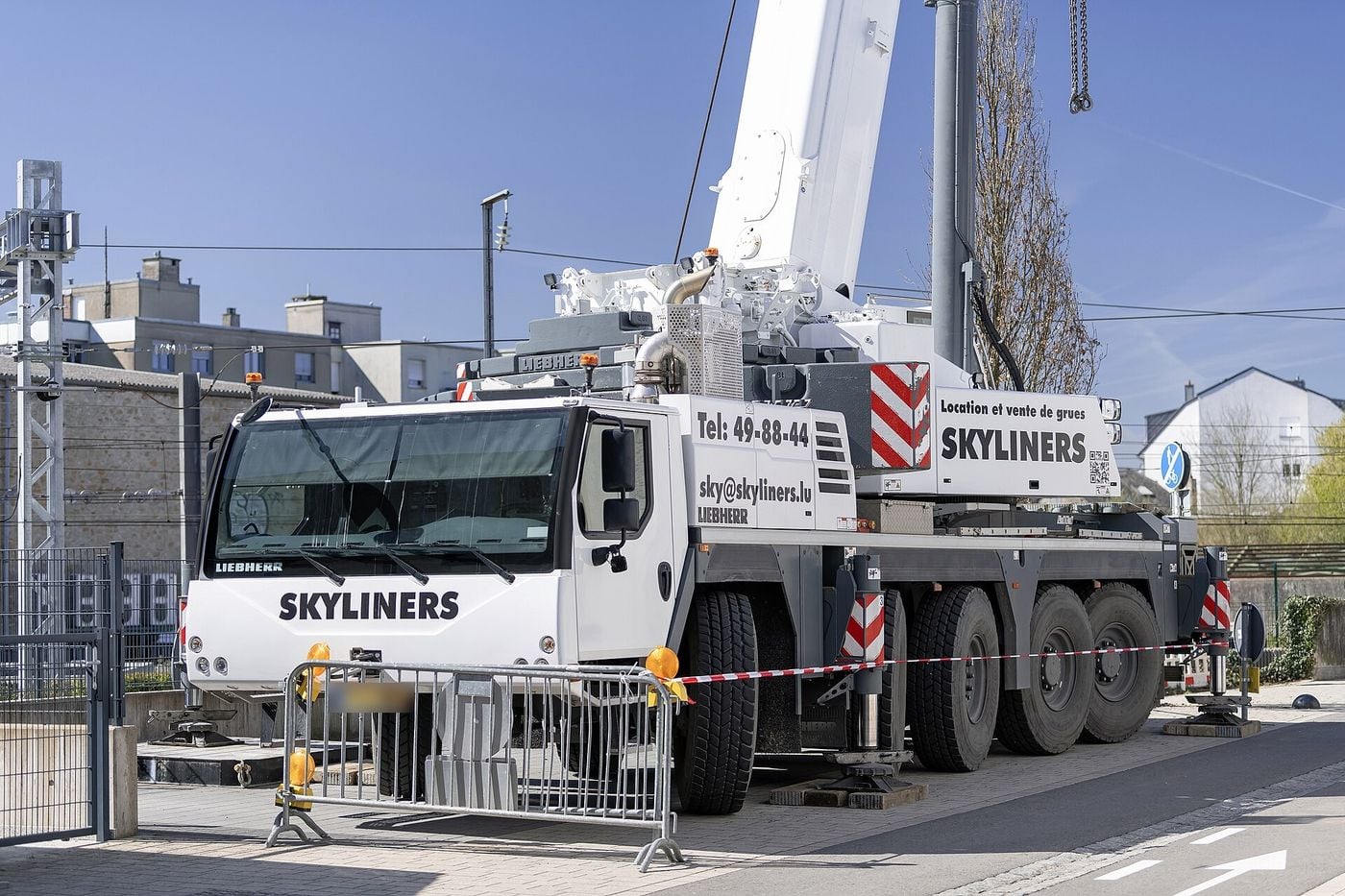
In EU vehicle approval law a mobile crane is a special purpose vehicle with its own code, SF: “A vehicle of category N3, not fitted for the carriage of goods, provided with a crane whose lifting moment is equal to or higher than 400 kNm” (Regulation (EU) 2018/858, Annex I, Part A, point 5.7). The Regulation has applied since 1 September 2020. A table in its Annex II lists the regulatory acts that apply to a mobile crane in EU type-approval and where it may deviate from them, from crab steering to braking on vehicles with more than four axles. The kinds of crane themselves are named by the makers: truck-mounted cranes built on a standard truck chassis, all-terrain cranes on an all-terrain chassis for public roads and off-road use, and rough-terrain cranes, which the makers describe as off-road machines for job sites, in Tadano’s case with a single cab for both driving and lifting.
Status as of 14 November 2026. Read on that day: Regulation (EU) 2018/858 in its Official Journal text, with point 5.7 of Annex I, Part A also in the German, Spanish, French, Italian and Polish versions, and in the consolidated text of 2 August 2026, both from the Publications Office of the European Union; Liebherr’s pages on its LTM, LTF and LRT crane series and on the LTM 1100-5.3; and Tadano’s overview of its crane types and its rough terrain crane page. The consolidated text is, in its own words, “meant purely as a documentation tool and has no legal effect”.
The EU definition: category N3, no goods, 400 kNm
Regulation (EU) 2018/858 defines a special purpose vehicle as “a vehicle of category M, N or O having specific technical features that enable it to perform a function that requires special arrangements or equipment” (Article 3, point (31)). Point 5 of Annex I, Part A lists twelve special purpose vehicles by name, code and definition, from the motor caravan (5.1, SA) to the multi-equipment carrier (5.12, SM), with a special group (5.8, SG) for any special purpose vehicle that fits none of the other definitions. The mobile crane is point 5.7.
| Element | Text of the Regulation | Where |
|---|---|---|
| Name and code | “Mobile crane”, “SF” | Annex I, Part A, point 5.7 |
| Vehicle category | “A vehicle of category N3”; category N consists of motor vehicles “designed and constructed primarily for the carriage of goods”, and N3 of “motor vehicles with a maximum mass exceeding 12 tonnes” | Point 5.7; Article 4(1)(b) |
| Goods | “not fitted for the carriage of goods” | Point 5.7 |
| Crane | “provided with a crane whose lifting moment is equal to or higher than 400 kNm” | Point 5.7 |
| Fixed equipment | “Vehicles fitted primarily with fixed equipment such as machinery or apparatus shall be regarded as N or O category.” | Annex I, introductory part, point 2.3.1 |
The Official Journal text of 2018 and the consolidated text of 2 August 2026 have the same wording for point 5.7. Five other language versions of the Official Journal text name the vehicle Mobilkran (German), grúa móvil (Spanish), grue mobile (French), gru mobile (Italian) and żuraw samojezdny (Polish), each with the same three conditions and the same 400 kNm. How the categories M, N and O and their suffixes work is set out in vehicle categories M, N and O explained.
Mobile crane or crane lorry
Annex I, Part C sets out codes for the types of bodywork, which, where necessary, are “supplemented by two digits”; the list of those digits is Appendix 2 to Annex I, “Digits used to supplement the codes to be used for various kinds of bodywork”. Number 26 in that list reads “Crane lorry (other than a mobile crane as defined in point 5.7 of Part A)”; number 24 is the recovery vehicle and number 27 the aerial work platform vehicle. A vehicle with a crane appears in two places in the Regulation: as the special purpose vehicle SF in Part A, and as the crane lorry in the list of bodywork digits, whose wording leaves out a mobile crane as defined in point 5.7.
Hydraulic loader cranes on goods vehicles, the standard EN 12999 that covers them and the national rules on examining cranes in service are described under truck-mounted loader cranes. How the two-digit supplements attach to the bodywork codes is shown under tow trucks and recovery vehicles, and aerial work platforms on truck chassis under bucket trucks and truck-mounted aerial platforms.
What EU type approval asks of a mobile crane
Part III of Annex II lists the regulatory acts for the EU type-approval of special purpose vehicles, one table per group; Appendix 5 is the table for mobile cranes, with a single column for category N3. The explanatory notes to the tables give the letters their meaning:
- X: “Compliance with the regulatory act is required according to the vehicle category for which type-approval is sought.”
- G: in a multi-stage approval, compliance with the act under which the base vehicle, for example the chassis used to build the special purpose vehicle, was type-approved “shall be accepted”.
- A: the approval authority “may agree to fully or partly grant exemptions” if the manufacturer demonstrates to the technical service that the vehicle cannot meet the full set of requirements “due to its special purpose”. The manufacturer “shall however endeavour to meet the requirements to the largest possible extent taking into account proportionality”, and the exemptions are described in Part 2 of the EU type-approval certificate and under “remarks” in the certificate of conformity.
Any specific provisions written next to a letter are to be taken into account as well. Most items in the table refer to Regulation (EU) 2019/2144.
| Item | Subject | Entry for mobile cranes |
|---|---|---|
| A2, A4, A5 | Seats and head restraints; safety-belt anchorages; safety-belts and restraint systems | X: “Application limited to seats designated for normal use when the vehicle is used on a public road.” |
| A11 | Front underrun protection | A: not required for vehicles meeting Annex I, Part A, point 4.3(b)(ii) and (iii) and point 4.3(c) |
| A12, A13 | Rear underrun protection; lateral protection | A |
| C1 | Steering equipment | X: “Crab steering allowed” |
| C4 | Braking | G: test only with the complete or completed vehicle. “Vehicles up to 4 axles shall comply with all the requirements laid down in the relevant regulatory acts.” Derogations are admitted for more than 4 axles if they are justified by the particular construction and all braking performances for parking, service and secondary braking are met. “Anti-lock braking system is not mandatory for vehicles with hydrostatic drive.” |
| C2, C7, C8 | Lane departure warning; stability control; advanced emergency braking on heavy-duty vehicles | n/a |
| D7 | Speed limitation devices | X |
| D8, E1 | Intelligent speed assistance; alcohol interlock installation facilitation | A: “Only to be applied in case of a chassis-cab base vehicle and n/a in all other cases.” |
| D15 | Installation of light signalling, road illumination and retro-reflective devices | A: “Provided that all mandatory lighting devices are installed” |
| E2 | Driver drowsiness and attention warning | n/a |
| F10 | Spray suppression systems | A: not required for vehicles meeting Annex I, Part A, point 4.3(b)(ii) and (iii) and point 4.3(c) |
| F11 | Masses and dimensions | A |
| G1 | Sound level | G: test only with the complete or completed vehicle; limits of 81 dB(A) for an engine power of less than 75 kW, 83 dB(A) from 75 kW to less than 150 kW and 84 dB(A) from 150 kW, “irrespective of the vehicle conditions such as engine type, gearbox type and any sub-classifications” |
| G3, G4, G6, G9 to G12, G16, G17 | Engine emissions in the laboratory and on the road, crankcase emissions, on-board diagnostics, defeat devices, auxiliary emission strategies, anti-tampering, engine power, reagent systems (Euro VI) | X: “Alternatively, Regulation (EU) 2016/1628 may apply.” |
The conditions cited for front underrun protection and spray suppression come from the off-road rules for M3 and N3 vehicles whose maximum mass exceeds 12 tonnes (Annex I, Part A, point 4.3). Point 4.3(b)(ii) requires “at least one differential locking mechanism or a mechanism having similar effect”, point 4.3(b)(iii) the ability “to climb a 25 % gradient as solo vehicle”, and point 4.3(c) at least four of six geometric requirements: approach, departure and ramp angles of at least 25 degrees each, and ground clearance of at least 250 mm under the front axle, 300 mm between the axles and 250 mm under the rear axle.
Truck-mounted, all-terrain and rough-terrain cranes in the makers’ words
Regulation (EU) 2018/858 names no kind of crane vehicle other than the mobile crane and the crane lorry. The table gives the kinds of wheeled crane as two makers describe them in their own ranges.
| Type | Maker and series | How the maker describes it |
|---|---|---|
| Truck-mounted crane | Liebherr LTF | A telescopic boom crane on a standard truck chassis; Liebherr dates the first LTF to 1979. Liebherr supplies crane configurations “for all conventional truck chassis” and calls the use “taxi cranes – in other words for short hoists and lots of road journeys”. On the road with a gross weight of 38 t carrying much of its own ballast, or 32 t or 33 t depending on the chassis with less ballast on board |
| All-terrain crane | Liebherr LTM | An “all-terrain chassis” for “travelling on public roads and for off-road use”; around 25 models “from a small two-axle to the large 9-axle model”, grouped in 2-, 3-, 4-, 5-, 6-, 8- and 9-axle series |
| All-terrain crane | Tadano All Terrain Cranes | “All-wheel steering and various boom lengths” |
| Rough-terrain crane | Tadano Rough Terrain Cranes | “a single cab for both driving and lifting operations”; all-wheel steering and all-wheel drive “to traverse uneven and rough terrain”, for confined job sites and narrow spaces |
| Rough-terrain crane | Liebherr LRT (LRT 1090-2.1, LRT 1100-2.1, LRT 1130-2.1) | “Off-road capable”; supplied with “standard global load charts according to ASME, EN, GOST, AS”; uses named on construction sites, in refineries, power stations and the oil and gas sector, in mines and in wind parks |
Neither rough-terrain page describes driving the cranes on public roads. Besides the LTM, LTF and LRT series, Liebherr lists LTC compact cranes, LG lattice boom mobile cranes, MK mobile construction cranes, military cranes and fire brigade cranes among its mobile cranes, and its LR and LTR crawler cranes as a separate group. Tadano’s overview also names city cranes, pick and carry cranes, lattice boom and telescopic boom crawler cranes, and knuckle boom cranes.
How a maker gives capacity: the Liebherr LTM 1100-5.3
Liebherr explains its model designations with the LTM 1150-5.3 as an example: the parts stand for the “Product series”, the “Lifting capacity in tonnes”, the “Number of axles” and the “Crane version”. Its five-axle LTM 1100-5.3 is described with the following figures.
| Item | Liebherr’s figure |
|---|---|
| Maximum load capacity | 100 t at a radius of 3.00 m |
| Telescopic boom | 13.00 m to 62.00 m |
| Lattice jib | 2.00 m to 16.00 m |
| Maximum hoist height | 76 m |
| Maximum radius | 64.0 m |
| Number of axles | 5 |
| Drive/steering | 10 x 6 x 10 as standard, 10 x 8 x 10 as an option |
| Drive engine | Liebherr 6-cylinder diesel, 400 kW |
| Driving speed | 85.00 km/h |
| Total ballast | 22.50 t |
| Ballast carried on public roads | Up to 16.9 t with an axle load of 12 t; in Liebherr’s words “75 % of the maximum ballast” |
| Lowest axle load given for travel | “The crane can travel with an axle load of just 9 t.” |
| Vehicle width | 2.55 m |
Liebherr states the maximum load capacity together with the radius at which it applies, and gives the boom and jib lengths, the hoist height and the radius alongside it. The EU definition in point 5.7 is written in terms of the crane’s lifting moment in kNm; the product page of the LTM 1100-5.3 gives no lifting moment. The drive and steering entry follows the wheel-formula notation, whose first two numbers are explained in axle configurations. For the gearbox, Liebherr names a DynamicPerform clutch module on the TraXon gearbox; the transmission itself is described under ZF TraXon.
Related pages
Indivisible loads that exceed the EU dimension limits, and the special permits for them, are the subject of low-loader trailers and abnormal loads.
Quick answers
- What is a mobile crane in EU vehicle categories?
- Regulation (EU) 2018/858 lists the mobile crane as a special purpose vehicle with the code SF: 'A vehicle of category N3, not fitted for the carriage of goods, provided with a crane whose lifting moment is equal to or higher than 400 kNm' (Annex I, Part A, point 5.7). Category N3 covers motor vehicles with a maximum mass exceeding 12 tonnes. The Regulation has applied since 1 September 2020, and the consolidated text of 2 August 2026 has the same wording.
- What is the difference between a mobile crane and a crane lorry?
- In Regulation (EU) 2018/858 the mobile crane SF is a special purpose vehicle of category N3 that is not fitted for the carriage of goods and has a crane with a lifting moment of at least 400 kNm. The crane lorry is a separate entry, number 26 in the list of digits that supplement the bodywork codes (Appendix 2 to Annex I), which reads 'Crane lorry (other than a mobile crane as defined in point 5.7 of Part A)'.
- What is the difference between an all-terrain crane and a rough-terrain crane?
- Regulation (EU) 2018/858 uses neither term; the makers describe the two kinds on their own pages. Liebherr describes its LTM all-terrain cranes as built on an all-terrain chassis for travelling on public roads and for off-road use, in models from two to nine axles. Tadano describes its rough terrain cranes as having a single cab for both driving and lifting, with all-wheel steering and all-wheel drive for uneven and rough terrain, and Liebherr calls its LRT rough terrain cranes off-road capable. Neither rough-terrain page describes driving on public roads.
- What does the name LTM 1100-5.3 mean?
- Liebherr explains its designations with the LTM 1150-5.3: the parts stand for the product series, the lifting capacity in tonnes, the number of axles and the crane version. For the LTM 1100-5.3 Liebherr gives a maximum load capacity of 100 t at a radius of 3.00 m, five axles, a telescopic boom of 13.00 to 62.00 m and a maximum hoist height of 76 m.
- Which EU type-approval requirements does a mobile crane have to meet?
- Appendix 5 of Annex II, Part III to Regulation (EU) 2018/858 lists them for category N3. Some are marked X, compliance according to the vehicle category, such as speed limitation devices; steering is marked X with 'Crab steering allowed'. Vehicles up to four axles must comply with all braking requirements, while derogations are admitted for more than four axles if justified by the construction and if the parking, service and secondary braking performances are met. For items marked A, such as masses and dimensions, the approval authority may grant exemptions where the manufacturer shows that the vehicle cannot meet them because of its special purpose.
Sources
- Regulation (EU) 2018/858 of the European Parliament and of the Council of 30 May 2018 on the approval and market surveillance of motor vehicles and their trailers — Official Journal text (OJ L 151, 14.6.2018): Article 91, Annex I Part A point 5.7 (also in the German, Spanish, French, Italian and Polish versions) and Appendix 2 to Annex I (item 26) — Publications Office of the European Union, 30 May 2018
- Regulation (EU) 2018/858 — consolidated text of 2 August 2026: Articles 3 and 4, Annex I introductory part point 2.3.1, Part A points 4.3 and 5, Part C point 1, Appendix 2 to Annex I, Annex II Part III explanatory notes and Appendix 5 (Mobile cranes) — Publications Office of the European Union
- LTM mobile cranes: all-terrain cranes, product series and model designations (read on 14 November 2026) — Liebherr
- LTM 1100-5.3 mobile crane: product page with technical data (read on 14 November 2026) — Liebherr
- LTF truck-mounted telescopic cranes (read on 14 November 2026) — Liebherr
- LRT rough terrain cranes (read on 14 November 2026) — Liebherr
- Tadano lifting equipment: overview of crane types (read on 14 November 2026) — Tadano
- Tadano rough terrain cranes (read on 14 November 2026) — Tadano