MCI
MCI J4500
MCI's J4500 coach from its J Series page: 45′ 7″ long and 102″ wide, front, drive and tag axle ratings, 56 or 60 seats, 200 US gallons of usable fuel and Bendix Wingman Advanced.
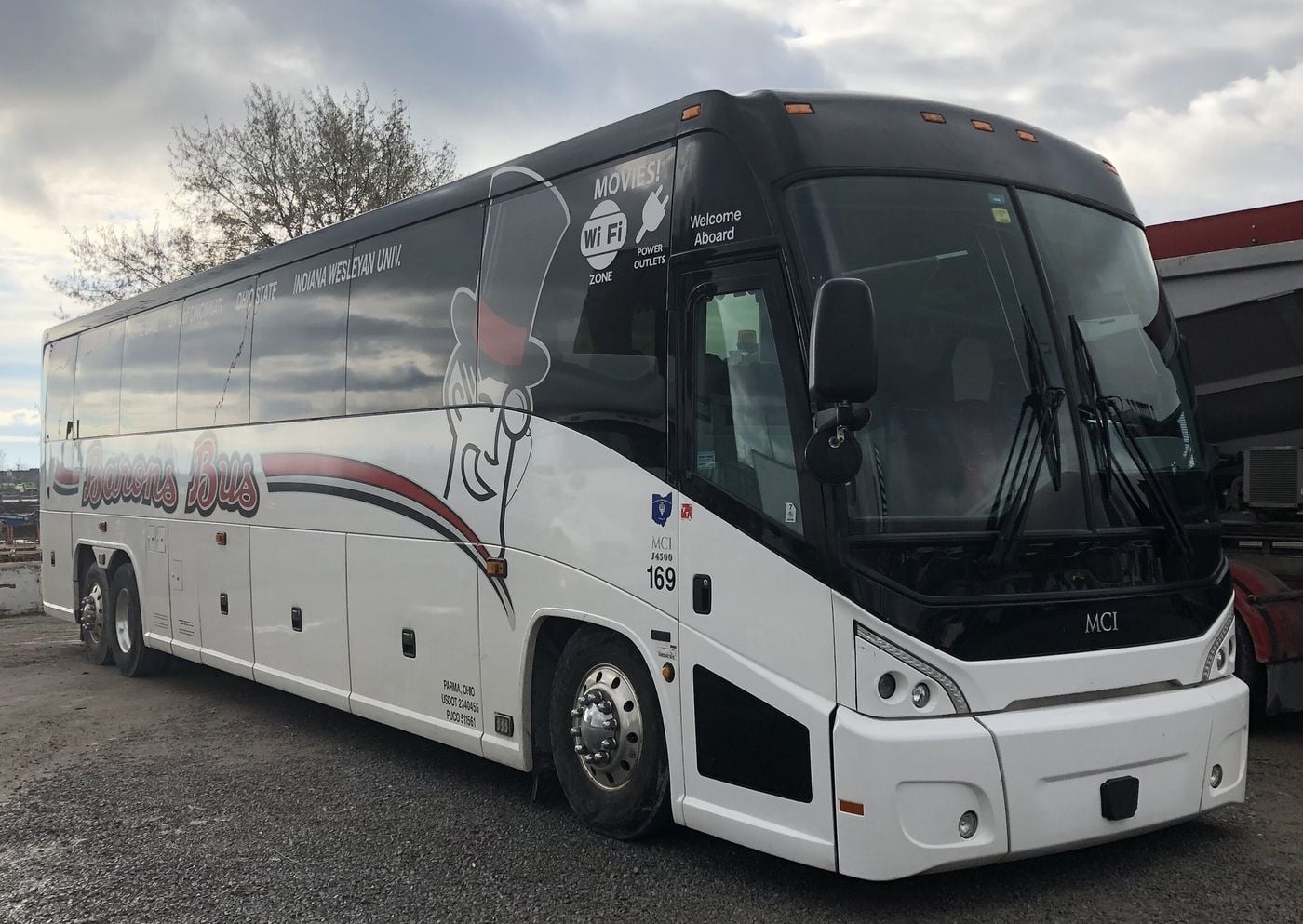

Model overview
- Segment
- Bus
- Capacity
- 56 (standard seating capacity) or 60 (optimal seating capacity)
The J4500 is the 45-foot coach of MCI’s J Series; the J3500 is the 35-foot model of the same series. MCI’s coach menu lists the J-Series coaches for “Tour + Charter, Severe Duty, Luxury Ground Transportation & Varsity Transportation”, and the J Series page calls the series a “clean-diesel luxury touring coach”. Under “Our Family”, the footer of MCI’s site lists NFI Group, Alexander Dennis, ARBOC, New Flyer and NFI Parts.
This page is built from MCI’s J Series page on mcicoach.com, in its English version. No date appears in the page text, which was saved on 4 November 2026; the page was read again on 14 November 2026. MCI gives weights in pounds, lengths in feet and inches, volumes in cubic feet and fuel in US gallons, and no metric figure. No MCI document opened gives the engine, the gearbox, a kerb weight or a production start date.
The J Series platform
MCI offers the J Series in 35-foot and 45-foot lengths, as the J3500 and the J4500. In MCI’s words, “The J4500 and J3500 models are built on a shared design platform, keeping electrical and HVAC systems, axles/brakes/suspension, and most frame and body components common.” MCI says that both models have interiors “designed in collaboration with longtime partner BMW Group’s Designworks”, and gives the series “Up to 60 Seats”.
Dimensions and weights
The J Series page prints a table of quick measurements with a column for each model. The J4500 column gives ratings for a front, a drive and a tag axle. Its turning radius is given in the row “Turning Radius (to bumper), Steer Tag”, and its cell in the row without steer tag is empty. The GVW row prints its figures without a unit, while the axle ratings and the payload are given in pounds.
| Row in the table | J4500 |
|---|---|
| GVW | 54,000 (no unit printed) |
| Front axle rating | 17,000 lb |
| Drive axle rating | 23,000 lb |
| Tag axle rating | 16,500 lb |
| Payload | 16,170 lb |
| Length | 45′ 7″ |
| Width | 102″ |
| Height | 141.75″ |
| Front overhang | 78.25″ |
| Rear overhang | 101.25″ |
| Wheelbase, front axle to drive axle | 315″ |
| Turning radius (to bumper) | empty cell |
| Turning radius (to bumper), steer tag | 40′ 11″ |
| Standard seating capacity | 56 passengers |
| Optimal seating capacity | 60 passengers |
| Interior floor to ceiling height | front 84.25″, rear 78.25″ |
| Parcel rack capacity without lift, with lavatory | 131.2 cu ft |
| Parcel rack capacity with lift, with lavatory | 131.2 cu ft |
| Below-floor baggage capacity without wheelchair lift | 445 cu ft |
| Below-floor baggage capacity with wheelchair lift | 430 cu ft (rear lift) |
| Fuel tank capacity, usable at 95% | 200 US gallons |
| Warranty | 30 months, unlimited miles |
The J3500 column of the same table gives a GVW of 42,000, a front axle rating of 14,500 lb, a drive axle rating of 27,500 lb and no tag axle figure, a payload of 11,500 lb, a length of 35′ 10″, a rear overhang of 123.68″, a wheelbase of 228.8″ and a turning radius to bumper of 32′ 10″, with 40 standard and 44 optimal seats, 92.3 cu ft of parcel rack, 285 cu ft of below-floor baggage space without a wheelchair lift and 270 cu ft with a rear lift, and 164 US gallons of usable fuel. Its width, height, front overhang, interior height and warranty are the same as the J4500’s.
Vehicle and axle weight ratings are set out in GVWR, GCWR and GAWR, US length and width limits for buses in bus and coach dimensions, and tag axles in axle configurations explained.
Seating, interior and luggage
MCI lists “Exclusive MCI luxury upholstery styles for passenger comfort”, factory-installed 2+1 premium or VIP seating configurations, USB-A and USB-C port options at each passenger seat and multiple driver-seat options. The entrance is MCI’s “Exclusive Spiral Entry”, and the page lists additional drip rail lights over the entrance door and the front junction box, and parcel rack wiring for third-party monitoring systems. The table’s parcel rack rows are given for a coach with a lavatory, with and without a lift, and its below-floor baggage rows with and without a wheelchair lift; with the rear lift the baggage capacity of the J4500 is 430 cu ft instead of 445 cu ft.
Body, fuel tank and electrical equipment
The J Series page lists “Optimized lower convex mirrors for wider field of view” and “Verified FMVSS-227 rollover safety standards, including updated window operation”. It also lists an improved front junction box door, a modernised rear junction box and a “Larger composite fuel tank with redesigned fuel neck system”; the table gives the usable fuel tank capacity at 95% as 200 US gallons. The back-up camera image is “integrated in display & IP”.
Safety and driver-assistance systems
The J Series page lists collision mitigation technology, a tire pressure monitoring system and automatic fire suppression, both marked “(MCI Basic)”, electronic stability control, “Patented digital wheel end sensing systems”, an optional next-generation 360° camera and the MCI Connect module. Stability control rules for buses are set out in electronic stability control.
MCI lists the Bendix Wingman Advanced adaptive cruise control and collision mitigation system, which uses a windshield-mounted, forward-facing camera in addition to the radar in the front bumper. The page names three Bendix Fusion functions: Stationary Vehicle Braking, which uses the forward-facing radar to identify large metal objects; Lane Departure Warning, which recognises lane markers and warns if the vehicle begins to drift into another lane; and Traffic Sign Recognition, which identifies common road signs such as speed limit signs.
Source notes
MCI’s J Series page gives the J4500 and the J3500 in one table of quick measurements, in MCI’s units. The J4500 column gives a GVW of 54000 (the row prints no unit), axle ratings of 17000 lb front, 23000 lb drive and 16500 lb tag, a payload of 16170 lb, a length of 45′ 7″, a width of 102″, a height of 141.75″, overhangs of 78.25″ front and 101.25″ rear, a wheelbase from front axle to drive axle of 315″ and a turning radius to bumper of 40′ 11″ for the steer tag (the cell without steer tag is empty), a standard seating capacity of 56 and an optimal seating capacity of 60 passengers, an interior floor-to-ceiling height of 84.25″ at the front and 78.25″ at the rear, a parcel rack capacity with lavatory of 131.2 cu ft with or without lift, a below-floor baggage capacity of 445 cu ft without wheelchair lift and 430 cu ft with a rear lift, a usable fuel tank capacity at 95% of 200 US gallons and a warranty of 30 months with unlimited miles. The J3500 column gives a GVW of 42000, 14500 lb front and 27500 lb drive with no tag axle figure, a payload of 11500 lb, a length of 35′ 10″, a rear overhang of 123.68″, a wheelbase of 228.8″, a turning radius to bumper of 32′ 10″, 40 standard and 44 optimal seats, 92.3 cu ft of parcel rack, 285 cu ft of baggage space without and 270 cu ft with a rear lift and 164 US gallons; its width, height, front overhang, interior height and warranty are the J4500’s. MCI says the two models share a design platform with common electrical and HVAC systems, axles, brakes and suspension and most frame and body components. The page lists USB-A and USB-C ports at each passenger seat, the Spiral Entry, a back-up camera image in the display, verified FMVSS-227 rollover safety standards, a larger composite fuel tank, factory-installed 2+1 premium or VIP seating, collision mitigation, a tire pressure monitoring system and automatic fire suppression (both marked MCI Basic), electronic stability control, digital wheel end sensing, an optional 360° camera, the MCI Connect module and the Bendix Wingman Advanced system with the Bendix Fusion functions. No MCI document opened gives the engine, the gearbox, a kerb weight, a metric figure or a production start date.
Quick answers
- How many passengers does the MCI J4500 carry?
- Capacity: 56 (standard seating capacity) or 60 (optimal seating capacity).