Timber trucks and log transport: weight limits, waivers and cranes
The EU leaves weights in national transport to each country: Sweden's BK4 roads take 74 t, Finland 76 t. Two US waivers allow log trucks of 98,000 and 99,000 lb on two Interstate stretches.
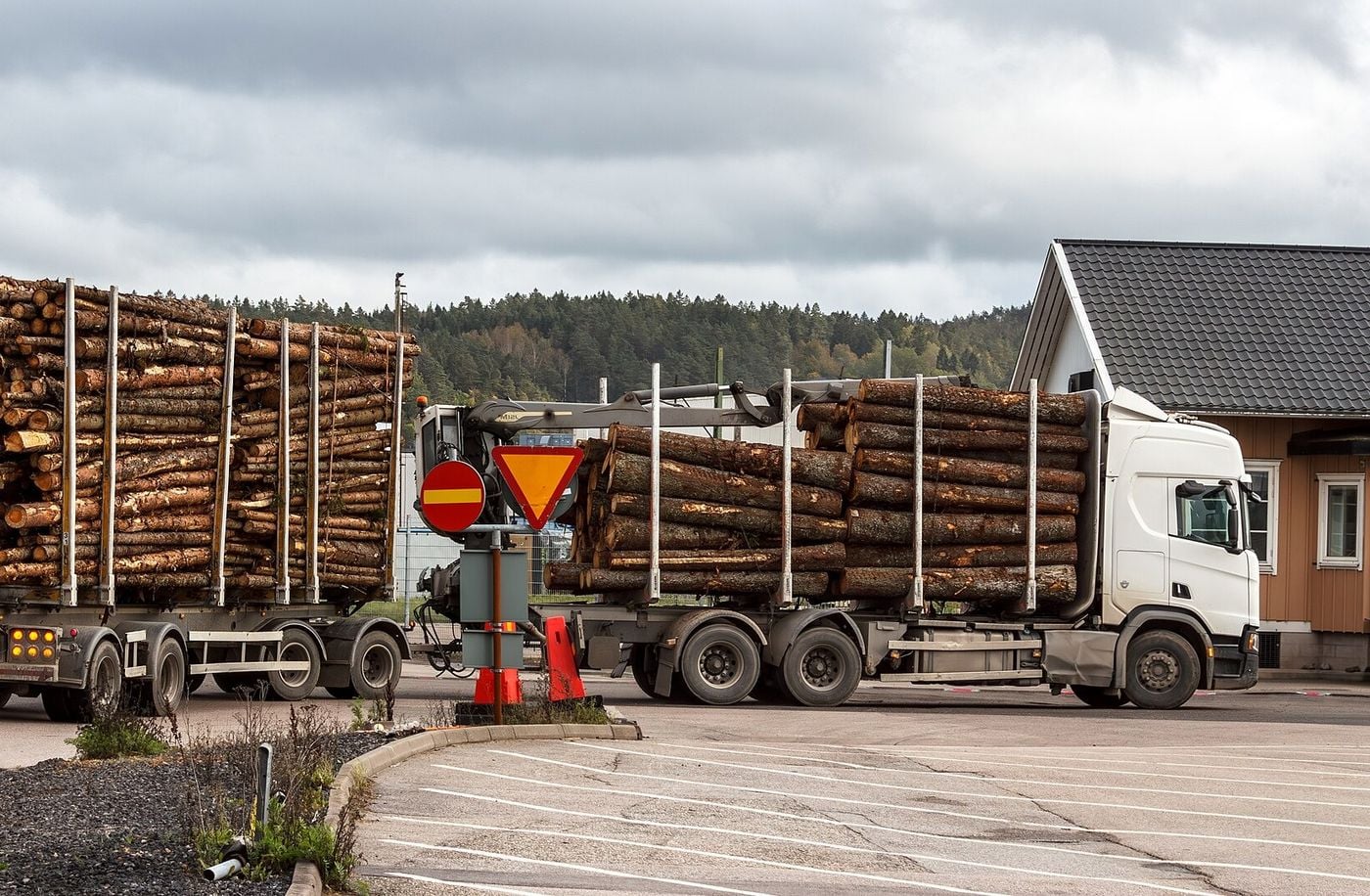
A timber truck, or log truck, carries wood out of the forest: in the words of US federal law, “raw or unfinished forest products, including logs, pulpwood, biomass, or wood chips”. EU law sets no weight of its own for these trucks. Directive 96/53/EC harmonises weights for international traffic only, lets each Member State authorise other weights for national transport, and names “operations linked to logging and the forestry industry” as an example of national operations for which a Member State may allow other dimensions. National limits differ. Sweden allows up to 74 tonnes on roads of bearing class BK4 and Finland’s table of combination masses runs to 76 tonnes; neither figure is specific to timber. In the United States the federal limit on the Interstate System is 80,000 pounds, and federal law waives it for logging trucks of up to 98,000 pounds on a stretch of Interstate 39 in Wisconsin and up to 99,000 pounds on a stretch of Interstate 35 in Minnesota.
Status as at 9 November 2026. Read on that day: Directive 96/53/EC in its consolidated text of 14 August 2019; Transportstyrelsen’s gross-weight tables, page last updated on 24 June 2026, and its slides of 2 April 2025 on bearing classes; Traficom’s publication 10/2021 on the rules for heavy combinations; 23 U.S.C. 127 in the 2023 edition of the United States Code and 23 CFR Part 658 in its edition of 1 April 2024; section 34 of the German StVZO; the product pages of five timber cranes from Palfinger and Hiab; and a Scania newsroom story of 2018.
What counts as timber transport
Subsections (o) and (q) of 23 U.S.C. 127 define a “covered logging vehicle” as one that is “transporting raw or unfinished forest products, including logs, pulpwood, biomass, or wood chips” and that has, among other conditions, not less than six axles. A Michigan combination listed in Appendix C to 23 CFR Part 658 may carry nothing else: “The only cargo that may be carried is saw logs, pulpwood, and tree length poles.” Finland’s load-securing rules have a section of their own for raw timber, raakapuu, carried in bundles. Crane makers list timber cranes as a range of their own: Palfinger lists its Epsilon timber cranes beside its recycling and construction cranes, and Hiab its Loglift forestry cranes beside its loader cranes; Hiab calls the Loglift 251S a “tree-length timber handling crane”.
EU law: weights and dimensions left to national rules
Directive 96/53/EC lays down, in the words of its title, “the maximum authorized dimensions in national and international traffic and the maximum authorized weights in international traffic”. Its only mention of timber is the logging example in Article 4(4). For the national transport of goods, Article 4(2) lets a Member State “nonetheless authorise” vehicles that do not conform to points 1.3, 2, 3, 4.1 and 4.3 of Annex I; points 2 and 3 are the vehicle and axle weights. The EU figures and the national cases are in truck weights: GVW and GCW.
Article 4(4) concerns dimensions. A Member State may allow vehicles that “carry out certain national transport operations that do not significantly affect international competition in the transport sector” to run with dimensions deviating from points 1.1, 1.2, 1.4 to 1.8, 4.2 and 4.4 of Annex I, among them the maximum length and width. Point (a) covers operations by specialised vehicles in circumstances in which vehicles from other Member States do not normally carry them out, “e.g. operations linked to logging and the forestry industry”. Both conditions of Article 4(4), and the national texts on longer combinations, are set out in long truck combinations.
National limits in Europe
Sweden. Roads other than private ones are divided into four bearing classes under the Trafikförordning (1998:1276). In Transportstyrelsen’s gross-weight tables, a vehicle or vehicle train with 20.2 m or more between its first and last axle may weigh 74 tonnes on roads of the highest class, BK4, and 64 tonnes on BK1; shorter distances give lower figures. The tables do not distinguish by load.
Transportstyrelsen’s slides of 2 April 2025 give the idea behind BK4: vehicles were to get more axles and so a lower average axle load. They set a typical vehicle before BK4, 64 tonnes on seven axles or 9.14 tonnes per axle, against an example BK4 vehicle of 29 plus 40 tonnes, 69 tonnes in all, at 9.86 tonnes per axle. When BK4 entered the Trafikförordning, the slides say, no ceiling values for gross weight were introduced for it, and the lack of them in Annex 4 to the ordinance has had some unwanted consequences; in 2020 Trafikverket and Transportstyrelsen jointly proposed, among other things, ceiling values for BK4. The slides also quote the government’s goal, set in its assignment to Trafikverket for the national infrastructure plan, that the whole state road network that now has BK1 reaches BK4. What the axle counts in a vehicle description mean is explained in axle configurations.
Finland. Traficom’s publication 10/2021 on the rules for heavy combinations reproduces section 122 of the Road Traffic Act (729/2018), which sets the maximum mass of a truck with one or more trailers by its number of axles. In that table nine axles give 69 tonnes, ten give 74 and eleven or more give 76. A combination with at least nine axles also reaches 76 tonnes if at least 65 percent of the mass of its trailer or trailers rests on axles with twin wheels. Above 68 tonnes at least 20 percent of the combination’s mass must rest on the driving axles and at least 9 percent on the towing truck’s steering axles. The table does not distinguish by load.
Two provisions in the same publication concern timber directly. Section 111 of the Act allows a vehicle or tool used for loading the vehicle to be attached behind the load space even where the vehicle then exceeds its maximum length, on six conditions, among them that the space for goods does not grow, that no dimension other than length is exceeded and that the vehicle’s width is not exceeded; Traficom’s note to the section says it also covers a timber crane. Traficom’s regulation on load-carrying bodies and load securing has a section of its own on securing raw timber loads, which sets the strength and the tensioning force of the ties on each bundle as a share of the bundle’s mass. The general rules on load securing are covered in load securing explained.
Germany. Section 34(6) of the road vehicle licensing regulation, the StVZO, sets 40.00 tonnes for vehicle combinations with more than four axles. The section names no separate weight for timber.
United States
On the Interstate System, federal rules allow 20,000 pounds on a single axle, 34,000 pounds on a tandem axle and 80,000 pounds gross, lower where the bridge formula gives less (23 CFR 658.17); they are explained in how much a semi-truck weighs. In 23 U.S.C. 127 and 23 CFR Part 658, four provisions deal with logs.
- Wisconsin. Under 23 U.S.C. 127(o), “The Secretary shall waive, with respect to a covered logging vehicle, the application of any vehicle weight limit established under this section.” The vehicle must weigh not more than 98,000 pounds, about 44.5 t, have not less than six axles and run on Interstate 39 from mile marker 175.8 to mile marker 189.
- Minnesota. Subsection (q) has the same wording for a covered logging vehicle of not more than 99,000 pounds, about 44.9 t, with not less than six axles, on Interstate 35 from mile marker 235.4 to mile marker 259.552.
- Maryland. Under subsection (e), repeated in 23 CFR 658.17(j), the single axle, tandem axle and bridge formula limits do not apply on Interstate 68 in Garrett and Allegany Counties to a specialised vehicle “equipped with a steering axle and a tridem axle and used for hauling coal, logs, and pulpwood”, if it is of a type that operated in those counties on US Routes 40 or 48 for that purpose on 1 August 1991.
- Michigan. Appendix C to 23 CFR Part 658 lists a truck-trailer combination with 63 feet of cargo-carrying length and an overall length of 70 feet, restricted to saw logs, pulpwood and tree length poles, with no permit required and access on all National Network routes. Its weight follows Michigan law: “Because it is not an LCV, it is not subject to the ISTEA freeze as it applies to maximum weight.”
Limits by country
| Country or route | Figure in the text | Applies to | Source of this row |
|---|---|---|---|
| European Union | No timber-specific weight | Article 4(2): national weights for national transport of goods. Article 4(4)(a): national dimensions for specialised vehicles, logging and the forestry industry given as the example | Directive 96/53/EC, Art. 4 |
| Sweden | 74 t on BK4 and 64 t on BK1 with at least 20.2 m between first and last axle | Any goods. A temporary ordinance for timber transports, listed by Transportstyrelsen: not verified | Transportstyrelsen, Bruttoviktstabeller |
| Finland | 76 t with at least 11 axles, or at least 9 with 65 percent of the trailer mass on twin wheels; 74 t with 10 axles | Any goods. Text in force after 2021: not verified | Road Traffic Act 729/2018, s. 122, as reproduced in Traficom publication 10/2021 |
| Germany | 40.00 t for combinations with more than four axles; no separate timber weight | Any goods. Exemptions: not verified | StVZO, § 34(6) |
| France | Not verified | National text not read | None |
| United States, Interstate System | 80,000 lb gross; 20,000 lb single axle; 34,000 lb tandem | All vehicles, lower where the bridge formula gives less | 23 CFR 658.17 |
| Wisconsin, I-39, mile markers 175.8 to 189 | Up to 98,000 lb, at least 6 axles | Covered logging vehicles | 23 U.S.C. 127(o) |
| Minnesota, I-35, mile markers 235.4 to 259.552 | Up to 99,000 lb, at least 6 axles | Covered logging vehicles | 23 U.S.C. 127(q) |
| Maryland, I-68, Garrett and Allegany Counties | Single axle, tandem axle and bridge formula limits do not apply | Specialised vehicles with a steering axle and a tridem axle hauling coal, logs and pulpwood, of a type in use there on 1 August 1991 | 23 U.S.C. 127(e); 23 CFR 658.17(j) |
| Michigan, National Network | Truck-trailer, 63 ft cargo-carrying length, 70 ft overall | Saw logs, pulpwood and tree length poles only | 23 CFR Part 658, Appendix C |
Timber cranes
Palfinger describes the three Epsilon models below as timber loader cranes; the standard and the rules for loader cranes are in truck-mounted loader cranes. Both makers list the outreach, the lifting moment or lifting capacity class in kilonewton-metres and the weight of each model. Palfinger calls these models L-type or Z-type and states that their key specs depend on the variant and equipment selected.
| Crane | Maker’s description | Outreach | Lifting moment or capacity class | Weight |
|---|---|---|---|---|
| Palfinger Epsilon M110L | Medium-duty L-type timber loader crane | 9.7 m | 111 kNm | 2,020 kg |
| Palfinger Epsilon M120Z | Medium-duty Z-type timber loader crane | 9.6 m | 109 kNm | 2,170 kg |
| Palfinger Epsilon S260L | Heavy-duty L-type timber loader crane | 12.8 m | 236 kNm | 2,360 kg |
| Hiab Loglift 251S, six variants | Forestry crane | 7.9 to 8.9 m | 220 to 230 kNm | 2,600 to 2,740 kg |
| Hiab Loglift 281S, four variants | Forestry crane | 8.3 to 9.7 m | 256 to 265 kNm | 2,990 to 3,110 kg |
A maker’s example
In a newsroom story of 14 August 2018, Scania describes a truck of Transports Rancon, a timber haulier in the Haute-Loire in southern France. It is a Scania R 650 V8 carrying a crane with a 10-metre boom; the haulier loads 16-metre logs one at a time onto a three-axle Faymonville trailer, which he controls with a second wheel for narrow bends and manoeuvring in the forest. Scania gives the truck’s ratings: “With a front axle capacity of 10 tonnes and two rear axles of 13 tonnes each, the vehicle has been approved for a gross combination weight rating of 70 tonnes and for carrying 57 tonnes of round timber.”
Quick answers
- Does EU law have special rules for timber trucks?
- Directive 96/53/EC has no timber-specific weight. It sets weights for international traffic, and Article 4(2) lets a Member State authorise other weights in national transport of goods. For dimensions, Article 4(4)(a) gives operations linked to logging and the forestry industry as its example of national operations by specialised vehicles that a Member State may allow to deviate from certain Annex I dimensions, among them length and width.
- How heavy can a timber truck be in Sweden?
- Up to 74 tonnes on roads of bearing class BK4, for a vehicle or vehicle train with at least 20.2 m between its first and last axle, under Transportstyrelsen's gross-weight table; on BK1 roads the same distance gives 64 tonnes. The tables do not distinguish by load. A temporary ordinance for timber transports, listed by Transportstyrelsen, is not verified.
- How heavy can a timber truck be in Finland?
- Up to 76 tonnes for a truck with trailers on at least eleven axles, or on at least nine where at least 65 percent of the trailer mass is on axles with twin wheels, in the table of section 122 of the Road Traffic Act as reproduced by Traficom in 2021. Ten axles give 74 tonnes and nine give 69. The table does not distinguish by load.
- What is the weight limit for log trucks in the US?
- 80,000 pounds gross on the Interstate System, with 20,000 pounds on a single axle and 34,000 on a tandem. Under 23 U.S.C. 127 the Secretary shall waive the section's weight limits for covered logging vehicles with at least six axles on two stretches: up to 98,000 pounds on Interstate 39 in Wisconsin, mile markers 175.8 to 189, and up to 99,000 pounds on Interstate 35 in Minnesota, mile markers 235.4 to 259.552.
- How much can a timber crane lift?
- The makers' product pages give the figure in kilonewton-metres, Palfinger as a maximum lifting moment and Hiab as a lifting capacity class. Palfinger lists 111 kNm and 9.7 m of outreach for its Epsilon M110L and 236 kNm and 12.8 m for the S260L; Hiab gives its Loglift 251S a lifting capacity class of 220 to 230 kNm and its Loglift 281S 256 to 265 kNm, with 7.9 to 9.7 m of hydraulic extension outreach across the two.
Sources
- Council Directive 96/53/EC laying down for certain road vehicles circulating within the Community the maximum authorized dimensions in national and international traffic and the maximum authorized weights in international traffic — consolidated text of 14 August 2019, title, Article 4 and Annex I — EUR-Lex, European Union
- Bruttoviktstabeller — gross weight tables for bearing classes BK1 to BK4 (page last updated 24 June 2026, read on 9 November 2026) — Transportstyrelsen, Sweden
- Bärighetsklasser ur ett regel- och ett fordonsperspektiv — seminar slides on bearing classes, 2 April 2025 — Transportstyrelsen, Sweden, 2 Apr 2025
- Uusi tieliikennelaki ja rekkojen käyttösäännöt (the new Road Traffic Act and the rules of use for heavy combinations), Traficomin julkaisuja 10/2021 — sections 109, 111 and 122 and the regulation on load-carrying bodies and load securing — Traficom, Finnish Transport and Communications Agency
- 23 U.S.C. 127, Vehicle weight limitations — Interstate System, United States Code 2023 edition — subsections (a), (e), (o) and (q) — govinfo, U.S. Government Publishing Office
- 23 CFR Part 658, Truck Size and Weight, Route Designations, edition of 1 April 2024 — section 658.17 and Appendix C, Michigan — Federal Highway Administration (Code of Federal Regulations, govinfo)
- Straßenverkehrs-Zulassungs-Ordnung (StVZO), § 34 Achslast und Gesamtgewicht, read on 9 November 2026 — Federal Ministry of Justice, Germany (gesetze-im-internet.de)
- EPSILON M110L, medium-duty L-type timber loader crane — key specs, read on 9 November 2026 — Palfinger
- EPSILON M120Z, medium-duty Z-type timber loader crane — key specs, read on 9 November 2026 — Palfinger
- EPSILON S260L, heavy-duty L-type timber loader crane — key specs, read on 9 November 2026 — Palfinger
- LOGLIFT 251S forestry crane — model specifications, read on 9 November 2026 — Hiab
- LOGLIFT 281S forestry crane — model specifications, read on 9 November 2026 — Hiab
- Trucks, timber and tricky terrain — newsroom story on the timber haulier Transports Rancon, Haute-Loire, 14 August 2018 — Scania Group, 14 Aug 2018